Aobo Wang, Beiyuan Guo, Shuqi Xue, Ting Jiang, Haifeng Bao (2022). A Taxonomy of Level of Automation in Intelligent Operational Supervisory Task. In: Human Factors and Systems Interaction. AHFE Open Access, vol. 52, pp. 270–277. https://doi.org/10.54941/ahfe1002165
With the application of automation technology, Human operators rely on automation functions or intelligent agents to conduct complex cognitive tasks, but this also leads to a series of human factor risks such as out-of-the-loop and first failure problems. An appropriate level of automation (LOA) design will help to alleviate the above human factors risks and improve the performance of human-machine cooperation, but the traditional LOA taxonomy is difficult to directly guide the human-machine function allocation of operational supervisory tasks. To characterize current LOA design practices, a literature review was conducted to review the LOA taxonomy of supervision and control tasks in related fields. This research summarizes the taxonomy dimensions of LOA. The intelligent operational supervisory task requires the operators to maintain a high degree of interaction and cooperation with the automation system. Therefore, we must shift the focus of LOA design to cognitive interaction tasks and takeover tasks. This research analyzes the characteristics of different dimensions of LOA taxonomy in the literature, and summarizes the LOA granularity of system task, cognitive interaction task and takeover task. On this basis, from the perspective of human-machine interaction, the LOA taxonomy of intelligent operational supervisory tasks is proposed. This research provides an important theoretical basis for human-machine function allocation scheme and system LOA design, and has important theoretical and practical significance for improving the human-machine interaction efficiency.
Intelligent operational supervisory task needs to rely on operators to conduct complex cognitive tasks. The control loop of human is gradually reconstru- cted by automation technology, and automation has also affected the whole stage of human information processing(Parasuraman and Wickens, 2008). Operators use automation functions to conduct complex cognitive tasks, but this also leads to a series of human factor risks such as out of the loop and first failure problem. Level of automation (LOA) design will help to mitigate the above risks and improve the performance of human-machine coopera- tion. With the application of intelligent technology, the context of LOA is
A Taxonomy of Level of Automation in Intelligent Operational Supervisory Task 271
expanding, and non-automated tasks such as cognitive tasks and intelligent interaction tasks are gradually being executed automatically. System task refers to the basic task expected to achieve the system functional objecti- ves. Cognitive tasks require more participation of intelligent agents, which are often collaboratively conducted by human and machine. Intelligent inte- raction task refers to communication task between human and automation, which is also defined as inherent task(Bindewald, Miller and Peterson, 2014). It includes human perception task of automation signal and communication task of sending control intention to automation system. However, the tradi- tional LOA taxonomy rarely distinguishes these three types of tasks, so it is difficult to guide the automatic design of intelligent operational supervisory tasks.
In addition, the operational design domain (ODD) of LOA is also gradu- ally expanding. Artificial intelligence and autonomous functions need to have flexible decision-making and control capabilities, or rely on the timely take- over and intervention of operators. When the automation function fails, the system will generate takeover tasks. Distributing decision authority between intelligent agents or humans is also known as dynamic automation design. The traditional LOA taxonomy does not clearly describe the automation design of takeover tasks, so it is difficult to cope with the dynamic changes of environment.
In order to guide the LOA design of intelligent operational supervisory tasks and improve the human-machine interaction performance of complex intelligent systems, this paper surveys deals with current LOA design practi- ces. On this basis, a LOA taxonomy of intelligent operational supervisory tasks is proposed.
TAXONOMY OF LEVELS OF AUTOMATION Automation has entered almost all industrial fields, and more than a dozen LOA taxonomies have been proposed. The automation continuum of a single dimensional scales usually reflects the change of automation degree in the system (Sheridan and Verplank, 1978) according to control mode (Draper, 1995), human-machine function allocation mode (Billings, 1997). One dimensional LOA taxonomy can clearly distinguish the boundary of LOA, but it is difficult to be effective in the task context of complex cogni- tive interaction. Traditional binary function allocations deliver a specific task to human or machines. However, for a wide range of cognitive and psycho- motor tasks, we should consider more intermediate LOA. As the granularity of control increases, the system generates new types or stages of automated functions, many studies have proposed a two-dimensional (2-D matrix) LOA scale, and even the three-dimensional (3-D matrix) LOA scale.
The human-machine function allocation strategy proposed by Endsley and Parasuraman is a typical application of two-dimensional LOA taxonomy. Parasuraman proposed different types of automation. Each type can have different degrees of automation(Parasuraman, Sheridan and Wickens, 2000). Endsley uses similar task stages to assign system functions (Endsley, 1999). The task stage proposed by Kaber and Endsley is similar to the automation
Table 1. LOA dimension and LOA taxonomy.
Table available in the original PDF paper.
No. LOA dimension Scale
Decision-making authority
1 Autonomy level of automation function
2 Human cognition stage Human information processing 3 Complexity of system and environment Degree of changes in the external environment 4 Intelligent interaction level Adaptability of human-machine interface
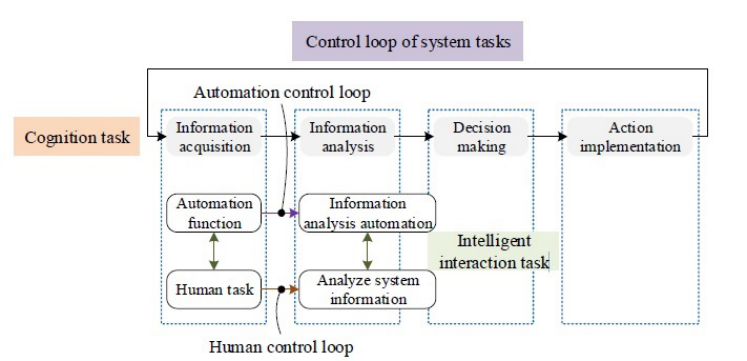
stage proposed by Parasuraman et al. (Endsley, 2017), which simplifies the human information processing into four types or stages, 1) Information acquisition; 2) Information analysis; 3) Decision making; 4) Action imple- mentation. This LOA taxonomy helps to analyze and evaluate the impact of LOA on human cognition and performance at each task stage. Similar appli- cations include the evaluation scale of spacecraft automation function propo- sed by proud et al. (Proud and Hart, 2003), and the human-machine coope- ration and sharing control proposed by Habib (Habib, Pacaux-Lemoine and Millot, 2016). This kind of taxonomy is mainly based on the two dimensions of the cognition stage of human and the degree of autonomy of automation. Riely added the dimension of LOA taxonomy according to the concept of system intelligence (Riley, 1989). This taxonomy tends to provide more auto- mation states, which is helpful to focuses on automation functions in the field of human-computer interaction. Simmler proposes a LOA taxonomy suitable for human-machine collaboration (Simmler and Frischknecht, 2021). Mili- gram et al. proposed a LOA taxonomy based on three dimensions, which added the modeling factor of the environment to the traditional automation dimension(Milgram, Rastogi and Grodski, 1995). In addition, there is also a specific LOA taxonomy in the industry. The Society of Automotive Engine- ers (SAE) has developed LOA for vehicle driving tasks (SAE, 2014). German Institute for Standardization (DIN) also proposed the grades of automation (GOA) of the metro system (DIN, 2007). European air traffic management puts forward LOA taxonomy based on relevant experiences of automation (Save, Feuerberg and Avia, 2012). Such taxonomies are usually related to spe- cific system. It provides more descriptive function of LOA, but it is difficult to directly guide human-machine interaction design.
We integrate the dimensional features of the LOA taxonomy into four dimensions (see Table 1). The first two dimensions are related to the control mode or level, which are commonly used in one-dimensional LOA taxo- nomy. The task stages are usually based on human information processing, which helps to improve the automation design of cognitive tasks. In high LOA the automation function must adapt to the changes of system environ- ment and the intelligent interaction requirements of human. Therefore, some studies take the complexity of the system and the level of intelligent intera- ction as LOA dimension. LOA is a continuum, but it also has some natural break points, which constitute the boundary between intelligent agents at different LOA (O’Neill et al., 2020). Vagia emphasizes that the level used
A Taxonomy of Level of Automation in Intelligent Operational Supervisory Task 273
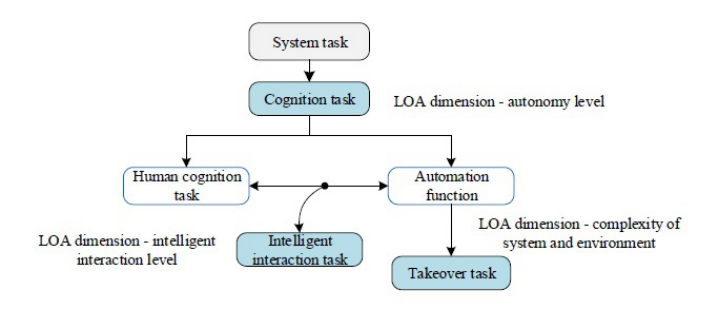
Figure 1: The relationship between LOA and system tasks, cognitive tasks and intelligent interaction tasks.
less frequently is not unimportant, and only the level suitable for the needs is important (Vagia, Transeth and Fjerdingen, 2016). Therefore, the number of LOA should be determined according to the specific task requirements.
APPLICATION The intelligent operational supervisory task consists of system task, cogni- tive task and intelligent interaction task (see Figure 1). Under different external environmental conditions, the system will generate takeover tasks. The dimension of human cognition stage and autonomy level of automa- tion function is suitable for LOA of system tasks. The LOA of interaction function should be designed according to the level of intelligent interaction. In addition, it is also necessary to consider the complexity of the external environment of the system and set takeover task. Finally, combined with the control and intelligence level of complex system, the LOA taxonomy of intelligent operational supervisory task is determined (see Figure 2).
In this section, we will describe the application of the LOA taxonomy pro- posed in this paper by taking the automation design of the metro operational control center (OCC) as an example.
The dispatcher monitors and analyses Automatic Train Supervision system signals, we need to design information acquisition automation function, which usually involves train operation monitoring tasks and Automatic Train Operation traction and braking management tasks. The dispatcher also needs to analyze the information of the electronic dispatching command manage- ment system, conduct the tasks of timetable management and station access planning, we need to design the automation function of information analy- sis and decision-making. Therefore, the LOA of the intelligent operational supervisory task of OCC involves the different autonomy level and cognitive stage. There is a need for communication between dispatchers and automa- tion systems in OCC. These communications occur in almost all cognitive
Figure 2: LOA taxonomy for operational supervisory tasks.
stages, so it is necessary to design intelligent interaction LOA in each cogni- tion stage. When OCC encounters an emergency, the automation system will generate takeover task. Therefore, when the ODD of automation function is expanded, the LOA of takeover task should be provided. When impro- ving the autonomy of automation function in different cognitive stages, it is also necessary to consider the interaction and cooperation between diffe- rent cognitive stages. When the ODD of automation function expands, it is necessary to consider the design of takeover tasks. An example of LOA design principles is shown in Table 2.
DISCUSSION
LOA leads to changes in human cognitive interaction with system tasks, so we should analyze the impact of automation on human performance of spe- cific cognitive or task stages, especially the impact of human factors. When designing LOA, we need to conduct cost-benefit analysis, rather than accor- ding to the improvement of automation technology. Wickens et al. used meta-analysis to analysis the impact of LOA on human task performance (Wickens et al., 2010), but Jamieson recently put forward that situational awareness may increase with the increase of LOA in complex task situa- tions (Jamieson and Skraaning, 2020). The impact of LOA on human task performance is highly related to the task stage (Wright and Kaber, 2005; Onnasch et al., 2014). And research is being carried out in different appli- cation fields (Tatasciore et al., 2021). Therefore, we must carefully analyze the task scenario and context of the system, which can be used as the basis for LOA design.
LOA design provides necessary suggestions for the design of human- machine function allocation scheme. This paper takes the first two dimensi- ons in Table 1 as the taxonomy basis. In order to consider the impact of LOA on human performance, it is necessary to divide tasks into different stages according to human information processing. The dimensions of intelligence and complexity represent the adaptability of automation and the variability
A Taxonomy of Level of Automation in Intelligent Operational Supervisory Task 275
Table 2. LOA design principles for OCC intelligent operational supervisory tasks.
Table available in the original PDF paper.
Automation design in different task stages
Human-machine interaction design between different task stages
The automation of operation tasks can design preset programs or execute independently according to automation instructions
The automation functions in dif- ferent task stages should establish communication with human dispa- tchers
The automation of monitoring tasks can integrate information and provide cognitive feedback to dispatchers
Appropriately improve the transpa- rency of automation and provide human-computer interaction inter- face Analysis and decision automation should be designed for takeover tasks:
Provide fallback agent or human intervention mechanism when the automation ODD is expanded
Provide fallback automation implementation scheme under the condition of adaptive automation
Provide information filtering or decision-making options under adaptable automation
of external environment. Therefore, this paper integrates these four dimensi- ons to put forward the LOA taxonomy, and points out that the human factors in specific cognitive stage should be considered in LOA design.
There is a certain relationship between LOA and dynamic automation is an embodiment of human-machine joint control strategy. In case of failure of automation system, the system will reduce the LOA to manual or lower level to ensure the safe operation. Usually, the system will design routine task scenarios. The routine situation refers to the situation that the basic automation function can deal with, while the emergency situation refers to the urgent and unknown situation. The settings of these task scenarios must also be integrated into the LOA design. In the future, we will study the LOA design of OCC in specific tasks and the human-computer interaction design under different task environments.
ACKNOWLEDGMENT
This work was supported by the Open Funding Project of National Key Labo- ratory of Human Factors Engineering under Grant NO. 6142222200313.
REFERENCES
Billings, C. (1997) Aviation Automation: The Search for A Human-centered Approach. 1st Edition. Boca Raton: CRC Press (Engineering & Technology). doi:10.1201/9781315137995.
Bindewald, J.M., Miller, M.E. and Peterson, G.L. (2014) ‘A function-to-task process model for adaptive automation system design’, International Journal of Human- Computer Studies, 72(12), pp. 822–834. doi:10.1016/j.ijhcs.2014.07.004. DIN (2007) ‘Urban guided transport management and command/control systems -
Part 1: System principles and fundamental concepts’. Draper, J.V. (1995) ‘Teleoperators for advanced manufacturing: Applications and human factors challenges’, International Journal of Human Factors in Manufa- cturing, 5(1), pp. 53–85. doi:10.1002/hfm.4530050105. Endsley, M.R. (1999) ‘Level of automation effects on performance, situation aware-
ness and workload in a dynamic control task’, Ergonomics, 42(3), pp. 462–492. doi:10.1080/001401399185595. Endsley, M.R. (2017) ‘From Here to Autonomy: Lessons Learned From Human– Automation Research’, Human Factors: The Journal of the Human Factors and Ergonomics Society, 59(1), pp. 5–27. doi:10.1177/0018720816681350. Habib, L., Pacaux-Lemoine, M.-P. and Millot, P. (2016) ‘Towards adaptability of
levels of automation with Human-machine cooperation approach’, in 2016 IEEE International Conference on Systems, Man, and Cybernetics (SMC). 2016 IEEE International Conference on Systems, Man, and Cybernetics (SMC), Budapest, Hungary: IEEE, pp. 001081–001086. doi:10.1109/SMC.2016.7844386. Jamieson, G.A. and Skraaning, G. (2020) ‘The Absence of Degree of Automation Trade-Offs in Complex Work Settings’, Human Factors: The Jour- nal of the Human Factors and Ergonomics Society, 62(4), pp. 516–529. doi:10.1177/0018720819842709. Milgram, P., Rastogi, A. and Grodski, J.J. (1995) ‘Telerobotic control using augmen-
ted reality’, in Proceedings 4th IEEE International Workshop on Robot and Human Communication. IEEE, pp. 21–29. O’Neill, T. et al. (2020) ‘Human–Autonomy Teaming: A Review and Analysis of the Empirical Literature’, Human Factors: The Journal of the Human Factors and Ergonomics Society, p. 001872082096086. doi:10.1177/0018720820960865. Onnasch, L. et al. (2014) ‘Human Performance Consequences of Stages and
Levels of Automation: An Integrated Meta-Analysis’, Human Factors: The Journal of the Human Factors and Ergonomics Society, 56(3), pp. 476–488. doi:10.1177/0018720813501549. Parasuraman, R., Sheridan, T.B. and Wickens, C.D. (2000) ‘A model for types and levels of human interaction with automation’, IEEE Transactions on Systems, Man, and Cybernetics - Part A: Systems and Humans, 30(3), pp. 286–297. doi:10.1109/3468.844354. Parasuraman, R. and Wickens, C.D. (2008) ‘Humans: Still Vital After All These Years
of Automation’, Human Factors, p. 10. Proud, R. and Hart, J. (2003) Methods for Determining the Level of Autonomy to Design into a Human Spaceflight Vehicle: A Function Specific Approach. Gaithersburg, MD: NASA Johnson Space Center Report. Riley, V. (1989) ‘A General Model of Mixed-Initiative Human-Machine Systems’,
Proceedings of the Human Factors Society Annual Meeting, 33(2), pp. 124–128. doi:10.1177/154193128903300227. SAE (2014) Taxonomy and definitions for terms related to on-road motor vehicle automated driving systems (Standard No. J3016), SAE International. Available at: http://standards.sae.org/j3016_201401/. Save, L., Feuerberg, B. and Avia, E. (2012) ‘Designing human-automation intera-
ction: a new level of automation taxonomy’, Proc. Human Factors of Systems and Technology, 2012.
A Taxonomy of Level of Automation in Intelligent Operational Supervisory Task 277
Sheridan, T.B. and Verplank, W.L. (1978) Human and Computer Control of Undersea Teleoperators. Technical Report. Cambridge, MA: MIT Press. Simmler, M. and Frischknecht, R. (2021) ‘A taxonomy of human–machine collabo-
ration: capturing automation and technical autonomy’, AI & SOCIETY, 36(1), pp. 239–250. doi:10.1007/s00146-020-01004-z. Tatasciore, M. et al. (2021) ‘Should We Just Let the Machines Do It? The Benefit and Cost of Action Recommendation and Action Implementation Automation’, Human Factors: The Journal of the Human Factors and Ergonomics Society, p. 001872082198914. doi:10.1177/0018720821989148. Vagia, M., Transeth, A.A. and Fjerdingen, S.A. (2016) ‘A literature review
on the levels of automation during the years. What are the different taxo- nomies that have been proposed?’, Applied Ergonomics, 53, pp. 190–202. doi:10.1016/j.apergo.2015.09.013. Wickens, C.D. et al. (2010) ‘Stages and Levels of Automation: An Integrated Metaanalysis’, Proceedings of the Human Factors and Ergonomics Society Annual Meeting, 54(4), pp. 389–393. doi:10.1177/154193121005400425. Wright, M.C. and Kaber, D.B. (2005) ‘Effects of Automation of Information-
Processing Functions on Teamwork’, Human Factors: The Journal of the Human Factors and Ergonomics Society, 47(1), pp. 50–66. doi:10.1518/0018720053653776.
LISTED IN THE AHFE DIGITAL BOOKSTORE CATALOGUE
Explore the complete digital volume
Human Factors and Systems Interaction
Read this individual research paper free through the original publisher, or explore the full digital proceedings book.
ISBN 978-1-958651-28-5
Explore this ISBN in the AHFE Bookstore ↗Listed in the July 2026 bookstore catalogue; search by ISBN to confirm current availability · Digital book purchase optional