Lilian Ama Afun (2022). Beyond Fashion Consumption: mapping the functional systems of the psychologists in socio-environmental issues of the fashion industry. In: Human Factors and Systems Interaction. AHFE Open Access, vol. 52, pp. 215–223. https://doi.org/10.54941/ahfe1002158
Fashion generates billions of money and employs a huge number of people from different contexts including arts, marketing, advertising, engineering, law, and psychology. However, the urge for new trends, chic and distinct clothing resulted in a constant cycle of excess supply over demand, contributing to a high volume of waste. Environmental concerns of such mass production have increased significantly over time resulting in tons of waste worldwide from non-use of materials, causing environmental degradation and spill of hazardous chemicals. Consumer’s linear system of buy-use-or not use-dispose creates large negative effects on the environment and economic losses to entrepreneurs within this field. Similarly, there is no time to keep up with consumer demands, as entrepreneurs struggle with unstable, unrealistic, and competitive market conditions. These socio-environmental issues are a huge part of the fashion industry, and such concerns have reached new heights due to the rate of fashion devolution and inhumane practices that have gained traction in the industry. This comes as no surprise as calls for social and environmentally conscious fashion production have emerged. Behavioral change is urgently needed now more than ever in the industry. One such promising avenue to resolve the tension between fashion and socio-environmental issues in the industry is to apply psychological principles to this context. This sparks feelings of anxiety, losses, insecurity, and inadequacies among the entrepreneurs. Despite these challenges workers in this industry work to meet the increasing needs of consumers. Whilst this has contributed greatly to the success of many fashion houses, modern trends in organizational sustainability require psychologists to offer insights into how the fashion industry can manage social and environmental challenges in a manner that is deemed to be socially responsible by society. In light of this, the current work aim at exploring the functional systems of industrial psychologists and the role they play in enabling fashion businesses to adopt sustainable business practices. Deploying a systematic literature review approach, the results showed that fashion and psychology are both disciplines essentially about humans. That functionally, the psychologists seek to understand how individual fashion designers think, feel and behave. Since they can understand behavior, psychologists are better able to design programs that can lead to long-term behavior change at different levels in the industry. Psychologists play a crucial role in the fashion industry such as offering counseling and insights into consumer behavior, consumer preferences, and product designs that work to stimulate sales and after-sales services that are environmentally sustainable.
The fashion industry has evolved over the years, with present trends in tech- nology, consumption habits and branding shaping the industry (Sahni and Chopra, 2020; Garcia, 2021). The fashion industry has embraced change, innovation and technology which has resulted in new products and fash- ion trends which consumers have come to love and appreciate. Consumer demands and modern trends in fashion also require innovative technology in order to satisfy the demands of modern consumers (V˘at˘am˘anescu, 2021). Within most fashion houses, there are various professionals who work toge- ther to ensure that a fashion brand is able to satisfy the needs of its customers at a profit. Professionals such as designers, illustrators, production managers, operational leads and human resource officers are in charge of determining the strategies and tactics that are required to steer fashion houses towards their goals and objectives (Karpova et al., 2013). At the same time, other
experts such as marketers are tasked with promoting the end product of fash- ion to stimulate consumer demands (Jung et al., 2020). Consumers’ desire for good designs, quality fashion items at low prices and exciting shopping experiences poses challenges for fashion entrepreneurs who need to under- stand the various threats facing the industry which may result in a possible doomsday scenario if the situation is not well managed (Gwilt and Rissanen, 2012). Whilst generating income and creating jobs worldwide, current pat- terns of unproductive ventures coupled with consumers constant changes in preference, as well as an environmentally unsustainable practices by actors within the field has had a detrimental effect on the environment. The industry in the past was known to be design-based and business-focused, but now it depends heavily on manipulative marketing techniques employed by adver- tisers to influence consumers buying behaviors. Though the fashion industry aims to target and exploit one end of society by encouraging high-spending behavior, it appears to also exploit another end of society through inhumane labour practices (Brydges et al., 2021). This dynamics necessitate the need to explore and conceptualize the functional system of the industrial psychologist practice and its socio-environmental influence on entrepreneurs’ adaption of sustainable business practices in the fashion industry.
LITERATURE REVIEW
The Industrial Psychologist, Fashion Entrepreneurship, Socio-Environmental Dynamics and Sustainable Business Practices Psychology is the science that studies human behavior and mental processes (Bargh, 2007). It is a field that provides insight into human behavior. This implies that psychologists have the capacity and can be enabled to manage man’s lasting actions and in-actions. In their training psychologists acquire the skills to apply psychological principles and theories to manage all manner of issues. This is relevant to the global fashion industry as psychologists play a key role in understanding triggers of consumer demand for fashion products, and also factors that can result in continual patronage. As practitioners, the services of psychologists are employed in care of people with mental issues. However, their domain transcends healthcare to issues of social concern (Manning, 2009). Little is known about other applied fields within psych- ology such as environmental psychology, cognitive psychology and fashion psychology. It is therefore critical to examine how psychological theories can be applied to stimulate behavior change in the fashion industry that promotes sustainable practices in the industry. In this stead, the following proposition (P) is posited.
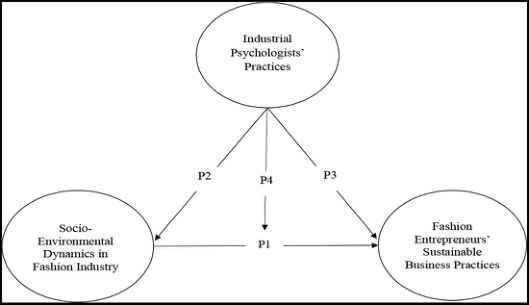
P1: Sustainable business practices will have a significant positive effect on socio-environmental dynamics in the fashion industry. According to Abdallah et al. (2012), sustainability refers to “development that meets the needs of the present without compromising the ability of future generations to meet their own needs.” This definition is extensive in that it explains how living within limits of available physical/environment, social and economic rights can perpetuate existing resources for the benefits of the
Beyond Fashion Consumption: Mapping the Functional Systems of the Psychologists 217
immediate and future generation. In the past, issues such as sustainability and conditions of service for factory workers have reared its head in the fashion industry. This has led to global brands such as Nike facing scrutiny for its outsourcing practices which did not meet socio-environmental stan- dards (Greenberg and Knight, 2004; Peretti and Micheletti, 2004). Hence, it is important to factor in sustainable fashion practices which include a range of business undertakings that seeks to manage a variety of perceived wrongs in the fashion industry which include employee victimization, animal cruelty and environmental damage (Lundblad and Davies, 2016).
Systemic Interaction Between Industrial Psychologist and Fashion Entrepreneur Informed by the Socio-Environmental Consequences of Fashion Consumption The modern behavior of consumers has various implications and consequ- ences for sustainability in the fashion industry. Consumers of the present age have a high demand for new and fast fashion, constantly demanding for innovations in fashion, without giving too much concern for the environ- mental effects. The issue of recycling in the fashion industry has been floated around, but not given much thought when it comes to practical implica- tion. As such, the effects of fashion consumption on the social-environmental factors are profound. Consumers and workers within the fashion industry are all affected by various issues which are brought about by the trends in fashion consumption, and the negative effects it has on the environment and sustainability in general. There is a tight nexus between social and physical systems that influence each other. It is a known fact that human behavior, decisions and policies influence one’s immediate environment and in turn the ecosystem also influences the decisions, actions and shapes policy dockets. Recent research on fashion’s activities and its influence on the environment and the social well-being of its workers has gained popularity in academia and public discussions (Liu et al., 2015; Turner et al., 2015). Despite the upsurge of interest in socio-environmental issues evident by an increasing number of publications. Missing in the scholarship are studies attempting to explain the impact of fashion on the social well-being of its workers. Embed- ded in most explanations is the over emphasis of environmentalism. With growing concern around the fashion industry’s socio-environmental impact, the industry has come under intense scrutiny by researchers as well as sta- keholders. Research on the industry’s negative impact has largely focused on environmental consequences of the industry’s activities; emission of greenh- ouse gases and secretion of harmful substances into water bodies which has a detrimental effect on the environment (Khan, 2019). Globally, ecologists and biodiversity experts have reported serious deterioration of the world’s climate caused by the industry. Failure of fashion experts to recognize the negative impact of its activities on the social and psychological well-being on its workers (Avi and Kallur, 2021), leaves a lot to be desired. The social and psychological effect of the industry’s practices is no means a new revela- tion (Wu and Li, 2019). The heightened concern stirred by evidence of social injustices have intensified labour exploitation, child labour, poor working
conditions, long hours of work and low wages has surged in recent years (Henninger et al., 2017; Salcedo-Sánchez et al., 2016). The social dangers of the fashion industry are as a result of demand for cheap, trendy garments which has resulted in fast fashion (a cheap business model), in which entre- preneurs are obliged to always find the cheapest medium and cut down on prices (Henninger et al., 2017; Salcedo-Sánchez et al., 2016) at the detriment of entrepreneurs and their workers. The dramatic increase in clothing con- sumption has been fueled by fast fashion, increased accessibility to fashion trends via online retailing and an increase in spending expenditure from a growing middle class and the youth (Amed et al. 2021). Unfortunately, fast fashion and excessive production has propagated a culture of excess sup- ply over demand and a pattern of ‘one-time’ use of clothing. Consequently, this cycle propagates a phenomenon of quick disposal of unused clothes into landfills (Clark, 2008; Langdown, 2014), overabundance of fashion produ- ction, competition and theft of creative content. In this stead, the following proposition (P) is posited.
P2: Industrial psychologists’ principles will have a significant impact on sustainable business practices in the fashion industry. In the middle of the struggle lies the entrepreneur who faces uncompro- mising set of pressure, precarity and constant need to invent and re-invent in order to stay abreast with a fast-paced production (Pike, 2017). Creati- ves in this industry are challenged in keeping a sense of balance and serenity, the difficulty of meeting deadlines (timing) and economic insistence. Another social issue generated by fashion is the huge concern of the younger genera- tion about their appearance and zeal for an ‘ideal body type and appearance.’ Despite the existing challenges, extant research has overlooked the peculiar realities and difficulties facing the industry as the issues of the sector tran- scends environmental degradation (Avi and Kallur, 2021), to more pressing issues that has become a center of discussion across the sciences, politics, education, public health, fashion marketing scholarship, religion, spiritua- lism, among others. Nonetheless, none of these disciplines have been able to provide a comprehensive and lasting solution to the threatening menace of the industry. Neumayer and Joly (2021) and Bowker (2018) assert that the neglect of psychology in sustainable research is at the core of why the shift to sustainable practices have been slow and has probably failed. In this stead, the following proposition (P) is posited.
P3: Principles of industrial psychologist will have an impact on socio-environmental dynamics of the fashion industry. Socio-environmental issues are a huge part of the fashion industry. It is therefore imperative to delve deeper into this space to determine the role psychologists can play in influencing fashion houses to adopt sustainable beh- aviors which enhance the image and reputation of fashion brands and appeal to environmentally friendly consumers. Psychologists play a crucial role in the fashion industry such as offering insights into consumer behavior, con- sumer preferences and product designs which can stimulate sales during the various seasons such as autumn, spring, summer and winter (Carter, 2011; Steg, 2015; Apaolaza et al., 2022). Even though owners of businesses profess sustainability concerns, their actual consumption behaviors poorly reflect
Beyond Fashion Consumption: Mapping the Functional Systems of the Psychologists 219
such responsibility (Chan and Wong, 2012; Joy et al., 2012; McNeil and Moore, 2015). Thus, this study offers a novel perspective which highlights the role psychologists can play in the field of fashion to educate consumers and workers in the fashion industry to become more conscious toward sustainable practices.
Systemic Interaction Between Industrial Psychologist and Fashion Entrepreneur on Sustainable Business Practices Psychology of fashion represents a new sub-field of psychology that expounds the contribution of psychologists and promotes a transdisciplinary perspe- ctive (Mair, 2015). It expands the discussion on sustainability of fashion to include an attempt to improve the total well-being of actors within the fash- ion sector. Psychologists’ contribution to sustainable practices in the fashion industry is a relatively recent topic. Psychologists are known to help brands become more diverse in the areas of design, thinking and communication (Mair, 2015). The specific focus on the use of psychological principles and methods to disentangle one of the world’s leading polluters of the environ- ment cannot be underestimated (Diale and Shammah, 2020). Theories of psychology and its practice have been applied to a wide range of fields inclu- ding clinical, educational, counseling, forensic, occupational management and in research (Diale and Shammah, 2020). This include finding remedy for environmental and social issues of individuals in organizations by devi- sing interventions and strategies that improve these problems. Psychologists have long been involved in environmental issues. Social and environmen- tal issues are as a result of the feelings, thinking and actions of individuals. According to cognitive psychologists, the best way to solve problems is to tap into the mind of the person causing it. The focus of psychology is to cre- ate conditions that make sustainable behaviors most pleasing. Thus, to end unsustainable human practices in the industry, the role of the psychologists cannot be ignored. Entrepreneurs need to produce differently, and consu- mers need to buy differently, and psychologists can help both parties with behavior change (Mair, 2015). With rising consumer demands, shopping and increasing competition, psychologists are ‘right’ to understand all the neural activities that happen in the brain as well as the social processes that happen between people (Mair, 2015). in the demand and supply curve. Psycholo- gists over the years have developed models that have helped in resolving socio-environmental issues in the fashion industry (Mair, 2015). Psycholo- gists unlike fashion forecasters, rely heavily on gut feelings, intuition and consumer patterns of demand to predict future needs. This model over the years has failed woefully, as predictions based on feelings lack statistical rigor (Mair, 2015). Other disciplines have proposed business models including recycling, resale, rental, reuse, and repair as environmental lifesaving means (Moran et al., 2021). Unfortunately, all the supposed innovation and experi- mentation in the fashion industry over the past 25 years has been unsuccessful to lessen its planetary impact, a reminder to those who think that voluntary efforts can successfully address social and environmental challenges facing the industry. Pressure for unrelenting growth coupled with consumer demand
Figure 1: Proposed model highlighting the systemic interactive triad between the indu- strial psychologist, socio-environmental dynamics of entrepreneurs, and sustainable business practices in the fashion industry.
for cheap and fast fashion has greatly contributed to failure of sustainable practices. In this stead, the following proposition (P) is posited.
P4: Principles of industrial psychologists will influence the relationship between sustainable business practices and socio- environmental principles.
Proposed Model for Systemic Interaction Between Industrial Psychologist and Fashion Entrepreneur and Sustainable Business Practices In the review above, four propositions were made relative to the systemic interaction between the industrial psychologist, entrepreneurs sustainable business practices and the socio-environmental dynamics in the fashion indu- stry. Based on the four propositions, the framework shown in Fig. 1 below is conceptualized to modelize the systemic interactive triad between the industrial psychologist, entrepreneurs sustainable business practices and the socio-environmental dynamics in the fashion industry.
CONCLUSION
Emerging trends in fashion psychology indicates an over-representation of research focusing on the negative impact of the sector on the environment, while social pressure emanating from unsustainable practices have been left largely unexplored. The social and psychological impact of fashion on its workers and consumers has been underestimated, and this has contributed to limited inclusion of psychologists in the fashion industry. The presence of fashion psychologists empowered to push a sustainability agenda can result in a thriving fashion industry globally. This would further contribute to the provision of decent work, inspire creativity and stimulate sustainable practi- ces within the industry. A number of strategies have been employed over the years to rectify environmental issues as sustainable fashion alternatives but many of these attempts have only scratched the surface of the issue rather
Beyond Fashion Consumption: Mapping the Functional Systems of the Psychologists 221
than address all the components. Fashion producers have adopted clothing materials that are more environmentally friendly. However, the sad truth is that all this experimentation and supposed models have failed to address the socio-environmental concerns challenging the industry as most of these stra- tegies lack rigor in its application. This study has drawn attention to the possible roles and contribution of psychologists to the fashion industry, and concludes on the premise that to push the sustainability agenda in the fashion industry, the efforts and expertise of psychologists are paramount.
REFERENCES
Amed, I., Balchandani, A., Berg, A., Hedrich, S., Jensen, JE., Le Merle, L., Rölkens, F. (2021). Fashion and McKinsey.: The State of Fashion 2022: An Uneven Recovery and New Frontiers, Report, McKinsey and Com- pany. https://www.mckinsey.com/~{}/media/mckinsey/industries/retail/our%20i nsights/state%20of%20fashion/2022/the-state-of-fashion-2022.pdf. Apaolaza, V., Hartmann, P., Paredes, MR., Trujillo, A., D’Souza, C. (2022).
What motivates consumers to buy fashion pet clothing? The role of attach- ment, pet anthropomorphism, and self-expansion. Journal of Business Research, Volume 141, No. (C), 367–379. Abdallah, S., Michaelson, J., Shah, S., Stoll, L., Marks, N. (2012). The happy planet index report. A global index of sustainable well-being. New Economics Foundation, London. Avi, D., Kallur, M. (2021). Looking Good and Feeling Green: Exploring drivers and
barriers to sustainability initiatives in Swedish fashion SMEs. Unpublished Thesis, Uppsala University. Bargh, J. A. (2007). Social psychology and the unconscious: The automaticity of higher mental processes. Psychology Press [aJYH]. Bowker, GC. (2018). Sustainable knowledge infrastructures. The promise of infra-
structure. 203–222. Duke University Press. Brydges, T., Rhiannon Pugh, R. (2021). Coming into fashion: Expanding the Entrepreneurial Ecosystem Concept to the Creative Industries Through a Toronto Case Study, Volume 65, No. 3, 346–367. https://doi.org/10.1111/cag.12674. Carter, DM. (2011). Recognizing the role of positive emotions in fostering environ-
mentally responsible behaviors. Ecopsychology, Volume 3, No. 1, 65–69. Chan, TY., Wong, CW. (2012). The consumption side of sustainable fashion supply chain: Understanding fashion consumer eco⣳fashion consumption decision. Journal of Fashion Marketing Management: An International Journal, Volume 16, No. 2, 193–215. Clark, H. (2008). SLOW+ F-ASHION—an Oxymoron—or a Promise for the
Future…?. Fashion Theory, Volume 12, No. 4, 427–446. Diale, BM., Shammah, ML. (2020). The Profession of Psychology: A systematic review of its uses and implications for African Sustainable. Development Gender Behavior, Volume 18, No. 3, 15923–15933. Garcia, CC. (2021). Fashion Forecasting: An Overview from Material Culture to
Industry. Journal of Fashion Marketing Management, Volume ahead-of-print No. Ahead-of-print. https://doi.org/10.1108/JFMM-11-2020-0241. Greenberg, J., Knight, G. (2004). Framing sweatshops: Nike, global production, and the American news media. Communication Critical/Cultural Studies. Volume 1, No. 2, 151–175.
Gwilt, A., Rissanen, T. (2012). Shaping Sustainable Fashion: Changing the Way we Make and Use Clothes, London: Earthscan. Henninger, CE., Alevizou, PJ., Oates, CJ. (2017). IMC, social media and UK fash-
ion micro-organisations. European Journal of Marketing, Volume 51, No. 3, 668–691. Joy, A., Sherry, JF., Venkatesh, A., Wang, J., Chan, R. (2012). Fast Fashion, Sustainability, and the Ethical Appeal of Luxury Brands. Fashion Theory. Volume 16, No. 3, 273–296. Jung, J., Kim, S. J., Kim, K. H. (2020). Sustainable marketing activities of traditio-
nal fashion market and brand loyalty. Journal of Business Research, Volume 120, 294–301. Karpova, E., Marcketti, S., Kamm, C. (2013). Fashion industry professionals’ viewpoints on creative traits and, strategies for creativity development. Thinking Skills Creativity, Volume 10, 159–167. Khan, I. (2019). Power generation expansion plan and sustainability in a develo-
ping country: A multi-criteria decision analysis. Journal of Cleaner Production, Volume, 220, 707–720. Langdown, A. (2014). Slow fashion as an alternative to mass production: A fashion practitioner’s journey. Social Business, Volume 4, No. 1, 33–43. Liu, J., Mooney, H., Hull, V., Davis, S. J., Gaskell, J., Hertel, T., ... Li, S. (2015).
Systems integration for global sustainability. Science, Volume 347, No. 6225, 1258832. DOI: 10.1126/science.1258832. Lundblad, L., Davies, IA. (2016). The values and motivations behind sustainable fashion consumption. Journal of Consumer Behavior, Volume 15, No. 2, 149–162. Mair, C. (2015). The Psychology of fashion. New Brunswick, NJ: Routledge. Manning, C. (2009). The psychology of sustainable behavior. Minnesota Pollution
Control Agency, 5–8. McNeil, L., Moore, R. (2015). Sustainable-fashion consumption and the fast fashion conundrum: fashionable consumers and attitudes to sustainability in clothing choice. International Journal of Consumer Studies, Volume 39, 212–222. Moran, C.A, Eichlemann, E, Buggy, CJ. (2021) The challenge of “Depeche Mode”
in the fashion industry - Does the industry have the capacity to become sustai- nable through circular economic principles, a scoping review. Sustainability Environment, Volume 7, No. 1, 1–16. Neumayer, E., Joly, C. (2021). Without social sciences, humanities and arts, the goal of sustainability may never be reached. Impact of Social Sciences Blog. Peretti, J., Micheletti, M. (2004). The Nike sweatshop email: Political consumerism,
internet, and culture jamming. In: Micheletti, M, Follesdal, A, Stolle, D (eds.), Poli- tics, Products and Markets: Exploring Political Consumerism, Past and Present (pp. 127–142). New Brunswick, NJ: Routledge. Pike, H. (2017). Will the ‘sharing economy’ work for fashion? Business of Fashion [online]. Retrieved March 5, 2017, https://www.businessoffashion.com/articles/f ashion-tech/will-the-sharing-economy-work-for-fashion-rent-the-runway-rental Sahni, H., Chopra, N. (2020). “CSR and SDG Mapping in Fashion & Textile Indu-
stry: Identifying Potential Challenges in the Wake of Isolationism”, In: CSR in an Age of Isolationism (Developments in Corporate Governance and Responsi- bility, Volume 16, Crowther, D., Quoquab, F. (Eds.), Bingley, Emerald Publishing Limited https://doi.org/10.1108/S2043-052320200000016012, (pp. 221–245).
Beyond Fashion Consumption: Mapping the Functional Systems of the Psychologists 223
Salcedo-Sánchez, ER., Garrido Hoyos, SE. Esteller Alberich, M., Martínez Morales, M. (2016). Application of water quality index to evaluate groundwater quality (temporal and spatial variation) of an intensively exploited aquifer (Puebla valley, Mexico). Environmental Monitoring Assessment, Volume 188, No. 10, 1–20. Steg, L. (2015). Environmental psychology and sustainable consumption. In: Rei-
sch, L., Thogersen, J. (eds.). Handbook of research on sustainable consumption, Cheltenham, England: Edward Elgar Publishing, 70–83. Turner Ii, BL., Esler, KJ., Bridgewater, P., Tewksbury, J., Sitas, N., Abrahams, B., Mooney, H. (2016). Socio-Environmental Systems (SES) Research: What Have We Learned and How Can We Use this Information in Future Research Programs. Current Opinion Environment Sustainability, Volume 19, 160–168. V˘at˘am˘anescu, EM., Dabija, DC., Gazzola, P., Cegarro-Navarro, JG., Buzzi, T.
(2021). Before and after the outbreak of covid-19: Linking fashion companies’ corporate social responsibility approach to consumers’ demand for sustainable products. Journal of Cleaner Production, Volume 321, 128945. Wu, J., Li, L. (2019). Sustainability Initiatives in the Fashion Industry. In: Beltramo, R., Romani., A., Cantore, P. (Eds.), Fashion Industry: An Itinerary Between Feelings and Technology, London: IntechOpen. DOI: 10.5772/intech- open.87062.
LISTED IN THE AHFE DIGITAL BOOKSTORE CATALOGUE
Explore the complete digital volume
Human Factors and Systems Interaction
Read this individual research paper free through the original publisher, or explore the full digital proceedings book.
ISBN 978-1-958651-28-5
Explore this ISBN in the AHFE Bookstore ↗Listed in the July 2026 bookstore catalogue; search by ISBN to confirm current availability · Digital book purchase optional