Martina A. Clarke, Lisa L Neitzke, Kathryn M Cooper (2022). Shared Living Providers (SLP) Experience Documentation Burden While Caring for Individuals with Intellectual and Developmental Disabilities (I/DD). In: Healthcare and Medical Devices. AHFE Open Access, vol. 51, pp. 31–36. https://doi.org/10.54941/ahfe1002095
Shared living providers (SLPs) have identified administrative burden as a major contributor to burnout and the decreased effectiveness of care delivery. SLPs are individuals that allow persons with I/DD to reside in their residential home while providing caregiving support in daily living activities, community integration, and many other activities. This project addresses health information technology (HIT)-related documentation burden, which is a critical barrier to progress in the intellectual and developmental disabilities (I/DD) support field. The aim of this study is to determine SLPs’ perception of documentation burden while caring for individuals with I/DD.MethodsSeventeen SLPs were surveyed to understand their perception of documentation burden to determine its role in burnout. The survey used to measure documentation burden was the Burden of Documentation for Nurses and Midwives (BurDoNsaM) survey. The BurDoNsaM is a 28-item validated survey, categorized using 6 subscales, representing essential areas of documentation burden. Three of the six subscale in the BurDoNsaM survey was used in this study. The three subscales included were: (1) views about value of clinical documentation, (2) burden of documentation, and (3) time taken to complete documentation. Seventeen of the 28 survey items were relevant to SLP duties and was included in our pilot study. SLPs were recruited after their clinic visit from University of Nebraska Medical Center (UNMC) Munroe Meyer Institute (MMI) Adult I/DD clinic. Survey data was recorded and stored in a secure database. The data was summarized using descriptive statistics.DiscussionThis pilot study was able to identify the areas that cause documentation burden for SLPs. Respondents found value in clinical documentation. Despite its value, respondents reported that the documentation process complex and is time consuming. SLPs are required to comply with an increasing, wide-ranging body of requirements to deliver and receive payment for care of individuals with I/DD. The cost of compliance with these requirements has long term effects, such as, increased cognitive load and burnout. Limitations of this pilot study include a small sample size. Future research should include a larger sample size and qualitative data to further identify the specific areas that cause the most burden.
Shared living providers (SLPs) have identified administrative burden as a major contributor to burnout and the decreased effectiveness of care delivery (Hatton et al. 1999, Skirrow and Hatton 2007, Gray-Stanley and Muramatsu 2011, Lunsky et al. 2014). SLPs are individuals that allow persons with intel- lectual and developmental disabilities (I/DD) to reside in their residential home while providing caregiving support in daily living activities, commu- nity integration, and many other activities (Bogenschutz et al. 2014). HIT, such as, electronic health records (EHRs) are associated with documentation burden resulting in clinician burnout (Moy et al. 2021). This is also true for caregivers even though they are not considered “clinicians.” Like clinicians, caregivers are required to comply with an increasing, wide-ranging body of requirements to deliver and receive payment for care of individuals with I/DD.
Demographics % n Gender Male 59% 10 Female 35% 6 Transgender 0% 0 Non-binary / third gender 0% 0 Prefer not to say 6% 1 Race Black or African American 18% 3 Asian 0% 0 White 82% 14 American Indian or Alaskan Native 0% 0 Pacific Islander 0% 0 Ethnicity Hispanic or Latino(a) 18% 3 Non-Hispanic 82% 14 Education Did not graduate high school 0% 0 High school graduate/GED 35% 6 Trade / some college 24% 4 College graduate 29% 5 Post graduate degree 12% 2 Comfort level using computers Very uncomfortable 0% 0 Neutral 12% 2 Comfortable 53% 9 Very comfortable 29% 5 Uncomfortable 6% 1
The cost of compliance with these requirements has long term effects, such as, increased cognitive load and burnout. The aim of this study is to deter- mine SLPs’ perception of documentation burden while caring for individuals with I/DD.
METHODS
Seventeen SLPs were surveyed to understand their perception of documen- tation burden to determine its role in burnout. The survey used to measure documentation burden was the Burden of Documentation for Nurses and Midwives (BurDoNsaM) survey (Brown et al. 2020). The BurDoNsaM is a 28-item validated survey, categorized using 6 subscales, representing essential areas of documentation burden. Three of the six subscale in the BurDoNsaM survey was used in this study. The three subscales included were: (1) views about value of clinical documentation, (2) burden of documentation, and (3) time taken to complete documentation. Seventeen of the 28 survey items were relevant to SLP duties and was included in our pilot study. SLPs were recruited after their clinic visit from University of Nebraska Medical Center (UNMC) Munroe Meyer Institute (MMI) Adult I/DD clinic. Survey data was recorded and stored in a secure database. The data was summarized using descriptive statistics.
Shared Living Providers (SLP) Experience Documentation Burden While Caring 33
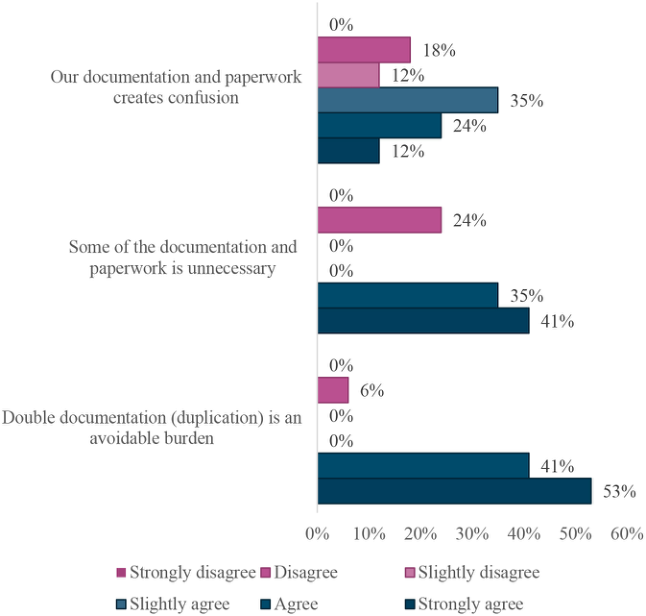
Figure 1: Survey respondents responses categorized by 6-point Likert scale about their perception of documentation burden experienced as an SLP.
RESULTS
Demographics SLPs age ranged from 30 to 67 years old (Table 1). Respondents experience as an SLP ranged from 6 months to over 20 years.
Documentation Burden Experienced as an SLP Twelve out of seventeen participants (71%; M = 7; SD = 1) agreed that documentation and paperwork create confusion (Figure 1). Thirteen out of seventeen participants (76%; M = 6; SD = 2) (76%) agreed that some of the documentation and paperwork is unnecessary. Sixteen out of seventeen respondents (94%; M = 6; SD = 1) agreed that double documentation is an avoidable burden.
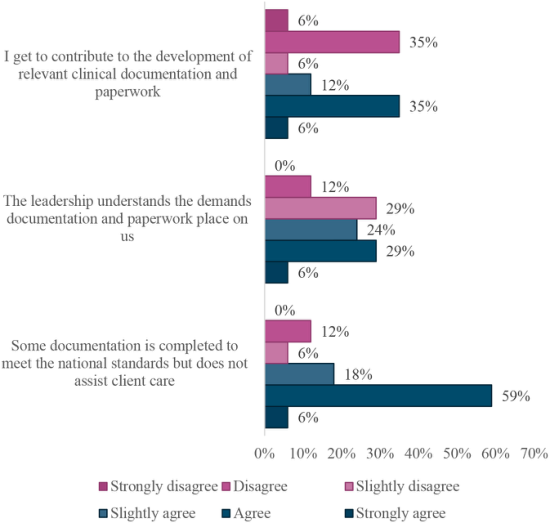
Documentation Efforts as an SLP Nine out of seventeen participants (53%; M = 7; SD = 2) agreed that they contribute to the development of relevant clinical documentation and paperwork (Figure 2). Ten out of seventeen participants (59%; M = 7; SD = 1) agreed that the leadership understands the
Figure 2: Survey respondents responses categorized by 6-point Likert scale about their perception of documentation efforts as an SLP.
demands documentation and paperwork place on SLPs. Fourteen out of seventeen participants (83%; M = 7; SD = 1) agreed that some documentation is completed to meet the national standards but does not assist client care.
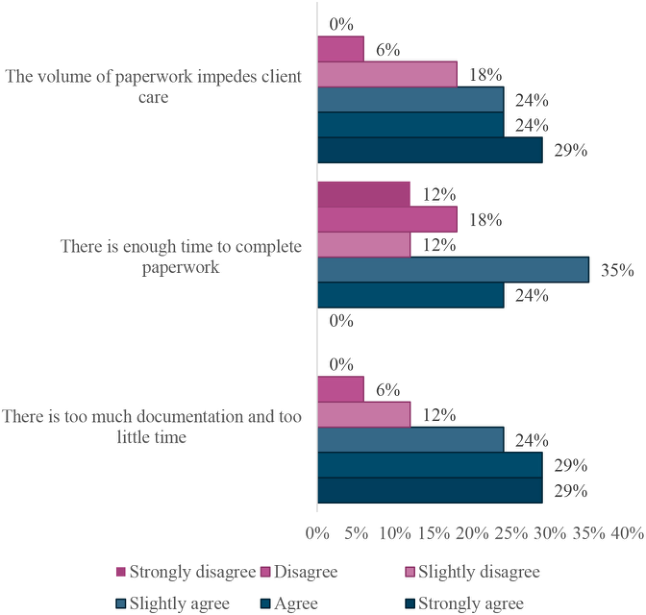
Time Taken to Complete Documentation Thirteen out of seventeen participants (77%; M = 6; SD = 1) agreed that the volume of paperwork impedes client care (Figure 3). Ten out of seventeen participants (59%; M = 8; SD = 1) agreed that there is enough time to complete paperwork. However, 14 out of 17 participants (82%; M = 6; SD = 1) agreed that there is too much documentation and too little time to complete it.
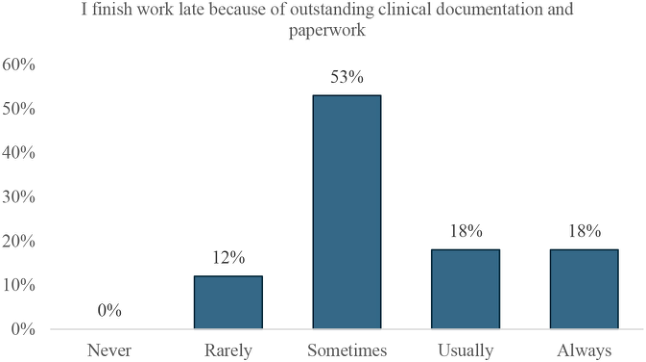
Three out of seventeen participants (18%) reported always or usually finishing work late because of outstanding clinical documentation and pape- rwork (Figure 4). Nine out of seventeen participants (53%) reported some- times finishing work late because of outstanding clinical documentation and paperwork. Two out of seventeen participants (12%) reported finish- ing work late because of outstanding clinical documentation and paperwork (M = 3; SD = 1).
DISCUSSION
This pilot study was able to identify the areas that cause documentation bur- den for SLPs. Respondents found value in clinical documentation. Despite
Shared Living Providers (SLP) Experience Documentation Burden While Caring 35
Figure 3: Survey respondents responses categorized by 6-point Likert scale about their perception of the time it takes to complete their documentation as an SLP.Figure 4: Survey response categorized by 5-point Likert scale on completing outstan- ding documentation.
its value, respondents reported that the documentation process complex and is time consuming. Documentation burden among frontline clinical workers,
such as, physicians and nurses has been an area of interest as described in the report, “Strategy on Reducing Regulatory and Administrative Burden Rela- ting to the Use of Health IT and Electronic Health Records (EHRs)” focuses on reducing HIT-related burden (Office of the National Coordinator 2020). HIT, such as, EHRs are associated with documentation burden resulting in clinician burnout (Moy et al. 2021). This is also true for SLPs even though they are not considered “clinicians.”
CONCLUSION
SLPs experience documentation burden while caring for individuals with I/DD. Like clinicians, SLPs are required to comply with an increasing, wide- ranging body of requirements to deliver and receive payment for care of individuals with I/DD. The cost of compliance with these requirements has long term effects, such as, increased cognitive load and burnout. Limitations of this pilot study include a small sample size. Future research should include a larger sample size and qualitative data to further identify the specific areas that cause the most burden.
REFERENCES
Bogenschutz, M. D., Hewitt, A., Nord, D. and Hepperlen, R. (2014) ‘Direct support workforce supporting individuals with IDD: current wages, benefits, and stability’, Intellect Dev Disabil, 52(5), 317–29. Brown, J. A., Cooper, A. L. and Albrecht, M. A. (2020) ‘Development and con-
tent validation of the Burden of Documentation for Nurses and Midwives (BurDoNsaM) survey’, J Adv Nurs, 76(5), 1273–1281. Gray-Stanley, J. A. and Muramatsu, N. (2011) ‘Work stress, burnout, and social and personal resources among direct care workers’, Res Dev Disabil, 32(3), 1065–74. Hatton, C., Rivers, M., Mason, H., Mason, L., Kiernan, C., Emerson, E., Alborz,
A. and Reeves, D. (1999) ‘Staff stressors and staff outcomes in services for adults with intellectual disabilities: the Staff Stressor Questionnaire’, Res Dev Disabil, 20(4), 269–85. Lunsky, Y., Hastings, R. P., Hensel, J., Arenovich, T. and Dewa, C. S. (2014) ‘Perceptions of positive contributions and burnout in community developmental disability workers’, Intellect Dev Disabil, 52(4), 249-57. Moy, A. J., Schwartz, J. M., Chen, R., Sadri, S., Lucas, E., Cato, K. D. and Rossetti, S.
C. (2021) ‘Measurement of clinical documentation burden among physicians and nurses using electronic health records: a scoping review’, Journal of the American Medical Informatics Association. Office of the National Coordinator (2020) Strategy on reducing regulatory and administrative burden relating to the use of health IT and EHRs, The Office of the National Coordinator for Health Information Technology. Skirrow, P. and Hatton, C. (2007) “Burnout’ Amongst Direct Care Workers in Servi-
ces for Adults with Intellectual Disabilities: A Systematic Review of Research Findings and Initial Normative Data’, Journal of Applied Research in Intellectual Disabilities, 20(2), 131–144.
LISTED IN THE AHFE DIGITAL BOOKSTORE CATALOGUE
Explore the complete digital volume
Healthcare and Medical Devices
Read this individual research paper free through the original publisher, or explore the full digital proceedings book.
ISBN 978-1-958651-27-8
Explore this ISBN in the AHFE Bookstore ↗Listed in the July 2026 bookstore catalogue; search by ISBN to confirm current availability · Digital book purchase optional