Avi Parush, Maya Lorenco-Levin, Catherine Campbell (2021). Dual Patient – Healthcare Provider Experience Mapping and Implications for Information Technology Deployment and Clinic Layout. In: Advances in Human Aspects of Healthcare. AHFE Open Access, vol. 13. https://doi.org/10.54941/ahfe100512
The implementation of information technology, in general, and electronic medical records (EMR), in particular, can have implications on various aspects of the healthcare process. This paper describes the development and implementation of a dual experience mapping technique to identify the mutual experience of patients and their families, on the one hand, and healthcare providers, on the other hand, as part of the preparation for deploying a new EMR system in a hospital environment. The dual experience mapping focused on identifying mutual pain points associated with the use of the new system as a function of various physical locations within hospital clinics. The findings facilitated the identification of mutual needs and definition of solution directions. Specifically, the recommendations addressed the layout of clinics with the deployed system in a way that addresses identified pain points and needs. The effectiveness of using the dual experience mapping is demonstrated in this project as a technique that can help in patient-oriented design and patient empowerment in healthcare.
The deployment of Information Technology (IT) such as a new Electronic Medical Record system in a large organization (e.g., a hospital) introduces challenges and far-reaching implications (Zandieh, Yoon-Flannery, Kuperman, Langsam, Hyman, & Kaushal, 2008). These include possible changes in workflow, procedures, task definitions and allocation, training, and changes in the physical parameters of the workspace where the new system will be deployed (e.g., Patel, Arocha, & Kushniruk, 2002; Fullerton, Aponte, Hopkins, & Ballard, 2006; Lawler, Hedge, & Pavlovic-Veselinovic, 2011, Gardner, 2012). This paper focuses on the possible implications of introducing a new Electronic Medical Record (EMR) to workspace physical organization and layout.
When introducing a new information system such as an EMR into where the healthcare provider, be it a physician or a nurse, is interacting with the patient and patient’s family, then the physical arrangement of elements in the workspace, and in particular any artifacts associated with the EMR, must be such that it supports the interaction. Artifacts could include devices such as computers, scanners, and printers that support on-screen work with the system. Inadequate physical arrangement could create a separation between the care provider and the patient, thus becoming a possible disrupting factor in the interaction (Stewart, Kroth, Schuyler, & Bailey, 2010).
Clinics in a Pediatric Hospital as a Case Study The study described here was conducted in a pediatric hospital. This hospital has over 150 beds, 70 ambulatory (outpatient) clinics and a referral base of approximately 2 million. Several hundreds of physicians and over 1000 nursing staff work on site. In 2012, the hospital started a step-wise approach to implementation of a third party EMR. The first phase includes implementation of an ambulatory EMR that will integrate with registration, scheduling and laboratory information systems. As part of this implementation, the hospital recognized that the selection and placement of equipment and space design facilitating user requirements and new electronic workflows was an important factor impacting overall system usability and adoption. Human Factors methods were applied to develop a better understanding of clinic workflow and EHR user requirements. These methods included a contextual inquiry consisting of walkthroughs, interviews, and observations in the clinics themselves.
The findings uncovered the challenge of how to locate and arrange elements in the workspace in a way that facilitates the interaction between the care provider and the patient, on the one hand, and the care provider with the EMR on the other hand. This introduces a multi-dimensional problem consisting of complex relations between several elements simultaneously. The elements in the context include the care provider interacting with patients and often their families, the care provider interacting with the EMR and sometimes including the patient in this interaction, the care provider utilizing other artifacts such as scanners and printers to intake or produce relevant documents, and all of this sometimes accomplished in different physical locations. In order to resolve the various tradeoffs in such a context there is a need for a method that can map as many of the elements as possible in a usable fashion and lead to identification of appropriate solutions.
User Journey and Experience Mapping There are various methods to identify issues and delineate solutions for such a challenge, including analyses of tasks and links as a function of procedures, workspace layouts, and technology parameters. In recent years, the attention to the holistic user experience has grown in various domains including healthcare. Tapping into the user experience as part of addressing the challenge of deploying new IT can add significant value to finding adequate solutions.
One of the techniques for analyzing user experience is user journey mapping (e.g., Westbrook, Coiera, Sophie Gosling, & Braithwaite, 2007). This technique is adopted from the service design discipline (Johnston, & Kong, 2011). The most common form of the technique is identifying the user, their journey through the service, the various service channels and touch points between the user and the service, and the experiences in all of those touch points. The technique is useful in identifying the pain points in the service, define requirements, and suggest solutions.
DUAL EXPERIENCEE MAPPING Objectives of the Experience Mapping
In order to adequately address the challenges of deploying a new EMR system, the following objectives were outlined:
Focus on locations of the journey and activities of the patient and care provider in those locations.
Focus on the role the EMR plays in the interaction between the two as a function of the location.
Identify pain points with artifacts and associated interactions at those locations.
Identify the key characteristics of the needs as a function of the dual patient-provider experience with the EMR at specific locations
Propose solution directions The Concept of Dual Experience Mapping
Typically, journey and experience mapping address the journey a customer or user takes when interacting with a given service or system. The mapping focuses on the touch points with the various service delivery channels. In the healthcare context discussed here, the most critical touch points are between patients and care providers. In addition, it is critical to map both of their interactions with the EHR system and the combined resulting experiences. Such integration could lead to identifying the mutual pain points and relevant solutions. To address this we developed the concept of a dual experience mapping. In this concept, the care provider is an equal participant in this mutual journey and not just another channel of service delivery. Their mutual touch points with the EHR channel thus becomes the critical focus of mapping the experiences, identifying possible pain points and looking for solutions. Finally, since the objective was to address the arrangement of physical workspace, the fundamental building blocks of the map were locations and the journey steps were embedded within the locations.
The Process of Dual Experience Mapping as a Function of Locations and System Based on the user research that was done in order to identify the challenges, and the data that was collected during that research, the following process of developing the dual experience map was undertaken:
Journey participants Activities Interaction
with EMR
Journey Locations Paint points Needs and
solutions
Figure 1: Information required for a dual experience map as a function of locations and the EMR system
Figure available in the original PDF paper.
It should be emphasized that even though the steps in the process are depicted in a sequential and linear fashion in Figure 1, the process is iterative. In other words, previous analysis and depictions could be re-visited and re-defined at each step.
Journey Participants The primary journey participants are the patients and their families, on the one hand, and the healthcare workers, on the other hand. In addition, the EMR was defined as the primary channel with which both key participants interact. These appear as three parallel routes in Figure 2: Patient at the top, healthcare worker at the bottom, and the EHR in the middle.
Mutual Journey Activities The next step was to outline the details of the journey phases and dual activities during encounter between the patient and healthcare worker. These are depicted in Figure 2.
Patient Check in
Wait Wait
Visit with physician
Vitals checked
Fill out forms
Book next appointment (if needed)
Leave clinic/h ospital
Patient stays in height/weight room, is taken to exam room or back to waiting room.
Patient (or parent) gives ID / Health Card to Clerk
Nurse leaves exam room to consult with physician or other clinician
Nurse calls patient on intercom or comes to wait room
Physician reviews history, examines patient, discusses patient condition/next steps, prints any necessary documents (handouts, forms, labels)
Clerk registers patient & gives any additional forms
Paper chart placed on desk when ready
Provider
Figure 2: Journey phases and activities for the primary journey participants, the patient and the healthcare provider
The main journey phases identified were: Waiting to be checked in, fill in forms, going through initial vitals checking, being examined by the physician, and concluding the visit by booking future appointments. The shapes that connect between the patient and the healthcare worker indicate mutual activities which are part of the ongoing encounter.
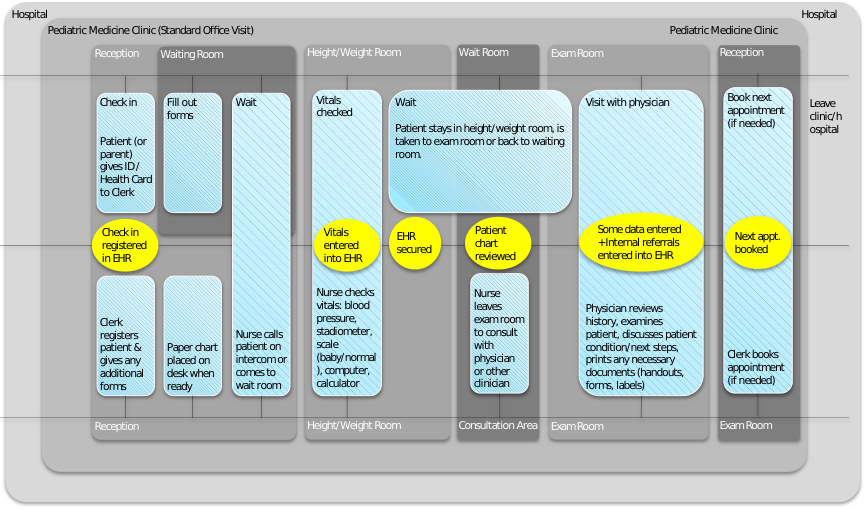
Interactions with the EMR One of the key objectives of the dual experience mapping was to identify journey activities and experiences as a function of the interaction with the EMR system. Thus, the next step in the process was to identify, for each of the dual activity steps in an encounter, the relevant interactions with the system.
Patient Check in
Wait Wait
Visit with physician
Vitals checked
Fill out forms
Book next appointment (if needed)
Leave clinic/h ospital
Patient stays in height/weight room, is taken to exam room or back to waiting room.
Patient (or parent) gives ID / Health Card to Clerk
EHR/IT
Next appt. booked
EHR secured
Some data entered + Internal referrals entered into EHR
Nurse leaves exam room to consult with physician or other clinician
Nurse calls patient on intercom or comes to wait room
Physician reviews history, examines patient, discusses patient condition/next steps, prints any necessary documents (handouts, forms, labels)
Clerk registers patient & gives any additional forms
Paper chart placed on desk when ready
Provider
Figure 3: Interactions with the EHR system during patient-healthcare provider encounters (depicted as elliptical shapes in the middle).
Interactions with the EMR include registration as part of the admission, entering vital signs and other parameters, reviewing patient history and notes, and booking future appointments.
Interaction Locations Human Aspects of Healthcare (2021)
Since the main challenge is the arrangement of the physical workspace where encounters take place, the next step in the mapping was to identify the physical locations for each of the journey phases and activities. These are depicted in Figure 4 . The places that were identified are: the hospital itself, the specific clinic, the reception area, the waiting room, a room for taking vitals and height and weight, and an examination room for additional tests and examinations. For example, one of the places identified is the room where height and weight are taken, including entering the parameters and other vital signs into the EHR. Another place is the exam room which also includes data entry and review from the EMR (compare to Doyle, Wang, Anthony, Borkan, Shield, & Goldman, 2012).
Hospital Hospital Pediatric Medicine Clinic (Standard Office Visit) Pediatric Medicine Clinic
Wait Room
Reception Exam Room
Reception Waiting Room Height/Weight Room Patient Check in Wait
Wait
Visit with physician
Vitals checked
Fill out forms
Book next appointment (if needed)
Leave clinic/h ospital
Patient stays in height/weight room, is taken to exam room or back to waiting room.
Patient (or parent) gives ID / Health Card to Clerk
EHR/IT
Next appt. booked
EHR secured
Some data entered + Internal referrals entered into EHR
Nurse leaves exam room to consult with physician or other clinician
Nurse calls patient on intercom or comes to wait room
Physician reviews history, examines patient, discusses patient condition/next steps, prints any necessary documents (handouts, forms, labels)
Clerk registers patient & gives any additional forms
Paper chart placed on desk when ready
Provider
Consultation Area
Exam Room
Height/Weight Room
Exam Room
Reception
Figure 4: The various physical locations for the journey phases and activities of both patient and healthcare worker
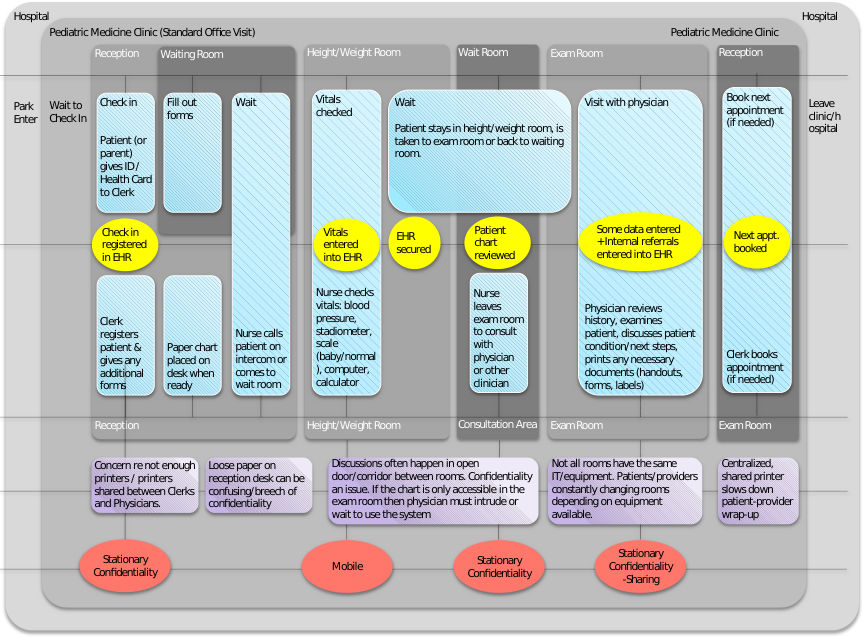
Pain Points Experience mapping was done by delineating pain points at various times throughout the dual journey (see Figure 5). The pain points had a potential impact on the mutual experience of the patient and the care provider. For example, one of the pain points was identified in the room were the child’s height and weight are measured. The pain point was that discussions often take place with open door or in the corridor between rooms. This results in a compromised privacy and confidentiality (compare to Jacques, 2010). This problem is because the system is only accessible in the exam room and the physician either interrupts whatever is taking place in that room or has to wait to use the system.
Characterizing the needs One of the objectives for the mapping was to identify the key characteristics of the needs as a function of the dual experience with the EMR at the specific locations. The combination of activity type and location for the activity resulted in two major dimensions:
The need for the healthcare worker to work alone vs. interact and share with the patient and family
The need for mobility vs. stationary work.
The four combinations of need characteristics were then added to the dual experience map. For example, there is a need to interact with the EMR as part of the journey phase taking place in the room for taking height and weight. Human Aspects of Healthcare (2021)
However, there was only one (paper) chart often resulting in hallway discussions/interruptions. This was earlier designated as a pain point. The need was characterized as having two aspects: need for mobility and need for privacy and confidentiality. In contrast, for the encounter in the exam room, where again there is a need to interact with the EMR, there was a pain point that not all locations have computers and healthcare providers need to change rooms constantly thus interrupting and disrupting the exam. Thus, the need was characterized as a need for stationary work while maintaining both privacy and confidentiality, and yet being able to interact and share with the patient and family.
Hospital Hospital Pediatric Medicine Clinic (Standard Office Visit) Pediatric Medicine Clinic
Wait Room
Reception Exam Room
Reception Waiting Room Height/Weight Room Patient Check in Wait
Wait
Visit with physician
Vitals checked
Fill out forms
Wait to Check In
Park Enter
Book next appointment (if needed)
Leave clinic/h ospital
Patient stays in height/weight room, is taken to exam room or back to waiting room.
Patient (or parent) gives ID / Health Card to Clerk
EHR/IT
Next appt. booked
EHR secured
Some data entered + Internal referrals entered into EHR
Nurse leaves exam room to consult with physician or other clinician
Nurse calls patient on intercom or comes to wait room
Physician reviews history, examines patient, discusses patient condition/next steps, prints any necessary documents (handouts, forms, labels)
Clerk registers patient & gives any additional forms
Paper chart placed on desk when ready
Provider
Consultation Area
Exam Room
Height/Weight Room
Exam Room
Reception
Pain Points
Concern re not enough printers / printers shared between Clerks and Physicians.
Loose paper on reception desk can be confusing/breech of confidentiality
Discussions often happen in open door/corridor between rooms. Confidentiality an issue. If the chart is only accessible in the exam room then physician must intrude or wait to use the system
Not all rooms have the same IT/equipment. Patients/providers constantly changing rooms depending on equipment available.
Centralized, shared printer slows down patient-provider wrap-up Stationary Confidentiality
Needs
Stationary Confidentiality
Stationary Confidentiality Mobile -Sharing
Figure 5: The pain points and dual experience mapped as a function of journey and locations for both patient and healthcare worker along with needs characterizations (at the bottom).
Solution directions The proposed solutions directions addressed the needs for mobility vs. stationary encounter characteristics and the need to have private interaction but also be able to share with patient and family when relevant. These were added to the dual experience map for each of the pain points at the various physical locations of the journey and the encounters. The solution directions addressed physical space layout primarily: the location of the monitors and interaction devices with the EMR system, locations of peripheral devices such as scanners and printers, and the physical convenience of data entry and review.
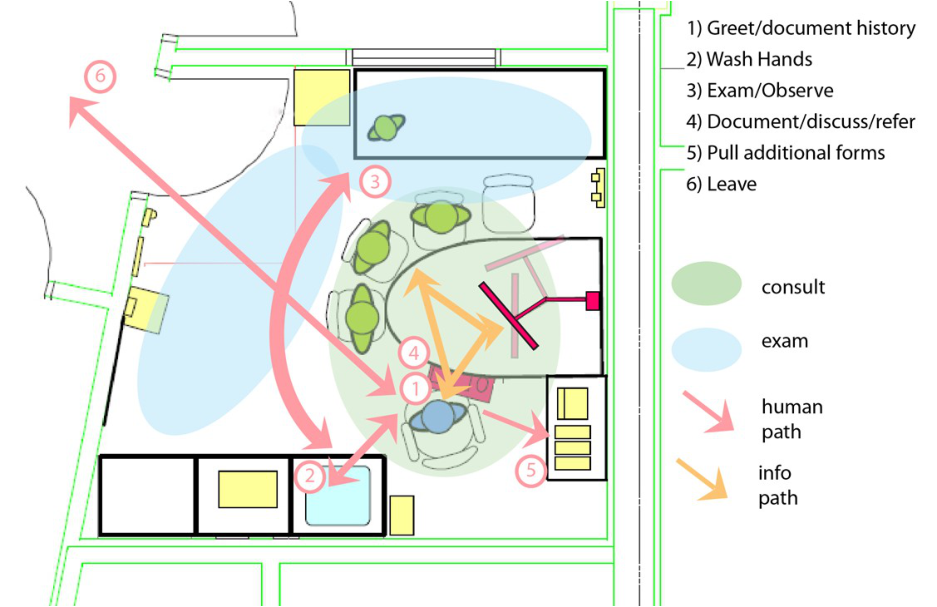
Implications to physical space layout The proposed solution directions were transformed into detailed workspace layout recommendations. Specifically the needs, as characterized by the two dimensions of mobility vs. stationary and privacy vs. sharing, were addressed in terms of the location of the EMR in the workspace, and the interaction patterns of the encounter. An example of the proposed layout of the exam room is presented in Figure 6.
Figure 6: Proposed layout of the exam room in consideration of the dual experience mapping and solution directions
It can be seen in Figure 6 that the monitor for the EMR system was placed in a way that lets the healthcare worker share the information with the patient and family. That location also allows the healthcare worker enter data in real time with minimal movement, thus minimizing disruption the continuity of the encounter.
CONCLUSIONS
This paper provided an overview of a project where mapping user journey and experience were utilized to address challenges in deploying a new EMR system in a hospital. Specifically, a dual experience map was developed to capture and analyze the journey and experience of both the patient and family, on the one hand, and the healthcare worker, on the other hand. This enabled the identification of mutual pain points along the journey, and lead to solution directions that are beneficial for both. With the increased awareness of the patient’s role in healthcare, the empowerment of patients and their families, and the need to implement IT in a patient-oriented manner (e.g., Gaunt, 2009; Boyd, McKernon, Mullin, & Old, 2012), a dual experience mapping approach is particularly important and relevant.
REFERENCES
Boyd, H., McKernon, S., Mullin, B., & Old, A. (2012). Improving healthcare through the use of co-design. Journal of the New Zealand Medical Association,125(1357). Doyle, R. J., Wang, N., Anthony, D., Borkan, J., Shield, R. R., & Goldman, R. E. (2012). Computers in the examination room
and the electronic health record: physicians' perceived impact on clinical encounters before and after full installation and implementation. Family practice, 29(5), 601-608. Fullerton, C., Aponte, P., Hopkins, R., Bragg, D., & Ballard, D. J. (2006). Lessons learned from pilot site implementation of an ambulatory electronic health record. Proceedings (Baylor University. Medical Center), 19(4), 303. Gardner, E. (2012). EHR Success All in the Details. Health Data Management, May 2012; 20(5), p30-34
Gaunt, N. (2009). Electronic health records for patient-centred healthcare.Integrating Healthcare With Information and Communications Technology, 274. Jacques, L. B. (2010). Electronic health records and respect for patient privacy: A prescription for compatibility. Vand. J. Ent. &
Tech. L., 13, 441. Johnston, R., & Kong, X. (2011). The customer experience: a road-map for improvement. Managing Service Quality, 21(1), 5-
24. Lawler, E. K., Hedge, A., & Pavlovic-Veselinovic, S. (2011). Cognitive ergonomics, socio-technical systems, and the impact of healthcare information technologies. International Journal of Industrial Ergonomics, 41(4), 336-344. Patel, V. L., Arocha, J. F., & Kushniruk, A. W. (2002). Patients' and physicians' understanding of health and biomedical
concepts: relationship to the design of EMR systems. Journal of biomedical informatics, 35(1), 8-16. Stewart, R. F., Kroth, P. J., Schuyler, M., & Bailey, R. (2010). Do electronic health records affect the patient-psychiatrist relationship? A before & after study of psychiatric outpatients. BMC psychiatry, 10(1), 3. Westbrook, J. I., Coiera, E. W., Sophie Gosling, A., & Braithwaite, J. (2007). Critical incidents and journey mapping as
techniques to evaluate the impact of online evidence retrieval systems on health care delivery and patient outcomes.International journal of medical informatics, 76(2), 234-245. Zandieh, S. O., Yoon-Flannery, K., Kuperman, G. J., Langsam, D. J., Hyman, D., & Kaushal, R. (2008). Challenges to EHR implementation in electronic-versus paper-based office practices. Journal of General Internal Medicine, 23(6), 755-761.
LISTED IN THE AHFE DIGITAL BOOKSTORE CATALOGUE
Explore the complete digital volume
Advances in Human Aspects of Healthcare
Read this individual research paper free through the original publisher, or explore the full digital proceedings book.
ISBN 978-1-4951-2093-0
Explore this ISBN in the AHFE Bookstore ↗Listed in the July 2026 bookstore catalogue; search by ISBN to confirm current availability · Digital book purchase optional