Sin- Wei Huang, Wei- Chi Chien (2022). Taking a Romantic Adventure Together: Explore the Design of Virtual Travelling for Couples in Long-Distance Relationships. In: Human Factors in Virtual Environments and Game Design. AHFE Open Access, vol. 50, pp. 180–188. https://doi.org/10.54941/ahfe1002076
This research explores the design possibility to create an online adventure for couples in long-distance relationships. Three missions – intensive eye contact, future planning, and cooperative work – were designed and realized on a virtual space on gather.town. Two couples participated in the user test. The result shows two different practices of couples to solve a joint problem and potential and concerns when designing adventurous experiences to enhance couples’ joint activities.
Metaverse, one of the most popular terms since October 2011 (google trends research, 2022), can be generally understood as a social space in a virtual environment (Brown, 2021; Ball, 2021). While this idea seems new, its princi- ple concept can be traced back to Xerox PARC’s Media Space (Stults, 1986) in the 80er or Ontario Telepresence Project in the 90er (e.g., Buxton, 1997). The essential attempt in these projects (including Metaverse) is to explore the potential social activities via the internet. While the elder approaches are translated into modern social media such as Facebook, Instagram, or LINE, Zuckerberg’s call for completely virtual lives grabs the audience’s attention because of the crucial communication barrier caused by COVID-19.
At the end of 2019, COVID-19 broke out. For epidemic prevention, peo- ple are expected or demanded to stay, work, and do everything possible at home as much as possible. As a result, various tools or platforms for online interaction are developed and used to serve diverse social require- ments, such as google meet, Zoom, gather.town, or Hubs. Some platforms like gather.town or Hubs allow personalizing virtual spaces and programing little interaction mechanisms, which inspires us to create a virtual space for couples in long-distance relationships (LDRs).
While plenty of design research have been conducted to explore design possibilities of long-distance interaction and study the mediated intimacy
Taking a Romantic Adventure Together: Explore the Design of Virtual Travelling 181
(Greenberg & Neustaedter, 2013); (Hassenzahl, Heidecker, Eckoldt, et al., 2012), we are interested in creating a joint traveling experience for couples in LDRs with the help of gather.town platform. In the following, we make a short review of related works, present our design, result of the field tests with two LDR couples, and conclusion at the end.
LDR AND JOINT ACTIVITIES The lack of joint life experience is one of the significant factors challenging LDRs’ maintenance (Aylor, 2003). In fact, couples’ relational bond without joint lives is more committed than maintained (Pistole et al., 2010). Besi- des, couples in LDRs also lose channels for their mutual caregiving and care-seeking practices (Pistole, 2010). Finally, to maintain their relatedness and cope with insecure feelings, LDR couples need to adopt different stra- tegies in their daily lives (Rempel et al., 1985). The most common strategy is to make regular phone calls or video calls. Other strategies may also be binge-watching and playing online games together or planning some future activities when they meet each other again.
Having joint activities is also a potential strategy to maintain LDRs. Stu- dies show that, through fulfilling a mission or a task together, couples can boost the deep intimacy (He, 2013). In more novel or even thrilling events, joint experience enhances relational satisfaction by mutual caregiving and the experienced secure feelings (Cortes et al., 2020). Among the existing technology-mediated interactions, (Hassenzahl, Heidecker, & Eckoldt, 2012) summarized the six design strategies: awareness, expressivity, physicalness, gift-giving, joint action, and memory (reminiscing), while joint action as design strategy suggests devices to allow a joint goal and cooperation.
Joint action can have diverse forms. A more long-term and routine-based activity is, for example, taking care of a pet together. For example, (Chien & Hassenzahl, 2017) prototyped a feeding machine with a magic bowl and attempted to help LDR couples pet-caring over a distance. In (Chien et al., 2016)‘s study of their Furfur, they identified LDR couple’s mutual supportive behavior in caring for a robotic pet together. Mueller et al.’s (2007) head- sets proposed interactive long-distance jogging practices. The users get aware of the physical status of the remote partners via the music played from the earphones.
A short-term and task-based activity can be solving problems or celebra- ting together. For example, (Kirk et al., 2016) designed interactive devices for performing mini celebrating activities together over a distance. In the game task, R. Pan et al. proposed that distant couples each obtain ten puzzles, moving them in their hands on a table, and trying to complete puzzles on the screen (Matkin et al., 2017). Mueller (2003) proposed a set of long-distance kicking sports games so that two people in different places can complete the task.
This paper proposes an online traveling experience designed for couples in LDRs. In the following, we introduce our three concepts built on gather.town and the results and analyses conducted in a qualitative manner.
182 Huang and Chien
Table 1. Three types of events that long-distance couples can try.
Table available in the original PDF paper.
Concept Seeing-you Seeing-me Drawing Our Future Follow Me Strategy emotional exchange plan joint activities in the future together
commitment, reflection, joint practicing
overcome obstacles together Goal promote eye contact, gaze at each other, romantic interaction
joint task, teamwork & cooperation, communication skill
DESIGN CONCEPTS Gather.town is a web-based platform for 2D online space. It allows geo- graphic stroll, video conferencing when engaging with other online users, self-made maps, and some interactive mechanisms, such as creating NPCs. From a previous survey with couples in LDR, we conceptualized three “missi- ons” in a joint online journey. These three missions represent three strategies for coping with different issues in LDR (see Table 1, explained in the fol- lowing). The three missions are translated into different rooms with tasks and placed in the maze on gather.town. The couples have to accomplish the missions together to escape the room and go to the following location.
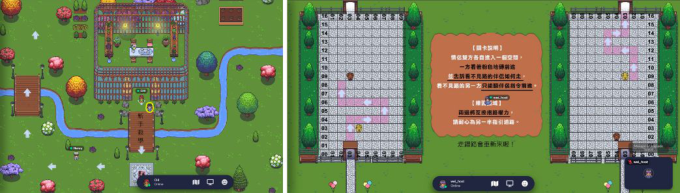
A. Seeing-you Seeing-me The lack of physical intimacy in LDRs inspires us to create some moments of intensive eye contact. At the entrance of gather.town map, a small introdu- ction is given for beginners (Fig. 1-left), the couples will enter a space for the first task. In this room, the long-distance couples are asked to look at each other via video stream, carefully observe their facial features, and draw the partners’ faces on a virtual whiteboard (featured by Eraser) in the room.
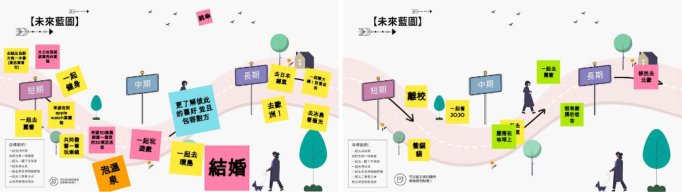
B. Drawing Our Future For LDR couples, whether they shall have a “joint future” is the significant commitment to maintaining a relational bond. However, this idea largely depends on whether they are managing it properly. After the couples leave the first room and take a walk on the map, they will enter the second special area. There is a bulletin board (featured by Google Jamboard) with some instructions. Couples are asked to discuss with each other and pin their future goals – from close to far-future – onto it.
C. Follow Me After the two tasks, the couple will travel to the third level. A labyrinth with dense fog lies in front of them. Two entrances are waiting for each one of them. When they move into their own path, they notice that the labyrinth has mirrored two parts. One is walking on the part with guidelines showing on the ground; the other one is walking in fog without seeing where s/he is (Fig. 1-right). The one walking on the clear ground has to guide her/his partner to move in the fog. Any wrong move will transmit the player back to the start point. Later in the labyrinth, the fogged and clear grounds change. Now, the one who was guided by the other has to make guidance.
Taking a Romantic Adventure Together: Explore the Design of Virtual Travelling 183
Figure 1: The maze and missions on gather.town.
D. The End At the end of their journey, the couple can look at their achievements as a small reward for their adventure.
PROCESS Two long-distance heterosexual couples (four participants aged 23 to 28, stu- dents) were invited to travel together on our map. They were first interviewed about their relational situation and then joined the map online. The first author played the role of NPC on the map, observed the participated cou- ples, and recorded their interaction. After the travel, they were interviewed again and asked to fulfill the questionnaire to evaluate their experience. The complete experiment took about 2 hours. In the end, the participants were given a small gift for gratitude.
The questionnaire included an overall evaluation and four scales, which are PANAS (Watson et al., 1988; 20 items), Memorable Tourism Experie- nces Scale (MTE Scale; Chandralal & Valenzuela, 2015), Needs Fulfilment Scale (FFS; Sheldon et al., 2001; Hassenzahl et al., 2010) and Game Experi- ence Flow Scale (GEF Scale version 4; Fang et al., 2013). Four scales make up the questionnaire of this study. PANAS tests participants’ emotional pro- files with ten positive emotions and ten negative emotions. The original MTE Scale has ten constructs. Among them, three do not fit an online adventure. The rest seven are self-beneficial experience, novel experience, affective emo- tions, perceived significance, social interaction with people, serendipitous and surprising experience, and fulfillment of personal travel interests. We select a nine-constructs Needs Fulfilment scale, including autonomy, relatedness, security, stimulation, self-esteem, physicalness, competence, popularity, and meaningfulness. GEF Scale has six parts: challenge & skill balance, clear goals, concentration on task at hand, paradox of control, immersion, and autotelic experience.
RESULT
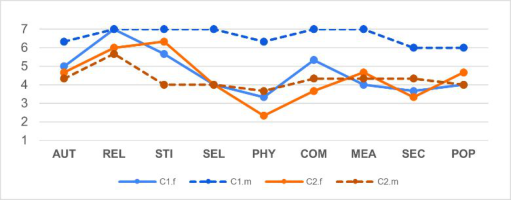
An Overview The profile of FFS (Figure 2) shows a generally higher score on relatedness, indicating a joint experience during the experiment. On the analogy of tra- vel, the MTE Scale shows a consistent result: Both members of couple 1
184 Huang and Chien
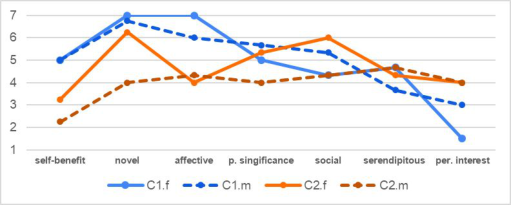
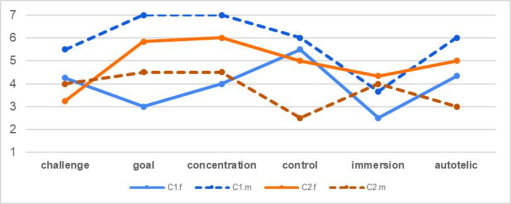
Figure 2: Result of the Needs Fulfilment Scale.Figure 3: Result of the Memorable Tourism Experience Scale.Figure 4: Result of Game Experience Flow Scale.
C1.f and C1.m consider the experience as more emotional and novel, while C2.m reported a low score on affective emotions (Figure 3). Besides, trave- ling in a virtual world lacks an orientation to the meaning of the location. As a result, the scores on self-benefit experience and personal interests are low, except C2.m. On the analogy of games and comparing to other scales, parti- cipants reported a relatively higher score in the dimension of concentration and goal (Figure 4).
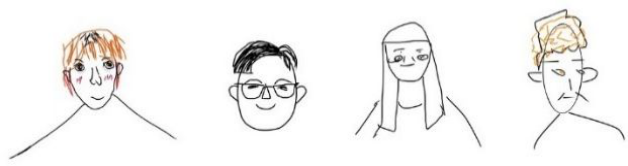
The Three Missions C1 was very engaged in the face-drawing task. They showed curiosity about their look under their partners’ hands. C1.f, “I was thinking that he must have drawn me poorly – he is screwed.” C1.m replied, “That’s because of the mouse. It doesn’t work fine.” C1.f, “anyway, I like this task more than the other.” In fact, C1.m made a quite delicate drawing – with different colors
Taking a Romantic Adventure Together: Explore the Design of Virtual Travelling 185
Figure 5: Portrait of a long-distance couple for a partner.Figure 6: Composed future plans in the second mission.
in his work (Figure 5-left). C2.m was a little absent-minded in the drawing mission. He said, “I was only thinking about how to finish.”
In the second mission, C1 was also more engaged than C2. A well- motivated discussion about their future can be identified (Figure 6). “It reminds me of our former discussion. Many things we have committed for a long time are not done yet. Now, we remember our goals and would like to achieve them” (C1.f). In a later talk with the couple, C1.f told us that “we would think back to our discussion in the experiment, and then we checked our joint goals in life which we have not achieved for a long time […] we think that we should hurry up and finish them.” C1.f also took this task as an opportunity to make wishes, which bothered the partner a little. “Some- one just kept making wishes and disrupted the discussion” (C1.m). On the contrary, C2 reported a low motivation in this task. C1.m, “we never plan. We are more freestyle. At that task, we just made some ideas and put them there.”
In the labyrinth of fog, C1.m found that the mechanism generates some interaction. However, “by just telling her to turn right or left was not very inspiring – something missing” (C1.m). C1.f was depressed when she could not accomplish the task by following her partner’s guide. They made a minor dispute during the interview. In this mission, C2 showed more interest. “For me, walking in the labyrinth was more interesting. Although it requires some cooperation, the mission was easy to me” (C2.f). C2.m, who was not motiva- ted in the previous two missions, was also engaged in the third one. “It was a kind of cooperation […] and required mutual understanding” (C2.m). We inquired about their gameplay experience and found that they are experie- nced players, which leads to a more positive evaluation of the third mission. C2.m, “it was closer to the games that I have played before.”
186 Huang and Chien
Figure 7: Result of negative affection in PANAS.
Joint Action: Side by Side vs. Walk-Behind While the first mission aims to enhance non-verbal interaction (eye contact) and the second verbal communication, the third mission has a more complex construct. We can identify two different practices from C1 and C2. C2 are both experienced game players. C2.f, “When walking in the labyrinth, coo- peration with each other is highly needed. The games we used to play were all for single-players, but now we are trying to fight together.” C2.m could quickly identify the mechanism of the labyrinth, “there is a separation in the middle, the two other areas are the opposite. To work together, we need much tacit understanding.” As a result, the labyrinth was too easy for them. The perceived challenge was scored low (Figure 4).
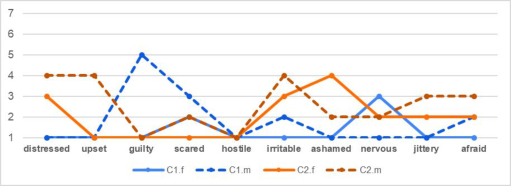
As for C1, C1.m played some computer games and found a walk-through strategy. However, C1.f, as an inexperienced game player, was in trouble. As a result, she played in a highly dependent way. “In the game, because he is very good at playing games, he led me in the game” (C1.f). C1.m found a shortcut (a bug in our design) and tried to guide C1.f to follow his trick. However, while C1.m’s guidance could not lead his partner to get out of the trouble, the C1.f’s trust became dissatisfaction. An interesting communication in the interview: C1.m, “I just tried several times and could go through it […] you just have to make several tries, and then you will get the idea.” C1.f, “but the point is that our cooperation was expected in this mission! […] You may be right, but we have to inform each other about how our cooperation should go on or, at least, discuss how our situations were.” C1.m, “but I didn’t know how to explain the situation. It was difficult to describe. When you talked about your situation, I could not understand.” C1.f, “well, fine!” The broken cooperation is reflected in their reported PANAS. C1.m has a high score on the guilty – for being unable to help his partner.
DISCUSSION & CONCLUSION This study proposes an online trip designed for LDR couples and serves as an initial exploration of design possibilities. We identified some characters in participants’ experiences. However, the result should be understood as potential considerations for future design but not generalizable theory.
In the experiment, our couples experienced joint activities they had not done before, such as playing games online, drawing each other, reviewing their joint future, and breaking through obstacles. While we designed the
Taking a Romantic Adventure Together: Explore the Design of Virtual Travelling 187
experience on a virtual map, the overall experience was more like a game or task rather than a journey. “A game has a planned route, while a journey is freer without limitation”(C1.f). C2.m, “the experiment was like a task to per- form or a problem to solve, which was quite goal-oriented.” C1.m, “maybe combining the tasks with google maps is a good idea. It would become an adventure or journey.” A combination of a virtual space with real world would be our future mission.
Drawing each other’s faces to promote intimacy worked well as a warm- up for couples to start a joint journey. In this process, the couples made kind chats and looked at each other carefully through the video screen. We observed a relaxing and fun-making interaction. Although they expressed concerns that their partners’ portraits would be done unlovely, the final works were just a droll to make both parties laugh.
Planning the future together packaged in a joint online task requires cou- ples’ motivation to initiate. From our observation, couples started with aimless chats and gradually went through a Q&A pattern. We noticed that planning for the future could be misinterpreted as making promises, in which an expression of personal wish become powerful and potentially dangerous.
To the enhanced interaction possibilities for LDR, we see different practices and strategies in the participants’ experience. Since all physical performance can only be done independently, discussion and decision-making can only achieve their mutuality. The virtual map created a condition of alienation, where couples were demanded to communicate and understand each other’s needs and ideas. In the experiment, the two couples could listen to their partners patiently most of the time, while they sometimes encountered poor communication. However, after more intense communication, they also coor- dinate their goals. Besides, different coordination is possible. Couples could stand side by side and play their role equivalently with mutual trust, or they could also align themselves in a dependent relationship and play the leader’s and follower’s roles.
Overall, we saw the potential of a virtual space for an intimate adventure. While an amusing adventure seldom exists in real life, this study demonstrates an alternative. We also show that mutual support and relational reflection need to be considered in the design of their journey experience.
REFERENCES
Aylor, B. A. (2003). Maintaining long-distance relationships. In D.J. Canary & M.
Dainton (Eds.), Maintaining relationships through communication: Relational, contextual, and cultural variations (pp. 127–140). Lawrence Erlbaum Associates. Brown, D. (2021). What is the ‘metaverse’? Facebook says it’s the future of the internet. https://www.washingtonpost.com/technology/2021/08/30/what-is- the-metaverse/ Chandralal, L., & Valenzuela, F.-R. (2015). Memorable tourism experiences: Scale
development. Contemporary Management Research, 11(3), 291–310. Chien, W. C., & Hassenzahl, M. (2020). Technology-mediated relationship maintenance in romantic long-distance relationships: An autoethnographical research through design. Human-Computer Interaction, 35(3), 1–48.
188 Huang and Chien
Chien, W., Hassenzahl, M., & Welge, J. (2016). Sharing a robotic pet as a maintenance strategy for romantic couples in long-distance relationships: An autobio- graphical design exploration. Extend Abstract of CHI’16 Conference on Human Factors in Computing Systems. Cortes, K., Britton, E., Holmes, J. G., & Scholer, A. A. (2020). Our adventures make
me feel secure: Novel activities boost relationship satisfaction through felt security. Journal of Experimental Social Psychology, 89. Fang, X., Zhang, J., & Chan, S. S. (2013). Development of an instrument for studying flow in computer game play. International Journal of Human-Computer Interaction, 29(7), 456–470. Greenberg, S., & Neustaedter, C. (2013). Shared living, experiences, and intimacy
over video chat in long distance relationships. In C. Neustaedter, S. Harison, & A. Sellen (Eds.), Connecting families: The impact of new communication technologies on domestic life (pp. 37–53). Springer-Verlag. Hassenzahl, M., Diefenbach, S., & Göritz, A. (2010). Needs, affect, and interactive products-facets of user experience. Interacting with Computers 22(5), 353–362. Hassenzahl, M., Heidecker, S., Eckoldt, K., Diefenbach, S., & Hillmann, U. (2011).
All you need is love: Current strategies of mediating intimate relationships through technology. ACM Transactions on Computer-Human Interaction, 19(4). He, L. (2013). Couple collaboration: A design research exploration. Proceedings of CHI’13 Conference on Human Factors in Computing Systems. Kirk, D. S., Chatting, D., Yurman, P., & Bichard, J. (2016). Ritual Machines I &
II : Making technology at home. Proceedings of CHI’16 Conference on Human Factors in Computing Systems. Matkin, B., Pan, R., Neustaedter, C., & Antle, A. N. (2017). Puzzle space: A distributed tangible puzzle for long distance couples. Extended Abstract of CSCW’17 Conference on Computer Supported Cooperative Work and Social Computing. Ball, M. (2021). The Metaverse Primer. https://www.matthewball.vc/the-metaverse-
primer Mueller, F., Agamanolis, S., & Picard, R. (2003). Exertion interfaces: Sports over a distance for social bonding and fun. Proceedings of CHI’03 Conference on Human Factors in Computing Systems. Mueller, F., O’Brien, S., & Thorogood, A. (2007). Jogging over a distance: Supporting
a “jogging together “ experience although being apart. Extend Abstract of CHI’07 Conference on Human Factors in Computing Systems. Pistole, M. C. (2010). Long-distance romantic couples: An attachment theoretical perspective. Journal of Marital and Family Therapy, 36(2), 115–125. Pistole, M. C., Roberts, A., & Mosko, J. E. (2010). Commitment predictors: Long-
distance versus geographically close relationships. Journal of Counseling and Development, 88(2), 146–153. Rempel, J. K., Holmes, J. G., & Zanna, M. P. (1985). Trust in close relationships.
Journal of Personality and Social Psychology, 49(1), 95–112. Sheldon, K. M., Elliot, A. J., Kim, Y., & Kasser, T. (2001). What is satisfying about satisfying events? Testing 10 candidate psychological needs. Journal of Personality and Social Psychology, 80(2), 325–339. Watson, D., Clark, L. A., & Tellegen, A. (1988). Development and validation of brief
measures of positive and negative affect: The PANAS scales. Journal of Personality and Social Psychology, 54(6), 1063–1070.
LISTED IN THE AHFE DIGITAL BOOKSTORE CATALOGUE
Explore the complete digital volume
Human Factors in Virtual Environments and Game Design
Read this individual research paper free through the original publisher, or explore the full digital proceedings book.
ISBN 978-1-958651-26-1
Explore this ISBN in the AHFE Bookstore ↗Listed in the July 2026 bookstore catalogue; search by ISBN to confirm current availability · Digital book purchase optional