Herwig Zeiner, Roland Unterberger, Dietmar Maurer, Silvia Russegger, Lucas Paletta (2022). Office-Based Workplace Monitoring and Time-Aware Feedback by using Ambient IoT Sensors. In: Cognitive Computing and Internet of Things. AHFE Open Access, vol. 43, pp. 16–22. https://doi.org/10.54941/ahfe1001834
During the COVID pandemic, our understanding of a workplace (e.g. office building, home office, other offices) has changed. For example, we are constantly changing our workspace in office jobs. It is a post-COVID phenomenon that we change our work environment more frequently and more often during a week. In this paper, we investigate what sensors and software tools we need to determine that we are working in ideal conditions, including good air quality, low CO2, etc. From an employee’s point of view, it is interesting if such monitoring devices can be easily used and combined. The evaluation should be possible and combinable by simple means. Why is this difficult? Considering that there is no common agreement among researchers on the definition of workplaces and new hybrid workplaces (i.e. office in company building, home office, and third office places) make the challenges even more complex. In this context, quantitative data from novel low-cost biosensors, such as for measuring carbon dioxide concentration distribution, highlighting the presence and attention of employees and their change in behavior within a working environment, are discussed, and the paper also provides an outlook towards novel research pathways for using a connected network of IoT devices and ambient biosensor technologies.
In this work, we explore a relevant building block for deeply and highly con- nected physical and digital workspaces. Recent technological advances such as the Internet of Things (IoT) and networked biosensors opened up new possibilities for assessing our workspaces.
First, employee engagement (Alshaabani 2022) has recently become an issue in businesses. On the one hand, every employer is obliged to create a healthy work environment, and on the other hand, every employee must be interested in working in such a healthy environment. Thus, it is in both interests to provide a healthy environment at a workplace. As a post-COVID phenomenon, we consider indoor air pollution (Seguel 2017) in this paper. This kind of air pollution is 2 to 5 times higher than outdoors, but people didn’t care about it before COVID.
Office-Based Workplace Monitoring and Time-Aware Feedback 17
The availability of data enables the evaluation of a range of new usage strategies, such as the analysis of long-term trends and psychophysiological parameters related to well-being.
Second, these networked IoT devices help us gain new views on how to interpret these new flexible office workspaces in a very different way. Emplo- yees gain an overview of their work environment and the environment they use. In this way, they gain new responsibilities (e.g., air quality, CO2 levels, humidity) and awareness of their personal environment and become engaged workers.
Finally, data collection and management alone do not add value to data- driven applications and users. It is necessary to process this data to create meaningful services and make the right intelligent decisions at the right time. With this in mind, we use a flexible IoT platform to manage data, devices, and services.
RELATED WORK
There are a number of factors that we must consider in our approach. The- refore, we describe the state of the art in several relevant topics in the field of low-cost biosensors with a clear focus on CO2 sensors and the cogni- tive effects. Furthermore, we can consider other relevant environmental aspects (Ortiz 2022). Finally, the technical viewpoint was also taken into consideration.
First of all, we spend about 90% of our time indoors (Leech 2002). The- refore, indoor air quality (IAQ) is the most important indicator of a healthy working environment. The term IAQ is defined as the quality of air within buildings (Wolkoff 2018). This indoor air quality is an important factor for our health and well-being (Seguel 2017). In addition, it has also been stu- died that good air quality can increase our cognitive performance. There are numerous studies on this topic. Every person emits CO2 when breath- ing, for example, and the occupancy can be inferred from the concentration determined (Jiang 2016). The available CO2 serves as an indicator of poorly perceived indoor air quality.
In a study of 50 classrooms, Wargocki (Wargocki 2005) found significant correlations between pupils’ cognitive performance and the CO2 concen- tration. For example, higher concentrations were correlated to significantly poorer mathematics test scores. There were also correlations at reading tests, but not statistically significant. Further research work was carried out in Satish (Satish 2012). Humans were exposed in double-blind experiments to 600, 1000, and 2500 ppm CO2, whereby the concentration was generated by means of synthetic CO2. Relative to the results at 600 ppm, the cognitive results were significantly worse with increasing CO2 concentration. Further studies were done with office works in Allen (Allen 2016). Moreover, a good working environment also increases the motivation of employees (Alshaa- bani 2022). There are numerous works on this subject. Furthermore, people complain of certain building-related symptoms even when their workspaces comply with the guidelines (Bluyssen 2020). The indoor office environment with its occupants is a complex system in which many factors contribute
to both satisfaction and health effects (Altomonte 2020), which may vary depending on the situation (Bluyssen 2014).
Finally, there is also a technical dimension. We need new low-cost sensors to measure CO2 levels or, for example, air pollutants including temperature and humidity. It is a COVID pandemic phenomenon that there is much more focus on this aspect, and many low-cost sensors have come on the market to measure air quality in offices. They are either wireless or wired and can be deployed in the buildings (Jung 2019). Suitable indoor conditions are very essential in our working spaces. It is also relevant to get easily the data by using the Web of Thing principle (Zeiner 2016). In general, data is collected, processed, and enriched with contextual information, e.g. time and space (Zeiner 2021a). It is a fact that the data is independent of the infrastructure. To ensure that data is temporally correct and retains its validity, timestamps are added to the data sets. Usually several timestamps are considered here, such as creation time and reception time. Time-stamped data is independent of the infrastructure. These overall process and relevant computing units are described in a recent publication (Zeiner 2021b). For the overall processing, time-awareness and location are further relevant information.
WORKPLACE MONITIORING SYSTEM SET-UP BY USING AMBIENT IOT SENSORS IoT applications follow a typical methodical approach. First, sensor boxes with the appropriate sensing functions and a wireless protocol are selected. Afterwards, it is determined where the sensors should be deployed. The inter- play of positioning and transmission range is essential in building these IoT networks. This is especially relevant when working with wireless networks. The second step is to determine where and how the data will be colle- cted, analysed, and visualized. The final step is to interpret the results and incorporate them into the established process.
The main components are distributed sensor boxes, a cloud-based IoT platform, and a mobile interface.
Sensor Boxes: To check the health of our working environment, we need flexible mobile sensor boxes with low-cost biosensors (e.g. temperature, humidity, and air quality). This sensor infrastructure can be easily instal- led, transported, used, and combined. These are the main challenges for monitoring the ever-changing environmental condition of our working envi- ronment. Finally, we want to make the process as convenient as possible. Few biosensors should be as easy as possible to take with us and use in the new working environment. Creating a healthy workplace environment and equipping it with a flexible, low-cost sensor box is a key advantage for the future. The use alone increases self-motivation and shows the commitment of the employees. A healthy environment also increases well-being and that is a good prerequisite to perform well.
As an outcome, we finally use a very flexible sensing solution, based on low-cost biosensors. As a result of our evaluation of different sensors, we finally use a very flexible sensor box based on low-cost biosensors. This sensor box is also a gateway. The data is transmitted directly to an
Office-Based Workplace Monitoring and Time-Aware Feedback 19
IoT platform via WLAN. The sensor boxes can also be used on site with Bluetooth.
Sensor Box position and relevant environmental consideration: Aerosols are mixtures of solid or liquid particles in a gaseous phase like air. Environ- mental aerosol particles vary greatly in size and diameters. Particles small enough remain airborne for hours to days. It is important to know that aerosols are generally not stable and change over time depending on humi- dity, temperature, and other physical and chemical processes. Aerosols may also contain bacteria and viruses. Effective ventilation (exchanging indoor air with outside air) can reduce the concentration of infectious particles in the indoor air.
In the case of window ventilation, cross-ventilation, which quickly exch- anges indoor air with fresh air via a draught, is optimal. Also effective is a “shock ventilation” with a wide open window (even better with several win- dows in one room at the same time) for a few minutes. For effective protection against infection, rooms where many people are working should be ventilated well and as often as possible. In conference rooms or big open office places or even in home office environments, ventilation is also required to reduce carbon dioxide levels during work hours.
In the case of highly infectious viruses like the COVID19 virus it should be noted that, beyond ventilation, other measures such as wearing mouth- to-nose covers, keeping a distance, and an adapted occupancy schedule are important to avoid direct infections. CO2 measuring devices should not be placed anywhere where there is a draught. Near a half-open window or something similar it is also useless, because the CO2 levels are proba- bly much higher at a place with lower ventilation, and therefore falsify the CO2 concentration level recorded by the sensor. The sensors should be placed as close to a person as possible. It is of no use to measure in a corner when people are sitting at the window and the bad air practi- cally does not reach the measuring device at all. With our low-cost and very small device it is of advantage that the person using it can place it directly next to her or his workplace. If there is permanently bad air, then at some point it also becomes tiresome. In this respect, productivity will most probably be reduced and fresh air could lead to an improvement of productivity.
IoT Platform: The IoT platform will support sensor box management, data management, and data analysis. The IoT platform will support users in deci- sion making. It will also provide an API for importing/exporting data. In this way, the data can be extracted for further analysis, are processed and the results are fed back into the platform. The chosen platform is cloud-based and offers a web- and app-based user interface. It can be used independently of the workplace.
EXPERIMENTS AND FIRST RESULTS For analysis, data were recorded on several days in work offices and in home office. The sensor boxes were always placed close to the person. In all experi- ments, the same sensor box was used in every case. The sensor boxes measure
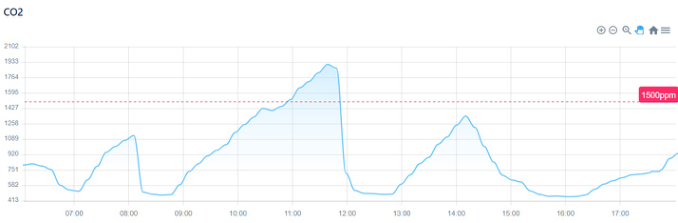
Figure 1: Two samples from our recordings. The picture above shows the measure- ment from the home office (3/2/2022) and the picture below the measurement from the workplace at the company (9/2/2022).
CO2 as well as humidity and temperature. Relatively accurate sensors for the measurements were used. The values were recorded every 10 minutes. To be able to compare this situation, similar room sizes were used. There was alw- ays only one person in the room during all the experiments. The data was sent from the sensor box to a cloud environment. A sensor box was also selected where the data could be exported for further investigation or also integrated into other applications using an API.
Afterwards, as specific evaluation, we focused particularly on the CO2 content in the rooms. Therefore, the CO2 values were recorded on several days. Figure 1 shows samples from two days, one in home office and one at the workplace in the company. The sensor boxes that were used to measure CO2 for the evaluation are located near the person in the office spaces (work- place in company or home office). From these experiments, we have derived a number of interesting insights. In both figures, one can clearly see when ventilation took place. A clear drop in the values is visible. Differences in the drop of the curve can result from room and window size. With closed doors and windows in the room, you can always see a significant increase in CO2 content. If a person leaves the room for a certain time, this curve flattens. It also shows that breaks are also regularly paused.
Finally, the person in the room is also informed with the help of the sensor whether it should be ventilated. In this case, the sensor box flashes red. How- ever, it turned out that this signal was not always perceived (see the second part in figure 1). This happened in very intense work periods when a high concentration on the task was needed.
Office-Based Workplace Monitoring and Time-Aware Feedback 21
CONCLUSION
In summary we are now paying more attention to indoor air quality after the COVID pandemic. This will not detect every infection of e.g. COVID-19. We cannot promise that our equipment will prevent infection, but we are paying attention to air quality. In this way, it definitely contributes to the well-being of employees.
However, with our system setup using a flexible IoT cloud-based IoT plat- form, monitoring CO2 is possible and this could raise the awareness of the person using it. The goal is to motivate that person to remember that a high CO2 concentration can increase the risk of infection and remind them to ventilate the room regularly. We hope that the added benefit and the still important value of such measurements in the future can lead to cleaner and healthier air at the workplace, thus increasing productivity, but most importantly contributing to our well-being.
ACKNOWLEDGMENT
The work is partly funded by the K-Project Smart@Surface. The project is funded within the context of COMET Competence Centers for Excel- lent Technologies by the Federal Ministry for Climate Action, Environment, Energy, Mobility, Innovation and Technology (BMK), the Federal Ministry for Digital and Economic Affairs (BMDW), and the federal states of Styria and Carinthia. The program is conducted by the Austrian Research Promo- tion Agency (FFG). The authors are grateful to the institutions funding the Smart@Surface project.
REFERENCES
Allen, J. G., MacNaughton, P., Satish, U., Santanam, S., Vallarino, J., & Spengler, J.
D. (2016). Associations of cognitive function scores with carbon dioxide, venti- lation, and volatile organic compound exposures in office workers: a controlled exposure study of green and conventional office environments. Environmental health perspectives, 124(6), 805–812. Alshaabani, A., Hamza, K. A., & Rudnák, I. (2022). Impact of Diversity Management on Employees’ Engagement: The Role of Organizational Trust and Job Insecurity. Sustainability, 14(1), 420. Altomonte, S. et. al. (2020). Ten questions concerning well-being in the built
environment. Building and Environment, 180, 106949. Bluyssen, P. M. (2014). What do we need to be able to (re) design healthy and comfortable indoor environments?. Intelligent Buildings International, 6(2), 69–92. Bluyssen, P. M. (2020). Towards an integrated analysis of the indoor environmen-
tal factors and its effects on occupants. Intelligent Buildings International, 12(3), 199–207. Jiang, C., Masood, M.K., Soh, Y.C., Li, H. (2016). Indoor occupancy estimation from carbon dioxide concentration. Energy and Buildings 131, 132–141 Jung, W., Jazizadeh, F. (2019). Human-in-the-loop HVAC operations: A quantitative
review on occupancy, comfort, and energy-efficiency dimensions. Applied Energy 239, 1471–1508
Leech, J. A., Nelson, W. C., Burnett, R. T., Aaron, S., & Raizenne, M. E.
(2002). It’s about time: a comparison of Canadian and American time–activity patterns. Journal of Exposure Science & Environmental Epidemiology, 12(6), 427–432. Ortiz, M. A., & Bluyssen, P. M. (2022). Profiling office workers based on their selfreported preferences of indoor environmental quality and psychosocial comfort at their workplace during COVID-19. Building and Environment, 108742. Satish, U., Mendell, M. J., Shekhar, K., Hotchi, T., Sullivan, D., Streufert, S., & Fisk,
W. J. (2012). Is CO2 an indoor pollutant? Direct effects of low-to-moderate Seguel, J. M., Merrill, R., Seguel, D., & Campagna, A. C. (2017). Indoor air quality. American journal of lifestyle medicine, 11(4), 284–295. Wargocki, P., Wyon, D., Matysiak, B., & Irgens, S. (2005). The effects of classroom
air temperature and outdoor air supply rate on performance of school work by children. In Proceedings of Indoor Air 2005, The 10th International Conference on Indoor Air Quality and Climate, Beijing, China (pp. 368–372). Wolkoff, P. (2018). Indoor air humidity, air quality, and health–an overview.
International journal of hygiene and environmental health 221(3), 376–390. Zeiner, H., Goller, M., Expósito Jiménez, V. J., Salmhofer, F., & Haas, W. (2016).
SeCoS: Web of things platform based on a microservices architecture and sup- port of time-awareness. e & i Elektrotechnik und Informationstechnik, 133(3), 158–162. Zeiner H. and Unterberger R. (2021a). Time-aware Data Spaces - A key Computing Unit in the Edge-to-Cloud Continuum, 2021 8th International Conference on Future Internet of Things and Cloud (FiCloud), 2021, pp. 250-255, doi: 10.1109/FiCloud49777.2021.00043. Zeiner, H., Paletta L., Aldrian J., Unterberger R. (2021b). Cognitive Living Spaces
by Using IoT Devices and Ambient Biosensor Technologies. In: Ayaz H., Asgher U., Paletta L. (eds) Advances in Neuroergonomics and Cognitive Engineering. AHFE 2021. Lecture Notes in Networks and Systems, vol 259. Springer, Cham. https://doi.org/10.1007/978-3-030-80285-1_47
LISTED IN THE AHFE DIGITAL BOOKSTORE CATALOGUE
Explore the complete digital volume
Cognitive Computing and Internet of Things
Read this individual research paper free through the original publisher, or explore the full digital proceedings book.
ISBN 978-1-958651-19-3
Explore this ISBN in the AHFE Bookstore ↗Listed in the July 2026 bookstore catalogue; search by ISBN to confirm current availability · Digital book purchase optional