Saeko Imura, Ryuichi Yamazaki, Noriko Hashida (2022). Suggestions to Make Working in a Sitting Chair more Comfortable. In: Kansei Engineering. AHFE Open Access, vol. 40, pp. 23–28. https://doi.org/10.54941/ahfe1001756
Telecommuting is now being promoted as a way to prevent the spread of COVID-19. The amount of money distributed in the seat category on the Rakuten market in April 2020 was a significant 280% higher than the same month last year. This shows that more and more people are using a seating chair to work on their computers in order to improve the environment for working at home. However, the 2016 study found several issues with working in a seated chair, such as poor posture and problems due to the height between the chair and the table. Therefore, the purpose of this study is to identify the factors that cause problems when using a sitting chair and the factors that make work comfortable, and to make suggestions accordingly.First, we conducted a basic experiment to identify problems when working in a sitting chair. From this result, this study proposes a cushion that makes PC work in a sitting chair more comfortable and a device that assists in standing up. The flow of the research is to pursue the functionality of the cushion itself, and then to clarify the elements of the necessary functions as a stand-up aid, and to consider adding these functions to the cushion.Experiments were conducted on existing smartphone cushions to identify factors that make working with them comfortable. Based on the experimental results and discussions, the height was set to 150mm and the size was set according to the results of the experiment. The surface is made of leather to improve stability.When we conducted a market survey on standing aids, we found that most of the ready-made products were pricey because they were for nursing care, and their appearance did not fit in with the interior design. In addition, most of them were over 300mm in height and required the user to stand up by grabbing the device with their hands, which is not familiar in daily life.In the end, we produced a final proposal that incorporated a standing aid into the cushion. Inside, a mixture of beads and cotton was placed in the gaps between the auxiliary devices to further enhance stability.The following five elements of peripheral devices that make working in a sitting chair comfortable were identified in this study.1) the height of the cushion should be 150mm, 2) the base of the cushion should be large enough to hold both arms, 3) the surface on which the PC is placed should be made of frictional material, and the surface in contact with the legs should be soft enough to fit the legs, 4) The auxiliary aid should be 300 mm in height, 5) The upper part of the auxiliary aid should be made of a material that fits the hand and makes it easy to find a place to place the hand.
In order to prevent the spread of COVID-19, telework, which allows people to work from home, has recently been recommended (Ministry of Inter- nal Affairs and Communications, 2021). At Nitori Holdings, which sells furniture and household goods, mail-order sales accounted for 9.7% of con- solidated sales, up 2.9 percentage points from the previous year, and data shows that e-commerce-only products, mainly large furniture such as chairs are driving strong mail-order sales (Ohta, 2021). These indicate that more and more people in Japan are using seating chairs to work on their PCs in order to create a work-at-home environment.
While the demand for seating chairs is increasing, most of the papers on seating chairs are for nursing care purposes, such as (Kajihara, 2014) and (Shinbori et al., 2011), and there are few papers on the use of seating chairs by able-bodied people when they work long hours, such as teleworking. The basic experiments in this study have revealed several stresses associated with working in a sitting chair. The experiment was conducted by having the sub- jects sit in a chair for 30 minutes for evaluation and observation. (1) relax and watch TV from two meters away, (2) look for photos on a smartphone, (3) place a PC on a table and type a sentence, and (4) stand up from a chair. The subjects were four in total, two males and two females. As a result, many people answered that they felt stressed because the height of the low table and chair did not match, causing them to lean forward in posture while working at the PC, putting a strain on their back and hips.
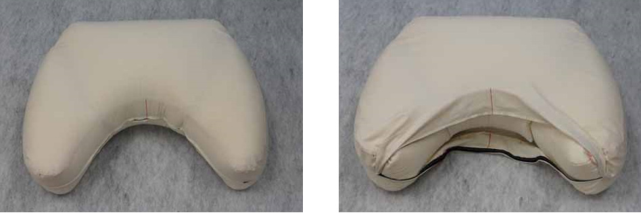
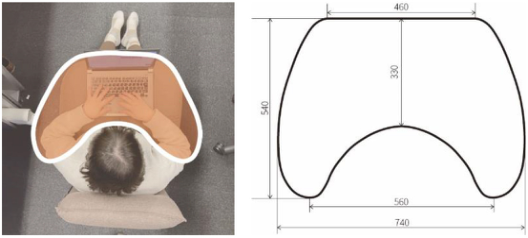
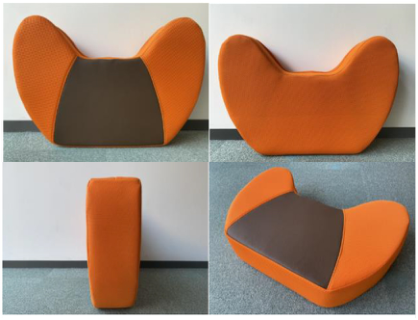
Figure 1: Cushion model that we made.Figure 2: Size of the cushion model produced.
Therefore, instead of a low table, we propose a PC cushion to be used with a seating chair, which is easy to adjust the height by yourself and easy to introduce in a space-saving manner.
PRODUCTION AND EVALUATION OF PC CUSHION MODELS First, we conducted an experiment of PC work using a cushion for smartph- ones (made by Yamazaki) as a base for PC cushions. As a result, it became clear that “the height of the work surface,” “stability when using the keybo- ard,” and “the size of the top surface as the work space” were important for work comfort.
Therefore, we made a model of a PC cushion for experimentation (see Figure 1). Experiments with existing products showed that the lack of elbow support by cushions put a strain on the wrists. Therefore, the shape of the cushion was to be such that a PC (13-15 inches) could be placed in the center and arms could be placed naturally on either side (see Figure 2). We also took into consideration that the PC should be large enough to be used at least 40 cm away from the eyes, referring to Fujitsu’s notes on using laptops (Fujitsu).
Evaluation Experiments With Different Sizes This size is available in three different heights: 150mm, 170mm, and 190mm. Using these cushions, we conducted an evaluation experiment to see how the height felt, how the size felt, and how the stability felt. Each subject was asked to work on a PC for 10 minutes. The evaluation experiment was conducted with a 5-minute break in between so that fatigue from the work would not
Suggestions to Make Working in A Sitting Chair More Comfortable 25
Table 1. Evaluation of each cushion height.
Table available in the original PDF paper.
Table 2. Relationship between the height of the subject and the height of the cushion.
Table available in the original PDF paper.
affect the results. The content of the PC work was left up to the subjects. The subjects were 18 students of the university, 9 males in their 20s and 9 females in their 20s.
The first thing to evaluate is the height. After each operation, a question- naire was given to the participants to evaluate the subjectivity on five levels: “low,” “rather low,” “just right,” “rather high,” and “high”. The ratings at each of the three heights are shown in Table 1. The most common answer was “just right” when the height was 150mm. However, one-third of all respon- dents answered that it was “just right” even at 170mm. In order to clarify whether this tendency is influenced by height, the following analysis was conducted (see Table 2).
Next, we conducted an experiment on the size of the work surface. A questionnaire was used to subjectively evaluate the work space in five levels: “small,” “rather small,” “just right,” “rather large,” and “large. As shown in Table 3, it can be said that the maximum number of people increa- sed as the height increased. Although the size of the work surface itself did not change, some respondents reported that the size of the work surface increased as the height increased.
Results and Discussion of the Experiment Using Cushions of Different Heights From the above results, it can be said that the height of 150mm is the most suitable for PC work, since the largest number of people answered “the height
Table 3. Size evaluation for each cushion height.
Table available in the original PDF paper.
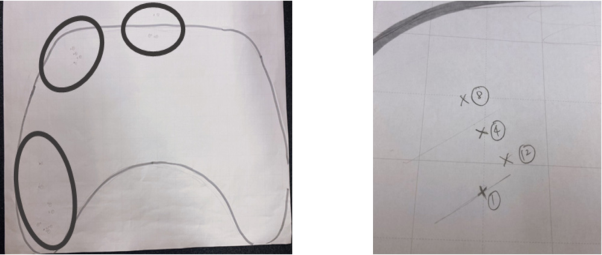
Figure 3: Experimental results for setting the ideal top surface sizes.
is just right” and it was evaluated regardless of their height. From the obse- rvation results, it is possible to adjust the height slightly depending on how the legs are placed, so the height of the cushion is decided to be 150mm. On the other hand, the size and stability remained an issue. Regarding the size, some people felt that the top size was a little large when the cushion height was 150mm. Also, some people answered that the size of this experimental model was too large considering that they would actually use it at home. As for the stability, no constant sense of stability was obtained at any height. From the interviews at this time, it became clear that there were two types of instability, the first being “the PC slipping on the work surface” and the second being “the cushion not blending with the legs. These can be solved by adjusting the type of material in the cushion.
Determine the Optimum Top Surface Size for Your Work Next, an experiment was conducted to determine the optimal top surface size for working on a cushion with a height of 150mm. After having the subjects work on the PC for 10 minutes, we asked them to indicate the position of the size they thought was ideal by placing a sticker on it, and the results were tabulated (see Figure ). The content of the PC work was left up to the subjects. The subjects were 18 students of our university, 9 males in their 20s and 9 females in their 20s.
Suggestions to Make Working in A Sitting Chair More Comfortable 27
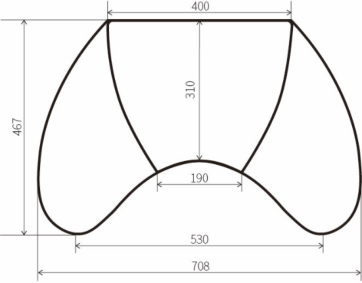
Figure 4: Size of the final proposal.Figure 5: PC cushion for final proposal.
Experimental Results and Discussion on Top Surface Size and Stability Based on this result, we changed the size to the one shown in Figure 4. As for the stability during work, the instability caused by the PC sliding was solved by using a leather material on the top surface of the cushion. The instability caused by the cushion not blending with the legs was solved by using a two- layer cushion structure, with beads and cotton on the leg side and urethane foam on the PC side.
CONCLUSION
In this study, we clarified the stress of working in a sitting chair during telework, and aimed to solve it by proposing a cushion for PCs. Through questionnaires and interviews, we aimed to achieve comfort for users from three major perspectives: cushion height, top surface size, and stability. The proposed PC cushion has a height of 150 mm and the top size is shown in Figure 5. In addition, the materials built into the cushions were made compo- site to increase stability. As a result of the final verification experiment with
12 students (5 males and 7 females), the average value was 4.58 in the overall evaluation (5-step subjective evaluation of the comfort of the work). About 60% of the subjects gave a perfect score of 5, and no one gave a score of less than 3. However, there was some variation in the evaluation of stability. In addition, comfort is thought to be related to the material and color of the cover, room temperature, and humidity, and these should be future issues.
REFERENCES
Fujitsu. (2021) Posture when using a computer, Fujitsu Website: https://www.fujits u.com/jp/about/businesspolicy/tech/design/ud/vdt/index-page3.html Kajihara Akira. (2014) “Development of a seat elevating wheelchair with seat
function”, Life Support Society of Japan, Vol. 26, No. 1, p. 33. Ministry of Internal Affairs and Communications (2021) Proactive use of telework as a countermeasure against new coronavirus infections, Ministry of Internal Affairs and Communications Website: https://www.soumu.go.jp/main_sosiki/joho_tsusi n/telework/02ryutsu02_04000341.html Ohta Shunsuke. (January 14, 2021) “Nitori HD’s mail-order sales up 59% in the
third quarter, maintaining strong sales on nest egg demand”, Japan Net Keizai Shimbun Website: https://netkeizai.com/articles/detail/2746 Shinbori Masahito, Sadahiro Keisuke, Murao Yashio and Nakatsuji Takeshi (2011).
“A study on application of new type linear drive unit: application to the assistant chair use for standing up”, in: Journal of Japan National College of Technology, Vol. 16, No. 3, pp. 17–22.
LISTED IN THE AHFE DIGITAL BOOKSTORE CATALOGUE
Explore the complete digital volume
Kansei Engineering
Read this individual research paper free through the original publisher, or explore the full digital proceedings book.
ISBN 978-1-958651-16-2
Explore this ISBN in the AHFE Bookstore ↗Listed in the July 2026 bookstore catalogue; search by ISBN to confirm current availability · Digital book purchase optional