Ryusei Anzai, Wonseok Yang (2022). The Effect of the Visual Stimulus on During Rest About Online Learning. In: Kansei Engineering. AHFE Open Access, vol. 40, pp. 16–22. https://doi.org/10.54941/ahfe1001755
Online learning is spreading rapidly in the field of education with the development of ICT. Online methods are no need to spend time moving and is expected to improve learning effectiveness, but it is more tiring on the physical exhaustion and difficult to maintain concentration for a long time than in-person classes. For those reasons, it is crucial to take appropriate rest in the Physical and mental aspects and recommence learning smoothly. According to Matsui et al.'s research, the faster the visual stimulus is presented, the more humans tend to overestimate the time, which indicates that there is a correlation between visual stimulus and cognitive sense. Thus, we thought it would be possible to provide rest with a high relaxation effect by giving the learner a visual stimulus during the rest time of online learning. In this research, we investigate human’s Kansei to visual stimuli during breaks in online learning. Based on the results, the aim is to propose a resting method with a high relaxation effect. Firstly, we conducted a short-term experiment on how to display the remaining time during the rest time of online learning over a period of 4 days. The results showed that the abstract display of the remaining time was more relaxing than the concrete display. Secondly, we evaluated learners' impressions of visual stimuli during the rest time in online learning, focusing on animation. The results showed that constant, easing, steps, and coming and going animation have different impressions. We found that constant animation tended to have an impression of calmness and stability. We also found that easing animation was average in various senses and that ease-in animation was more likely to have an impression of a distraction than ease-out animation. The steps animation tended to cause psychological anxiety due to its coarseness and roughness. Furthermore, We discovered that coming and going animation was more likely to cause dynamic or flashy impressions. Based on these survey results, we proposed a resting method with a high relaxation effect. Specifically, we proposed a method to abstract the display of the break time and present the animation according to the purpose of the rest. For cooling down, it is better to use constant animation that gives a sense of calmness and stability. For raising the learners' feelings, it is better to use coming and going animation, which tends to be dynamic and stimulating. Other than that, easing animation, which has less emotional change, is considered to be effective. Thus, providing abstract visual stimuli and changing the animation depending on the type of the rest may be effective in helping learners to relax.
Online learning is becoming mainstream, with most educational institutions offering classes online (Statista Research Department, 2022). While online learning does not require moving time and can suggest improving learning effectiveness, it is more difficult to maintain concentration for long spans due to eye fatigue than face-to-face learning (Ikeya, 2017) (Kyoto Univer- sity of Arts, 2020). Various methods are being discussed and systematized to break barriers to online learning (Nakahara, 2020) (Parviz and Azimov, 2020). However, there are few studies on how to take breaks in online classes; according to Jared Spataro (Jared, 2020), online meetings and collaborations are more mentally taxing than face-to-face collaborations. Therefore, it is worthwhile to think about breaks in online learning. Although there are vari- ous break methods, such as Jessica Stillman’s 52-17 rule (Jessica, 2014) and Karasawa’s 15-45-90 rule (Karasawa, 2014), we focused on time perception of visual stimuli. According to Matsui et al.’s study (Matsui and Nakamura, 2017), the more the presentation speed of visual stimuli accelerates, the more we tend to overestimate time, which indicates a relationship between visual stimuli and cognitive sense. Therefore, we hypothesized that providing pro- per visual stimuli to learners during online learning breaks would have a
The Effect of the Visual Stimulus on During Break About Online Learning 17
highly relaxing effect. There are, of course, various online breaks validation studies have tested (Yamazaki, 2019), but most of them have focused on indi- vidual behaviors (Karrie et al., 2016) or the importance of breaks (Mary et al., 2012). However, as far as I know, there is no previous work that addresses the display method. In this study, we will investigate Humans Kansei to visual sti- muli during online learning breaks in order to give learners highly relaxation breaks. Based on this research, we aim to consider a way to provide relaxing visual stimuli during online learning breaks. Additionary, this study defines relaxation as “something that relieves tension. Therefore, breaks with a high relaxation are situations in which it is easy to change one’s mind after the break.
RESEARCH METHODOLOGY We investigated Humans Kansei to visual stimuli during online learning breaks through two experiments.
1. Experiment 1
We experimented with two objectives: to investigate the effectiveness of visual stimuli and to compare abstract and concrete displays. The reason for investigating effective visual stimuli is to verify whether visual approaches are available in providing highly relaxing breaks as a premise. Moreover, the motivation for comparing abstract/concrete displays is that displaying abstract seems to have a more relaxing effect since Fraises concluded that the more often attention is paid to the passage of time, the more we overestimate time (Fraisse, 1984). The experiment is as follows.
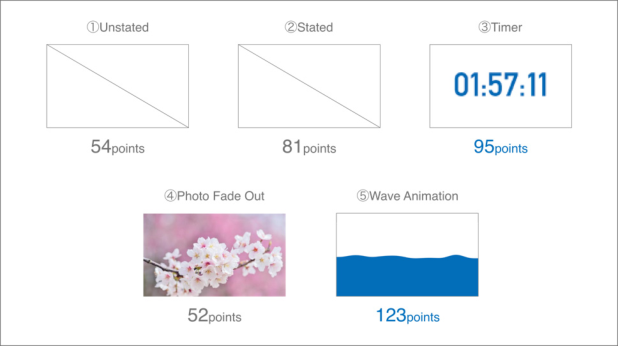
Content: During the 120 minutes of online learning, the subjects take five 2-minute breaks. They break off in different ways and rank the relaxation effect at the end of the class: The first break is “Unstated” with no screen display and no indication of the break time. The second break is “Stated” with no screen display but verbal notification of the break time. The third break is “Timer”, the fourth break is “Photo fade out”, and the fifth break is “Wave animation”.
Subjects: 42 male and female second-year university students taking online classes.
2. Experiment 2
Based on the results of the research 1, we experimented to evaluate the impressions of visual stimuli with a focus on animation. The experiment is as follows.
Content: We asked subjects to watch 10 animated videos of blue colored rectangles filling in from the bottom on a 16:9 full screen for 30 seconds each, and to evaluate them using the SD method immediately after com- pletion. The reason for using the blue color was that Matsuoka pointed out that beige and blue make the mind relax (Matsuoka, 2005). About the SD method, we prepared 15 pairs of items referring some papers (Inoue and Kobayashi, 1985) (Ichihara, 2009).
18 Anzai and Yang
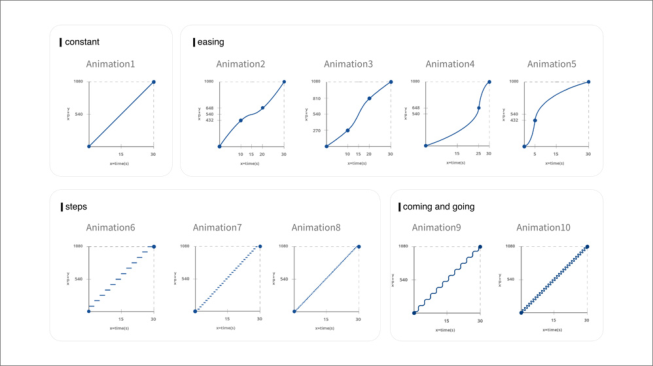
Figure 1: 10 Different Animations used in Experiment 2.
10 Animation: Animation1: constant speed (36px/sec), Animation2: easy- ease (fast, slow, fast), Animation3: reverse easy-ease (slow, fast, slow), Animation4: easy-ease-out (slow, fast), Animation5: easy-ease-in (fast, slow), Animation6: big-step (step forward 90px once every 2.5 seconds), Animation7: medium-step (step forward 36px once every second), Anima- tion8: small-step (step forward 18px once every 0.5 seconds), Animation9: coming and going once every second (72px forward in 0.5 seconds, 0.5px back in 0.5 seconds). Animation10: coming and going once every 5 seconds (180px forward in 2.5 seconds, 90px back in 2.5 seconds).
Categorization of Animations: Using the animation-timing-function of MDN Web Docs as a reference (MDN Web Docs, 2022), we categori- zed Animation 1 as “constant animation”, Animation 2, 3, 4 as “easing animation”, Animation 6, 7, 8 as “step animation” and Animation 9, 10 as “coming and going animation”, and investigated the characteristics of each category.
Subjects: 21 male and female university students taking an online class.
RESULTS
Experiment 1: How to Display Screen on During Break We questioned the subjects about “Which of the five breaks did you find most relaxing? Please rank them”. We scored 5 points to first place, 4 points to second place, 3 points to third place, 2 points to fourth place, 1 point to fifth place, and calculated the total score. The overall result was “Unstated”: 54 points, “Stated”: 81 points, “Timer”: 95 points, “Photo fade out”: 81 points, and “Wave animation”: 81 points.
Considering the visual stimuli, the scores of the animations “Timer”: 95 points and “Wave Animation”: 123 points were higher than those of “Sta- ted”: 81 points without visual stimuli. That suggests that it is possible to
The Effect of the Visual Stimulus on During Break About Online Learning 19
Figure 2: Total score of ranked responses regarding relaxing screen displays.
promote the relaxation effect of learners by providing appropriate visual stimuli.
As for abstract/concrete, the top two items with the highest average sco- res were “Wave animation”: 123 points and “Timer”: 95 points. However, many of them said that the timer made them feel impatient. That implies that abstract displays are more desirable to enhance the relaxation effect.
In addition, the score of “Stated”: 81 points was higher than that of “Unstated”: 54 points. This indicates that it is helpful to present the break time clearly in the break to enhance the relaxation effect.
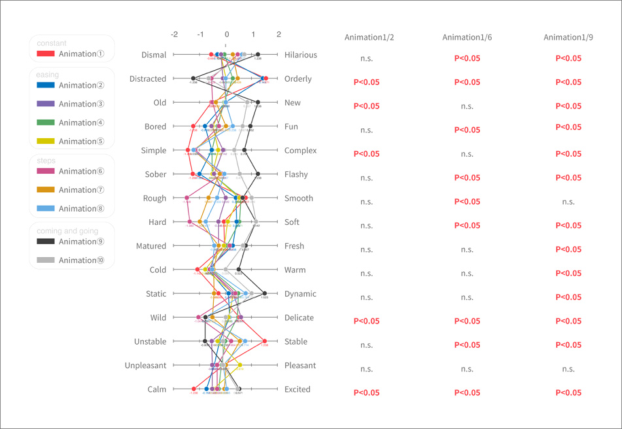
Research2: Impression Evaluation Using by Animation Sample We calculated the mean scores and conducted an analysis of variance using the results of 10 different animations. Analyses of variance were conducted for animations 2, 6, and 9, which are representative of each category, against animation 1, constant speed animation. Then, we calculated p-values.
About the constant speed animation, we surveyed those with the high- est absolute mean values: “orderly,” 1.57; “simple,” 1.42; “Sober,” 1.29; “bored,” 1.24; “stable,” 1.24; and “Calm,” −1.24. These indicate that the animation with constant speed has a cool-down impression.
About easing animation, we obtained the most intermediate result among others. Comparing the mean values of the “distracted” between Anima- tion2,4, which gradually becomes faster and Animation3,5, a group that gradually becomes slower, Animation2,4 are 0.51 higher than the others. That means that the gradually slowing group tended to give an unpleasant impression.
About the step animation, the mean values of the words “Rough,” “Hard,” and “Wild”were higher as animations approach animation 8 to animation 6. That implies that the shorter the time, the rougher the image. In addition, the mean values for positive words such as “fun” tended to be higher as the time became shorter.
20 Anzai and Yang
Figure 3: Calculation of mean scores and analysis of variance for Experiment 2.
About the coming and going animation, the highest absolute mean values of Animation9.10 were “Dynamic” 1.31, “New” 1.05, “Cheerful” 1.00, and “Excited” 0.86, which indicated that they tended to feel elated. This impression also tends to be amplified when traffic is high.
CONSIDERATION AND DISCUSSIONS Based on the results of these research, we considered a way to provide rela- xing visual stimuli during online learning breaks. Firstly, we suggested that the visual stimuli approach during online learning breaks is helpful and that steadily clarifying the break time and abstractly displaying the remaining time support learners to have a relaxing effect. Next step, we founded that the emotions felt differed depending on the type of animation. This result implies the effectiveness of applying animations to different purposes, as in The Illu- sion of Life (Thomas and Johnston, 1995) and Designing Interface Animation (Head, 2016). Therefore, we thought it would be good to have a specifica- tion that allows the animation to change according to the learner’s situation. Therefore, we thought it would be good to have a specification that allows the animation to change according to the learner’s situation. To cool down, a constant one giving the impression of calmness and stability seems useful. In order to enhance learners’ feelings, it is beneficial to use a coming and going one leading to uplifting feelings. For other purposes, easing animation, especi- ally the easy-ease-out one, which causes little emotional change, is presumed appropriate. However, there is a possibility of giving a boring impression when using a constant one. Therefore, it is a prerequisite to consider the disadvantages when using animation.
The Effect of the Visual Stimulus on During Break About Online Learning 21
CONCLUSION
The purpose of this research is to investigate Humans Kansei to visual stimuli during breaks in online learning in order to consider a way to provide visual stimuli with a high relaxation effect.
Firstly, we conducted Experiment 1 to explore how to display the remai- ning time during a break for relaxation during online learning.
Secondly, in Experiment 2, we evaluated learners’ impressions focusing on animations by using the SD method.
Based on the above results, we contemplated visual stimuli during breaks in online learning with a high relaxation effect. Specifically, the idea is a spe- cification that allows the animation to change according to the purpose of breaks. For cool down, constant animation is seemingly effective to create a sense of calmness and stability. Moreover, in order to raise the learners’ feelings, coming and going animation, which gives the impression of being dynamic and exciting, is presumed beneficial. Otherwise, easing animation seems favorable since it shows little change in emotion.
This manuscript demonstrates the relationship between visual stimuli and Humans Kansei during breaks in online learning. We could report on the utility of visual stimuli; however, we need to increase the number of samples and collect more opinions through long-term experiments to get more precise results. In the future, we plan to explore other factors such as color and brightness (Material Design, 2022) (Yoshimoto and Takeuchi, 2011) to create a more diverse set of animations.
REFERENCES
Asuka Yamazaki. (2019).Effect of Introducing Small Breaks during Class Hours on Health Promotion and Learning Performance Frank Thomas, Ollie Johnston. (1995). The Illusion of Life Jared Spataro. (2020). The future of work - the good, the challenging & the unknown Jessica Stillman. (2014). The Magic Numbers for Maximum Productivity: 52 and 17 Jun Nakahara. (2020). Online classes without raising hurdles, Rikkyo University,
School of Business Administration Study Group Materials Karrie E. Godwin, Ma. V. Almeda, Howard Seltman, Shimin Kai, Mandi D. Skerbetz, Ryan S. Baker, Anna V. Fisher. (2016). Off-task behavior in elementary school children Keiji Matsui, Satoshi Nakamura. (2017). Effect of visual stimulus presentation on
peripheral vision on temporal evaluation Kyoto University of Arts. (2020). Overview of online class survey for the first semester Mary Helen Immordino-Yang, Joanna A. Christodoulou, Vanessa Singh. (2012).
Break Is Not Idleness: Implications of the Brain’s Default Mode for Human Development and Education Masaaki Inoue, Toshinobu Kobayashi. (1985). The Research Domain And Scale Construction of Adjective-Pairs In A Semantic Differential Method in Japan Material Design. (2022). Speed-Duration MDN Web Docs. (2022). animation-timing-function Parviz, Azimov. (2020). Effects Of Remote Work On The Workplace and Workers Paul Fraisse. (1984). Perception and Estimation of Time Annual Review of Psycho-
logy, 35:1, 1–37
22 Anzai and Yang
Sanae Yoshimoto, Tatsuto Takeuchi. (2011). Effect of retinal illuminance on visual motion perception Shigeru Ichihara. (2009).Possibilities and Future Challenges of the Semantic Diffe-
rential Method Shion Karasawa. (2017). God’s Art of Time: Maximizing Your Brain’s Performance Statista Research Department. (2022). Global e-learning market size by segment 2019-2026 Takeshi Matsuoka. (2005). Color and Personality -The World of Image Explored by
Color-, pp. 26–28, Val Head. (2016).Designing Interface Animation: Improving the User Experience Through Animation Yuji Ikeya. (2017). Empirical experiments on study time and learning retention and
concentration
LISTED IN THE AHFE DIGITAL BOOKSTORE CATALOGUE
Explore the complete digital volume
Kansei Engineering
Read this individual research paper free through the original publisher, or explore the full digital proceedings book.
ISBN 978-1-958651-16-2
Explore this ISBN in the AHFE Bookstore ↗Listed in the July 2026 bookstore catalogue; search by ISBN to confirm current availability · Digital book purchase optional