Natasa Vujica-Herzog, Borut Buchmeister, Matic Breznik (2022). Ergonomics, digital twins and time measurements for optimal workplace design. In: Human Factors and Simulation. AHFE Open Access, vol. 30, pp. 60–67. https://doi.org/10.54941/ahfe1001492
Ergonomics and Human Factors are both defined as a scientific discipline concerned with understanding the interactions between workers and other elements of a system. The implementation of ergonomics in industrial engineering, where workers are an integral part of the system, is very important in the development phase of the product/production and also in the planning of production technologies. The interaction between man and machine can be very intense in mass production, especially in assembly lines, and is therefore the focus of process optimization. In addition, appropriate workplace design has long-term effects on the worker. It is well known that it can prevent musculoskeletal complaints, increase productivity and reduce production costs.As part of the current trend of Industry 4.0 (I4.0), the traditional approach to workplace design is becoming intertwined with "smart" paradigms such as sensors, computing platforms, communication technology, control, simulation, data-intensive modelling, and predictive engineering. It is therefore important for companies to understand the great potential of the I4.0 concept and leverage its benefits in terms of moving from machine-dominated manufacturing to digital manufacturing.These technologies offer us the possibility to reproduce the work environment in a virtual scenario where it is possible to simulate manual tasks, evaluate ergonomic indices and perform time analysis at the same time. The idea of using ergonomic simulation software is not new. Several attempts have been made in Europe in the past. Starting with DELTA's ERGOMAS, ERGOMan systems, Siemens Jack and more recently Process simulate, both possibly supported by Xsens suit. With the I4.0 paradigm in mind, we examined the featured computing platforms developed from 1994 to the present to track the progress and changes made. For simulations, the most progress was made with the development of the Task Simulation Builder interface and later an important step was made with the development of sensor technology for motion capture. For example, for assembly lines, an integrated approach for setting working times was developed using the classical MTM approach and EAWS methods. With these technologies and accumulated knowledge, the design process changed rapidly and several published papers show the benefits of computer-aided approaches also for timing analysis. Based on the presented facts, the question arose: can computer-aided approaches integrated with ergonomics replace the existing standardised approaches for time determination? In our research, a case study of workplace design was conducted using two of the latest platforms, Siemens Jack and Process Simulate in conjunction with Xsens suit. A collaborative human-robot workplace was designed as a digital twin and tested in our lab with 6 subjects considering their anthropometric measurements. The human movements were converted into computer software and evaluated using OWAS analysis for ergonomics and MTM method for timing. The results of the research carried out will help us to evaluate a similar approach carried out with two different computer platforms and to answer the question of the usefulness and reliability of the presented platforms also for time analysis.
Ergonomics and Human Factors are both defined as scientific disciplines concerned with understanding the interactions between workers and other elements of a system. The application of ergonomics in industrial enginee- ring, where workers are an integral part of the system, is very important in the product/production development phase and also in the design of production technologies (Harari et al., 2017; Kusiak, 2018; Breznik and Vujica Herzog, 2021). The interaction between man and machine can be very in-tense in mass production, especially in assembly lines, and is therefore the focus of process optimization. In addition, appropriate workplace design has long-term effects on the worker. It is known to prevent musculoskeletal complaints, increase productivity and reduce production costs.
As part of the current trend of Industry 4.0 (I4.0), the traditional approach to workplace design is becoming intertwined with “smart” paradigms such as sensors, computing platforms, communication technology, control, simu- lation, data-intensive modelling and predictive engineering (Oztemel and Gursev, 2020; Caputo at al., 2019). It is therefore important for companies to
Ergonomics, Digital Twins and Time Measurements for Optimal Workplace Design 61
understand the great potential of the I4.0 concept and leverage its benefits to transition from machine-dominated manufacturing to digital manufacturing (Mateus et al., 2019).
These technologies offer us the possibility to recreate the work environ- ment in a virtual scenario where it is possible to simulate manual tasks, evaluate ergonomic indices and perform time analysis at the same time. The idea of using ergonomic simulation software is not new. Several attempts have been made in Europe in the past (Menges, 1995; Schaub et al., 1997). Starting with DELTA’s ERGOMAS, ERGOMan systems, Siemens Jack and more recently Process simulate, both possibly sup-ported by Xsens suit.
With the I4.0 paradigm in mind, we examined the featured computing plat- forms developed from 1994 to the present to track the progress and changes made. For simulations, the greatest progress was made with the development of the Task Simulation Builder interface and later an important step was made with the development of sensor technology for motion capture. For exam- ple, for assembly lines, an integrated approach for setting working times was developed using the classical Methods Time Measurement (MTM) approach and EAWS methods. With these technologies and accumulated knowledge, the design process changed rapidly and several published papers show the advantages of computer-aided approaches also for time analysis. Based on the presented facts, the question arose: can computer-aided approaches integra- ted with ergonomics re-place the existing standardized approaches for time determination?
In our research, a case study of workplace design was conducted using two of the latest platforms, Siemens Jack and Process Simulate in conjunction with Xsens suit. A collaborative human-robot workplace was designed as a digital twin and tested in our lab with 6 subjects considering their anthropometric measurements. The human movements were converted into computer softw- are and evaluated using OWAS analysis for ergonomics and MTM method for timing. The results of the presented research show the usefulness and reliability of the pre-scented platforms also for time analysis.
METHODS
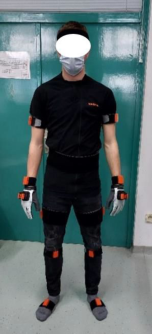
Research Framework Ergonomic workplace design has been taken up in our laboratory at the Faculty of Mechanical Engineering. A collaborative human-robot worksta- tion was designed in the laboratory environment and as a digital twin in the computer, and later tested with 6 subjects considering their anthropometric measurements (Figure 1). In the paper results for 1 subject are presented. The workflow consists of three steps/phases:
1. the worker picks up the small box of building blocks from the floor and places it on a small table next to the workstation. 2. he puts together two small building blocks one after the other with the help of the robot to form a larger box. The same process is repeated three times. 3. the worker takes away the empty box and places it on another table.
Figure 1: Xsens suit with sensors and human-robot collaborative workplace.
The procedure intentionally includes situations/movements that are not suitable for the worker (e.g., picking up small box from the floor, the height of the work table is too low, placing small box with building blocks next to the work table) in order to obtain different results (suitable and not suitable for the worker) from the performed analyses. The study was divided as follows:
6 subjects with different anthropometric measurements were selected,
Each subject first put on the Xsens suit and then performed the calibration process to match the movements with the human model designed in the computer (first with Xsens and then with the model designed in Pro-cess simulate)
The subject learned the phases of the workflow and repeated them 2-3 times
The subject’s movements were recorded with the smartphone and later manually evaluated with the OWAS analysis
The results of the OWAS analysis were also obtained by computer simula- tion based on the movements recorded with the Xsens suit and simulation with the Task Simulation Builder (TSB).
The results of the OWAS analyses obtained from three different sources were compared.
The time analysis was performed using the MTM method.
OWAS Method The Ovako Working Posture Analysis System (OWAS) was developed in Fin- land in 1972 (Karhu et al., 1981). It is considered a practical method for identifying and evaluating working postures. Postures are classified into 28 positions, including postures of the back (four positions), upper limbs (four), hands (three), lower limbs (nine), head and neck (five), and handling loads or forces (three). Each body area consists of graded postures that describe the risk or severity of the posture of that body area. For each of these positions, there are predefined high and low risk postures that are coded by the observer.
Ergonomics, Digital Twins and Time Measurements for Optimal Workplace Design 63
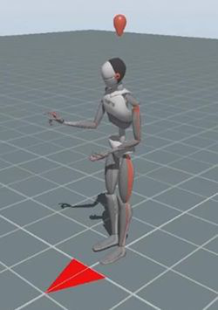
Figure 2: Human model in Xsens and in Process simulate environment.
After calculating the amount of time the worker spends in these postures, the final step is to assign a four-level action code for improving the task (changes not required, changes required in the near future, changes required immedia- tely, intensive observation required). For the computer-based OWAS analysis, Process Simulate was used with the Xsens suit and Task Simulation Builder.
Methods Time Measurement (MTM) System In terms of ergonomics, the time required to perform activities must also match the desired end product of the workstation. With the help of the Meth- ods time measurement (MTM) system, a time analysis of the workplace was created. The basic concept of MTM is to decompose a task into its basic human activities, use basic times for them from tables, and combine them into a basic time for the entire task. Several variants of MTM have been developed, differing in their focus. Because of the length of the process time, the MTM Universal Analysing System (MTM-UAS) was chosen. MTM-UAS was created to meet manufacturers’ demands for productivity improvement in batch production. Today it is widely used in the automotive industry (Di Giornimo et al., 2012).
RESULTS AND DISCUSSION
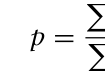
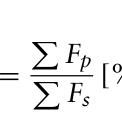
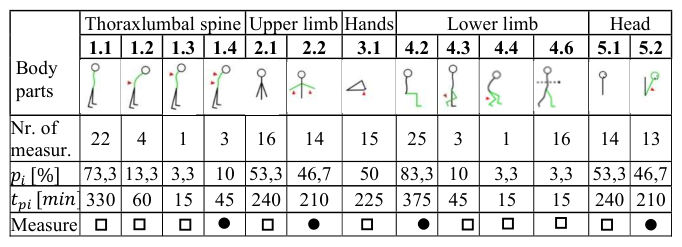
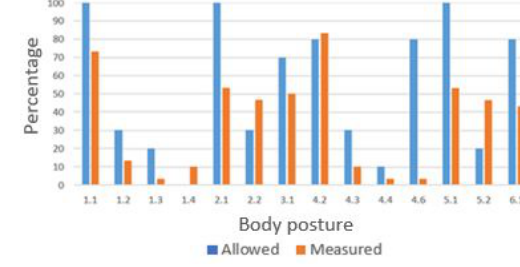
Results of manually performed OWAS analysis used to evaluate the strain caused by different operators’ postures at observed workstations are pre- sented in Table 1 and in Fig. 3. Percentage of each body posture was calcu- lated using equation (1) and also time portion for that body posture was calculated (2).
Equation reproduced from the original PDF.
[%] (1)
Equation reproduced from the original PDF.
100 [min] (2)
Table 1. OWAS results with recommended measures.Figure 3: Results of manually performed OWAS analysis.
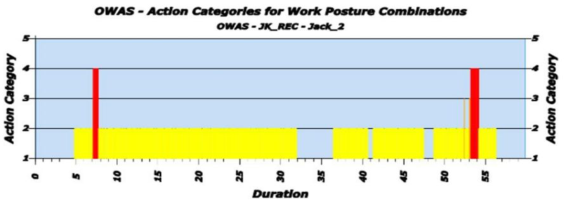
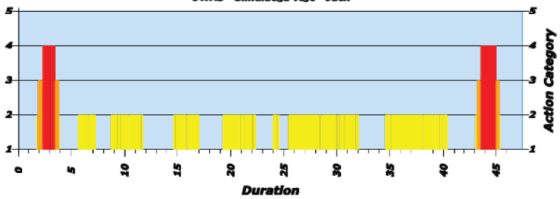
The values obtained were compared with the recommended values and are marked. The results confirmed earlier predictions showing that posture 1.4 - bent and twisted on one side - could be harmful to the worker and must be changed in the near future. Postures 2.2 - both arms slightly bent, 4.2 - standing on both legs and 5.2 - with head bent forward also have a high percentage and therefore need to be changed in the near future. No changes are required for the other postures unless they cause discomfort. The results of the OWAS analysis obtained with the Xsens suit are shown in accorda- nce with the timeline in Fig. 4, and Fig. 5 shows the results based on the TSB interface. Visually, the shape of both graphs is similar, harmful postu- res are detected when the worker bends forward and turns on one side. The computerized OWAS results are even more accurate compared to the manu- ally performed OWAS, because the observation interval is shorter (number of observed images), but the accuracy of the obtained results depends on the reliability of the motion transmission and thus on the number and position of the sensors.
MTM-UAS includes seven basic movement categories: Fetching and Pla- cing, Placing, Tool Handling, Operating, Motion Cycles, Body Movements, and Visual Control. In our case, only the fetch and place, place, and body movements were considered. To account for the time, the worker waits for the robot to complete the task, a short process time of the robot was included.
Ergonomics, Digital Twins and Time Measurements for Optimal Workplace Design 65
Figure 4: Results of OWAS analysis_ from Xsens suit.Figure 5: Results of OWAS analysis_ based on TSB.Table 2. Time analysis with MTM method.
Table available in the original PDF paper.
The results of the MTM-UAS time analysis are shown in Table 2. Origi- nally, the analysis was divided into three parts as described in the workflow. All necessary travel, object handling and waiting for the robot are included in these parts. These parts can also be used later as standard blocks if there are many similar jobs, which is common in an assembly line. Splitting the time analysis is also recommended in case the results show that the output is not achieved and a redistribution of the workstations is required. The split parts were later combined into one workstation for presentation purposes. The sum of all process steps is 44.84 seconds. In comparison of the time analyses obtained with Xsens - Simulation is 51,15s and with Task Simulation Builder
(TSB) - Simulation is 47,42s. The time recorded by the Xsens device and tran- sferred to a simulation during the worker’s work is the highest. This shows that the worker was not as skilled as would be expected of him. The time analysis performed with the TSB simulation and MTM-UAS shows similar results with a deviation of 5.5%. In our case, the time analysis performed with the TSB simulation is not as rigorous as the standard MTM-UAS. This shows that it could be used as a guide for time analysis in the future.
The results of the presented research show the usefulness and reliability of the presented platforms for ergonomic and also for time analysis. With the presented technologies and accumulated knowledge, the design of pro- duction processes can change rapidly. Nowadays, the design and evaluation of human-robot collaboration workplaces is frequently mentioned as part of Industry 4.0. It is a complex problem that requires a lot of attention and effort both in industry and academia. The research conducted here addresses this issue and is intended as an additional useful contribution to the field. The comparison of the manual and computer-aided analysis shows that the results are similar from an ergonomic point of view, but there are also dif- ferences that need to be considered in the time analysis. It can be seen that the different approaches to process design have advantages and obstacles, so further analysis would be beneficial.
ACKNOWLEDGEMENT
The authors acknowledge that the Grant P2-0190 was supported financially by the Slovenian Research Agency.
REFERENCES
Breznik, M. and Vujica-Herzog, N. (2021), “Ergonomic design of the workplace for final quality control”. Ergonomi, 4, 1–9. Caputo, F., Greco, A., Fera, M., Macchiaroli, R. (2019), “Digital twins to enhance
the integration of ergonomics in the workplace design”, International Journal of Industrial Ergonomics, 71, 20–31. Di Giornimo, G., Di Martino, C., Lanzotti, A., Marzano, A., Russo, G. (2012), “Improving MTM-UAS to predetermine automotive maintenance times”. Inter- national Journal on Interactive Design and Manufacturing, 6, 265–273. Harari, Y., Bechar, A., Raschke, U., Riemer, R. (2017), “Automated Simulation-Based
Workplace Design that Considers Ergonomics and Productivity”. International Journal of Simulation Modelling. 16 (1), 5–18. Karhu, O., Harkoen, R., Sorvali, P., Vespalainen, P. (1981), “Observing working postures in industry: examples of OWAS application”. Applied Ergonomics, 12(1), 13–17. Kusiak, A. (2018), “Smart manufacturing”. International Journal of Production
Research, 56(1-2), 508–517. Mateus, J.E.C., Clayes D., Limere, V., Cottyn, J. Aghezzaf, E.H. (2019), “Ergonomics and performance factors for human-robot collaborative workplace design”, IFACPapersOnLine, 52 (13), 2550–2555. Menges, R. (1995), “Rechnergestutzte Bewegungssimulation mit ERGOMan REFA”.
Nachrichten. 48, 13–18.
Ergonomics, Digital Twins and Time Measurements for Optimal Workplace Design 67
Oztemel, E., Gursev, S. (2020), “Literature review of Industry 4.0 and related technologies”. Journal of Intelligent Manufacturing, 31 (1), 127–182. Schaub, K., Landau, K., Menges, R., Grossmann, K. (1997), “A Computer-Aided
Tool for Ergonomic Workplace Design and Preventive Health Care”. Human Factors and Ergonomics in Manufacturing. 7 (1), 269–304.
LISTED IN THE AHFE DIGITAL BOOKSTORE CATALOGUE
Explore the complete digital volume
Human Factors and Simulation
Read this individual research paper free through the original publisher, or explore the full digital proceedings book.
ISBN 978-1-958651-06-3
Explore this ISBN in the AHFE Bookstore ↗Listed in the July 2026 bookstore catalogue; search by ISBN to confirm current availability · Digital book purchase optional