Jinchao Lin, Gerald Matthews, Niav Hughes, Kelly Dickerson (2022). Novices as models of expert operators: Evidence from the NRC Human Performance Test Facility. In: Human Factors and Simulation. AHFE Open Access, vol. 30, pp. 1–10. https://doi.org/10.54941/ahfe1001485
Humans are integral to the safe operation of a nuclear power plant (NPP). Following the Three Mile Island accident in 1979, the United States Nuclear Regulatory Commission (NRC) began focusing on incorporating good human factors engineering design principles in regulation and emphasizing the importance of adequate training of plant operations staff. As part of this focus, NRC amended its regulations to require facility licensees to have simulation facilities for use in administering NRC operating tests and licensed operator requalification training (52 FR 9460). Since then, the simulator has become an important tool for operator training and license examinations. As technology develops, new designs and technology becomes available to the nuclear power community. The staff of NRC is responsible for reviewing and determining the acceptability of new designs to ensure they support safe plant operations. Since the human operator is vital to NPP safety, NRC must understand the potential impact of new designs on human performance to support sound regulatory decisions (Hughes, D’Agostino, & Reinerman-Jones, 2017). Despite the importance of human performance in plant safety, much of the basis for current NRC Human Factors Engineering guidance is from other domains (e.g., aviation, defense), qualitative data from operational experiences in NPPs, and limited empirical studies in a nuclear environment (Hughes & D’Agostino, 2016). To close this data gap, NRC launched the Human Performance Test Facility (HPFT) project to explore the impact of new designs, technologies, and concepts of operations on human performance using generic simulator platforms.One of the challenges for conducting human performance research in the nuclear domain is access to trained operators. Without sufficient sample size, it is difficult to perform analyses with adequate statistical power and draw substantial conclusions. To overcome the participant access challenge NRC partnered with the University of Central Florida (UCF) and use college students as a proxy for expert operators to study the impact of traditional and new Main Control Room (MCR) designs, technologies, and concepts of operations on performance of common NPP tasks and physiological and subjective workload. This approach follows the principle of “equal but different”. This means that students experienced simplified versions of complex tasks and the system user interface.This paper will review data collected from three experiments and summarize the evidence revealed by using novices as models of expert operators in the nuclear domain. Across the experiments novices and expert operators interact with touchscreen or desktop versions of an NPP MCR interface. Performance and workload were examined. Additionally, the studies sought to validate the methodology of the “equal but different” principle. Taken together the studies revealed that the “equal but different” method induced comparable cognitive demands in students and experts. This means that student novices can stand in for expert operators to help identify workload-related safety concerns in the nuclear domain. Future research will extend this approach to other MCR technologies, such as automation and novel control room configurations. Further, the method developed in the HPTF can be applied in other domains where access to experts is limited.
Humans are integral to the safe operation of a nuclear power plant (NPP). Following the Three Mile Island accident in 1979, the United States Nuclear Regulatory Commission (NRC) began focusing on incorporating good human factors engineering design principles in regulation and emph- asizing the importance of adequate training of plant operations staff. As part of this focus, NRC amended its regulations to require facility licensees to have simulation facilities for use in administering NRC operating tests and licensed operator requalification training (52 FR 9460). Since then, the simulator has become an important tool for operator training and license examinations.
As technology develops, new designs and technology becomes available to the nuclear power community. The staff of NRC is responsible for review- ing and determining the acceptability of new designs to ensure they support safe plant operations. Since the human operator is vital to NPP safety, NRC must understand the potential impact of new designs on human performance to support sound regulatory decisions (Hughes, D’Agostino, & Reinerman- Jones, 2017). Despite the importance of human performance in plant safety,
much of the basis for current NRC Human Factors Engineering guidance is from other domains (e.g., aviation, defense), qualitative data from ope- rational experiences in NPPs, and limited empirical studies in a nuclear environment (Hughes & D’Agostino, 2016). To close this data gap, NRC launched the Human Performance Test Facility (HPFT) project to explore the impact of new designs, technologies, and concepts of operations on human performance using generic simulator platforms.
One of the challenges for conducting human performance research in the nuclear domain is access to trained operators. Without sufficient sam- ple size, it is difficult to perform analyses with adequate statistical power and draw substantial conclusions. To overcome the participant access chal- lenge NRC partnered with the University of Central Florida (UCF) and use college students as a proxy for expert operators to study the impact of tra- ditional and new Main Control Room (MCR) designs, technologies, and concepts of operations on performance of common NPP tasks and physiolo- gical and subjective workload. This approach follows the principle of “equal but different”.
Equal but Different Approach Conducting laboratory-based research studies using novice college students as a sample to get meaningful findings that are generalizable to the real-world environments can be a challenge. Criticism of the methods used to perform laboratory experiments typically stems from a concern that the participant pool excludes operational experts and/or a misunderstanding of experimen- tal strategies available to account for differences between novice and expert participants (Lackey, Reinerman-Jones, & Salcedom, 2014). In order to col- lect meaningful data from novices, the “equal but different” approach was adopted in the study designs of the HPTF project experiments. By follow- ing the principle of “equal but different” approach, although the simulated environment in the laboratory is different from the real-world working envi- ronment, the experimental task scenarios are controlled to induce the same type and comparable level of cognition workload that would be experienced by expert operators. Specifically, the complexity of the environment was reduced, and the operation procedure was modified so that the same type and comparable level of cognition workload can be experienced by novice participants without requiring them to have all the knowledge and skills of an expert operator.
METHODS
Data collected in three previously completed NRC HPTF studies were revie- wed and reanalyzed to demonstrate the validity of using novices as models of expert operators in human factors studies in the nuclear operation domain. The studies investigated workload responses of both novices and experts using simulators with different types of interfaces in three common NPP operation task types. Designs of the three studies are summarized in Table 1.
Novices as Models of Expert Operators: Evidence from the NRC Human Performance 3
Table 1. Summary of study designs.
Table available in the original PDF paper.
Study Participant Sample size Simulator Interface Study A Student novices 71 (M = 20.2, SD = 2.7) GSE GPWR Simulated analog/Touch Study B Expert operators 18 (M = 45.9,
Equations and mathematical formulas are available in the original paper PDF.
Analog/Manual
TTC Westinghouse PWR
The experimental scenario developed for Studies A and B consisted of tasks reflecting common activities required when completing operating procedu- res: checking, detection and response implementation. Checking requires a one-time inspection of an I&C to verify that it is in the appropriate state. Detection requires continuous monitoring of a control parameter to identify a change in the state of the plant. Response implementation requires a fine motor response (mouse usage or finger touch) to change the state of the NPP by locating a control and subsequently manipulating the control in the requi- red direction. There were twelve steps in the experimental scenario, grouped by task type (4 checking steps, 4 detection steps, and 4 response implemen- tation steps). The order of task type block was partially counterbalanced across participants as a means of balancing the need for laboratory control (i.e., using tasks blocks) and realism (i.e., a checking task would never fol- low either of the other two tasks in the real environment) (Reinerman-Jones, Guznov, Mercado, & D’ Agostino, 2013).
The experimental scenario for Study C was developed based on a gene- ric version of an emergency operating procedure (EOP) for a “Loss of All Alternating Current Power (ECA-0.0)” scenario but modified for experimen- tal use. The experimental procedure contained 69 steps supporting three different task types. In the experimental procedure, there were 30 steps (16 checking, 5 detection, and 9 response implementation) for RO 1, and 39 steps (27 checking, 1 detection, and 11 response implementation) for RO 2. The number of steps was not balanced nor was task type due to the nature of the original, realistic EOP, which requires steps to be taken in a prescribed sequence.
Multivariate Workload Assessment There has been a longstanding debate in human factors over the optimal methodology for workload assessment. While the NASA Task Load Index (NASA-TLX) is the single most popular workload measure, it does not pro- vide a comprehensive workload assessment. Studies conducted in the HPTF project utilized a multivariate workload assessment strategy and supplemen- ted the NASA-TLX with additional subjective measures, such as the Multiple Resource Questionnaire (MRQ), psychophysiological measures derived from electrocardiogram (ECG), electroencephalogram (EEG), transcranial doppler (TCD), and functional near-infrared spectroscopy (fNIR), and performance- based measures including the index of effectiveness of communication and
accuracy of task execution. This paper will focus on selected subjective and psychophysiological measures.
RESULTS
To validate the “equal but different” approach and demonstrate that the same type and comparable level of cognition workload would be experie- nced by expert operators can be induced in novices, we conducted Chi-square goodness-of-fit tests to compare the distribution of the NASA-TLX ratings between the novices and experts and ANOVAs to compare the workload metrics from both subjective and psychophysiological measures.
Chi-Square Goodness-of-Fit Test To determine if workload level experienced by the novices were comparable to the workload experienced by the expert operators, a series of chi-square goodness-of-fit tests were conducted to compare the distribution of the NASA-TLX ratings between novices and experts as well between experts using different types of simulators. Based on a recent meta-analysis of NASA- TLX scores (Grier, 2015), the MCR operation tasks can be categorized as command-and-control tasks. Following Grier’s command-and-control task model, NASA-TLX ratings less 38 were categorized as low workload, ratings greater than 60 were categorized as high workload, and ratings between 38 and 60 were categorized as medium workload. The frequency of workload level ratings is shown in Table 2. The physical demand and temporal demand subscale ratings were not analyzed due to the nature of the frequency distri- butions. For the other subscales, the chi-square goodness-of-fit tests indicated that the workload experienced by the novice participants was similarly distri- buted to the workload experienced by the expert operators using the same simulator with touchscreen interface. By comparing the frequency distributi- ons between study B and C, the chi-square goodness-of-fit tests revealed that only the experienced performance ratings are similarly distributed between expert operators using the digital simulator with touchscreen interface and the analog simulator.
Subjective Measures
Figure 1 illustrates a comparison of the overall NASA-TLX ratings collected after the entire experimental scenario in Study C and the averaged ratings from three task types in Study A and B. No significant difference in glo- bal workload and all six subscales between novices (Study A) and experts (Study B) using the same type of simulator was revealed by the analysis. Alth- ough there is no statistical difference between Study A and B, generally, the expert operators experienced lower workload than the novices and experts using the analog simulator. Compared to the experts using the analog simu- lator, the novices using the digital simulator experienced greater frustration, F(2,90) = 3.35, p < .05, ηp2 =.07. In addition, expert operators using analog simulator reported greater temporal demand than experts using the digital simulator, F(2,90) = 3.16, p < .05, ηp2 =.07. The findings are consistent
Novices as Models of Expert Operators: Evidence from the NRC Human Performance 5
Table 2. NASA-TLX frequency table.
Table available in the original PDF paper.
Frequency Study B Study A Study C χ2 B vs A χ2 B vs C Global workload 2.28 67.85* Low 11 43 12 Medium 6 25 6 High 1 6 12 Mental demand 5.17 15.40* Low 11 33 12 Medium 4 20 5 High 3 16 13 Performance 1.98 5.60 Low 12 41 22 Medium 4 20 2 High 2 8 6 Effort .85 7.35* Low 12 45 21 Medium 4 18 2 High 2 6 7 Frustration .59 12.36* Low 10 41 26 Medium 6 22 1 High 2 6 3 Physical demand NA NA Low 17 55 26 Medium 2 12 3 High 1 2 1 Temporal demand NA NA Low 14 39 51 Medium 4 25 4 High 0 5 5
NASA-TLX
Study C
Study C
Study C
Study C
Study C
Study C
Study C
Study B
Study B
Study B
Study B
Study B
Study B
Study B
Study A
Study A
Study A
Study A
Study A
Study A
Study A Global Mental Physical Temporal Effort Frustration Performance
Figure 1: NASA-TLX ratings. Error bars represent standard errors.
Figure available in the original PDF paper.
with Grier’s classification of command and control tasks, workload expe- rienced by novices and experts was low to medium across the NASA-TLX subscales.
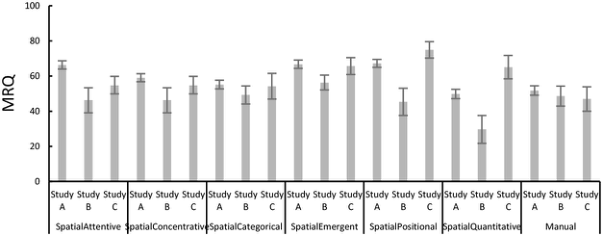
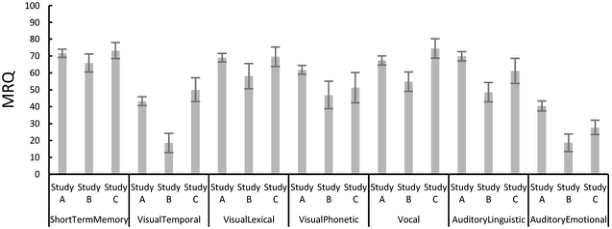
Figure 2a: MRQ ratings. Error bars represent standard errors.Figure 2b: MRQ ratings (Continued). Error bars represent standard errors.
Figure 2a and 2b illustrate a comparison of the overall MRQ ratings col- lected after the entire experimental scenario in Study C and the averaged ratings from three task types in Study A and B. The MRQ revealed simi- lar trends between novices (Study A) and experts (Study B), especially in the subscales that would play a critical role in influencing the cognitive demands during NPP MCR operations, such as short-term memory, spatial attentive demand, spatial concentrative demand, and spatial categorical demand. Con- sistent with the findings revealed by NASA-TLX, experts in Study B using digital simulator reported the lowest workload across the MRQ subscales. Notably, some of the group differences were significant. Specifically, expert operators using analog simulator reported lower auditory emotional demand than novices using the same type of simulator, F(2,90) = 4.77, p < .05, ηp2 =.10. Expert operators in Study B also reported significantly lower spatial positional demand (F(2,90) = 6.91, p < .01, ηp2 =.13), spatial quantitative demand (F(2,90) = 6.73, p < .01, ηp2 =.13), and visual temporal demand (F(2,90) = 6.05, p < .01, ηp2 =.12) than participants in Study A and C.
Psychophysiological Measures One-way ANOVAs were conducted to determine if the psychophysiological indices of workload were significantly different between novices and expert operators on a task-type basis. Selected metrics from four psychophysio- logical sensors, including ECG, EEG, fNIR, and TCD are reported in the following sections.
Novices as Models of Expert Operators: Evidence from the NRC Human Performance 7
HRV (%)
Study Study Study Study
Study Study Study Study
Study
-20 A B C
B C Checking Detection Response
Figure 3: Heart rate variability percentage change from baseline by task type. Error bars represent standard errors.
Figure available in the original PDF paper.
EEG (%)
0 40 80 120
-40 Study Study Study
Study Study Study Study
Study Study
C Checking Detection Response
AlphaF BetaF ThetaF
Figure 4: EEG alpha/beta/theta percentage change from baseline by task type. Error bars represent standard errors.
Figure available in the original PDF paper.
No significant difference between novices and expert operators in HRV change after exposure to checking, detection, and response implementation tasks was revealed (Figure 3).
For EEG analysis, three bandwidths, alpha (8-13 Hz), beta (13-30 Hz), and theta (4-8 Hz), were used as the workload indices in the spe- ctral frequency analysis. No significant difference between novices (Study A) and expert operators using the same digital simulator (Study B) in EEG alpha, beta, or theta change in the frontal lobe after exposure to checking, detection, and response implementation tasks was revealed (Figure 4). Although the difference between novices and experts using the same type of simulator was not significant, compared to experts in Study C using the analog simulator, the EEG changes were in a much smal- ler magnitude in all three bands among novices, especially in detection tasks.
Figure 5 demonstrates the change in oxygen saturation in left and right hemispheres measured by fNIR. Similar to ECG and EEG results, no signi- ficant difference between novices and expert operators in oxygen saturation change during the checking, detection, and response implementation tasks was revealed.
Figure 6 demonstrates the change in cerebral flood flow velocity mea- sured by TCD. Similar to other psychophysiological metrics, no significant difference between novices and expert operators in oxygen saturation change
0 2 4 6
Study Study Study Study
Study Study Study Study
Study
C Checking Detection Response
Oxygen Saturation (%)
Left Right
Figure 5: Oxygen saturation in left/right hemisphere percentage change from baseline by task type. Error bars represent standard errors.
Figure available in the original PDF paper.
CBFV (%) -2 Study Study Study
Study Study Study Study
Study Study
C Checking Detection Response
Figure 6: Cerebral flood flow velocity percentage change from baseline by task type. Error bars represent standard errors.
Figure available in the original PDF paper.
after exposure to checking, detection, and response implementation tasks was revealed.
DISCUSSION
The analyses compared data collected from three experiments and revea- led evidence of using novices as models of expert operators in the nuclear domain. The chi-square goodness-of-fit tests confirmed that the workload (measured by NASA-TLX) experienced by the novice participants recruited in the HPTF study were similar distributed as the workload experienced by the expert operators. The non-significant ANOVA results from the subje- ctive measures, such as NASA-TLX and MRQ, suggested that the novices not only fit the distribution of the expert operators, but experienced same type and comparable level of cognition workload that would be experienced by expert operators in the controlled experiments. Although not all resources covered by the subscales of MRQ showed non-significant results in novice- expert comparisons, the experimental manipulations successfully induced the most important resources in NPP operations, such as short-term memory and the processes related to various spatial demand, in comparable levels. The non-significant ANOVA results from the psychophysiological measures indicated that the novices not only experienced and reported the same type and comparable level of cognition workload, but the workload manipulation indeed induced similar changes in physiological response. Taken together the
Novices as Models of Expert Operators: Evidence from the NRC Human Performance 9
studies revealed that the “equal but different” approach induced same type and comparable cognitive level of cognition workload in novices and expert operators.
Student novices can not only stand in for expert operators who work in the current NPPs to help identify workload-related safety concerns but also serve as good representatives of future workforce working in the next- generation NPP MCR in the future. Most of current expert operators were trained to use the traditional analog control system. Currently, there are no experts for the emerging technology. As technology advances, the industry calls for plant modernization. Future workforce may not have the training and expertise that current expert operators have. In addition, compared to current expert operators, future operators are likely to have different atti- tude toward technology which may affect their interaction with the control system and introduce novel human factors issues. Future research could use novices as models of expert operators beyond workload research and extend the “equal but different” approach to human factors issues related to other MCR technologies, such as automation and novel control room configura- tions. Further, the method developed in the HPTF can be applied in other domains where access to experts is limited.
In conclusion, the analyses confirmed that the HTPF studies successfully induced same type and comparable level of cognition workload that would be experienced by expert operators in controlled lab experiments using stu- dent novices as participants and validated the methodology of the “equal but different” principle. Overall, novices can be trained to be models of expert operators to help identify human factors issues in the nuclear domain as well as other domains where access to experts is limited.
ACKNOWLEDGMENT
This paper was prepared as an account of work sponsored in part by an agency of the U.S. Government. Neither the U.S. Government nor any age- ncy thereof, nor any of their employees, makes any warranty, expressed or implied, or assumes any legal liability or responsibility for any third party’s use, or the results of such use, of any information, apparatus, product, or process disclosed in this report, or represents that its use by such third party would not infringe privately owned rights. The views expressed in this paper are not necessarily those of the U.S. Nuclear Regulatory Commission.
REFERENCES
Grier, R.A., 2015, September. How high is high? A meta-analysis of NASA-TLX global workload scores. In Proceedings of the HFES Annual Meeting (Vol. 59, No. 1, pp. 1727–1731). CA: SAGE. Hughes, N. and D’Agostino, A., 2016, September. Gathering meaningful data from
novices and or in simplified operating environments to inform us about highly complex operational environments. In Proceedings of the HFES Annual Meeting (Vol. 60, No. 1, pp. 47–50). CA: SAGE.
Hughes, N., D’Agostino, A. and Reinerman-Jones, L., 2017. The NRC Human Performance Test Facility: An approach to data collection using novices and a sim- plified environment. In Advances in Human Factors in Energy: Oil, Gas, Nuclear and Electric Power Industries (pp. 183–192). Springer, Cham. Lackey, S., Reinerman-Jones, L.E. and Salcedo, J., 2014. Equal but different: 5
research strategies for improving conclusions drawn from novice populations. In Proceedings of the 2014 MODSIM World Conference, Hampton, VA (April, 2014). Reinerman-Jones, L., Guznov, S., Mercado, J. and D’Agostino, A., 2013, July. Developing methodology for experimentation using a nuclear power plant simulator. In International Conference on Augmented Cognition (pp. 181–188). Springer, Berlin, Heidelberg.
LISTED IN THE AHFE DIGITAL BOOKSTORE CATALOGUE
Explore the complete digital volume
Human Factors and Simulation
Read this individual research paper free through the original publisher, or explore the full digital proceedings book.
ISBN 978-1-958651-06-3
Explore this ISBN in the AHFE Bookstore ↗Listed in the July 2026 bookstore catalogue; search by ISBN to confirm current availability · Digital book purchase optional