Lina Wu, Kai Liu (2022). Model-based flight phase suppression safety design and evaluation process for crew warnings. In: Human-Centered Aerospace Systems and Sustainability Applications. AHFE Open Access, vol. 26, pp. 16–19. https://doi.org/10.54941/ahfe1001429
The crew warning information provides the crew with status indication information that they need to know during normal or abnormal flight, accurately and effectively inform the crew of the aircraft status, and guide the crew to take corresponding measures or establish situational awareness to reduce the impact of failure.However, in some critical flight stages, the flight crew needs to concentrate on manipulating the aircraft. The appearance of inappropriate warning messages will cause interference to the flight crew and affect flight safety. Therefore, in the warning design of civil aircraft, a flight phase suppression plan for warnings is generally formulated to suppress part of the crew warning information in some specific flight phases.The design of the flight phase suppression of the crew warning information will lead to the failure of the crew warning information during the flight phase of the crew warning information suppression when the warning function is normal. notice".Therefore, the flight phase suppression plan for the crew warning information should be evaluated by the safety engineer to ensure that the suppressed warning information will not affect the pilot's current flight control and meet the safety requirements.In the process of safety assessment, the analysis of the impact of "unannounced" failures is to consider that the crew is not aware of the failure during the entire flight phase, and the crew is unable to perform mitigation procedures or establish situational awareness, resulting in the impact of "unannounced" failures than "announced" failures. Bigger. However, the flight phase suppression of the crew warning information does not mean that the flight phase does not fail. The crew can know the failure after the suppression phase; therefore, the "unannounced" effect of the flight phase suppression phase may be the same as the "unannounced" effect during the entire flight phase. It's not the same. Used directly, the "unannounced" failure impact level of the entire phase is used as the "unannounced" impact level of the flight phase suppression phase, which may be too conservative.This paper presents a safety assessment method for the suppression of civil aircraft crew warning information during flight phase. Through determining the establishment of a list of factors affecting the failure; establishing one by one the corresponding relationship matrix between the factors and the failure impact levels and the relationship matrix of the factors changing with time; finally establishing the relationship matrix of the civil aircraft's various failure impact levels with time. As a criterion for the safety of civil aircraft crew warning information during flight phase suppression.
Model-Based Flight Phase Suppression Safety Design and Evaluation Process 17
INTRODUCTION
Crew alarm suppression design in flight phase will result in the fact that when the alarm function is normal, in the flight phase of crew alarm suppression, if a fault occurs, no crew alarm will occur, that is, the failure will be “unannou- nced”in the flight phase of flight crew alarm suppression (Todd and Thomas, 2012). However, the flight phase suppression of the flight crew warning is not the whole flight phase without the alarm, the flight crew can know the failure after the suppression stage; and in the FHA process, the analysis of the “unannounced”failure effect is to consider the flight crew unaware of the failure during the entire flight phase , the crew was unable to perform miti- gation procedures or establish situational awareness, resulting in a greater impact of an “unannounced” failure than an “announced” failure. There- fore, the effects of flight phase suppression phase “unannounced” may not be the same as full phase “unannounced” (Veitengruber, 1978). It may be too conservative to directly use the full-phase “unannounced”failure impact level as the “unannounced” impact level for the flight-phase suppression phase.
The flight phase suppression is not carried out when the flight crew is alerted, and the flight crew is aware of the fault “immediately” after the fai- lure occurs, so as to implement mitigation procedures or establish situational awareness to reduce the impact of the failure; after the flight phase suppres- sion is performed on the flight phase warning, the flight crew is “delayed (after the suppression stage)” know the failure, and then implement mitiga- tion procedures or establish situational awareness to reduce the impact of the failure (Masefield, 1993). Therefore, the analysis of the safety impact of the suppression of the flight crew warning in the flight phase mainly evaluates the difference between the crew receiving the warning information after the suppressed flight phase and receiving the warning information immediately.
If the effect of the failure on the aircraft, crew and passengers does not increase or worsen with increasing flight time, the effect of the failure during the flight crew warning suppression phase can be considered to be the same as the “announced” failure effect; if the failure affects the aircraft, crew and passengers The impact of the failure will become larger or worse with the increase of flight time, so the failure impact of the crew warning suppression phase is greater than the “notified”failure impact, which may further increase the impact level of the failure state. Furthermore, the degree to which this effect becomes greater or worse is related to the time the flight crew is alerted to the suppression of the flight phase.
From the perspective of positive design, the duration of the alarm sup- pression of the unit determines the failure impact, the failure scene response determines the impact level classification, and the impact level classification determines the safety requirements, and the system design should meet the safety requirements; on the contrary, if the system design It has been com- pleted and the safety level that can be achieved has been clarified, then the duration of the crew alarm that can be suppressed must be determined accor- ding to the failure impact level corresponding to the current safety level. Therefore, the analysis of failures and their effects over time can help to balance safety requirements and flight-phase suppression requirements for crew warnings.
18 Wu and Liu
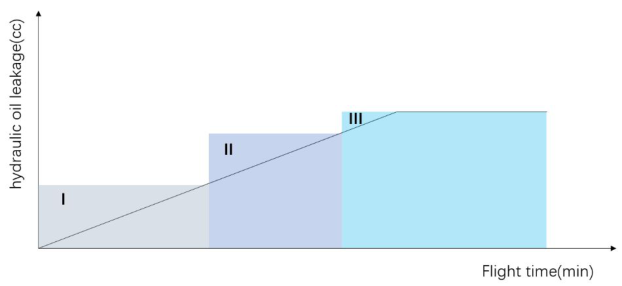
Figure 1: Time model of hydraulic oil leakage impact.
MODELING PROCESS The modeling process is as follows:
a) Find the corresponding failure state (FC) of the unit alarm according to the trigger logic of the unit alarm; b) To perform a failure effects analysis:
1) Identify the factors that affect the FC; 2) Build models of factors changing over time; 3) A model of the FC failure impact level as a function of time is established.
c) Propose safety design requirements.
EXAMPLES The volume of 1# hydraulic oil of a certain type of aircraft is about 49L, the pipe diameter is 1/2in in a certain area, and the maximum leakage flow rate is 20cc/min. For the crew alarm “HVD 1 PRESS LOW”:
a) Use the analysis method of fault tree to identify all the failures (FC) that may lead to the low pressure of the 1# hydraulic system; b) Confirmation of failure status: “1# hydraulic system leakage”may lead to 1 # hydraulic system low pressure, that is, one of the FCs correspon- ding to the unit alarm “HY D1 PRESS LOW” is “1# hydraulic system leakage”; c) Impact analysis: The leakage of hydraulic oil causes the deterioration of the surrounding environment, resulting in the pollution and corro- sion of the surrounding cables, joints or electrical components by the hydraulic oil; d) Build a model: see Figure 1 (time model of hydraulic oil leakage impact); e) Develop security design requirements:
Model-Based Flight Phase Suppression Safety Design and Evaluation Process 19
1) Hydraulic pipe joints should be arranged below the electronic equipment; 2) The gap between the hydraulic pipeline and the nearby structure is not less than 4mm; 3) The drainage capacity of this area is not less than 10cc/min; 4) The alarm information suppression time cannot be longer than 10min.
CONCLUSION
The evaluation of the failure impact in the crew warning suppression stage has changed from the evaluation of “whether the impact of the failure on the aircraft, crew and passengers will increase or deteriorate with the increase of flight time”, and then to the evaluation of “the failure and its impact change with time”, the results of which can be used for safety design related to the failure.
ACKNOWLEDGMENT
The authors would like to acknowledge all the researchers listed as references and the members in aircraft safety group in SADRI, this paper cannot be done without their previous efforts.
REFERENCES
Masefield, P., 1993. Book Review: The Naked Pilot: The Human Factor in Aircraft Accidents. The Journal of Transport History, 14(1), pp. 84–85. Todd, M. and Thomas, M., 2012. Flight Hours and Flight Crew Performance
in Commercial Aviation. Aviation, Space, and Environmental Medicine, 83(8), pp. 776–782. Veitengruber, J., 1978. Design Criteria for Aircraft Warning, Caution, and Advisory Alerting Systems. Journal of Aircraft, 15(9), pp. 574–581.
LISTED IN THE AHFE DIGITAL BOOKSTORE CATALOGUE
Explore the complete digital volume
Human-Centered Aerospace Systems and Sustainability Applications
Read this individual research paper free through the original publisher, or explore the full digital proceedings book.
ISBN 978-1-958651-02-5
Explore this ISBN in the AHFE Bookstore ↗Listed in the July 2026 bookstore catalogue; search by ISBN to confirm current availability · Digital book purchase optional