Daniel Buckland, Megan Parisi, Kaitlin Mctigue, Shu-Chieh Wu, Tina Panontin, Gordon Vos, Devan Petersen, Alonso Vera (2022). NASA’S Identified Risk of Adverse Outcomes Due to Inadequate Human-Systems Integration Architecture. In: Human-Centered Aerospace Systems and Sustainability Applications. AHFE Open Access, vol. 26, pp. 1–9. https://doi.org/10.54941/ahfe1001427
The NASA Human System Risk Board (HSRB) has the overall responsibility for tracking the evolution of the top ~30 human system risks that it has identified to be associated with human spaceflight. As part of this process, the Board is charged with maintaining a consistent, integrated process to mitigate those risks, and developing evidence-based risk posture recommendations. One of the identified risks is due to inadequate human systems integration architecture (HSIA) and a driving factor of this risk is that given decreasing real-time ground support for execution of complex operations during future exploration missions, there is a possibility of adverse performance outcomes including that crew are unable to adequately respond to unanticipated critical malfunctions or detect safety critical procedural errors. The HSRB uses Directed Acyclic Graphs (DAGs) as a communication tool for describing how astronaut exposure to spaceflight hazards leads to meaningful mission-level health and performance outcomes and as the basis for understanding intermediate causal relationships between risk contributing factors and countermeasures that link hazards to outcomes. The HSIA risk DAG will be presented and described. Historically, critical malfunctions requiring Crew/MCC management occurred at a rate of 1.7 times per year for ISS averaged over the lifetime and 3-4 times per year in the burn in phase for the vehicle. These averages do not include EVA data, which greatly increases the incident rate. Prior experience from the Apollo program showed 10/11 crewed missions experienced significant anomalies where crew relied heavily on MCC expertise in real-time. These failure patterns are in line with those observed in other complex engineered systems (e.g., oil rigs, launch systems, commercial aviation, etc.) It is likely that general malfunction and error rates are > 10% for short duration missions (<30 days), based on past and current spaceflight operations data. Likelihood of adverse outcomes has the potential to increase as crew conduct work with new, complex systems and with less ground support. For Low Earth Orbit missions and Lunar missions less than 30 days, assuming minimal comm delays, disruptions and bandwidth limitations, malfunctions and errors can affect mission objectives and crew health but may be mitigated by ground support. For Lunar missions greater than 30 days and any potential Mars mission malfunctions and errors can have Loss of Crew and Loss of Mission consequences due to reduced ground support (communication delays, constraints and blackouts) for more complex operations, as well as reduced resupply and evacuation options.
For the past 20 years, NASA’s human presence in space has concentrated on activities in Low Earth Orbit (LEO), specifically on the International Space Station (ISS). As NASA prepares to return humans to the Moon, followed by
human missions to Mars, the agency must address new risks and uncertainties to ensure the health and safety of human crew members.
NASA’s Human Research Program (HRP) has identified five hazards of human spaceflight: Altered Gravity Fields, Distance from Earth, Radiation, Isolation and Confinement, and Hostile/Closed Environments (Whiting & Abadie, 2019). With in each of these hazard categories lie several associ- ated risks. The NASA Human System Risk Board (HSRB) has the overall responsibility for tracking the evolution of the 30 human system risks iden- tified to be associated with these hazards (NASA Human Research Program, 2021). Twenty-nine of these 30 risks can result in functional impairment that is expected to worsen as mission duration increases. The “30th”risk, the Risk of Adverse Outcomes due to Inadequate Human-System Integration Archi- tecture (the HSIA Risk), is essentially the risk that the crew will not be able to keep the vehicle alive (NASA Engineering & Safety Center, 2022).
THE HSIA RISK A Paradigm Shift in HSIA
Human-systems integration architecture (HSIA) is a construct used to describe the communication, coordination, and cooperation between humans and cyber-physical systems that must occur in order to accomplish an ope- ration or mission (Panontin et al., 2021). The whole system –the crew, all engineered systems supporting the mission, human experts on the ground, data systems, screens, communication devices, and physical spaces – is an HSIA that enables the execution of complex mission operations and resolution of safety-critical issues. The HSIA currently in place for human spaceflight is the result of a slow evolution over a series of orbital and lunar missions. Apollo, Shuttle, and ISS-era missions have all heavily relied on experts with access to data on the ground to keep the vehicle alive, via real-time problem solving.
A key challenge with safe exploration beyond LEO is that the legacy HSIA will no longer be safe to use as Distance from Earth (the risk’s primary hazard) increases. For Lunar missions greater than 30 days and any Mars mission, communication delays, resupply challenges, increased mission complexity, and limited evacuation opportunities necessitate a paradigm shift in HSIA. Given this increasing need for crew independence and the greater operatio- nal complexity in future exploration missions, there is a possibility of adverse outcomes associated with deficiencies in HSIA, specifically that crew are unable to adequately respond to unanticipated critical malfunctions and/or perform safety critical procedures to keep the vehicle functional (Vera et al., 2021). Discussion of human-systems integration (HSI) tends to target the interface level of HSIA: the medium of communication between humans and systems. One might attempt to “fix” the HSI by changing the user interfaces of a system – a tempting option when the integration and interaction levels of the system are human-driven and complex. The consequences associated with unanticipated critical malfunctions beyond LEO cannot be mitigated at the interface level alone because decreasing ground support drastically reduces
NASA’S Identified Risk of Adverse Outcomes 3
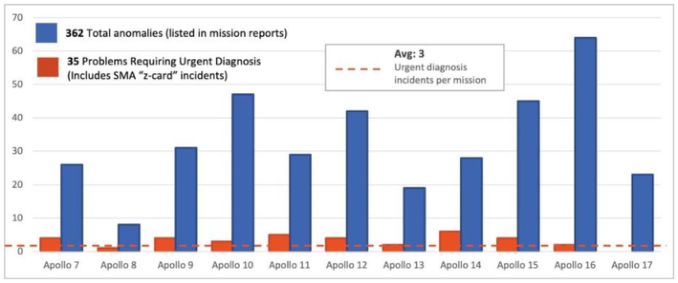
Figure 1: Anomalies on the crewed Apollo missions. The red bars show significant anomalies requiring urgent response, and blue bars show total anomalies listed in Apollo mission reports.
intervention options. With fewer humans available to address unanticipa- ted, safety critical events and provide system resilience, any HSI solution to this problem must support all levels: cooperation (e.g., problem solving), coordination (e.g., procedure execution) and communication (e.g., telemetry visualization).
Characterizing the HSIA Risk Evidence characterizing the HSIA risk is extensive. To estimate likelihoods, anomaly rates were determined from historical data from past spaceflight missions including ISS and Apollo (see Figure 1). To assess what the crew would need to do to adequately respond to these events, the investigations and deliberations of ISS Mission Evaluation Room and Anomaly Resolution Teams were observed in real-time (remotely); astronauts, flight controllers and instructors interviewed; flight and operation logs reviewed; and trouble- shooting approaches taken in analogous domains examined. To assess effects of communication delays on problem resolution and procedure execution, detailed timelines were reconstructed for past ISS anomaly resolution pro- cesses and extrapolated to a Mars transit scenario (NASA Engineering & Safety Center, 2022).
The HSRB ranks each risk by likelihood and consequence. From the assessments described above, it was determined that significant anomalies requiring urgent diagnosis by Mission Control Center (MCC) experts occur- red at a rate of 1.7 times per year for ISS averaged over the lifetime and 3–4 times per year in the “burn-in” phase for the vehicle (Panontin et al., 2021). Prior experience from the Apollo program showed 10/11 crewed mis- sions experienced significant anomalies where crew relied heavily on MCC expertise in real-time. These failure patterns are in line with those observed in other complex engineered systems (e.g., oil rigs, launch systems, commercial aviation, etc.) (Vera et al., 2021). This data suggests that general malfunction and error rates are > 10% even for short duration missions (<30 days).
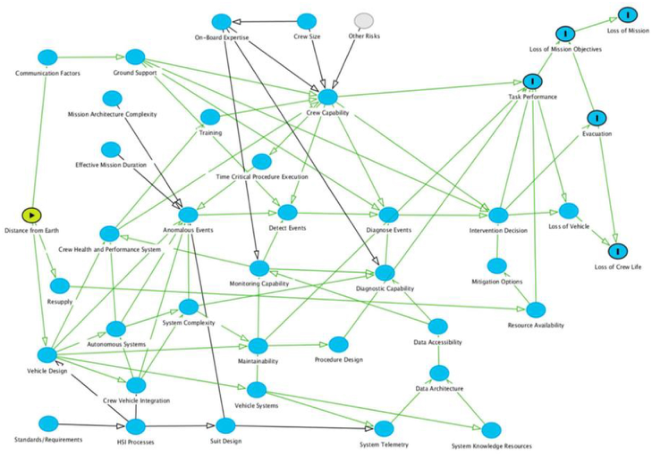
Figure 2: DAG for the risk of adverse outcomes due to inadequate HSIA.
For Low Earth Orbit (LEO) missions and Lunar missions less than 30 days, assuming minimal comm delays, disruptions and bandwidth limitations, mal- functions and errors can affect mission objectives but can be well mitigated by ground support. For Lunar missions greater than 30 days and any potential Mars mission, however, malfunctions and errors can have Loss of Crew and Loss of Mission consequences due to reduced ground support (communica- tion delays and constraints) for more complex operations, as well as reduced resupply and evacuation options. For this reason, the HSRB determines the HSIA Risk is high (i.e., a red risk) for Lunar Orbital & Surface missions and Mars missions (Vera et al., 2021).
DIRECTED ACYCLIC GRAPHS The HSRB uses Directed Acyclic Graphs (DAGs) as the basis for understan- ding intermediate causal relationships between risk contributing factors and countermeasures that link hazards to outcomes and as a communication tool for describing how astronaut exposure to spaceflight hazards leads to mea- ningful mission-level health and performance outcomes. The DAG for the HSIA Risk is depicted in Figure 2.
At the heart of the HSIA Risk DAG lies a central pathway from Anomalous Events to intervention performance outcomes (see Figure 3). When anoma- lous events occur, the team must detect the event, accurately diagnose the event, decide on an intervention, and perform appropriate tasks in time to save the vehicle, the crew, and the mission.
The capabilities represented in this central path (detection, diagnosis, inte- rvention, task performance) must be enabled in a fundamentally new way on missions beyond LEO, as ground support decreases and mission complexity
NASA’S Identified Risk of Adverse Outcomes 5
Figure 3: Central path of anomaly response.
Figure available in the original PDF paper.
increases. The following section breaks down this central DAG narrative, cataloging the current state of each node and investigating how these actions can be successfully enabled on missions beyond LEO.
HSIA DAG NARRATIVE Anomalous Events
Unanticipated, critical problems (including malfunctions, failures, and unex- pected interactions of subsystems) can occur in complex engineered systems, regardless of the preparation and expertise utilized in the engineering process (Panontin et al., 2021). The total number of events faced is likely to incre- ase with mission duration (and therefore with distance from Earth). Though these events cannot be avoided entirely, the frequency and severity of these anomalies are impacted by a variety of known factors, including the design of the vehicle, the crew-vehicle integration, autonomous systems, and the complexity of the mission and mission systems. While these factors can act as countermeasures (e.g., a well-designed vehicle can prevent certain ano- malies), they can also increase the frequency or severity of anomalies, either because they are done poorly or simply because they introduce complexity.
Detect Events The first step in anomaly response is recognizing and capturing a notable divergence from what is nominal and/or expected. This detection utilizes ground support and crew capability and is impacted by the monitoring capabilities provided to the human-system team.
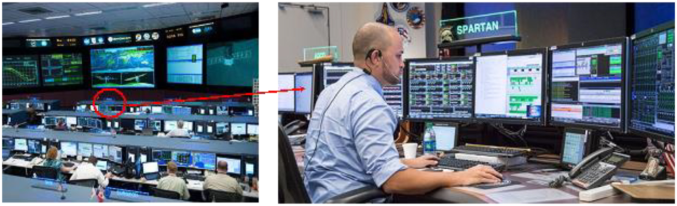
Today, anomaly detection heavily relies on the capabilities of experts on the ground in the ISS Flight Control Room (FCR), Multipurpose Support Rooms, and the Mission Evaluation Room (MER) (Panontin et al., 2021). Every day, there are 80+ experts on the ground with a combined 600+ years of system-specific experience sitting console and monitoring data across these rooms. While the number of team members sitting console decreases slightly overnight, the FCR is staffed 24/7 with individuals monitoring data. Each person sitting console monitors an extensive amount of telemetry data pulled from the vehicle (see Figure 4). Crew members on the ISS typically do not have access to the telemetry data monitored by the ground, as crew members are not expected to provide any data monitoring capabilities.
On Lunar missions, most data monitoring will likely still take place from the ground, but teams will need to monitor data from multiple vehicles, built by multiple contractors. Presenting this vast amount of data in an accessible and consistent way will be key to successful event detection. Lunar tele- metry streams may be delayed by seconds, meaning the crew capability to detect events will need to be strengthened, especially for critical incidents that
Figure 4: Data monitored by a single ISS flight control station.
require immediate action. As missions move beyond the Moon and commu- nication delays increase to up to 20 minutes one-way, the crew, with the help of intelligent onboard systems, will need to perform essentially all the data monitoring needed to detect critical events in a timely manner.
Diagnose Events After the human-system team has detected the event, the team must chara- cterize the problem and determine its causes and impacts. Whether or not an event is successfully diagnosed depends on the availability of the ground and the capabilities of the crew, as well as the sensors, data, tools, and expertise available to the team, or the diagnostic capability.
Like detection, diagnosis today relies heavily on ground expertise. The cur- rent HSIA for the ISS is ground-based and work-force intensive, relying on many engineers and operators with broad and deep expertise; large, distri- buted datasets; and expansive analytical and computing power. (Panontin et al., 2021). Diagnosis is an iterative process involving hypothesis genera- tion and testing (NASA Engineering & Safety Center, 2022), and NASA’s MER anomaly response teams employ creative and critical thinking to colla- boratively troubleshoot anomalies The iterative process is carried out by the ground with a real-time cadence, but when hypothesis testing requires crew involvement, the crew performs on-board troubleshooting activities at the direction of the ground. Ground controllers may also manipulate the vehicle for hypothesis testing without crew awareness.
As missions move beyond LEO, the crew’s capability to diagnose events will need to increase to compensate for reduced ground support. Like dete- ction, the ground will likely still play a large role in diagnosing anomalies on Lunar missions, but the small communication delay may necessitate greater reliance on the crew for hypothesis testing. Even with a small communication delay, the ground may avoid “commanding in the blind,” or sending a com- mand to the vehicle without knowing its present state. The crew will need the right tools, sensors, and expertise onboard the vehicle to assist in completing diagnostic activities. On a mission to Mars, crew capability will be the pri- mary driver for diagnosis as ground support reduces even further. Depending on the cadence of hypothesis generation and testing, the crew may need to carry out diagnostic activities without any ground support.
NASA’S Identified Risk of Adverse Outcomes 7
Intervention Decision After diagnosing the event, the human-system team must decide what, if any, intervention to employ to correct the causes of the anomaly and/or mitigate the consequences. Like detection and diagnosis, the intervention decision is impacted by the abilities of the ground and the crew, but the decision largely hinges on the mitigation options available to the team.
For the ISS, a large team of MER and MCC engineers generate possi- ble mitigation options, assess them (based on risk, benefit, cost, crew time needed, etc.), and systematically choose a path forward. When physical main- tenance and repair is required, the intervention decision is impacted by the ability to resupply (NASA Engineering & Safety Center, 2022). If the crew needs to use a spare onboard the vehicle to address the anomaly, the ground can plan to send another spare at the earliest opportunity. If the interven- tion requires a component not currently onboard the vehicle, the ground can send the new component with the next visiting vehicle. The ability to resupply can also extend the intervention decision timeframe. If a critical consumable is impaired by the anomaly (e.g., an oxygen leak), the ability to resupply consumables allows for extra time to consider mitigation options.
The mitigation options available decrease for missions beyond LEO. As resupply opportunities decrease with distance from Earth, fewer resources become available for system failure intervention. When a system does fail, crew members will need to focus on repair rather than replacement. Repla- cing an entire unit due to a component failure is a suboptimal solution when limited spares exist. Crew members will also need to preserve consumables onboard the vehicle whenever possible, increasing the repair cadence when consumables are at risk. Crew capability to make an intervention decision will need to increase as ground support decreases.
Task Performance If the intervention requires action, the human-system team needs to perform relevant tasks to implement the intervention. Task performance success is impacted by procedure design and by the maintainability of the vehicle, or the ease and rapidity with which systems or equipment can be restored to operational status.
Current ISS procedures are designed around the data, personnel, and resources available on the ground (NASA Engineering & Safety Center, 2022). Certain procedures are executed entirely by the ground with no crew input. When a procedure needs to be executed by the crew, the ground over- sees the procedure in real-time, often even verbally commanding the steps. During crew execution of a procedure, it is common to pause and wait for ground input before proceeding. Flight controllers and MER engineers some- times pause at points in a procedure to consult their investigative fault trees, review data and resources, and debate amongst the team on how best to proceed.
For missions beyond LEO, procedures should be designed with auto- nomous crews in mind. Crew members will need access to the resources typically used by the ground to alleviate procedure ambiguity, as the ground
may not be able to provide real-time guidance and oversight, even with small communication delays. When unanticipated anomalies with no set procedures in-place occur, crew members may need flexibility in pulling from and combining multiple procedures to adequately execute necessary tasks. With increased system complexity on Lunar and Mars missions, the vehicle needs to be designed more specifically for maintainability. Design considerations like standardization, interchangeability, modularization, sim- plification, accessibility, and identification, as well as human factors, should be considered to improve task performance success when an intervention is needed.
DISCUSSION
As crewed exploration missions venture farther from the Earth, ground sup- port decreases, and crews must act with greater autonomy than ever before. This will require a radical paradigm shift in mission operations. NASA must reimagine the systems, tools, and roles, both onboard and on the ground, to enable the detection, diagnosis, intervention, and task performance capabili- ties needed to prevent the loss of the vehicle when events requiring immediate response occur. Moreover, the design and implementation of the systems and tools must support the roles and responsibilities levied upon the crew and intelligent systems and be considered from a system architecture perspective to achieve overall human-systems resilience.
Specifically, detection and diagnosis of anomalies require onboard data systems that support monitoring, analysis, and trend identification for vehicle systems via sensors. Artificial intelligence (AI) may be leveraged to augment a small crew’s ability to monitor vast amounts of data previously attended to by 80+ experts on the ground in real-time. However, AI will not replace human creativity, critical thinking, and problem-solving. Time-sensitive dia- gnosis will be performed by the crew with support from enabling technologies such as data visualization and decision aids.
Intervention and task execution test the ability of onboard teams to per- form complex operations that have historically been handled by the ground or executed by crew with real-time oversight from ground personnel. AR/VR and other supportive technologies should be investigated to help crew chara- cterize and assess impacts of problems in complex, interconnected systems. Crew will also need to work with limited resources and mitigation options in an unforgiving environment. Standards and requirements for advanced maintainability, reliability, and diagnosability must be established early in the vehicle development cycle to promote systems resilience. In-space manufactu- ring technologies should be considered to mitigate the limitations of sparing and resupply.
CONCLUSION
This paper describes the driving factors behind the HSIA Risk’s classifica- tion as red (high). Data from past lunar and orbital missions suggest that unanticipated, safety-critical anomalies requiring immediate response will
NASA’S Identified Risk of Adverse Outcomes 9
occur on missions beyond LEO, even under the best engineering expectations. As ground support decreases and mission complexity increases, crews must become more autonomous than ever before. A paradigm shift in Human- Systems Integration, both onboard and on the ground, is needed to enable successful anomaly diagnosis, detection, intervention, and task performance on missions beyond LEO. NASA’s HSIA team calls on the human-systems engineering community to research technologies that can support a small, isolated crew’s ability to problem-solve in complex systems.
REFERENCES
NASA Engineering and Safety Center. 2022. Safe Human Expeditions Beyond Low Earth Orbit (LEO). NASA Human Research Program. 2021. Human Research Program Inte- grated Research Plan. HRP-47065. [Online] NASA Johnson Space Cen- ter. Available at: https://humanresearchroadmap.nasa.gov/Documents/IRP_Rev- Current.pdf (Accessed 24 February 2022). Panontin, T.L., Wu, S.C., Parisi, M.E., McTigue, K.R.. & Vera, A.H. 2021. Human-
systems integration architecture needs analysis: on-board anomaly resolution during autonomous operations. NASA Ames Research Center. Vera, A.H., Vos, G., & Petersen D., 2021. ‘Updates to risk of adverse outcomes due to inadequate human systems integration architecture’ [PowerPoint presentation]. NASA Human System Risk Board. Whiting, M. & Abadie, L. (2019) 5 hazards of human spaceflight [Online]. Availa-
ble at: https://www.nasa.gov/hrp/5-hazards-of-human-spaceflight (Accessed: 24 February 2022)
LISTED IN THE AHFE DIGITAL BOOKSTORE CATALOGUE
Explore the complete digital volume
Human-Centered Aerospace Systems and Sustainability Applications
Read this individual research paper free through the original publisher, or explore the full digital proceedings book.
ISBN 978-1-958651-02-5
Explore this ISBN in the AHFE Bookstore ↗Listed in the July 2026 bookstore catalogue; search by ISBN to confirm current availability · Digital book purchase optional