Thomas Koester, Mariam Mastour (2026). The Importance of Integrating Personality as a Topic in Crew Resource Management Training. In: Training, Education, and Learning Sciences. AHFE Open Access, vol. 231, pp. 186–196. https://doi.org/10.54941/ahfe1008010
Current maritime Crew Resource Management (CRM) courses cover a wide range of relevant topics, such as communication and leadership style, but content specifically addressing individual differences and personality is not mandatory. This paper draws on personality profile data from 457 container ship officers to illustrate how general knowledge and insights about personality, traits, and individual profiles can be integrated into CRM courses to initiate meaningful discussions and reflections. We conclude that such integration will enrich CRM learning outcomes by deepening participants’ understanding of the relationships between personality, behaviour, and team dynamics. Moreover, it can enhance overall safety and performance by enabling officers to recognise and reflect on personality differences, thereby empowering them to influence their own working conditions and team performance.
Receiving Crew Resource Management (CRM) training courses in various safety-critical sectors, e.g. aviation, maritime, oil & gas, etc., is essential to effectively utilise all available resources for crew personnel in order to ensure efficient and safe operations. This encompasses improving and retaining non-technical skills covered by topics such as teamwork, communication, leadership, situation awareness, etc. However, limited to no maritime courses offer topics on personality. The lack of topics on personality profiles reveals how personality profiles are not considered in maritime CRM courses despite its importance and relevance in CRM domains. The present paper aims to illustrate how differences between people – when measured as differences in personality traits and profiles – become relevant for communication, leadership, team dynamic etc. and how personality guides behaviour.
The notable absence of personality as maritime CRM topic is for example reflected by the International Maritime Organisation where the international specification includes a number of minimum standards of competence for officers. However, the specification does not distinctly include topics such as personality differences, as stated by the International Convention on Standards of Training, Certification and Watchkeeping (International
The Importance of Integrating Personality 187 Maritime Organisation, IMO, 2010, STCW Code table A-II/1). CRM training courses within oil and gas do not include personality as a topic either as stated by the International Association of Oil & Gas Producers (International Association of Oil & Gas Producers, IOGP, 2020). They trivially state that CRM training is “[…] not about personality, but about behaviour” (ibid., p. 9) and included as a feature but not as a separate topic. This conflicts with the general approach within personality theory, as behaviour specifically can be explained by personality traits, due to being one of its foundational factors: “…people’s behavior can be explained in terms of their [personality] traits” (Hogan & Hogan, 2007, p. 13). It is therefore essential to understand the differences in personality profiles to be able to influence behaviour.
It is important to note that most organisations provide CRM courses with a set number of topics that serve as minimum requirements, thus allowing for other topics to be covered. The lack of incorporating personality as a topic from the outset demonstrates an underestimation of how important personality profiles are in maritime CRM courses. Including this will influence crew personnel to make informed decisions for safe and efficient operations based on knowledge of the crew’s personality profiles and how they affect team dynamics. This is a paradox compared to the aviation domain, where personality awareness is prioritised and included as a CRM training element (European Aviation Safety Agency, 2016, p. 113, item 112).
This paper will bring light to the importance of incorporating personality as a crucial topic in maritime CRM training. We argue that simply by understanding personality in the context of CRM training, the knowledge can create a basis for processing information in other circumstances that concern teamwork, communication, decision-making etc. Recognising personality profiles in CRM domains will uncover traits, strengths and talents and can be used as a tool to develop further as well as utilising them to complement the crew’s work processes. This will allow maritime officers to adapt their strategies and make informed decisions based on their understanding of personality similarities and differences.
According to Hogan & Hogan (2007), personality is defined in two ways: identity and reputation. Identity is a person’s goals and the strategies they use to obtain acceptance and status. It is how a person sees themselves and it explains their behaviour. Additionally, personality is a person’s reputation which describes how their behaviour is seen by others.
In order to apply specific personality profiles directly in CRM courses, a personality assessment instrument is required to develop the personality profiles for the participants in the course. Hogan & Hogan (2007) have developed a tool that is designed to measure personality, mainly in occupational settings, the Hogan Personality Inventory (HPI). The HPI consists of seven dimensions of personality traits and is based on the Five-Factor Model (FFM). The FFM is a widely known and accepted framework used to describe personality on five dimensions. Thus, the five factors form the foundation for most research within personality psychology, including the HPI. The HPI is a validated instrument that predicts job performance across occupations and organisations. Interpersonal differences and concepts about personality, traits and profiles can also be integrated in CRM courses on a more generic
188 Koester and Mastour level and without addressing specific profiles for the course participants. Our paper outlines findings about merchant marine officers’ personality profiles of general character and provides, with reference to the HPI, a professional vocabulary which can be used to discuss and reflect on differences and similarities between officers’ profiles across departments and rank.
ANALYSIS AND DISCUSSION This paper presents a register study of 457 merchant ship officers’ personality profiles. The personality profiles were created by the Hogan test system using the HPI assessment tool. The officers answered the computer-based test as part of a safety culture program. Tests were taken from 2015 to 2017, and the profiles were calculated based on the Hogan global 2011 norm group (Hogan Assessment Systems, 2011).
Descriptive Statistics We have analysed the personality profiles – according to the seven Hogan HPI scales – for 457 merchant marine officers using SPSS version 31 combined with scripts in Python for visualization of results in graphs and diagrams. Apart from the HPI profile itself, we also used data about each officer’s age, department (deck or engine) and rank to find relationships and correlations between these and their personality profiles.
All officers in the study are male. They can be grouped into two departments: Deck officers (n = 238) typically navigating the ship from the bridge, taking care of route planning, external communication, watchkeeping, ship handling etc. and engine officers (n = 219) taking care of, operating and maintaining the ship’s propulsion and different support systems delivering, e.g., electricity, ventilation, heating, water, sewage treatment, etc. Officers in each department can further be grouped by rank. The Master (n = 62), also called the captain, has the highest rank in the deck department followed by the Chief Officer (n = 69), the 2nd Officer (n = 47) and the 3rd Officer (n = 60). In the engine department, the Chief Engineer (n = 62) has the highest rank followed by the 2nd Engineer (n = 40), the 3rd Engineer (n = 57) and the 4th Engineer (n = 21). The Electrical Technical Officer, ETO (n=39) is also part of the engine crew. The crew can be grouped into the senior crew (n = 233) which is the Master and Chief Officer from the deck department and the Chief Engineer and 2nd Engineer from the engine department, and the junior crew (n = 224) which is all other (lower) ranks in deck and engine departments.
The officers’ age ranges from 24 to 64 years with a mean of 39 years (SD = 11) and they represent 23 different nationalities. Not surprisingly, increasing age correlates with increasing rank. The correlation is positive and strong (correlation coefficient = .811) and significant (nonparametric correlation, Spearman’s rho, p < .001).
The Importance of Integrating Personality 189 Statistical Analyses and Discussions
Our further analyses, e.g., of correlations and differences, in this paper are based on a set of preconditions and criteria as stipulated here: According to tradition, we use p < = 0.05 as the critical value for significance. For the present data analysis Cohen’s d is used to measure effect size. We classify the effect sizes as small (d = 0.2), medium (d = 0.5) and large (d = 0.8). Correlations are classified according to Schober et al. (2018).
Although HPI scale scores are technically ordinal percentile scores, they are widely treated as continuous (interval-level) variables in applied research and in Hogan’s own validation studies. Following this convention – and given our large sample size – we treat HPI scales as interval-level and assume approximate normality for parametric analyses.
The Hogan global norm group is described in Hogan (Hogan Assessment Systems, 2011). The global norm group represents a broad and general population in an occupational context and is used as the basis for interpretation of individual Hogan HPI scores and profiles. Given the norm group and the design of the HPI scales, the value 50 represents, by definition, the mean of the general population.
Officers vs. the General Population Based on the one-sample t test, there are significant differences between the officers’ mean scores and the Hogan global norm group on six HPI scales (p < .001). However, there is no significant difference on the Inquisitive scale (p = .884). For the majority of the scales, the officers’ scores are significantly lower than the norm group, except for the Prudence scale of which the officers’ score is significantly higher (M = 60, SD = 28, p < .001).
Despite the significant differences for six of the seven scales, the effect sizes vary. Learning Approach, Sociability and Prudence have small effect sizes (d < = 0.36). Interpersonal Sensitivity has a slightly higher effect size (d = −0.45) and is classified as medium whereas Adjustment (d = −0.74) and Ambition (d = −1) have large effect sizes. The analysis demonstrates that the differences between the officers and the Hogan norm group on five scales are not substantial with the exception of the Adjustment and Ambition scale, which shows that the officers’ scores are considerably lower. The present analysis revealed significant differences, indicating that the null hypothesis is rejected (p < .001).
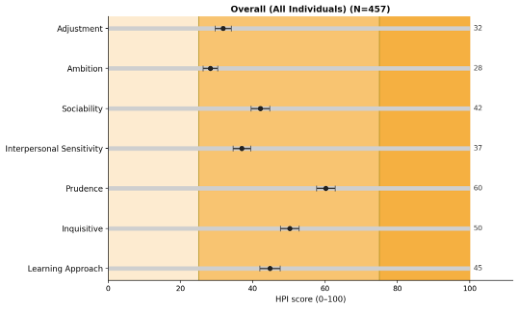
Particularly for the Adjustment and Ambition scales, the differences were large. The officers’ mean score on Adjustment (M = 32, SD = 25) suggests that officers worry more about mistakes than the norm group and are somewhat critical. This may be due to them taking pride in their work and serving as their own worst critic. From a safety perspective, learning from past mistakes is essential. However, it is also important that worries about mistakes and a self-critical approach does not become a distraction during daily and forward-looking proactive operation. Therefore, this insight is valuable input to the syllabus in CRM courses, which should focus on techniques that draw attention away from the past and help officers focus on
190 Koester and Mastour forward planning instead. This could for, example, be structured debriefing techniques that support post event reflections, thereby helping individuals with a tendency to ruminate to reach closure.
A mean score of 28 on the Ambition scale (SD = 22) indicates that the officers are happier as team players than the Hogan norm group and are less likely to compete directly with others. This fits well with the intuitive perception and understanding of maritime officers as these roles require efficient teamwork and the ability to co-exist in remote locations over longer periods of time. As such, people with competitive nature may not thrive in these environments.
Officers’ scores on the Sociability (M = 42, SD = 28), Interpersonal Sensitivity (M = 37, SD = 27) and Learning Approach scale (M = 45, SD = 31) are also lower than the norm group, however, it is only slightly lower than the norm group. The mean scores indicate that officers are less social and they prefer to work independently but will work in a team when it is required. The lower mean score on Sociability can be explained by the officers’ occupation. High sociability can be linked to impulsivity (Hogan et al., 1996) which is arguably incongruent with officer roles. Officers are responsible for people, equipment and safety in a demanding environment with specified procedures and protocols. This requires high conscientiousness and short and long- term planning for achieving success (Lipowski et al., 2014). Consequently, a controlled and non-impulsive officer may be needed. Sociability and impulsivity traits can be influenced by personality and cognitive capacity and can therefore be difficult to learn. Nonetheless, this can be addressed in CRM training courses by means of techniques and strategies that allows officers to reflect and plan carefully in complex and high-risk situations. These techniques are tools to utilise if the officer does not naturally possess certain personality traits that are relevant.
The present findings also indicate that the officers are more straight- forward in their communication and may seem tough and confrontational. Furthermore, the mean scores indicate that the officers are more practically oriented than the norm group and prefer a hands-on approach. Relating these findings to CRM training courses can support officers in terms of managing their confrontational nature and communication styles. Makarowski et al. (2020) found that the ship’s safety is affected when an assertive captain cooperates with officers who are impulsive and have “undercontrolled” personality types. This situation could lead to lack of agreement in the crew, loss of a shared situational awareness and loss of shared goals, thereby compromising safety. Communication between officers is therefore essential as it can have substantial repercussions on the safety of the ship if it is inadequate.
Prudence was the only scale with a mean score significantly higher than the norm group (M = 60, SD = 28), indicating that officers work well with structured and established rules and processes. They are less spontaneous and more risk-avoidant than the norm group. Intuitively, this fits well in the operational context at sea, which is a compliance driven regime where officers must adhere to several layers of rules and regulations.
The Importance of Integrating Personality 191 In regard to CRM courses, discussions of prudence, compliance and rule following is essential. Having a low score on the scale could bring the officer in conflict with the fundamental principles in the compliance regime. On the other hand, having a high score could indicate that officers are being less flexible. Further, a high score indicates that the officers’ decision- making approach will be biased towards a more risk-averse behaviour and conservative approach. A mean higher than the norm group indicates that officers in general could be less flexible and more conservative when it comes to rule following and compliance, and this must be addressed in CRM courses. Being less flexible and more conservative can be a serious safety issue in a dynamic environment at sea where officers should be able to improvise and deviate from rules and procedures when required by the circumstances.
Comparing Different Subgroups of Officers We examined the differences between officers on deck and the officers in the engine room to understand differences and similarities between them. In addition, the differences between junior and senior officers are further investigated.
The data analysis showed that there is minimal or non-significant difference between officers on deck (n = 238) and officers in the engine room (n = 219) on all the HPI scales. Only the Prudence scale shows a significant difference between the groups (p = .037, independent-samples t-test). However, the effect size is small (d = −.196) indicating a minor difference. Therefore, we can conclude that the sampled officers on deck and in the engine room are quite similar and there are no substantial differences. This can be explained by the findings of Rosetti et al. (2025) who state that individuals with similar personality traits choose similar occupations. They found that similar traits arise within the same occupation, thus, individuals that stay in similar occupations also develop more similar personalities over time. Accordingly, the lack of major difference between deck and engine crew may be due to their comparable work resulting in related personality traits. This explanation might also be applicable to the findings from the Junior vs. Senior analysis which is examined below.
When analysing differences between the junior and the senior crew, the data show a similar pattern to that of the deck crew vs. engine room crew. Despite the consistent pattern, four of the seven HPI scales show significant differences between the junior and senior crew. This includes the Adjustment (p = .018), Ambition (p = .002), Sociability (p = .033) and Inquisitive scale (p = .006). The similar pattern is reflected by the small effect sizes which are between −.288 and .200. This suggests that – similar to deck vs. engine crew – there are small and significant differences but no major differences between the junior and senior crew. This is consistent with findings by Makarowski et al. (2020) who found no statistically significant differences in extraversion and openness to experience between master mariners and navigation students. However, the present findings may be explained by a further examination of the specific ranks as categorising the ranks in bigger and broader groups may result in the risk of overlooking information and the data becomes
192 Koester and Mastour generalised. A more extensive analysis of the differences between specific ranks is therefore needed to reduce the risk of oversimplifying the dataset.
The findings mentioned above are immensely important in the CRM context because they strongly support a “one team – one culture” mindset rather than reinforcing subcultural divisions such as deck vs. engine or junior vs. senior. A stereotypical understanding of, for example, deck and engine departments as conflicting cultures is not supported by our data and must therefore be disregarded – at best, such assumptions could come from anecdotal evidence. The absence of major differences clearly indicates that personal style and behaviours tend to converge rather than diverge across departments and ranks. In the CRM context, this again argues for strengthening coherence and fostering a unified team culture.
The Master’s Score on the Ambition Scale Looking at the scores on the seven Hogan HPI scales for all ranks, one thing stands out. The Master (n = 62) has a significantly (independent sample t-test, p < .001) higher score on the Ambition scale (M = 42, SD = 26) than the group of other officers (n = 395, M = 26, SD = 20) with a large effect size (d = −.785). Compared to the norm group, all officers have a significantly lower (one sample t-test, p < .001) mean score on the Ambition scale (M = 28, SD = 22) with a large effect size (d = −1.003). Looking at the group of Masters alone (n = 62), they still have significantly lower (one sample t-test, p = .026) mean score on the Ambition scale, but with low effect (d = −.290). The mean score for the norm group would by definition be 50.
Comparing the Masters with each of the other nine rank groups individually shows that Masters have significantly higher means on the Ambition scale compared to any of the eight other rank groups. This includes the group of Chief Engineers, the highest rank in the engine department. For the Ambition scale, “high-scoring individuals tend to be leader-like, energetic, driven, competitive, and focused on achieving results and success” (Hogan & Hogan, 2007, p. 109). However, this applies to scores between 65 and 100. The mean score for Masters (M = 42) corresponds with the interpretation that they are “relatively ambitious, reasonably hardworking, and good team players” which, is associated with scores between 36 and 64 (ibid.). The rest of the officers’ mean (M = 26) fit the interpretation for scores between 0 and 35: “Low-scoring individuals will prefer to have tasks assigned to them and will be more comfortable following others than leading” (ibid.).
We know that increasing rank correlates with increasing age. One explanation behind the significantly higher Ambition score for Masters could be, that it is because they are the oldest in the study, and that Ambition grows with increasing age. There is a positive correlation between age and the Ambition scores for the population in the study, but the correlation is weak (Pearson correlation = .117) and not significant (p = .013). Therefore, the higher Ambition scores for Masters cannot be explained by age alone. Another explanation could relate to Impression Management which, indicates the degree to which a person’s responses: “…are likely presenting themselves in a socially desirable manner and attempting to
The Importance of Integrating Personality 193 manage impressions” (Hogan Assessment Systems, 2013). But looking at the proportion of individuals showing impression management – as identified in the individual HPI profiles – this appears to be smaller for the Masters (26%, n = 62) compared to the rest of the group (33%, n = 395). Therefore, we have no reason to believe that Impression Management can explain the Masters’ higher score on Ambition.
The usual way to become a Master is to be promoted through ranks. The most likely explanation for the higher Ambition score of Masters – given that we now can exclude age and social desirability – is that it is shaped by selection criteria for promotion in the specific organisation. In other words, that high scoring Chief Officers – the level from which they are promoted to become Masters – are more likely to get promoted in the specific organisation due to, e.g., higher leader-like behaviours and performance. Chief Officers not showing these characteristics may not get promotion, stay on their rank or shift position to other organisations for promotion. This filtering of Chief Officers for promotion might induce the Ambition score bias seen for the Masters.
Looking at the differences between Masters and the rest of the crew when it comes to the Ambition characteristics can spark meaningful discussions, and thereby insights, about roles, leadership and team dynamics in CRM training sessions. Discussions can take place without being personal or specific but based solely on mean values and “the typical Master Ambition profile”.
Homogeneity Between Officers on the Interpersonal Sensitivity Scale Comparing means of all nine ranks with each other for all HPI scales shows us some tendencies. For each of the seven HPI scales, between 2 and 11 combinations of ranks – out of a total of 36 rank combinations – show significant differences in mean scores. Except for Interpersonal Sensitivity where, there are no significant differences between the ranks, i.e., that this is the scale where all ranks are most alike. To understand this case, we could ask why the officers are so alike on the Interpersonal Sensitivity scale. On the other hand, we could ask why the officers are different on all the other scales. Research has shown that “individuals tend to develop more homogeneous – or similar – personalities within, rather than between, occupations due to attraction and selection, attrition, and socialization effects” (Rosetti et al., 2025). Anni et al. (2024) point to similar mechanisms for homogeneity within occupations: “People choose jobs”, “people are chosen for jobs” and “jobs may change people”. According to King et al. (2016), “Support for homogeneity within organizations and occupations was found, regardless of the granularity with which occupation were defined”. Based on this, it is not surprising that the officers in our study show homogeneity. It is expected that officers will show similar profiles. They have all applied for a job in the same organization. They were all selected for the job. They may have initially differed but might changed due to the work conditions and culture in the organization. This also corresponds with Anni et al. (2024), saying that “occupations with higher average levels of the personality domains
194 Koester and Mastour typically linked to better job performance tended to be more homogeneous in these domains”. The interpretation of the similarity in scores between ranks on the Interpersonal Sensitivity scale will be that officers perform best and have the highest chance of retention over time if they have profiles similar to the rest of the crew regardless of rank. Both self-selection and role-shaping work are the strongest across ranks for the Interpersonal Sensitivity parameter.
This is an interesting finding in the CRM training context. It means that having a similar Interpersonal Sensitivity profile compared with other officers on board can be a strong predictor of success in, e.g., teamwork, communication, and leadership.
The Typical Profile According to Anni et al. (2024), King et al. (2016) and Rosetti et al. (2025), there is evidence that persons in similar occupations will have similar personalities. It is therefore – at least theoretically – appropriate to assume that there will be typical HPI profiles for officers on merchant marine ships. We have also seen that the officers in the present study have different mean HPI scores compared with the general population – represented by the Hogan norm group – on several parameters.
Based on this, we have produced “typical profiles” from the results in our dataset calculated as means for all officers collectively, for junior and senior officers separately, for deck and engine departments separately, for all combinations of seniority and department and for each of the nine ranks individually. See example below in Figure 1. For comparison, the “typical general population profile” would have a mean score of 50 on all seven scales. The diagrams can be used as generic and anonymous cases and examples in CRM training when discussing individual similarities and differences, personality traits and personality profiles and how they influence performance and team dynamics.
Figure 1: The typical generic officer profile (all officers) based on the study group.
CONCLUSION
The discussions in our paper as well as the study of the 457 officers’ personality profiles are prompted by the fact that personality is not a mandatory topic in maritime CRM courses according to IMO (International Maritime Organisation, IMO, 2010, STCW Code table A-II/1). The topic is still regarded as an underlying concept relevant for the understanding of other mandatory concepts such as leadership, communication, decision- making and teamwork. Through this paper, we advocate for the integration of points and concepts related to personality, traits and profiles as an enhancement in CRM courses, to set the mandatory topics in perspective as well as putting interpersonal differences on the agenda in discussions and reflections.
We have explained that personality can be introduced on a very individual and specific level, e.g., by having CRM participants attend personality profiling programs before or as part of the training, or on a more generic level where test systems like the HPI offer a professional vocabulary for identifying, discussing and reflecting on personality related topics in CRM courses.
Furthermore, we explain examples, based on our study, of how CRM courses can be inspired and informed by a deeper understanding of differences and similarities between the officers and the general population as well as between different subgroups of officers. We also suggest that tools and techniques can be trained for use in situations where individuals might be challenged based on their personality profile in the specific maritime setting and context, e.g., when interacting in a team of diverse personality types.
In a broader perspective, personality research is not solely important in CRM training. It is also relevant in relation to recruitment and retention, where it can inform individuals as well as organisational decisions and priorities and support matching individuals with roles. This will not only have a positive effect on safety – which is the core objective of CRM – but also on performance, motivation and wellbeing in general. Therefore, Human Factors specialists and psychologists must be involved in the integration of personality research into the human performance related domains in shipping, including, but not limited to, safety, operations, training and HR.
Although we have mentioned the possibility of training personal tools and techniques to compensate for a less optimal match between person and role personality wise, our main view is that CRM should be used as a platform for empowerment of frontline personnel for them to influence work conditions rather than an attempt to “fix” the personnel to make them fit the system.
When the crew takes time to understand and reflect on interpersonal variations, they not only become more aware of the consequences of these differences – they also gain the ability to codesign their own work conditions to better accommodate them. These conditions may include how meetings are structured, how decisions are made, how feedback is given and received, and how communication is coordinated in general.
REFERENCES
Anni, K., Vainik, U., & Mõttus, R. (2024). Personality profiles of 263 occupations.
Journal of Applied Psychology. Advance online publication. European Aviation Safety Agency. (2016). Acceptable means of compliance (AMC) and guidance material (GM) to Annex III. Hogan, R., Hogan, J., & Roberts, B. W. (1996). Personality measurement and
employment decisions: Questions and answers. American Psychologist, 51 (5): 469–477. Hogan Assessment Systems (2011). Hogan Personality Inventory, Hogan Development Survey, & Motives, Values, Preferences Inventory Global Norms. Documentation of Normative Data. Tulsa, OK: Hogan Assessment Systems Inc. Hogan Assessment Systems (2013). Interpreting HPI subscales. Tulsa, OK: Hogan
Assessment Systems Inc. Hogan, R. & Hogan, J. (2007). Hogan Personality Inventory Manual (3rd ed.).
Tulsa, OK: Hogan Assessment Systems. King, D. D., Huang, J. L., Ott-Holland, C. J., Wadlington, P. L., Ryan, A. M., & Elizondo, F. (2016). Personality homogeneity in organizations and occupations: Considering similarity sources. Journal of Business and Psychology, 31: 587–602. International Maritime Organisation, IMO (2010). International Convention on
Standards of Training, Certification and Watchkeeping for Seafarers (STCW). International Association of Oil & Gas Producers, IOGP (2020). Crew Resource Management for Well Operations teams (Report 501). Lipowski, M., Lipowska, M., Peplińska, A. & Jeżewska, M. (2014). Personality
determinants of health behaviours of merchant navy officers. International Maritime Health, 65 (3): 158–165. Makarowski, R., Plopa, M., Piotrowski, A. & Plopa, W. (2020). The human factor in maritime transport: Personality and aggression levels of master mariners and navigation students. Advances in Cognitive Psychology, 16 (4): 363–369. Rossetti, C., Biemann, T., & Dlouhy, K. (2025). The emergence of similar personalities
in similar occupations. Journal of Organizational Behavior. Advance online publication. Schober, P., Boer, C., & Schwarte, L. A. (2018). Correlation Coefficients: Appropriate Use and Interpretation. Anesthesia & Analgesia, 126 (5): 1763–1768.
LISTED IN THE AHFE DIGITAL BOOKSTORE CATALOGUE
Explore the complete digital volume
Training, Education, and Learning Sciences
Read this individual research paper free through the original publisher, or explore the full digital proceedings book.
ISBN 979-8-950676-07-9
Explore this ISBN in the AHFE Bookstore ↗Listed in the July 2026 bookstore catalogue; search by ISBN to confirm current availability · Digital book purchase optional