Violeta Clemente, Fátima Pombo (2022). From Utopia to Dystopia: Students Insights for the Development of Contemporary Societies through Design Fiction. In: Human Dynamics and Design for the Development of Contemporary Societies. AHFE Open Access, vol. 25, pp. 454–465. https://doi.org/10.54941/ahfe1001421
1 ID + Research for Design, Media and Culture Aveiro, Portugal; School of Design, Management and Production Technologies Northern Aveiro, Aveiro University Oliveira de Azeméis, Portugal ↗
2 ID + Research for Design, Media and Culture Aveiro, Portugal; Department of Communication and Art, Aveiro University Aveiro, Portugal ↗
This work describes an educational experience exploring the speculative essence of Design Fiction as a pedagogical tool to promote engineering students’ thinking skills within a Design Thinking course. The experience took place at a Portuguese University during the academic year 2021/2022. Students were challenged to speculate about the future of contemporary societies by developing a Design Fiction Scenario around the themes of Sustainability, Future and Technology. After describing the approach adopted and overall data about the intervention, some selected students ideas are presented. Then, students’ written essays content is analyzed regarding their awareness, concerns and hopes about the future of contemporary societies. Results show that while some of the teams followed the direction of utopia, envisioning desirable scenarios to the future, other teams adopted a less optimistic view and designed scenarios where contemporary societies and technology would lead to extreme situations or even chaos, a few of them even raising strong ethical issues. In some cases, it seems rather evident that students deliberately proceeded with these pessimistic scenarios intentionally trying to provoke reactions and stimulate debate among their peers. In other cases students appear to not be aware of those possible dangerous outcomes. Finally we discuss the value and limitations of our approach and conclude by suggesting some guidelines to apply in future interventions aiming to the role of Design as discipline in creating utopian and dystopian fictions regarding scenarios of future development.
The term Design Fiction was coined by science fiction author Bruce Sterling when explaining how design impacted his literary production. More recen- tly, Sterling (2012) has refined design fiction definition as the intentional use of diegetic prototypes to suspend disbelief about change. The term diegesis refers to the narrative meaning that a diegetic prototype exists within a story world. Disbelief suspension refers to the fact that the focus is not on finished
Students Insights for the Development of Contemporary Societies through Design Fiction 455
products but rather on insights about what change can bring. Thus, the role of Design Fiction is not to show how things will exactly be but to open up a space for questioning. Design Fiction could be described as the construction of a narrative about a fictional world supported by prototypes which provide fictional evidence of that alternative world aiming to create space for specu- lation. An excellent piece of Design Fiction can be found within the 2021 book Writing Design Fiction: Relocating a City in Crisis by Tony Fry. Besi- des discussing Design Fiction it includes a work of fiction in itself telling the dramatic relocation of an entire city facing environmental catastrophe due to rising sea levels.
This paper reports a descriptive, non-interventionist, case study repor- ting an educational experience within a Design Thinking Module lectured to engineering students from a Portuguese University during the academic year 2021/2022, with 4 weeks of extension, 3 hours a week in a total of 12 hours. Sixteen engineering courses were involved. The total number of students assigned to the module was 186, organized in 6 classes, ranging from 20 to 50 students per class. Taking the opportunity to potentially prompt students to think about the future of contemporary societies, the module final assignment challenged them to develop a Design Fiction Scena- rio around the themes of Sustainability, Future and Technology. Organized in 5 elements teams, students were expected to envision and present an uto- pian vision based on the principles and methods of design. To that end, beyond Design Thinking, course contents’ included topics as the UN 17 Sustainable Development Goals, the pillars of the New European Bauhaus as beauty, sustainability and togetherness as well as the historic founda- tions of Bauhaus principles as inspiration to discuss contemporary time. Results showed that while some of the teams followed the direction of uto- pia, envisioning desirable scenarios to the future, other teams adopted a less optimistic view and designed scenarios where contemporary societies and technology would lead to extreme situations or even chaos, a few of them even raising strong ethical issues. In those cases, it seems rather evident that students deliberately proceeded with these pessimistic scenarios intenti- onally trying to provoke reactions and stimulate debate among their peers. In this paper through content analysis method it is explored students’ writ- ten essays regarding their awareness, concerns and hopes about the future of contemporary societies. Finally it is discussed the interest of Design Fiction combined with Design Thinking as an educational tool to promote and deve- lop critical skills and future-oriented skills within engineering educational context.
COURSE OVERVIEW During the year 2021/2022 a Portuguese University added two new “Tran- sferable Skills I and II” units to engineering curricula, respectively, at 1st and 2nd semester of the 2nd curricular year. Among the different modules offered at the 1st semester unit, a Design Thinking module with 4 weeks of extension, with 3 hours a week, in a total of 12 hours, was included. The module was
456 Clemente and Pombo
Table 1. Design thinking module course overview.
Table available in the original PDF paper.
Week (3h/week) Contents 1st week From Bauhaus to New European Bauhaus. Design Thinking Expectations: Pre-Module Questionnaires. Design Thinking Models Overview. The Model Evolution 62. 2nd week 17 ONU Goals for Sustainable Development. Design Thinking dynamics: divergence, convergence, interactivity. Problem Emergence Phase. Tools: Opportunity Mind Map and Intent Statement. 3rd week Empathy Phase. Tools: Stakeholder Map, Personas, Empathy Map, Users’ journey. Experimentation or Ideation phase. Creative Thinking Characte- ristics: Fluency, Flexibility, Originality and Elaboration. Tools: Analogies and Semantic Confrontations. Elaboration Phase: The Value of Prototypes (Marshmallow and Spaghetti Tower activity) 4th week Exposition (Communication phase) Tools: Storytelling. Cogni- tive science behind Storytelling. Re-evaluation of Design Thinking Expectations: Post-Module Questionnaires. Evaluations: Students oral Presentations, Written Essays and Prototypes Delivering.
Note: The Design Thinking Model adopted within the module was the Evolution 62 from mindshake.pt (https://www.mindshake.pt/design-thinking/).
lectured by this study authors. Course contents were organised according to Table 1.
Evaluation consisted in students to work in a maximum of 5 students per team, and present a Design Fiction scenario at the end of the 4 weeks relating it with the themes of Sustainability, Future and Technology. The presentation is complemented by the delivery of any artifacts or prototypes supporting the presented Design Fiction scenario and a 1000 to 1500 words written essay describing the development process.
The total number of students assigned to the module was 186 (136 male and 50 female) organized in 5 classes, ranging from 20 to 50 students per class. Sixteen engineering courses were involved were from diverse fields such as Electrical Computer, Informatics, Telematic, Telecommunications, Physics, Mechanics, Industrial Engineering and Management, Environmen- tal Engineering, Biomedical Engineering, Materials Engineering or Civil Engineering.
RESULTS AND ANALYSIS During the semester, beginning in October 2021 until January 2021, 3 rounds of the module occured. Along the semester the system of courses rotation allows students to attend other Modules that are also part of the Transferable Skills Unit. A total of 165 students attended lessons regularly organized in teams with a total of 34 Design Fiction works being presented (Table 2).
Students Insights for the Development of Contemporary Societies through Design Fiction 457
Table 2. Design Fiction ideas presented by students in alphabetical order.
Table available in the original PDF paper.
Design fiction idea Short description
1. Artificial Intellige- nce
Contrasting the use of AI in two distinct scenarios: to help human beings or to dominate them 2. BioBin A garbage bin/plant vase that allows plastic composting, obtaining plant fertilizer from it 3. Blockscraper Ecologically sustainable and movable flats, inspired in the ‘Jenga’ game 4. Clothes for Every Season An implanted chip in every human analyses several individual parameters and life style factors and suggests the number of children each human should have
Clothes with variable isolation, adaptable to every season weather changes 5. Conditioned Human Interaction Program (CHIP)
6. CRISPR A technology that already exists (it was a case of misinterpretation of the assignment by the students) 7. Diagnocity Device that allows the immediate diagnostic of any health condition and the automatic booking of health appointments 8. DressPixeis Modifiable clothes, able to change colours, textures and patterns through nano technology 9. EcoPipe Pipeline system to collect recyclable materials from households 10. Energetic Fashion (E-wear)
Clothes able to convert body heat into useful electrical energy 11. Energy Link A body suit able to convert human movement into electrical energy 12. Exodus Moving an entire city to a new location due to sea levels rising 13. Guardian Bird Robot bird created to supervise natural areas (forests, rivers), detecting and preventing anomalies 14. H@H (Health at Home)
Nano chip that continuously acquires data from the individual, assisting health maintenance especially through nutritional guidelines 15. H2F Hydrogen Continuous and accessible hydrogen supply network to power fuel cell cars 16. Health + An ATM-like machine that provides immediate diagnostic through body scanning and automatically appoints a physician consultation 17. High Land An smart city located at a ‘plastic island’, the island resulting from the aggregation of all plastic in the oceans 18. Hike n’ SeeK Augmented reality app to explore travels and hiking 19. Ícaro A ‘nuclear reactor’ fuelled by a ‘fragment of Sun’ brought to the Earth 20. KCALL4 Life Style
An app functioning as a ‘spent calories’ certificate that denies or not benefits to the citizens according with their sedentarism levels 21. Kore Smart watch able to transport any object by reducing its size to a nano scale
458 Clemente and Pombo
Table 2. Continued Design fiction idea Short description
Table available in the original PDF paper.
22. MetamoFloor Floor able to dynamically change its shape into furniture according with users’ needs 23. Microwave bed A bed/machine that allows users to take the same benefits from a 8 hours repairing sleep in only one hour of use 24. No Barrier Glasses
Wearable glasses to aid individuals with auditive /speech impairment 25. New Amazónia Artificial cultivable island made from gathering all the plastic in the oceans, intentionally designed as a replica of Amazonia Forest 26. Ocean Pod A machine that collects all the garbage at the bottom of the oceans 27. Spark Walk An urban system that allows to convert kinetic energy from citizens’ walking movement into electrical energy to fuel city lights 28. Smart Sub Cities Temporary transference of human life (cities) to the underground to ‘relief’ Earth surface 29. Tote Iter Cloning system to simulate /explore multiple professional pathways before the time when the individual needs to choose his/her professional pathway, allowing an experienced-based informed decision 30. Truth Solutions Wearable bracelet that obligates users to always speak the truth 31. Uaditive An aeronautical fuel able to restore the ozone layer by liberating patching molecules while plains are flying 32. Vocation Full App that allows students to explore professional realities through virtual reality 33.Weightless Tote bags, backpack and travel bags able to convert any object into a weightless one mainly aiming to assist people with physical limitations or reduced mobility to transport small-medium size goods 34. We Move You An integrated and intelligent urban system relying in 5G technology that automatically manages people and goods mobility within the city without users intervention ending with the vehicles private property paradigm
A general observation of the ideas presented at Table 2 shows that students perception of Sustainability, Future And Technology appears to be ambi- valent and diversified. Some teams envision some slightly improvements or adaptations of already existent technologies (as is the case of CRISPR or Hike n’ Seek ideas, for example), which could be implemented right now or at a very near future. Others imagine a widespread expansion of existing tech- nologies (for example, No Barrier Glasses, Vocation Full or We Move You,) which would probably become possible in a medium-long future. Finally, some teams predict science fiction scenarios (like CHIP, KORE or Nova Ama- zonia), which currently seem to be far away from our present reality, in a very distant future.
Students Insights for the Development of Contemporary Societies through Design Fiction 459
Additionally it can be noticed that while a future utopian vision was expli- citly asked in the assignment brief, some of the developed ideas enclose dystopian possibilities. In a few cases it seems rather evident that students deliberately proceeded with these pessimistic scenarios intentionally, trying to provoke reactions and stimulate debate among their peers. In other cases students apparently have not considered the possibility of worse scenarios.
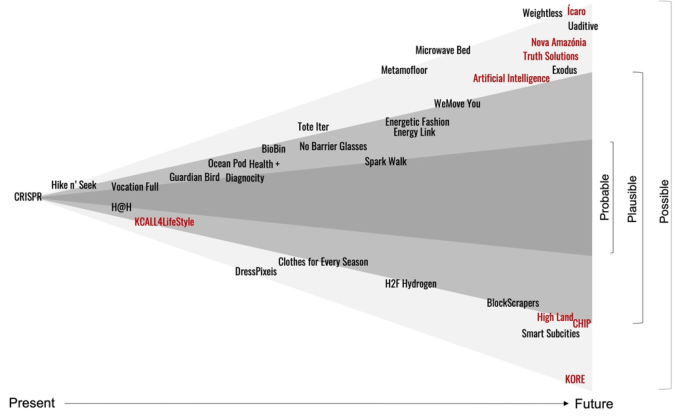
Trying to give a structure to the students’ ideas, we organized them accor- ding to Joseph Voros (2001) future cone (figure 1). The concept of the cone is that each idea is positioned in the horizontal axis according to the “time- frame in which the idea might be made real, from present to far in the future” while its vertical location indicates the likelihood of the design actually exi- sting, from probable to possible futures (Maxwell, 2019, p. 1488). After positioning all the students ideas in the cone, we added another dimen- sion to the analysis by using a different color to signal ideas with major potential to conduct to dystopic scenarios. Obviously, both processes, either distribute ideas within the time frame either locate them in terms of feasibi- lity were guided by authors’ sensibility which is obviously a very relativist approach.
A first observation of figure 1 reveals a significant number of ideas located at a distant future and requiring technology not yet available nowadays nor predictably available in the near future. That indicates that students were able to overcome their initial resistance to suspend rationality and disbelief. It can also be noticed that the majority of ideas with possible dystopic outcomes are positioned in the distant future (horizontal axis) and beyond plausible future (vertical axis). That may indicate that the more students distanced themselves from their known reality the greater difficulties they had to predict possi- ble negative or dangerous consequences from the designed scenario. Another possible interpretation is that the more students pushed their thinking to
460 Clemente and Pombo
fictional realities the more they were interested in creative speculative and hypothetically chaotic scenarios to provoke debate among their peers.
In the next section the ideas with major obvious dystopic potential (again, according to authors’ perspective) are presented with little more detail. In some cases, ideas are presented together in the same subsection due to their similarities or common points. When possible, students’ essays insights are provided aiming to understand if there was or not, a deliberate intentionality from each students’ team to produce dystopian future realities.
Artificial Intelligence: An Intentional Alert to Possible Dystopian Future Idea 1 (Table 2), Artificial Intelligence, did not exactly attended to the assi- gnment brief (where only one future scenario was asked), but we chose to mention it due to the fact that it was the only one where students delibera- tely opted to present a dystopic view of future. Instead of a detailed future idea, with diegetic prototypes to support the narrative, this team opted for presenting 3 less elaborated different hypotheses regarding artificial intelli- gence future. As stated by students in their own essay: “students intended to convey the idea of how robotics can lead to an apocalyptic scenario (…) a prolepsis of a dark future dominated by AI where (…) the life of the human being who passes to be a mere robot.”
CHIP, KCALL4 Life Style and Truth Solution: The end of free will This three ideas have in common the fact that the solution, probably well intentioned to real and current problems including global overpopulation, sedentary lifestyle and dishonesty /corruption can easily lead to totalitarian scenarios where individual free will is compromised.
CHIP (idea 6), according to students’ essay, “is a microchip that limits the number of children that the individual on which it was implemented may have. CHIP is based on nanotechnology and is implemented in the human being since birth. It then accompanies the individual in his daily life, collecting information related to his physical and psychological characteristics, namely, health and psychological/personality issues, as well as acquiring information regarding the interpersonal relationships and integration and interaction in society and in the world, including education, criminal record, salary and place of residence.”
An evidence that the team has considered possible dangerous outcomes from their idea is manifested in the following statement: “It is extremely important to mention that, once the limit [of children] is stipulated, it is up to every human being to use his common sense and power of decision to exercise his free will within the defined norms”. However it is also stated by team 6 that “in the event that the limit is reached, the hundreds of nano robots present on the chip will take care of interrupting the secretion of hor- mones responsible for fertility”. So, the solution is presented as an “aid to human decision that (…) seeks to develop and sustain a new attitude towards individual existence in the world (…) based on deliberation, assertiveness and the power of decision and exercise of free will”, however, “subject to
Students Insights for the Development of Contemporary Societies through Design Fiction 461
restrictions”. Students admitted that it was their intention to explicitly pro- voke discomfort in the audience when presenting their idea to the peers and to stimulate debate about the outcomes of such radical idea.
K4CAL4life (idea 20) is a solution to sedentary lifestyle, and its subse- quent health issues. It is materialized through a calorie counter technology “carried out by the Governments of each country in a similar way to what happened with the Covid-19 vaccine, that is, recommended, but not manda- tory (with certain exceptions: chronic patients)”. It works according with a “scoring system” that, depending on points earned by physical activity, regu- lates users’ life. Some examples include the amount of calories the user can buy at the supermarket or the type of meal he/she is authorized to consume when eating out. This team’s written essay does not show any concern with the dangerous control over citizens life and free will that this solution may potentially represent.
Truth Solutions (idea 30) is a product designed with the objective, in students’ own words, to build an “utopian future”, without “lie, mistrust, corruption” resulting in a society that can live “honestly and truthfully”. It consists in a “portable technological device”, similar to a bracelet “which prevents the user from lying (….) by regulating the appropriate hormo- nal functions so that the user is compelled to tell the truth as accurately as possible.” … On their essay, students admitted that “despite so many positive sides” there were also problems associated with the idea: “If we consider a scenario in which everyone wears our bracelet, we would have a world without decision-making power (free will) and all our actions would be monotonous, regulated from the bracelet.”. Additionally, they state that “lying is part of being human and this helps so that society does not collapse, strengthening our personal relationships”. In this case it seems rather evident that students considered both positive and negative outcomes of their idea. And even if that is not explicitly said, it appears that they intended to provoke debate around the benefits of always speaking the truth against the inherent human need to lie.
New Amazonia and High Land: Gathering Ocean Plastics to Create Functional Islands These two ideas arise from the same concept which is to gather all the pla- stic currently dispersed the oceans with the double objective of making the aquatic environment safer for the submarine life and, at the same time, using this plastic to build artificial islands with functional purposes. Idea 25 “New Amazonia”proposes to make the plastic island cultivable to create new forest to substitute or complement Amazonia as Earth’ lungs. Specially designed ecosystems would also be created in the island to protect endangered spe- cies. High Land (idea 17) is a very similar idea with the difference that in this case the island would be designed for human life through the buil- ding of ecologically sustainable smart cities. None of the students essays shows considerations relative to the possible negative impact of the ideas, for example, in completely changing planet Earth ecosystem. In both cases
462 Clemente and Pombo
the ideas are assumed as strictly beneficial and with utopic results of “har- mony”and “environmental cooperation”where “waste and garbage becomes an opportunity to generate something we need to recreate a beautiful world”.
KORE: Changing Objects Size KORE (idea 21) is “a watch-shaped device capable of compressing objects to the atomic level and storing them in small compartments with just one click”. It also involves the possibility to “send the compressed material via Bluetooth (…) instead of sending something in the Giga Byte we can some- day send it n Kilograms or even Tons”. According the students that developed the idea, it is “useful in several aspects, for example (…) heavy loads’ tran- sportation, thus minimizing travel costs, (…) but also (…) being useful in the storage of household goods in small physical spaces”. KORE environmen- tal impact, including fossil fuel consumption, dumps size, oceans and forest pollution reduction is discussed by students with certitude. They also point out the concept potential to transport high volume goods to assist people in underdeveloped countries or communities under extreme difficulties such as refugee camps and natural disasters areas. But no risks regarding the misuse of the technology, which are very easy to foresee are discussed in students’ written essay.
Ícaro: Bringing a “piece” of Sun to the Earth Ícaro (idea 19) is a concept developed to answer to a possible energy crisis based on the possibility to create a battery able to generate infinite energy from a “fragment” of Sun. Inspired by some sci-fi movies, students provide some detail about the idea: a fragment of Sun is directly attracted to a con- tained chamber, in the Earth, by a super powerful magnet. “Once confined to the chamber, the fragment would simply continue to carry out the fusion reactions that it already did in the Sun, thus generating heat to heat water into steam, which would move the turbines, generating, the desired energy”. Aside any technical inaccuracies or currently seen impossibilities to the idea, which are not the core of the present discussion, it is worthwhile to look at the possible risks expressed in the students essay. The only concern explicitly stated is that even if this source, by itself, “is able to supply all the society’s energy needs, we don’t think it’s prudent to end with all fossil based fuel all at once”. Noticeably, none concerns associated, for example, with planetary ecosystem or solar system imbalances are considered by students.
DISCUSSION
One of the main goals of this educational experience was to push students away from ‘pure rationality’. Is our conviction, as Design Thinking educa- tors, that completely rational approaches and “deeply rooted conviction” about rational positions can make problem solving very inflexible, condu- cting to solutions repetition. “Attachment to the rational high ground is accompanied by an acute fear of what may lie beyond the confines of this rationality, which is often referred to in terms of anarchy and chaos” (Dorst, 2015, pp. 17–18). Inversely, design fiction “implicitly have an elucidative
Students Insights for the Development of Contemporary Societies through Design Fiction 463
edge. Being exploratory and inquisitive is a definitional characteristic… this is one of the reasons why ironic humor and dystopia are common features in Design Fictions” (Coulton and Lindley, 2017, p. S4637). Even admitting that these are very provisional results, it clears that combining design Fiction with Design Thinking could be a powerful educational tool to enhance students problem solving skills pushing them to think far away from their present realities, suspending judgement, disbelief and rationality.
At the same time, since “utopias and dystopias should be regarded as essen- tial forms that design fiction may take”(Markussen and Knutz, 2013, p. 232) this educational tools seems to provide an opportunity to promote and deve- lop students critical skills. Main characteristics of critical thinking include problem definition, appropriate questions formulation, information synth- esis and result evaluation, which involve abilities such as collect data, use the correct senses to select related information, analyze, classify data, make conclusions and predictions, validate and design hypotheses (Fadilla et. al., 2021). Critical thinking is considered one of the greatest needs of enginee- ring education for the 21st century by several authors (Cortàzar et al., 2021, Faridi et. al. , 2021). However, it was noticed that very few student teams considered potential risk or dangerous outcomes of their solutions. Among the utopic impacts of designed ideas referred by students is, with no surprises since sustainability was one of the assignment topics, a more environmentally friendly existence. Other utopic visions are related with improved quality of life related to health, comfort, convenience, happiness and honesty. The dystopic impacts were generally underestimated with very few exception. Concerns with eco-systemic changes and possible natural disasters increa- sement, dehumanization, data security loss of privacy, loss of freedom, loss of free will exercise, pressure to keep up with changes where generally under estimated. This lack of awareness about dystopic overcome is in accordance with a similar study carried out by Levrini et al. (2019). This result seems to indicate that students need a more structured tool to guide their reflections. Instead of a free essay where instructors do not declare explicit expectations for what is to be included maybe students, at least at this academic level, would benefit from an instrument that creates favorable conditions to the reflection process, whether in the form of guidance and encouragement or even questions and exercises.
Another outcome of this experiment is associated with the promotion of students future-oriented skills. Skills to grapple with the future are mentioned to be “in the lists of soft skills strongly requested by STEM-based industry leaders or societal stakeholders”. Examples of required future-oriented skills are “strategic thinking and planning, risk taking, possibilities thinking, mana- ging uncertainty, creative thinking, modelling and argumentation, and project planning”(Levrini et al., 2019, p. 2651).At this point it is worthwhile to men- tion that, at the initial stages of the intervention (2nd week, Table 1), almost every students showed difficulties and great resistance in imagining future scenarios, in distance themselves front present reality and to push their thin- king beyond what current technology makes possible. However, as is showed by the resulting ideas, a great number of teams were able to overcome this
464 Clemente and Pombo
obstacles. Thus, our educational experiment seems to confirm that Design Fiction research characteristics invoked by Markussen and Knutz (2013) which include “possible futures prototyping”, “far away from our present realities”, and “utopias and dystopias speculation” (p. 232) can be useful within the educational context to foster engineering students future-oriented thinking. However, because “the boundary between utopia and dystopia is not clear-cut” and “many projects include both utopian and dystopian quali- ties”(Markussen and Knutz, 2014) the need of structured reflective guidance already mentioned above, is again brought to attention.
FINAL REMARKS This work shows the potential of Design Fiction combined with Design Thinking as a useful educational tool to foster engineering students’ criti- cal skills and future oriented skills. They provide a space where students are able to overcome their difficulties to explore unconventional ideas and to imagine future positive societal changes. Presented work reinforces that Design Fiction scenarios often include both utopian and dystopian possibili- ties. However it also reveals that, without the appropriate guidance, students tend to disregard negative effects of their designs. Thus, a reflective tool speci- fically designed to guide students’ reflective process would probably be useful and should be designed and implemented in future editions of the educational module.
ACKNOWLEDGMENT
This work is financed by national funds through the FCT – Fundaçãoo para a Ciência e a Tecnologia, I.P., underthe scope of the project UIDB/04057/2020.
REFERENCES
Cortázar, C., Nussbaum, M., Harcha, J., Alvares, D., López, F., Goñi, J., & Cabezas, V. (2021). Promoting critical thinking in an online, project-based course. Computers in Human Behavior, 119, 106705. Dorst, K. (2015). Frame innovation: Create new thinking by design. MIT press. Fadilla, N., Nurlaela, L., Rijanto, T., Ariyanto, S. R., Rahmah, L., &Huda, S. (2021,
March). Effect of problem-based learning on critical thinking skills. In Journal of Physics: Conference Series(Vol. 1810, No. 1, p. 012060). IOP Publishing. Faridi, H., Tuli, N., Mantri, A., Singh, G., &Gargrish, S. (2021). A framework utilizing augmented reality to improve critical thinking ability and learning gain of the students in Physics. ComputerApplications in EngineeringEducation, 29(1), 258–273. Knutz, E., &Markussen, T. (2014). The role of fiction in experiments within design,
art & architecture-towards a new typology of design fiction. Artifact: Journal of Design Practice, 3(2), 8–1. Levrini, O., Tasquier, G., Branchetti, L., &Barelli, E. (2019). Developing futurescaffolding skills through science education. International Journal of Science Education, 41(18), 2647–2674.
Students Insights for the Development of Contemporary Societies through Design Fiction 465
Markussen, T., &Knutz, E. (2013). The poetics of design fiction. In Proceedings of the 6th International Conference on Designing Pleasurable Products and Interfaces (pp. 231–240). Maxwell, D., Pillatt, T., Edwards, L., & Newman, R. (2019). Applying design
fiction in primary schools to explore environmental challenges. The Design Journal, 22(sup1), 1481–1497. Sterling, B. Bruce Sterling Explains the Intriguing New Concept of Design Fiction (Interview by Torie Bosch). Slate, 2012. Voros, J. (2001). A primer on futures studies, foresight and the use of scenarios. Pros-
pect: TheForesightBulletin, 6(1).
LISTED IN THE AHFE DIGITAL BOOKSTORE CATALOGUE
Explore the complete digital volume
Human Dynamics and Design for the Development of Contemporary Societies
Read this individual research paper free through the original publisher, or explore the full digital proceedings book.
ISBN 978-1-958651-01-8
Explore this ISBN in the AHFE Bookstore ↗Listed in the July 2026 bookstore catalogue; search by ISBN to confirm current availability · Digital book purchase optional