António Gorgel Pinto, Paula Reaes Pinto (2022). Slipper Palace. Creative Entrepreneurship for the Common Good. In: Human Dynamics and Design for the Development of Contemporary Societies. AHFE Open Access, vol. 25, pp. 438–445. https://doi.org/10.54941/ahfe1001419
The Slipper Palace is an example of the multitude of entrepreneurship within a participatory design project. A group of stakeholders experimented with a workshop model to co-create design patterns for fabrics to use as raw material in the production of fashion accessories. The initiative is related to the urban and cultural context of the National Palace of Queluz, in the municipality of Sintra, the Metropolitan Area of Lisbon, and a community of local artisans who intend to benefit from the cultural and commercial potential of the place. Through their condition of creative workers, the local artisans, with the support of a participatory design methodology, assumed themselves as eminently social beings and active participants for the transformation of society aiming for the common good.
SOCIAL INVESTMENT IN PORTUGAL The Slipper Palace project is part of a larger initiative called UpStart– Creative Industries, created by the Aga Khan Foundation in partnership with the University of Évora and promoted by the Portugal Social Innovation program.
The project’s promoter is a public initiative aimed at increasing social innovation and boosting the social investment market in Portugal. Under the Portugal 2020 Partnership Agreement, the Social Innovation program is expected to mobilize around 150 million euros from the European Social Fund, distributing this amount through four funding instruments aimed at projects that propose alternative and innovative approaches to social pro- blems. This is a pioneering experience in Europe, considering that Portugal is the only Member State that has set aside part of the EU funds until 2020 to test new forms of financing to stimulate innovation and social investment (Portugal Inovação Social, n.d.).
In addition to promoting social innovation and entrepreneurship in Por- tugal as a way of generating new solutions to recurrent social problems, the Social Innovation program plays a significant role in stimulating the social investment market by creating financing instruments better suited to specific
Slipper Palace. Creative Entrepreneurship for the Common Good 439
needs of the social economy sector, as well as to social innovation and entre- preneurship projects. Equally important is the empowerment of the main actors of the social innovation and entrepreneurship system in Portugal to ensure greater efficiency in the response levels of social organizations and contribute to their economic and financial sustainability (Portugal Inovação Social, n.d.).
In this context, the Centre for Art History and Artistic Research, at the University of Évora, together with the Aga Khan Foundation, have been con- tinuing a collaboration that has taken place since 2017, namely through a set of participatory design projects involving disenfranchised communities from the outskirts of Lisbon. The platform maintained by these institutions seeks to implement a transdisciplinary methodology, using processes from parti- cipatory art and design, design for social innovation, as well as alternative economic strategies, leveraged by a heritage dimension and a creative con- servation logic, to promote the social and cultural sustainability of the local communities involved.
The UpStart initiative is an innovative model of creative and cultural entre- preneurship for disenfranchised groups to increase income and improve the living conditions of vulnerable communities based on artistic and craft pra- ctices and the business potential present in creative industries. It aims to test an Acceleration and Incubation Program, which covers 220 individuals to develop micro-businesses, the valorization of techniques, craft knowledge, and cultural heritage, as innovation factors. The UpStart proposal is fun- damentally based on three vectors of social integration that intersect and complement each other, making the process more sustainable for the indivi- dual: (1) work, through the economic inclusion of the involved communities; (2) the sense of belonging and appreciation of identity, through the reco- gnition of craft techniques and cultural heritage; (3) the systematization of support networks, through the promotion of social relationships and the cre- ation of a brand that certifies the resulting production (Fundação Aga Khan Portugal, 2020).
ENTREPRENEURSHIP FOR THE COMMON GOOD According to Michael Hardt and Antonio Negri (2017: 139), the concept of entrepreneurship is related to the idea of a multitude and its vocation for “cooperative social production and reproduction.” The authors argue for the need to recover the notion of entrepreneurship, which has been distorted due to the growing influence of global capitalism and neoliberalism, reframing it with a broader number of people and resources in the sense of plura- lism and cooperation. According to neoliberal logic, the entrepreneur is a self-centered individual who takes responsibility for his/her life, well-being, personal interests, to the detriment of collaboration with other people or entities to realize a common purpose. Within the scope of the multitude of entrepreneurship, the entrepreneur is understood as someone whose main characteristic is the creativity he/she possesses, which allows him/her to deve- lop new solutions based on already existing possibilities, that is, the ability to understand the different types of existing resources and create alternative
440 Pinto and Pinto
and innovative combinations, namely entrepreneurial actions that evolve and adapt to change.
Among the factors that allow the development of the multitude of entre- preneurship is the existence of modes of production that are increasingly determining for society, such as social cooperation, the use of digital media, among others. Besides allowing the conception of new material goods, these contemporary forms of action and production are mixed with traditional forms of work that, in synergy, enhance the “production of forms of life” and make possible the transformation of society and social interactions. In this sense, the concept of production encompasses far more than commodi- ties, but also how new actions of social cooperation and conditions of life are generated. By acting on different possibilities of social interaction and produ- ction, the multitude of entrepreneurship contributes to intersubjectivity and the valorization of the idea of the common (Hardt & Negri 2017: 144).
Different possibilities of the multitude of entrepreneurship manifest them- selves through the creative combination of human and material resources for autonomous production and social reproduction. These collaborative acti- ons coincide inside and outside contexts of capitalist production, provided that the necessary means of production and financial resources are availa- ble to trigger the entrepreneurial activity and that the different combinations of human and material resources are public and not private. In the context of the multitude of entrepreneurship, private property inhibits social produ- ction, particularly cooperation between individuals and entities, whether in the creation of new productive actions, their respective production or social reproduction, or the possibilities for collaboration that open up after the production of something for the common good (Hardt & Negri, 2017).
The idea of entrepreneurial action, of a public character, for the com- mon good, is related to Hannah Arendt’s concept of vita activa, where she addresses the three activities she considers to be the most relevant concer- ning the public action of individuals in a society, namely: labor, work, and action. Labor comprises the primary activities of the human being, as a biological being, in order to satisfy his/her vital needs. Work concerns the activity that allows human beings to dominate nature and not be subjugated by it. Action allows human beings to go beyond their condition of workers to assume themselves as eminently social beings. Action takes place in the public sphere and represents the whole exercise of citizenship in a space of multitude (Arendt 2001). Despite its relevance, labor is of little significance to the human condition. At the same time, work represents the attitude of vita activa, in which it is possible to give meaning to the idea of freedom. In Arendt’s view, it is through the vita activa that it is possible to care for forms of cooperative action, where the various social actors take responsibility for public and political order matters.
The disengagement of citizens from public order issues, particularly in times of social and economic crisis, leads to a certain alienation from the common interests that permeate people and entities. At the same time, this indifference has the negative consequence of occupying the public space by other actors whose primary interest is not necessarily the common good. For this reason, the promotion of a vita activa as a form of “human togetherness,
Slipper Palace. Creative Entrepreneurship for the Common Good 441
participatory democracy, freedom, and plurality” through concrete or spo- ken actions is a philosophy that remains current. Alastair Fuad-Luke (2020: 32) highlights the role of “design-led activists” (Fuad-Luke, 2009) as agents with a vocation to intensify understanding around the importance of col- laboration between people and entities, as well as in the creation of new productive actions that act as a lever for pluralism and cooperation. In this way, designers should promote the development of participatory actions with communities and citizen groups, and other agents focused on the same goals of social transformation.
Activist design is a practice that aims at social transformation through the creation of alternatives for the activation and strengthening of ties that unite people and entities to promote their cooperation, as well as sustainability in various areas of society, such as institutional, environmental, and economic. Thus, it is essential for both professional and non-intentional designers to understand the dominant culture, towards which they have a different view, to create a “counter-narrative” (Fuad-Luke, 2009: 27). The design of inter- mediation solutions in favor of cooperation between individuals and entities also allows the dissemination of intersubjectivity in creative areas and the destabilization of existing systems, voluntarily or involuntarily influenced by neoliberal logic. In this context, new opportunities for interaction and col- laboration have emerged that present alternative forms of social cohesion, namely the intensification of relations between different publics, the joint definition of problems, possibilities, and priorities, and the co-creation of new forms of action where participation and aesthetic experience represent a common denominator for the benefit of the vita activa (Fuad-Luke, 2020).
SLIPPER PALACE The Slipper Palace project was developed in the scope of the UpStart–Creative Industries initiative, under the coordination of the designers/researchers from the University of Évora (authors of the article). The initiative had as a starting point the creation and development of a workshop model aiming at the co- creation of modular graphic forms to be used in the elaboration of patterns for fabric. The training’s main objective is to share knowledge about visual perception, graphical expression, and visual communication, focusing on the observation and appropriation of local iconography and the representation of personal objects of some significance. This was followed by digital fabric printing from a selection of graphic compositions for patterns, with which fashion accessories will be produced for commercialization by the associ- ation itself. It is planned to repeat the same process with other groups of participants shortly.
The first group of participants with whom the whole process of social enga- gement and co-creation was tested and systematized was the community of artisans of the Association GAVE. This space is located in the noble area of the Queluz parish, near the National Palace of Queluz, in the municipality of Sintra, the Metropolitan Area of Lisbon. The National Palace of Queluz has its origins in the eighteenth century when it became the Royal Palace through the existing building expansion by the architect and goldsmith Jean-Baptiste
442 Pinto and Pinto
Robillion. At the time, King D. Pedro III, who was responsible for transfor- ming the property into the Royal Palace, promoted the construction of leisure and entertainment spaces for the Royal Family with a palatial architecture characterized by exterior and interior spaces that reflect the evolution of the styles of the time, through Baroque, Rococo and Neoclassicism, where the elements that evoke classical mythology and the lead statues from the studio of English sculptor John Cheere stand out (Parques de Sintra, n.d.).
The GAVE Association is located in the Bairro Almeida Araújo, or “Slipper Neighborhood”, whose proximity to the National Palace of Queluz allows the associated artists and artisans to be more exposed to the cultural, tou- ristic, and commercial dynamics that the area offers. The origin of this neighborhood is related to the need to fix the employees of the Queluz Palace, in the period when the Royal Family began to reside permanently in the place. The “Slipper Neighborhood”is currently an urban unit isolated from the city of Queluz, functioning as an infrastructure of the Palace, which as a cultural heritage extends its activity to the neighborhood population. The locals are mainly from a migration movement, from rural to urban areas, which began in the 20s and 30s of the twentieth century.
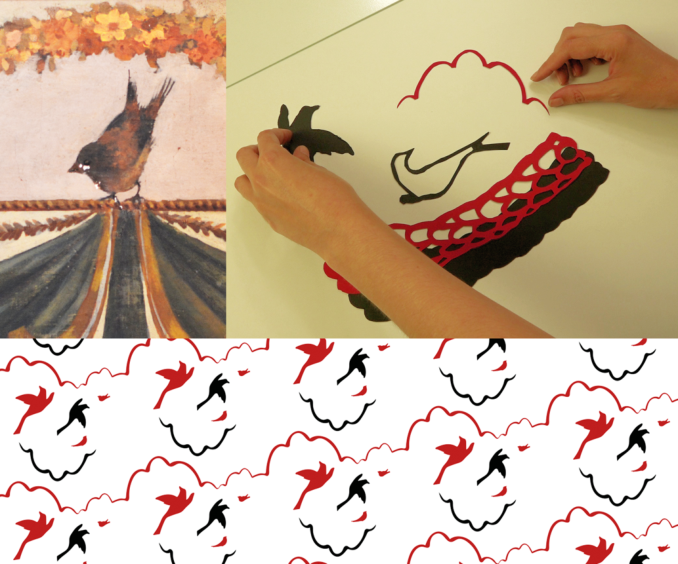
The workshop entitled Slipper Palace was an action in which the co- creative process was developed with the primary goal of creating patterns for fabrics. At the same time, although most of the participants already had some experience in art and craft practices, another purpose of the initiative was to enhance the latent creativity in the participants so that it may be felt more assertively and informed by specific knowledge in visual perception, graphic expression, and visual communication. The workshop was develo- ped in several stages: first, a collection of images of the place – Queluz Palace, “Slipper Neighborhood”, and participants’ objects that represented a strong relation with their daily lives or identity. Afterwards, a set of drawings was made, from each selected image, considering the negative space, the silhou- ette, the contour line, and the change of scale of the various forms. In the second stage, cardboard cut-outs were made from the previous drawings, and graphic compositions were elaborated to combine the collected icono- graphic and personal elements. In a third step, all pieces were photographed and digitally edited by the designers, working as modules to create diffe- rent patterns (see Figure 1). The patterns were presented to the participants, who had the opportunity to give their opinion and continue the co-creativity process. Finally, a selection of patterns went on to the production of prin- ted fabric through digital printing. The creation of fashion accessories such as bags with different sizes and shapes is planned. The GAVE association will later market these products, integrating the local cultural and touristic dynamics.
EMPIRICAL VALIDATION After the workshop, some multiple-choice questions were asked through an online form, whose link was sent to the participants to understand their degree of agreement. The same questionnaire was answered by four design researchers from the UNIDCOM research center at the European University.
Slipper Palace. Creative Entrepreneurship for the Common Good 443
Figure 1: Top-left, detail from the Palace interior decoration; top-right, participant playing with different shapes; bottom, one of the final patterns created (Authors, 2022).
Three of these researchers are interested in sustainability and social transfor- mation, among other more particular interests, such as entrepreneurship, ethnography, fashion design, arts and crafts, and so on. A selection of statements put up for consideration was as follows:
1. Creating more support from the public purse, so that different forms of cooperation between designers and citizens can take place is crucial for developing innovative forms of entrepreneurship. 2. An entrepreneurship model that values the community and promotes sustainable development must understand and leverage different types of existing resources, human and material, and create alternative and innovative combinations. 3. The entrepreneur in this context, whether an individual or a collective, should have as paramount characteristic creativity and the ability to deve- lop new solutions, based on both new and existing possibilities, in the sense of pluralism and cooperation. 4. The development of entrepreneurial initiatives for local community sustainability can influence other communities in the same direction and enhance democracy. 5. Entrepreneurship participatory projects with a pluralist dimension, when they constitute a source of income, allow the citizens involved to go beyond their condition of workers, to assume themselves through an active voice in society.
444 Pinto and Pinto
All statements posed to the participants and design experts met with con- sensus, only varying the degree of agreement – strongly agree or agree. The respondents selected none of the following options – indifferent or strongly disagree. The design experts who participated in the survey were volunteers who answered after a lecture about the UpStart project and the Slipper Palace initiative.
CONCLUSION
The Slipper Palace is an excellent example of an initiative funded by public funds to increase social innovation and boost the social investment market in Portugal. This is significant support that can leverage organizations like the University of Évora and the Aga Khan Foundation as promoters of the social innovation and entrepreneurship system in Portugal, as well as structural aid to ensure the enhancement of creative and cultural entrepreneurship of disenfranchised communities to increase their income and living conditions based on artistic and craft practices.
To help solve the sustainability challenges of the human being, it is essen- tial to recover the notion of entrepreneurship in the sense of pluralism and cooperation. The entrepreneur must be someone whose main characteri- stic is his/her creativity, allowing the transformation of society and social interactions focusing on the common good.
The Slipper Palace represents an opportunity for interaction and collabo- ration between stakeholders and citizens. It is an alternative form of social cohesion that bridges different audiences to understand and define specific problems, possibilities, and priorities. What is in question is the co-creation of innovative forms of action where the human togetherness and aesthetic experience represent the most significant strengths for a better participatory democracy.
ACKNOWLEDGMENT
This research is financed with: Nacional Funds through FCT – Portuguese Foundation for Science and Technology, within the scope of the project: Ref.a UIDB/00112/2020; LISBOA-06-4234-FSE-000103, Programa Parcerias para o Impacto.
REFERENCES
Arendt, Hannah. (2001). A Condição Humana [The Human Condition]. Lisbon: Relógio d’Égua. Fuad-Luke, Alastair. (2009). Design Activism: Beautiful Strangeness for a Sustainable
World (1st ed.). London: Earthscan. Fuad-Luke, Alastair. (2020). “Activism”, in: Designing in Dark Times: An Arendtian Lexicon, Tassinari, Virginia and Staszowski, Eduardo (Ed.). pp. 30–36. Fundação Aga Khan Portugal. (2020). Programa de Parcerias para o Impacto. Plano
de Desenvolvimento da IIES [Impact Partnership Program. IIES Development Plan]. UpStart: Creative Industries.
Slipper Palace. Creative Entrepreneurship for the Common Good 445
Gardens and National Palace of Queluz - Sintra. (n.d.). Parques de Sintra [Sintra’s Parks]. Retrieved February 5, 2022, from https://www.parquesdesintra.pt/en/pa rks-monuments/the-gardens-and-national-palace-of-queluz/ Hardt, Michael and Negri, Antonio (2017). Assembly. New York: Oxford University
Press. Portugal Inovação Social. Capacitação para o Investimento Social, Parcerias para o Impacto, Títulos de Impacto Social e Fundo para a Inovação Social. (n.d.) [Portugal Social Innovation. Capacity Building for Social Investment, Impact Partnerships, Social Impact Bonds and Social Innovation Fund]. Portugal Ino- vação Social [Portugal Social Innovation]. Retrieved February 5, 2022, from https://inovacaosocial.portugal2020.pt
LISTED IN THE AHFE DIGITAL BOOKSTORE CATALOGUE
Explore the complete digital volume
Human Dynamics and Design for the Development of Contemporary Societies
Read this individual research paper free through the original publisher, or explore the full digital proceedings book.
ISBN 978-1-958651-01-8
Explore this ISBN in the AHFE Bookstore ↗Listed in the July 2026 bookstore catalogue; search by ISBN to confirm current availability · Digital book purchase optional