Fernando Miguel Marques (2022). “ALImentáRIO” - Holder for the Supplementary Feeding of Wild Birds. In: Human Dynamics and Design for the Development of Contemporary Societies. AHFE Open Access, vol. 25, pp. 267–272. https://doi.org/10.54941/ahfe1001397
Ciaud, Research Centre for Architecture, Urbanism and Design, Lisbon School of, Architecture, Universidade de Lisboa, Rua Sá Nogueira, Polo Universitário do Alto da, Ajuda, 1349-063 Lisboa, Portugal ↗
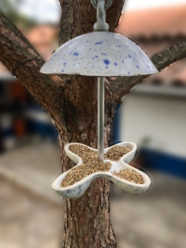
This is an animal design project (design thinking to meet the needs of animals) which aims to bring birds into contact with humans and - through this solution - to bring the sound and movement produced by them into our lives (whether in the countryside, whether in the urban landscape), which can be translated into joy and peace achieved by the harmony of natural wildlife in our domestic environment.Starting question Knowing that birds are elusive and fearful animals, but also can bring joy and movement to our daily lives, how can we attract them to our coexistence? Supplementary feeding can be a good solution, and there are already some versions available on the international market, especially in countries where winter is more extreme. In southern Europe, feeding birds is still not a very common practice. Depending on the type of food the birds eat in their natural habitat and, depending on the endogenous birds, there are variations in the diet, and only a test of placing food available to the birds will determine the type of food to be placed in the supplementary feeder.The "AlimentáRIO" (feeder) is a ceramic supplementary feeding stand/holder that can contain various types of food, in order to test if birds can be attracted close to your home.There are several types of bird food: nectar, seeds, worms, fruit, tallow/lard... And, for each of these types of food, there is a specific type of feeder. The "AlimentáRIO" is a versatile feeder intended to cover all types. Nectar is more suitable for birds that can pollinate during late winter and early spring, when insects are less active. For these reasons, nectar should only be placed in feeders as a food supplement in the winter and autumn.In Portugal, there are some birds that drink nectar, according to Luís Pascoal da Silva , a researcher at CIBIO-inBIO. The scientist states that there are several pollinating birds in Portugal, but the study of the contribution of these birds to pollination is scarce. Seeds - besides the traditional canary seed - can contain sunflower seeds or nuts, such as walnuts and peanuts, depending on the endogenous birds. Fruit is also sought after by some species of birds, namely apples and pears, in addition to other exotic fruits. However, in general, birds can be drawn to any type of fruit. Fat balls are usually tallow/lard balls with seeds and fruits to reinforce supplementary feeding during cold seasons. The "AlimentáRIO" is a suspended wild bird feeder that can be hung in more or less sheltered places, made with materials resistant to the elements, without the need for maintenance. However, its cleaning must be done according to the recommendations referred to in the full article. As already mentioned, the construction materials are low maintenance, and the food container and the deflecting bell jar are made with stoneware - the type of ceramics more resistant to both bumps and thermal variations. The junction of the two parts is made with a nickel-plated threaded rod, covered with an aluminium tube, and all components are joined by manual screw threads, which allows to assemble and disassemble it without the use of any tools, thus facilitating an in-depth cleaning at the end of the supplementary feeding season.The "AlimentáRIO" has a lower part with four concavities for placing food, which allows the possible placement of different types of food at the same time, thus drawing different species. As it is a feeder consisting of a protective and deflecting bell jar, the birds are protected from possible direct attacks from predators and from falling leaves in the autumn. The fact that it is a supplementary feeder that can be hung with a rope makes it difficult for rats and squirrels to get close to the food, given that, if by chance these animals manage to descend on the rope, they must also overcome the challenge of getting through the bell jar (which is a spherical cap) to get to the place where the food is. The results of the placement tests of this supplementary feeder have been reassuring, which show that the feeders foster the approximation of wild birds in relatively short periods of time - between 3 weeks and one month.
When we travel through the countryside along the fields, there are countless devices created by “Man”to keep wild birds away, which are seen as everyday thieves of poor unfortunate men doomed to coexist with those malevolent beings.
All over the landscape, various types of artefacts can be seen hanging from trees or sticks, with the function of scaring the birds, ranging from han- ging CDs to silver inflatables and silver ribbons, or other paraphernalia that - with the wind and solar incidence - causes reflections and frightens the birds.
There are also other more elaborate artefacts such as scarecrows inhe- rited from our grandparents, or bells that make a sound when the wind blows.
This project is not intended for this type of person, but rather for their antagonist. The aim is to be able to feed the birds, thus being able to enjoy their company without interfering too much with their wildlife.
Research Question There is a time of the year where experts recommend supplementary feeding for wild birds - which coincides with the coldest time of the year, during the winter, when there is food shortage - thus increasing individual survival rates. In spring, it can encourage birds to nest in the vicinity, significantly improving the survival of chicks in the nests.
In Lima & Lima (2005) “Is it harmful to feed wild birds?”, the authors state that “In Europe, feeding birds is a common activity and it is not con- sidered illegal - quite the opposite. It is encouraged by the community and the hundreds of stores specialized in selling balanced food for birds, feeders, and all kinds of artificial nests and drinkers. The severe European winter often causes a great impact in certain populations due to difficulty in sea- rching for food, especially when the snow layer remains in the ground for a few weeks.”
However, supplementary feeding can also be harmful, since birds (like all living beings) need a diverse diet, and the successive recurrence of eating food provided by humans can make their diet less nutritious.
Avery (2020) states that, in some studies conducted (which covered appro- ximately 342 species of birds), it was found that approximately 75% of species had one or more complementary partners in addition to the nest par- tner, and that the supplementary feeding supplied by humans can reduce the variety of partners, as it is the case of the domestic sparrow.
According to the author, this is an indicator that supplementary feeding can change behavior and affect the genetic variation of urban populations and, in the future, that these populations will be less likely to resist parasites and gregarious diseases.
For birds that drink nectar, such as hummingbirds, providing them with sugar water that mimics the nectar of flowers can significantly reduce the number of these birds’ visits to plants, as well as limit the pollination contribution of these birds.
For these reasons, nectar should only be placed in feeders as a food supplement in summer and autumn, or in winter when the plants are not blooming.
However, studies conducted in the United States report that species such as hummingbirds, in the southwest of the USA, have become more abundant due to the local use of feeders.
In the UK,it has been the case that migratory birds such as warblers became established during the winter, making this group of birds genetically distinct from their analogues that migrate south during the winter.
Avery (2020) states that studies such as those carried out by the FeederWa- tch Project observed that birds that feed on supplementary feeders have more parasites and transmit pathogens more easily, so the hygiene of the feeders is extremely important.
“ALimentáRIO” - Holder for the Supplementary Feeding of Wild Birds 269
Requirements for a Supplementary Feeder In terms of functionality, the feeders can be divided into specific uses, depending on the type of diet of the birds one intends to feed.
Types of Feeder Platform or ground (feeders to use on the ground or on top of a table) - they are sort of a roughly flat plate to place supplementary food, and can be used to feed, for example, song thrushes, crows, sparrows, doves, and others.
Hopper or Funnel Platform (hollow trunk-shaped box) (large or small hop- per) – these are seed dispensers that usually have a box-shaped reservoir (which sometimes resembles a house model) and a base to support the seeds and perch area for the birds. They can be used to attract goldfinches, doves, pine warblers, woodpeckers, sparrows, etc.
Tube feeder are hanging or pole tubes that have several holes with perches; they can be made of metal, plastic or net, and can take seeds or fat balls, as well as live food, such as larvae, etc. They can be used to attract blackbirds, warblers, woodpeckers, sparrows, etc.
Nectar feeder are container feeders for nectar or sugar water, and can have some sort of feeding bottle or a place where to put the nectar. They can be used to attract hummingbirds, rufous hummingbirds, and yellow warblers.
Suet cage these are usually boxes with bars (like a cage) so that the birds have access to the fat balls. They can be used to attract woodpeckers, warblers, or other types of birds.
Materials
The materials used must be robust and resistant to thermal variations. The most used in feeders are: metal mesh, stainless steel (most used in hanging feeders for cages), and injected plastic molding (also applied in cage feeders to be placed outside or inside the cages). Feeders to be placed outdoors, dire- ctly in nature, are usually produced with less industrial technologies, using materials such as painted iron, combined with wire, mesh, acrylic, or cera- mic. There are also those made entirely of wood or cast iron. In the suet cages, usually materials such as rubbers and silicones are used .
Requirements to have in Mind Wild bird feeders are very common in several northern European countries, starting to become increasingly popular in southern European countries.
When buying a feeder, it is important to make sure that it is easy to clean, and that the accessories are easy to disassemble for better cleaning.
These feeders should be cleaned at least once a month, ideally being cleaned twice a month, or whenever excrement is found in the food. A more thorough cleaning should be done whenever the supplementary feeding season ends, with a 5% disinfectant solution.
The feeders must have a roof-type protection to protect the birds from the weather, be it rain or snow, or even too much sun, as well as support areas for
270 Marques
Figure 1: ALimentáRIO#1 cross base shape.
birds to roost. Colors must be brighter to attract wild birds, and the feeders should be placed in new locations on a regular basis.
The location of the feeders must be chosen carefully not to attract other species of animals such as cats, squirrels or rats, which can be predators of the birds and the food. The hanging feeders will be the most effective. Some brands of stake feeders solve this issue by placing a large platform on the stake before the feeder holder.
The “ALimentáRIO” Process The “AlimentáRIO” is a suspended wild bird feeder that can be hung in more or less sheltered places, made with materials resistant to the elements, without the need for maintenance. However, its cleaning must be done according to the recommendations previously referred to.
Designed for the outdoors of domestic spaces, this supplementary food dispenser for wild birds, made of ceramic, was developed in two versions, in order to be adaptable to different situations, and to see which one would be better suited for small wild birds.
Configuration The “ALimentáRIOS” are formed by a ceramic glaze feeding receptacle base, common to both models - the cross shape one (ALimentáRIO#1) and the elliptical shape one (ALimentáRIO#2) -, along with a metal support that con- nects it to a dome to protect the food. This supplementary feeder is built with materials resistant to the elements and time, as all the materials used perform very well in what concerns aging, requiring minimal cleaning maintenance, with only water and detergent. It is easily disassembled without the need for tools. All the metallic components can be recycled at the end of their life cycle, which is intended to last as long as possible.
Of the materials used, only the ceramic components are not recyclable. There were two types of ceramics applied: a more colorful version in earthe- nware (typical ceramics used for tableware); and a more resistant version in stoneware (as mentioned in the Anglo-Saxon designation of “stone ceramic”, due to its extreme resistance to both thermal shock and even impact against harder surfaces).
“ALimentáRIO” - Holder for the Supplementary Feeding of Wild Birds 271
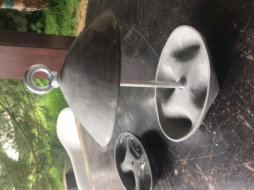
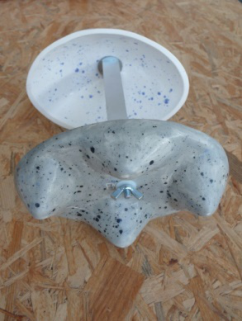
Figure 2: ALimentáRIO#2 in stoneware, only glazed on the inside to facilitate cleaning and sanitizing.Figure 3: Bottom view of the ALImentáRIO, with a nylon ring and a wingnut for final tightening.
The choice of stoneware was decisive because it is a hanging feeder, and stronger wind or even the fall of a branch or pine cone could damage the earthenware ceramic, which was something that has not yet occurred with the earthenware, with the stoneware efficiently withstanding the impact observed in the testing phase.
The assembly of this feeder - which needs no tools - is done through a round upper eyebolt that holds the harness with the tree rope, which is fixed with a threaded rod that corresponds to the “ALimentáRIO “ pole, which promotes the necessary distance between the two ceramic elements - the cover and the food container. The upper dome resembles a spherical cap that protects the food against atmospheric elements, becoming a deterrent to predators, given that, even if they manage to descend on the rope, their intent will be hampered by the geometry of the dome that pushes them towards the ground, and not on the food plate.
The threaded rod is covered with an aluminium tube, which will serve as protection and distance between the ceramic pieces, having as direct stops the ceramic rings (metallic on one side, and nylon on the other) to absorb forces and not make the ceramic crackle when tightening it, which is done with the wingnut under the food container.
The food container is formed by four concavities, which allow to place different types of food.
272 Marques
This assembly process allows the fast and easy assembly and disassembly of the feeder - which will have to be efficiently cleaned every month, or whenever it has excrement -, allowing the ceramic components to be handwashed or cleaned in the dishwasher.
Since the testing period carried out until now, the feeder (which is more suited for seeds) has been rapidly attracting the birds, which may be of vari- ous species, given that there are four concavities that allow the placement of diverse food or water, in order to be close to the food container. In addition to seeds, the “ALImentáRIO” can contain tallow/suet, for the colder seasons. In this case, the food container should serve as a cuvette/mold to cool the fat of the tallow balls when they are still hot. During its preparation, the tallow must be poured in the various concavities of the feeding container and left to cool. The proper texture of the ceramic glaze and the shape’s configuration will create friction, allowing several birds to eat without the fat balls falling.
Both the cross and elliptical shapes allow the simultaneous use of several birds. Some moments were observed when 2 or maximum 3 birds were fee- ding simultaneously, and when more arrived, all of them flew away. It usually happens that while one or two birds feed, others await their turn.
REFERENCES
Avery, J. (2020). Como alimentar pássaros selvagens da forma correta? [Electronic Version]. socientifica, 3 de março 2020. Retrieved julho 2021 from https://socientifica.com.br/como-alimentar-passaros-selvagens-da-forma-correta/. [How to correctly feed wild birds?] Andrés, J. P. (2008). Selección de materiales en el processo de diseño. Barcelona:
ediciones CPG. Beylerian, G. M., & Dent, A. (2005). Material Connexion; The global resource of new and innovative materials for architects, artists and designers (1 ed.). London: Thames & Hudson. Birkeland, J. ( 2005). Design for sustainability, A sourcebook of integrated eco-logical
solutions. London: Earthscan Publicatios Ltd. Canotilho, M. H. P. C. (Ed.). (2003). Processos de cozedura em cerâmica. Bragança: Instituto Politécnico de Bragança.[Ceramic firing processes] Geraldes, H. (2021). Conheça os maiores polinizadores de Portugal [Electronic Ver-
sion]. Retrieved setembro 2021 from https://www.wilder.pt/naturalistas/conheca- os-maiores-polinizadores-de-portugal/.[Meet Portugal’s biggest pollinators] Johnson, P. D., & Besselsen, D. G. (2002). Practical Aspects of Experimental Design in Animal Research. ILAR Journal, 43, 4. Lederer, R. J. Como Alimentar Pássaros Selvagens. Retrieved setembro, 2012, from ht
tps://pt.wikihow.com/Alimentar-P%C3%A1ssaros-Selvagens [How to feed wild birds?] Lima, P. C., & Lima, R. d. C. F. D. R. (2005). Alimentar pássaros silvestres é prejudicial? [Electronic Version], Actualidades Ornitológicas N127, 28. Retrieved nov. 2021 from http://www.ao.com.br/download/aliments.pdf. [Is it harmful to feed wild birds?] Reviewsemgeral. (2021). Alimentadores de pássaros: Qual é o melhor em 2021?
Retrieved setembro, 2021, from https://reviewsemgeral.com/alimentadores-de-pa ssaros [Bird feeders: which one is the best in 2021?] TheCornellLab. (2021). Feeder Types Retrieved setembro, 2021, from https://feeder watch.org/learn/feeding-birds/#feeder-types-2
LISTED IN THE AHFE DIGITAL BOOKSTORE CATALOGUE
Explore the complete digital volume
Human Dynamics and Design for the Development of Contemporary Societies
Read this individual research paper free through the original publisher, or explore the full digital proceedings book.
ISBN 978-1-958651-01-8
Explore this ISBN in the AHFE Bookstore ↗Listed in the July 2026 bookstore catalogue; search by ISBN to confirm current availability · Digital book purchase optional