Aslihan Tece Bayrak (2022). An Abstract Model for Compassionate Game AI: Designing a Companion for a Compassionate Game. In: Human Interaction & Emerging Technologies (IHIET-AI 2022): Artificial Intelligence & Future Applications. AHFE Open Access, vol. 23. https://doi.org/10.54941/ahfe100888
The application of using digital technologies for diagnosis, treatment, and health care has increased as a strategy to provide effective and reachable services for a growing elderly population with increasing number of chronic diseases. Similarly, the interest in using game technology and game experience for these purposes is rising. This paper presents a conceptual model for a compassionate game AI that aids the player-patients throughout their gameplay experience. The model outlines how compassion can be injected in the nature of the companion to fulfill its role within a compassionate game. Compassionate game design aims to offer a comforting experience within the challenging nature of games. Complementing this, compassionate AI is up-lifting and supportive while also receptive to the dynamics of the game.
Artificial Intelligence (AI) in games is commonly considered to represent non-player inhabitants of the game world and assists or challenges the player, while mostly referred as non-player characters (NPCs). The act of assisting mostly involves providing support in the scenarios that require additional players, fulfilling the roles of town-folk or quest-givers, or points of delivery for sub-text, story, or materials required in the game. Enemy AI is increasingly designed to evolve and “intelligently” continue to pose a challenge for the main player character. Conversely, assisting AI is rarely designed to learn, evolve, and “intelligently” behave to increase their contribution for their collaboration with the main player character like a team player. Moreover, assisting AI in games is rarely considered for emotional support or compassion. Even though the concept of companion characters is commonly used in commercial games, the role of the companion revolves around instructing the player for how to play, hinting the player for what to do, teasing the player for comedic storytelling, or narrating the story.
This paper presents an abstract model for a compassionate game AI that frames the concept of compassion for a companion AI and discusses the role of compassionate AI within an assistive rehabilitation framework for games as systems of rehabilitation. Contributions of the paper are: (1) a concept of compassionate AI that fills an identified gap for assistive interactive technologies especially for health and rehabilitation, (2) the role of a compassionate AI within an interactive system for health and rehabilitation, (3) behaviour of a compassionate AI to contribute to the goals of an interactive system for health and rehabilitation. The concepts for the compassionate AI have been developed through a research through design activity while the author was exploring strategies to inject compassion into the design of a game-based exercise rehabilitation experience.
A TAXONOMY OF GAME AI There have been a few different approaches to classify the contribution, audience perception, and technical implementation of AI in games. Gunn et al. (2009) presented a taxonomy for game AI with considerations on genre, environmental discreteness, play sequence, information visibility, etc. and how these concepts relate to the existing AI methodologies. However, the role of the AI in the game world or how AI is perceived by the player was not considered. On the contrary, Mateas (1999) earlier suggested that a believable agent’s success is determined by the perception of the audience. Following suit with Mateas’s suggestion, Warpefelt and Verhagen (2017) conducted an online survey via providing visual probes toward forming a classification of NPCs based on how the players perceive their (NPCs’) roles and function in the given scenes. Their evaluation resulted in a typology with four meta- types categorizing players’ perception of NPCs roles in games. These are functions such as vendor or questgiver, adversaries such as enemy or opponent, friends such as
Human Interaction & Emerging Technologies (IHIET-AI 2022) Artificial Intelligence & Future Applications https://openaccess.cms-conferences.org/#/publications/book/978-1-7923-8989-4 sidekick, ally, pet or companion, and providers in roles such as storyteller or loot provider.
At its basic implementation, a game AI is nothing but a finite state machine comprising a set of behaviors managed by some predefined conditions. Those behaviors characterize the role of the game AI as a non-player entity in the game world. Emmerich et al. (2018) suggested that the design of the companions strongly influence the players’ experience; therefore, their believability carry importance along with their representation, behavior, social role, relatability, etc. The design space, Emmerich et al. noted, rely on the expectations of the player and whether the depicted AI becomes believable in the given situation within the current setup of the world. Following suit with Warpefelt and Verhagen’s classification (2017) but also arguing that companions are a special type of NPCs that can add layers to the atmosphere and gameplay by serving for various purposes such as goal-givers, tutors, helpers, etc., they presented an overview for the design space of companions in digital games as a result of a literature review (Emmerich et al, 2018). As per their definition, a companion is an NPC (human or non-human) “which accompanies the player character over a large amount of time during the game” (Emmerich et al, 2018). Their survey among a university student population showed that common preference for companions bend the design space towards a well-built character and personality that provide an illusion of intelligence fitting the given context of a game.
The discussion in this paper focuses on how AI is perceived by a player rather than technical complexity of the AI implementation. The perception is shaped based on what kind of role the AI plays or in which way the AI is presented in the world (Emmerich et al., 2018). Here, AI is considered in three camps based on their performance in the game world and whether their functionality is visible to the player or not (hence perceivable or not). These camps are; (1) performative AI: non-player characters (NPCs) that participate in the play activity either as friend (assistive) or foe (hindering or competing), (2) companion AI: companions that escort the player yet do not directly participate in the play activity although they are known to the player, (3) system level AI that manages the scenarios, scenes, resources, dynamics, etc. but does not participate in the play activity and is not directly known to the player. Performative AI has a visible performance and can be collaborating or competing (perceived as friend or foe) where common conceptual approaches of AI solutions include player strategy prediction and adaptive AI. Collaborating NPCs are referred also as companions (Emmerich et al, 2018) regardless of player’s ability to directly control them and use them as a player character such as seen with Ellie in Last of Us (Naughty Dog, 2013). Companion characters that are also controllable by the player are created with a strong personality to carry the story forward (Emmerich et al, 2018). Conversely, enemy NPCs seem to receive less personalization although they are integral to the challenge presented throughout the experience except the converse example from Shadow of Mordor (Monolith Productions, 2014) where NPCs have progression paths, evolving personalities, and a cultivated rage carefully managed by a patented AI system called Nemesis System (Patent, 2021). Another system level AI example is the AI Director (Fandom, n.d.) of Left 4 Dead (2010, Valve), which dynamically manages the pacing, dramatics and difficulty of the game. Both the AI
Director and the Nemesis System can be considered as examples of how dynamic difficulty adjustment approaches have evolved. Moreover, the Nemesis System stands out with its ability to represent a collective and actionable consciousness for the enemy NPCs.
The companion AI has both visible and invisible roles and functionalities, therefore resides in between performative and system level AI with a varying significance from cosmetic to dialogue-bound directives. Examples include pet companions that may also act as NPCs in a limited capacity (such as in Into the Dead 2 (PikPok, 2017)) or that may be with the player throughout with a single descriptive role (such as Argo in Shadow of Collosus (Team Ico, 2005)) or a bit of both such as the dog Dogmeat of Fallout series (Interplay Entertainment et al., 1997-2004). Examples for dialogue agents include instructive behavior such as Navi in Legend of Zelda series (Nintendo et al., 1986-2017) and Elizabeth in Bioshock Infinite (Irrational Games, 2013), or Glados with a teasing character in Portal I (Valve, 2007) and Portal II (Valve, 2011). Even though it is less likely that player communities would consider Navi or Argo as representatives of an AI behavior, each of these companions contribute to the gameplay meaningfully since their role is defined in relation to the characteristics of the game. The player never directly controls them more than assigning a goal for their action if made available, and they have their own programmed behavior. For some, such as Elizabeth, Glados, and Navi, their role is integral to the initiation of the player into the game world and the continuum of player’s participation in the gameplay. Similar to those, the purpose of the companion within our framework is offering emotional support, escort for objectives, and compassionate adjustment in order to increase motivation and support the rehabilitation process.
CONCEPT OF COMPASSION IN GAMES FOR REHABILITATION Games are proposed to contribute healthcare by uniting gameplay and rehabilitation strategy in a meaningful metaphor that provides accurate, timely, and positive feedback (Tece Bayrak et al., 2020). It is suggested that practicing compassionate care requires caring conversations and building connections (Treadaway et al., 2019; Dewar et al., 2014). Similar to the concept of belonging, Dewar (2014) noted that building relationships with the patients can help effectively practicing compassionate care (Treadaway et al., 2019). Following suit, the compassionate games paradigm adopted this notion to contemplate on how compassion can shape gameplay experience and how it could improve the outcomes of a game-based exercise rehabilitation (Bayrak, 2020). This meant the game would compensate for disease related difficulties and positively encourage for one’s continuation to the activity. Therefore, a player-base with a chronic disease would not feel frustration due to an inability to perform using the skills that are already affected by the disease. Hence, the game is compassionate.
It can be argued that the ability of a game-based rehabilitation system to show compassion is the key to motivation for a long-term use of the game. Literature shows that adherence to therapy and rehabilitation is one of the biggest hurdles of treatment for improving quality of life of people living with chronic diseases (Levac et al., 2017). This is not only a motivation issue due to a boredom of routine sessions, but also an accessibility issue due to challenges of arranging sessions away from home. Similar to the “Assist me” concept by Gilleade et al. (2005), a compassionate game can assist a player towards getting the most effective outcome from their gameplay session while reinforcing self-esteem and positive behavior. Unlike a binary thought of winning versus losing, the most effective outcome in this context strives for reaching the prescribed aims of a rehabilitation program. This may mean some tasks in the game needs to have variability depending on the status of the player (Bayrak, 2020).
COMPASSIONATE AI IN REHABILITATION, ITS ROLE, AND PURPOSE The role of AI within a game-based rehabilitation environment has two starting tasks for compassion; (1) managing the system for a best possible optimal environment for players’ rehabilitation, performance, and capability, (2) managing player expectations of the gameplay experience and of themselves (perception of self and the experience) (Tece Bayrak et al., 2021). Therefore, the effectiveness of an AI implementation is less about believability in terms of how smart the AI is, but more about how well these tasks are performed to support the player throughout the experience. The holistic structure of the game needs to be reinforced with the help of the AI (Yannakakis, 2012). Slightly diverging from Umarov and Mozgovoy’s (2014) argument of two necessities for a game agent —believability and effectiveness in their behavior— effectiveness in behavior carries more value than their believability in our concept. In fact, their believability is a confluence of the believability of the game’s metaphors and their integration to the game world (Tece Bayrak, 2021).
The idea of molding the companion’s behavior based on a player’s current experience has similarities with the concept of affective videogames (Lara-Cabrera and Camacho, 2019). Gilleade et al. (2005) explain that a videogame is considered affective if the player is not consciously aware of how their physiological responses are influencing gameplay. However, for the efficacy of the rehabilitation, the perception and trust of the player to the system’s ability to care is important (Treadaway et al., 2019). Therefore, compassionate AI needs to show compassion and positively reinforce beneficial behavior. In a context of a game-based aerobic exercise system, the reinforcing behavior is exerting in a targeted heart rate interval, focusing on breathing, and slowing down if the heart rate increases above an optimal rate determined by the condition and the age of the patient. This means system needs to directly use the physiological responses of the player, drive the session accordingly so that the physiological state is within the intended limits. Meanwhile, provide
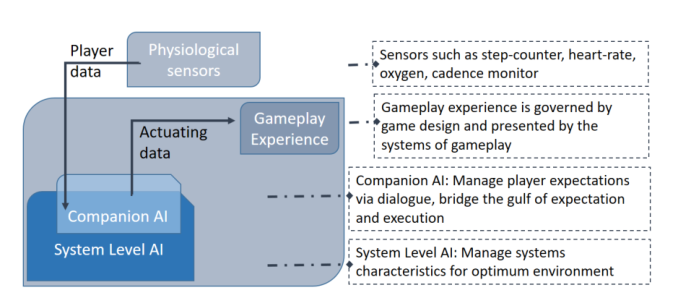
Human Interaction & Emerging Technologies (IHIET-AI 2022) Artificial Intelligence & Future Applications https://openaccess.cms-conferences.org/#/publications/book/978-1-7923-8989-4 feedback when the physiological state suggests a health concern such as too high heartbeat suggesting a path to cardiac arrest or too slow cadence that would injure the joints. Figure 1 shows the integration of a compassionate AI system with gameplay experience and physiological sensors. Here, the compassionate AI comprises a system level AI and a companion AI. The companion AI helps as an actuator to promote intended activity. The actuating data can be applied to the gameplay experience at a user interface level, at a system level (therefore considered by the game’s design), or directly affect the companion’s behavior. The companion is responsible for informing, encouraging, and affirming the player for the changes during the activity while also reminding them about the goals of the activity to realign their perception (Locke and Latham, 2006).
Figure 1. The game receives physiological updates from non-invasive wearable sensors such as heart rate monitor, step counter, cadence monitor, etc. As per this data, the experience is regulated to facilitate exertion for an effective heart rate and to ensure safety.
In order for this concept to function, the accuracy, continuity, and timeliness of player data is important. The player data can be evaluated with its momentary merit, in an accumulative fashion, or continuously depending on the design of the system. The decision of how often and in which way the data will be used shapes the behavior of the companion and the strategy of the system level AI. Momentary use of data can be based on any metric that indicates success and struggle. Accumulative use of data can be based on repeated errors/failures/successes assuming that perhaps the first few of the errors were experimental while repetition suggests that this is an error. Continuous evaluation of player data ensures the continuum of the experience. Especially in a game-based exercise program, the exertion data needs to be a continuous data since exercise is central to the goals of the system. The exercise regime is based on a rehabilitation strategy advised for a specific condition, and the condition impacts the participant’s ability to perform (Tece Bayrak et al., 2021). Therefore, the condition impacts the experience.
Chowanda et al. (2016) presented a framework to facilitate the creation of game companions that exhibit emotions and develop social relations over time via their ability of perceiving and exhibiting emotions. The framework relied on a camera to
Human Interaction & Emerging Technologies (IHIET-AI 2022) Artificial Intelligence & Future Applications https://openaccess.cms-conferences.org/#/publications/book/978-1-7923-8989-4 allow an agent recognise, interpret, and sense the expressions of a player in order for the agent to filter emotions as per their personality traits and respond accordingly in a manner that represents a social relationship. This approach seems promising for perceived realism towards building relationships, and it can be conducive for practicing compassion or building agents that can recognize facial expressions to inform an ability of extending empathy.
BEHAVIOR OF A COMPASSIONATE AI The tasks of a compassionate AI can be accomplished with the collaboration of a system level AI and a companion AI. This has similarities with Mateas’ work (1999) on interactive drama systems in the sense that the game extends compassion to the player by considering their physiological status and how they perform while forming a new dialogue bubble for the companion. If the game falls short in recognizing previous steps in its way of showing compassion, the responses of the game would start coming across as inconsiderate or annoying to the player. This is no different than the idea of connected dialogue in interactive drama systems (Arinbjarnar at al., 2009). Therefore, the companion needs to act with intention to help and support the player throughout by using an accumulated knowledge based on player’s progression in the current session and past sessions.
While managing the player experience for motivation and effectiveness of exercise rehabilitation, the compassionate AI should aim for keeping the motivation in a reinforcing loop while locking frustration into a balancing loop. The role of the companion is enhancing the balancing loop by leveraging the player’s own will towards carrying on performing. The system level AI has a crucial but less visible role here: reducing the friction in a player’s interaction with the system, adjusting the exercise variables to fit with their current status, and compensating with assistance in performing the required tasks. On the other hand, the contextual form of companion behavior can be grouped under four categories as seen in the Table 1 and would need to be in dialogue form for accessibility. The tonality, accent, speed, and pitch of the dialogue should be calibrated at the beginning of the session according to the player’s hearing.
An example of reminding is the companion reminding the player to breath by using a special breathing technique to help them relax. A supporting audio-visual representation for the breathing technique can complement the companion’s efforts on explaining this concept to the player. This would offer visual stimuli to sync their breathing pattern, therefore facilitating the application of the technique. Next time, when companion needs to remind about the technique again, it could refer to the technique accompanied with the same visual stimuli, and the dialogue can be a natural follow-up for reminding rather than a full re-explanation as a way of showing awareness of context in their intended behavior.
Table 1: Table shows the intention and context of companion behavior, and some complementary elements that can support the behavior of the companion.
Table available in the original PDF paper.
The intention Behavioural context Elements supporting companion: Inform o Current status o Current performance o Next actions o Stages/events in the game o Strategies to improve performance
o Readable game state (such as speed dials, using familiar representation with quantifiers) o Audio-visual feedback including colour changes and visual representations (such as a pulsing heart icon when heart rate starts climbing too high) o Aiding the dialogue by highlighting relevant content in the game world to inform how currently given information is connected to the game world Encourage
o Self-esteem o Success o Can-do attitude
o Dialogue o Audio-visual feedback supporting and complementing the dialogue Remind
o Goals o Capability o Successes o Improvements
o Dialogue o Audio-visual feedback supporting and complementing the dialogue (such as achievements, statistics) Affirm o Acknowledging actions o Adjusting behaviour o Reiterating successes o Self-love
o Dialogue o Audio-visual feedback supporting and complementing the dialogue o Visual aids at a user interface level
CONCLUSIONS
This paper has presented a concept for a compassionate AI arguing for its utility and reliance on a collaborative performance of a system level AI and a companion AI. The discussion brought existing companion characters from commercial games into context and reflected on their value in the game world. Although much of the existing research on game AI focuses on the roles and functionality that are confined in a momentary game experience or the technical implementation of the AI, this paper focused on the capacity of the system level AI concept and the necessities of controlling the experience in a long term fashion. The role of the compassionate AI as a contributor to assistive interactive technologies, its behavior, and intent are presented within a companion’s role. This is by no means a complete picture but a starting discussion for shaping the role of AI within games for health and rehabilitation.
Arinbjarnar, M., Barber, H., Kudenko, D. (2009), “A critical review of interactive drama systems.” In AISB'09 Symposium: AI & Games, Edinburgh, UK. Bayrak, A. T. (2020), “Compassionate Game Design: A Holistic Perspective for a
Player-centric Game Design Paradigm for Games4health.” International Journal on Advances in Intelligent Systems, 13(1), 1-18. Chowanda, A., Flintham, M., Blanchfield, P., Valstar. M. (2016), “Playing with social and emotional game companions.” In International Conference on Intelligent Virtual Agents, pp. 85-95. Springer, Cham. Dewar, B., Adamson, E., Smith, S., Surfleet, J., & King, L. (2014), “Clarifying
misconceptions about compassionate care.” Journal of Advanced Nursing, 70(8), 1738-1747. Emmerich, K., Ring, P., & Masuch, M. (2018), “I'm Glad You Are on My Side: How to Design Compelling Game Companions.” In Proceedings of the 2018 Annual Symposium on Computer-Human Interaction in Play, pp. 141-152. Fandom, n.d., Last accessed: November 2021, URL: https://left4dead.fandom.com/wiki/The_Director Gilleade, K., Dix, A., Allanson, J. (2005), “Affective videogames and modes of
affective gaming: assist me, challenge me, emote me.” DiGRA 2005: Changing Views–Worlds in Play. Gunn, E. A. A., Craenen, B. G. W., & Hart, E. (2009), “A taxonomy of video games and AI.” In AI and Games Symposium, pp. 4-14. Lara-Cabrera, R., Camacho, D. (2019), “A taxonomy and state of the art revision on
affective games.” Future Generation Computer Systems, 92, 516-525. Levac, D., Glegg, S., Colquhoun, H., Miller, P., Noubary, F. (2017), “Virtual reality and active videogame-based practice, learning needs, and preferences: A cross- Canada survey of physical therapists and occupational therapists,” Games for health journal 6, no. 4, pp. 217-228. Locke, E. A., Latham, G. P. (2006), “New directions in goal-setting theory.” Current
directions in psychological science, 15(5), 265-268. Mateas, M. (1999), “An Oz-centric review of interactive drama and believable agents.” In Artificial intelligence today, Springer, Berlin, Heidelberg, pp. 297- 328. Patent. (2021), “The Nemesis System patent”, Last accessed: November 2021, URL:
https://patents.google.com/patent/US20160279522A1/en Tece Bayrak, A., Wünsche, B. (2021), “Player Motivation in Therapy Games for Parkinson's Disease: A Scoping Review: Understanding meaningful play, self- determination and flow.” In 2021 Australasian Computer Science Week Multiconference, pp. 1-10. Tece Bayrak, A., Wuensche, B., Reading, S. A., & Lutteroth, C. (2020), “Games as
Systems for Rehabilitation: A Design Strategy for Game-based Exercise Rehabilitation for Parkinson's Disease.” In Proceedings of the 53rd Hawaii International Conference on System Sciences. Tece Bayrak, A., Wunsche, B. C., Reading, S.A. (2021), “Player Profile as a Lens to Advocate Designing Compassionate Therapy Games for Parkinson’s Disease”, to be published in proceedings of OzCHI’21.
Treadaway, C., Taylor, A., & Fennell, J. (2019), “Compassionate design for dementia care.” International Journal of Design Creativity and Innovation, 7(3), 144-157. Umarov, I., Mozgovoy, M. (2014), “Creating Believable and Effective AI Agents for
Games and Simulations.” In Contemporary advancements in information technology development in dynamic environments, Mehdi Khosrow-Pour (Ed.). IGI global, Hershey, Pennsylvania, 33–57. Warpefelt, H., Verhagen, H. (2017), “A model of non-player character believability.”
Journal of Gaming & Virtual Worlds, 9(1), 39-53. Yannakakis, G. N. (2012), “Game AI revisited.” In Proceedings of the 9th conference on Computing Frontiers, pp. 285-292.
Read this individual research paper free through the original publisher, or explore the full digital proceedings book.
ISBN 978-1-7923-8989-4
Explore this ISBN in the AHFE Bookstore ↗Listed in the July 2026 bookstore catalogue; search by ISBN to confirm current availability · Digital book purchase optional