Han Wang, Zefeng Li (2022). The application of machine learning and deep learning to Ophthalmology: A bibliometric study (2000-2021). In: Human Interaction & Emerging Technologies (IHIET-AI 2022): Artificial Intelligence & Future Applications. AHFE Open Access, vol. 23. https://doi.org/10.54941/ahfe100886
Machine learning (ML) and deep learning (DL) are an advanced technology for the latest 20 years, which has been applied for multiple fields. This study utilizes methods of text mining and bibliometric analysis to explore applications of ML and DL to Ophthalmology. 50-ML-related and 60-DL-related papers from Web of Science (WOS), 15-ML-related and 38-DL-related articles from China National Knowledge Infrastructure (CNKI) are explored from 2000 to 2021. A descriptive analysis of major article, developing trends, journal releasing, topic mapping and quotation relationships is implemented in this paper. Leading authors, institutions, and journals in the related research are identified. Findings show that there is a significant difference between DL and ML studies pertaining to the application of Artificial Intelligence (AI) for Ophthalmology, especially for the hot-topic mapping and institutions.
Machine learning and deep learning are the modern applicable technologies for digital clinical diagnosis and treatment development (Acharya et al., 2017; Leopold, Orchard, Zelek, & Lakshminarayanan, 2019; C. Lin et al., 2021). Artificial Intelligence (AI) based approaches for Ophthalmic fundus detection tasks is one of the most hotspots for intelligent medicine fields (C. Lin et al., 2021).
This article explores the literature review during the near 20 years. Utilizing bibliography study (W.-C. Lin, Chen, Chiang, & Hribar, 2020) method with the tool of CiteSpace on Web of Science (WOS) and China National Knowledge Infrastructure (CNKI), this study identified the most academic author, journal and institution in this area. Besides, a keyword map and the burst topic time distribution are generated. Finally, a comparison between the applications of deep learning and machine learning to Ophthalmology is discussed.
The structure of this survey is as the following. The second section is related to the method this article utilized, the third section involves the result and discussion. Conclusions are delivered in the last section.
METHODOLOGY
This study utilizes the methods of text mining and bibliographic analysis (W.-C. Lin et al., 2020; López-Muñoz, Weinreb, Moghimi, & Povedano-Montero, 2021) to deliver a systematic review for the topic of deep learning (Yang et al., 2021) and machine learning (Schmidt-Erfurth et al., 2018) applicated to the field of Ophthalmology during 2000 to 2021. Based on WOS and CNKI, 65-ML-related papers (50 from WOS and 15 from CNKI) and 98-DL-related papers (60 from WOS and 38 from CNKI) are collected. Search string is set as (TS= (“Machine Learning”) AND (“Ophthalmology”)) and (TS= (“Deep Learning”) AND (“Ophthalmology”)).
A systematic study based on bibliographic analysis is implemented, a tool of CiteSpace is utilized for key word mapping and developing trend history exploration. Both of English and Chinese articles are collected from the database, where Chinese literature is translated into English when it comes to the hotspot mapping. Besides, the core article, author, institution and journal are identified based on the amount and centrality of WOS publications.
RESULTS AND DISCUSSIONS Developing trend of publications for WOS and CNKI
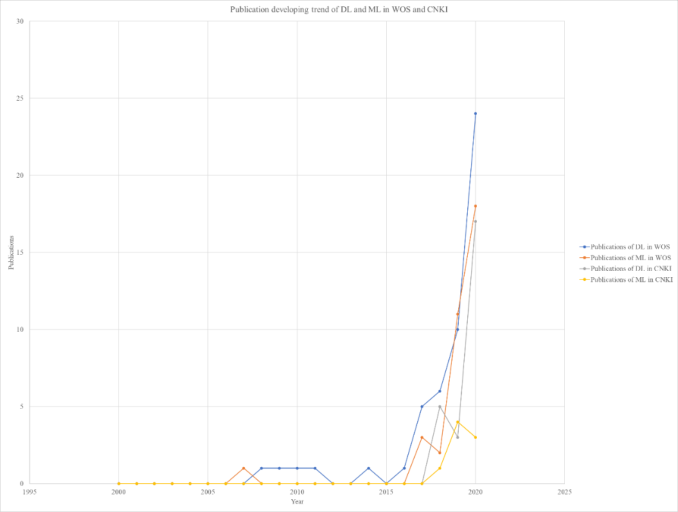
As the Fig.1 shown, in the application of ML and DL to Ophthalmology academic area, WOS dataset has an advanced advantage than CNKI. Furthermore, algorithms of DL present a significant advantage comparing to ML. This difference is more obvious in the recent 5 years.
Figure 1: The developing trend of ML and DL from WOS and CNKI.
Core article, authors, institutions and journals of WOS According to the cited amount, the top-5 academic influential articles of WOS are listed as the Table 1, where AI-based algorithm and computer-aided diagnosis (CAD) are involved in these articles.
1 “Automated diabetic macular edema (DME) grading system using DWT, DCT features 28 0
Human Interaction & Emerging Technologies (IHIET-AI 2022) Artificial Intelligence & Future Applications https://openaccess.cms-conferences.org/#/publications/book/978-1-7923-8989-4 and maculopathy index. “(Acharya et al.,
2017) 2 “Evidence for an enduring ischaemic penumbra following central retinal artery
16 0.01
occlusion, with implications for fibrinolytic therapy.”(McLeod & Beatty, 2015) 3 “PixelBNN: Augmenting the PixelCNN with
batch normalization and the presentation of
15 0.01
a fast architecture for retinal vessel segmentation.”(Leopold et al., 2019) 4 “A hybrid proposed fundus image
enhancement framework for diabetic
14 0
retinopathy.”(Qureshi, Ma, & Shaheed, 2019) 5 “Applications of artificial intelligence to
electronic health record data in
13 0
ophthalmology.”(W.-C. Lin et al., 2020) According to the publication amount, the top-5 academic influential scholars of WOS are listed as the Table 2, where AARON Y. LEE is the most influential author, who is involved the study of an explainable AI-based deep learning gearbox in OCT images (Maloca et al., 2021; Wang, 2021).
Table 2: Top 5 authors according to the publication amount.
Table available in the original PDF paper.
Ranking Author Count Centrality 1 AARON Y. LEE 3 0
2 CATHERINE EGAN 2 0
3 JANARTHANAM JOTHI BALAJI 2 0
4 MICHAEL F. CHIANG 2 0
5 VASUDEVAN LAKSHMINARAYANAN 2 0
According to the centrality, the top-5 academic core cited journals of WOS are listed as the Table 3, where Scientific Reports is the most influential journal, which is with a count of 14 publications and a centrality value of 0.21. This journal shows an influence factor of 4.379 in 2020/2021, according to the website of www.bioxbio.com.
According to the publication amount, the top-5 academic core institutions of WOS are listed as the Table 4, where Moorfields Eye Hospital NHS Foundation Trust con- tributes the most publications. It is an NHS foundation trust which runs Moorfields
Eye Hospital. The article of “Unraveling the deep learning gearbox in optical coherence tomography image segmentation towards explainable artificial intelligence” is sponsored by this institution (Maloca et al., 2021).
Table 1: Top 5 journals according to the centrality.
Table available in the original PDF paper.
Ranking Cited journal Count Centrality 1 Scientific Reports 14 0.21 2 Expert Systems with Applications 7 0.2
3 PLOS ONE 25 0.14 4 CW Journal 61 0.11 5 Proceedings / CVPR, IEEE Computer Society
Conference on Computer Vision and Pattern
17 0.11
Recognition
Table 2: Top 5 institutions according to the publication amount.
Table available in the original PDF paper.
Ranking Institutions Count Centrality
1 Moorfields Eye Hospital NHS Foundation Trust 3 0
2 Singapore National Eye Centre 2 0
3 National University of Singapore 2 0
4 Oregon Health and Science University 2 0
5 Sun Yat Sen University 2 0
Hotspots mapping and developing trend of ML and DL The keyword distribution is illustrated in the Fig.2. According to the centrality value (>0.1) (W.-C. Lin et al., 2020), top 15 keywords of ML are listed in the table 5, top 10 keywords of DL are listed in the table 6. Findings shows that the research direction of ML and DL applicated in the ACD is the major topic. As for ML-based AI algorithm, Fig.2 (a) and Table 5 presents that, its application to diabetic retinopathy (DR) and macular degeneration (MD) is the most focused. Furthermore, it is indicated that ML-based algorithms are also utilized for classification tasks, as a supplementary algorithm for DL-based approaches. As far as DL-based AI algorithm, Fig.2 (b) and Table 6 indicates that DL-based ACD on diabetic macular edema (DME), diabetic retinopathy and retinopathy is highlighted, where optical coherence tomography (OCT) and convolutional neural network (CNN) techniques are involved.
As the Fig.3 shown, during the keyword bursting history of ML (a), keywords of Age- related macular degeneration (AMD), OCT and ML burst in 2017, topics of DR emerged in 2018, prediction, glaucoma, hotspots of DL, AI and classification burst in 2019, topics of medical ethics, neural network, ophthalmology, eye disease, automated detection, MD, progression, learning method, psychological distress, depression and prevalence appeared in 2020. Keywords of DME, clinical data, CNN, medical image, main outcome measure, operating characteristic curve, American academy. Intelligent diagnosis, big data and AI technology burst in 2021. When it comes to the historic developing trend of DL (Figure b in Fig.3), topics of glaucoma, DR, DL and CNN emerged in 2017, keywords of OCT, ML and AI burst in 2019, topics of medical ethics, automated detection, MD, disease diagnosis and DME appeared in 2020, hotspots of validation, CNN, degeneration, retinopathy and big data burst in 2021. Therefore, this study concluded that during the historic trend of ML and DL, the conception of big data is a novel hotspot, which burst in 2021. The combination of ML and DL algorithms in ophthalmic ACD tasks is in 2019. DL exhibits a great advantage when it comes to OCT fundus diagnosis. Moreover, the issue of medical ethics is the hot topic for ML and DL applicated to ophthalmology in 2020.
CONCLUSIONS
This study utilized the method of text mining and bibliographic research on the topic of applications of ML and DL to Ophthalmology from 2000 to 2021. Based on WOS and CNKI, 163 references are explored. Six findings are contributed. (1) WOS dataset has an advanced advantage than CNKI, where algorithms of DL present a significant advantage comparing to ML, this difference is more obvious in the recent 5 years. (2) Core article, authors, institutions and journals of WOS are recognized. (3) Hotspot mapping and developing trend of ML and DL are compared and discussed. ML-based algorithms applicated to DR and MD is the most focused, which is also regard-ed as a supplementary algorithm for DL-based approaches. DL-based ACD on DME, DR and retinopathy is highlighted. (4) during the historic trend of ML and DL, the conception of big data is a novel hotspot, which burst in 2021. (5) DL exhibits a great advantage when it comes to OCT fundus diagnosis. (6) Moreover, the issue of medical ethics is the hot topic for ML and DL applicated to ophthalmology in 2020.
However, there is some limitations of this article. Firstly, the Chinese papers are
Human Interaction & Emerging Technologies (IHIET-AI 2022) Artificial Intelligence & Future Applications https://openaccess.cms-conferences.org/#/publications/book/978-1-7923-8989-4 translated into English during the keyword extraction process, where the inevitable translation error could lead to a misunderstanding of keyword distribution. Secondly, the amount of literature this study applied is not enough for the systematic review. Thus, there are following suggestions for the future research. (1) More than one language should be considered and a process of correcting translation should be focused. (2) More articles should be listed during the process of bibliographic study. (3) More key-words should be listed as the search string.
Figure 3: History trend of Topic busting. Figure a. is the keyword mapping of ML, and figure b. presents the keyword distribution of DL.
This project supported by the 2020 Key Technology R&D Program of GuangDong, China, Grant No. ZH01110405180056PWC, Natural Science Foundation of Chongqing, China, Grant No. cstc2021jcyj-msxmX1108,Zhuhai Technology and Research Foundation, Grant No. ZH22036201210034PWC, Zhuhai Basic and Application Research Project, Grant No. ZH22017003200011PWC.
REFERENCES
Acharya, U. R., Mookiah, M. R. K., Koh, J. E., Tan, J. H., Bhandary, S. V., Rao, A. K., . . .
Laude, A. (2017). Automated diabetic macular edema (DME) grading system using DWT, DCT features and maculopathy index. Computers in biology and medicine, 84, 59-68. Leopold, H. A., Orchard, J., Zelek, J. S., & Lakshminarayanan, V. (2019). PixelBNN: Augmenting the PixelCNN with batch normalization and the presentation of a fast architecture for retinal vessel segmentation. Journal of Imaging, 5(2), 26. Lin, C., Song, X., Li, L., Li, Y., Jiang, M., Sun, R., . . . Fan, X. (2021). Detection of
active and inactive phases of thyroid-associated ophthalmopathy using deep convolutional neural network. BMC ophthalmology, 21(1), 1-9. Lin, W.-C., Chen, J. S., Chiang, M. F., & Hribar, M. R. (2020). Applications of artificial intelligence to electronic health record data in ophthalmology. Translational vision science & technology, 9(2), 13-13. López-Muñoz, F., Weinreb, R. N., Moghimi, S., & Povedano-Montero, F. J. (2021).
A bibliometric and mapping analysis of glaucoma research between 1900 and 2019. Ophthalmology Glaucoma. Maloca, P. M., Müller, P. L., Lee, A. Y., Tufail, A., Balaskas, K., Niklaus, S., . . .
Egan, C. (2021). Unraveling the deep learning gearbox in optical coherence tomography image segmentation towards explainable artificial intelligence. Communications biology, 4(1), 1-12. McLeod, D., & Beatty, S. (2015). Evidence for an enduring ischaemic penumbra following central retinal artery occlusion, with implications for fibrinolytic therapy. Progress in retinal and eye research, 49, 82-119. Qureshi, I., Ma, J., & Shaheed, K. (2019). A hybrid proposed fundus image
enhancement framework for diabetic retinopathy. Algorithms, 12(1), 14. Schmidt-Erfurth, U., Bogunovic, H., Sadeghipour, A., Schlegl, T., Langs, G., Gerendas, B. S., . . . Waldstein, S. M. (2018). Machine learning to analyze the prognostic value of current imaging biomarkers in neovascular age- related macular degeneration. Ophthalmology Retina, 2(1), 24-30. Wang, H. (2021). A Review of Artificial Intelligence in Ophthalmology Field—
Taking the Fundus Diagnosis Based on OCT Images as an Example. Artificial Intelligence and Robotics Research, 10(4), 306-312. doi:https://doi.org/10.12677/AIRR.2021.104031
Yang, J., Fong, S., Wang, H., Hu, Q., Lin, C., Huang, S., . . . Wu, Y. (2021). Artificial intelligence in ophthalmopathy and ultra-wide field image: a survey. Expert Systems with Applications, 115068.
Read this individual research paper free through the original publisher, or explore the full digital proceedings book.
ISBN 978-1-7923-8989-4
Explore this ISBN in the AHFE Bookstore ↗Listed in the July 2026 bookstore catalogue; search by ISBN to confirm current availability · Digital book purchase optional