Yulia Morozova (2022). Cognitive Mapping of Strategic Development in the Agricultural Sector. In: Intelligent Human Systems Integration (IHSI 2022): Integrating People and Intelligent Systems. AHFE Open Access, vol. 22. https://doi.org/10.54941/ahfe100995
Planning of agricultural company strategic development requires considering the influence of qualitative factors of a different nature. The problem of finding possible scenarios, identifying the causes of problematic situations and ways of their solution requires formalizing the expert knowledge, which is expressed by qualitative assessments and concepts. Formalization of semi structured scenarios of a company’s strategic development based on expert knowledge is possible using cognitive maps. The article reviews applications of cognitive mapping for decision making in the agricultural sector. The basic qualitative factors influencing strategic development of agricultural company are revealed. The cognitive map describing strategic development of an agricultural company is presented.The rapid development of information technologies and digitalization poses new challenges for agricultural enterprises in Russia. Agricultural enterprises face the following tasks: increasing the export of agricultural products, creating end-to-end chains from the producer to the end consumer, based on digital technologies such as blockchain, the Internet of Things and the use of Big Data, increasing labor productivity and maximizing profits. It is expected that digitalization in agriculture will lead to the creation of optimal production and logistics chains that will unite retail and wholesale trading companies, agricultural producers, and their suppliers into a single structure with adaptive management. The digital transformation of agriculture will also create the necessary conditions for private investment in the development of platforms and applications for agricultural producers, and the activation of agricultural consulting. The implementation of Big Data analytical platforms for all verticals of the agro-industrial complex will allow receiving and processing huge amounts of information, as well as predicting crop yields and climate risks more effectively. Efficiency growth is expected from the implementation of digital technologies directly into production: robotics, the purchase of ‘smart equipment’, satellites and drones, automated irrigation systems and greenhouses. The distribution process will completely change due to the digitalization of sales, full traceability of the product path from the manufacturer to consumers based on blockchain and electronic exchanges for the sale of agricultural products. However, there are many obstacles on the way to digitalization. For instance, the level of development of digital skills of the Russian Federation population is still much lower than in developed countries. Building a long-term strategy of development of an agricultural company under these conditions requires considering quantitative, structural, stochastic factors, as well as qualitative, factors of various nature. Moreover, you need to consider the interaction of factors and analyze the possible development of the situation in dynamics. The appropriate method for solving this task is cognitive mapping. In this research we offer an approach to strategic planning based on fuzzy cognitive mapping and present the cognitive map of strategic development of an agricultural company that has a network of greenhouse complexes in Russia.
Intelligent Human Systems Integration (IHSI 2022): Integrating People and Intelligent Systems https://openaccess.cms-conferences.org/#/publications/book/978-1-7923-8988-7
INTRODUCTION
The rapid development of information technologies and digitalization poses new challenges for agricultural enterprises in Russia. Agricultural enterprises face the following tasks: increasing the export of agricultural products, creating end-to-end chains from the producer to the end consumer, based on digital technologies such as blockchain, the Internet of Things and the use of Big Data, increasing labor productivity and maximizing profits. It is expected that digitalization in agriculture will lead to the creation of optimal production and logistics chains that will unite retail and wholesale trading companies, agricultural producers, and their suppliers into a single structure with adaptive management. The digital transformation of agriculture will also create the necessary conditions for private investment in the development of platforms and applications for agricultural producers, and the activation of agricultural consulting. The implementation of Big Data analytical platforms for all verticals of the agro-industrial complex will allow receiving and processing huge amounts of information, as well as predicting crop yields and climate risks more effectively. Efficiency growth is expected from the implementation of digital technologies directly into production: robotics, the purchase of ‘smart equipment’, satellites and drones, automated irrigation systems and greenhouses. The distribution process will completely change due to the digitalization of sales, full traceability of the product path from the manufacturer to consumers based on blockchain and electronic exchanges for the sale of agricultural products. However, there are many obstacles on the way to digitalization. For instance, the level of development of digital skills of the Russian Federation population is still much lower than in developed countries.
Building a long-term strategy of development of an agricultural company under these conditions requires considering quantitative, structural, stochastic factors, as well as qualitative, abstract factors of various nature. Moreover, you need to consider the interaction of factors and analyze the possible development of the situation in dynamics. The appropriate method for solving this task is cognitive mapping.
In this research we offer an approach to strategic planning based on fuzzy cognitive mapping and present the cognitive map of strategic development of an agricultural company that has a network of greenhouse complexes in Russia.
LITERATURE REVIEW
A comprehensive review of the history of agricultural systems modeling is presented by J.W. Jones et al (Jones et al., 2017). Authors observed the evolution of agricultural system modeling, including development of process-based bio-physical models of crops and livestock, statistical models based on historical observations, and economic optimization and simulation models on household and regional to global scales. The importance of embracing new technologies in creation of new agricultural systems
Intelligent Human Systems Integration (IHSI 2022): Integrating People and Intelligent Systems https://openaccess.cms-conferences.org/#/publications/book/978-1-7923-8988-7 models was emphasized.
The use of fuzzy cognitive maps as a strategic tool was discussed in (Glykas, 2012). Author showed that fuzzy cognitive maps combine advantages of strategy maps and scenarios that are effective means to communicate the present and future strategy of an organization. A series of steps to create a scenario-based strategy map was observed including identifying the strategic objectives, creating scenarios, creating a strategy map with objectives for each scenario, and establishing the commonality of objectives across the various scenarios.
Managerial decision making in the agricultural sphere faces different kinds of uncertainties that should be included in a strategy map. Among uncertainties studied by V. Borodin et al. (Borodin et al., 2016) there are such factors as weather, market, crop prices and yield, demand for jobs, water supply, production speed, harvests, and labour productivity.
The role of cognitive maps as a communication tool for farmers, policy makers, and researchers as well as a risk management tool, is emphasized by F. van Winsen et al (Van Winsen et al., 2013). During interviews with farmers, researchers classified the concepts as, source of uncertainty, effect, risk management, and value at stake. The concepts that were most mentioned are animal disease, how long the farm has been in existence, income, milk price, regulation, controls, fines, health of cattle, investment, pleasure in farming, and weather conditions.
There are other examples of applying cognitive maps in the agricultural sphere. S. Poomagal et al (Poomagal et al., 2021) used a fuzzy cognitive map approach to predict the hazardous effects of insecticide on the environment. S. Targetti, L. Schaller, and J. Kantelhardt used fuzzy cognitive mapping for studying the problem of public goods in agricultural landscapes and proved the importance of social infrastructure, awareness, and marketing in supporting the effectiveness and feasibility of public-goods governance. G.I. Edwards and K. Kok presented a fuzzy cognitive map of the Nigerian rice agri-food system (Edwards and Kok, 2021), which revealed 26 concepts, including government import restriction policies, financing and subsidies, insecurity and conflicts, commercialization, mechanization, demand, local economic growth, market price, consumer preferences, product quality, land holding, farm technology, productivity, area under production and others. E.I. Papageorgiou, A.T. Markinos, and T.A. Gemtos (Papageorgiou et al., 2011) applied a fuzzy cognitive map for predicting yield in cotton crops and showed advantages of this approach over machine learning algorithms because of its simple structure and flexibility. R. Goswami et al (Goswami et al., 2021) used a fuzzy cognitive mapping approach to understand the reasoning and prediction of stakeholders regarding the outcomes of COVID-19 and ‘cyclone Amphan’ on the agricultural systems of the study region in India.
Intelligent Human Systems Integration (IHSI 2022): Integrating People and Intelligent Systems https://openaccess.cms-conferences.org/#/publications/book/978-1-7923-8988-7
METHODOLOGY
The concept of cognitive maps was proposed by E. Tolman (Tolman, 1948) to represent causal relationships between elements of a given environment in political and social sciences. Later cognitive maps were used by R. Axelrod (Axelrod, 1976) to formalize the knowledge of decision makers. Fuzzy cognitive maps originated from the combination of Zadeh’s fuzzy logic (Zadeh, 1965) and neural networks. The methodological foundations of cognitive maps construction were described in the works of F. Roberts (Roberts, 1976) and B. Kosko (Kosko, 1986).
The constructing of a cognitive map includes forming a list of factors, establishing interlinkages, and assessing them on a selected scale. A functional cognitive map is a graph of causal relationships between the factors in the situation where all factors are represented by variables and all the dependent factors are assigned by the aggregation function.
One of the most common functions used for aggregation in the node of causal relationships and due to external interlinkages influence on factor xi, is a function of the following form: 𝑥𝑖(𝑡+ 1) = 𝑥𝑖(𝑡) + ∑ 𝑎𝑖𝑗(𝑥𝑗(𝑡) −𝑥𝑗(𝑡−1)) + 𝑔𝑖(𝑡), 𝑗∈𝐼𝑖 i=1, …, N , (1)
where xi(t+1) and xi(t) are the values of the i-th factor at time t + 1 and t, respectively, aij is weight of mutual influence between factors xj and xi; Ii are indices of directly influencing factors on factor xi; gi(t) is external influence.
A modification of this function using elements of fuzzy logic is also used: (2)
Equation reproduced from the original PDF.
where N is the number of input concepts; 𝐾̃𝑖(𝑡+ 1), 𝐾̃𝑖(𝑡), 𝐾̃𝑖(𝑡−1) - fuzzy values of concepts at relevant times; 𝑅̃𝑖𝑗 - fuzzy relationship between concepts; «
» - fuzzy
Equation reproduced from the original PDF.
» - aggregation operation of individual fuzzy influence; «―» - operation of incrementing fuzzy values of concepts; «⊕» - operation of fuzzy aggregation of cumulative effects and the previous value of the output concept.
To obtain forecasts of the development of the situation using cognitive maps, it is possible to use the method with summing the increments of factors or the method with choosing the maximum increment. In qualitative cognitive maps, the second method is most appropriate, firstly, because linguistic values are not additive, and secondly, because this avoids the multiplicative error due to rough expert estimates of the weights of arcs and factor values.
Intelligent Human Systems Integration (IHSI 2022): Integrating People and Intelligent Systems https://openaccess.cms-conferences.org/#/publications/book/978-1-7923-8988-7
Planning the strategic development of the company often involves solving problems about preventing its undesirable development. Problems can be caused by unfavorable conditions of the outside environment, underestimation of the company's weaknesses, insufficient resources, and contradictions in the interests of participants in the supply chain. The diagnostic map contains a description of the factor-symptoms of the problem, causative factors, that correct behavior of the system, target factors, stakeholders of the problem, factors characterizing the area of interest of stakeholders, and stakeholder control factors.
BUILDING A FUZZY COGNITIVE MAP In this case study we demonstrate building a fuzzy cognitive map of strategic development of the agricultural company that has a network of greenhouse complexes in Russia. The initial stage of strategic planning is the definition of the company's goals which are to increase the market share, sales, and the level of service. Strategic tasks are formulated as distribution network optimization, market share increase, cost optimization, supply chain reliability increase, and response speed increase. Due to the perishable nature of the products, a company needs a flexible supply chain that can react to changes as fast as possible, as well as delicate handling of the product.
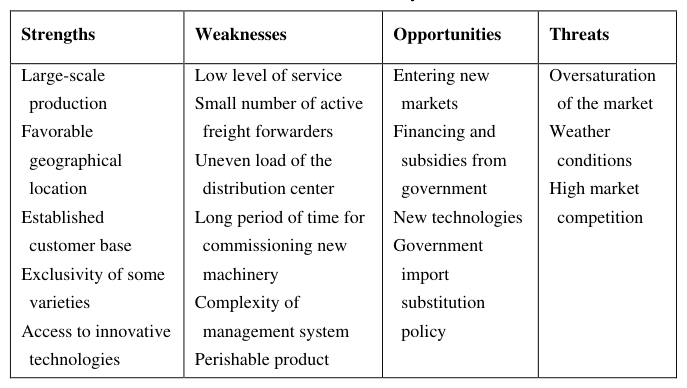
Factors that have a significant impact on the strategic development of the company are identified in a SWOT analysis (see Table 1).
Intelligent Human Systems Integration (IHSI 2022): Integrating People and Intelligent Systems https://openaccess.cms-conferences.org/#/publications/book/978-1-7923-8988-7 product line, which all can be increased, although this comes at an expense.
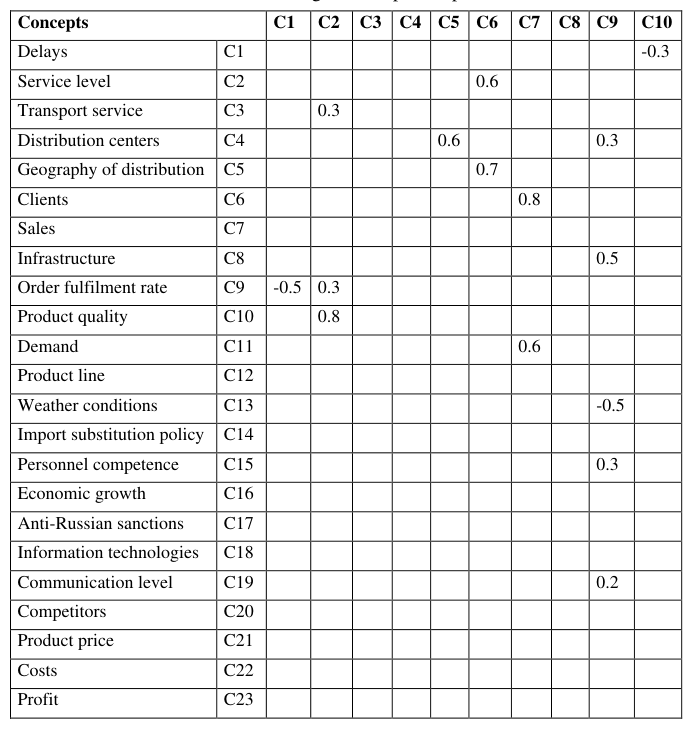
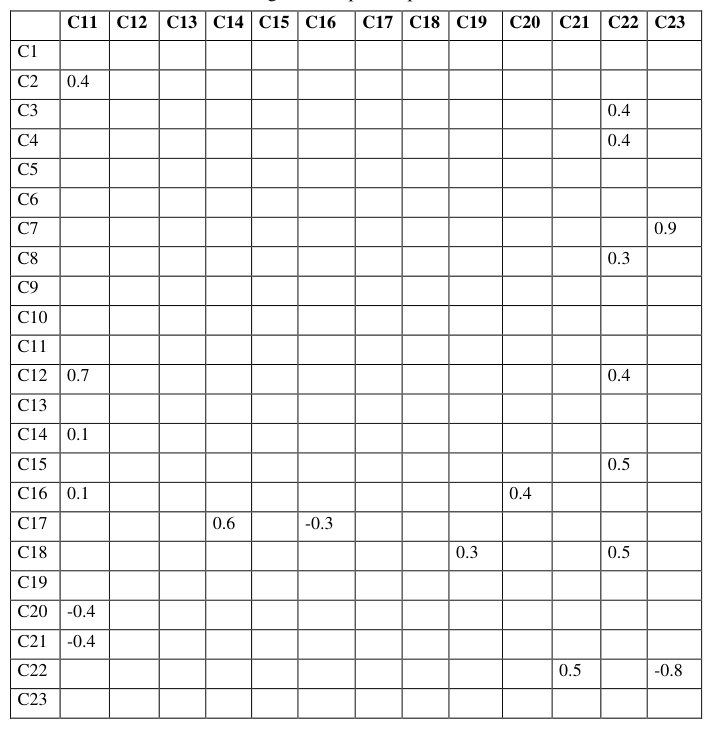
Table 2. Cognitive map concepts
Intelligent Human Systems Integration (IHSI 2022): Integrating People and Intelligent Systems https://openaccess.cms-conferences.org/#/publications/book/978-1-7923-8988-7
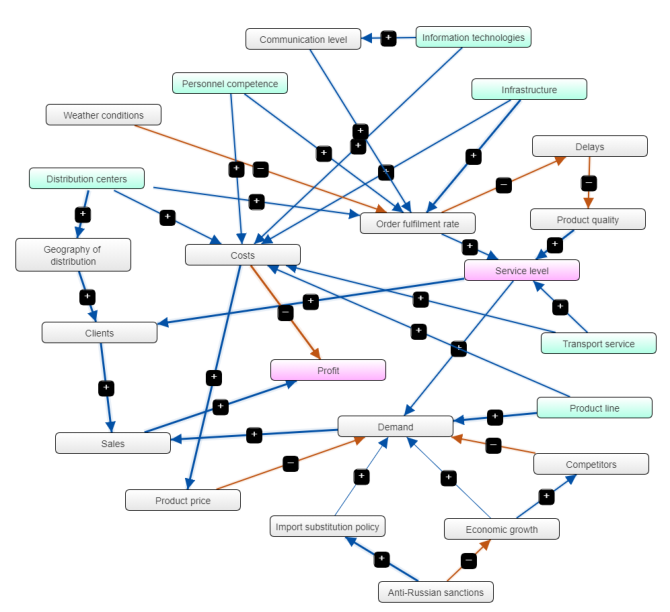
C23 The graph of the cognitive map is shown in Figure 1. All control factors that allow increasing profit are associated with costs and expenses that reduce the value of profit. Thus, it is necessary to find such a combination of control factors in which the positive effect will be higher than the negative.
Intelligent Human Systems Integration (IHSI 2022): Integrating People and Intelligent Systems https://openaccess.cms-conferences.org/#/publications/book/978-1-7923-8988-7
Figure 1. Cognitive map graph
RESULTS
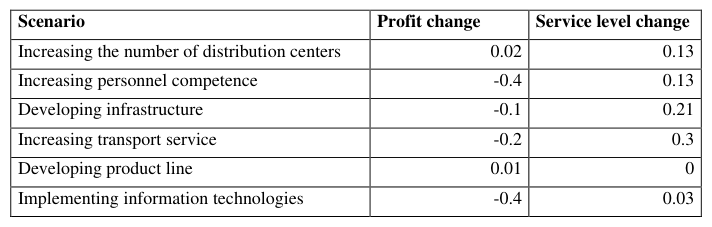
The results of scenario calculations that were performed using a cognitive map are presented in Table 4.
Table 4. Results of scenario calculations
Intelligent Human Systems Integration (IHSI 2022): Integrating People and Intelligent Systems https://openaccess.cms-conferences.org/#/publications/book/978-1-7923-8988-7
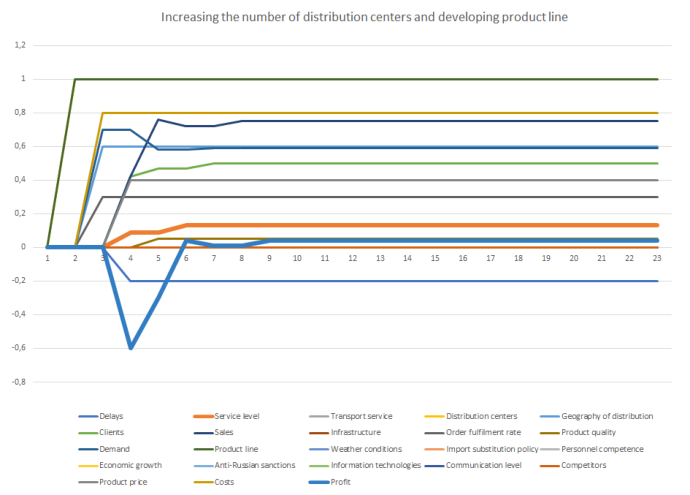
Based on the results of scenario calculations, we can conclude that the company should focus on the factors “Distribution centers” and “Product line” because they have the greatest impact on the strategic development of the company. The result of the calculation of the combined scenario is shown in Figure 2.
Figure 2. Scenario ‘Increasing the number of distribution centers and developing product line’.
CONCLUSION
To conduct a more detailed study, the developed cognitive map can be supplemented by other factors, considering, for example, the level of company’s cooperation with partners, implementation of Big Data analytics, mechanization level, and productivity.
REFERENCES
Axelrod, R. (1976), “The cognitive mapping approach to decision making”, The Structure of Decision, Princeton Univ. Press, Princeton. Borodin, V., Bourtembourg, J., Hnaien, F. and Labadie, N. (2016), “Handling
uncertainty in agricultural supply chain management: A state of the art”, European Journal of Operational Research, Elsevier B.V., Vol. 254 No. 2, pp.
Intelligent Human Systems Integration (IHSI 2022): Integrating People and Intelligent Systems https://openaccess.cms-conferences.org/#/publications/book/978-1-7923-8988-7
348–359. Edwards, G.I. and Kok, K. (2021), “Building a Fuzzy Cognitive Map from stakeholder knowledge: An Episodic, asynchronous approach”, Current Research in Environmental Sustainability, Elsevier B.V., Vol. 3 No. June, p. 100053. Glykas, M. (2012), “Performance measurement scenarios with fuzzy cognitive
strategic maps”, International Journal of Information Management, Elsevier Ltd, Vol. 32 No. 2, pp. 182–195. Goswami, R., Roy, K., Dutta, S., Ray, K., Sarkar, S., Brahmachari, K., Nanda, M.K., et al. (2021), “Multi-faceted impact and outcome of COVID-19 on smallholder agricultural systems: Integrating qualitative research and fuzzy cognitive mapping to explore resilient strategies”, Agricultural Systems, Elsevier Ltd, Vol. 189 No. January, p. 103051. Jones, J.W., Antle, J.M., Basso, B., Boote, K.J., Conant, R.T., Foster, I., Godfray,
H.C.J., et al. (2017), “Brief history of agricultural systems modeling”, Agricultural Systems, Elsevier B.V., Vol. 155, pp. 240–254. Kosko, B. (1986), “Fuzzy cognitive maps”, International Journal of Man-Machine Studies, Vol. 24, pp. 65–75. Papageorgiou, E.I., Markinos, A.T. and Gemtos, T.A. (2011), “Fuzzy cognitive map
based approach for predicting yield in cotton crop production as a basis for decision support system in precision agriculture application”, Applied Soft Computing Journal, Elsevier B.V., Vol. 11 No. 4, pp. 3643–3657. Poomagal, S., Sujatha, R., Kumar, P.S. and Vo, D.V.N. (2021), “A fuzzy cognitive map approach to predict the hazardous effects of malathion to environment (air, water and soil)”, Chemosphere, Elsevier Ltd, Vol. 263, p. 127926. Roberts, F. (1976), Discrete Mathematical Models with Applications to Social,
Biological and Environ-Mental Problems, Prentice Hall, New Jersey. Tolman, E.C. (1948), “Cognitive maps in rats and men”, Psychological Review, Vol.
55, pp. 189–208. Van Winsen, F., de Mey, Y., Lauwers, L., Van Passel, S., Vancauteren, M. and Wauters, E. (2013), “Cognitive mapping: A method to elucidate and present farmers’ risk perception”, Agricultural Systems, Elsevier Ltd, Vol. 122, pp. 42– 52. Zadeh, L.A. (1965), “Fuzzy Sets”, Journal of Information and Control, Vol. 8, pp.
338–353.
Intelligent Human Systems Integration (IHSI 2022): Integrating People and Intelligent Systems https://openaccess.cms-conferences.org/#/publications/book/978-1-7923-8988-7
LISTED IN THE AHFE DIGITAL BOOKSTORE CATALOGUE
Explore the complete digital volume
Intelligent Human Systems Integration (IHSI 2022): Integrating People and Intelligent Systems
Read this individual research paper free through the original publisher, or explore the full digital proceedings book.
ISBN 978-1-7923-8988-7
Explore this ISBN in the AHFE Bookstore ↗Listed in the July 2026 bookstore catalogue; search by ISBN to confirm current availability · Digital book purchase optional