Rafael Oehme, Waldemar Titov, Konstantin Krauss, Till Gnann, Thomas Schlegel (2022). Data-based Usage Analysis of Shared e-scooters in the Context of Public Transport. In: Intelligent Human Systems Integration (IHSI 2022): Integrating People and Intelligent Systems. AHFE Open Access, vol. 22. https://doi.org/10.54941/ahfe100990
Shared e-scooters could improve the sustainability of traffic by being an incentive to switch to public transportation and simultaneously being a potential first- and last-mile-solution. Currently, it is not clear whether e-scooter sharing is a positive addition or an additional burden for urban traffic. This work evaluates the usage of shared e-scooters and its impacts on public transport, based on movement data of e-scooters distributed in the German city of Karlsruhe. A central research question answered in this work is whether shared e-scooters contribute to increasing the attractiveness of public transport or whether they substitute it. Since this question has hardly been investigated so far with the help of mobility data, this work addresses a research gap.Therefore, a concept is presented that can be used to perform a usage analysis of shared e-scooters. In particular, the question will be addressed to what extent shared e-scooters are used for the first- or last-mile and how often they substitute public transport. Furthermore, it will be assessed how suitable our approach is to investigate the mentioned questions.To answer the research questions, we present methods with which the raw e-scooter data, collected via the publicly available APIs, is processed, and the investigation is carried out. In a first step, the shared e-scooter data is processed as plausible paths with the help of our customized python analysis tools. The intermediate result should be e-scooter paths that can be interpreted as trips made by users. Therefore, we applied a similar approach as in comparable studies [1-3].The data basis is validated by calculating key figures and performing a temporal-spatial usage analysis. Through a comparison with the results of similar studies [1-3] it can be assessed to what extent the data is representative and whether special features can be found in the study area. In addition, external influences such as weather conditions or covid-19-related restrictions that may have acted during the study period were considered.The e-scooter trips are then categorized to assess potential use in the context of public transport use. For this categorization, the shared e-scooter trips are divided based on their proximity to public transport stops into four categories: access, departure, substitution, and other trips. An access trip is defined as a potential first-mile trip, departure trips are potential last-mile trips and substitution trips are considered as potential public transport substitutions. More than a third of the studied shared e-scooter trips could have potentially been made using public transportation. In the full paper, the results of our study are interpreted, and the used approaches are evaluated. The focus is on estimating, how many of the access and departure trips are actual first and last mile trips. It could be estimated that, with a share of about 18%, shared e-scooters are used for the first- and last-mile, about as often as surveys in France (15%) and Portland (12%) show [4]. Finally, supplemented by public transport passenger data, we investigate whether statistical correlations between shared e-scooter and public transport use can be proven.References:[1] McKenzie, Grant (2019): Spatiotemporal comparative analysis of scooter-share and bike-share usage patterns in Washington, D.C. Journal of Transport Geography. https://www.researchgate.net/publication/333543134_Spatiotemporal_comparative_analysis_of_scooter-share_and_bike-share_usage_patterns_in_Washington_DC[2]Reck, Daniel; Haitao, He; Guidon, Sergio; Axhausena, Kay W. (2021): Explaining shared micromobility usage, competition and mode choice by modelling empirical data from Zurich, Switzerland. Volume 124. Transportation Research Part C: Emerging Technologies. https://www.sciencedirect.com/science/article/pii/S0968090X20308445, [3] Caspi, O.; Smart, M.; Noland, R. (2020): Spatial associations of dockless shared e-scooter usage. Volume 86. Transportation Research Part D: Transport and Environment. https://www.sciencedirect.com/science/article/abs/pii/S1361920920305836[4] Gubman, Joanna; Jung, Alexander; Kiel, Thomas; Strehmann, Jan (2019): Shared E-Scooters: Paving the Road Ahead, Policy Recommendations for Local Government. Berlin: Agora Verkehrswende.
Intelligent Human Systems Integration (IHSI 2022): Integrating People and Intelligent Systems https://openaccess.cms-conferences.org/#/publications/book/978-1-7923-8988-7
INTRODUCTION
In particular, the research question will be addressed to what extent shared e-scooters are used for the first- and last mile and how often they substitute public transport. Furthermore, it will be assessed how suitable our approach is to investigate the mentioned question. To answer the research questions, we present methods with which the data is processed, and the investigation is carried out. In a first step, the raw e-scooter data is processed as plausible trips, which can be interpreted as user trips. Secondly, we validate the data by calculating key figures, performing a spatiotemporal usage analysis and estimate the impact of external influences such as weather conditions or covid-19-related restrictions that have acted during the study period. The e-scooter trips are then categorized to evaluate potential usage in the context of public transport usage. For this categorization, the shared e-scooter trips are divided based on their proximity to public transport stops. In this study, only rail- based public transport is considered as public transport.
RELATED WORK
Due to the comparatively short time in which e-scooter sharing has been the subject of research, the number of studies on e-scooter usage is still limited. While the aspect of usage has been addressed in some publications, the integration of shared e-scooters and public transport was so far hardly investigated.
The fact that there are so few data-based studies on e-scooter usage is partly because e-scooter sharing is a relatively new form of mobility and partly because e-scooter data is often not accessible to researchers (Jiao et al. 2020). McKenzie examined how bike and e-scooter sharing usage patterns differ or are similar, by investigating movement data. Based on this data, a spatiotemporal usage analysis was carried out. According to McKenzie, bike sharing, in contrast to e-scooter sharing, is mainly used for commuting to work (McKenzie 2019). That the main trip purpose for e-scooter trips is not work is also reported by Caspi et al. (Caspi et al. 2020). Most e-scooter trips occur in city centers, as well as near universities. Furthermore, e-scooters are probably frequently used by students (Jiao et al. 2020, Caspi et al. 2020, San Francisco Municipal Transportation Agency SFMTA 2019).
Another data-based research analyzed e-scooter usage in various European cities. Due to the average trip lengths, the authors do not see e-scooters as competition to public transport, but rather to cycling and walking (Tack et al. 2019). As shown in the mentioned works, data-based usage analyses have already been carried out. Thereby temporal and spatial usage patterns that were examined seem to correspond in many respects.
Besides movement data, surveys and interviews can be used to examine e-scooter usage. The San Francisco Municipal Transportation Agency (SFMTA) investigated
Intelligent Human Systems Integration (IHSI 2022): Integrating People and Intelligent Systems https://openaccess.cms-conferences.org/#/publications/book/978-1-7923-8988-7 e-scooter usage and their relationship with public transport. The survey provided valuable insight, e.g., regarding the average trip length or how often e-scooters are used in combination with or instead of public (SFMTA 2019). A literature review by Oeschger et al. identifies a research gap for data analyses that address the question of how micro mobility, and in particular newer electric micro-vehicles, are used for access and egress to public transport (Oeschger et al. 2020). As one of the goals of this paper is to investigate how shared e-scooters are used in the context of public transport, this very research gap is addressed.
In a preprint published in March 2021 by Yan et al., the research question of this paper is examined. The authors also take a data-driven approach to investigate whether shared e-scooters complement or replace existing mobility options, in particular bike-sharing and public transport. The methodology used to answer the research question is similar to our approach applied in the current work. However, the authors define the categories differently, which means that no conclusions can be drawn about first- or last mile trips. Yan et al. conclude from their analysis that most e-scooter trips substitute public transportation. However, the analysis also showed the potential for last mile bridging (Yan et al. 2021).
Apart from the recently published preprint by Yan et al., there seems to be no research, using a data-driven approach to investigate the research question of this paper. A data-based analysis of e-scooter usage on the first- and last mile was also identified as a research gap by Oeschger et al. and only partially investigated by Yan et al. This work could thus provide new insights into first and last mile usage of shared e-scooters. While the focus of the work will therefore be on the study of access and egress trips, the substitution of public transport by e-scooters will also be investigated.
SHARED E-SCOOTER DATA Between 27/11/2020 and 08/12/2020, e-scooter data from three different providers were queried via the publicly available API's and the collected data was made available for the purpose of conducting this research. The API calls were made approximately every 17 minutes. The data scraped via the APIs shows the e-scooters available at the respective positions (latitude, longitude) at the time of the query (timestamp), including information such as provider, license plate and the current battery level. The scraped data therefore does not show e-scooter journeys, but rather where the e-scooters are located and for how long. For this study, it is interesting to see when and where the e-scooters were moved, rather than where they are parked the rest of the time. In order to look at traveled routes, the data first needs to be prepared. A similar approach as in (Tack et al. 2019, McKenzie 2019) was used for data preparation.
A route consists of a starting point and a destination. Accordingly, a change of location must be identified for an e-scooter so that a route can be recognized.
Intelligent Human Systems Integration (IHSI 2022): Integrating People and Intelligent Systems https://openaccess.cms-conferences.org/#/publications/book/978-1-7923-8988-7
Comparing several consecutive locations of the same e-scooter (unique identification feature is the license plate number), we draw conclusions from the data as to whether the e-scooter was parked or moved. If the longitude and latitude of an e-scooter change from one query to the next, it can be assumed that the e-scooter has been moved. Using our python tool, the raw dataset was automatically analyzed for such location changes. This analysis resulted in e-scooter movements or trips. Not all of these trips can be identified as trips traveled by a user. In addition to user-performed trips, the data may also map other e-scooter movements. Both, the providers' fleet management (collection, charging, delivery) and technical errors (faulty data or GPS tracking problems) could be misinterpreted as user trips (Caspi et al. 2020).
Following the model of (McKenzie 2019, Caspi et al. 2020) conditions were formulated that must be fulfilled in order to interpret an e-scooter movement as a user-induced trip. First, the distance from start to destination must be greater than 100 meters. Secondly, the distance from start to finish must not exceed 5,000 meters. Thirdly, the battery level must not increase during the ride. During the processing, of almost 500,000 e-scooter movements 16,028 e-scooter trips were filtered, which can be interpreted as trips traveled by users.
DATA ANALYSIS AND METHODS The concept applied for this work can be separated into three steps: general analysis, categorization approach and correlation analysis. Firstly, a general analysis of the e- scooter usage is carried out. Key figures such as the average number of e-scooter trips per day, the average distance traveled or the number of e-scooters in the study area can be used to evaluate the data basis. By comparing the research results with those of the studies under consideration, one's own results can be validated. In addition, external influences such as weather conditions and pandemic-related restrictions are considered and their impact on e-scooter usage is estimated. Besides, e-scooter usage is examined on both a temporal and spatial level and the usage patterns are compared with similar studies to identify similarities and differences. The data is suitable for examining e-scooter usage over the course of the day and week and interpreting it accordingly. On a spatial level, usage patterns can be investigated with the help of visualizations. Special features of e-scooter usage in the study period or in the study area can thus be identified and interpreted.
Secondly, the e-scooter routes are categorized in terms of potential usage in connection with public transport. Investigating the integration of e-scooter and public transport usage requires specific methods, as intermodal trip chains are not easy to identify as such (Oeschger et al. 2020). To investigate the integration by means of movement data, trips are often selected by “creating a buffer around public transport stations, and those micromobility sharing trips that start or end within that buffer are considered access or egress trips” (Oeschger et al. 2020). In this approach, the trips are categorized based on their origin-destination relationship. The decisive factor for
Intelligent Human Systems Integration (IHSI 2022): Integrating People and Intelligent Systems https://openaccess.cms-conferences.org/#/publications/book/978-1-7923-8988-7 the classification is the geographical location of the start and end points of a trip, as well as the distance of the start and end points to public transport stations.
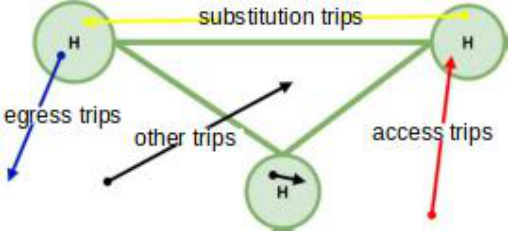
In a first step, the buffer size is defined. Based on similar studies and on our iterative prototyping approach, the buffer size was set at a radius of 150 meters. An egress trip is referred to as a potential last mile trip because the e-scooter journey could have been preceded by a public transport journey. Conversely, an access trip can be interpreted as a potential first-mile trip, as the e-scooter journey is likely followed by a public transport journey. In addition to the public transport-related first- and last mile trips, e-scooters could also be used instead of public transport. E-scooter trips that start within one buffer and end in another are therefore considered as potential public transport substitutions and referred to as substitution trips, as shown in figure 1. E-scooter trips that begin and end more than 150 meters from a station away and trips that begin and end within the same buffer are hereinafter referred to as other trips.
Figure 1: Categorization of e-scooter trips
As an interim result, we can now make a statement about how often e-scooters could have been used in connection with public transport, and how often there was a potential public transport substitution. Subsequently, the results will be examined in more detail to estimate how many of the access and egress trips could actually correspond to first- and last mile usages. By looking at the stop-related e-scooter trips together with public transport passenger data, possible correlations are investigated by a correlation analysis. While investigating access and egress trips alone is limited in its informative value, by including the passenger data, the scope of interpretation can be enlarged, allowing the previous investigation to be further checked for plausibility. It will be investigated whether a correlation between public transport and e-scooter usage can be proven, and if so, how pronounced it is.
To investigate whether there are correlations between the two variables, the correlation coefficient by person is calculated for boarding passengers and access trips as well as for alighting passengers and egress trips. For this purpose, public transport usage and e-scooter usage are considered over the course of the day and in a spatial context. For the temporal correlation analysis, passenger data for one tram vehicle was compared with e-scooter usage near public transport stations served exclusively by this line. For the spatial analysis, all stations in the study area with boarding and alighting passengers and e-scooter usage were considered.
Intelligent Human Systems Integration (IHSI 2022): Integrating People and Intelligent Systems https://openaccess.cms-conferences.org/#/publications/book/978-1-7923-8988-7
RESULTS
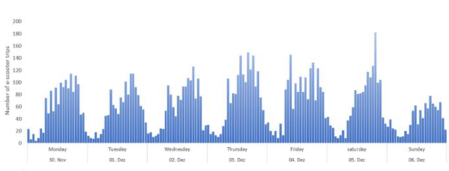
Firstly, the spatiotemporal usage analysis showed that the distribution of the examined e-scooter trips over the course of the day, which is demonstrated in figure 2, could be classified as representative. Plausible explanations for the deviations in the temporal usage patterns could be formulated by interpreting possible trip purposes. The fact that significantly fewer e-scooter trips are made on weekends, especially on Sundays, than during the week contradicts the results of some related studies. This could indicate that e-scooters in Karlsruhe are more often used for work trips. While a higher concentration around the city centre of Karlsruhe is observed, other than expected, no usage hotspots were detected in areas around the universities. The fact that e-scooter trips start or end most frequently at the main train station seems to be a peculiarity of the study area. However, it can be observed that public transport stations are often places of increased e-scooter usage. Even though the data covered only 12 days, the data basis can be classified as representative overall.
Figure 2: Spatiotemporal usage analysis
Secondly, the categorization approach reveals that more than one-third of all e- scooter trips were potentially made in connection with public transportation. 22.8% of trips were categorized as egress trips. The 2,127 trips identified as access trips represent 13.3% of the total trips. The fewest trips were categorized as potential substitution trips. Only 8.4% of trips could be public transportation substitutes. At 55.5%, the vast majority of trips could not be interpreted as either access, egress, or substitution trips.
In total, 36.1% of the trips could generally be connected to public transport. The intermodal usage of e-scooters and public transport varies from city to city according to the surveys. In San Francisco, 34% of respondents use an e-scooter in combination with public transport, compared to 18% in Arlington (Virginia, USA) (Gubman et al. 2019, Yan et al. 2021, SFMTA 2019). In a survey in France, 15% of users reported also using public transport on their last e-scooter trip, compared to about 12% in Portland (Gubman et al. 2019). With the 36.1% identified in this study, e-scooters would be used comparatively often in combination with public transport.
International studies have also investigated which means of transport are substituted by e-scooters. In France, 29% of e-scooter users stated they would have used public transport instead. In Portland and San Francisco, this was true for just over 10% of
Intelligent Human Systems Integration (IHSI 2022): Integrating People and Intelligent Systems https://openaccess.cms-conferences.org/#/publications/book/978-1-7923-8988-7 respondents (Gubman et al. 2019, SFMTA 2019). Thus, the 8.4% substitution potential identified here would correspond more to a low substitution share. Both the values determined for potential usage in connection with public transport and the share of potential public transport substitutions roughly correspond to results from surveys conducted in other cities. However, it is questionable how many of the access and egress trips correspond to first- and last mile usage. Therefore, the results are further analysed by considering the different types of trips in a temporal and spatial context.
The temporal analysis shows that many access and egress trips could correspond to first- and last mile usage. The question to what extent the access and egress trips can also be considered as first- and last mile trips can only be answered to a limited extent by looking at the trip length. Since there is no precise definition for the distance of a first- or last mile trip, our study can only be based on estimated values. Considering values between 600 m (based on the pedestrian accessibility of public transport stations) and 2500 m (maximum distance of a common e-scooter ride), 20 to 86% of the access and egress trips can be interpreted as plausible first- or last mile trips. If an estimated 50% of stop-related e-scooter usage involves first- or last mile usage, then out of the 36% of e-scooter trips potentially made in combination with public transport, about 18% would be actual first- or last mile trips. With 18%, e-scooters in Karlsruhe would be used for first- and last mile trips about as often as surveys in France (15%), Portland (12%), and Arlington (18%) showed (Gubman et al. 2019, Yan et al. 2021, SFMTA 2019).
Thirdly, the correlation analysis states that the sole consideration of boarding passengers and access trips as well as alighting passengers and egress trips at the delimited stops of a streetcar serving a certain line does not reveal any correlations. Neither on a temporal nor on a spatial level statistically significant correlations could be proven. However, by extending the study to all stations with boarding and alighting passengers and e-scooter usage, moderately strong correlations can be demonstrated between boarding passengers and access trips, and between alighting passengers and egress trips.
From the results of the correlation analysis, it can be concluded that a higher number of boarding or alighting passengers is associated with more access or egress trips. Although a causal relationship cannot be proven based on the statistical analysis, the statistical correlations can be considered as an indication of a complementary relationship between e-scooter and public transport usage in the study area and time (Fahrmeir et al. 2016).
OUTLOOK & LIMITATIONS The results presented in this work are comparable to similar findings presented by other researchers. The answer to the research question is, that shared e-scooters are
Intelligent Human Systems Integration (IHSI 2022): Integrating People and Intelligent Systems https://openaccess.cms-conferences.org/#/publications/book/978-1-7923-8988-7 completing public transport more than they substitute it. About one in five e-scooter trips is made in combination with public transport, while less than 10% of all e- scooter trips are directly substituting public transportation. E-scooters thereby contribute to increasing the attractiveness of public transport being a suitable solution for the first- and last mile. In addition, it was discovered that the structure of the access and egress trips partly does not correspond to the typical, pedestrian pattern of a first- and last-mile trip, since often not the next, but a more distant station is the starting or ending point of such e-scooter trips. While the pandemic-related avoidance of public transport and the high speed of the e-scooters compared to walking could be plausible explanations, e-scooter trips starting and ending at crucial public transport hubs could reduce travel-, waiting- and transfer-times and thus increase the attractiveness of public transport even more.
This work was limited above all by the nature of the data. Due to the short data collection period, the results are only representative to a limited extent. In addition, the data is not very precise due to the query procedure of the chosen API, not allowing for accurate conclusions about the start and end of an e-scooter trip. The approach to categorizing trips using stop buffers is suitable for estimating potential usage, especially for investigating first- and last mile usage. While the categorization with a buffer radius of 150 meters allows an initial assessment, further analyses, such as the consideration of path lengths, can be used to make these initial assessments more precise.
For a more specific analysis of public transport substitutions, the actual public transport service as well as the travel time savings of the different alternatives and the routing of the e-scooter trips should be considered. The data-based research approach could also be complemented by social science research such as surveys or interviews to address questions about mobility behavior and intermodal e-scooter usage. Since the definition of the stop buffers has a significant impact on the outcome of the categorization approach, the hypotheses regarding parking and borrowing an e- scooter before or after using public transportation could be tested through a field study.
ACKNOWLEDGEMENTS
This work was conducted within the scope of the project establishment of the Baden- Württemberg Institut für Nachhaltige Mobilität (BWIM1) funded by the Ministry of Science, Research and Arts as well as the Ministry of Transport Baden-Württemberg.
1 Baden-Württemberg Institut für Nachhaltige Mobilität (BWIM) URL: https://bw-im.de/
Intelligent Human Systems Integration (IHSI 2022): Integrating People and Intelligent Systems https://openaccess.cms-conferences.org/#/publications/book/978-1-7923-8988-7
REFERENCES
Caspi, O.; Smart, M.; Noland, R. (2020): Spatial associations of dockless shared escooter usage. https://doi.org/10.1016/j.trd.2020.102396 Fahrmeir, Ludwig; Heumann, Christian; Künstler, Rita; Pigeot, Iris; Tutz, Gerhard
(2016): Statistik. Der Weg zur Datenanalyse. DOI 10.1007/978-3-662-50372-0 Gubman, Joanna; Jung, Alexander; Kiel, Thomas; Strehmann, Jan (2019): E- Tretroller im Stadtverkehr. Handlungsempehlungen für deutsche Städte und Gemeinden zum Umgang mit stationslosen Verleihsystemen. https://www.agora- verkehrswende.de/fileadmin/Projekte/2019/E-Tretroller_im_Stadtverkehr/Agora- Verkehrswende_e-Tretroller_im_Stadtverkehr_WEB.pdf Jiao, J.; Bai, S. (2020): Understanding the Shared E-scooter Travels in Austin. DOI
https://doi.org/10.3390/ijgi9020135 McKenzie, Grant (2019): Spatiotemporal comparative analysis of scooter-share and bike-share usage patterns in Washington, D.C. DOI 10.1016/j.jtrangeo.2019.05.007 Oeschger, Giulia; Carroll, Páraic; Caulfield, Brian (2020): Micromobility and public
transport integration: The current state of knowledge. DOI 10.1016/j.trd.2020.102628 San Francisco Municipal Transportation Agency (SFMTA) (2019): Powered scooter share mid-pilot evaluation. https://www.sfmta.com/sites/default/files/reports-and- documents/2019/08/powered_scooter_share_mid-pilot_evaluation_final.pdf Tack, A.; Klein, A.; Bock, B. (2019): E-Scooter in Deutschland. ein datenbasierter
Debattenbeitrag. https://scooters.civity.de/ Yan, Xiang; Yang, Wencui; Zhang, Xiaojian; Xu, Yiming; Bejleri, Ilir; Zhao, Xilei (2021): Do e-scooters fill mobility gaps and promote equity before and during COVID-19? A spatiotemporal analysis using open big data. https://arxiv.org/abs/2103.09060
Intelligent Human Systems Integration (IHSI 2022): Integrating People and Intelligent Systems https://openaccess.cms-conferences.org/#/publications/book/978-1-7923-8988-7
LISTED IN THE AHFE DIGITAL BOOKSTORE CATALOGUE
Explore the complete digital volume
Intelligent Human Systems Integration (IHSI 2022): Integrating People and Intelligent Systems
Read this individual research paper free through the original publisher, or explore the full digital proceedings book.
ISBN 978-1-7923-8988-7
Explore this ISBN in the AHFE Bookstore ↗Listed in the July 2026 bookstore catalogue; search by ISBN to confirm current availability · Digital book purchase optional