Ahmed Farooq, Hasse Sinivaara, Mikko Laaksonen, Hanna Virtainen, Arto Hippula, Veikko Surakka, Roope Raisamo (2022). Creating Tactile Interaction Surfaces for the Origo Steering Wheel Concept using CWI and EHWs. In: Intelligent Human Systems Integration (IHSI 2022): Integrating People and Intelligent Systems. AHFE Open Access, vol. 22. https://doi.org/10.54941/ahfe100962
As the automotive industry transitions to electric and autonomous vehicles (SAE 2-3) more and more information needs to be reviewed by the driver in real-time. Conventional information presentation techniques are not ideal for reviewing this type of information as it lacks multimodal and cross modal presentation. Haptics, one of the key interaction modalities, is often over-looked as it is considered non-functional in a vibration heavy environment, such as a moving vehicle. However, modern techniques of generating, medi-ating, and delivering tactile feedback have greatly improved in the last five years. Localizing techniques such as Constructive Wave Interference (CWI) and mediation technique of Embedded Haptic Waveguides (EHWs) can be combined to create reliable and consistent tactile output in even the most challenging environments. In this research authors utilize these techniques to create tactile feedback zones on the steering wheel, which can be used to relay haptic signals to the driver with little to no visual demand. These zones were 3D-printed onto an intelligent adaptive (Origo) steering wheel. Authors com-pared the efficiency of the Origo Wheel with the onboard wheel of a Porsche Cayenne, using identical actuation components while the vehicle was being driven on the Nokia Tires Track. Compared to the Porsche Cayenne's original steering wheel, the Origo wheel was able to mediate actuation to the driver’s point of contact more efficiently which yielded better driving and secondary task performance. Using the Origo wheel was also rated to have required low-er cognitive load in completing the IVIS tasks in the moving vehicle.
The multigeneration transitioning towards cleaner, smarter, and more connected vehicles is currently picking up pace. However, this transition may happen in stages and will require considerable alterations to how drivers interact with their vehicles. Information provided in current vehicles is streamlined to alerts, warnings and summarized updates, however, as our vehicles become more autonomous, driver's role may change from driving the vehicle to supervising the semi-autonomous components within it. This would require a radical revision of what it means to control a modern vehicle and there is a need to develop more robust information communication channels between the driver and the autonomous vehicle. Current methods of using predominantly visual and auditory information to relay warnings and alerts may not be sufficient for up-coming electrified and semi-autonomous. Additionally, information from supporting driving systems (Lamm and Wolff, 2019), smart road infrastructure (Salvatore et al., 2020), additional sensors (Kocić et al., 2018) / computational systems (Liangkai et al., 2020) within the vehicle and personalized secondary communication tasks (Colley et al., 2020), can all become overwhelming for the driver. Therefore, during this transition drivers may need to process and react to more information than ever before from a variety of sources and react to it faster, creating additional complexity which can severely affect driving performance and cause road accidents. Even the possibility of these radical changes themselves challenge certain drivers with confusion and alienation, because almost everything current drivers have been accustomed to while operating a personal vehicle, may change. For this reason, it is critical to develop new multimodal and cross modal techniques to relay complex information to the driver in a summarized manner.
Intelligent Human Systems Integration (IHSI 2022): Integrating People and Intelligent Systems https://openaccess.cms-conferences.org/#/publications/book/978-1-7923-8988-7
This includes information regarding autonomous vehicle transitions (Hando-Over, Take- Over) as well as supervisory information (road conditions, traffic information and navigation updates). Haptic feedback can be a great tool to relay some of this information without creating additional visual distraction. However, unreliability of haptic signals within noisy environments is one challenge that limits the use of this modality. In this research authors explore new techniques (EHWs, CWI) of creating, mediating, and delivering actuation signals that can work even in noisy environments, such as a moving vehicle.
RELATED RESEARCH INTO EHWS & CWI To reduce signal distortion such as intensity attenuation and spectral degradation, it is possible to utilize haptic waveguides that can channel or mediate the source signals more efficiently. In fact, waveguides have been widely used in various audio-based devices for decades (Berdahl et al, 2009; Morse and Feshbach, 1956; Pierce, 1989). Depending on the material properties as well as the structural design of the waveguide, applied signals may be enhanced to create more reliable and consistent global device actuation. On the other hand, Constructive wave interference is a method of providing localized actuation signals using virtual actuators. They can be created by modulating the propagation of standing waves along the surface of actuation from two opposite sides. Coe et al., (Coe et al., 2019) found that it was possible to create discrete localized low-frequency actuation in between the two sur- face-mounted actuators by adjusting the independent high-frequency direct-signals from each actuator thereby, creating adjustable indirect actuation points. Combining these two novel techniques can be an excellent tool for providing localized actuation on any interaction surface even in haptically noisy environments i.e., moving vehicle. In this research the authors discuss the development of the Haptic Origo Steering wheel, which was introduced in the German Design Award 20211.
ORIGO STEERING WHEEL DESIGN Providing reliable tactile output on the steering wheel in a moving vehicle has been quite challenging (Yoren et al., 2018; Shakeri et al., 2017). with regards to efficiency of actuation, signal mediation and mitigation of environmental noise. In this section, authors discuss the use of 3D-printed Embedded Haptic Waveguides (EHWs) (Farooq et al., 2020a; Farooq et al., 2020b) within the steering wheel to mediate the tactile feedback from the actuator to the
1 Origo Steering Wheel, German Design Awards 2021. https://www.german-design-award.com/en/the- winners/gallery/detail/33348-origo-steering-wheel.html
Intelligent Human Systems Integration (IHSI 2022): Integrating People and Intelligent Systems https://openaccess.cms-conferences.org/#/publications/book/978-1-7923-8988-7 point of contact. Moreover, utilizing the novel concept of Constructive Wave Interference (CWI) (Coe et al., 2019) the interactive surface of the steering wheel can be used to create localized actuation through virtual exciters. These exciters can be calibrated by modulating the output signal of two oppositely placed actuators embedded within the wheel. The novel steering wheel (Origo wheel) can provide reliable tactile feedback in a variety of haptically noisy environments. Origo Wheel was part of the academic-industrial collaboration (MIVI Project) in developing novel interaction components for autonomous vehicles, therefore the outer design is in accordance with the publicly available version shared in the 2021 German Design Awards. This paper only details the haptic interaction aspect of the Origo Wheel.
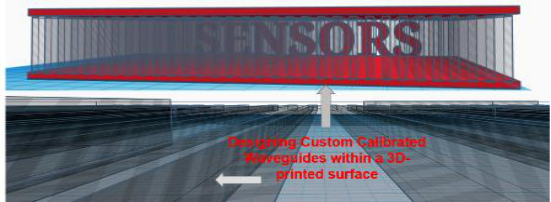
Figure 1. Design and structure of the Origo Embedded Haptic Waveguides and Constructive Wave Interference virtual exciter locations (A&B).
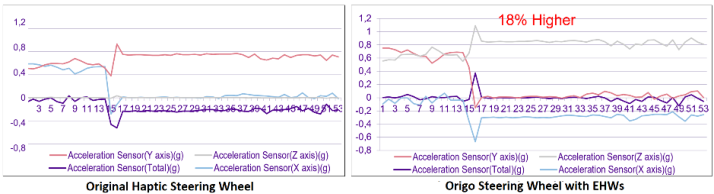
The 3D-printed Steering wheel with EHWs utilized horizontal and vertical shafts that were parallel to the travel direction of the intended signal (Fig. 1). These sub-surface shafts acted as low impedance loads, ensuring that the actuated signal was effectively relayed throughout the device. This meant the solid shafts within the surface acted as the mediators while the empty space around them ensured minimum distortion and integration of the applied signal. (Hudin et al., 2015; Dhiab and Hudin, 2019). The ratio between the solid material and empty space was 1:1.5 as this provided more efficient mediation while testing for 60Hz feedback signal. Materials used, printing process, and fabrication was all kept identical to Farooq et al., (2020). Once the design of the Origo Wheel was finalize we tested the wheel in a moving vehicle with a 250ms 60Hz actuation signal and recorded, on average 18% more efficient output compared to the Porsche Cayenne original wheel mounted with the same Lofelt L5
Intelligent Human Systems Integration (IHSI 2022): Integrating People and Intelligent Systems https://openaccess.cms-conferences.org/#/publications/book/978-1-7923-8988-7 actuators (Fig. 2).
Figure 2. Results comparing Original Porsche & Origo Wheel with Embedded Haptic Waveguides.
To create virtual excitation throughout the periphery of the steering wheel using Constructive Wave Interference (CWI) we utilized the two L5 actuators and modulated their output to ensure the signal interference was felts at two points of the wheel (A & B), just under the two wings (Fig. 1). This was also done for the native steering wheel (OHW) in the Porsche Cayenne, however, testing should that due to the material of the native steering wheel the mediation of the actuation signal traveling through the periphery of the wheel was very low and often not sensible in the moving vehicle.
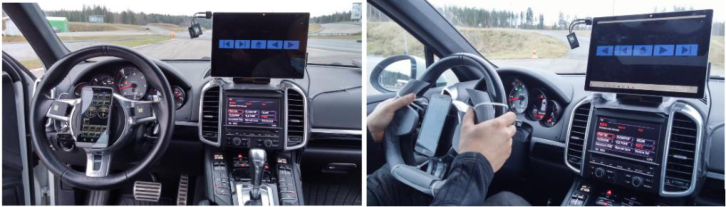
EXPERIMENT DESIGN To compare the Origo wheel with the native steering wheel in the Porsche Cayenne (OHW), we connected the actuators from both wheel to a MS Surface 4 Tablet acting as a central stack (Fig. 3). The Tablet was mounted on top of the dashboard next to the embedded IVIS display (Fig. 3) roughly within driver’s eyeline. The tablet utilized custom IVIS software which required the participant to complete two task 1) Text entry and 2) Dynamic Menu selection. The text entry task required the participants enter a randomly generated (8 letter) phrase into the onscreen keyboard, where each key provided the identical actuation confirmation feedback to the corresponding steering wheel (Origo and OHW). The Menu selection task used 5 horizontally placed onscreen buttons. A randomly generated 6 icon sequence needed to be entered using these onscreen buttons. Every time a selection was made the onscreen buttons were rearranged dynamically, meaning the participants had to visually identify their selection target throughout the task.
Intelligent Human Systems Integration (IHSI 2022): Integrating People and Intelligent Systems https://openaccess.cms-conferences.org/#/publications/book/978-1-7923-8988-7
Figure 3. Placement of actuators, sensors, MS tablet and Origo wheel.
Each feedback provided the same 60Hz, 150ms actuation signal to the corresponding steering wheel. Using this setup, we recruited 8 professional Nokia Tires Track drivers to drive a 460m straight section of the track. Both tasks were carried out while the drivers drove on the track at a consistent 60Km/h, meaning they had ~30 secs to complete the tasks. Participants completed both tasks randomly, once using the OHW and Origo wheel, with and without haptic feedback, using only the MS Surface tablet. The participants were asked to prioritize their primary task, which was driving in a straight line at a consistent speed of 60km/h, while conduct the two secondary IVIS task (text entry & menu selection) as soon as possible. During the study, auditory feedback was turned off. Primary task performance parameters i.e., Steering wheel Reversal Rate (SRR) (Gustav and Engström, 2006; Ostlund et al., 2005), Standard Deviation Lane Position (SDLP) (Verster and Roth, 2011; Green et al., 2003), and Speed variations were recorded during the task. Secondary task performance measures (i.e., Completion time, Errors, Incompletes, Screen contact time and Touch-point accuracy) were also logged for analysis. Each participant drove one lap of the track to record their baseline driving behavior before the study.
RESULTS AND DISCUSSION
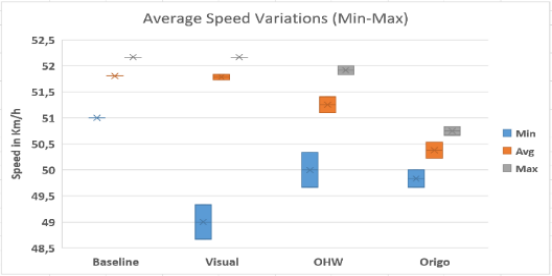
Results from the primary task show improved task performance across all measures (SRR, SDLP and speed variation) for the Origo steering wheel over OHW (Fig. 4). SRR showed fewer corrections for Origo wheel compared to OHW and visual only condition. Similarly, SDLP also showed haptics provided through the Origo wheel reduced secondary task related distractions but also that visual only condition was much more distracting for both tasks. Moreover, speed variation results again showed that the haptic feedback from Origo wheel mitigated the distraction caused by the secondary task, and that visual only condition greatly affected the primary task performance and here we see the largest deviation from baseline.
Intelligent Human Systems Integration (IHSI 2022): Integrating People and Intelligent Systems https://openaccess.cms-conferences.org/#/publications/book/978-1-7923-8988-7
Intelligent Human Systems Integration (IHSI 2022): Integrating People and Intelligent Systems https://openaccess.cms-conferences.org/#/publications/book/978-1-7923-8988-7
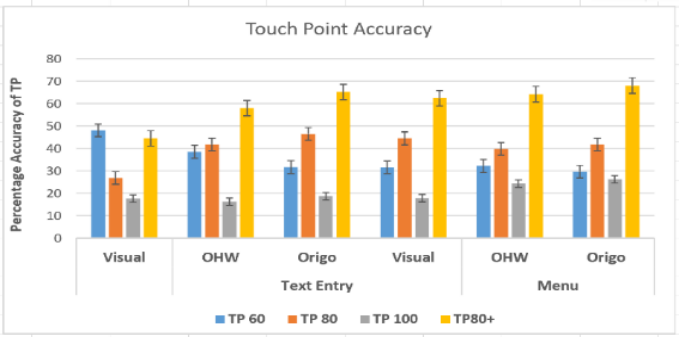
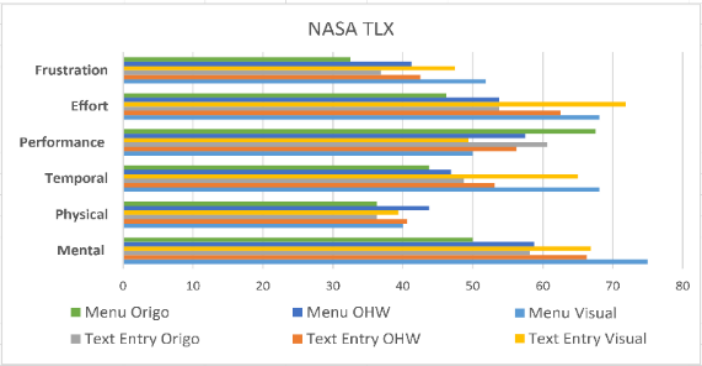
Looking at results from Secondary task performance (STP) we see similar results (Fig. 5). Although Menu task was lower in visual and cognitive load compared to text entry task both recorded greatest errors for visual only condition and OHW compared to Origo wheel. Task completion times, errors, and incompletes were again lowest for Origo steering wheel followed by OHW. Other measurement including touch point accuracy (80% and above) as well as onscreen dwell times (Cristina and Lopez-Moliner, 2015) also showed visual load to be lowest for Origo steering wheel. NASA TLX measure (Fig. 5) reaffirm the findings of increased performance in both tasks while lowering mental load, effort and frustration.
Figure 5. (top) STP results and (middle) Touch Point Accuracy results, (bottom). NASA TLX workload break up rating provided by participants.
Intelligent Human Systems Integration (IHSI 2022): Integrating People and Intelligent Systems https://openaccess.cms-conferences.org/#/publications/book/978-1-7923-8988-7
Figure 5. (top) STP results and (middle) Touch Point Accuracy results, (bottom). NASA TLX workload break up rating provided by participants.
ACKNOWLEDGMENTS
Origo Steering wheel research was carried out in Multimodal In-Vehicle Interaction & Intelligent Information Presentation (MIVI project), funded by Business Finland (grant 8004/31/2018). The Origo Wheel is a joint development effort between all stakeholders of the project, Special thanks to Mr. Hannu Onnela at Nokia tires track for arranging the test vehicle and facilitating with reserving professional drivers as participant for the data collection
REFERENCES
Berdahl, Edgar; Niemeyer, Gunter; Smith, Julius, Orion (2009). “Using Haptic Devices to Interface Directly with Digital Waveguide-Based Musical Instruments”. In Proceedings of New Interfaces of Musical Expression (NIME09), June 3-6, 2009, Pittsburgh, PA, pp. 183-186. Coe, Patrick; Farooq, Ahmed; Evreinov, Grigori; Raisamo, Raisamo (2019). “Generating
Virtual Tactile Exciter for HD Haptics: A Tectonic Actuators Case Study”. In Proceeding of IEEE SENSORS, Montreal, QC, Canada, October 2019, pp. 1-4. Colley, Mark and Rukzio Enico “Towards a Design Space for External Communication of Autonomous Vehicles”. In Extended Abstracts of the 2020 CHI Conference on Human
Intelligent Human Systems Integration (IHSI 2022): Integrating People and Intelligent Systems https://openaccess.cms-conferences.org/#/publications/book/978-1-7923-8988-7
Factors in Computing Systems (CHI EA '20). Association for Computing Machinery, NY, USA, 1–8. Cristina de la Malla; Joan Lopez-Moliner (2015). “Hitting moving targets with a continuously changing temporal window”. Journal of Experimental brain research. 233. 10.1007/s00221-015-4321-x. Dhiab, Ayoub, Ben; Hudin, Charles (2019). “Confinement of Vibrotactile Stimuli in Narrow
Plates - Principle and Effect of Finger Loading”. In Proceeding 2019 IEEE World Haptics Confer-ence (WHC) 9-12 July 2019. pp.431-436. Farooq, Ahmed; Tan, Hong Z; Weill-Duflos, Antoine; Cooperstock, Jeremy R.; Raisamo, Raisamo (2020). "Embedded Haptic Waveguides to Improve Tactile Feedback: Designing a custom 3D-printed surface to enhance signal mediation," 2020 IEEE SENSORS, 2020, pp. 1-4. Farooq, Ahmed; Tan, Hong Z.; Raisamo, Raisamo (2020). “Enhancing Vibrotactile Signal
Propagation using Sub-Surface 3D-Printed Waveguides”. In Adjunct Publication of the 33rd Annual ACM Symposium on User Interface Software and Technology (UIST '20 Adjunct). Association for Computing Machinery, New York, NY, USA, 49–52. Green, Paul; Cullinane, Brian; Zylstra, Brad; Smith, Daniel (2004). “Typical Values for Driving Performance with Emphasis on the Standard Deviation of Lane Position: A Summary of Literature (Technical Report UMTRI-2003-42)”. 2003, Ann Arbor, MI: The University of Michigan Transportation Research Institute International Journal of General Medicine 4:359-71. Gustav, Markkula; Engström, Johan (2006). “A Steering Wheel Reversal Rate Metric for
Assessing Effects of Visual and Cognitive Secondary Task Load”. Proceedings of the 13th ITS World Congress. 13th ITS World Congress, 08-12 Oct, 2006 London, UK. Hudin, Charles; Lozada, J., Hayward, Vincent (2015). “Localized Tactile Feedback on a Transparent Surface Through Time-Reversal Wave Focusing”. IEEE Trans Hap., 2015, vol. 8, n. 2 pp. 188-198. Kocić, Jelena; Jovičić, Nenad; Drndarević, Vujo (2018). "Sensors and Sensor Fusion in
Auton. Veh.," 2018 26th Telecommunications Forum (TELFOR), 2018, pp. 420-425. Lamm, Lukas; Wolff, Christian (2019). "Exploratory Analysis of the Research Literature on Evaluation of In-Vehicle Systems". Proceedings of the 11th International Conference on Automotive User Interfaces and Interactive Vehicular Applications (AutomotiveUI '19). Association for Computing Machinery, New York, NY, USA, 60–69. Liangkai, Liu; Lu, Sidi; Zhong, Ren; Wu, Baofu; Yao, Yongtao; Zhang, Qingyang; Shi,
Weisong (2020). "Computing Systems for Autonomous Driving: State-of-the-Art and Challenges." IEEE Internet of Things Journal (2020). Mark, K. Review: “Philip M. Morse and Herman Feshbach. (2007). Methods of theoretical physics”. Bull. Amer. Math. Soc. 62 (1956), no. 1, 52-54. Ostlund, Peters; Thorslund, Engstrom Markkula; Keinath Horst; Juch, Mattes; and Foehl,
“AIDE D2.2.5”, 2005, page 126-128. Pierce, Allan, D. (1981) “Acoustics, An Introduction to Its Physical Principles and Applications”, Chapter 7. Originally published in 1981; Reprinted in 1989. Acoustical Society of America. Salvatore, Trubia; Alessandro, Severino; Salvatore, Curto; Fabio, Arena and Giovanni, Pau
(2020). “Smart Roads: An Overview of What Future Mobility Will Look Like”. Infrastructures. 5.
Intelligent Human Systems Integration (IHSI 2022): Integrating People and Intelligent Systems https://openaccess.cms-conferences.org/#/publications/book/978-1-7923-8988-7
Shakeri, Gözel; Williamson, John, H.; Brewster, Stephen (2017). “Novel Multimodal Feedback Techniques for In-Car Mid-Air Gesture Interaction”. In Proceedings of the 9th International Conference on Automotive User Interfaces and Interactive Vehicular Applications (Automotive'UI 17). Association for Computing Machinery, New York, NY, USA, 129–136. Verster, Joris, C.; Roth, Thomas (2011). “Standard Operation Procedures for conducting the
on-the-road driving test, and measurement of the standard deviation of lateral position (SDLP)”. International Journal of General Medicine 4(default):359-71, 2011. Yoren, Gaffary; Anatole, Lecuyer (2018). “The Use of Haptic and Tactile Information in the Car to Improve Driving Safety: A Review of Current Technologies". In Frontiers in ICT Journal, 5, 2018.
Intelligent Human Systems Integration (IHSI 2022): Integrating People and Intelligent Systems https://openaccess.cms-conferences.org/#/publications/book/978-1-7923-8988-7
LISTED IN THE AHFE DIGITAL BOOKSTORE CATALOGUE
Explore the complete digital volume
Intelligent Human Systems Integration (IHSI 2022): Integrating People and Intelligent Systems
Read this individual research paper free through the original publisher, or explore the full digital proceedings book.
ISBN 978-1-7923-8988-7
Explore this ISBN in the AHFE Bookstore ↗Listed in the July 2026 bookstore catalogue; search by ISBN to confirm current availability · Digital book purchase optional