Ana Colim, Rita Morgado, Nuno Sousa, Carlos Faria, João Cunha, João Oliveira, Luís Rocha (2021). The transformation of manual workstations with collabo-rative robotics: the workers' perceptions. In: Human Systems Engineering and Design (IHSED2021): Future Trends and Applications. AHFE Open Access, vol. 21. https://doi.org/10.54941/ahfe1001171
The human factors constitute the focal point of the future Industry 5.0. The introduction of novel technologies (as collaborative robotics) in real-industry scenarios brings challenges related to the acceptance and confidence by the human-workers. The main goal of the current paper is to share the workers’ perceptions about robotics, during a real experience developed in a manufac-turing industry. Regarding assess the workers’ perceptions (n = 14 assembly workers), a questionnaire was developed and applied. The elaboration of this questionnaire was based on the bibliographic review of previous studies, and the main topics are the following: (i) workers characterization; (ii) robotics impact in occupational context; (iii) traditional robotics vs. traditional robot-ics; (iv) requirements that could compromise the HRC implementation. The results highlighted the importance of the workers’ involvement during a pro-cess of HRC introduction in a real-industry context, foreseeing a successful implementation with a safety feeling by the workers.
The manufacturing paradigm is shifting towards production systems adaptive, intelligent and flexible enough to achieve the ever-changing market requests, experiencing a rapid digital transformation. Foreseeing the future 5th Industrial Revolution, the innovative innovative production models will be marked by the synergy between humans and autonomous/intelligent robots, promising efficiency and customizable manufacturing (Nahavandi, 2019). In this domain, Human-Robot Collaboration (HRC) emerges and plays a crucial role to answer this challenge. In HRC scenarios, the robots are liberated from their safeguarded cages, existing a closer human-machine interaction, which benefits from the accuracy, speed, and repeatability typical of robots, as well as from the innate adaptability, dexterity, and intelligence distinctive of humans. This mutualist relationship entails benefits in terms of productivity, flexibility, and job enhancement rather than replacement, but it also creates significant challenges in terms of safety, intuitive interfaces, and design/planning methodologies (Villani et al., 2018).
Several problems are still present in manufacturing settings, exposing workers to inadequate postures, monotonous work, repetitive movements, cognitive and physical overload (de Guimarães et al., 2015; A. Colim et al., 2020). These risk factors can compromise workers’ health and performance, compromising their well-being and representing a barrier for sustainable workstations. The potential of HRC has been highlighted as a solution to mitigate musculoskeletal problems existing in manufacturing production. In this field, regarding reducing the human workload and mitigate the musculoskeletal risk, the HRC has been recommended (Cherubini et al., 2016; Maurice et al., 2017). Among other emerging technologies, the industrial cobots (i.e. robots that collaborate with human workers in industrial settings) have been suggested as an innovative solution to reduce ergonomic concerns that arise due to on-the-job physical and cognitive loading, while improving work safety, quality and productivity (Cherubini et al., 2016). However, in this context, safety and human well-being are the main challenges, and re-search, particularly in the real-industrial environment, is necessary to test and validate the implementation of HRC (Villani et al., 2018). Therefore, the current study aims to present the assembly workers’ perceptions about robotics during the design of collaborative robotics workstations.
Human Systems Engineering and Design (IHSED 2021) https://openaccess.cms-conferences.org/#/publications/book/978-1-7923-8987-0
METHODOLOGY
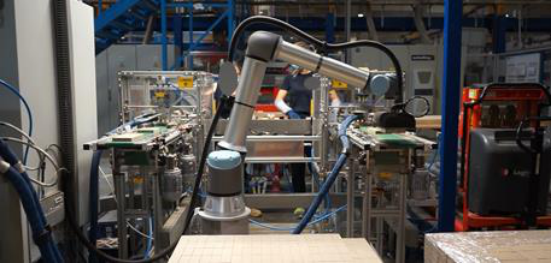
Description of the case study The current study was developed in a manufacturing industry that produces furniture. In its assembly section, the workers are continuously exposed to musculoskeletal risk factors, performing several manual and repetitive tasks. In this con-text, the HRC was selected to implement in two workstations to improve ergonomic conditions. The first collaborative workstation implemented is composed of a cobot UR10e® and automation (Figure 1). The function of this robotic sys-tem is to dispense Medium- Density Fibreboard (MDF) blocks with a cord of hot glue that is reached by the workers to complete the work cycle of MDF frames assembly. The design phase of this workstation considered safety and ergonomic criteria as previously published in (Ana Colim, Faria, et al., 2020)(Ana Colim et al., 2021). For the mentioned workstation, the company allocated four workers. The ergonomic impact of this new implementation was previously described in (A. Colim et al., 2021).
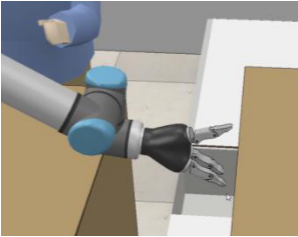
The current article presents the workers’ perceptions about robotics during the design phase of this first HRC implementation (n = 4 workers), as well as during a prospective approach for a second collaborative workstation (n = 10 workers). During the prospective study, different manual workstations were considered, and using CoppeliaSim® were created simulations for future HRC scenarios (Figure 2). The design and conceptualization of the second collaborative work-station are in development.
All workers were interviewed during their workday, performing a normal working activity. Workers participated in the study voluntarily. All participants signed an Informed Consent Term in agreement with the Committee of Ethics for Research in Social and Humans Sciences of the University of Minho, and in agreement with the Declaration of Helsinki (approval number CEICSH 095/2019), and in agreement with the Declaration of Helsinki.
Figure 1. Assembly workstation with the cobot.
Human Systems Engineering and Design (IHSED 2021) https://openaccess.cms-conferences.org/#/publications/book/978-1-7923-8987-0
Figure 2. Example of simulation for a possible workstation with cobots. Questionnaire The questionnaire was applied to the 14 workers before any direct experience with cobots. This technique for data collection was structured in four parts, namely:
(i) workers’ characterization; (ii) robotics impact in occupational context; (iii) traditional robotics vs. collaborative robotics; (iv) requirements that could compromise the HRC implementation. The questions included in the second part of the questionnaire are related to the robotics impact in terms of production. Twelve statements were formulated, to achieve an equal distribution between positive and negative perceptions. These statements were randomly presented in the questionnaire and the workers had to indicate their degree of agreement on a 5-Likert scale (0 - No opinion; 1 - Total disagreement; 2 - disagreement; 3 - Neutral; 4 - Some agreement; 5 - Totally agree). In the third part of the questionnaire, the knowledge that workers had about traditional and collaborative robotics was investigated, as well as the possible concerns, constraints, and expectations. The questions of this category were based on two previous studies conducted with practitioners, robotics and mechanics students, and potential cobots users, considering their experiences, barriers and expectations about cobots implementation in the industry (Kildal et al., 2018; Aaltonen and Salmi, 2019). The last part of this questionnaire intends to assess the requirements that could compromise the collaboration between cobots and humans, according to the workers' opinions. The requirements assessed were the following: safety; adequacy of cobot rhythm to the workers' rhythm; flexibility; system efficiency; level of workers’ education; communication between cobot and humans; training for this collaboration. Each requirement was evaluated on a 5-Likert scale (0 - No opinion; 1 - Does not compromise at all; 2 - Does not have much influence; 3 - Neutral; 4 - Influence in any way; 5 - Determining factor). Throughout the different categories is always given the opportunity the workers expressed their free opinion about the topics (with comments and suggestions of improvements). A descriptive analysis of the global results, considering the 14 assembly workers was performed.
Human Systems Engineering and Design (IHSED 2021) https://openaccess.cms-conferences.org/#/publications/book/978-1-7923-8987-0
RESULTS AND DISCUSSION
The workers' age were around 59.3 ± 9.9 years, with a work experience of 9.5 ± 3.1 ears in the company. Figure 3 presents the distribution of the answers across the statements related to the positive and negative impact of robotics in an industrial context. As described before, the workers expressed their opinions for each statement (S) through a 5-Likert scale.
Figure. 3. Answers distribution for the statements related to a positive and negative impact of robotics. Legend of positive statements: S2 - Robots can share tasks with humans; S3 - The robots inclusion in shop floor allows adjusting working hours and improving working conditions; S4
- The integration of robotics can create more jobs than it can destroy; S7 - Robotics helps to reduce repetitive and/or higher intensity efforts; S9 - The robots are a source of development and added value for companies in all sectors; S11 - Robotics can increase the productivity of assembly workstations. Legend of negative impact statements: S1 - Robotics can put jobs occupied by people at risk;
S5 - Robotic work will increase repetitive tasks and/or monotony; S6 - It is possible for humans to feel insecure and threatened by the robotics risks; S8 - With the robotics introduction, the humans will have more complex/mentally demanding tasks; S10 - The existence of tasks with robots increases the stress and anxiety in workers; S12 - Robots can
cause accidents and injuries to workers. Relatively to the positive impact of robotics, the statement with more agreement by workers is the S3 “The robots inclusion in shop floor allows adjusting working hours and improving working conditions”, reflecting their confidence in the HRC potential for improving the occupational conditions (as stated by previous studies (Cherubini et al., 2016; Maurice et al., 2017)). However, considering the statements related to a negative impact, most of the surveyed workers are concerned with the fact that robots can cause accidents and injuries to workers (S12). The introduction of HRC in workstations must be preceded by teamwork involving workers in decisions and training with this new technology (as adopted in our study), in order to promote the workers-trust in safety measures and requirements inherent to cobots. A previous study, based on a literature review (Gualtieri, Rauch and Vidoni, 2021), corroborated
Human Systems Engineering and Design (IHSED 2021) https://openaccess.cms-conferences.org/#/publications/book/978-1-7923-8987-0 this approach, highlighting the importance of the acceptability of the cobot by the human workers.
In times when the topic of human labor replacement by robots generates so much controversy (Weiss et al., 2016), the design of new workstations where robots collaborate with the workers is an encouraging vision. However, for workers without adequate knowledge about HRC, this technology can be seen as a factor that could replace human work. Therefore, it was expected that the workers’ answers reflect this doubt (as evidenced for the S4 and S1, with an answer distribution divergent and with some workers with a neutral or none opinion). With training and a participatory HRC introduction, we believe that these perceptions will be changed and workers will be perceived that this mutualist relation (between cobots and humans) could create collaborative scenarios, where the continuous accuracy, speed, and repeatability typical of robots can be combined with the innate adaptability, dexterity, perception, and intelligence distinctive of humans (Krüger, Lien and Verl, 2009). In the third category of the questionnaire, the workers expressed their ideas about the characteristics of traditional and collaborative robotics. Initially, the majority of the workers reported that do not know a collaborative robot, but they are aware that the company will implement this technology. They also mentioned that prefer to work with robots protected in cages (as existing on your shop floor). Considering the results presented in Figure 3, it is evident that various workers have no opinion about the concepts and ideas presented, and have no opinion on the subject. This happens even for the concept of “more human-robot collaboration”, and some of them erroneously attribute this to the traditional robots. Finally, about the requirements that can compromise the HRC implementation (Figure 4), the workers highlighted safety as the principal determining factor. This evidences the need for research focused on the communication and training of the workers, reinforcing the safety issues, before the implementation of the HRC on the shop floor (as mentioned previously). Moreover, it should be noted that various workers have no opinion about different questions/topics addressed along with the questionnaire. Being the HRC an emergent technology and still underrepresented in real-industry contexts (mainly in the furniture manufacturing, such as the company involved in the actual study) (Fletcher et al., 2020), these results were expected. However, this points out the relevance of all phases of HRC implementation, must adopt a participatory approach, involving all stakeholders, attributing to the workers an active voice. This type of approach is defended by our research and it is in line with previous studies focused on ergonomic interventions in manufacturing industries (de Guimarães et al., 2015; Ana Colim, Sousa, et al., 2020).
Human Systems Engineering and Design (IHSED 2021) https://openaccess.cms-conferences.org/#/publications/book/978-1-7923-8987-0
Traditional vs. Collaborative robotics
Greater flexibility Acquisition more expensive
More safe Higher velocity
Number of workers Traditional robotics Collaborative robotics No opinion
Figure 3. Answers distribution for the relation between concepts and type of robotics (traditional or collaborative).
Figure available in the original PDF paper.
Principal requirements for HRC
02468 10 12 14
Number of workers
5 - Determining factor
4 - Influence in any way
3 - Neutral
2 - Does not have much influence
1 - Does not compromise at all
0 - No opinion
Figure 4. Answers distribution for the principal requirements for HRC implementation. CONCLUDING REMARKS AND FUTURE WORK The industrial collaborative robot market is rapidly growing. Additionally, in the manufacturing industry, this technology has been pointed as a solution to help in the mitigation of musculoskeletal risks and to increase flexibility and productivity of the production processes. Nowadays, the cobots are capable of performing collaborative tasks and operating in a shared workspace with human workers (Cherubini et al., 2016; Villani et al., 2018). In this domain, it is of particular interest to know the
Figure available in the original PDF paper.
Human Systems Engineering and Design (IHSED 2021) https://openaccess.cms-conferences.org/#/publications/book/978-1-7923-8987-0 workers’ perceptions about HRC, identifying the main mis-trusts to develop strategies that enhance the workers’ confidence and acceptance. This case study exemplifies an initial exploration in this domain, and the results will have implications for further research work and could be replicated by other researchers. As future work, we intend to continue this participatory intervention, including the workers' perceptions, suggestions, and doubts, as well as this questionnaire will be applied along the time. We believe that with this approach and with increasing experience of working with HRC, workers' perceptions will be different and their trust will be reinforced. However, the increasing dynamic interactions, more or less closed, between cobots and humans could introduce new forms of discomfort for the workers. It will be relevant to develop and apply methodologies for collaborative systems assessment, that could identify and mitigate potential sources of psychosocial risks. As defended by (Gualtieri, Rauch and Vidoni, 2021), simulations and prototypes will be very important to test and validate the design of these workstations (as we applied in our research), collecting the workers' opinions. In this domain, the individuals’ characteristics, cognitive abilities and skills will also assume a determinant influence. Therefore, cognitive ergonomics will play an important role to create collaborative workstations safe, trustworthy and efficient. With the development of our research, considering the recommendations of the ISO 10075 – “Ergonomic principles related to mental workload”, we intend to develop this area applying: (i) subjective scaling by methods that provide information on how workers subjectively assess different aspects of mental workload (such as, NA-SATLx questionnaire) (Pacaux-lemoine et al., 2017); (ii) physiological measurements, applying methods that provide information about physiological states of workers under given work conditions (such as, electrodermal activity and heart rate) (Charles and Nixon, 2019). ACKNOWLEDGMENTS This work has been supported by NORTE-06-3559-FSE-000018, integrated in the invitation NORTE-59-2018-41, aiming the Hiring of Highly Qualified Human Resources, co-financed by the Regional Operational Programme of the North 2020, thematic area of Competitiveness and Employment, through the European Social Fund (ESF).
REFERENCES
Aaltonen, I. and Salmi, T. (2019) ‘Experiences and expectations of collaborative robots in industry and academia: Barriers and development needs’, Procedia Manufacturing. Elsevier B.V., 38(2019), pp. 1151–1158. doi: 10.1016/j.promfg.2020.01.204.
Charles, R. L. and Nixon, J. (2019) ‘Measuring mental workload using physiological measures : A systematic review’, Applied Ergonomics. Elsevier, 74(August 2018), pp. 221– 232. doi: 10.1016/j.apergo.2018.08.028. Cherubini, A. et al. (2016) ‘Collaborative manufacturing with physical human-robot
Human Systems Engineering and Design (IHSED 2021) https://openaccess.cms-conferences.org/#/publications/book/978-1-7923-8987-0 interaction’, Robotics and Computer-Integrated Manufacturing. Elsevier, 40, pp. 1–13. doi: 10.1016/j.rcim.2015.12.007. Colim, A. et al. (2020) ‘Ergonomic Intervention on a Packing Workstation with Robotic Aid – Case Study at a Furniture Manufacturing Industry’, WORK: A Journal of Prevention, Assessment, and Rehabilitation, 66(1), pp. 229–237. doi: https://doi.org/10.3233/WOR- 203144. Colim, Ana, Sousa, N., et al. (2020) ‘Ergonomic intervention on a packing workstation with robotic aid –case study at a furniture manufacturing industry’, Work, 66(1), pp. 229–237. doi: 10.3233/WOR-203144. Colim, Ana, Faria, C., et al. (2020) ‘Towards an ergonomic assessment framework for industrial assembly workstations - A case study’, Applied Sciences (Switzerland), 10(9). doi: 10.3390/app10093048. Colim, A. et al. (2021) ‘Lean Manufacturing and Ergonomics Integration : Defining Productivity and Wellbeing Indicators in a Human – Robot Workstation’, 13, p. 1931. doi: https://doi.org/10.3390/su13041931.
Colim, Ana et al. (2021) ‘Physical Ergonomic Improvement and Safe Design of an Assembly Workstation through Collaborative Robotics’.
Fletcher, S. R. et al. (2020) ‘Adaptive automation assembly: Identifying system requirements for technical efficiency and worker satisfaction’, Computers and Industrial Engineering. Elsevier, 139(xxxx), p. 105772. doi: 10.1016/j.cie.2019.03.036.
Gualtieri, L., Rauch, E. and Vidoni, R. (2021) ‘Emerging research fields in safety and ergonomics in industrial collaborative robotics: A systematic literature review’, Robotics and Computer-Integrated Manufacturing. Elsevier Ltd, 67(April 2020), p. 101998. doi: 10.1016/j.rcim.2020.101998. de Guimarães, L. B. M. et al. (2015) ‘Participatory ergonomics intervention for improving human and production outcomes of a Brazilian furniture company’, International Journal of Industrial Ergonomics, 49, pp. 97–107. doi: 10.1016/j.ergon.2015.02.002.
Kildal, J. et al. (2018) ‘Potential users’ key concerns and expectations for the adoption of cobots’, Procedia CIRP. Elsevier B.V., 72, pp. 21–26. doi: 10.1016/j.procir.2018.03.104.
Krüger, J., Lien, T. K. and Verl, A. (2009) ‘Cooperation of human and machines in assembly lines’, CIRP Annals - Manufacturing Technology, 58(2), pp. 628–646. doi: 10.1016/j.cirp.2009.09.009. Maurice, P. et al. (2017) ‘Human-oriented design of collaborative robots’, International Journal of Industrial Ergonomics. Elsevier Ltd, 57, pp. 88–102. doi: 10.1016/j.ergon.2016.11.011. Nahavandi, S. (2019) ‘Industry 5.0 — A Human-Centric Solution’, Sustainability, 11, p. 4371. doi: https://doi.org/10.3390/su11164371. Pacaux-lemoine, M. et al. (2017) ‘Computers & Industrial Engineering Designing intelligent manufacturing systems through Human-Machine Cooperation principles : A human- centered approach’, Computers & Industrial Engineering. Elsevier Ltd, 111, pp. 581–595. doi: 10.1016/j.cie.2017.05.014. Villani, V. et al. (2018) ‘Survey on human–robot collaboration in industrial settings: Safety, intuitive interfaces and applications’, Mechatronics. Elsevier, 55(March), pp. 248–266. doi: 10.1016/j.mechatronics.2018.02.009. Weiss, A. et al. (2016) ‘First Application of Robot Teaching in an Existing Industry 4.0 Environment: Does It Really Work?’, Societies, 6(3), p. 20. doi: 10.3390/soc6030020.
Human Systems Engineering and Design (IHSED 2021) https://openaccess.cms-conferences.org/#/publications/book/978-1-7923-8987-0
LISTED IN THE AHFE DIGITAL BOOKSTORE CATALOGUE
Explore the complete digital volume
Human Systems Engineering and Design (IHSED2021): Future Trends and Applications
Read this individual research paper free through the original publisher, or explore the full digital proceedings book.
ISBN 978-1-7923-8987-0
Explore this ISBN in the AHFE Bookstore ↗Listed in the July 2026 bookstore catalogue; search by ISBN to confirm current availability · Digital book purchase optional