Ellen Taylor, Anjali Joseph, Xiaobo Quan, Upali Nanda (2022). Designing a Tool to Support Patient Safety: Using Research to Inform a Proactive Approach to Healthcare Facility Design. In: Advances in Ergonomics In Design, Usability & Special Populations: Part III. AHFE Open Access, vol. 20. https://doi.org/10.54941/ahfe1001343
Healthcare architecture has become an increasingly specialized field, marked by a complex interaction between people, operations and the physical environment and an ever changing landscape of regulation and reimbursement. Patient safety is often considered in a behavioral context – what can someone do differently to improve outcomes? However, as a complex system of interactions, patient safety is better advanced through a systems-thinking lens of Human Factors/Ergonomics (HFE). Attaianese and Duca commented on the use of HFE principles in design, stating that, “when the system is the built environment, the systemic approach requires that designers move from an attention exclusively reserved for building functions towards the set of actions that users actually perform and that building has to support.” This paper reports the development of a proactive Safety Risk Assessment (SRA) tool which will contribute to the 2014 Facility Guidelines Institute (FGI) Guidelines for the Design and Construction of Hospitals and Outpatient Facilities. Six hazard areas have been considered as underlying conditions to injury or harm in the design of healthcare environments: 1) Hospital Associated Infections, 2) Falls/Immobility, 3) Medication Safety, 4) Patient Handling, 5) Security, and 6) Behavioral Health/Psychiatric Injury. These categories have been developed using iterative cycles of Delphi and nominal group methods to achieve consensus of categories and question sets for inclusion in the SRA.
The pernicious problem of patient safety gained international public awareness when the Institute of Medicine (IOM) released its 1999 and 2001 reports, To Err is Human and Crossing the Quality Chasm. These reports highlight that as many as 98,000 people die in hospitals each year as a result of medical errors that could have been prevented , ostensibly due to complex and uncoordinated delivery . Unfortunately, there are impediments in measuring progress in safety and recent reports find that the numbers may be worse than initially reported . This is a worldwide condition, with a resulting magnitude of harm reported in billions of dollars of waste .
It has been stated that healthcare is arguably more complex than any other broadly equivalent industry, and is extremely resource sensitive, making the evidence base critical and the return on investment often difficult to gauge . The complexity is further aggravated by the segregation of organizational silos. Like clinical aspects of healthcare, design in healthcare also bridges a diverse group of disciplines. The unification of stakeholders is presumably ‘the common aim of making it better for the user’- functional, safe, and usable . However, the design of healthcare facilities is also siloed, traditionally following a lengthy and complex process that balances the typical triad of scope, schedule and budget. This process often results in conflicting goals for service, care and long-term efficiency. The ramifications of healthcare facility design are felt for the next 30-50 years, or more. Over the lifespan of the building (and even over the lifecycle of the project development that can take seven years) priorities will change; models of care will change; staff and patients will change; and technology will change.
Developing a Proactive Design Tool for Considering Hazards and Risk in Healthcare Design There are currently no readily available tools to systematically review the design of the built environment as an underlying condition for patient and staff safety in healthcare environments. Aside from life safety issues, risk in the design of healthcare environments is rarely considered in a proactive systematic way. However, there are similarities to be drawn to life safety: both involve cultural and organizational issues; neither can be achieved solely by application of isolated, non-connected features; and both are interdependently connected within operationalized environments . Evidence-based design (EBD) is defined as “the process of basing decisions about the built environment on credible research to achieve the best possible outcomes” . Becker and Carthey state that because evidence can increase confidence in outcome probabilities and identify relevant factors to be considered, EBD is a form of risk management. Unfortunately, causal links between specific features of the built environment and outcomes are largely absent from the research literature .
Risk management estimates both the likelihood of the event and the potential consequences. It is often represented in a risk matrix with axes moving from low to high. Loosemore notes that risk management is ‘not a precise science or, indeed, a particularly well- developed art-form,’ but rather a systematic, rigorous and creative thinking underpinned by some simple tools and techniques. While some built environment checklists have been developed as audit tools to create a vulnerability measure for individual units , these evaluate buildings in use and are not proactive in nature. One area that has received more attention is infection control, most often as it relates to construction risk mitigation , but increasingly for facility design . Using the environment as a strategic tool can be an enduring and viable approach to improving outcomes, but it requires new perspectives to encourage innovative design solutions .
Reconciling Architectural Design, Human Factors, and Evaluation Tools To instill a proactive process, there is a need for understanding the integration of hazard and risk reduction. In the case of resilient design, for example, many emergency events are not entirely unexpected and could be reasonably mitigated, but there is currently not a sufficiently proactive role . This offers a role for HFE integration in building design. To understand the context of design tools, a literature search was conducted to identify formal evaluation processes and tools used by architects and design teams. The aim was to (a) identify development of specific tools, and (b) understand how (or if) the tools had successfully interfaced with stakeholders to identify the types of issues that might warrant consideration in the SRA development.
The papers included in the final review were coded in NVivo 10. Based on a prior study that investigated the use of design guidance by healthcare architects and planners in the United Kingdom (UK) three primary categories of coding (Figure 2): design culture (existing processes and the environment-behavior relationships), the evidence base (using, sharing, and managing knowledge), and guidance need (tools, piloting, and opportunities for change) were established , with new subcategories to further define themes.
Figure 2: Broad NVivo Coding for Design Tools, based on Hignett & Lu, 2009 The implications drawn from this literature review are briefly summarized below.
Figure available in the original PDF paper.
Design Culture While the design process for healthcare architecture is notable for its ability to address complexity, it also has disconnects. It is suggested that this is promulgated through a culture of existing processes that result from academic education systems; a linear, yet iterative series of project tasks; a design climate of competing drivers; and ambiguity about the value of design. Additionally, building design requires systems-thinking that address physical, cognitive, and organizational aspects of user processes. For a successful outcome, design teams must navigate from simple “functions” to a more complete understanding of the user actions that the building has to support .
Guidance Guidance tools are one approach to manage and disseminate knowledge. While a number of built environment evaluation tools have been previously developed, the review and search focused on published results or tool development (new or ongoing) after 2002 – a next generation assessment. Lessons were drawn and summarized from the Achieving Excellence Design Evaluation Toolkit (AEDET) Evolution (being supplemented by the exemplary layer) ; the Government of Alberta Building Performance Evaluation (BPE) ; a Sharing Knowledge “manual” ; the Design Quality Indicator (DQI) ; Environmental Audit Tool (EAT) ; the US Military Health System (MHS) Post-Occupancy Evaluation (POE) and World-Class Checklist ; Usable Buildings Portfolio ; and the Physical Security Review Checklist .
Evidence Base Using, sharing and managing knowledge needs to consider transforming evidence into useful information that includes discussion of site-specific data, supplemented by professional experience, research findings, and consideration for economic, social, culture, and political factors of the project . According to Attaianese and Duca , who cite multiple studies, the ability to adopt a HFE perspective, for example, relies on the availability of HFE standards or EBD case studies that evaluate the effect of the built environment. The ability to effectively share and integrate information then depends on both language and learning styles.
Developing a Safety Risk Assessment (SRA) Tool A grant was awarded to The Center for Health Design (CHD) by the Agency for Healthcare Research and Quality (AHRQ):“Developing and disseminating a Patient Safety Risk Assessment (PSRA) toolkit.” (Grant 1R13HS021824- 01). The premise of the three-year project is that the built environment is a critical component of the healthcare system. The goal is to create safer healthcare environments by developing a toolkit to enable careful consideration of built environment factors that impact safety, proactively, during the design and construction of healthcare facilities. The project was envisioned to be a multi-disciplinary collaborative process using subject matter experts with diverse backgrounds to evaluate content proposed for the SRA tool. Workgroup leaders for the six risk components were established with expert volunteer workgroups (10-20 per group) to represent a diversity of expertise and views. The seventh component, immobility was originally grouped with falls.
Participants were recruited based upon experience and expertise for particular topic areas. Volunteers were drawn from a variety of fields such as architecture, facilities management, medicine, HFE, occupational health, and healthcare administration. The highest representation included HFE specialists and clinicians (both 12 percent of the volunteers). Employment also reflected a diversity of viewpoints, with the majority of participants representing healthcare provider organizations (43 percent). An 11 member Advisory Council was also formed to provide advice and feedback to the Principle Investigator through regular conference calls.
METHOD
The SRA tool has been developed using a consensus-based methodology with six primary workgroups. In Year 1 (2013), the content was developed using a combination of literature reviews, a modified Delphi process (conducted through online surveys), and a modified nominal group technique (used at a face-to-face seminar).
Literature Reviews The research team conducted literature reviews for the six topics. This included searches for: research (empirical research and literature reviews), consensus documents (white papers and recognized consensus-based design guidelines), or other (expert opinion). These were gathered through searches of several sources, such as The CHD Knowledge Repository (http://www.healthdesign.org/search/articles), PubMed, and Google Scholar. Items were indexed and reviewed for such items as: study design; results (general); sample (n), if available; sample data period(s); setting type (e.g. hospital, ambulatory care); hospital department (e.g. nursing unit, diagnostic and treatment); unit type (e.g. emergency, Medical/surgical, ICU); population type (e.g. elderly, rehab); a built environment design category (e.g. building envelope, room layout) and a subset of conditions leading to the built- environment hazard (e.g. acoustical environment, visibility). Latent condition questions were developed as a result of the review (i.e. how the built environment acts as an underlying condition to safety).
To capture the complexity of all of the topics, while using a common structure, the research team created a mind map (MindManager 2012 for Windows). This document was developed to illustrate the literature review framework and present to workgroups that were established for the Year 1 content development. Relevant language in the FGI (Facility Guidelines Institute) Guidelines for the Design and Construction of Hospitals and Outpatient Facilities (Guidelines) was analyzed and cross-referenced with possible latent condition questions. The result was a draft list of safety-related latent condition questions and related rationales divided in six topic areas with the sources marked (e.g. research, consensus, opinions, FGI Guidelines [body & appendix]).
Delphi Process for Consensus Consensus studies are typically designed to combine the knowledge and experience of experts with the limited amount of available evidence . Based on the intended AHRQ workgroup process (accounting for remote work, geographical spread, potentially dominant personalities, and certain homogeneity of topic matter expertise), the Delphi process was chosen. Developed in the 1950s , Delphi is the procedure for eliciting opinions from a group, preferably made up of experts or knowledgeable individuals. Whereas group decision-making can suffer from the incidence of dominant individuals, irrelevant “noise” that is generated (unrelated to problem solving), and group pressure for compromise, the Delphi procedure address this through: anonymity (reducing dominant personalities by using questionnaires or online surveys and formal communication controlled by the experimenter), controlled feedback (results of the previous iteration reported as a summary to respondents), and statistical “group response” to reduce pressure for conformity. Respondents are also requested to make some form of self-rating with respect to the questions (competence to answer, estimate of confidence) . The surveys are usually conducted over three or four rounds and are considered complete when there is convergence of opinion or where a point of diminishing return has been reached . Some suggest that at least 70 percent of Delphi subjects need to rate three or higher on a four point Likert-type scale and the median has to be at 3.25 or higher . Seventy percent consensus has been used in other instances, as well .
In one study, structured questions included: “Should this item be included into the criteria list?” or “Do you agree with the rewording this time?” The answer options used were 5-point Likert scales (totally agree–totally disagree) or a “yes/no/don’t know” answer format. Participants were also allowed to offer reasons for their choices, which were included in the feedback report. In Round 1, participants were asked how strongly they agreed to include an item in the final criteria list (5-point Likert scale) and allowed to suggest alternative wording and to add extra items. In Round 2, the questionnaire provided opinions on the results and questions about the formulation of the items selected from Round 1 on which the participants agreed most. However, all items not selected initially were included for a second chance. Participants indicated the items they felt essential and were again allowed to provide rationale. In the third round, items were reworded based on the arguments in Round 2. Participants were asked to select the original or reworded option. Of the items given a “second chance,” participants stated which items to include in the final list. Consensus was achieved after three rounds .
Modifications that use a literature review for Round 1 have been stated and are referenced in other papers . Others report a modification that offers partial anonymity (e.g. the panelist knew of identities, but did not have interaction) . Additional modifications cited in a paper include rounds varying from two to ten and feedback varying from a single number to complete distributions . Woudenberg also notes that the feedback of arguments is rarely given and that partial anonymity can increase compliance.
In developing the SRA, the first round of the Delphi process an orientation call to summarize the literature review findings. The groups were asked if they felt there were any obvious topic omissions or sources that should be reviewed. The first questionnaire was developed (Round 2), based upon the conditions found during the literature review for each category. The survey was distributed using an online format (Survey Monkey). Survey content included the design-related questions to be evaluated, the rationale for the question, and information indicating whether the questions are supported by: “R” research (empirical or literature review); “C” a consensus document (another established guideline or white paper); “O” other (expert opinion or best practice recommendation); “B” included in the body of the 2014 FGI Guidelines; or “A,” appendix language. The questions were grouped by environmental condition or built environment category, and respondents were asked to evaluate: whether the item should be included in the SRA tool; why or why not (optional); whether the wording was agreeable; rewording suggestion (optional); and the expert opinion about the level of risk associated with the individual item. The workgroup leader was a participant in the modified Delphi process Rounds 2-4, but the CHD researcher who generated the content and questionnaire was not a participant in rounds subsequent to the Round 1 literature reviews.
Table 1: Description of Delphi Process Rounds Round 1: Literature review by topic area
After the surveys had been closed, analysis was conducted to determine which items should be included in the Round 2 survey. Those questions garnering 70 percent for inclusion and wording were considered as “final” content (consensus achieved), and those with 70 percent consensus to not include were deleted. Those topics that did not gain a 70 percent consensus for inclusion and/or wording were incorporated into Round 2. A second online questionnaire (Round 3) was distributed based upon the results of the first questionnaire, and a modified nominal group technique was used during the workshop seminar as the fourth round.
Nominal Group Technique The Nominal Group technique is similar to the Delphi process in using a structured meeting that provides order for obtaining qualitative information from expert or target groups . Participants are asked to develop a list of ideas on a specific topic, individually and without discussion. At the end of the first period of time, the most important idea on the list are presented (round robin). This is repeated until the lists are exhausted. The information is recorded on a chart, allowing everyone to see the composite result. A group discussion follows to evaluate ideas, subsequently followed by each individual ranking or rating the idea. It requires strong and experienced facilitation . With the nominal group technique, ideas can be generated and problems solved in a single meeting .
Any items that had not received consensus for inclusion or wording following Round 3 were brought forward to the face-to-face workshop seminar. The workgroups were intended to be facilitated a modified nominal group technique, in which participants would individually evaluate the items that had not yet reached consensus. A round robin process was envisioned to allow each participant a voice in the final decision. However, most workgroups found the process to be cumbersome and most found it to be more effective to have an open discussion to resolve disagreements on wording or inclusion. The votes, comments, and revisions were recorded by a scribe from CHD on large format (24” x 36”) sheets and brought to a central area for all workgroups to review in a “gallery walk” where workgroup members could comment on items in other areas.
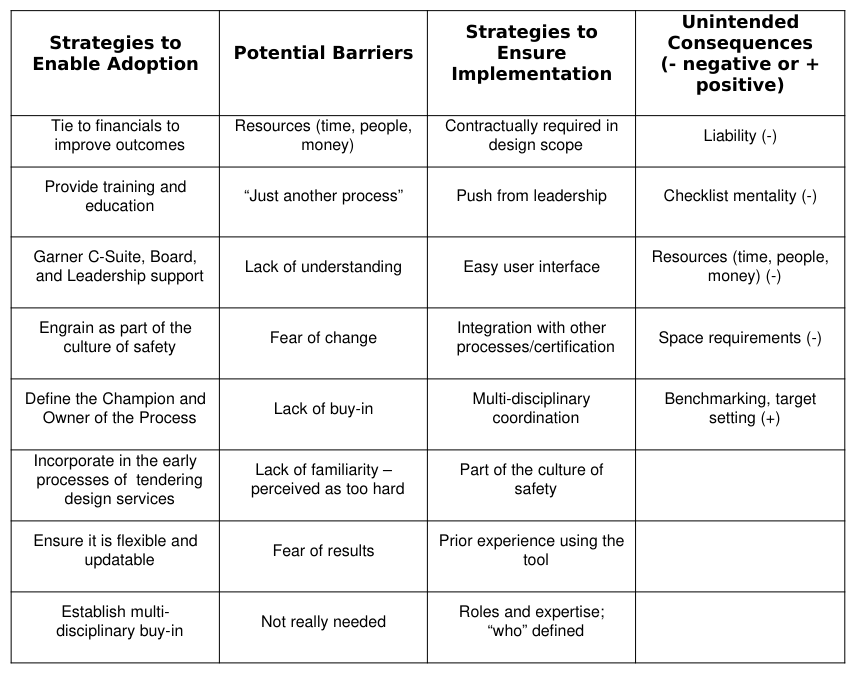
Workgroup Feedback on Adoption, Implementation, Barriers, and Unintended Consequences The groups were reorganized into a second set of six cross-expert workgroups to evaluate how the SRA might be incorporated in one of six project scenarios (i.e. each new group had at least one expert from each of the other topic areas and a mix of backgrounds). This was to reflect the amount of information a team would need to consider (i.e. all risk components or just some) according to the FGI Guidelines requirements. Questions were also posed about the SRA process such as tool adoption, implementation, and impact on work flow. Comments were recorded on large format grids (24” x 36”) according to topic. It was anticipated that the reorganized workgroups with missed expertise would consider the scope of the project when reviewing the scenario analysis questions. However, the scribes found that the scenario presented to the workgroups was less relevant to the topic of discussion; rather the themes were discussed at a more generic level. Results were coded using NVivo 10 to summarize common discussion points across groups. The predominant themes are outlined in Table 2.
Table 2: Themes for Adoption, Implementation, and Barriers
The workgroups indicated that when using the SRA, they would most likely sort the tool by risk component (e.g. falls) and/or location (e.g. operating room). However, the workshop also revealed the underlying need to appropriately segregate and order the information to address the questions being asked at a particular phase of the design process. Another consideration expressed by the workgroups was process ownership. Larger projects would be more difficult to manage and a coordinator might struggle to effectively engage the needed diversity of stakeholders. Concerns were raised about an exercise inappropriately completed by a single person to meet Guidelines requirements. The feeling was that the tool needed to be both a roadmap to help educate the team about the types of expertise that might be brought into a project, as well as a tool of accountability to ensure that the multidisciplinary process was followed (identifying specific people that participated versus a role).
Several individuals expressed concern about liability issues. If there is a comprehensive list of considerations, few projects will be able to undertake all items, and in fact, some options may conflict across risk components. Participants questioned whether an Owner would be liable if some items were not included in a project. Workgroup members also speculated that some teams might be more focused on the number of considerations used, rather than a thoughtful use of those considerations. Lastly, the content was initially developed in a question form, with the intent that the tense would change, based on the phase of the project.
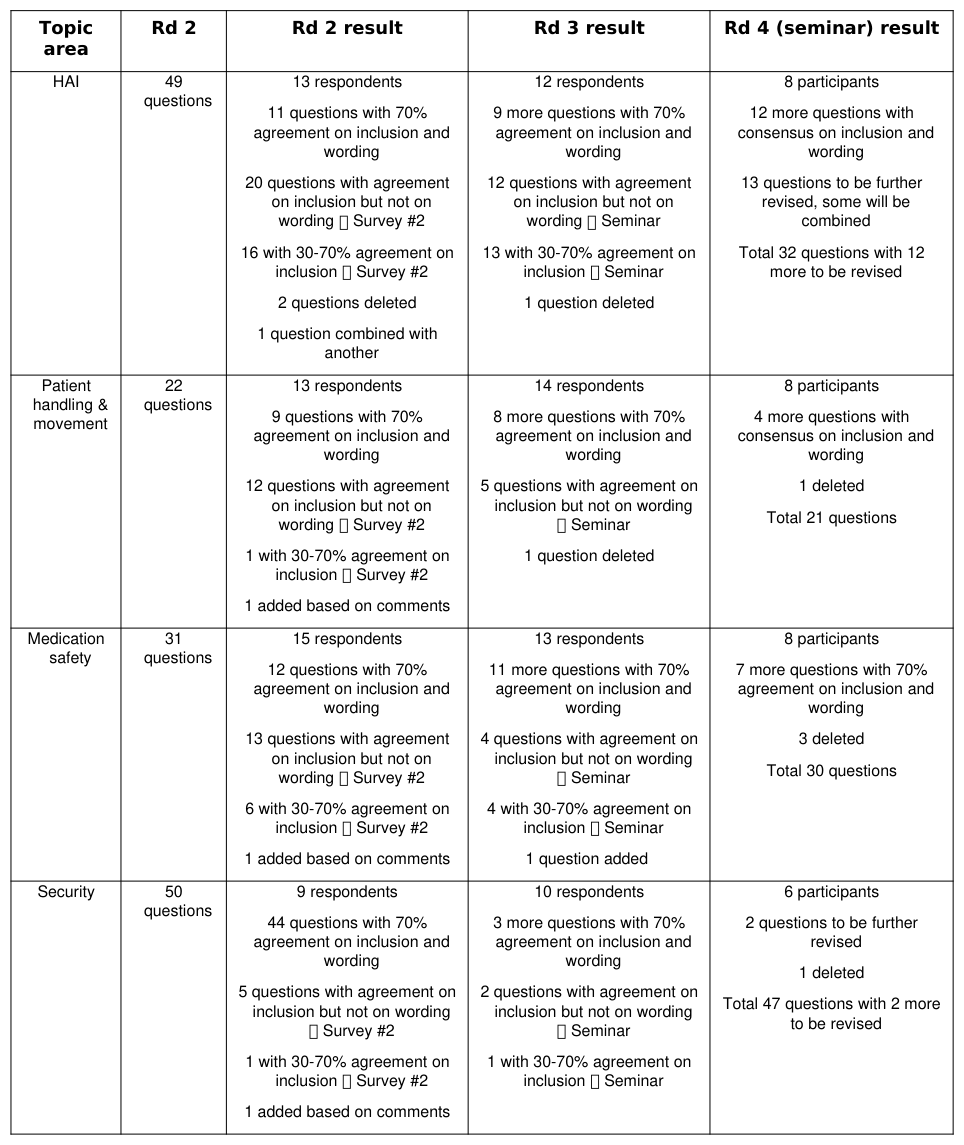
RESULTS TO DATE The consensus process resulted in over 200 considerations for seven hazard areas. The results of Rounds 2-4 are summarized in Table 3. (Round 1 was conducted via the literature review.)
Table 3: Description of Delphi Process Rounds
One group (HAI) did not reach consensus on all items and expressed interest in continuing to work together to both refine that content that did not achieve and enlist several additional specialty experts to supplement content with more forward-thinking best practice that may not yet be covered in published literature. This group also struggled with the content that has become more “main stream” and regulated. They questioned whether it was necessary to cite considerations for the number and location of hand hygiene stations when this is already regulated by the FGI Guidelines.
The HAI group also expressed concern about the cognition overload with too many questions and suggested that the tool focus on those items that were less well-regulated. They also suggested that some additional items be grouped as a single consideration. It is interesting that HAI has the longest history for patient safety (with respect to guidelines and regulations) and that the other groups with less history were more open to a wider range of considerations. The factor of cognitive overload, however, is applicable to all categories and the tool as a whole. Pilot testing will include considerations for whether questions are relevant based on the project phase and scope.
DISCUSSION
Based upon the literature review of tool development and the Year 1 results, there are numerous further considerations going forward in the development of the SRA related to design culture, the evidence base, and guidance (Table 4). There is also a need to establish a plan for maintenance following the grant development phase.
Table 4: Considerations for Further SRA Development Design Culture Evidence Base Guidance
While Year 1 focused on content development with the workgroups also identifying potential barriers and opportunities in adopting the tool. Year 2 will provide insight on processes for implementation. Pilot testing will include considerations for whether the questions easy to understand and answer and will evaluate whether the questions lead to appropriate discussion about safety and whether the “right” people are in the room. The research team will need to consider whether the design team piloting the content is presented with limited information, based on the project phase and scope or whether the team would “sort through” the material to better inform the research team about the appropriateness of the information at a given phase. Observation during pilot testing may provide insight into the culture brought into use of the tool by the project team. Portions of data from Year 2 will be audio- recorded for qualitative analysis and summarized using an exploratory approach to identify themes to inform final decisions for the public release of the tool, planned for 2015.
Portions of this project were supported by grant number R13HS021824 from the Agency for Healthcare Research and Quality. The content is solely the responsibility of the author and does not necessarily represent the official views of the Agency for Healthcare Research and Quality.
REFERENCES
LISTED IN THE AHFE DIGITAL BOOKSTORE CATALOGUE
Explore the complete digital volume
Advances in Ergonomics In Design, Usability & Special Populations: Part III
Read this individual research paper free through the original publisher, or explore the full digital proceedings book.
ISBN 978-1-4951-2108-1
Explore this ISBN in the AHFE Bookstore ↗Listed in the July 2026 bookstore catalogue; search by ISBN to confirm current availability · Digital book purchase optional