Rosiane Pereira Alvesa, Laura Bezerra Martinsa, Suzana Barreto Martinsb (2022). Ergonomic Design of Labor Garments and the Perception of Comfort / Discomfort: A Discussion About Project Guidelines. In: Advances in Ergonomics In Design, Usability & Special Populations: Part III. AHFE Open Access, vol. 20. https://doi.org/10.54941/ahfe1001305
Some studies point to the importance of work as a means of social integration. In this sense, the knowledge generated by ergonomics about human factors and activities in productive public and domestic spaces have contributed to this integration. The social relations of work and productivity are mediated by worker welfare, which also involves the use of clothing with attributes that contribute to comfort and risk reduction. In this context the role of the designer is to design clothing equipped with these attributes. Therefore, the following objectives were set: To evaluate the application of project Guidelines in work clothing design and relate their use to the perception of comfort by female employees of the UFPE-CAA administrative sector. The methodological procedures were based on the "Guidelines for the design of clothing for use while performing tasks," in Alves, Martins and Martins (2013). These guidelines had a significant effect on the work-clothing project. It considered the nature of the tasks, the needs and preferences of workers. The perception test during use revealed a prevalence of physical comfort over discomfort in general.
To work, as pointed by different areas of knowledge, is an important means of social integration, mediated by physical, physiological and psychological well being of workers. In this sense, the knowledge generated by ergonomics about human factors and activities in productive public and domestic spaces have contributed to this integration.
Some researches, such as those conducted by Castillo and Cubillos (2012) with Colombian electric utility workers; Oñate and Espinoza (2012) based on anthropometric measurements of Chilean miners; and Zwolinska and Bogdan (2012) in measuring the thermal stress in Polish surgeons, indicate that the welfare of workers also involves the use of clothing with attributes that contribute to comfort and to reducing risks.
It is in the scope of design to develop work clothes, endowed with attributes (pattern, materials, cuts and seams), that during interaction with the body it covers and the tasks undertaken by the person may collaborate for the comfort of the employee. It is comfort in the sense of harmony between different dimensions in a given environment, as discussed by Van der Linden (2007) and Dejean (2012). However, given the complexity of working all dimensions of comfort, in this study conducted from the perspective of ergonomics, as recommended by Moraes (2008), a methodological approach to study only the physical comfort and usability of work clothes was chosen.
The usability of a garment, with reference to Jordan (1998) is related to ease of use. Similarly, to the aspects of effectiveness, efficiency and satisfaction with which specified users could achieve specific goals in particular contexts and environments. However, it is important to emphasize that usability is not a product isolated property. I.e., besides the attributes of clothing, it also depends on who is using it, on the environment, and the goal or objective one is trying to achieve.
The design of the clothing, especially those intended for extended use during the performance of tasks, should consider the specifics of the activity, of the users, of context. These specificities are the basis for determining the attributes of the clothing as well as its best combination. In this sense, it is suggested as a creation process facilitating tool and in manufacture of work clothes the use of "Project Guidelines."
The goal, therefore, was to evaluate the application of Project Guidelines in work clothing design and relate their use to the perception of comfort / discomfort by female employees in the administrative sector.
For the development of this research, survey and qualitative analysis of data was chosen, in order to understand the phenomena in the real work context. It is therefore a case study. The methodological approach and the procedures adopted were based on the "Guidelines for the design of clothing for use while performing tasks" in Alves, Martins and Martins (2013), carried out in two steps:
Phase 1: Implementation of guidelines: a) Application of semi-structured interviews to nine female employees of the UFPE-CAA administrative sector and observation of the behavior adopted within the work routine;
b) Data synthesis, generation of alternatives and project definition; c) Completion of the project: the making of ten pieces of clothing (five pants and five tops).
Phase 2: Evaluation of comfort and usability: a) Distribution of the clothing made to five of the nine female employees interviewed in Phase 1. Each respondent was instructed to: wear the clothes as many times as possible during the week; keep doing maintenance (washing and ironing) as they usually do with other everyday use clothes;
b) Application of a questionnaire to evaluate the usability and perception of comfort by respondents. The questions were referenced in the Oikos Methodology for usability and comfort evaluation in clothing (Martins, 2005). While the response options had the verbal scales model discussed by Van Der Linden (2007), formulated with five alternatives with adjectives of intensity.
To highlight some statements of respondents, pseudonyms UAD were adopted for the group, followed by the number for each individual interviewed.
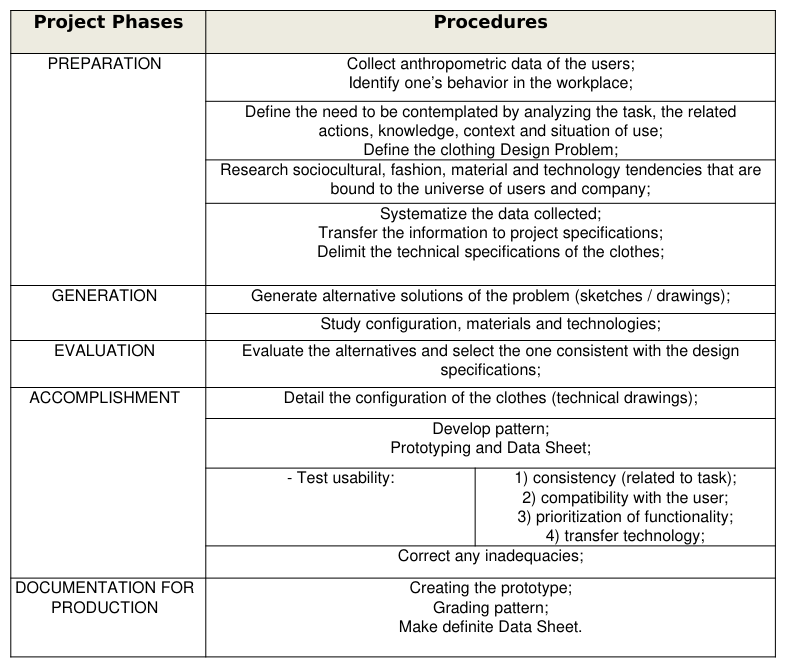
PROJECT GUIDELINES AND ITS RELATION TO PHYSICAL COMFORT Work clothes and uniforms are also products of garment design, and as such they result from a project. Given the purpose of the product it is relevant to include ergonomic guidelines at the stage of designing (Table 1). The ergonomic conception, in this case, would have the role of contributing to the creation and manufacturing of clothing, which in the interaction with the body of the users and the tasks performed by them may be able to provide more comfort and reduce the potential for biological, ergonomic and physical hazards.
Even if these guidelines are not a full methodology themselves: the project phases of Montemezzo (2003); the indications for work clothes development in Castillo and Cubillos (2012); and part of the checklist in Martins (2005), are criteria for assessing the usability.
Table 1: Guidelines for the design of work clothes (Alves, Martins e Martins, 2013) Project Phases Procedures
However, to provide comfort is not something simple, given the complexity involved in this term. Mainly because according to Dejean (2012) despite comfort being practically a universal desire, people have different opinions as to what is most important to their own well being.
The first period in which this welfare became as desirable as possible on a large scale was in the 1670s in Paris. Period in which the adjective commode (comfortable) and the noun commodité (amenity), which originally meant convenience and cleanliness, have been used domestically to refer to personal hygiene and everything that promotes a feeling of comfort and well being (DEJEAN, 2012).
The term comfort, therefore, derived from the French language from the word commoditie. "The words used in
English, comfort and comfortable derive from another French word, réconfort, help or assistence.1" (DEJEAN 2012, p.17).
Regarding the product in the seventeenth century, the concept of comfort was associated with the characteristics of functionality, luxuriousness and pleasing aesthetics (DEJEAN 2012). Characteristics that remain relevant in contemporary societies, given the increasing search for products that associate with comfort which appears as a quality attribute (VAN DER LINDEN, 2007).
For Van der Linden (2007, p.63) because it is a subjective concept, there is no universal definition. Hence the different knowledge and professional areas approach the definition of comfort to their field of study. For example, "a doctor tends to emphasize the physiological aspects; a psychologist, behavioral aspects; an engineer, the performance" and so on.
When it comes to the design of the garment, not recently has comfort of clothes been associated with its attributes, such as form obtained by pattern and textile materials (fabrics and trims). One example of this, according to DEJEAN (2012), was the replacement, during the century of comfort (1670-1765), of the sumptuous fabrics (heavy, hard and formal) in many occasions and environments by fresh and light silks (gauze and muslin) and by cotton fabrics imported from India. These new fabrics gave greater mobility to the body.
In the same period, new clothing styles emerged, based on kimono patterns. A loose fit did not demand tight underwear indispensable before to sustain the old court dresses, which required women to assume the upright standing posture. With the new clothes they could sit and move more easily. Moreover, the dresses started to show visible fasteners, which induced the freedom to dress oneself. As for the fabric, cotton for its softness, lightness and malleability became the material that is to the present day put on beds and selected for more comfortable clothes.
However, systematic studies of the relationship of comfort with the characteristics of manufactured products and the work environment emerged in the late 1950s. Since then, research has been based on two main lines of thought with respect to the dimensions of comfort: 1) the understanding of comfort as opposed to discomfort (comfort-discomfort axis), 2) the comfort and discomfort as two different dimensions. These theoretical perspectives have relevance for developing tools for evaluating comfort in products (VAN DER LINDEN, 2007).
The one-dimensional comfort-discomfort axis was questioned by several authors, sustained in the argument that the absence of discomfort does not mean in positive affect perception of comfort. There must be consideration of factors such as motivation and context of use.
Different authors when referring to the comfort of clothing, mention the definition of Slater, for which comfort is expressed in the state of pleasure or pleasantness resulting from the physiological, psychological and physical harmony between human beings and the environment. The concept of harmony is related to the ability to meet all dimensions: a) physiological dimension concerns the functioning of the human body, involving actions of involuntary regulation; b) psychological dimension involves the mental comfort, issues of self-image, relationships with others and privacy; c) physical dimension concerns interaction with the environment and its effects on physiological and psychological dimensions. However, according to Moraes (2008 p.17), "through the perspective of ergonomics, user satisfaction in the interaction with products is linked to usability and to terms of physical comfort."
Given the subjectivity, both physical comfort and discomfort have been evaluated indirectly, through inquiries and biomechanical measure techniques, physiological, behavioral registration scales and verbalizations.
As for usability, according to Jordan (1998) it is related to ease of use and aspects of effectiveness, efficiency and satisfaction. Effectiveness regards the degree or extent with which the goal of the task is achieved, while efficiency refers to the amount of effort required to achieve the goal. If effort is low efficiency is high. Satisfaction refers to the level of comfort that the user feels when using a product and its significance to reach goals. It is noteworthy that usability is not an isolated property of the product. It also depends on who is using it, on the environment, and on the goal or objective one is trying to achieve.
Clothing comfort and usability for their ability to contribute to the general welfare of the employee, may be positive in reducing risks. In labor relations and in the use of products, the concept of risk is associated with the concepts of accident and danger. According to Van der Linden (2007, p.84-85), "Risk is the probability of occurrence of an 1 Translation mine.
undesirable event and danger is the potential damage content that this event can offer."
According to Van Der Linden (2007) risk perception is mediated by factors such as severity of injury, change in behavior, culture and pleasure. And adds that in the workplace, adoption of safe behavior with the use of personal protective equipment can result in personal costs in relation to discomfort. In this case, tolerance to discomfort is related to the high severity of risk.
As can be seen, clothing worn in the workplace operates as Personal Protective Equipment and its relation to comfort is relevant to risk reduction, even if it is of low severity such as the case of the environment in this research. It is noteworthy that despite the relation of comfort and risk having appeared in this study, risk was not measured it was only identified subjectively.
Van Der Linden (2007, p.110) has developed a model of perception of comfort and risk. Based on the fact that people seek some kind of pleasure while preserving their integrity, he proposed the idea of a dominant reference for the reference which has the greater intensity in that evaluation context. For this author, the perception of risk is conected to appearance and to perception of usability and functionality.
The aforementioned author argues that the perception of product comfort and risk can be interpreted as affective responses resulting from the following parameters: a) product characteristics - appearance, usability and functionality; b) how the product stimulates the individual - object, event or agent; c) dominant reference to person - pleasure or pain; d) level of processing that occurs in the evaluation - visceral, behavioral and reflective.
WORK CLOTHES DESIGN FOR THE ADMINISTRATION SECTOR FEMALE EMPLOYEES All respondents recruited as research subjects develop their work activities at the Agreste Academic Center (CAA) of Federal University of Pernambuco (UFPE) in the city of Caruaru in the Agreste region of the state of Pernambuco. Aged between 24-49 years, they are all graduates and public servants. Their activities are related to the administration and to support teachers and students, in sectors such as the board of CAA, library, infrastructure, and education departments.
The work routine of the women interviewed varied according to the demand of the day, all related to the administrative sector. Most of the time, their posture was sitting in front of a computer screen. In this position, the movements performed were associated with the angle of extended or flexed arms and trunk rotation. At other times the static standing posture was adopted, alternating with short walks to attend the public and long walks to go around campus, with descent and ascent of stairs and / or ramps.
At the workplace, the air conditioning was artificial and the furniture - tables, chairs and cabinets - were distributed in a small space that the respondents perceived as crowded and disorganized. That is, the environment itself generated a feeling of discomfort.
As the interviewees do not use uniforms, they self select pieces of their wardrobe to go to work. They reported having difficulties to buy clothes for work, even though they were at the Agreste of Pernambuco, considered to be a clothes manufacturing complex. According to them, the variety of models is limited, the fabrics are repeated and seaming finishes are bad. There are insufficient beautiful clothes that offer wellbeing. They understand that comfort is essential when it comes to work clothes.
Most of the self-selected clothes for use in the workplace do not fit the needs of the interviewees, or the nature of the activities they perform. Some of the reports of discomfort are related to the body characteristic, movements performed and attribute of clothing: I wore a tight dress and it went up when I walked. Furthermore, the leg friction caused irritation and redness. I have also used a neckline that worried me. The other day I came to work with a pair of jeans that hindered mobility, because the fabric was too stiff and inelastic. It had low waistline and the crotch was too short (UAD7, 2013).
The situations mentioned, besides generating a feeling of discomfort, present low severity biohazard, which can increase the level of irritability at work. Restrictions of movements also differ from a comfortable situation, defined by respondents as "having freedom in their movements, to feel free. Not bothering to pull or feel tight. To not remember one is dressed."
The discomfort was also related to specific attributes of the clothes, for example, for them the long sleeve is more elegant, but the ¾ sleeve allows for greater mobility. Allied to this, the climate change that occurs in the late afternoon in the arid zone calls for an outfit that during the day suits the hot weather and at night a mild climate.
Overall, during the first phase of the research, the interviewees reported they prefered to use blouse and pants during office hours and dresses as a second option. They highlighted the preference for adjusted or slightly loose parts. Regarding material, most said they preferred cotton fabric since the fiber facilitates heat exchange with the environment. However, because this fiber wrinkles more easily, some of the respondents said they prefered polyester fabric, associating it with the maintenance of elegance.
For the design of work clothes, the extension of time of use was a relevant factor. Therefore, besides the consideration of hours worked (6-8 hrs / day), it was found that some of them went from work to the postgraduate course. Preference related to trims and its location on clothing, focusing on physical comfort and usability were considered, besides the attributes aforementioned, such as pattern and material.
I avoid buying clothes that have many closures. I prefer buttons. The zipper is easier to close, but also find it easier to break. And Velcro does not give security. I prefer the closure on the front, because it is easier to handle and visualize. (UAD1, 2013).
Based on data collected through exploratory research and the preferences of the female employees, working clothes were designed with the following features:
Straight pants with diagonal pocket and shirting blouse with priest collar, long sleeve with adjustable option for ¾ in different colors, all pastel. The choice of different colors was based on the fact that this clothing is not set as a uniform, but a garment of daily use that has characteristics of functionality relevant to the context of work analysis;
The fabric elected for making pants was smooth twill, composition 97% cotton and 3% elastane. In order to maintain aeration, given the high temperatures in the Agreste region during the day, and to maintain the clothing closest to the body and reduce creasing characteristic of cotton, spandex was used. There were two options for blouse fabric: voile and poplin, both 100% cotton.
Usability testing and perception of comfort In the second phase of the study, participated in the usability tests five of the 11 respondents of the first phase. In this group, the age ranged from 34-49 years old. Each received a pant and a blouse and the following guidelines: to wash clothes as they usually do with other similar clothes, use as many times as possible for a week in the workplace, after a week of use answer a questionnaire recording individual perception of comfort and use.
According to the respondents, the blouse presented ease in the processes of dressing and undressing, as well as the front buttoning process. However, buttoning its sleeve for adjusting the length was difficult because of the location, which required to be buttoned with only one hand. A possible solution in this case for future projects would be to replace plain fabric cuffs for knit fabric cuffs. The sleeve was also evaluated as a problem in performing some tasks.
As for maintenance, the washing process was described as easy. 80% of users said they washed the shirt by hand. This facilitated the conservation of the blouse.
In general, the blouse was compatible with the activity. And all respondents were satisfied regarding the physical comfort and the feeling of safety while performing activities. However, they presented median satisfaction related to appearance. Thus converges with the literature that comfort is related to harmony of physical, physiological and psychological dimensions. But in this case with dominant reference to the physical comfort.
The pants, according to the interviews also showed ease in the process of dressing and undressing. The processes of opening and closing the zipper, buttoning and unbuttoning the button were also easy. As for the machine washing performed by nearly all respondents, classification varied from easy to neutral. The appearance of the piece was preserved.
The majority of interviewees reported that there was compatibility of the pants with the activity. They also did not generate any kind of physical discomfort. All shared the sense of physical comfort. However, there was dissatisfaction with the appearance associated by them with loose fitting pants hem. When trying to understand this dissatisfaction, the jeans worn by them and by the women of the region were observed. It was noticed that almost 100% of women in the region use skinny pants, extremely tight on the body, to the point of looking uncomfortable within the physical dimension. In this case, cultural mediation in taste for this kind of pattern becomes reference dominance higher than the attributes that ensure physical comfort.
We also emphasize that the user’s perception of adjustment does not converge with the literature. Instead, it is closer to the term snug to the body - tight with an intention of revealing shape. This justifies the fact that many companies in the region produce only skinny pants. And justifies the fact that this pant style has become almost a collective uniform.
In this sense, the perception of comfort by respondents is beyond the tactile and usability aspects. It also refers to the matter of taste built by their experiences and cultural references. As reflected in the statements that follow: Comfort for me is both a viability of using for a certain time and aesthetics (UAD1, 2013).
I realized I was safe in the clothes that showed nothing more from my body and I like it because it is very bad to move and show intimate details at work. But I did not like the color or the fabric of the pants (UAD2, 2013).
For users, the clothes were physically comfortable but aesthetically satisfaction was average. They said they prefered tight pants and fabrics that do not wrinkle. In a way it is perceived as a paradox, considering that their original choice was cotton on account of weather. It is characteristic of cotton to wrinkle. This characteristic decreases when the fiber is blended with other synthetic fibers.
I thought that in general I looked good. But nevertheless day after day, I realize that the fabric (pants and shirt) wrinkles too much and it was a bit ungraceful. (UAD2, 2013).
Some of the issues relating to the attributes of clothing were also raised. The physical discomfort related to the collar, the cuffs, sleeves and trims were reported – specifically the button, the waistband, and the leg pattern.
It was also reported that at some times of the day, especially in the absence of air-conditioning, there was a greater sense of warmth. Even without technical conditions to measure the thermophysiological comfort, the results indicate that the selection of material is relevant to ensure the minimum dimension of comfort.
CONCLUSIONS
The application of the Guidelines for the design of clothing for use while performing tasks was evaluated positively to compile procedures for designing work clothes for a specific audience, in a particular context of use.
Mediation of these project Guidelines for the development of clothing design, allowed greater systematization and direction for the work of designers, with emphasis on the following achievements: 1) the project was based on the needs and preferences of the users; 2) the pieces created are suited to the nature of the tasks; 3) user perception test indicated a dominant reference to the physical comfort over discomfort in general.
By relating the positive balance between the characteristics of items of designed and manufactured clothing with the perception of comfort by female employees at the UFPE-CAA administrative sector, the importance of project Guidelines evaluated in this study stands out. It is also emphasized that its application is constituted as a mediator instrument for the design of professional clothing. It is suggested, therefore, to extend its application to other work clothes projects.
REFERENCES
Alves, R.P., Martins, S.B., Martins, L.B. (2013).“Usabilidade e diretrizes projetuais para desenvolvimento de roupas íntimas ergonômicas”. In: Annals of the IX Colloquium Fashion. 6th International Edition. Fortaleza-CE. Castillo, J., Cubillos, A. (2012). “Ergonomics principles to design clothing work for electrical workers in Colombia”. In: IEA
2012: 18th World congress on Ergonomics - Designing a sustainable future; Work: A Journal of Prevention, Assessment and Rehabilitation, Volume 41, Supplement 1/ 2012, IOS Press. p.623-627. DeJean, J. E. (2012). “O século do conforto: quando os parisienses descobriram o casual e criaram o lar moderno”. Trad.
Catharina Epprecht. Rio de Janeiro: Civilização Brasileira. Jordan, P.W. (1998) “An Introduction to Usability”. London: Taylor & Francis. Martins, S. B. (2005) “O Conforto no vestuário: uma interpretação da ergonomia. Metodologia para avaliação de usabilidade e conforto no vestuário”. Thesis (Ph.D in Industrial Engineering from UFSC). Florianópolis-SC. Montemezzo, M. C. de F. S. (2003). “Diretrizes metodológicas para o projeto de produtos de moda no âmbito acadêmico.
(Dissertation – Masters in Industrial Design from Sao Paulo State University, College of Architecture, Arts and Communication) Bauru-SP. Moraes, A. de. (2008) “Foreword” In: Mont’alvão, C.; Damazio, V. Design, ergonomia e emoção. Rio de Janeiro: Mauad X. OÑATE Esteban; MEYER, Felipe; ESPINOZA, Jorge. (2012). “On the, road toward the development of clothing size standards and safety devices for Chilean workers.” In: IEA 2012: 18th World congress on Ergonomics - Designing a sustainable future; Work: A Journal of Prevention, Assessment and Rehabilitation, Volume 41, Supplement 1/ 2012, IOS Press, p.5400-5402. Van der Linden, J. (2007). “Ergonomia e Design: prazer, conforto e risco no uso dos produtos”. Porto Alegre: UniRitter. Zwolinska, M., Bogdan, A. (2012). “Impact of the medical clothing on the thermal stress of surgeons”. In: Applied Ergonomics.
Volume 43, Elsevier. p.1096 - 1104
LISTED IN THE AHFE DIGITAL BOOKSTORE CATALOGUE
Explore the complete digital volume
Advances in Ergonomics In Design, Usability & Special Populations: Part III
Read this individual research paper free through the original publisher, or explore the full digital proceedings book.
ISBN 978-1-4951-2108-1
Explore this ISBN in the AHFE Bookstore ↗Listed in the July 2026 bookstore catalogue; search by ISBN to confirm current availability · Digital book purchase optional