Jean-François Thibault, Jacqueline Papin (2022). Build an Ergonomics Program for an Industrial International Group. In: Advances in Ergonomics In Design, Usability & Special Populations: Part II. AHFE Open Access, vol. 19. https://doi.org/10.54941/ahfe1001220
In order to protect health at work and to improve the performance of its sites, the Safran group is committed to implementing an ergonomics program at all of its sites in Europe and abroad. This article, based on both a literature review and preliminary feedback from the current process within the Safran group, presents the challenges of such a program, the program’s structure, its perspectives, and the questions it poses in its different modes of integration of ergonomics in a diverse environment.
Industrial firms operating in a constantly changing environment are forced to improve their competitiveness on an ongoing basis to deal with global competition. Numerous approaches to improving competitiveness are deployed by industrial firms looking, for example, to increase productivity, improve quality, build their real capacity for innovation, make them more financially attractive and so on. Regardless of the type of approach taken to improving competitiveness, however, they cannot ignore a fundamental and founding resource in industry, namely its human capital. It is, in fact, the productive capacity of the business’s “human resources” that lies at the heart of the process of driving performance in a productive system. No system of work can function without operational staff: it is their skills, experience and knowledge that are used either directly (for example, at their work station) or indirectly (for example in design or management) to generate added value. Numerous firms have understood this and their aim in turning to ergonomics is to improve the quality of work by adapting it to the needs of operators, in order to optimize interactions between them and the other components of the work system. It is a sizeable challenge for ergonomics and the existential questions that frame it as a field (somewhere between an art, a technique, a technology, a scientific discipline, etc.) date back some time (Wisner, 1966, Hendrick, 1991; Daniellou, 1996; Wilson, 2000; Falzon, 2004). The same applies to an international industrial business, which needs to take a highly pragmatic approach to the position of ergonomics in its organization. This article sets out how the Safran Group has organized an ergonomics program for all of its sites worldwide.
THE NOTION OF AN ERGONOMICS PROGRAM Firstly, it should be noted that there are very few references to the concept of an ergonomics program in an international industrial group in publications written in French, in spite of pioneers such as Françoise Doppler, Michel Sailly or Thierry Roger, who have done extensive work in this area in their own firms. As a result, we started with the accepted sense of the English term “corporate ergonomics program” and referred to studies carried out on various continents and in various countries, such as Sweden, Holland, Canada, the United States and Malaysia. It appears that the automotive industry has significant experience in developing and implementing ergonomics programs in automobile manufacturers (Sailly, 1999; Joseph, 2003; Munck-Ulfsalt and al., 2003; Roger and al., 2009). In this context, the notion of an ergonomics program relates to an industrial policy of integrating ergonomics both centrally, at group level, and at all sites (which may be split over several continents). Obviously, in practice, this extremely large area generates diverse needs, positions and ultimately practices in terms of ergonomics. As a result, only a solidly constructed ergonomics program can help to disseminate common objectives and articulate problem-solving processes based on specific issues and combining local and central management. Numerous businesses have addressed the notion of an ergonomics program as a process for anticipating, identifying, designing, developing, analyzing and controlling risk factors associated with ergonomics to ensure workers’ health and safety (Mustafa and al., 2009). A risk-based approach of this kind has the advantage of integrating perfectly into the Health, Safety and Environment-type programs already in place, particularly in industry. By using this type of approach and more generally referring to significant topics in industry, such as the ageing of the working population, longer working hours, strenuousness, musculoskeletal disorders, etc., the objectives attributed to ergonomics programs are mainly to do with health prevention at work, with more tenuous links to strategies to improve performance implemented in industrial groups (Hagg, 2003; Dul and al., 2009). What’s more, an approach focused solely on ergonomics risks can lead, on the one hand, to a catalogue of risks in which ergonomics is drowned out by other issues and on the other, to a highly compartmentalized view of work situations, ignoring, amongst other things, the real relationships that exist between these risks. Beyond a risk-focused or technological view of ergonomics, most programs are based on a participative approach that involves all stakeholders, including those with expertise in ergonomics (Hagg, op.cit.).
ISSUES FACED BY THE SAFRAN GROUP The Safran Group is an international high-tech group that employs over 65,000 staff in 57 countries. As a leading equipment manufacturer, the Group manages around 15 companies working in four areas, namely:
- aeronautical (aeroplane and helicopter engines) and space propulsion (spacecraft engines), - aeronautical equipment (landing gear, carbon wheels and brakes, aeronautical cabling, nacelles, etc.), - defense (flight control systems, inertial navigation system, etc. - security (biometric identity documents, hold baggage explosives detection, etc.). It therefore goes without saying that such a wide range of products and production systems results in extremely diverse work situations, from assembling microelectronic components in a cleanroom to the assembly line for an aeroplane engine or Ariane 5 booster.
The employees of the Group’s 140 sites are based mainly in Europe (72%), America (19%), the Asia-Pacific region (5%) and Africa and the Middle East (4%). Moreover, as a high-tech group faced with ever-more influential external factors (such as the increase in the cost of energy and raw materials, the growth in air traffic and airport congestion, and the need to reduce noise and greenhouse gases, etc.), Safran is constantly pursuing a strategy of innovation. The Group devotes 11% of its turnover, for example, to investment in R&D and needs to recruit thousands of employees (young graduates, experienced engineers and managers, technicians and manual workers) to support its development. As a result, the Group’s working systems and more particularly, its production units need to integrate interindividual variability through technological, organizational and cultural transfer but also by incorporating diversity, for example through older staff, people with disabilities, work flexibility and young “recruits”.
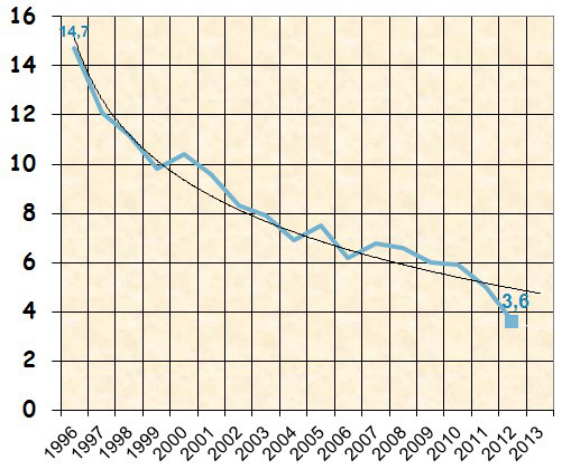
Finally, based on its Sustainable Development policy (implemented by its Sustainable Development department), the Group and its 140 sites have embarked, amongst other things, on health prevention and workplace safety programs aimed at reducing occupational accidents and illnesses every year. As figure 1 shows, the results are encouraging, with a threefold reduction in the Frequency Rate of Accidents resulting in Lost Work Time in 15 years.
Figure 1. Frequency Rate of Accidents resulting in Lost Work Time in the Safran Group Numerous issues remain, however, whether these are manual handling problems (50% of occupational accidents) and/or occupational illnesses (70% of occupational illnesses declared are musculoskeletal disorders).
IMPLEMENTING AN ERGONOMICS PROGRAM FOR THE SAFRAN GROUP An ergonomics program was instigated three years ago in the Safran Group’s Sustainable Development department to address these issues. Building on various trials currently underway in industry, internal feedback on the first two years of the program and our experience of managing ergonomics projects in industry (Thibault, 2000, 2002; Garrigou and al., 2001), since 2013 the Ergonomics Program has been based on four strategic principles, namely: - the dialogue between the macro and micro levels of the process.
- the program’s socio-technical approach (from development to implementation). - the development of a common operational framework.
- managing the performance of the program.
Based on the idea that ergonomics can contribute, within a socio-technical system, to the quality of the relationship between technological components, operators and work organization, our Ergonomics Program covers various levels, from strategic management to operational management. This is based on structuring the interactions between a program management function and a project management function involving management criteria (Thibault, 1999). At Safran, for example, a local program management function for the Ergonomics Program (combining both the site’s decision-makers and the central Group representatives concerned) sets objectives in relation to ergonomics that will be incorporated annually into the site’s Operational Plan for Health, Safety and Environmental Progress (POPSSE). A project management plan will, for example, manage a project in one area of the site including ergonomics indicators that will feed into the POPSSE; the POPSSEs in turn are monitored and assessed annually at a local level with the involvement of Group representatives. The Ergonomics Program leader coordinates the operation of the program for the Group by: - Defining the means, resources and competencies necessary for deploying the ergonomics program in the Group.
- Consolidating and developing the methodological tools and frameworks necessary for the HSE (Health, Safety, and Environment) units to implement the ergonomics program. - Coordinating the Ergonomics network and extending it internationally. - Acting as a contact person for ergonomics training and communications. - Interfacing with the ‘HSE preventers’, disability, methods, human resources, industrialization, continuous improvement and other networks. - Providing support for HSE units and regional coordinators (broken down by continent). - Monitoring developments in technology, regulations and standards - Advising the Group’s management on the contribution made by ergonomics to the achievement of the Safran Group’s strategic challenges.
From a standard for ergonomics … Managing a common framework based on a standard for ergonomics is fundamental between: - the macro level, at which strategic objectives are expressed, transferred and implemented in operational terms; - the micro level of consolidating data fed back from 140 sites and regulating the information flow in two directions (top-down and bottom-up).
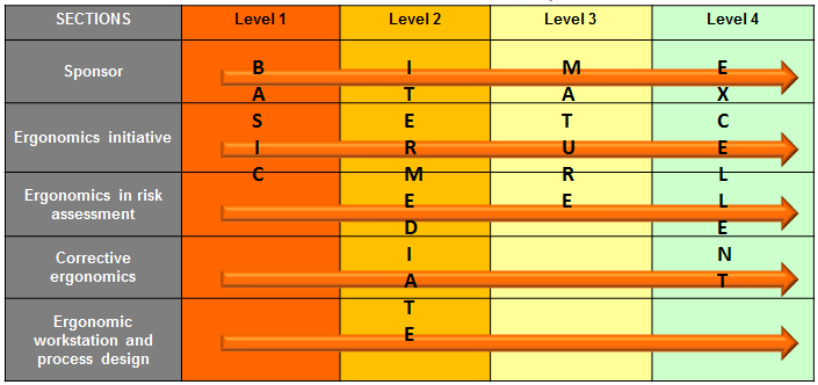
The Ergonomics standard forms part of an HSE standard, which is structured in the form of a matrix made up of the various sections to be managed based on four levels of maturity (see figure 2). It is therefore a management tool, which: - enables sites to carry out a self-assessment exercise to establish their own level of maturity. - acts as a tool for promoting dialogue and consistency within the Group, which feeds into the definition of central and local objectives, in particular the inclusion of ergonomics in the annual POPSSEs.
- can be used as an internal site audit tool.
Figure 2. The Safran Group's Ergonomics Standard
The Ergonomics standard consists of five sections, which are assessed at each of the Group’s sites based on four levels of maturity. The sections are:
- the “Sponsor” section, which identifies the program management function for ergonomics at each site. - the “Ergonomics initiative” section, which defines the socio-technical process used to implement ergonomics and which involves the various local stakeholders. - the “Ergonomics in risk assessment” section, which establishes ergonomics as part of the occupational risk assessment of the site’s various work units.
- the “Corrective ergonomics” section, which specifies the process of integrating ergonomics into the implementation of corrective actions, for example following an occupational accident. - the “Ergonomic workstation and process design” section, which establishes ergonomics as part of the management of design projects.
Developing an Ergonomics standard within an HSE standard (which includes ISO14001 and OHSAS18001 requirements, amongst other things) helps to establish ergonomics as part of an occupational health and safety management system that is recognized at an international level and is supported by the International Labour Organization.
... to various levels of ergonomics-related practices It is clear that implementing a standard of this kind requires a socio-technical process that positions the business’s various stakeholders within a social structure. Based on feedback from around 50 of the Group’s sites worldwide, we have observed a range of practices in ergonomics. These are developed on-site by at least three main categories of stakeholders who are involved:
- In risk assessment.
- In ergonomics support for the site.
- In supporting professional ergonomists.
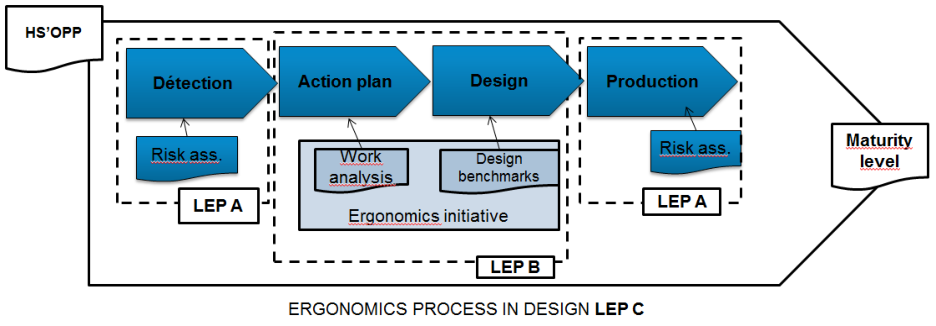
These three Levels of Ergonomics-related Practices (LEPs) are part of a general process that combines four stages (detection – analysis – design – production), as shown in figure 3.
Figure 3. The Ergonomics process at Safran Group sites
The first Level of Ergonomics-related Practices (LEP A) covers occupational risk assessment. Depending on the country, the practice of occupational risk assessment may fall under a regulatory and legislative framework. In France, for example, the employer is obliged to take all necessary measures to ensure the safety and protect the health of their staff (article L 4121-1 to 3 of the French Labour Code). Moreover, in France the results of occupational risk assessments must be recorded in a single document (French decree no. 2001-1016 of 5 November 2001). In general terms, however, aside from the obligatory aspect, assessing occupational risks is also an excellent way of involving the business in a process of improvement that promotes social dialogue and better working conditions. Making this a reality, however, means extending the approach to prevention beyond a limited group of ‘insiders’, namely the business’s prevention staff (the Health and Safety department, Occupational Health department, etc.). Establishing ergonomics as part of an occupational risk assessment thus involves active participation by employees, from analyzing their work by giving them resources and training so that they are capable of identifying risks, to analyzing work situations, to participating in the development of action plans and checking the effectiveness of the solutions implemented. Since 2013, for example, we have developed a program of training operational staff at all our sites around the world with the aim of helping them attain an initial level of skills in ergonomics (LEP A) to enable them to assess their work situations and, in particular, the risks associated with problems of load handling, repetitive actions and posture. All (LEP A) training courses are delivered in the country’s native language by an accredited “local” trainer to help employees assimilate what they have learned. This initial level of ergonomics-related practice required the Safran Group to build a network of local resources on each continent and to date, to develop initial training in French, English, Chinese, Portuguese and Spanish.
Very often, during risk assessment processes or discussions on what measures should be taken, appealing to people’s knowledge of ergonomics tends, for better or worse, to rely on common sense or a vague understanding gleaned from a guide or awareness-raising session on ergonomics, the presence of a trainee ergonomist, etc. The Level of Ergonomics-related Practices A (LEP A) helps to deal with the problem in numerous “simple” cases but it needs someone to act as a guarantor of the methodology with regard to analyzing the work activity and taking account of variability, for example, but also the use of reference points and knowledge of ergonomics. The role of the “ergonomics correspondent” is therefore essential at each site to: - support operational staff in implementing more “complex solutions”, particularly following a risk assessment. - monitoring new developments in ergonomics by positioning him/herself as a support during industrialization, investment, reorganization and continuous improvement projects. - capitalizing on experiences for the site by making the link with the POPSSE and therefore with the ergonomics sponsor.
As a result, the Level of Ergonomics-related Practices B (LEP B) requires ergonomics correspondents with training in ergonomics mainly focusing on work analyses and basic knowledge, often in the context of continuing education with a wide variety of profiles (preventer, nurse, methodological expert, etc.). This level of training complements “introduction to ergonomics” training activities run with the departments and various stakeholders.
Finally, including ergonomics in design processes is becoming a strategic issue for the Group for various reasons. For example, there are a number of issues relating to: - human resources, where adapting work to reflect the variability of individuals is important in designing work stations and organizational structures. In designing a precision assembly work station, for example, there are well-established links between ageing, ambient lighting and quality. - the group’s international development, where, for example, the anthropometric variations of individuals need to be taken into account in equipment design. - innovation in products and processes, which can fundamentally transform working conditions; moreover, these can last for decades, given the very long life cycles in the aeronautical industry. Safran has started to move towards integrating ergonomics into innovative product design but it is still marginal.
Integrating ergonomics into design (beyond familiarizing program management functions with design and R&D programs) requires occupational skills in ergonomics; this represents the third Level of Ergonomics-related Practices (LEP C) and is designed to develop effective and relevant support as early on in a project as possible. Support of this kind means incorporating ergonomics-related issues at the stage of feasibility studies (for example, through program management assistance) through to supporting the project at its various phases (for example, through project management assistance). Currently, ergonomics is only incorporated into design to a limited extent for at least two reasons. The added value of ergonomics appears to be well established in respect of risk assessment and corrective actions but is almost non-existent amongst design program sponsors. There are very few professional ergonomists and very often they are “stolen” by other levels of ergonomics-related practices such as risk assessment.
Faced with the eternal question of defining the occupation and/or profession of ergonomist (Richard, 1999), the various ergonomics competencies are now established and referenced within Safran:
- in the Ergonomics Standard, in the form of the skills used. - in the Training framework in the Safran Group training catalogue, which, amongst other things, mentions the type of skills to be acquired depending on the kind of ergonomics training. - in the Human Resources framework, both in the form of a pathway for acquiring ergonomics skills through continuing education but also in the form of an ergonomics job description and definition of responsibilities.
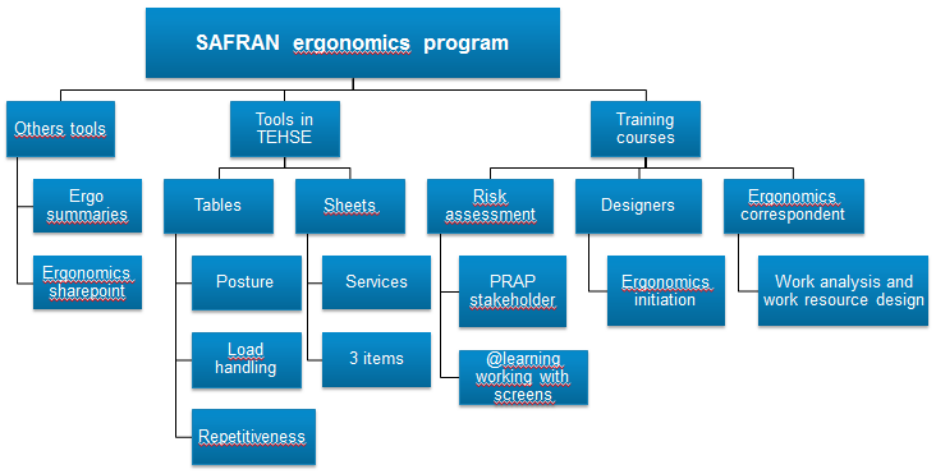
In general terms, the Safran Group’s Ergonomics Program is based on an international process characterized by an Ergonomics Standard, tools and training (see figure 4). This process is deployed in the various countries in the form of participative approaches, which combine the various stakeholders, each of whom has a specific and defined role in the ergonomics program implemented.
Figure 4. The Safran Group's Ergonomics Program
Moreover, it is important for there to be somewhere to discuss practices and capitalize on them. Reflection and discussions on various ergonomics practices are organized as part of an Ergonomics network led by the Program Head, who brings all practitioners together to discuss common themes (for example, the relationship between different levels of ergonomics practices) in working groups (for example, when developing corporate tools such as those used to assess risk). All information from the Ergonomics Program and network is made available to the sites through an internal Safran Group computer database.
CONCLUSION
Developing an ergonomics program for an international group relies primarily on a strategic view of the issues to which ergonomics practices can contribute. As in many international groups, this view depends primarily on ergonomic practices being represented as an assessment activity and a way of resolving occupational health issues. For Safran, this represents an excellent springboard for examining the ways in which work is organized given numerous potential diversions (Valleyre, 2006) and at the same time strengthens a strong representation of “corrective” ergonomics.
Based on the shared understanding that exists of occupational health prevention, it seems to us essential to develop a representation of ergonomics practices that is also centered on economic and human performance (Hubault, 1992). How can we introduce real Man-Machine Interface engineering in our “young” Ergonomics program to ensure better design from the outset and generate more added value?
There are several avenues open to us: - Continue to rely on the Health, Safety and Environment network, which is one of the pillars of Sustainable Development at Safran. - Share a common operational reference framework for truly international ergonomics, incorporating not only international norms and standards but also a diverse range of recognized ergonomics practices. - Consolidate recognition of various ergonomics practices in both operational and skills acquisition terms.
- Increase the presence of ergonomists in projects with a capacity for innovation and new ideas in ergonomics in partnership with research. - Communicate and exchange ideas internally as well as outside the Safran Group to force us to reflect on our Ergonomics Program.
In conclusion, better design of organizational structures, production tools and products is a significant challenge for the Safran Group’s performance. As a consequence, it is also one of the major objectives of the Group’s Ergonomics Program for the coming years.
REFERENCES
Daniellou, F. (1996), L’ergonomie en quête de ces principes, débats épistémologiques, Octarès (Ed.). Dul, J., Neumann, W.P. (2009), Ergonomics contributions to company strategies, in Applied Ergonomics, Vol.40, issue 4, pp.745-752. Falzon, P. (2004), Nature, objectifs et connaissances de l’ergonomie, in Ergonomie, PUF (Ed.). pp.17-35 Garrigou, A., Thibault, J.F., Jackson, M., Mascia, F., (2001), Contributions et démarche de l'ergonomie dans les processus de
conception, in PISTES, vol.3 n°2 Hagg, G.M., (2003), Corporate initiatives in ergonomics, in Applied Ergonomics, vol.34, Issue 1, pp.3-15 Hendrick, H.W., (1991), Ergonomics in organizational design and management, in Ergonomics, vol.34, issue 6, pp.743-756 Hubault, F., (1992), Le point de vue de l’activité de travail : comprendre autrement la performance de l’entreprise, in M. Noulin, L’ergonomie, Techniplus (Ed.). pp. 42-46 Joseph, B., (2003), Corporate Ergonomics Programme at the Ford Motor Company. In Applied Ergonomics, vol.34, issue 1,
pp.23-28 Mustafa, S.A., Kamaruddin, S., Othman, Z., Mokhtar, M., (2009), Ergonomics Awareness and Identifying Frequently Used Ergonomics Programs in Manufacturing Industries Using Quality Function Deployment, in American Journal of Scientific Research, issue 3, pp.51-66 Munck-Ulfsalt, U., Falck, A., Forsberg, C., Dahlin, A., Eriksson, A,. (2003), Corporate Ergonomics Programme at Volvo Car
Corporation. In Applied Ergonomics, vol. 34, issue 1, pp.17-22 Richard, P., (1999), Professionnalisation des ergonomes. Du métier prescrit aux métiers réels, in Les évolutions de la prescription, Actes du XXXVIIe congrès de la SELF, pp.16-33 Roger, T., Arabi, H., Lauret, S., Morais, A., (2009), L’organisation du travail des ergonomes et les modèles d’exercice de leur
métier dans l’entreprise, in Actes du 44e congrès de la SELF. Sailly, M., (1999), Démarche socio-technique intégrée aux projets industriels, in Actes colloque ADEO, Ergonomie et conception de systèmes de production, pp. 5-8 Wilson, J.R., (2000), Repositioning ergonomics in Proceedings of the IEA 2000/HFES 2000 Congress, pp.190-193 Thibault, J.-F., (2002), Quand le processus de prescription reflète la performance de l’intervention ergonomique, in Les
évolutions de la prescription, Actes du XXXVIIe congrès de la SELF, pp.370-375 Thibault, J.-F., (2000), Practice of ergonomics management in industrial design, in “Ergonomics for the new millennium”, IEA 2000, XIVth Triennal congress and human factors and ergonomics society, pp.297-299 Thibault, J.F., Jackson, M., (1999), L’ergonomie face aux critères de gestion des processus de conception industrielle, in Actes du
XXXIVe Congrès de la SELF, pp.555-564 Valeyre, A., (2006), Conditions de travail et santé au travail des salariés de l’Union européenne : des situations contrastées selon les formes d’organisation, Document de travail n°73, Centre d’Etudes de l’Emploi Wisner, A., (1966), Extraits de la leçon inaugurale, in Réflexions sur l’ergonomie, Octarès (Ed.), pp.33-46
LISTED IN THE AHFE DIGITAL BOOKSTORE CATALOGUE
Explore the complete digital volume
Advances in Ergonomics In Design, Usability & Special Populations: Part II
Read this individual research paper free through the original publisher, or explore the full digital proceedings book.
ISBN 978-1-4951-2107-4
Explore this ISBN in the AHFE Bookstore ↗Listed in the July 2026 bookstore catalogue; search by ISBN to confirm current availability · Digital book purchase optional