Katharina Dahmen-Zimmer, Alf C. Zimmer (2022). Maneuvering in Intersections – What Is the Specific Challenge for Elderly Drivers?Underlying Causes for Violations and a Design for an Assistive System. In: Advances in Ergonomics In Design, Usability & Special Populations: Part II. AHFE Open Access, vol. 19. https://doi.org/10.54941/ahfe1001232
Publisher statistics will load when you open Metrics.
AHFE OPEN ACCESS OPEN ACCESS CONFERENCE PROCEEDINGS PAPER
Maneuvering in Intersections – What Is the Specific Challenge for Elderly Drivers?Underlying Causes for Violations and a Design for an Assistive System
Statistics of traffic accidents in relation to specific situations and maneuvers show that in intersections elderly drivers have a significantly increased risk, especially when turning left. In cooperation with Ruhr University, Bochum, an extensive analysis of real maneuvers in various intersections has been undertaken by multiple-view video observations. The age of the drivers has been determined by rating the age as observable in the faces. It has turned out that this higher risk cannot be contributed to any distinctive constructive element in road. A subsequent experiment in a driving simulator has led to similar results. It is therefore plausible to assume that increased risk is related to already known age-related deficits in cognitive functions. These are of special importance for the dynamic and situational factors when maneuvering in an intersection, in contrast to the static factors as e.g. road design. In order to assist drivers in intersections when turning left, a Left-Turn- Assistant has been developed and evaluated in a driving simulator. It turns out that with the Intersection Assistant elderly drivers improve the quality of their decisions for their maneuvers significantly and no longer show an increased risk in comparison to experienced drivers in the medium-age category.
Especially in developed countries there is a trend towards increasingly aging societies with concurrent problems in the fields of economics, social policy, and health care. In addressing these problems it is often overlooked that in the process of aging fundamental negative changes happen in motor, perceptual, and cognitive functions, which often counteract introduced policies for overcoming the above mentioned problems (Salthouse, 1994). These deficits make it difficult for many elderly to master requirements of modern daily life, namly, modern technology and especially the demands in individual motor traffic. However, these manifest deficits do not lead to a concurrent increase in accident proneness. Apparently, the expertise of older drivers based on many years of driving experience plus compensatory driving strategies not only mitigate the effects of motor, perceptual, attentional, and cognitive deficits but also compensate them, at least up to the age of about 75 years.
New technologies bear the potential to assist the elderly in overcoming their deficits by improving the interactions of elderly people with their environment, namely by improving visibility, tractability, and comprehensibility. So-called intelligent interfaces or assistive technologies are prominent examples but the well documented problems in introducing these new human-machine interfaces make it apparent that the benefits of these technologies depend on the quality of the fit between the specific demands and experiences of the elderly user and the design. Most of these, quite often successful, developments are based on information technology. E.g. in the important field of traffic systems for navigation, for traction control, for collision warning, for parking assistance, and other devices have been developed to alleviate the task demands and thereby, hopefully, to overcome the above mentioned deficits of the elderly driver. What sometimes is overlooked in this IT-centered approach is the role road design plays for safe driving. A systemic approach to road safety should consist of improved in-car instrumentation and assistance as well as of a road construction aiming at an easy ‘legibility’ of traffic situations (‘self-explaining roads’, Matena, 2006). Overall, the consistency of road elements and in-car-instrumentation should enable the driver to perform maneuvers in a safe way.
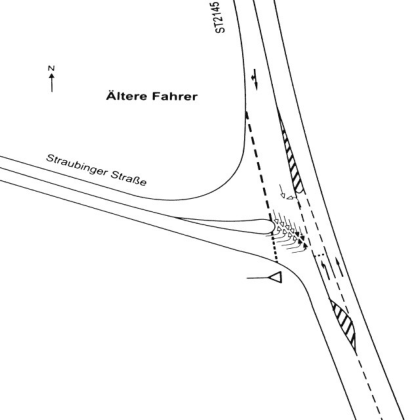
Accident statistics for elderly drivers show that despite the fact that elderly (early 60s to mid-70s) overall do not constitute a population at risk, there is one major exception: for elderly drivers maneuvers in intersections seem to be especially demanding and often lead to accidents (e.g. Emsbach & Friedel, 1999). Figure 1 shows this for an exemplary intersection.
Figure 1: Accidents of older (left) and younger (right) drivers (König, 2008)
AGE-RELATED DRIVING MANEUVERS IN INTERSECTIONS Comparative observational studies
In order to address the question which elements of road design for intersections might contribute to this hazard, a joint research project of road design engineers (University of Bochum) and applied cognitive psychologists (University of Regensburg) has been undertaken. The study consisted of three parts:
extensive analyses of accidents in intersections with a focus on types of accidents typical for younger and elderly drivers
field observations of different types of intersections with a focus on violations and near-accidents comparing younger and older drivers
simulator-based studies with a focus on the planning and execution of maneuvering in different types of intersections, again comparing the behavior of younger and older drivers.
The results (Brilon, Wiebusch-Wothge, Dahmen-Zimmer, Zimmer, König, Kostka, 2008) show that according to accident statistics five types maneuvers in intersections leading to accidents show significant differences between younger and older drivers (> 55 y.o.)
1. Entering and crossing: higher risk for older drivers 2. Passing: higher risk for younger drivers, especially due to tailgating 3. Turning left: especially high risk for older drivers (see Figure 1 for the comparison of accidents for younger and older drivers in one intersection) 4. Loss of control, especially in rural areas : higher risk for younger drivers
While the younger drivers seem to be especially accident prone in situations where risk taking and lack of experience play a role, for older drivers the complexity of the situation (maneuvering while taking into account the behavior of other drivers) seems to play the crucial role.
From these statistical analyses it is not possible to identify specific road design parameters contributing to the accident risk in intersections because accidents as statistically rare events usually do not allow the analysis of single intersections. For this reasons field observations at intersections with different design parameters have been undertaken. In selected intersections the traffic has been observed with video multiple cameras with time codes. The analysis of the video tapes did not only allow the identification of traffic violations and near-accidents but also the determination of speed and the approximate age of the drivers (from the faces).
The results from these observations allow the following conclusions:
1. In general, the observations support the results from the accident analyses concerning the differences between younger and older drivers 2. The analysis of speed reductions and stops allows the estimation of accepted time gaps. They indicate that older drivers compensate their deficits by taking more time. 3. While standard intersections do not pose a major problem for older drivers, non-standard situations due to construction work or curved intersections have a negative impact. 4. The more visible and consistent the guiding lines in intersections are, the less problems result for all drivers, that is, younger and older drivers both profit from these measures.
The obvious advantage of field observation, namely, that the method is non-intrusive, at the same time restricts the control of variables and the types of obtainable data, for these reasons, the following simulator-based studies have been undertaken.
Simulator-based Study The objective of the first study was to complement and expand the results from the field observations. Four different simulator-based courses for the subjects (17 younger drivers, average age 37 y. o., and 18 older drivers, average age 67 y. o.) consisted each of three types of intersections with different kinds of guiding lines, with or without traffic lights, and with yield signs or with stop signs. The different types of intersections (standard, asymmetric, combined) were chosen because the field study had shown that the comparison of these types reveal best what makes maneuvering in intersections easy or difficult. Each subject had to drive all 4 different courses. Before the experiment they were instructed to observe traffic regulations (e.g. waiting at a stop sign for at least 5 sec.) and they were familiarized with driving in the simulator.
The temporal as well as spatial parameters for all courses and subjects were measured and allowed to determine for every situation the position the simulated car, the speed, and the time-to-collision. Furthermore specific events like collisions with simulated other cars (n = 8) were registered. After each simulator trial the subjects were asked to answer a questionnaire – a modified version of the NASA-TLX tailored to the experimental setting.
The major results show that guiding lines make the traffic behavior more homogeneous and therefore more predictable. For the younger drivers guiding lines reduce the stress. In the group of the older drivers there was a very low level of stress under all conditions. The older drivers tend to be more cautious when turning left at intersections with traffic lights, most of them wait until the oncoming computer generated traffic stopped.
In combined intersections where the traffic flow has to be crossed twice safe driving maneuvers are assured best if both partial intersections are regulated by stop signs.
When turning left both younger and older drivers deviate from the trajectory underlying the norms for road construction. However, younger drivers cut the corner, while – in contrast – older drivers move on a too wide curve. Both maneuvers can be regarded as unsafe: Cutting the curve makes the maneuver less predictable for other drivers and taking a too wide curve can lead to conflicts with cars in the on-coming traffic flow.
In general, the results of the simulator study confirm and partially expand the results from the field observations, insofar as guiding lines have a positive effect for traffic safety. Furthermore, especially in combined intersections, redundant regulating signs are taken into account by the drivers and prevent traffic conflicts.
In general, older drivers have on the one hand ample experience with driving maneuvers and on the other hand strategies compensating their psycho-motor deficits. These strategies mostly consist in avoiding situations which are challenging because the conditions for driving are bad or the situations in themselves exhibit high variability and therefore a lack of predictability. This seems to be the case in the left-turn maneuver. Turning left on intersections is apparently an especially difficult maneuver for the older drivers – a result which is in line with the data from traffic statistics and the illustrative example in Figure 1. However – most importantly – performing this maneuver cannot be avoided.
DEVELOPMENT AND EVALUATION OF A LEFT-TURN-ASSISTANT In a further research project, the Engineering Psychology Group at the University of Regensburg has developed a prototype for an assistive system for turning left on intersection because this is apparently a maneuver where older drivers need support (see Figure 2). In a series of experiment this prototype has been tested in the Regensburg driving simulator. In this experiment not only younger (N = 20, average age 26 y. o.) and older drivers (N = 21, average age 68 y. o.) have been compared but also the effect of time pressure and of speed limit on driving maneuvers.
Suggested maneuver: Turning left Turning left Stop or finish Stop the maneuver
Figure 2: The Interface of the Turn-Left-Assistant Time-pressure was induced by a ‘passenger’ urging the driver to get to the airport in time repeatedly. In the no-time- pressure condition the driver was alone in the simulator car. The objective for using the variable time-pressure was not only to make the task more realistic but also to the test if the compliance with the activities suggested by the Left-Turn-Assistant is stable against social pressure.
Figure available in the original PDF paper.
During the introductory drive all subjects were tested for reaction time (Braking Test), and working memory (memory for digits in a simulated speech activated dialing task). As expected from the literature the younger drivers were significantly faster in the braking test compared to the older drivers. However, testing the working memory revealed no significant age-related differences.
All subjects performed four test drives on a course with three different types of intersections where they had to turn left under the conditions:
1. without Left-Turn-Assistant / without time pressure 2. with Left-Turn-Assistant / without time pressure 3. without Left-Turn-Assistant / with time pressure 4. with Left-Turn-Assistant / without time pressure.
The zones with speed limit (80 km/h) and without speed limit were part of the driving courses.
The main results are:
1. In general, the group of younger drivers accepts smaller time gaps for the turning maneuver (F = 5.79, p < 0.02, eta square = .179). 2. In both groups time pressure leads to shorter accepted time gaps in the on-coming traffic for the turning maneuver (F = 141.83, p < 0.001, eta-square = .816). Furthermore, there is a significant interaction between age and time pressure in one intersection. 3. In general, the Left-Turn-Assistant induces the acceptance of smaller time gaps in both groups. However, depending on the specifics of the two intersections and time pressure this effect vanishes. 4. The minimal time-to-collision is longer for the older drivers, and is for both groups reduced under time pressure and the presence of the Left-Turn-Assistant. 5. Under time pressure both groups drive faster and violate the speed limits (about 10% above the posted speed).
All subjects experienced the simulated driving conditions as realistic and their maneuvering as usual for them; especially the time pressure increased the realistic impression of the setting in the simulator.
One major result concerning the effects of the Left-Turn-Assistant is that the maneuvering of younger and older drivers becomes more similar, that is, the traffic becomes more homogeneous.
A final cautionary remark is necessary: the older drivers willing to participate might not be representative for their age group due to self-selection, namely that they felt especially fit for driving, which is indicated by their comparatively high driving experience.
CONCLUSIONS
If one summarizes the results of the field study and both simulator studies there is a twofold resume to derive: On the one hand, from an applied point of view the development of the Left-Turn-Assistant shows a possible avenue towards better traffic safety for the elderly, on the other hand, from a causal analysis point of view the question remains still open, what exactly makes the maneuver of turning left in intersections so difficult for older drivers.
Ball & Owsley (1991) argue that a major cause for traffic accidents of the elderly consists in an inefficient use of the useful field of vision (UFOV) resulting in a kind of tunnel vision. However useful this approach might be, especially for training (Ball, Wadley, & Ewards, 2002), it does not explain why turning left is so difficult. An alternative, or better, supplementary, explanation is that the management of attention in this situation is so difficult because of the rapidly changing stream of task-relevant information and the presence of distracting information. One important characteristic of the Left-Turn-Assistant consists in making the traffic behavior more homogeneous and therefore more predictable, thereby addressing the problem of the information over-flow .
Insofar, the specific challenge for elderly drivers still cannot be exactly identified but approaches have been developed which makes the driving maneuver of turning left less challenging for the elderly.
REFERENCES
Ball, K. & Owsley, C. (1991), Identifying correlates of accident involvement for the older driver. Human Factors. 33(5), pp. 583 – 595. Ball, K., Wadley, V.G., & Edwards, J.D. (2002). Advances in technology used to assess and retrain older drivers. Gerontology. 1
(4), pp. 252 – 261. Brilon. W., Wiebusch-Wothge, R., König, R., Zimmer, A., Dahmen-Zimmer, K., Kostka, M. (2008). Berücksichtigung des Leistungsvermögens von Kraftfahrern (Human Factors) bei Entwurf und Bemessung von Knotenpunkten am Beispiel älterer Fahrer. Final Report for the Research Grant FE82.231/2002 for Bundesanstalt für Straßenwesen, Bergisch Gladbach. Dahmen-Zimmer, K. Sirek, J., Kostka, A., Zimmer, A. (2010) Einflussgrößen auf die Ergebnisse der Evaluation von
Fahrassistenzsystemen im Fahrsimulator. Final Report – Research Grant FE89.205/2008/AP for Bundesanstalt für Straßenwesen, Bergisch Gladbach. Emsbach, M. & Friedel, B. (1999). Unfälle älterer Kraftfahrer. Zeitschrift für Gerontologie und Geriatrie. 32 (5). König, R. (2008) Verkehrsablauf an plangleichen Knotenpunkten unter Berücksichtigung der Altersstruktur der Verkehrsteilnehmer. Schriftenreihe des Lehrstuhls für Verkehrswesen der Ruhr-Universität Bochum.
Matena, S., Weber, R., Louwerse, R., Drolenga, H., Vaneerdewegh, P., Pokorny, P., Cardoso, J. (2006). Road categorization and design of self explaining roads. RIPCORD ISEREST. Salthouse, T.A. (1994). The nature of speed on adult age differences in cognition. Developmental Psychology. 30 (2), pp. 240 –
259.
LISTED IN THE AHFE DIGITAL BOOKSTORE CATALOGUE
Explore the complete digital volume
Advances in Ergonomics In Design, Usability & Special Populations: Part II
Read this individual research paper free through the original publisher, or explore the full digital proceedings book.
ISBN 978-1-4951-2107-4
Explore this ISBN in the AHFE Bookstore ↗Listed in the July 2026 bookstore catalogue; search by ISBN to confirm current availability · Digital book purchase optional