Cláudia Pernencar (2022). Human-Social Interaction Model for E-Health Interfaces. In: Advances in Ergonomics In Design, Usability & Special Populations: Part I. AHFE Open Access, vol. 18. https://doi.org/10.54941/ahfe100824
UNIDCOM/IADE – Unidade de Investigação em Design e Comunicação IADE-U Instituto de Arte, Design e Empresa - Universitário Av. D. Carlos I, 4, 1200-649 Lisboa, Portugal ↗
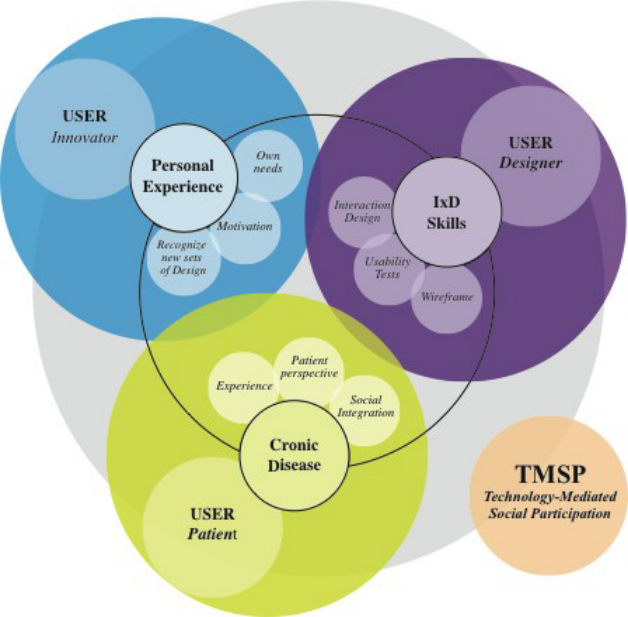
Living with chronic diseases has an enormous impact in patient’s daily life. Those who feel that impact on their day-to-day especially regarding with the management of the disease itself, often end up getting solutions to overcome the difficulties becoming both "User Innovator" and "User Patient". If we associate to this detail, the professional experience as a "User Designer" then, we can probably reduce the step's number during the iterative Design Process that is used to develop a digital system, as the research we are covering. We intend to analyze these problems concerning the model "Human-Social Interaction model for e-health interfaces" presented on this paper. We include three axes and their specifications. “User Innovator” with personal experience (Own needs, motivation and recognize news sets of designs); “User Designer” with Interaction Design skills (Interaction design, usability tests and wireframe); “User Patient” with Cronic Disease (Experience, patient perspective and social integration).
We know that human-to-human interaction, human-to-documents interaction and human-to-system interaction are guidelines traditions for interactivity research (McMillan, 2002). We can also find, well-published principles to designing complex systems, providing methodologies to understand crucial details like utility, functionality and usability (Johnson, Johnson, & Zhang, 2005; Jakob Nielsen, 1998, 2005, 2011, n.d.) but when we discuss about integrate this issues and being simultaneously a “User Innovator”, a “User Designer” and a “User Patient”, we have difficulties in provide focus answers because we need to design systems for both expert vs. non-expert, attending for our experience does not overlap the designer's creativity in finding the best user experience format which suite in this interfaces.
According with this perspective, we applied the “Human-Social Interaction model for e-health interfaces” to a specific research “My Crohn’s disease on real time information – HCI improvement for e-health interfaces” (Pernencar, 2013) which consists in exploring the challenge of redesign an e-health interface through analyzing four case studies – Mobile and desktop applications. The first studies that we have done, we concluded that all, have the same visual data performance which in our opinion, were thought for expert users. We think that the gap between users expert and non-expert, the user customizes the interface while keeping the interaction paradigms.
When we discuss if HCI (Human Computer Interaction) is neither a science nor a design discipline (Mackay & Fayard, 1997), it is because the focus of our work is to understand if our integrative model of different disciplines can reduce the numbers of design steps in an iterative process (J. Nielsen & Faber, 1996a). We agree that designing interactive systems can be effectively served by drawing techniques coming from science and design or new techniques constructed specially for it. If we consider the possibility of addressing new questions with a multidisciplinary approach, drawing tools, techniques and paradigms from both science and design, maybe we will be more successful in what we are searching for systemize the design process according the proposed model.
HCI like other multidisciplinary fields borrows techniques from component disciplines and we need to understand how they are related to each other. By embracing the challenges of design and e-health business, we can redefine more broadly, maybe even insinuates a fresh name such as “Human-Community Interaction” or even “Human- Social Interaction” (Shneiderman, Plaisant, Cohen, & Jacobs, 2009). Having regarded our research, the model that we present is a suggestion where digital illiteracy factors are not forgotten: "User Patient > Social integration". This approach brings researchers to deal with scientific questions about as experienced users can answer with ideas and solutions to real problems of their daily lives.
History For (Shneiderman, 2011), researchers must to participate in the redefining of HCI across multiple disciplines because the success of social media as blogs, Facebook, Twitter, YouTube and others. The traditional discussion groups becomes more active in local and global communities which means that questions of how to motivate this participation, the increase of social trust, and promote collaboration reminding big challenges, involving a group of disciplines which we highlight ID (Interface Design) and UX (User Experience). Some enthusiasts (Ballegaard, Hansen, & Kyng, 2008; Bardram, 2005; Kulkarni & Öztürk, 2007; Luo, 2008) believe that with a humble modest redesign, the technology that encourage the social media can be exploited to support priorities such as healthcare, disaster response, community safety, and energy sustainability. However, accomplishing these ambitious goals will require a long-term research to validated scientific theories and reliable, secure, and scalable technology strategies.
If we look into the potential domains of application of TMSP (Technology-Mediated Social Participation) (Shneiderman, 2011) and the expected benefits like “Unite professionals and citizens in one center to gain information, support and improve research” (Olson, Mark, Churchill, & Rotman, 2010) we realized, that the redefining of Design Process we were addressing is focused on more social lines and will answer vital research questions while creating inspirational prototypes, conducting innovative evaluations, and developing robust technologies. By placing greater emphasis on social media, the HCI community could constructively be influence by "User Innovators".
Initial approaches Nielsen Norman Group said (1998) that with 5 tests users, we can almost get closer to user testing’s maximum benefit-cost radio. If we considered the proposed model where we have more experience like "User Designer" and "User Patient" than other group and applying the potential of TMSP domains (Olson et al., 2010; Shneiderman, 2011) we would get the chance to influence the still unfolding design of healthcare technologies and their applications. These shifts would refresh the research community with compelling new challenges that would lead us toward more profound questions by embracing the creation of ambitious interface design goals and integrating new social paradigms. Override the different impressions about the benefits of participation, We considered it an important challenge for community, business, and national leaders. It also leads researchers from several areas to deal with profound scientific questions about human behavior, community engagement, collaborative strategies and international cooperation.
Social implications Usability tests are essential to create enjoyable experiences of use. When we are in the iterative process during the development of a digital product, the more iteration the project has, the more expensive it becomes (J. Nielsen & Faber, 1996b; Jakob Nielsen, 2005, 2011). We have the same situation with the number of users. More users are concerned, more he have an expensive project. In some situations, predictive theories like those that we are studying wouldn’t be precise enough to forecast the evolution of social implications and the outcomes of collective action projects. Occasionally, deeper insights will lead to generative theories that suggest new design strategies, novel methods for limiting behavior and new goals for collective information coming from usability tests. In the world of TMSP, there may be new challenges for these traditional assumptions. The variables of interest include trust, empathy, responsibility, and privacy that for us, still hard to define and difficult to measure. Even frequently discussed variables such as motivation, persuasion, self-efficacy, technology acceptance, and universal usability are not simple to measure beyond subjective scales that produce volatile and nuanced responses (Shneiderman et al., 2009; Shneiderman, 2011).
The range of TMSP theories needed is staggering, from descriptive theories that come from cleaned and aggregated data organized into meaningful insights to explanatory theories that present cause and effect patterns. These theories lay the foundations for prescriptive theories that provide guidelines and best practices for interface designers, community managers, and policy makers.
PROBLEMATIC The problematic is divided into two items: The first concerns to the research process for develop "MyCrohn" applications, which is part of a Ph.D in an ongoing process. The second ones, is other working in progress where we have applied the model presented in this paper that served as basis to analyzing if we could actually get a smaller number of iterations in the design process. The objective is to reduce costs and investments in the project.
According with Sociedade Portuguesa de Gastroenterologia it is estimated that there are over 7,000 diagnosed cases in Portugal of Crohn disease (“APDI,” 2012; SPG, nd). If we consider the latest statistics that show an increased of it inside young people we can find other relevant matters, the role of parents as agents that enable young patient to have a normal life, where the constant contact with the doctors or clinics for control especially the medication is undoubtedly an advantage. Another important aspect is the access to the history of a chronic patient by other clinics in different hospitals. For this situation, the attending can win with the existence of a platform that enables quickly make a diagnosis more assertive if there is access to information that probably the patient do not know or do not remember. Other situation is the number of times that the same task is repeated for different users in separated environments related with medication records. The risk of altering is due to faulty interpretation. A good example is when medication’s information is recorded on different calendars without synchronization.
A twelve’s years of experience as a Crohn’s illness together with a Ph.D. research area – IxD (Interaction Design) and ID – we feel that we can help those with the same pathology by improving a digital medical workflow, which integrate a specific interface model and thereby contributing with solutions and research into social and environmental contexts that genuinely is relevant for a specific custom – e-health and m-health.
RESEARCH OBJECTIVES The objectives of this research were to apply “Human-Social interaction model for e-health interfaces” was applied in the project "MyCrohn" (Pernencar, 2013) with the goal of helping to reduce the iterative design process creating the graphical user interface project to be a first contact for non-expert users, likes a “technological mediation”. We intended to apply to the research project "MyCrohn" the three axes of this methodology: "User Innovator" with personal experience; user designer with IxD skills and "user patient" with cronic disease. Our model intended to reduce the iterative design process. It is a deductive model that starts from theory of a particular cognition phenomenon’s chosen, to users behavior, which makes a specific prediction in the form of hypothesis about that phenomenon. The hypothesis is revised without measured tests, which means that the results can be more generalized and less intrusive. In a scenario-based design, researchers draw their inductive ideas from observation of users interaction after they answer specific questions. After conclusions, we make the same tests with expert users, to subsequently compare the user degree of difficulty and with this information start the second stage of wireframing.
According to the above points, others need to be considered taking into account the main objective of "MyCrohn" research, which are:
It is possible applying the “Human-Social Interaction Model for e-health interfaces” reduce the costs of projects similar of “MyCrohn”?
Can we give important inputs and simultaneously being a “User Designer” and a “User Patient” without mixing personal feelings?
Considered Mark Weiser sentence “The most profound technologies are those that disappear” (1991), today’s multimedia machines converge computer screen into the background (Saffer, 2007) and UB (Ubiquitous computing) will always be in a constant transformation of human interactions, however there are always opportunities to innovate on GUI. If we take this point into account and the consideration that “Medical care will improve interfaces enable to refined diagnoses and treatment plans, also basic records for hospitals and clinics.” (Shneiderman et al., 2009), there are excellent conditions to develop new graphical approaches to digital interfaces.
RESEARCH SETTINGS Citizen perspective of healthcare technology
“Our lifestyles are increasingly out of balance, and we are placing our health at risk through unhealthy habits. We are ageing as a population and likely to suffer from chronic diseases, as we get older. As a result, our healthcare systems are under increasing need for costly and complicated care. With their limited resources and traditional models, they are already struggling to meet existing demand. In short, the healthcare industry is in crisis and facing paradigm change. However, there are plenty of opportunities for innovation within this crisis.” (Parameswaran & Raijmakers, 2011).
The traditional clinical perspective is no longer confined to hospitals, thanks to the development of new healthcare systems, closest to the patient's needs involving the impact on their daily life. With an increasing number of chronic patients, there is a life to be enjoyed and common health problems to be solved (Pernencar, 2013). For most patients, health and disease are just a detail of life as a whole of what is necessary for them: e.g. spending time with their family and friends, having an interesting job or exciting hobbies (Ballegaard et al., 2008). Health and healthcare technology are just small pieces that patients try to fit the larger puzzle of the everyday routines.
The priority for most western countries is to reduce institutionalization of these patients. The more complex their condition is, and the most difficult is the coordination of healthcare management (Tufte, 1990). The next generation of pervasive and ubiquitous healthcare systems will be a challenging task. These systems are likely to involve a complex structure that will consist of various devices, ranging from resource-constrained to sensors and actuators to complex multimedia devices (Kulkarni & Öztürk, 2007).
Ubiquitous computing for healthcare and e-heath Ubiquitous computing moves the computation from the desktop environment and to every digital interface of our lives. Instantaneous information will be distributed over an array of small wireless networked devices. These can be embedded in daily artifacts such tablets, smartphones, light switches, stereos, and watches (West, 2011). This capability is revolutionizing the computing, allowing it to take place anywhere and at any time.
When we recreate contents for a space both virtual and real, the designer needs to solve multiple problems at once. This experience integrated into any ubiquitous computing requires a needed time to get into place. Making any kind of set of tools “ubiquitous” implies a fairly large distribution problem. The basic thrust of designer's work in this area that will be needed for the next few years will combine infrastructural work with a variety of devices to create a functional, overall user experience.
The technologies for computing-in-place are becoming more real with each passing day. Wall-size displays are a reality in many areas, and with the continuing decreases in power and cost for communication, more smart devices are becoming part of an ever-expanding grid of computation (Stefik et al., 1987). Unfortunately, most of the new device introductions are independent of other systems: Mobile phones which do not integrate well with pagers, and neither communicate well with their owner’s portable computer. All of these are ubiquitous, but they don’t play well together.
Designing real health contents should rely on the kind of ubiquity which means placing information everywhere in the user environment, providing ways for them to interconnect, talk and work together it would be excellent if much of this integrated work has gone into the patients display devices with and input-output information, while relatively little has focused on the invisible problem of actually getting all these devices and resources to work together. Three important directions for future work in virtual ubiquitous computing seem clear: First, devices will work to continue creating novel kinds of output and input devices in areas where people can use them. Second, a transparent communication between devices, information and people must become more functional and standard. Finally, the UxD can use the constellation of devices and information resources available to user (Russell & Weiser, 1998).
The influence factors of User Experience Beyond the User Interface (UI) there is an overall experience: How does a user interact with a range of different devices can create the illusion of a single working space? If computational devices are truly ubiquitous, the possible combinations and possibilities for interactions between devices must be remarkable (Russell & Weiser, 1998). Designing for different devices and systems can cooperatively work together at the same time competing for user attention. If we take this point into account and consider “medical care will improve interfaces enable to redefined diagnoses and treatment plans, also primary records for hospitals and clinics” (Shneiderman et al., 2009) there are excellent conditions to develop new graphic approaches to digital interfaces.
To make user experience measurable, the direct and indirect influencing factors need to be well known. HCI features as well as systems features should be considered. For that reason some factors of this research are divided into two main aspects which together influence UX before, during and after the first part of the project. UX evaluation describes the change from expectations through momentary experiences until a reflective experience. It is assumed that basic human needs are the key drivers to develop a product with quality (Hassenzahl, Eckoldt, & Thielsch, 2009). An interactive development product too long can cause fulfillment and frustration of such user experience must (Schulze & Krömker, 2010) mainly influenced the product qualities and become too expensive.
According to Mahlke (2008) these qualities of a better product could be classified in utility, usability, visual attractiveness and hedonic quality. Though, there is no direct correlation of one need to one specific product quality in general which is why direct links between human needs and product qualities must be identified by analytical and empirical studies. Measurement of UX can be explicitly targeted to evaluate certain aspects of these influencing factors depending on the product goals.
Over the past years, UX research in the academic community has created several methods to UX evaluation frameworks. However, industry adopted them rather vaguely into product development. Due to this existing gap between research academics and what companies actually do, this paper concerns the question if the "Human-Social Interaction Model for e-health interfaces" could reduce the steps in the process of interactive products keeping the challenge of UX evaluation. Therefore, influencing factors that need to be measured, including social and system features and emotional/ motivations dimension must be analyzed. In order to exam these factors transparently and link them to “MyCrohn”, we going to collect quantitative and qualitative data at the end to join an evaluation process set. First experiences of using the UX framework and this process set by means of a new web-community concept will be outlined and discussed (Schulze & Krömker, 2010).
The whole area of computational systems offers considerable scope for research (Hawthorn, 2000). There is a need for studies looking at: How much use users make of its computers and for what ends, who are the non-users and late adopters among all population and why? One could look at changes in sources of support and our motivational changes as “User Innovation” and “User Designer” becomes more involved with computing.
We can expect that some target users will be more easily distracted than other ones by extraneous design detail or background noise. For specific users group, graphics need to be carefully selected for relevance rather than decoration. E.g, Multimedia approaches and the more flamboyant application disadvantage for older users. One might paraphrase Don Norman (2004) to the effect that “If it won a design or art award, former users would probably hate it”. When researching the usability of the new interface feature, Korteling’s paper (1994) referred to above indicates that increase in difficulty might not show up in performance on the novel feature itself. Instead poorer performance due to the new feature may appear on other tasks performed at the same time. Our interface research designs should reflect this.
The challenge for “User Innovators” It is necessary to understand the user needs in order that technological products are developed correctly. This fact sometimes is discriminatory between what is commercially success with an industrial good innovation and those projects which fail (Curnow & Moring, 1968). The behavior of “User Inovators” according with Von Hippel (1976), are persons who influence the direction and the rate of innovation in some specific industries. According with Ergonomics In Design, Usability & Special Populations I (2022)
Baldwin, Hienerth, & Von Hippel (2006), the first user is who wants to buy the goods embodied to the lead of user innovations, instead of building for them. Users in general conditions are the first manufacturers to enter to the market. They use flexible ideas, high-variable-cost, low-capital production technologies and community to build their own prototypes. The relative costs of these user-manufacturers will tend to limit the size of the business.
Going back to the beginning of IxD history - Xerox PARC (“PARC, a Xerox company,” 2002) - The idea of associating a program to a picture created the GUI (Graphical User Interface) in 1975. Due to technology, always changing the way we communicate, some standard references are in various locations scattered and others are inadequate for future methods. As said before, specific environments require a visual adaptation according to the purpose of the communication and user needs. According to this sentence, e-health requires specific GUI.
The first step in clinical quality improvement frequently involves assessing the level of adherence to the clinical processes known or believed that can contribute to improved patient health (Banks, 1998) but a range of challenging properties in medical business makes it different from a typical place of work: Extreme mobility, interruptions and a higher level of communication. This makes healthcare an attractive application area for Design of pervasive computing technology (Bardram, 2009).
Analysing the UI of the applications referred above, which relies exclusively on the observation being purely empirical, one may consider the available information – Application market online screenshots. Visually they have the same layout and most often repeated tasks, which makes us wonder where are the different points existing between them and why we are going to change the interface. If we consider the community users (Patients, family and clinics), which will have access to data on different interface sizes, then makes sense for Designers to consider new approaches due to information complexity.
UCD FRAMEWORK FOR USER INNOVATORS Step 1 – Define the model
Figure 1. Human-Social Interaction Model for e-health Interfaces Ergonomics In Design, Usability & Special Populations I (2022)
? In Portugal, there are several personal blogs of patients. According to INPI (Instituto Nacional da Propriedade Intelectual) consulted on July, 2012 there were two trademarks with different names from the same company, but no one have website and or even an application.
Step 2 – Apply the model to “MyCrohn” research as a “User Innovator” After an extensive research during 1 year, we decided to choose 4 applications even that, we didn’t found more with similar characteristics. After analysing them through comparison methodology, we conclude that they have the same complex UX. For this research, we propose it as our case studies — Mobile and desktop applications for Crohn’s disease:1
Crohn Al Dia (Abbott, nd, 2011): This free multiplatform application helps patients with Crohn's disease to record daily symptoms, share them with their doctor, through their own mobile devices. In addition, patients can see correlation between symptoms, meals and medication. This requires registration and permission to share data;
Diario de Crohn (Diario de Crohn, 2011): It is an application to help patients with Crohn's disease to monitor, record and share with their doctor symptoms and key information about their disease, through their mobile devices. It is a free multiplatform application for patients with Crohn's disease and only requires registration and permission to share data;
Gi Monitor (Medivo Inc, 2009, 2013): It is a symptom logging multiplatform applications (Mobile/ Desktop) for patients with IBD (Inflammatory Bowel Disease) – Crohn’s or Ulcerative Colitis which have many visual resemblances and tasks from “Cronh Al Dia”, provide also log symptoms to their physicians and asking for a treatment;
MyIBD (SickKids, 2011): This free multiplatform application helps patients with Crohn's disease to manage their IBD with features that will help them and the doctor to better understand the kind of treatment.
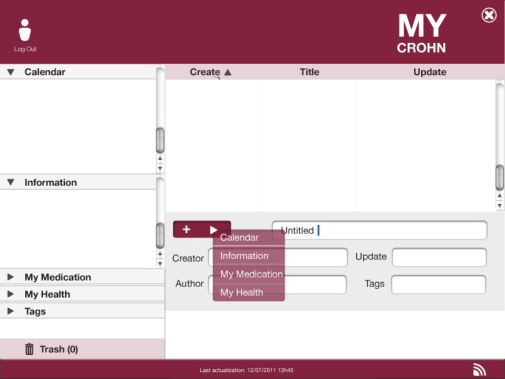
Step 3 – Apply the HSI model to “MyCrohn” as a “User Designer” “Feedback in interaction is the heart of what makes an iterative process useful or even purposeful” (Anderson, McRee, & Wilson, 2010) and as a part of direct involvement of people in collaborative environment that we can define as participatory design phase, it was define a initial process to give the first inputs about the interface’s usability of “MyCrohn” applications. The methods of iterative design share one basic idea: there's no one perfect user interface design and we can't get good usability by simply shipping your best idea. Design in the sense that we use it, is a creative problem-solving effort (Anderson et al., 2010) and we have to try and test multiple ideas Competitive, Parallel and Iterative tests are 3 different models to consider iterative design alternatives (Garret, 2003). Combining them, we can get a wide diversity of a low cost than simply sticking to a single approach. For “MyCrohn” paper prototyping, I considered the iterative design because it's the simplest process model like a linear progression with oldest foundations for UCD (User-Centered Design), cheapest – We can iterate in a few hours and strongest, because we can keep going trough many iterations as long as budget allows. Competitive and Parallel testing are normally one-shot components of a design project. The iterative design process includes three phases. For each we’ve to conduct a usability evaluation such as user testing or heuristic evaluation, than revise it based on the usability findings (Jakob Nielsen, 2011):
1st phase: Sketched Wireframes;
2nd phase: Paper/Interactive Wireframe (Table 1);
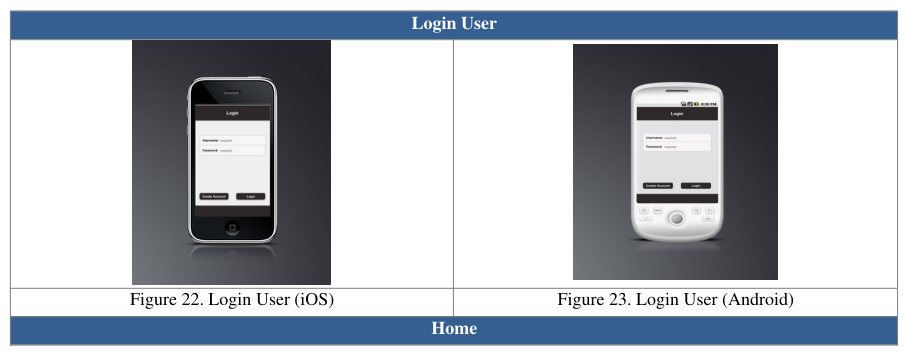
3rd phase: Visual Designs (Table 3 and Table 4).
Table 1: “MyCrohn” Project
Table available in the original PDF paper.
1
Figure 2. Logo draft Figure 3. Colors for each user Desktop Application – User: Doctor
Figure 19. Step 16 Figure 20. Step 17 Figure 21. Step 18 Despite not presenting the wireframes for mobile application “MyCrohn”, we have done the same kind of tests.
Figure available in the original PDF paper.
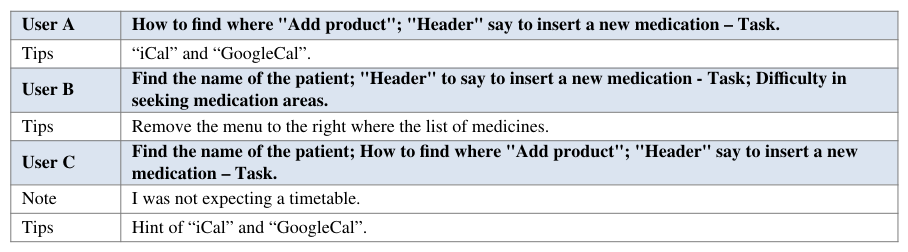
Step 4 – Result of the step 3 – Usability tests
Table 2: Results of the tests (User Feedback) User A How to find where "Add product"; "Header" say to insert a new medication – Task.
Step 5 – Designing the first ideas as a “User Designer”
Table 3: Visual Designs (Mobile application) Login UserFigure 22. Login User (iOS) Figure 23. Login User (Android)
Figure available in the original PDF paper.
Figure 24. User: Patient (iOS) Figure 25. User: Doctor (iOS) Figure 26. User: Family (iOS)
Figure available in the original PDF paper.
Figure 27. User: Patient (Android) Figure 28. User: Doctor (Android) Figure 29. User: Family (Android)
Figure available in the original PDF paper.
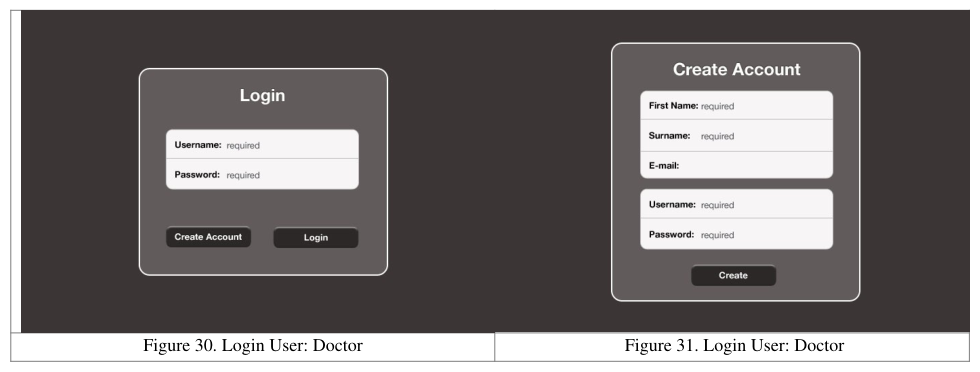
Table 4: Internal hospital interfaceFigure 30. Login User: Doctor Figure 31. Login User: Doctor
Figure available in the original PDF paper.
Figure 32. Login User: Doctor
CONCLUSIONS AND FUTURE WORK According to my Ph.D challenges, which consist on joining different methodologies in two layers, further work was done during the last tree years. A first draft of “MyCrohn” digital interface was developed and tested with users without the disease. During this phase, an initial literature plan was reviewed to obtain the most conclusive possible model: Understanding the difference of being both Designer and Patient, we can concentrate our effective benefits of a new UX interface e-health. By embracing the challenges Design and e-health business, we can redefine HCI more broadly, maybe even signalling the change with a fresh name such as “Human Community Interaction” or even “Human-Social Interaction (HSI)”. This new approach brings researchers to deal with profound scientific questions about individual behaviour, collaborative strategies and community engagement.
The model that was applied to this first stage, it was a most effectively to realize initial empirical analysis is the knowledge of the "User Designer" not outweighed the need for "Patient User" and turn not shuffling with a "User Innovator". Even without statistic analysis, we could conclude that the application of this model helped us to connect all axes. As a "User Designer", ended up making the mistake to draw the first visual approach to existing similar visual patterns. However, it was an important step to get to the right Interface Design, currently being developed. This is what we has proposed, to build a customizable interface with integrated information visualization.
REFERENCES
Abbott. (nd). Crohn Al Dia. Crohn Al Dia - Para Ayudarte. Retrieved December 11, 2013, from http://www.crohnaldia.com/ Abbott. (2011). Crohn Al Dia. Retrieved from https://play.google.com/store/apps/details?id=ar.com.mooral.activities&hl=pt_PT Anderson, J., McRee, J., & Wilson, R. (2010). Effective UI - The Art of Building Great User Experience in Software. O’Reilly Media. APDI. (2012). Associação Portuguesa da Doença Inflamatória do Intestino. Retrieved December 11, 2013, from
http://www.apdi.org.pt/ Baldwin, C., Hienerth, C., & Hippel, E. von. (2006). How user innovations become commercial products: A theoretical investigation and case study. Research Policy, 35(9), 1291 – 1313. doi:http://dx.doi.org/10.1016/j.respol.2006.04.012 Ballegaard, S. A. kke, Hansen, T. R., & Kyng, M. (2008). Healthcare in Everyday Life - Designing Healthcare Services for Daily
Life. Health (San Francisco), 1807–1816. Banks, N. J. (1998). Designing medical record abstraction forms. International Journal for Quality in Health Care: Journal of the International Society for Quality in Health Care / ISQua, 10(2), 163–167. Bardram, J. E. (2005). Activity-based computing: support for mobility and collaboration in ubiquitous computing. Personal and
Ubiquitous Computing, 9(5), 312–322. doi:10.1007/s00779-004-0335-2 Bardram, J. E. (2009). Activity-based computing for medical work in hospitals. ACM Trans. Comput.-Hum. Interact, 16(2), 10:1–10:36. doi:10.1145/1534903.1534907
Curnow, R. C., & Moring, G. G. (1968). “Project sappho”: A study in industrial innovation. Futures, 1(2), 82–90.
doi:10.1016/S0016-3287(68)80001-1 Diario de Crohn. (2011). Retrieved from https://play.google.com/store/apps/details?
id=com.letshealth.diariodecrohn.activities&hl=pt_PT Garret, J. (2003). The elements of user experience: User-Centered design for the web (1st ed.). Berkeley CA: New Riders. Hassenzahl, M., Eckoldt, K., & Thielsch, M. T. (2009). User Experience und Experience Design - Konzepte und Herausforderungen (Usability Professionals.). Fraunhofer-Verlag. Retrieved from http://pubpsych.zpid.de/pubpsych/Search.action?search=&q=ISBNO=%22978-3-8396-0043-6%22&stats=LNK Hawthorn, D. (2000). Possible implications of aging for interface designers. Interacting with Computers, 12(5), 507–528.
doi:10.1016/S0953-5438(99)00021-1 Johnson, C. M., Johnson, T. R., & Zhang, J. (2005). A user-centered framework for redesigning health care interfaces. Journal of Biomedical Informatics, 38(1), 75–87. doi:10.1016/j.jbi.2004.11.005 Korteling, J. E. (Hans). (1994). Effects of Aging, Skill Modification, and Demand Alternation on Multiple- Task Performance.
Human Factors: The Journal of the Human Factors and Ergonomics Society, 36(1), 27–43. doi:10.1177/001872089403600102 Kulkarni, P., & Öztürk, Y. (2007). Requirements and design spaces of mobile medical care. ACM SIGMOBILE Mobile Computing and Communications Review, 11(3), 12–30. doi:10.1145/1317425.1317427 Luo, J. (2008). Mobile Computing in Healthcare: The Dreams and Wishes of Clinicians. In Proceedings of the 2Nd International
Workshop on Systems and Networking Support for Health Care and Assisted Living Environments (pp. 1:1–1:4). New York, NY, USA: ACM. doi:10.1145/1515747.1515749 Mackay, W. E., & Fayard, A.-L. (1997). HCI, Natural Science and Design: A Framework for Triangulation Across Disciplines.
In Proceedings of the 2Nd Conference on Designing Interactive Systems: Processes, Practices, Methods, and Techniques (p. 12). Amsterdam, The Netherlands: acm. doi:10.1145/263552.263612 Mahlke, S. (2008). HF: User Experience of Interaction with Technical Systems Theories, Methods, Empirical Results and Their Application to the Development of Interactive Systems. Saarbrücken: VDM Verlag Dr. Müller. McMillan, S. J. (2002). Exploring models of interactivity from multiple research traditions: Users, documents ans systems.
London: SAGE Publications, Inc. Medivo Inc. (2009). WellApps. Retrieved December 11, 2013, from http://www.wellapps.com/ Medivo Inc. (2013). GI Monitor. Retrieved from https://itunes.apple.com/us/app/gi-monitor/id315539155 Nielsen, J. (1998). How Many Test Users in a Usability Study? Nielsen Norman Group. Evidence-Based User Experience Research, Training, and Consulting. Retrieved February 21, 2014, from http://www.nngroup.com/articles/how-many- test-users/ Nielsen, J. (2005). Medical Usability: How to Kill Patients Through Bad Design. Nielsen Norman Group. Retrieved December
11, 2013, from http://www.useit.com/articles/medical-usability/ Nielsen, J. (2011). Parallel & Iterative Design + Competitive Testing = High Usability. Nielsen Norman Group. Retrieved December 11, 2013, from http://www.useit.com/articles/parallel-and-iterative-design/ Nielsen, J. (n.d.). Usability Metrics How to Measure. Retrieved from http://www.useit.com/alertbox/20010121.html Nielsen, J., & Faber, J. M. (1996a). Improving system usability through parallel design. Computer, 29(2), 29–35. doi:Parallel
Design Nielsen, J., & Faber, J. M. (1996b). Improving system usability through parallel design. Computer, 29(2), 29–35.
doi:10.1109/2.485844 Norman, D. A. (2004). Emotional Design. New York: Basic Books. Olson, G., Mark, G., Churchill, E., & Rotman, D. (2010). New Missions for a Sociotechnical Infrastructure. Computer, 43(11), 37–43. doi:10.1109/MC.2010.321 Parameswaran, L., & Raijmakers, J. (2011). People-focused innovation in healthcare. Philips Design. Retrieved December 11,
2013, from http://www.design.philips.com/philips/shared/assets/design_assets/pdf/nvbD/july2010/ people_focused_innovation_in_healthcare.pdf PARC, a Xerox company. (2002). Retrieved December 11, 2013, from http://www.parc.com/ Pernencar, C. A. (2013). My Crohn’s diease on real time information. In 2013 IEEE 2nd International Conference on Serious Games and Applications for Health (SeGAH) (pp. 1–7). doi:10.1109/SeGAH.2013.6665304 Russell, D. M., & Weiser, M. (1998). The Future of Integrated Computing in Combined Design of Ubiquitous Real & Virtual
Worlds. Lecture Notes in Computer Science, (April), 275–276. Saffer, D. (2007). Designing for Interaction - Creating innovative applications (1st ed.). Berkeley CA: New Riders. Schulze, K., & Krömker, H. (2010). A Framework to Measure User Experience of Interactive Online Products. Technology. Shneiderman, B. (2011). Technology-mediated social participation: the next 25 years of HCI challenges. In Proceedings of the 14th international conference on Human-computer interaction: design and development approaches - Volume Part I (pp. 3–14). Orlando, FL: Springer-Verlag. Shneiderman, B., Plaisant, C., Cohen, M., & Jacobs, S. (2009). Designing the User Interface: Strategies for Effective Human-
Computer Interaction (5th ed.). Prentice Hall. SickKids. (2011). myIBD. Retrieved from https://itunes.apple.com/us/app/myibd/id444728980 SPG. (nd). Sociedade Portuguesa de Gastroenterologia. Retrieved December 11, 2013, from http://www.spg.pt/ Stefik, M., Foster, G., Bobrow, D. G., Kahn, K., Lanning, S., & Suchman, L. (1987). Beyond the Chalkboard: Computer Support for Collaboration and Problem Solving in Meetings. Commun. ACM, 30(1), 32–47. doi:10.1145/7885.7887
Tufte, E. (1990). Envisioning Information. Graphics Press USA. Von Hippel, E. (1976). The dominant role of users in the scientific instrument innovation process. Research Policy, 5(3), 212–
239. doi:10.1016/0048-7333(76)90028-7 Weiser, M. (1991). The Computer for the 21st Century. Communications, 3(3). West, M. T. (2011). Ubiquitous Computing. In Proceedings of the 39th Annual ACM SIGUCCS Conference (pp. 175–182). New York, NY, USA: ACM. doi:10.1145/2070364.2070410
LISTED IN THE AHFE DIGITAL BOOKSTORE CATALOGUE
Explore the complete digital volume
Advances in Ergonomics In Design, Usability & Special Populations: Part I
Read this individual research paper free through the original publisher, or explore the full digital proceedings book.
ISBN 978-1-4951-2106-7
Explore this ISBN in the AHFE Bookstore ↗Listed in the July 2026 bookstore catalogue; search by ISBN to confirm current availability · Digital book purchase optional