Takahiro Uchiyama, Daigoro Yokoyama, Yusuke Fukuda, Miyuki Yagi, Miwa Nakanishi (2022). Does Spectacle-Type Wearable Display Improve Efficiency and Safety? : An Experimental Evaluation of Practical Use. In: Advances in Ergonomics In Design, Usability & Special Populations: Part I. AHFE Open Access, vol. 18. https://doi.org/10.54941/ahfe100816
In this study, we experimentally evaluated the effectiveness of using a spectacle-type wearable display (SWD) to enhance safety and efficiency. Particularly, we aimed to understand whether the use of SWDs instead of small monitors in medicine or aviation will improve task accuracy and efficiency and to what extent. Specifically, we applied an SWD for operating an object while watching an image displayed on the monitor, and we investigated the effect of using SWDs as an alternative to small monitors via simulation experiments. We focused on efficiency and safety, and found that safety improved by 24% and efficiency by 8%–29%. The effectiveness of the SWD is larger in case where the position of the small monitor makes operating the object difficult.
Spectacle-type wearable displays (SWDs) are expected to see considerable market growth. The diversification of SWDs depending on the application is also expected. In particular, SWDs that do not block the field of view of the user and overlay information are expected to find use in many applications related to work assistant. Introduction of SWDs to inspection and preparation activities is expected and the verification of their use has been carried out via simulation experiments (Nakanishi et al., 2003, 2005) (Yamazaki et al., 2013). An SWD enables users to have access to information when they need it. For example, in assembly lines and wiring work, the use of an SWD allows the user to access instruction manuals and procedures, thus avoiding the need to use conventional paper media and stationary terminals (Caudell et al., 1992) (Nakano et al., 2006) (Nakanishi et al., 2008). In the aviation and medical fields, where safety is paramount, the application of SWDs has been proposed (Andrei et al., 1996) but no specific verification results or discussion of benefits exist (Muramatsu et al., 2008). With the introduction of the element of human interface, the degree of difficulty increases and the lack or delay in such studies is attributed to the higher safety and performance requirements in the medical and aviation fields. However, significant improvement in the hardware and changes in the business environment in the medical or aviation industry are making introduction of SWDs possible.
In this study, we experimentally evaluate the effectiveness of using SWDs in medicine and aviation in order to enhance safety and efficiency. Particularly, we aim to understand whether using an SWD will improve the accuracy and efficiency of the work done otherwise.
METHOD
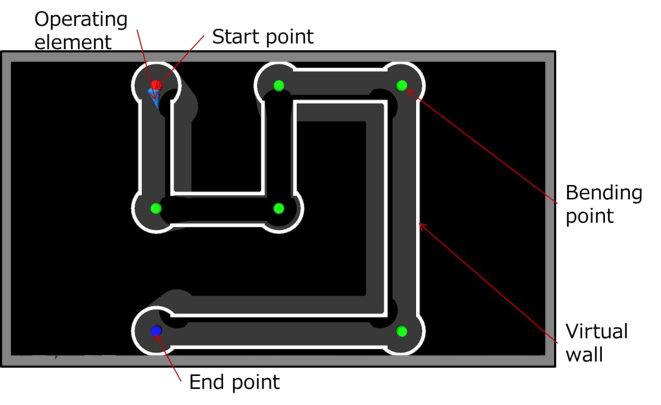
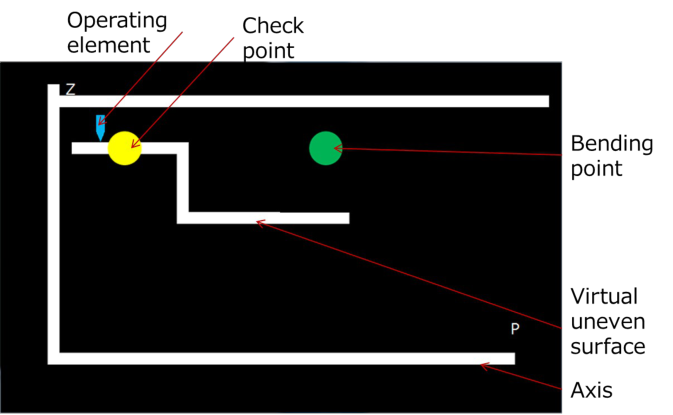
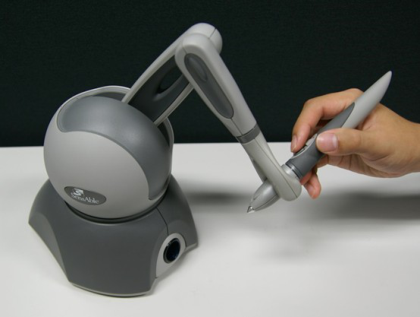
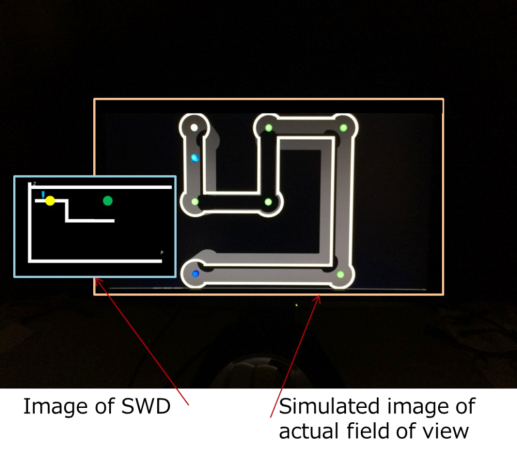
Experimental Tasks We simulated performing an operation while obtaining video information for parts that cannot be directly viewed. We used images viewed from above a labyrinth formed by two parallel walls (Figure 1) as the actual field of view; the operation was simulated on a 23 inch display (Diamond Crysta RDT 23IWM, MITSUBISHI, 28°34′5″ × 16°17′55″). In addition, we used images viewed laterally on a portable 7 inch monitor (HM-TL7T, Hanwha Q CELLS Japan, 17°37′17″ × 9°56′ 39″) (Figure 2). The starting point of the route is shown in red and the end point in blue. Bending points, shown in green and that could be seen in the real field of view, were placed between the starting and end points. Furthermore, virtual irregularities were placed along the route, which could be seen in the portable monitor. There were five checkpoints indicated by yellow in the middle of the route and they could also be seen in the portable monitor. The task was to move the operating element from the starting to the end point without touching the floor and the walls, while checking successively the image in the portable monitor and the real field image. However, it was required to touch all the checkpoints. The image displayed on the portable monitor was the section from one bending point to the next, and we could switch to the image of the next section by touching the bending point. The operating element was controlled by a three-dimensional input device (Phantom Omni, 3 D, Inc. Figure 3). When the operating element touched the floor or the walls, the three-dimensional input device was programmed to present a reaction force, which was experienced physically by the subjects.
Figure 1. Example of the simulated video of the actual field of viewFigure 2. Example of the presentation image of the SWD or monitorFigure 3. Three-dimensional input device
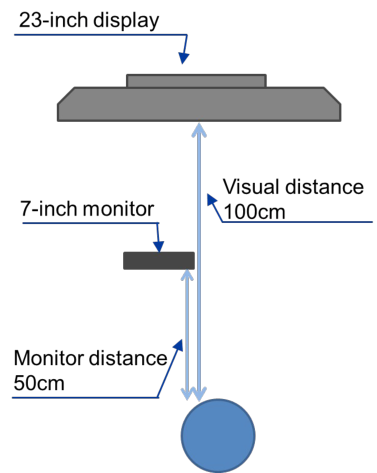
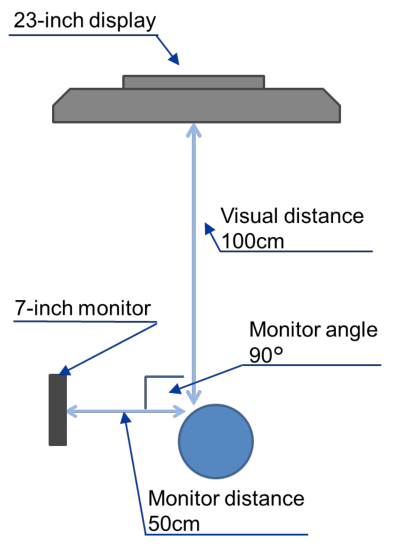
Experimental conditions For the aforementioned tasks, the following experimental conditions were set in order to examine how the performance of the subject changes when we replace the portable monitor with the SWD. In Case 1, the portable monitor was positioned in front but slightly off the subject's eyes, opposite to the real field of view image (Figure 4). In Case 2, the portable monitor was positioned in such a manner that the subject must move his/her head to view it (Figure 5). In both cases, the distance of vision to the portable monitor was the same (50 cm). In Case 3, the image shown on the portable monitor was also shown on an SWD of a monocular see-through-type terminal (Air Scouter, Brother Industries, Ltd.). The use of SWD allows the subject to view the see-through-type terminal image (17°37′ × 9°56′) of the equivalent 7 inch monitor at the viewing distance of 50 cm (Figure 6).
Figure 4. Condition where the monitor is positioned in front of user’s eyeFigure 5. Condition where the monitor is positioned on the left sideFigure 6. SWD image in the real field of view
Participants The subjects were 24 male and female adults (average age 21.92 years, SD 0.86 years) with no vision problems. We established the dominant eye of the subjects in advance by the hole-in-card test. The subjects wore the SWD on the dominant eye. We also installed the portable monitor in front and on the side of the field of view.
Experimental Procedure
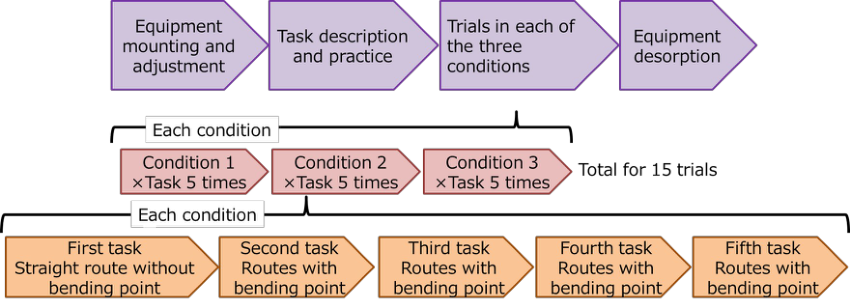
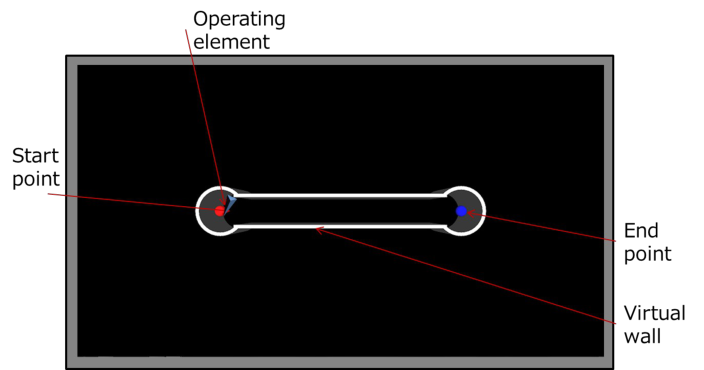
Figure 7 shows the experimental procedure. After the subjects received training for the task, they practiced by using the route. After we confirmed that the subjects could perform the task, the subjects performed the task five times under the previously mentioned experimental conditions. In addition, efforts were taken to offset the order effect of the three conditions. In all cases, the subjects first followed straight routes without bending points (Figure 8) and then followed routes with bending points four times. In addition, we unified the distance from start to end and the number of bending points, and we changed the location of the checkpoints and bending pattern each time making the route followed by the subjects different.
Figure 7. Experimental procedureFigure 8. Image of the actual field of view without a bending point
Experimental Environment The subjects sat in front of the 23-inch display, which showed the actual field of view image, and operated the three- dimensional input device manually. Then, we adjusted the height of the chair to bring the line of sight of the subject at the center of the 23-inch display. The average interior luminance was 3.22 lx during the experiment.
Ethics We obtained the informed consent of the participants and we encrypted the data.
DATA ANALYSIS We analyzed the subjects’ performance to obtain a measure of the efficiency and safety in using SWD. We treated the time needed to end the task as an indicator of efficiency, and the number of times the subjects accidentally touched the floor or walls as an indicator of safety. In addition, we standardized the task performance because we anticipated differences owing to the individual subjects. The standardization was carried out separately for each condition of route without bending points and route with bending points.
: integrated value for each task performance and all conditions experienced by each subject : average integrated value for each task performance and all conditions experienced by each subject
: standard deviation of the integrated value for one subject : Z-score
RESULTS
Task performance and efficiency
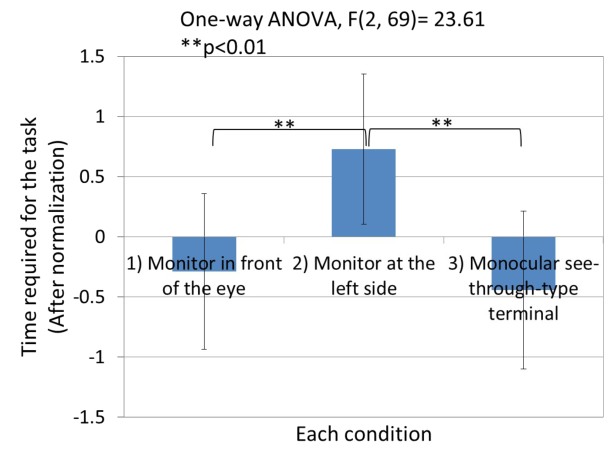
Figure 9 shows the time required for completing the route without bending points, which is the first task for each condition. Figure 10 shows the time required for completing the routes with bending points, which were second to fifth tasks for each condition. In addition, the index value is the value after the aforementioned normalization is Ergonomics In Design, Usability & Special Populations I (2022) completed. The time required for performing the task when the portable monitor was placed in front and when using the SWD was significantly shorter than when the monitor was placed at the left side. When we compared cases 1 and 3, we confirmed the reduction in time for case 3 for routes with bending points, whereas there was no significant difference between them for routes without bending points. It was more difficult to alternate between the portable monitor and the actual view for routes with bending points than for routes without bending points. When we compared the use of the SWD and the portable monitor in front, we found no significant difference; however, tasks that require frequent alternating of views were affected.
For routes with bending points, the time required for case 3 is 92% of the time needed for case 1 and 79% of the time for case 2. For routes without bending points, the time required for case 3 is 71% of the time needed for case 2.
Figure 9. Time required for each condition (route without bending points)Figure 10. Time required for each condition (route with bending points)
Figure available in the original PDF paper.
Task performance and safety
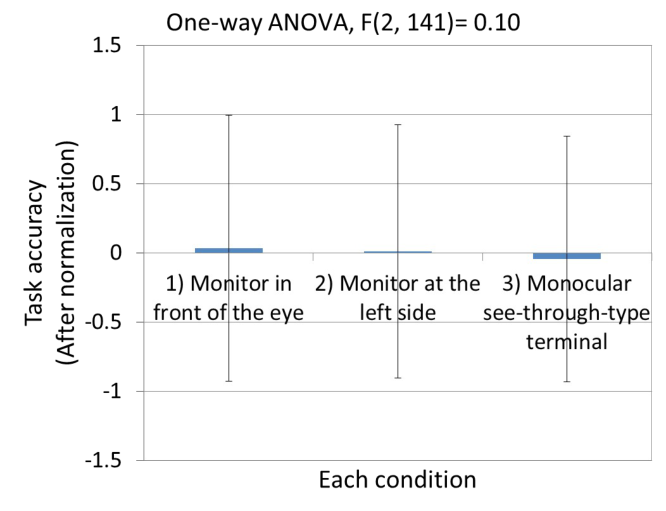
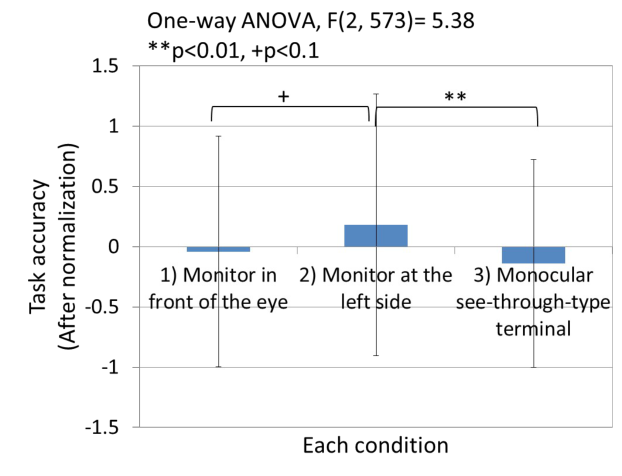
Figure 11 shows the number of times the floor or walls were touched for routes without bending points. Figure 12 shows the number of times the floor or walls were touched for routes with bending points. The index value is the value after normalization. No difference was seen between the routes without bending points; however, the number of contacts for case 3 was significantly lower than case 2 for routes with bending points. Therefore, when the portable monitor is positioned away from the objects of vision, the subjects were forced to frequently change views. Thus, we suggest that the errors will decrease by introducing the spectacle-type terminal.
For routes with bending points, the number of contacts for case 3 is 76% of the number for case 2.
Figure 11. Task accuracy for each condition (route without bending points)Figure 12. Task accuracy for each condition (route with bending points)
DISCUSSION
We expect increase in efficiency and safety when an SWD is introduced in situations where the monitor is placed away from the object of vision and for tasks that require frequent changes of view. For tasks that do not require frequent view changes, as long as the portable monitor is close to the objects of vision, we found that the SWD is not necessary. The results suggest the following for medical or aviation applications. First, we expect that the introduction of a spectacle-type terminal will result in 24% improvement in safety and 8%–29% in efficiency relative to conventional methods. The introduction of such new devices incurs costs; hence the data will be useful for evaluating the cost-effectiveness. In the case of using a portable monitor, the position never affects the safety and efficiency when using an SWD.
CONCLUSIONS
In this study, we aimed to study the task of operating an object while watching an image on a monitor and we investigated the use of SWDs as an alternative to small monitors via simulation experiments. We focused on efficiency and safety, and concluded that safety improves by 24% and efficiency by 8%–29% compared with the conventional methods. The effectiveness of the device is larger when the small monitor is not positioned at favorable locations.
To date, the introduction of SWDs in the medical or aviation field has not been considered as much as factories, for example, but the results suggest that this is an effective method for increasing the efficiency and safety, and will help decision-making in real life. Despite the difficulties, we anticipate that the use of such devices in the medical or aviation field will increase in the future.
REFERENCES
Andrei, S., Mark, A.L., William, F.G., Gentaro, H., Mary, C.W., Etta, D.P., Henry, F. (1996), “Technologies for Augmented Reality Systems: Realizing Ultrasound-Guided Needle Biopsies”, SIGGRAPH '96 Proceedings of the 23rd annual conference on Computer graphics and interactive techniques, pp.439-446. Caudell, T.P., Mizell, D.W. (1992), “Augmented reality: an application of heads-up display technology to manual manufacturing
processes”, System Sciences, Proceedings of the Twenty-Fifth Hawaii International Conference, Volume 2, pp.659-669.
Muramatsu, K., Tsukamoto, M., (2008), “Design and Implementation of a Communication Support System with Wearable Devices for Dentistry”, Journal of Information Processing Society of Japan, Volume 49, No.1, pp.11-18. Nakanishi, M., Okada, Y., (2003), “An Experimental Study on the Possibility of Applying a Monocular See-Through Head-
Mounted Display to Industrial Work–Dynamic Control in Augmented Reality-”, The Society For Industrial Plant Human Factors of Japan, Volume 8, No.1, pp.26-33. (in Japanese) Nakanishi, M., Okada, Y., (2005), “Application of augmented reality with a monocular see-through head-mounted display for VDT work–A study through an experiment simulating the radar monitoring task in air traffic control–”, Japan Ergonomics Society, Volume 41, No.4, pp.218-227. Nakanishi, M., Tamamushi, S., Okada, Y., (2008), “Feasibility study for establishing a design guideline of manuals with
Augmented Reality: verification and expansion of the basic model that provides "effective complexity",”, The Society For Industrial Plant Human Factors of Japan, Volume 13, No.1. Nakanishi, M., Ozeki, M., Akasaka, T., Okada, Y., (2007), “Human Factor Requirements for Applying Augmented Reality to Manuals in Actual Work Situations”, the 2007 IEEE International Conference on SMC (Systems, Man, and Cybernetics), on CD-ROM. Nakano, M., Odagiri, S., Mori, H., Isono, H., (2006), “Comparison of PC Assembly Work Using Monocular See-through HMD
and Instruction Manual”, Japan Ergonomics Society, Volume 42, pp.366-367. Yamazaki, K., Shibata, T., Kimura, A., Tamura, H., (2013), “Application of Mixed Reality Technology to Order Picking for Warehouse Storage”, Proceedings of the Virtual Reality Society of Japan, Annual Conference 18, pp.196-199.
LISTED IN THE AHFE DIGITAL BOOKSTORE CATALOGUE
Explore the complete digital volume
Advances in Ergonomics In Design, Usability & Special Populations: Part I
Read this individual research paper free through the original publisher, or explore the full digital proceedings book.
ISBN 978-1-4951-2106-7
Explore this ISBN in the AHFE Bookstore ↗Listed in the July 2026 bookstore catalogue; search by ISBN to confirm current availability · Digital book purchase optional