Daigoro Yokoyama, Takahiro Uchiyama, Yusuke Fukuda, Miyuki Yagi, Miwa Nakanishi (2022). Analysis of a Spectacle-Type Device for Rapid Visual Referencing. In: Advances in Ergonomics In Design, Usability & Special Populations: Part I. AHFE Open Access, vol. 18. https://doi.org/10.54941/ahfe100815
This study investigates a reference form through which the user shifts his main eyesight view to the ancillary information presented by a monocular see-through head-mounted display (HMD) within a short time. The system requires only “glance” at ancillary information. Assuming that the HMD is applied for short-time referencing at any time, we hypothesize that the optimal position of the presented auxiliary information is the equilibrium point, where the referencing efficiency is traded against the complexity of the visual field. Besides presenting our proposed design, we experimentally verify this hypothesis in the current study. In the experiment, the optimal position of information presentation is evaluated from the time required to glance at HMD-presented information and from task performance, which relates to the complexity of the visual field. The optimal position was neither the periphery nor the center of the visual field but was shifted by 15° in the horizontal direction (external angle) from the center of the visual field.
With the recent expansion of the mobile device market, increasing demand for spectacle-type wearable displays (SWDs) is expected. Users of SWDs operate chiefly with their normal vision and can readily retrieve information when required. Supporting information, such as work procedures, should be continuously available to industrial workers. Therefore, in this study, we have designed a reference form that enables the user to shift his viewpoint from the main eyesight to the ancillary information presented by a monocular see-through head-mounted display (HMD) within a short time. In this system, the user needs to only “glance” at the necessary ancillary information (hereafter, we refer to our form as “short reference at any time”).
Conventionally, material can be referenced at any time from paper or stationary information terminals. However, several studies have suggested that replacing these terminals with HMDs will improve work efficiency (Caudell et al., 1992) (Nakanishi et al., 2007) (Tanuma et al., 2012), chiefly because the ancillary information is consistently presented in the same field of view of the work object. Therefore, viewpoint movement while referencing the material can be saved. On the other hand, ancillary information may be cluttered by irrelevant information captured in the field of view, which may be problematic (Nakano et al., 2006).
We can consider that saccade eye movement occurs during short-time HMD referencing at any time. The time required for saccade motion, when changes in the dynamic characteristics occur according to various conditions (Gisbergen et al., 1981), generally depends on the distance and direction (Westheimer, 1954) (Ebisawa et al., 1997). From this knowledge, we can consider that when the reference object is positioned at or nearby the center of the visual field, the efficiency of short-time referencing will be enhanced. Given that retinal ganglion cells are most densely packed at the fovea (Curcio, 1990), users acquire large quantities of visual information at the center of their visual field (Watabe et al 1975). Therefore, although the ancillary information is rendered more obvious when centralized in the visual field, the advantages are offset by the visual complexity if the presented objects do not require a reference. Therefore, we consider that a tradeoff exists between the efficiency of short-time referencing and complexity of the visual field. This tradeoff implies an optimal distance that is offset from the center of the visual field. In fact, some commercially available HMDs are designed to avoid the central visual field when the user views an image, although the designs vary among manufacturers. To date, the best location for video presentation has not been investigated.
Therefore, in this study, assuming that a HMD is adopted for short-time referencing at any time during work, we hypothesize that the optimal position for presenting auxiliary information is the equilibrium point where the reduction in the referencing efficiency is exactly offset by enhanced simplicity of the visual field. We experimentally verify this hypothesis and propose a design.
METHOD
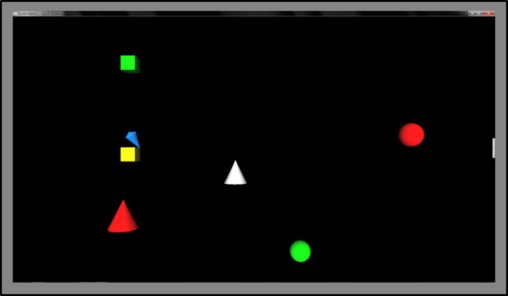
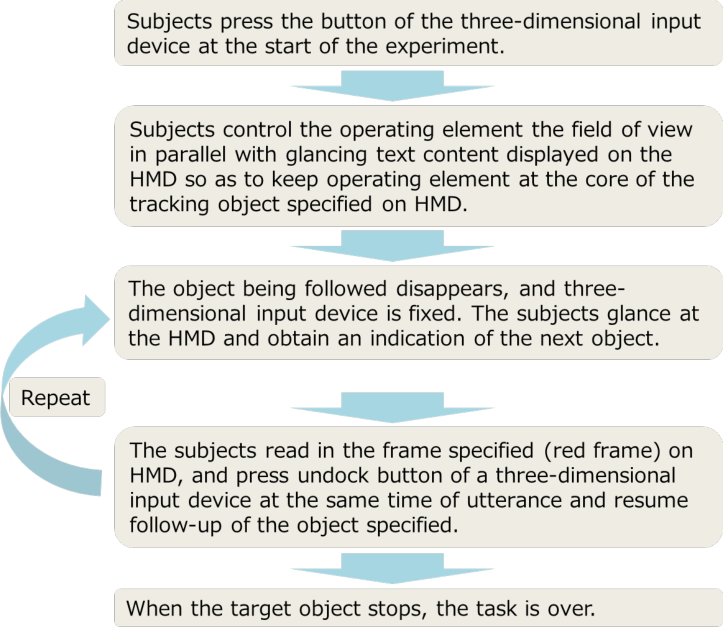
Experimental Task During the experiment, it was proposed that users should glance at supporting information displayed on the HMD only while operating on real targets in a work space. First, the subjects were seated in front of a 23-inch display (Diamond Crysta RDT 23IWM, Mitsubishi). Using their normal vision, they were requested to chase an object moving across the display with a three-dimensional input device (Phantom Omni, 3D Incorporated). Among 6 objects randomly moving across the display, the subjects chased objects of specified colors and shapes using three- dimensional directions. Figure 1 illustrates a typical display view during the task. The elements that the subjects controlled by operating the three-dimensional input device are displayed. The subjects were required to retain the tip of the operating element at the center of the tracked object. The 6 objects were presented in different colors (green, yellow, white, and red) and shapes (sphere, cube, and cone). The chased object was made to disappear once the subjects had referenced the HMD (AirScouter, Brother) display for a specified time. The colors and shapes were always enumerated as text in the HMD. After reading these highlighted word sets, the subjects chased the specified object. Figure 2 is an example of the strings that were permanently displayed on the HMD and presented in the field of view of the subject. The font size, decided from the results of previous studies [1], was 0°25′46″, which was easily read by the subjects. The strings comprised 48 symbols describing color and shape combinations, one of which is highlighted in the red frame in Figure 2. The sequence and highlighted symbol set was switched every 15 s so that the subjects could not remember them during tracking tasks. During reference to the HMD, the target object was wiped from the screen; for example, if the highlighted symbol set was “red △,” the subjects recognized the red cone as the next target object. To ascertain that subjects had correctly read the symbol set, they were requested to verbally state the recognized target object. If the target object became lost during a task, the three-dimensional input device was automatically locked. Thus, we could clearly distinguish whether the subject had faced the tracking task or had stopped tracking and consulted the HMD. In follow-up tasks, the subject pressed the unlocking button at the time of reading the symbol set and resumed operation. The time of a single task was 1 min 40 s, with 5 disappearances of the object. The subjects were requested to repeatedly interrupt the tracking task, read the information presented by the HMD, and resume tracking. The flow of a single task is shown in Figure 3.
Figure 1. Image of an actual field of viewFigure 2. Text content displayed on the SWD
Figure available in the original PDF paper.
Figure 3. Flow of a single task
Experimental Environment
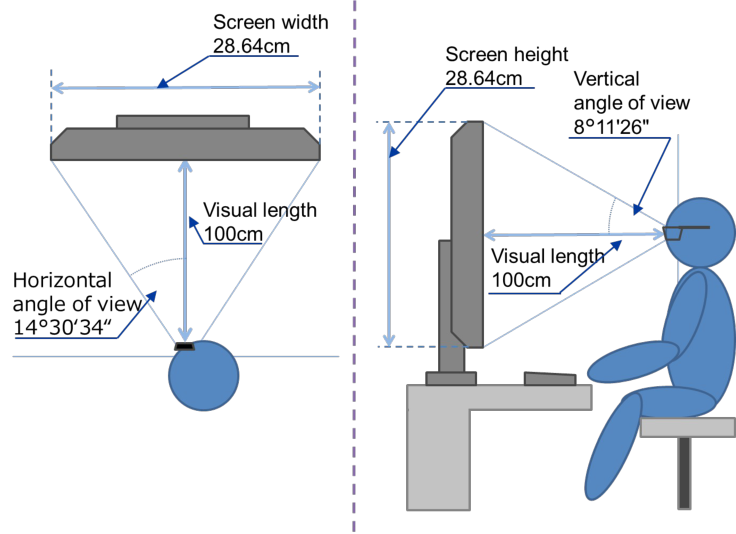
Figure 4 shows the arrangement of the experimental apparatus and subjects. The viewing distance from the subjects to the 23-inch display (simulating the actual field of view) was 100 cm. In addition, to ensure that the center of the visual field of the subject matched the center of the display, we adjusted the height of the chair. The viewing angle of the information presentation area of the display was 28°34′5″ in the horizontal direction (unilateral 14°30′34″) and 16°17′55″ in the vertical direction (unilateral 8°11′26″), as shown in Figure 5. The average interior luminance during the experiment was 3.22 lx.
Figure 4. Experimental environment
Figure available in the original PDF paper.
Figure 5. Viewing angle to the display
Participants Twenty-four adults [average age: 21.3 ± 1.29 (SD) years; range: 19–24 years] with no vision problems participated in the study. Because all subjects were right-eye dominant (evaluated by the hole-in-card test), the HMD was mounted at the left eye side, as reported in previous studies [2].
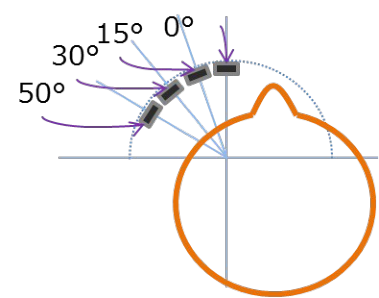
Experimental Conditions Positional information by the HMD was presented as 8 patterns mimicking the information-receiving characteristics of human vision. This information comprised 4 patterns [(15°, 0°), (8°, 0°), (−10°, 0°), (−40°, 0°)] in the vertical direction (Figure 6) and 3 patterns [(0°, 15°), (0°, 30°), (0°, 50°)] in the horizontal direction (Figure 7), where the center of the visual field is (0°, 0°). Viewing directions were changed by repositioning the HMD adjuster in the vertical direction and the HMD frame in the horizontal direction. In each condition, the viewing angle of the information presented on the HMD was fixed (at approximately 14°24′ × 10°48′).
Figure 6. Vertical positions of the presented image
Figure available in the original PDF paper.
Figure 7. Horizontal positions of the presented image
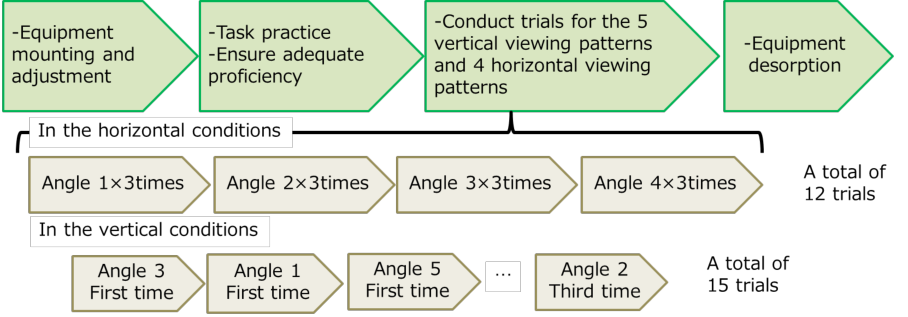
To properly evaluate the efficiency of the experimental performance and to reduce the effect of the viewing sequence, the experiment proceeded through the following steps (Figure 8). Prior to an experimental run, the subjects repeatedly practiced the tracking task. We confirmed that increasing proficiency did not alter performance accuracy. The information was then presented to the subjects at different vertical positions. Each subject performed the task 3 times for each of the 5 vertical viewing patterns [the standard condition (0°, 0°) and the 4 vertical patterns described above] in a random order. To offset the order effect, the random order of the 5 viewing patterns was varied in each of the 3 trials. The above procedure was then repeated for the 4 horizontal viewing patterns [the standard condition (0°, 0°) and the 3 horizontal patterns described above]. To offset the order effect, we took a counter balance between the 24 subjects and specified a trial order. In this procedure, the effect of ordering was corrected in the horizontal and vertical directions, although an order effect may have been introduced by viewing from left to right or vice versa. Therefore, we incorporated the standard condition (0°, 0°), which alters the position of information presented in both vertical and horizontal directions, providing a reference during analysis.
Figure 8. Experimental procedure
Measurements To evaluate the efficiency of referencing by the HMD, we measured the time between disappearance of a previously tracked object and the tracking of the next object. Specifically, we recorded the time between automatic locking of the three-dimensional input device (as the n−1th object disappeared) and the unlocking of the device to begin tracking the nth object. Although not all of this time was expended in reading the HMD information; time not spent consulting the HMD was assumed equal under all experimental conditions. In addition, the accuracy of the tracking task was considered to indicate the complexity of the visual field when redundant information was presented on the HMD. Specifically, we recorded the distance between the tip of the operator and the center of the tracked object
(deviation).
Ethics All participants provided informed consent. Data were encrypted to prevent identification.
RESULT
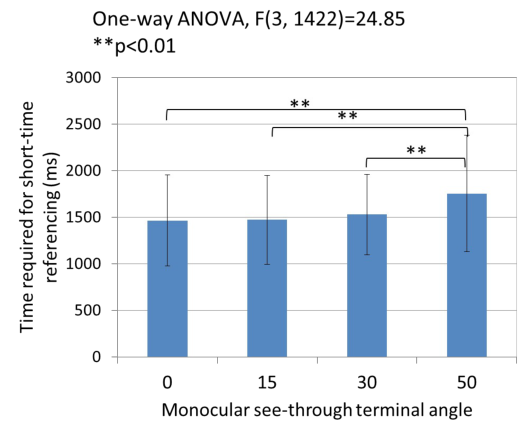
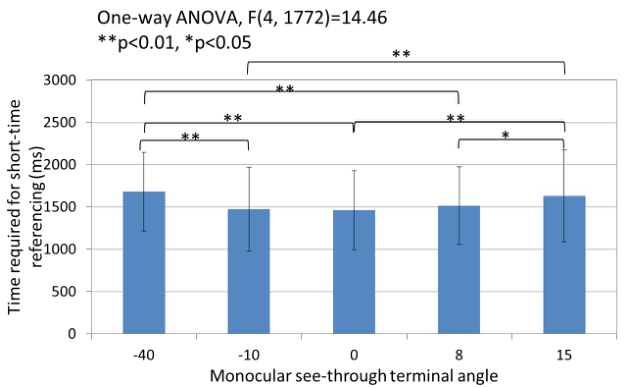
Referencing Efficiency The time of referencing the information presented on the HMD was compared among the viewing patterns. Figures 9 and 10 show the time required for referencing the HMD at different horizontal and vertical positions, respectively. The subjects required significantly more time to reference information at (0°, 50°) than at closer horizontal angles. In the vertical direction, the referencing time was statistically identical at (−10°, 0°), (0°, 0°), and (8°, 0°), but was significantly extended at (−40°, 0°) and (15°, 0°). These results support our hypothesis that the referencing efficiency declines as the information presented by the HMD deviates from the center of the visual field. Furthermore, based on the viewing angle to the display (see Figure 5), the viewpoint of the subject during the tracking task shifted by up to 15° in the horizontal direction (unilaterally) and up to 8° in the vertical direction (unilaterally). This result suggests that the referencing efficiency is generally preserved when the information on a HMD is presented within the range of movement of users’ actual fields of view.
Figure 9. Time required for short-time referencing of HMD information presented at different horizontal anglesFigure 10. Time required for short-time referencing of HMD information presented at different vertical angles Complexity of the Visual Field
To evaluate the accuracy of the tracking task, we integrated the distance between the center of the follow-up object and the tip of the operator recorded for each subject at a given information presentation position. Because individual differences were observed in the accuracy of the tracking task, the data were first normalized as follows and compared among conditions:
,
where x, μ, and σ are the integrated values, average integrated value, and standard deviation of the integrated values, respectively, at each position of the information presented for each subject and Z is the normalized integrated value.
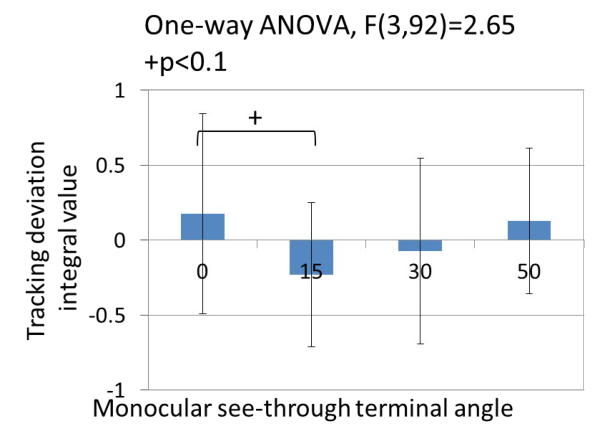
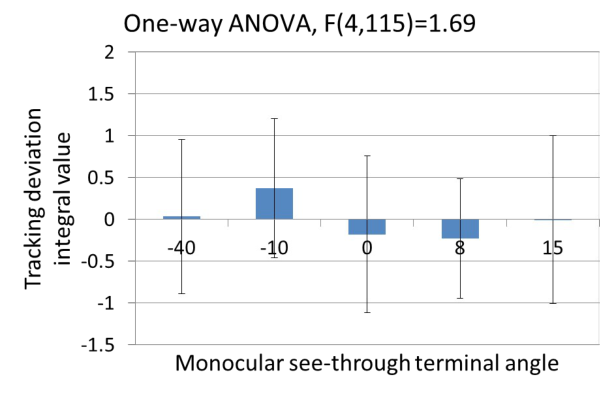
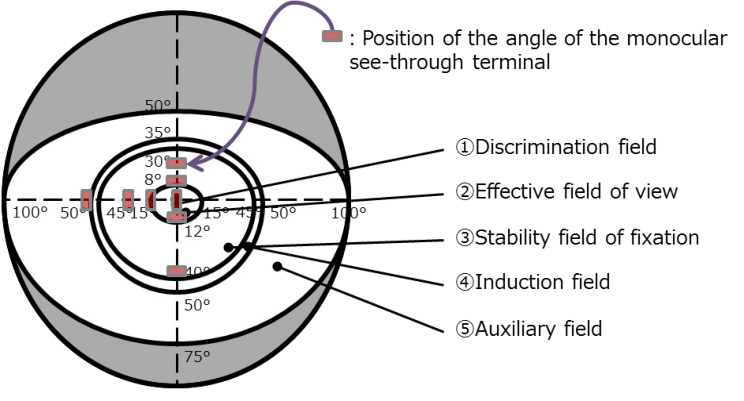
Figures 11 and 12 show the normalized integrated tracking deviation at each presented position in the horizontal and vertical directions, respectively. Smaller deviations imply higher tracking performance. Figure 11 indicates that tracking is considerably more accurate at (0°, 0°) than at (0°, 15°). In the vertical direction, although the differences were not statistically significant, tracking was least accurate at (−10°, 0°) and relatively high at (0°, 0°) and (8°, 0°). These results suggest that the complexity of the visual field relaxes when the information presented by a HMD is viewed at 15° from the center of the visual field (0°, 0°). As the information is presented further from the center of the visual field, no further improvement in the complexity of the visual field occurs. Comparing these results with those of the previous section, we can infer that task performance was degraded by the decreased efficiency of short- time referencing at wider angles. Supporting this inference, the complexity of the visual field was unaltered in the vertical direction, i.e., at (−40°, 0°) and (15°, 0°). Moreover, the complexity of the visual field became relaxed when information was presented at 8° above the center of the visual field, but worsened at the same position below the center of the visual field (at −10°). We suggest that the human eye is designed to receive more information from the depression angles than from the elevation angles, relative to the center of the visual field (see Figure 13). Therefore, we consider that the mid-range vertical direction (−10°, 0°) is related to tracking performance. As mentioned in the previous section, during tracking, the subject ranges his real field of view through approximately 15° in the horizontal direction (unilaterally) and approximately 8° in the vertical direction. Therefore, HMD information presented at (−10°, 0°) is unlikely to inhibit the tracking of the visual target. However, when referencing the HMD from the mid-range horizontal and vertical directions, users may have experienced discomfort in their field of view, with consequent reduction in performance. In fact, after completing the experiment, many subjects reported “obstructive” and “in the middle” as their experiences of referencing the HMD from (−10°, 0°).
Figure 11. Normalized integrated tracking deviation for HMD information presented from different horizontal anglesFigure 12. Normalized integrated tracking deviation for HMD information presented from different vertical anglesFigure 13. Information-receiving characteristics of the human eye
STUDY OF THE OPTIMAL POSITION OF THE INFORMATION PRESENTED IN SHORT REFERENCE AT ANY TIME The previous section analyzed the complexity of the visual field and the referencing efficiency of users glancing at a HMD. A trade-off between referencing efficiency and viewing complexity was not confirmed but was suggested. Therefore, we incorporated both factors into a total evaluation index and attempted a comprehensive determination of the optimal position for HMD information presentation.
First, as mentioned in section 2.4, our experimental procedure could not exclude an order effect between left–right viewing and up–down viewing of the presented information. Therefore, the reference condition (0°, 0°) was incorporated in both horizontal and vertical viewing patterns. Here we examine whether the order effect exists and (if present) to what extent it influences the outcome. To this end, we assume that differences under the same conditions are wholly ascribed to the order effect, and subtract the difference from the results obtained at each horizontal position of information presentation. The corrected values are given by the following equation:
,
where Vall and newVn denote the complete and corrected data, respectively, in the vertical direction. Vn and hn are the average values of n data in the vertical and horizontal directions, respectively, and Sall is the standard deviation of all data (corrected by the vertical data).
The corrected data were then normalized as follows. The field-of-view complexity index and the referencing efficiency were scaled using the standard condition (0°, 0°).
,
where xn and newxn are the data and corrected data, respectively Following the above procedures, we obtained the weighted sum of 1:1 for the field-of-view complexity index and the referencing efficiency. We defined the value which obtained by inverting the sign index value when value increase as a total evaluation index in consideration of both sides.
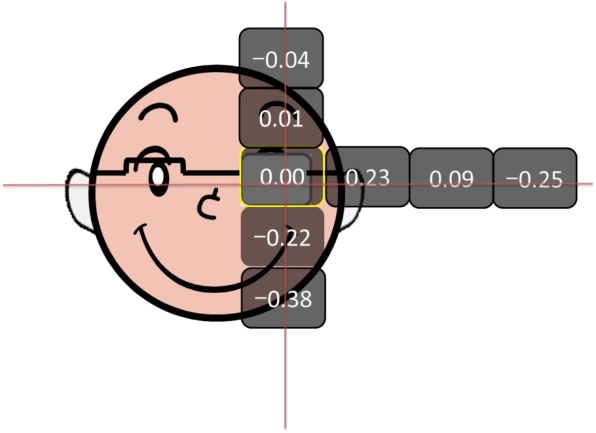
Figure 14 shows the total evaluation index at each position of the presented information. The highest evaluation was obtained at (0°, 15°). On the other hand, at (0°, 50°) and (−40°, 0°), which are significantly far from the center of the visual field, and at (−10°, 0°), which is relatively close to the center of the visual field (0°, 0°), evaluation indexes were low. From these results, we infer that the complexity of view is mitigated without compromising the referencing efficiency when the HMD is horizontally positioned at 15° from the center of the visual field (0°, 0°). This result suggests that an optimal position exists for presenting information on a HMD that can be rapidly accessed by workers.
Figure 14. Evaluation index computed for each position of information presentation
CONCLUSIONS
Assuming that a HMD is available for short-time referencing at any time during working hours, we have focused on the complexity of the visual field and the referencing efficiency. We expect that a trade-off exists between these 2 factors. Therefore, we experimentally determined the optimal position for presenting HMD information that mitigates the complexity of the visual field while preserving performance accuracy. The optimal position was found to be intermediate between the periphery and center of the visual field. Specifically, a horizontal shift of 15° from the center of the visual field yielded the highest evaluation score. As mentioned in the Introduction, rapid referencing of continuously accessible information is a distinct advantage of monocular see-through terminals in industrial applications. The proposal of this study could be adopted in guidelines for terminal designs. However, our approach requires further development. When constructing a comprehensive evaluation index of the field-of-view complexity and referencing efficiency, we weighed both factors equally. This weighing may change with the perceived importance of the visual target and the frequency of viewing. The weighing of ancillary information may also depend on the actual field of view. The appropriateness of defining an optimal position for information presentation will form part of our developmental research.
Wearable terminals have been newly introduced to the market (Fujiwara, 2014), and a wide range of terminals and applications are expected. We propose that ergonomics will play an important future role in the use and design of comfortable and versatile wearable terminals.
REFERENCES
Caudell, T.P., Mizell, D.W. (1992), “Augmented reality: an application of heads-up display technology to manual manufacturing processes”, System Sciences, Proceedings of the Twenty-Fifth Hawaii International Conference, Volume 2, pp.659-669. Curcio, C. A., Sloan, K. R., Kalina, R.E., Hendricson, A. E., (1990), “Human photoreceptor topography”, Journal of
Comparative Neurology, 292, 497-523.
Ebisawa, Y, Ono, R. (1997), “Variability in Saccadic Dynamics under Visual Stimulus and Instruction Conditions” The Institute of Image Information and Television Engineers, Vol.51, No.7, pp.1106-1113. Nakanishi, M., Ozeki, M., Akasaka, T., Okada, Y., (2007), “Human Factor Requirements for Applying Augmented Reality to
Manuals in Actual Work Situations”, the 2007 IEEE International Conference on SMC (Systems, Man, and Cybernetics), on CD-ROM.
Nakano, M., Odagiri, S., Mori, H., Isono, H., (2006), “Comparison of PC Assembly Work Using Monocular See-through HMD and Instruction Manual”, Japan Ergonomics Society, Volume 42, pp.366-367. Tanuma, K, Nomura, M, Nakanishi, M. (2012), “Effect of the Angle of View of a Monocular See-Through HMD on Ease of
getting Information”, Proceedings of the Annual Meeting of Japan Ergonomics Society, Vol. 48spl Van Gisbergen,JA., Robinson, DA., Gielen, S., (1981), “A Quantitative Analysis of Generation of Saccadic Eye Movements by Burst Neurons”, Journal of Neurophysiology, Vol.45, No.3, pp.417-442. Watabe, E., Sakata, H., (1975), “Science of visual”, Photographic industry, pp30-32. Westheimer G., (1954), “Mechanism of Saccadic Eye Movements”, Arch. Ophthalmol, Vol.52, pp.710-724. Fujiwara, N., (2014), “First year of wearable terminal”, The Sannkei Shimbun, 2014.2.17-27,
LISTED IN THE AHFE DIGITAL BOOKSTORE CATALOGUE
Explore the complete digital volume
Advances in Ergonomics In Design, Usability & Special Populations: Part I
Read this individual research paper free through the original publisher, or explore the full digital proceedings book.
ISBN 978-1-4951-2106-7
Explore this ISBN in the AHFE Bookstore ↗Listed in the July 2026 bookstore catalogue; search by ISBN to confirm current availability · Digital book purchase optional