Wang Zelonga, Eriko Aibab, Soutatsu Kanazawac, Tomoko Otad (2022). Numerical Analysis on The way of Tea Between Expert and Non-Expert. In: Advances in Ergonomics In Design, Usability & Special Populations: Part I. AHFE Open Access, vol. 18. https://doi.org/10.54941/ahfe100802
1 Department of Advanced Fibro-Science, Kyoto Institute of Technology, Kyoto, 6068585, Japan ↗
2 Graduate School of Information Systems, The University of Electro-Communications, Tokyo, 1828585, Japan c Urasenke Konnichian Tea workshop, Kyoto, 6028241, Japan ↗
In this paper, the processes of Japanese ‘the way of tea’ making by expert and non-expert were investigated. The bubble form and distribution states after 100% and 50% of tea making finishing time were recorded and analyzed through numerical processing. In order to verify the relationship between the bubble distribution and the tea making motion, the whole tea making processes by expert and non-expert were record and compared by high-speed camera. Consequently, it can be concluded that expert can efficient way to make a perfect Japanese tea.
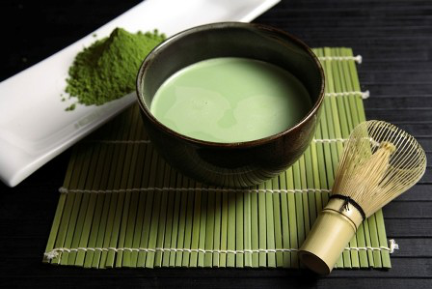
Japan is the third largest advanced economies all around the world, which primarily focused on electrical product and high technical innovation, but also a country inspires people’s etiquette cultivation and traditional culture respect. The long Japanese ancient culture accumulated a number of traditional artistic activities including the way of tea (“Chado”), flower arrangement, “Kendo” and so on. Japanese tea is developed based on "daily after-meal" as shown in Figure 1. “The way of tea” is a special art performance to entertain the guests, through the tea ceremony Ergonomics In Design, Usability & Special Populations I (2022) people will achieve temperament, improve the cultural quality and aesthetic view. Tea ceremony is consisted of many specific and strict procedures, whose basic skill just only handed over by oral instructions by expert. However, until now the scientific explanation for the detail process skill is limited. Therefore, it is valuable to conduct some scientific comparison and motion analysis to keep this country cultural treasure and inherit to the next generation effectively.
In this research, beginner and expert with different experience years were employed as the behavior subject. During “the way of tea” performance, one the one hand, both beginner and expert’s motion and trace were captured by High-speed camera; on the other hand, the difference of formed bubbles distribution and degree on the tea surface between expert and beginners were inspected and compared as well. The relationship between the bubble distribution and "motion" analysis was discussed. Base on the motion record during tea ceremony process, each process’s point of expert and beginner were focused, motion feature affect on bubble distribution were extracted and analyzed according to each process. It is deserved to find that expert’s action quicker but accurate, focus longer but shift to next action without hesitation, which provided a beauty of the reliant environment for the guests rather than non-expert. Furthermore, the bubble form and distribution states after 50% and 100% of tea making time described and transferred by numerical processing. As well known, forming process is very critical for the way of tea as a tasty tea would depend on the bubble size, distribution and so on. It is notify that both expert and non-expert made up the bubble distribution area widely at the first half of tea ceremony finishing time. Especially, expert was able to perform faster agitation speed at the first half making time and make the bubble smaller on finished tea surface finally, which showed a strong evidence of a good taste for expert’s tea.
In a word, this study was focus on the relationship between the bubble distribution and the tea stirring speed during the way of tea process between expert and beginner. Through numerical processing and analyzing, expert’s motional differences and characteristic on the way of tea were revealed and also delivered some certain motion skills for beginners consequently.
Figure 1. The way of tea
EXPERIMENT Subjects
Two Japanese tea masters from Kyoto were employed as the participants in this study. One of them was called expert with more than 30 years experience in ‘the way of tea’, who can keep the motion of scooping water and ensure the added water weight in the bowl nearly the same for each tea making process. The another participant was called non-expert who has 20 years experience in ‘the way of tea’.
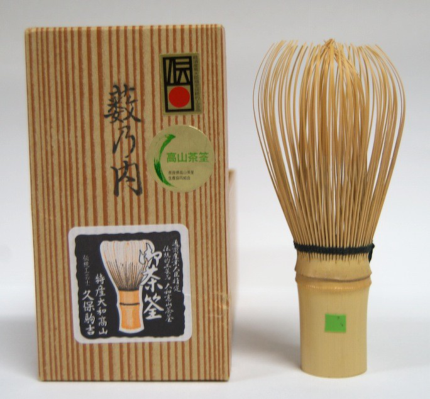
Instrument One Japanese tea whisks were selected for proceeding the experiment called as ‘Yabunochi’, which were the one of
Ergonomics In Design, Usability & Special Populations I (2022) most popular tea whisks in Japan as shown in Figure 2.
Figure 2. The tea whisks of ‘Yabunochi’
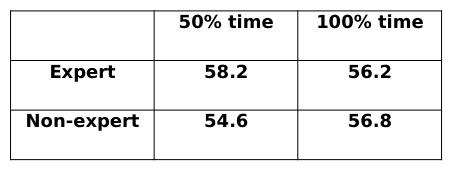
Experiment process 1.5g of matcha tea power and approximate 56 g of hot water were dumped into the bowl, and the moisture content of tea was controlled at approximately 97% steadily. The weight of hot water was illustrated in Table 1.
Table 1: The weight of the hot water in each trial (g) 50% time 100% time
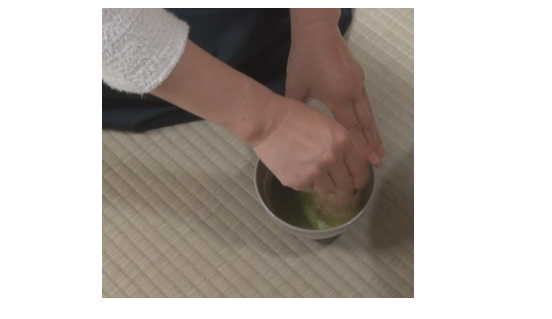
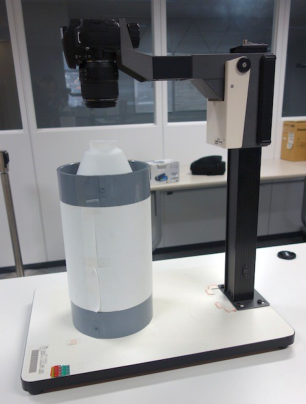
The participants were required to whisk together green tea powder and hot water as shown in Fig.3. Two time stages including 100% and 50% of tea making finishing time were focused and investigated for the tea made by expert and non-expert. And bubble form and distribution state after 100% and 50% of tea making procedure were also recorded and illustrated by single-lens reflex camera (D40x Nikon CO. Ltd). Especially, in order to obtain high-quality photographs a camera device was employed to support and fix the camera as shown in Fig.4
Ergonomics In Design, Usability & Special Populations I (2022)
Figure 3. The tea making actionFigure 4. Camera device
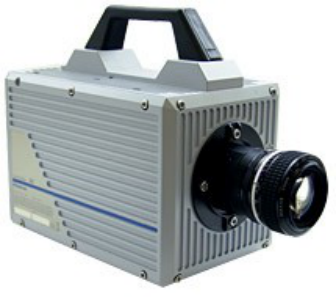
Both expert and non-expert’s complete process, 100% tea making time, were clearly recorded by a high-speed camera (FASTCAM SA4 Photron CO. Ltd) from different angles as shown in Figure 5. The shutter speed was 3600 frames per-second. Two high brightness spotlights provided light source on both sides.
Figure 5. High-speed camera system
Image analysis method Ergonomics In Design, Usability & Special Populations I (2022)
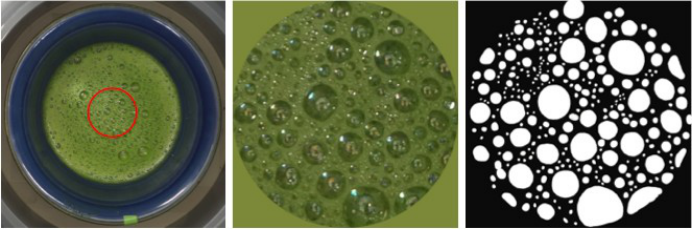
In this research, all the photos were transformed into the same size as the size of the bowl (Diameter: 12.6cm) firstly. Afterwards, circle region located at the center of bowl with 480 pixels were analyzed and transferred by numerical processing from Figure 6.1 to Figure 6.2. It should be mentioned that only bubble forms larger than 0.03mm2 area was marked. Furthermore, marked bubbles were transformed by the binarization processing method into a white and black two colors as shown in Figure 6.3. The outlines of bubble form and bubbles’ distribution state were also sketched on the processed image. Finally, the areas of the bubbles were calculated and converted to the area unit.
1. Trim of image 2. Painting out 3. Binarization processing
Figure 6. Procedure of image processing
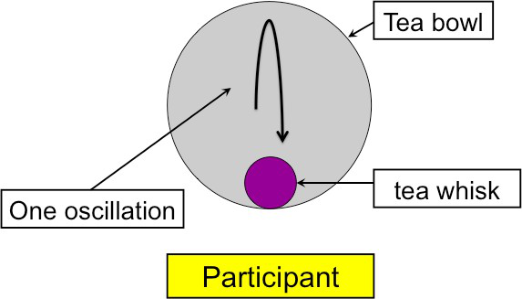
Processing analysis investigation Participants’ all movement elements were counted and summarized by watching the video. The numbers of tea whisk frequency was judged and summarized according to tea whisk oscillate back and forth as shown in Figure 7. The time of entire process was calculated accurately be given to two decimal places. The whole processes of expert and non-expert divided into first half process and second half process were paid attention and contrasted with each other, which were called as first period and second period in this study. Furthermore, vibrational frequencies of tea whisks by expert and non-expert were generated during the first period, second period and whole process.
Figure 7. The schematic diagram of tea whisk oscillate process
RESULT AND DISCUSSION
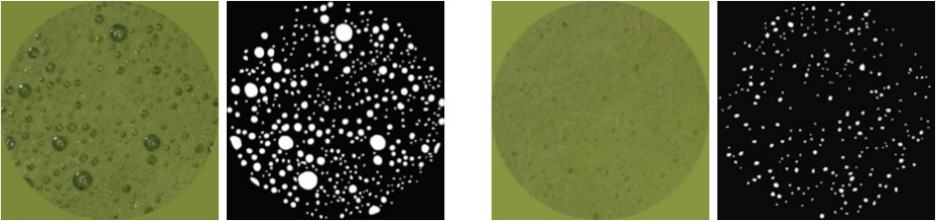
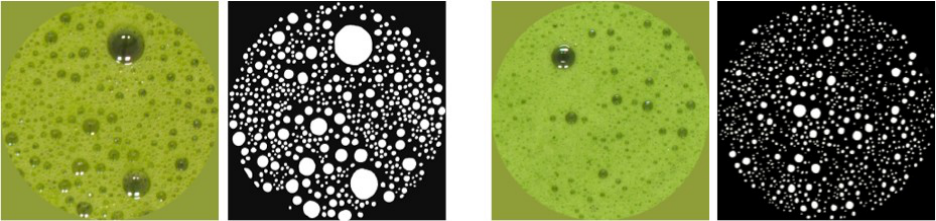
The collected images and processed images from expert and non-expert were revealed side-by-side as shown in Figure 8 and Figure 9. By comparing these two figures. It was easy to identify that the number of bigger 0.03 mm 2 bubbles by expert was far less than non-expert. The bubbles’ shape was not facile to detect in the case of 100% tea Ergonomics In Design, Usability & Special Populations I (2022) making time by expert. It was considered that the tea have already reached desired state.
1. 50% tea making time 2.100% tea making time
Figure 8. The pictures of expert before and after processed in case 50% and 100% tea making time
1. 50% tea making time 2.100% tea making time
Figure 9. The pictures of non-expert before and after processed in case 50% and 100% tea making time
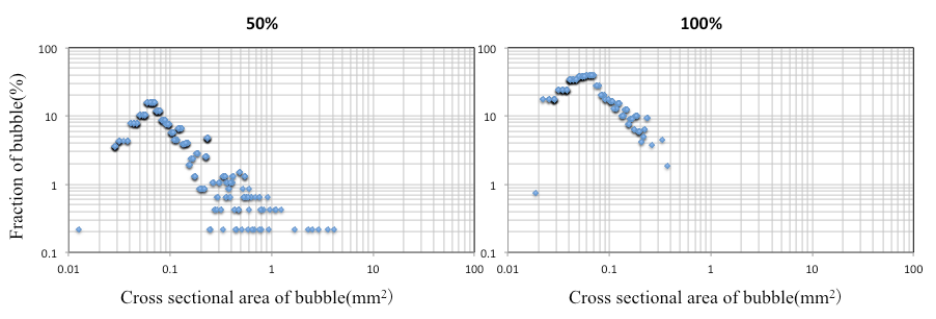
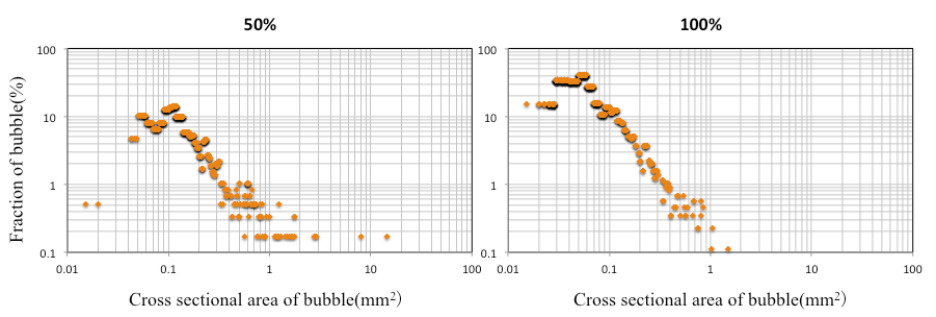
Bubbles’ size and the distribution made by expert and non-expert in two time stages including 50% and 100% of tea making process were presented in Figure 10 and Figure 11. The horizontal axis shows the area of the bubble by the logarithm scale and the vertical axis shows the bubble size frequency.
According to Figure 10 and Figure 11, it can be found that both expert and non-expert were able to produce medium sized of bubble at the middle of tea making procedure as shown in the case of 50% time. The areas of bubble produced by expert and non-expert were showed similar distribution in the case of 50%. However, comparing with expert’s situation, the larger sized bubbles were appeared slightly for the same 50% time case by non-expert. And it is easy to find that the bubbles existed in the 100% case was decreased significantly compared with 50% case. The areas of bubble made by non-expert just showed a slight decreasing trend comparing with expert.
Additionally, It is deserved to find that the majority of bubbles existed in the tea surface produced by expert and non-expert of are below 0.1mm2 when time stage increased to 100%. And all bubbles were smaller than 0.5 mm2 produced by expert, however, there were many bubbles larger than it in case of non-expert. It was considered that the tea made by expert was presented the wider distribution of small bubbles.
Ergonomics In Design, Usability & Special Populations I (2022)
Figure 10. The form and distribution of bubble in the center of bowl made by expertFigure 11. The form and distribution of bubble in the center of bowl made by non-expert
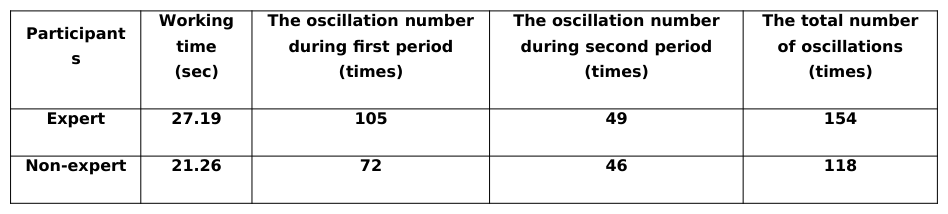
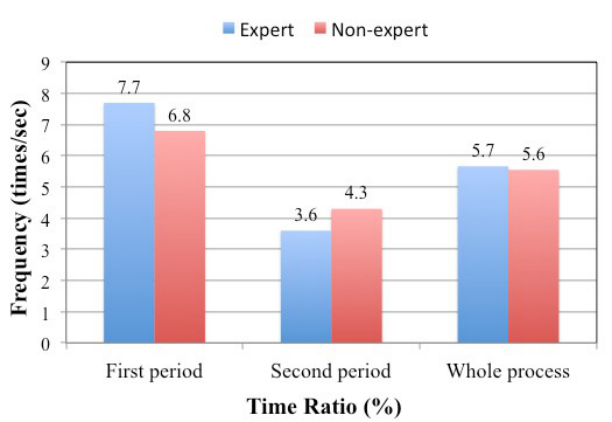
The working time and oscillation number of complete process by expert and non-expert were counted in Table 2. And the stirring frequency of expert and non-expert was presented at Figure 12 including first period and second period and whole period. It was interesting that expert was spent more time to make the tea than non-expert, 27.19s and 21.26s, and carried out 36 times oscillations more than non-expert. Among them, it was dispalyed the significant difference between expert and non-expert in first period.
Table 2: The summary sheet of complete tea making process by expert and non-expert Working
Referring to Figure 12, there were extremely similar frequency between expert and non-expert during the whole tea Ergonomics In Design, Usability & Special Populations I (2022) making process. And high speed at the first period and slowed speed at second period were performed by both expert and non-expert. However, the stirring speed of expert was faster non-expert more than 1 time per second during the first period. Contrastively, the opposite was presented during the second period.
With the analyzing result, it was considered that expert was able to perform high stirring speed during the first process in order to agitate the tea powder in hot water quickly. Next control the suitable speed during the second process so that and mix agitated tea powder and presented the wider distribution of small bubbles finally.
Figure 12. The frequency of tea making action by expert and non-expert
CONCLUSIONS
With the analyzing result, the method of expert can produce the most widespread bubbles quickly at the beginning of tea making. Afterwards, big bubble size and area existed in previous time stage was changed into smaller one gradually and effectively until the final tea finishing. In a word, it was considered that expert was able to perform high stirring speed during the first process in order to agitate the tea powder in hot water quickly. Next control the suitable speed during the second process so that and mix agitated tea powder and presented the wider distribution of small bubbles finally. In other words, it can be concluded that tea powder and hot water can be efficiently mixed together by expert very well.
REFERENCES
Aiba, E. Kanazawa, S. Ota, T. Kuroda, K. Takai, Y. Goto, A. Hamada, H. (2013), “Developing a System to Assess the Skills of Japanese Way of Tea by Analyzing the Forming Sound A Case Study”, Human Factors and Ergonomics Society International meeting. Goto, A. Endo, A. Narita, C. Takai, Y. Shimode, Y. Hamada, H. (2012), “Comparison of painting technique of Urushi products
between expert and non-expert”, Advances in Ergo-nomics in Manufacturing, pages 160-167, ISBN: 978-1-4398-7039-6. Tujimoto, N. Ichihashi,Y. Iue, M. Ota, T. Hamasaki, K. Nakai,A. Goto,A. (2009), “Comparison of bubble forming in a bowl of thin tea between expert and non-expert”, Proceeding of 11 th Japan International SAMPE Symposium & Exhibiton.
Ergonomics In Design, Usability & Special Populations I (2022)
LISTED IN THE AHFE DIGITAL BOOKSTORE CATALOGUE
Explore the complete digital volume
Advances in Ergonomics In Design, Usability & Special Populations: Part I
Read this individual research paper free through the original publisher, or explore the full digital proceedings book.
ISBN 978-1-4951-2106-7
Explore this ISBN in the AHFE Bookstore ↗Listed in the July 2026 bookstore catalogue; search by ISBN to confirm current availability · Digital book purchase optional