Andris Freivalds, Shihyun Park, Joonho Changa, Neil Sharkeyb (2018). Grip Force Simulations Using an Instrumented Cadaver Forearm. In: Advances in Physical Ergonomics and Human Factors: Part II. AHFE Open Access, vol. 2. https://doi.org/10.54941/ahfe100079
Forceful tendon exertions while gripping hand tools may be one of the factors leading to the development of work-related musculoskeletal disorders (WRSMDs). Estimated tendon forces from biomechanical hand models are unreliable and need to be validated. A novel neuromuscular grip simulator using a cadaver forearm was developed consisting of 1) an aluminum frame supporting the specimen, 2) a motion-delivery unit with stepper motors applying force to the FDP and FDS tendons, 3) a data acquisition unit for force transducers, 4) a camera system measuring finger joint angles, and 5) an operating system to control the complete simulator. Of special necessity were an adjustable fixation system, the Wristjack and the use of freeze clamps with liquid nitrogen to insure a tight bond between the slippery tendons and the force delivery system. Key experimental factors varied were five different diameter handles and the ratio of FDP/FDS tendon forces. The results on two specimens showed an inverse relationship of handle size and grip force, with the smallest handle size of 30 mm being best. A 3:2 ratio (40% FDS) provided the best efficiency and the largest gripping. Internal tendon averaged 6.2 times the external forces,matching the biomechanical model predictions of Kong, 2004. 72% of the power grip was concentrated on the distal phalanges. Overall, this novel simulator served well for understanding internal tendon forces.
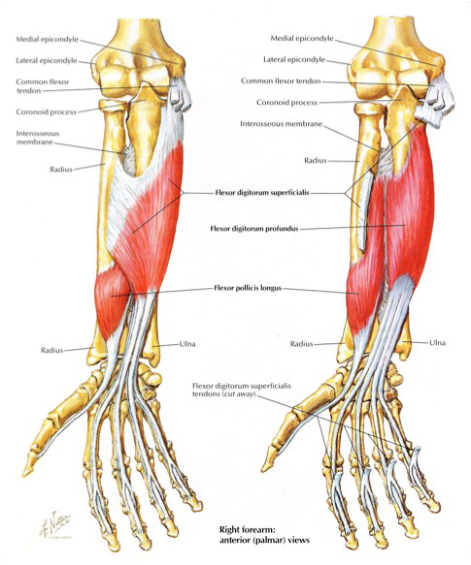
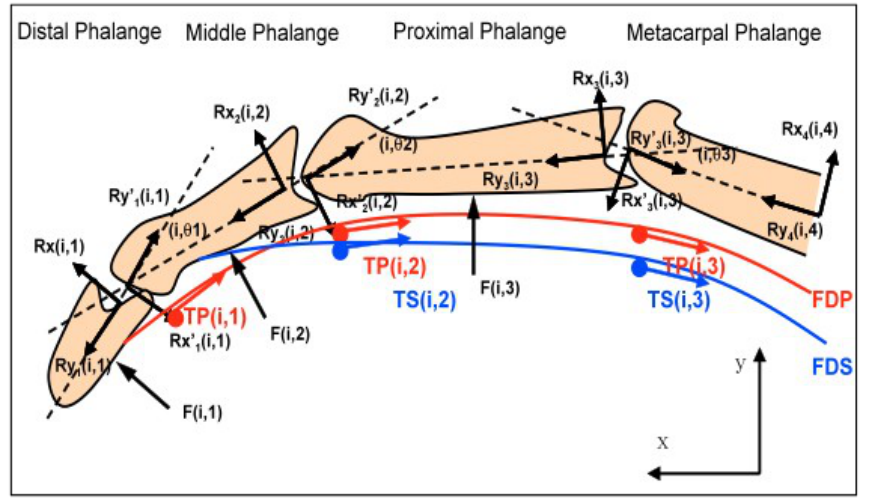
Forceful tendon exertions while gripping hand tools may be one of the factors leading to the development of work- related musculoskeletal disorders (WRSMDs). Grip force is primarily determined by two main extrinsic muscles located in the forearm: flexor digitorum superficialis (FDS) and flexor digitorum profundus (FDP) (see Figure 1). Note that both muscle tendons subdivide under the flexor retinaculum and have separate slips to each of the fingers. Also, the FDP inserts into distal phalanx, while FDS inserts into the medial phalanx and also bifurcates so as allow the FDP to pass through (see figure 2). The hand contains a variety of intrinsic muscles that are relatively small and weak and contribute little to the total grip force other than providing some precision or control. The internal tendon forces have been estimated based on the physiological cross-sectional areas of the FDP and the FDS and resulted in values as high as 3.7 times the external forces (An, 1985) or 7.9 times based on in-vivo measurements (Schuind, 1992). A biomechanical model by Kong, 2004 (see Figure 3) estimated the internal forces as high as 9 times the external force. One critical factor in this estimation is also the relative contribution of each muscle in this static indeterminate situation. Typically, researchers will choose some relative force contributions between the two muscles, with a typical FDP/FDS ratio of 3:1 being used (Marco, 1998). Identification of an optimum handle size to maximize the efficiency of grip force while minimizing tendon forces is of key interest in minimizing injury potential. Therefore, it was decided to perform a direct simulation of a power grip using an instrumented cadaver forearm specimen.
.
Figure 1. Extrinsic forearm muscles Figure 2. Intrinsic Hand MusclesFigure 3. Kong (2004) biomechanical hand model
METHODS
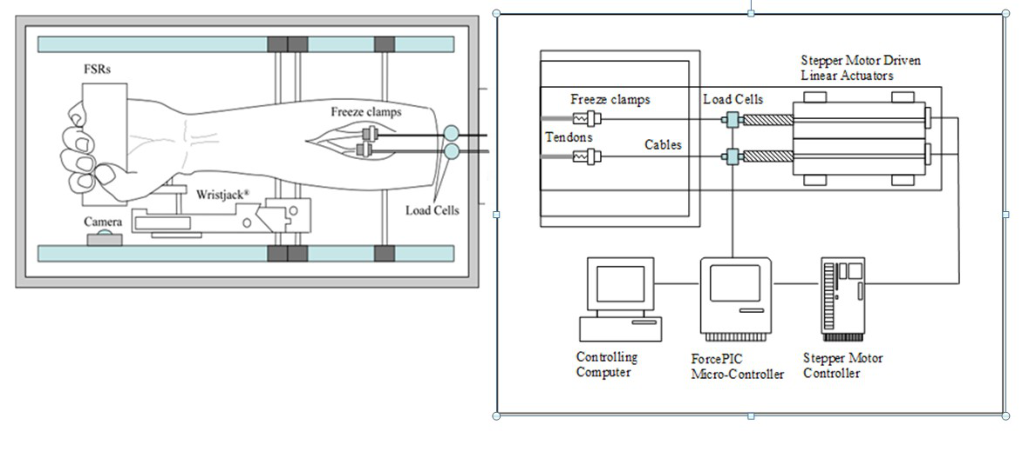
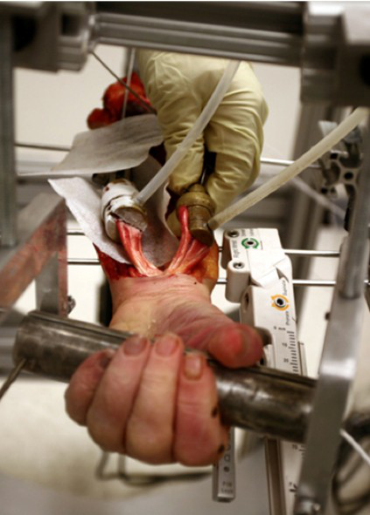
The neuromuscular grip simulator, termed the THING (THe Interactive Neuromuscular Gripper) consisted of five components: 1) an aluminum frame supporting the specimen, 2) a motion-delivery unit with stepper motors applying force to the FDP and FDS tendons, 3) a data acquisition unit for force transducers, 4) a camera system measuring finger joint angles, and 5) an operating system to control the complete simulator (see Figure 4). Of special necessity were an adjustable fixation system, the Wristjack, and the use of freeze clamps with liquid nitrogen to insure a tight bond between the slippery tendons and the force delivery system (Sharkey, 1995; see Figure 5). Force sensitive resistors (FSRs) were applied to the cadaver hand to measure grip force distribution and a split aluminum handle was instrumented with a load cell to measure total force (see Figure 6). The split allowed the handle size to be adjusted.
Figure 4. The Interactive Neuromuscular Gripper (THING)
.
Figure 5. Freeze clamp Figure 6. FSR distribution and load cell handle.
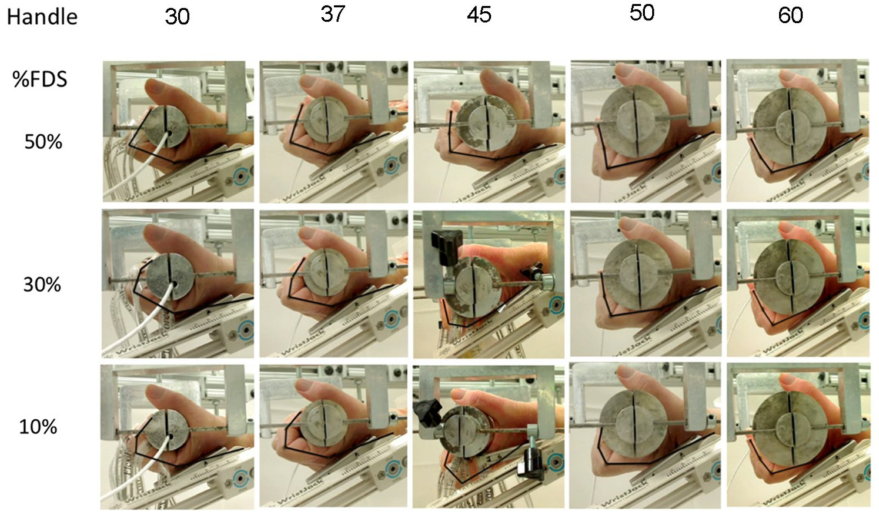
Key experimental factors varied were five different handle diameters (30, 37, 45, 50 and 60 mm) and the ratio of FDP/FDS tendon forces (9:1, 4:1, 7:3, 3:2, 1:1). The latter could also be considered as the proportion of the total tendon forces provides by the FDS muscle (10, 20, 30, 40, 50%) as compared to FDP muscle (90, 80, 70, 60, 50%).. This ratio was very critical in changing the gripping dynamics and overall gripping forces as shown by the varying finger joint angles shown in Fig. 7
Figure 6. Hand grip configuration as a function of %FDS contribution and handle diameter.
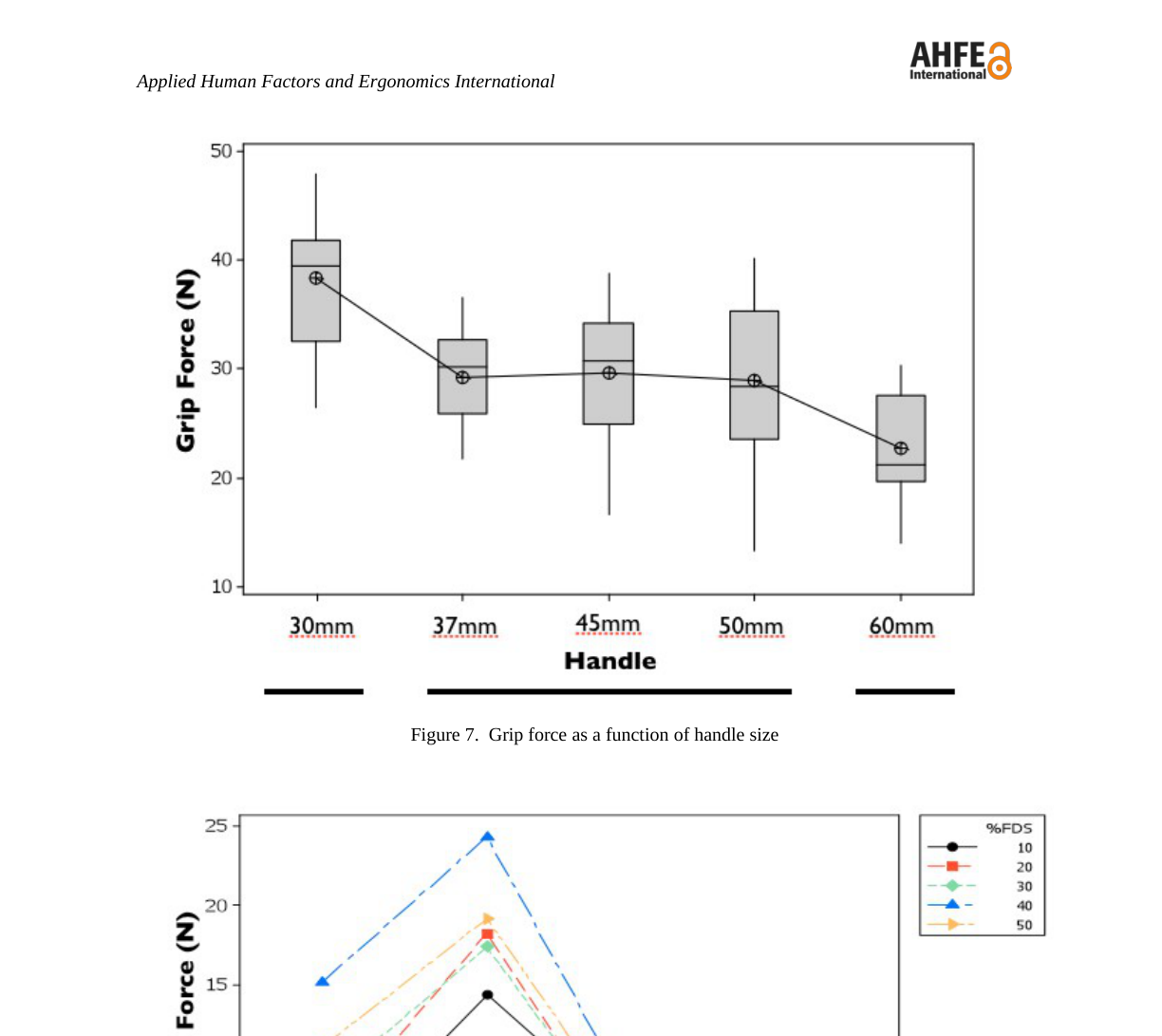
RESULTS AND CONCLUSIONS The THING worked remarkably well. Actual tendon force values matched target force values very closely (r2=1.0, p<0.0001, see Table 1). Simulation results on two specimens showed an inverse relationship of handle size and grip force, with the smallest handle size of 30 mm being significantly better (p<0.05) than the other handles (see Figure 7). Most of the gripping force was concentrated in the middle finger (see Figure 8) and the distal phalanges (see Figure 9). In all cases a 3:2 FDP/FDS tendon ratio or 40% FDS contribution provided the largest gripping force.
Table 1. Target and actual tendon forces
Table available in the original PDF paper.
Figure 7. Grip force as a function of handle size
Figure available in the original PDF paper.
Figure 8. Finger forces and %FDS tendon force contributionFigure 9. Phalange forces and %FDS tendon force contribution
Figure available in the original PDF paper.
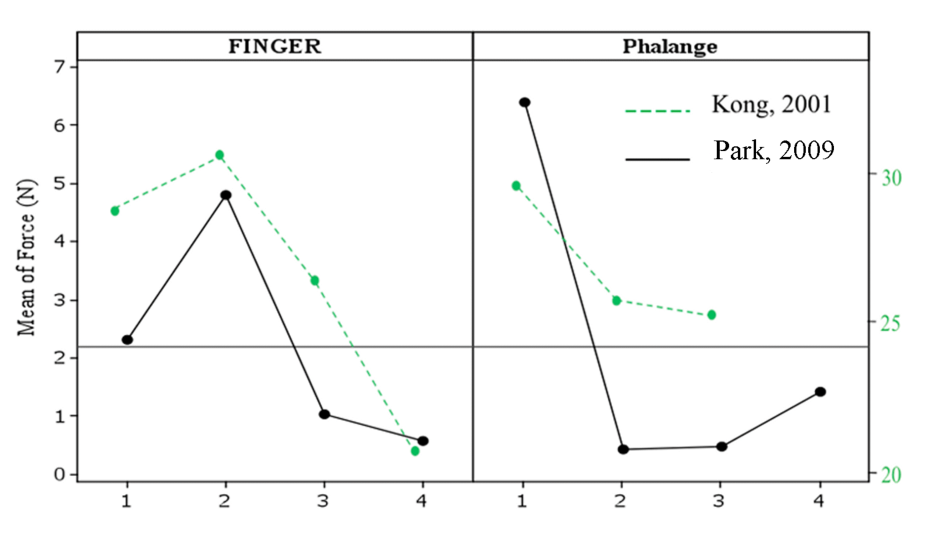
Internal tendon averaged 6.2 times the external forces (which closely matched the biomechanical predictions of Kong, 2004, see Figure 10). However, a low value of 4.1 times the external force was achieved for the 30 mm handle, again indicating the efficiency of the smaller handle.
Figure 10. Validation of Kong (2004) biomechanical hand model
Because of the success of the THING, further testing is being performed on the potential research question of the optimum phalange/trigger position to minimize tendon triggering forces during power tool activation. Currently, three triggering positions (distal phalanx, distal-interphalangeal joint, middle phalanx) are being tested on five specimens for the most efficient triggering forces.
REFERENCES
An, K. N., Chao, E.Y., Cooney, W.P., and Linscheid, R.L., 1985. Forces in the normal and abnormal hand. Journal of orthopedic research. 3: 202-211. Ayoub, M.M. and Lo Presti, P., 1971. The determination of an optimum size cylindrical handle by use of electromyography.
Ergonomics. 14 (4): 509-518. Dong, R.G., Schopper, A.W., McDowell, T.W., Welcome, D.E., Wu, J.Z., and Smutz, W.P., 2004. Vibration energy absorption (VEA) in human fingers-hand-arm system. Medical Engineering and Physics. 26:483–492. Edgren, C.S., Radwin, R.G., and Irwin, C.B., 2004. Grip force vectors for varying handle diameters and hand sizes. Human
Factors. 46 (2): 244-251. Irwin, C.B. and Radwin, R.G., 2008. A new method for estimating hand internal loads from external force measurements.
Ergonomics. 51:156–167. Kong, Y.K., Freivalds, A., and Kim, S.E., 2004. Evaluation of handles in a maximum gripping task. Ergonomics. 47(12): 1350-
1364. Kong, Y.K., Lowe, B.D., 2005. Evaluation of handle diameters and orientations in a maximum torque task. International Journal of Industrial Ergonomics. 35:1073-1084. Marco, R.A.W., Sharkey, N.A. and Smith, T.S., 1998. Pathomechanics of closed rupture of the flexor tendon pulleys in rock
climbers. The journal of bone and joint surgery. 80A(7):1012-1019. NIOSH, 1997. Musculoskeletal Disorders and Workplace Factors. Report 97-141. Cincinnati, OH, National Institute for Occupational Safety and Health. Schuind, F., Garcia-Elias, M., Cooney III., W.P., and An, K.N., 1992. Flexor tendon forces: in vivo measurements. Journal of
Hand Surgery (American). 17(2): 291-298. Seo, N.J. and Armstrong, T.J., 2008. Investigation of grip force, normal force, contact area, hand size, and handle size for cylindrical handles. Human Factors. 50(5):734-744. Sharkey, N.A., Smith T.S., and Lundmark D.C., 1995. Freeze clamping musculo-tendinous junctions for in vitro simulation of
joint mechanics. Journal of biomechanics. 28(5): 631-635. Valero-Cuevas, F.J., Zajac, F.E., and Burgar, C.G., 1998. Large index-fingertip forces are produced by subject-independent patterns of muscle excitation. Journal of Biomechanics. 31:693–703.
LISTED IN THE AHFE DIGITAL BOOKSTORE CATALOGUE
Explore the complete digital volume
Advances in Physical Ergonomics and Human Factors: Part II
Read this individual research paper free through the original publisher, or explore the full digital proceedings book.
ISBN 978-1-4951-2105-0
Explore this ISBN in the AHFE Bookstore ↗Listed in the July 2026 bookstore catalogue; search by ISBN to confirm current availability · Digital book purchase optional