Ryang-Hee Kim, Sung-Sic Choi (2018). Safety Assessment of Pesticide-Barrier Protection Properties of High-Tech Material Agricultural Safety Clothing: In Vivo-Test Using the Artificial Skin. In: Advances in Physical Ergonomics and Human Factors: Part I. AHFE Open Access, vol. 1. https://doi.org/10.54941/10027
Publisher statistics will load when you open Metrics.
AHFE OPEN ACCESS OPEN ACCESS CONFERENCE PROCEEDINGS PAPER
Safety Assessment of Pesticide-Barrier Protection Properties of High-Tech Material Agricultural Safety Clothing: In Vivo-Test Using the Artificial Skin
Industrial safety clothing is supposed to have capability to adjust its inside microclimate, to protect the human body from dangerous environments, and to improve productivity. So, it is important to select proper materials, forms, and wearing methods of work-clothes. Agricultural Safety Clothing (ASC) should protect the human body from environmental conditions such as cold, heat, and humidity as well as from working conditions. Agricultural Safety Clothing should also enhance the safety, comfort, and efficiency of works. However, they have increased the use of pesticide to harvest more crops, which has caused various side effects, and insects have become resistant to pesticides. For these issues, we aimed to develop the newly agricultural safety clothing based on highly technology finish textiles, and to estimate pesticide protective performance properties. And we were to evaluate the pesticide barrier property and safety performance properties of newly designed ASC being made with high-tech proof finish spun-laced nonwoven fabrics. The results of this study were as follows: 1). New high-tech proof finished ASC has respectively negligible or sometimes inconclusive amount of pesticide residue. Hence, newly designed ASC with high-tech proof finish fabrics was evaluated as the safety ASC better than the conventional safety clothing.
Clothing directly touches human body, between the human body and external environment, helping the human body adjust or modify its physiological functions according to environment. Clothing also balances the heat exchange between humans and environments. Ultimately, clothing enhances the physical, physiological, and psychological comfort, and broadens the activity area of humans.
Work-clothing is supposed to have capability to adjust its inside microclimate, to protect the human body from dangerous environments, and to improve productivity. So, it is important to select proper materials, forms, and wearing methods of work-clothes. Farm-work clothing should protect the human body from environmental conditions such as cold, heat, and humidity as well as from working conditions including vinyl greenhouse, crop- dusting, and working posture. Farm-work clothing should also enhance the safety, comfort, and efficiency of works.
Physical Ergonomics I (2018)
Farmers have improved their life conditions, and raised their agricultural productivity so far. They are now pursuing an economic development and a scientific life style. However, they have increased the use of pesticide to harvest more crops, which has caused various side effects, and insects have become resistant to pesticides.
Consequently, the toxicity of pesticides has become stronger, with a higher concentration. Recently, the issue of environmental pollution and poisoning has risen on a large scale. According to a survey report, 88.3% of pesticide- users have experienced toxic problems, while 22.8% have had acute symptoms. This means that it is inevitable to wear pesticide-proof clothing in order to protect the human body while spraying agricultural chemicals.
However, the standards had just targeted on the pesticide-proof effect of water-repellent clothes. Less than 10% of pesticide-users have worn pesticide-proof clothes because those anti-pesticide clothes were usually uncomfortable with hot/sticky feelings and low anti-sweat/heat capability. Although farmers recognized pesticide-proof clothes were necessary, about 70% of pesticide-users rather preferred to wear general rain coats or other working-clothes, according to the report (Choi, J.H., Kim, S.Y. 2004).
Studies on pesticide-proof clothing have not been so active yet, even though many people expect pesticide-proof clothes to protect the human body from toxic pesticides in deleterious working conditions such as hot, humid summer in the case of Korea, and to remove heat/sweat rapidly. In this condition, farmers have been exposed to harmful states during pesticide-spraying works. Now they are in need of more comfortable materials and efficient designs of pesticide-proof clothes (Kim, Y.H., 2007).
According to a recent study on pesticide-proof clothing, some expert groups are trying to develop a lighter, softer, and cheaper cloth material in order to enhance pesticide-proof effect and comfort. It is to use ‘spun-laced, non- woven fiber, manufactured in water-oil-repellency method.’ GIFAP (Groupement International Des Associations Nationales Fabricants De Products Agrochemiques) suggests a new clothing type, taking into account pesticide- proof effect and working activities.
This study focused on improving the comfort of pesticide-proof clothes, comparing the differences in anti-pesticide effect and function between the newly developed ‘water-oil repellent material,’ Sontara, and other existing protective-clothing materials. Two types of clothes were made; one was newly-developed, while the other was existing-typed one. This study compared them through wearing tests.
THEORETICAL BACKGROUND
Previous Studies on Pesticide-Proof Clothing Requirements of pesticide-proof clothing
Pesticides have different ingredients and functions depending on the kinds. The insecticidal activity of pesticides takes effect when a pesticide permeates into insects to have a toxic action at a certain site of action. This is the most important function of pesticide. In other words, pesticide is supposed to easily permeate into the body of insect through its skin and tarsus. This function is closely related to the chemical structure, contents of the pesticide as well as the epidermal structure of the insect. To permeate into the skin of insects, pesticide has to dissolve or absorb the lipid layer. The chemical structure of adhesive solution should have lipophile property or reactor-hydrolyzing lipid layer to melt it, at least. In the case of KKT, it contains a strong oil-soluble property of chloroform (-CCl₃). Adding oil-solubility and permeability strengthens the insecticidal effects. Generally, oily solution is more effective than water-dispersible or powdered pesticide because it has lipophile solvent to dissolve lipid layer.
In addition to these chemical properties, pesticides include following physical characteristics for being sprayed. First, powdered pesticide should maintain the independent particle state, not in the state of lumps. It should stay suspended in the air for a long time, in order to be evenly sprayed. This property is called flowability or dispersibility. Second, pesticide should evenly infiltrate into plants, which is called floatability.Third, pesticide Physical Ergonomics I (2018) should easily adhere to plants after being sprayed, which can be done by the property of deposition and adherence. Fourth, pesticide should have the property of stability in order to maintain its ingredients, not being instantly dissolved by oxygen or humidity.
These physical properties possibly make pesticide permeate into human body through many paths, and the pesticide permeation affects the human body with its toxic ingredients, staying inside the human body. In short, some ingredients of insecticides dissolve lipid layer of human skin tissue, and paralyze human nerves by poisoning, while rest ingredients are accumulated in the human body to cause other chronic and latent poisoning diseases (Kim, S.S., et al, 2008).
Now, this part will look into the kinds and toxic properties of pesticides which are usually used in the rural areas. Phenoxy herbicides also had a danger to cause the loss of neuronal tubes, palate, miscarriages, death births, male infertility and oligospermia, etc. Then, empirical studies revealed that organic phosphorus pesticides might also cause poisoning on the nerves, and it has become a new issue of pesticide research. According to diverse reports, organic phosphorus pesticides cause an acute poisoning by restraining of acetyl-choline esterase inside the nervous system. Later, further study reported that organic phosphorus pesticides contain delayed neuronal poison that causes chronic intoxication symptoms.
When a farmer is seriously exposed to an organic phosphorus pesticide seriously for long time, the farmer possibly has symptoms of severe muscular pain in lower body, paresthesia on distal ends, numbs and even paralysis including delayed poly neuropathy. In order to protect human body from these toxic pesticides, maintaining a comfortable working condition, an ideal type of protective clothing is necessary, which has to satisfy the requirements such as good dermal protection, comfort, and durability.
Figure 1. Requirements for Agricultural Safety Clothing (ASC)
Figure available in the original PDF paper.
Protective clothing has to provide comfort as well as durability against abrasion and damage to maintain the property of pesticide-proof effect. Protective clothes manufactured in early stage adopted PVC coating method to strengthen the pesticide-proof effect. Tests of this method on human body have shown high temperature levels due to its over-thick material; rectal temperature was 37.2±2 , and skin/inside-clothes temperatures were also high, ℃ with a high relative humidity level inside clothes (95±2%).
This means that although the PVC coating method was excellent in pesticide-proof effect, it had a serious problem with comfort. A method using the technology of water transmission and moisture-proof was developed to cover up for the weakness. Experimental tests indicated that Water-transmitting/moisture-proof clothes enhanced comfort, improving the working conditions in terms of heart rate and inside-clothes temperature/humidity. However, despite its high cost, it still had a serious problem in pesticide-proof effect. So, another new method was to be developed to reinforce anti-pesticide effect, maintaining the high level of comfort.
Physical Ergonomics I (2018)
Although new materials and manufacturing methods have been developed for better anti-pesticide effect and comfort, durability against water-cleaning and abrasion was also needed to keep those effects. Durability was a critical factor in material-developing and manufacturing. An experimental test revealed the possibility that durability of material can bring about different results in anti-pesticide effect, through a test of exposing two kinds of different materials to abrasion.
Let’s see the examples of Kleenguard EP and Tyvek. Kleenguard showed increasing level of pesticide permeation when it was scrubbed; after 6 minute brushing, the permeation level increased from 0.07% to 0.4%. In the case of Tyvek, there was no big difference in the permeation levels. However, Tyvek took a negative effect on subjective comfort, due to its low water-transmission property, without heat-sweat transmission ability.
Above was a study to find an ideal type of protective clothing. Protective clothes are supposed to have easiness in working, putting-on, and taking-off, for they are used for physical activities to produce something. The easiness in working, putting-on, and taking-off helps people work efficiently with a feeling of comfort, and improves productivity. In such a point of view, it is very important to develop proper design types of protective clothes, considering the structure of human body, working motions, and cloth materials. In fact, there have been a lot of researches to develop better designs of protective clothes. Experts including Branson have found that coverall-styled protective clothes are most excellent after testing the assessment of thermal response on various design types including vent-suit, coverall, and 2-piece, all of which were made of the same material.
Figure 2. Requirements of Materials for Agricultural Safety Clothing (ASC)
Figure available in the original PDF paper.
Considering above-mentioned conditions, an ideal type of protective clothes should have the property of excellent pesticide-proof, durability, low-cost, comfort as well as good design. Especially, a comfortable design should take into account the human motions in working and their changes. It has to consider the characteristics of clothing materials, and enhance the easiness of works and thermal comfort. Ultimately, they all should serve for human- physiological and subjective comfort in the human body-clothes system.
Physical Ergonomics I (2018)
Figure 3. Performance properties of Agricultural Safety Clothing (ASC) and Materials
Figure available in the original PDF paper.
Influence of cloth material and manufacturing method on pesticide-proof and functionality The protective clothing manufactured by PVC coating method in the early stage had an excellent pesticide-proof effect. However, they were short of heat-sweat transmission function, due to a low ventilation capability. On the contrary, the protective clothes made of vapor-permeable/water-proof fabric, in order to cover up for the weakness of PVC coating, were able to enhance comfort.
However, they were vulnerable to pesticide-proof effect, with unavailability owing to the high price. So, the urgent research issue of manufacturing technology is how to develop a new material that has both properties of heat-vapor transmission and pesticide-proof capability.
In terms of cloth material, many experts have suggested ‘non-woven fiber’ as a material of protective clothing. It is made of textile, threads, or filament fiber, through the physical, thermal, and chemical methods. It is non- directionally combined to have a sheet or web structure. This method needs to irregularly press the web with a high water pressure. This method can enhance the drape, ventilation, and vapor permeability, to give comfort to users.
According to a recent empirical study to test anti-pesticide-effect and comfort of farm-work clothes materials, ‘spun-laced Sontara material’ was selected as the most comfortable material out of all the tested materials including ‘spun-laced Sontara,’ ‘Tyvek,’ and ‘Kinlon.’ Spun-laced Sontara is a reinforced textile material manufactured by putting a water-pressure on short staples to make them a strong fibrous tissue. This type of material has a significant durability owing to its homogeneity and high intensity. It also has a fine drape, good feeling, and almost infinite flexibility, which can give pesticide-proof clothing both properties of durability and comfort.
In addition, this type of material can be applied to various high-functional textiles because it is combined with diverse independent fibers or laminated. So it can satisfy many ultimate purposes. A new method is necessary to put a coating on a clothing material with a comfort feeling in order to add excellent pesticide-proof effect to it. In fact, a certain treatment on non-woven fiber was applied to pesticide-proof clothes. The typical case was the water-and-oil- repellent manufacturing technology that used fluorine compound.
Physical Ergonomics I (2018)
(A) (B) Figure 4. SEM observation of Materials: (A) PU coated Nylon, (B) Non-woven Sontata
ⓡ for Agricultural Safety Clothing (ASC) (R.-H., Kim, 2013)
It was turned out that as the fluoride quantity increased, the effect of water-and-oil-repellency got stronger, according to ‘3M Oil Repellency Test’ (It treats various kinds of poly-1, 1-dihydroperfluoroacrylates on a dye- printed textile (80*80) to test water-repellency and oil-repellency). The water-oil-repellency effect by fluorine compound generated a quite strong durability against repeated water-washing and dry-cleaning, according to the experiment. Not all of these fluorine compounds can take add the property of water-oil repellency effect. There are some required conditions for a satisfied manufacturing process of textile. The most important condition is whether fluorinated carbon chain is largely distributed over the textile, with a proper degree of orientation. The largely- spread distribution of fluorinated carbon chain forms a fluorinated surface on the textile, which has water-oil repellency effect caused by the low energy of the fluorinated surface.
This study focused on improving the comfort of pesticide-proof clothes, comparing the differences in anti-pesticide effect and function between the newly developed ‘water-oil repellent material,’ Sontara, and other existing protective-clothing materials. The purposes of this study were as followings. First, this study basically aimed at evaluating/comparing the ‘pesticide-proof effect and function’ of a new material, ‘water-oil repellent finished Sontara,’ and the conventional material: ‘poly-urethane (PU) coated nylon’.Ultimately this study pursued suggesting an ideal type of comfortable pesticide-proof clothes.
EXPERIMENTAL METHOD AND PROCEDURE
Specimen This study focused on testing the pesticide-proof effect and functions of 2 kinds of materials; one was PU-coated nylon which had been designated as anti-pesticide protective clothing and the other was spun-laced/ non-woven/ water-oil repellent finished Sontara which is recently on the market. Details are described in Table 1.
Pesticides This test used carbamate insecticides of 2-sec-butylphenyl-methylcarbamate (BPMC, Bassaⓡ) and organic phosphorus germicides of S-benzy1 0,0-di-isopropyl phosphorothioate (IBP, Kitazinⓡ). They are all used for rice farming in Korea. 50% emulsion liquid was diluted to 0.05% AI. The chemical structure and properties are described in Table 2.
Table 1: Specifications of specimens (PU coated Nylon, Non-woven Sontata
Table available in the original PDF paper.
ⓡ for Agricultural Safety Clothing)
Physical Ergonomics I (2018)
Table 2: Characteristics of Pesticides
Table available in the original PDF paper.
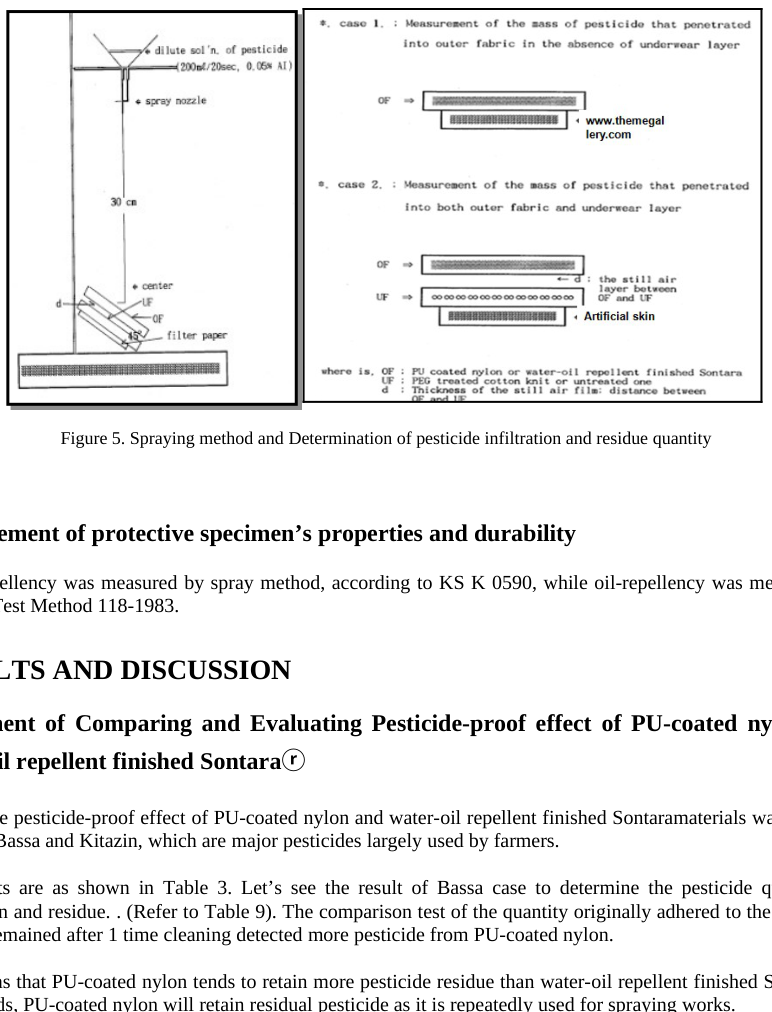
Spraying method We fixed the specimen on a press with an angle of 45 degree inclination, and sprayed 200mℓ pesticide with a 10mℓ/sec speed for 20 seconds, using 30cm high spray nozzle, and left it for 3.5 hours at the condition of 18±2 , ℃ 60% RH. The infiltration rate of pesticide was estimated by the quantity that permeated protective clothing to adhere to underwear or filter paper. Detailed spraying method is described in Figure 5.
Determination of pesticide infiltration and residue quantity Specimen and filter paper were collected by the 5x5cm²-size, and shaken in 60mℓ of acetone for 2 hours, by rotary shake (MD V. New Bronswick Rotary Shaker, U.S.A), with a speed of 100 R.P.M. Pesticide was concentrated to be abstracted by rotary vacuum evaporator (EYELA, Japan). It was added by 5mℓ of hexane. The concentration rate was measured by Gas Chromatography (HP 5890 SERIES 11 (BPD), Hitach G-3
The infiltration quantity of pesticide was measured by the methods described in Figure 5. Filter paper was attached to the back side of protective clothing in the case 1, while being attached to the back side of specimen in the case 2, to measure the pesticide quantity that permeated the plies of protective clothing.
Residual quantity was determined by the quantity measured twice at the surface of protective clothing, once after spraying, and one more time after water-cleaning. The water cleaning was done by a home electric water-washing machine according to KS K 0465, with a detergent concentration of 1.5g/1, in a standard washing course (washing-spin dry-rinse twice -spin dry; for 45 minutes ) (Kim, R. H., 2013).
Physical Ergonomics I (2018)
Figure 5. Spraying method and Determination of pesticide infiltration and residue quantity
Figure available in the original PDF paper.
Table 3: Pesticide-proof effect of PU-coated nylon and water-oil repellent finished Sontaramaterials was made to target on Bassa (A) and Kitazin (B)
(A) (B)
Physical Ergonomics I (2018)
The results were as followings. PU-coated nylon rarely had pesticide quantity left on underwear / filter paper, while water-oil repellent finished Sontara had a slight quantity of pesticide on the underwear specimen. However, pesticide was not detected form the filter paper. This means underwear was preventing pesticide, and supplementing the weakness of water-oil repellent Sontara protective clothing.
When it comes to Kitazin test (Table 3), the pesticide was detected from protective clothes, under-wears, and filter papers on the whole. However, the permeation patterns were almost the same, regardless of the protective clothing- underwear combinations.
These results indicated the same tendency to the previous studies on the measurement of acetal-choline esterase activity for the two pesticide kinds, before / after spraying work. In other words, more Kitazin was absorbed by the human body than Bassa, and reduced cholin esterase activity.
Consequently, it can be said that Kitazin is more likely to permeate into clothes and human body than Bassa. This can be explained in terms of the differences in solubilities. Kitazin has a 430mg/1 of water-solubility, while Bassa has a 660mg/1 solubility. And Kitazin has an over 1kg/1 of fat-organic solvent solubility, while Bassa has an over 200g/1 solubility. This means that Kitazin has a higher fat-solubility. So, it can be said that fat-soluble pesticides are more likely to adhere to and reside in human body and clothes than water-soluble pesticides. In other words, it will be important to select pesticides in consideration of their chemical properties. According to the comparison test on the two specimens in terms of pesticide-proof effect, PU-coated nylon was better than water-oil repellent finished Sontara. This seems to have resulted from the structural difference of the two specimens.
On the contrary, PU-coated nylon had more pesticide retained in specimens, with more residues after cleaning. This can be explained in terms of the chemical properties. Fat-solubility and hydro phobic property of nylon and its surface structure were likely to cause it. When a fat-soluble matter adheres to a hydro phobic textile, it is not easily removed by water cleaning. Residual amount increases because of its closer structure prevent the adhered particles from getting removed.
Comparison and evaluation of protective clothing materials’ water repellency / oil repellency
Physical Ergonomics I (2018)
Water-oil repellency test was conducted to see the difference between PU coated nylon, and spun-laced, non-woven, water-oil repellent finished Sontara made of fluoro carbonaceous Teflon. The comparison and evaluation of ⓡ functional durability after water cleaning are shown in Figure 6. Figure 6 shows that both of the two specimens had 100% water-repellency before cleaning.
Figure 6. Evaluation of water repellency / oil repellency of PU coated nylon and Sontaraⓡ
Figure available in the original PDF paper.
Tests on water-cleaned specimens show that water-repellency effect has sharply decreased in water-oil repellent finished clothing than PU-coated nylon. The causes seem to be as followings. First, water cleaning removes the wood pulp lamella in water-oil repellent finished clothing material. Water-oil repellent finished Sontaraⓡ is composed of upper lamella composed of wood pulp and lower lamella composed of PET. Water cleaning is likely to remove the wood pulp lamella. In the case of PU-coated nylon, water cleaning can also affects the coated lamella to be damaged or removed.
Such results show the different reduction levels of water-repellency effect, depending on the structure, property and manufacturing method of fabrics. In short, PU-wet-coated nylon has less pores than water-oil repellent finished Sontaraⓡ, with a stronger water-repellency effect after water-cleaning than Sontaraⓡ of spun-laced non-woven fabric. As the number of cleaning times increase, oil-repellency effect of water-oil repellent finished Sontaraⓡ sharply decreases. It is because repeated cleanings remove the wood pulp lamella of water-oil repellent finished material as well as increasing the number of pores of water-oil repellent finished Sontara. This causes a larger reduction of oil-repellency effect than PU-coated nylon.
As shown above, it is explained that water-oil repellency is influenced by the pore distribution on textile, the fabric composition ratio of textile, and the physical-chemical properties of textiles.
CONCLUSIONS
This study focused on evaluating and comparing the pesticide-proof effect and functionality of the materials for pesticide protective clothes; PU-coated nylon and water-oil repellent finished spun-laced non-woven fabric. This study also tried to devise and suggest a new design type to reduce physiological burden.. Conclusion is as following.
In these results of pesticide-proof effect on PU-coated nylon and water-oil repellent finished Sontara , water-oil ⓡ repellent finished Sontara had higher pesticide-proof effect than PU-coated nylon, while pesticide residue was ⓡ lower in water-oil repellent finished Sontara than PU-coated nylon. Also, water-oil repellent finished Sontaraⓡ were all excellent in pesticide-proof effect and functionality. Water-oil repellent finished Sontara turned out to have higher comfort than PU-coated nylon.
Physical Ergonomics I (2018)
Nevertheless, further study will be needed over designs and accompanied protective equipment including gloves, masks, and so on, in order to enhance comfort more effectively. This study was conducted in an artificial climate- control room. More researches should be in fields of pesticide-spraying works, considering the working conditions and motions.
REFERENCES
Choi, J.H., Kim, S.Y. (2004), Rail Vehicle Maintenance Worker Study on non-woven fabric for protection against wear, Journal of the Korean Society of Clothing and Textiles, vol. 28, p.1165~1174 Kim, J.H. (1999), Research on the design development of rural women for agricultural pesticides protective clothing, The
Research Journal of the Costume Culture, vol. 11, No. 6, pp.867~878 Kim, R. H. (2013), Virtual Assessment of Pesticide-barrier Protection Properties Using the Artificial Skin of Developed Hightech Material Safety Clothing for Agricultural Workers, Proceedings of The 1st International 2013 AmI&E Conference, paper ID 23, Taijung, July, Taiwan. Kim, S.S., et al, (2008), Assessment of construction industrial Clothingwith improving fabric, Journal of the Korean Society of
Clothing and Textiles, vol. 32, No. 2, pp.228~235. Kim, Y.H., 2007, A study of functional design for auto-mobil driaver, Journal of the Korean Society of Clothing and Textiles, vol. 31, No. 4, pp.531~561. Shin, J.S., Kim, C.J., 1999, Worker exposure to pesticides and pesticide analysis on the status of wearing on the agricultural
clothing’, The Research Journal of the Costume Culture, vol. 12, No. 5 pp.142~153 Whang, K.S., Kim,K.S., Lee, K.S., et al., 2007, Development of functional materials and pesticides agricultural clothing Study on Performance, Journal of the Korean Society of Clothing and Textiles, Vol. 31, No. 11, pp.1611-1620 You, K.S., (2004). The use of pesticides in the behavior of small farmers and the investigation into agricultural wear, Journal of
the Korean Society of Clothing and Textiles,Vol. 28, No. 9/10, pp.1292-1299 Bajaj, P., 2008,Protective clothing, , Sengupta A K, and Tech B. Press
Physical Ergonomics I (2018)
LISTED IN THE AHFE DIGITAL BOOKSTORE CATALOGUE
Explore the complete digital volume
Advances in Physical Ergonomics and Human Factors: Part I
Read this individual research paper free through the original publisher, or explore the full digital proceedings book.
ISBN 978-1-4951-2104-3
Explore this ISBN in the AHFE Bookstore ↗Listed in the July 2026 bookstore catalogue; search by ISBN to confirm current availability · Digital book purchase optional