Ralf Heller, Michael Sauter, Ralph Bruder (2020). Application of Performance Measurement in the Context of Ergonomic Work Design. In: Advances in The Ergonomics in Manufacturing: Managing the Enterprise of the Future. AHFE Open Access, vol. 12. https://doi.org/10.54941/ahfe100458
While enhancing productivity, performance measurement in the context of ergonomic work design becomes more relevant. Based on the theoretical and conceptual background of performance measurement systems as well as the stressstrain concept and the man-at-work system we generated a cause-and-effect model as a framework for a performance measurement system in the context of ergonomic work design. No investigation has indicated so far the importance, current and planned application, expected functions, relevant perspectives, potential performances indicators and the possible success of performance measurement in the ergonomic context. Data from 73 industrial engineering experts of an international company working in small-sized to large-sized production facilities support the development of an ergonomic performance measurement system. Our findings show that such a system is relevant to industrial engineering work and that performance indicators are already being used. Furthermore there are some interesting relations between monitoring performance indicators and successful processes as well as overall outcomes. Our results challenge the view that performance measurement in the context of ergonomic work design is a prerequisite for being more efficient to fulfill the outcomes performance and well-being.
Important insights to the level and the relevance of ergonomic work design in industrial companies can be derived from the implementation of productivity management and performance based payment systems. Mechanical engineering companies with a high variant diversity have a very wide-ranged product portfolio. Especially in high-wage countries, like e.g. Germany, customized products and system solutions play an increasingly important part facing customers with a higher price sensitivity. Therefore the management of productivity is one essential key task to ensure and to increase the competitive position of a company (Sauter and von Killisch-Horn, 2011). Productivity is a measure of how well resources are combined and used to accomplish specific desirable results (Bain 1982). The human work as one essential resource is important especially in companies with a high variant diversity whereas automation is technically not possible or not profitable. Performance based payment systems are a lever to increase productivity through worker’s participation. Our experiences show that the process of increasing productivity requires a very good ergonomic work design. Often it is not a question of having the right ergonomic standards and methods but rather the consistent use and implementation of ergonomic standards, methods and their related processes. A long-term sustainable increase and assurance of productivity in a company depends, among other dependencies, on its human resources. Therefore it is essential to promote and to protect the worker’s capabilities through ergonomic work design. In times of demographic change these findings become more relevant.
Human factors/Ergonomics (HFE) focusses on the interaction between human beings and the elements of a system and the two closely related outcomes performance and well-being. Performance outcomes are understood as e.g. productivity, quality and innovation of a system. Outcomes of well-being are health, security, satisfaction as well as personal development (Dul et al., 2012). In todays practice Dul and Neumann (2009) argue that executive staff usually associates ergonomics with occupational health and safety and not with performance. They support the idea of ergonomics being an integrated part of business strategy and thereby of the planning and control cycles within a company to ensure performance (Dul and Neumann, 2009). For planning and controlling a company’s strategy performance measurement systems are a well-known instrument (Atkinson et. al, 1997). In the context of ergonomics a discussion about performance measurement has not taken place (Zink and Seibert, 2009).
In order to integrate ergonomics into the business strategy as well as the plan and control cycles of a company performance measurement systems in the context of ergonomic work design are effective. The goal of this article is to close this gap and extend performance measurement research in the field of ergonomics. To meet the two related outcomes of HFE and therefore to contribute to the objectives of a company in a long-term and sustainable manner we assume that a performance measurement system in the context of ergonomic work design is needed in practical use. Our goal is to present a concept for an ergonomic performance measurement system and give an overview of the relevance, the current and planned application as well as the links between monitoring certain performance indicators, the successful process and the overall outcomes.
This article has been split into four main sections. First, a conceptual and theoretical background on performance measurement systems is given. Second, a concept for a performance measurement system in the context of ergonomic work design is presented. Third, the results of an expert survey show the practical benefit as well as the actual application of such a system and to support the presented concept. Fourth, based on this we discuss theoretical and managerial implications for future research and practical application.
THEORETICAL AND CONCEPTUAL BACKGROUND OF PERFORMANCE MEASUREMENT SYSTEMS A performance measure is “a metric used to quantify the efficiency and/or effectiveness of an action”. As a result a performance measurement system is a “set of metrics used to quantify both the efficiency and effectiveness of actions” (Neely et al., 1995). The basic function of performance measurement systems is to provide useful information for decision makers and managers to solve problems. Geiss (1986) describes therefore three functions: (1) function to control, (2) function to analyze and (3) a function to document. The controlling function serves to steer the activities within a company in a certain direction by setting objectives. The analyzing function helps to evaluate the current condition of the systems in focus. Finally the documenting function provides over time potential information to compare systems based on planned and actual data (Geiss, 1986). In addition literature emphasizes a motivation function of performance measurement systems with the goal to affect actions of decision makers and managers by incentives and rewards (Kaplan and Norton, 1996). In order to realize the functions of a performance measurement system, Maskell (1991) for example describes certain requirements: A performance measurement system should (1) be relevant to the strategy of the company, (2) include financial- and nonfinancial measures, (3) be adaptable/variable to different production sites, (4) be easy changeable and updateable over time, (5) be simple and user-friendly (6) provide fast feedback to operators and managers and finally (7) intend to foster improvement rather than just monitor (Maskell, 1991). A performance measurement system addresses the needs of different stakeholders of a company. It’s done by a blend of strategic measures such as outcome and drivers indicators, financial and nonfinancial indicators as well as internal and external indicators (Anthony and Govindarajan, 2003).
Looking on performance measurement systems in use the balanced scorecard is probably one of the best known. It consists out of four perspectives: the financial perspective, the internal business perspective, the customer perspective and the innovation and learning perspective (Kaplan and Norton, 1996). Its strength lies in the integration of different dimensions of performance (Neely, 1995). Nevertheless Atkinson et al. (1997) criticize that the balanced scorecard approach fails to recognize stakeholder issues, for example the employee’s contribution to the objectives of the company and the role of the community in defining the environment in which the company works. In addition to that they look at performance measurement as a two-way process. In one way it enables management to assess stakeholders’ contributions to the company’s primary and secondary goals. In the other way performance measurement enables stakeholders to assess whether the company is capable of fulfilling its obligations to them now and in the future (Atkinson et. al, 1997).
CONCEPT OF A PERFORMANCE MEASUREMENT SYSTEM IN THE CONTEXT OF ERGONOMIC WORK DESIGN Cause-and-effect model as a framework
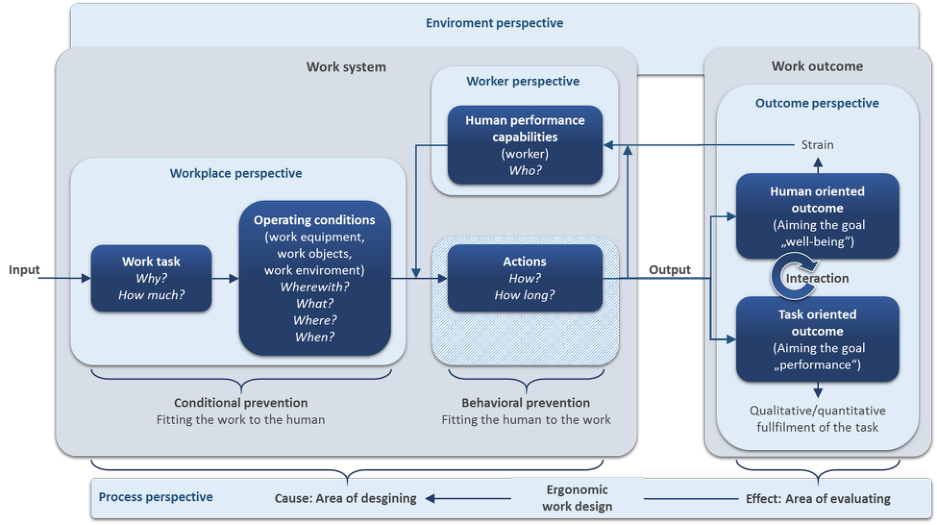
Based on the stress-strain concept (Rohmert, 1986) and the man-at-work system (Rohmert, 1986) we generated a framework for developing a performance measurement system in the context of ergonomic work design. This framework as cause and effect model consists out of the work system and the work outcome (Figure 1). There are inputs of a work system as well as outputs like material, information and energy. The inputs are transformed into outputs by a defined work task, certain operating conditions (Landau, 2001) and the actions performed by the worker using his human performance capabilities. Designing the work task and the operating conditions is accomplished by fitting the work to the human (conditional prevention). Fitting the human to the work (behavioral prevention) is done by designing the actions performed by the worker as well as affecting the human performance capabilities. The elements mentioned above are the causes for the effects described by the work outcome. The work outcome can be divided into two causes. First, a human oriented outcome which is described by an individual reaction of the human based on the causes and demands of the work system. The individual reaction is called strain and has an effect on the human performance capabilities. Second, a task-oriented outcome which is a quantitative and qualitative fulfillment of the task. The two outcomes pursue the goal of HFE which is performance (task- oriented outcome) and well-being (human oriented outcome). Both in the short and long term these goals are interacting with each other (Dul et al. 2012). By evaluating the work outcome (effect) conclusions can be drawn to generate a positive impact on areas of designing (cause) by ergonomic work design.
Figure 1. Cause-and-effect model as a framework to derive the five perspectives of the ergonomic performance measurement system
Five perspectives of the ergonomic performance measurement system Based on the cause-and-effect model we derived five perspectives of the ergonomic performance measurement system to achieve the outcomes performance and well-being (Figure 1). First, the worker perspective identifies the human performance capabilities which are providing important information for ergonomic work design (Bruder et al. 2008). Possible performance indicators are e.g. average age, amount of workers with challenges and types of challenges. Second, the workplace perspective focuses on the workplace as minimum unit of a work system consisting of the work task and the operating conditions. Relevant performance indicators could be e.g. weight and frequency of manual handling, amount of standing/walking/sitting and indices or values of risk assessments such as EAWS (Schaub et al., 2012) or NIOSH (Waters et al., 1994). Third, the process perspective aims the most important processes to ensure the outcomes of ergonomic work design. Four relevant processes were identified: corrective ergonomics, conceptual ergonomics, integration of workers with challenges and ergonomic awareness. All processes focus on performance indicators in the context of action tracking within the ergonomic performance measurement system. Corrective ergonomics describes the design of existing workplaces which is done according to requests from employees or first diagnoses of work-related health problems (Bruder et al. 2008) as well as ergonomic assessments. Performance indicators are conceivable such as e.g. due dates, amount of open/completed measures, costs/benefits of measures. Conceptual ergonomics focusses on ergonomic design or risk assessment along the production development process (Bruder et al. 2008). The amount of open/successful measures, in terms of ergonomically designed workplaces, is an example for performance indicators within conceptual ergonomics. The integration of workers with challenges into the work system through a comparison between the requirements of the workplace and the challenges of the worker (Bruder et al. 2008) is defined as the integration process. It can be measured by indicators such as e.g. amount of open/successful integrations and the duration of the integration processes. Finally, the ergonomic awareness is a process to foster understanding and know-how of ergonomic work design with the related outcomes. The target group is professional and executive staff as well as production workers. Possible performance indicators are e.g. amount of trained employees within different target groups. The forth perspective of the ergonomic performance measurement systems is the environmental perspective which focusses on the environment of the company and its expected population within the next years as well as important innovations concerning ergonomic work design. Future company scenarios can be derived by comparing actual or new work systems with the capabilities of future company population (Rademacher et al. 2008). In times of demographic change this knowledge gives insights into the potential mid- and long-term performance of a company. Performance indicators within this perspective are e.g. average age and types of challenges of the external population. Finally the fifth perspective is the outcome perspective. It represents the strategic goal of human factors/ergonomics and is the overall focus of all the other perspectives of the ergonomic performance measurement system. Performance outcome are understood as e.g. productivity, quality and innovation of a system. Outcomes of well-being are health, security, satisfaction as well as personal development (Dul et al., 2012).
AN EXPERT SURVEY ON PERFORMANCE MEASUREMENT SYSTEMS IN THE CONTEXT OF ERGONOMIC WORK DESIGN
Methods
Our focus is on performance measurement systems in the context of ergonomic work design in production facilities within Germany. We conducted our study in an international corporation of the automotive supply and mechanical engineering sector.
We used the key informant methodology (Campbell, 1955). The focused key informants group for the study was among heads of industrial engineering as well as industrial engineers of about 30 different productions facilities. It is presumed that they have a high expertise in the goals, methods and concepts of ergonomics as well as know-how, motivation and influence for a practical implementation of performance measurement systems within the company.
The survey period lasted about two months in total during three industrial engineering symposia and about four interdisciplinary workshops for ergonomic work design. Since the symposia as well as the workshops are open for other professional and executive staff they also had the opportunity to participate. Of the 105 handed out questionnaires, 73 usable surveys were returned right at the symposia, during the workshop or via mail (69.5 percent of the 105 handed out). This return rate is obvious over par compared with average response rates of 52.7 percent with a standard deviation of 20.4 percent whereas surveys completed in person have response rates (62.4 percent) that are higher (Baruch and Holtom, 2008). The completion of the survey in person, repeatedly personal reminders in front of the plenum as well as an assumed interest of the topic, explains the relatively high response rate.
Measures Number of production workers. Seven categories were identified such as “> 50-300”, “300-500”, “500-1,000”, “1,000-1,500”, “1,500-2,500”, “2,500-3,500”,”>3,500” production workers.
Importance. Informants were asked if a performance measurement system is important for planning and controlling the ergonomic work design scored from (1) very unimportant to (5) very important.
Current and planned application. Concerning the use of a performance measurement system three options were given such as “Yes”, “No” and “No, but we are using single performance indicators”. In addition four factors were identified in case an informant is not using a performance measurement system including “Lack of competence”, “Too work-intense”, “Too costly” and “Not necessary”.
Featured Functions. Four main functions were identified for a performance measurement system. The main function to control includes functions to “Increase the quality”, “Monitor and steer ergonomic measures” and “Increase competitiveness” during demographic change through age-oriented work design. The main function to analyze consists of the function to “Clearly present assessments”, “Better inspection” and “Improving the identification of risks”. The main function to document implies to “Document the progress” whereas the main function to motivate implies to “Increase the motivation to improve ergonomic work design”. All functions are scored from (1) strongly disagree to (5) strongly agree.
Relevant perspectives and performance indicators. Sixteen performance indicators in four different perspectives were identified. The worker perspective contains three indicators like “Average age of employees”, “Number of workers with challenges” and “Types of challenges”. Five performance indicators are accounted to the workplace perspective such as “Ergonomic checklist value” (based on an internal company checklist which assesses several operating conditions at workplace), “Weights and frequency of manual handling”, “Amount of standing, walking, sitting”, the “NIOSH Index” as well as the “EAWS Value”. The process perspective has six indicators including “Amount of due assessments”, “Action tracking corrective ergonomics (e.g. open/completed measures)”, “Costs/benefits of improvements”, “Action tracking integration process (e.g. amount of successful integrated employees), “Action tracking conceptual ergonomics (e.g. open/successful measures)”, “Action tracking ergonomic awareness (e.g. amount of qualified employees)”. The environment perspective includes two factors, such as the “Development of average age” and the “Development of various illness types”. The experts were asked if they collect the performance indicators at their production site or not. Furthermore they were asked to indicate their importance on a five-point scale ranging from (1) very unimportant to (5) very important.
Performing processes of ergonomic work design. Six factors were identified as relevant processes of ergonomic work design. First, that risks assessments identify stresses and therefore help to develop “Practical solutions”. Second, that workplaces with negative risk assessments are “Fast (re-)designed”. Third, the “Use of knowledge” of actual assessments for conceptual ergonomics and fourth the “Fast integration” of workers with challenges to a workplace that suits their demands and needs. In addition ergonomic work design is fifth “Adapting to population” of the workers and sixth that an “Overall understanding” concerning the need and benefits of ergonomics among executive staff and workers is in place. The experts used a five-point scale ranging from (1) very bad to (5) very good.
Outcomes of ergonomic work design. The outcome of ergonomic work design was measured using six criteria: “Reduction of absenteeism”, “Preserving the physical capabilities”, “Increasing job satisfaction”, “Increasing productivity”, “Increasing quality” and “Increasing competitiveness”. The experts rated the success on a five-point scale ranging from (1) totally disagree to (5) totally agree.
Measurement of Objectivity, Validity and Reliability Objectivity is a measure which reflects the fact that independently of the interviewer the same results are obtained (Alreck and Settle, 2004). Through different actions, the objectivity is guaranteed in the same framework conditions during the survey, with defined rules for evaluation and inspection by a second evaluator. Validity, as a degree to which a questionnaire reflects reality (Alreck and Settle, 2004), was conceded by a pretest with experts to evaluate the questionnaire. The reliability, a measure for internal consistency of each variable, can be quantified using the reliability coefficient Cronbachs α (Cronbach, 1947). Reliabilities were all good, exceeding the 0.80 reference value suggested by Cortina (1993) shown in Table 1 (Cortina, 1993).
Table 1: Overview of Cronbachs α for questions Variables Cronbachs α Items
Table available in the original PDF paper.
Featured Functions of a performance measurement system 0,845 8 Collecting of performance indicators 0.809 22 Importance of performance indicators 0.836 22 Performing processes of ergonomic work design 0,837 7 Success of ergonomic work design 0,804 6
RESULTS
The study is focusing at medium and large production facilities relating to the amount of production workers. Half of the questioned experts work in production facilities with less than 1,000 production workers. The other half works in facilities with more than 1,000 up to over 3,500 production workers.
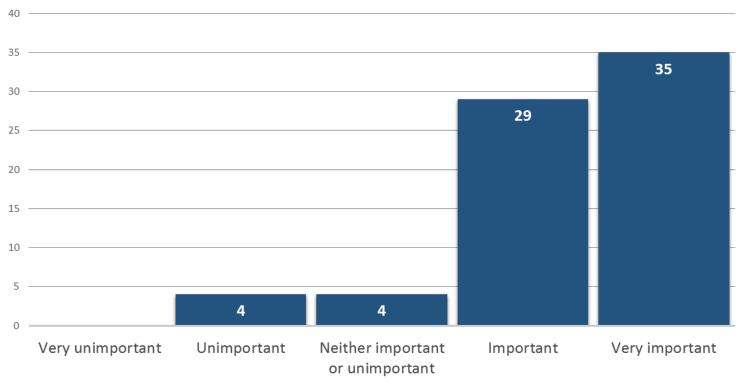
Importance of an ergonomic performance measurement system Descriptive statistics for the importance of a performance measurement system for ergonomic work design appears in the histogram of Figure 2. The majority of the experts sees a performance measurement system for ergonomic work design as “Very important” and “Important”. Based on the results it can be derived that there is a demand and affirmation for such a system.
Figure 2. Importance of a performance measurement system for ergonomic work design Current and planned application of an ergonomic performance measurement system
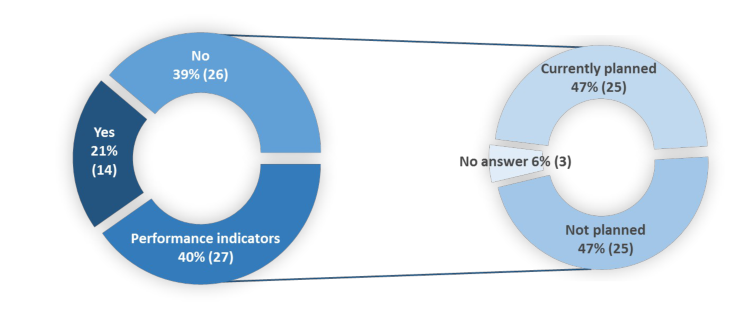
Besides the importance of a performance measurement system it is interesting to prove whether such systems are already in use at different production facilities. A fifth (21 percent) of the experts is already using a performance measurement system. Most of the experts are using single performance indicators (40 percent) but there are also experts (39 percent) that use neither a performance measurement system nor single performance indicators (left circle of figure 4).
Figure 3. General present and planned use of performance measurement systems for ergonomic work design
The last two groups were asked if they are planning to implement such a system (right circle of figure 3). Half of them are planning to implement such a system (47 percent) whereas the other half doesn’t (47 percent). The results show that performance measurement systems and performance indicators for ergonomic work design are very well established (61 percent). More than half of the experts is already using such systems or plan their implementation (57 percent). From that we derive that performance measurement systems in the context of ergonomic work design are enjoying growing popularity and that they will be an integral part of different methods and tools within industrial engineering work.
There are two main reasons for a not yet widespread application. First of all there is a lack of knowledge for the development and the implementation of performance measurement systems (29 percent) in the productions facilities. Secondly the experts say that such a system is very work-intense (22 percent). Around ten percent believe that it is too costly or not necessary. In other words, the lack of knowledge, personal and financial resources prevents the development and implementation of performance measurement systems.
Featured functions of an ergonomic performance measurement system The first column in Table 2 shows the different functions of a performance measurement system. The function to control focuses on controlling the ergonomic work design. The experts strongly agree that they expect to “Monitor and steer ergonomic measures” (4.59 ± 0.72), “Increase quality of ergonomic work design” (4.52 ± 0.75) and agree to “Increase the competitiveness” in times of demographic change through age-appropriate workplace design (4.21 ± 0.89) with a performance measurement system. Focusing on the function to analyze, the experts agree with “Improved identification of risk areas” (4.42 ± 0.92) with high stress, with a “Better inspection” (4.41 ± 0.78) of the actual status of ergonomic work design as well as with a “Clearly-presented assessment” (4.31 ± 0.84) of workplaces and cost-centers within a production facility. The function to document is important to “Document the progress of ergonomic work design” (4.24 ± 0.80). The experts also agree that a performance measurement system should include a motivation function to “Motivate executive staff and employees” (4.30 ± 0.80) to improve ergonomic work design. In other words, the findings appear to be consistent with the functions of performance measurements systems derived from literature.
Table 2: Functions of a performance measurement system Functions Expectations Mean Std. dev.
Table available in the original PDF paper.
Function to control
Increasing the quality of ergonomic work design 4.52 0.75 Monitoring and steering ergonomic measures 4.59 0.72 Increasing the competiveness 4.21 0.89
Function to analyze
Clearly-presented assessments 4.31 0.84 Better inspection 4.41 0.73 Improving the identification of risks 4.42 0.92 Function to document Documenting the progress 4.24 0.80 Function to motivate Increasing motivation 4.30 0.80
Relevant perspectives and performance indicators of an ergonomic performance measurement system
Table 3 reveals in the third column the amount of experts which are monitoring the performance indicators within their production facility and the forth column the importance of the performance indicator. The “Average age of employees” is mostly (82 percent) monitored within the worker perspective whereas indicators concerning the “Number of worker with challenges” (65 percent) as well as “Types of challenges” (48 percent) are less common. Despite this fact the performance indicators concerning the challenges of workers are considered to be very important (4.36 ± 0.60). The workplace perspective shows that both, the internal ergonomic checklist value (94 percent) and the NIOSH value (92 percent) are the performance indicators that are monitored the most. The difference between the NIOSH index and the EAWS value (65 percent) can be explained by the fact that EAWS is a relatively new assessment within the corporation. Interesting findings can be derived by taking a closer look at the process perspective. Whereas monitoring performance indicators of processes like corrective ergonomics (92 percent) seem to be very well established, the processes concerning conceptual ergonomics (34 percent), the integration process (41 percent) as well as ergonomic awareness (43 percent) are not. Surprisingly performance indicators related to “Cost/Benefits of improvements” are rarely monitored (25 percent). Nevertheless the experts agree that all of the performance indicators of the process perspective are from important to very important to monitor. Finally the environment perspective reveals that the external view is not yet established in case of monitoring the “Development of average age” (23 percent) or the “Development of various illness types” (14 percent), but is considered to be important (3.79 ± 0.68 and 3.90 ± 0.59).
Table 3: Collection and importance of performance indicators
Table available in the original PDF paper.
Collection Importance
Perspectives Performance indicators
Mean Std. dev. Mean Std. dev.
Worker perspective
Average age of employees 0.82 0.39 4.22 0.54 Number of workers with challenges 0.65 0.48 4.36 0.60 Types of challenges 0.48 0.50 4.36 0.60 Ergonomic Checklist Value 0.94 0.24 4.64 0.64 Weights and frequency of manual handling 0.83 0.38 4.55 0.66
Workplace perspective Amount of standing/walking/sitting 0.66 0.47 4.00 0.80 NIOSH Index 0.92 0.28 4.58 0.56 EAWS Value 0.65 0.48 4.09 0.81
Development of average age 0.23 0.43 3.79 0.68 Development of various illness types 0.14 0.35 3.90 0.59
Completely independent from the previous results it is important to critically ask, if an ergonomic performance measurement system adds value to the business. There are, of course, related costs and labor necessary to run such a system. Therefore it must create sustainable benefits and added performance value for production facilities and the entire company.
Performing processes of ergonomic work design
Table 4: Performance measures and the success of processes of ergonomic work design - Pearson correlation coefficients Adapting Overall Performance measures Practical solutions
Table available in the original PDF paper.
Fast (re-) designing
Use of know-
Fast integratio ledge n to population
under- standing Average age of employees -0.073 0.071 0.153 -0.069 -0.034 0.122 Number of workers with challenges 0.302 0.537** 0.324* 0.219 0.176 0.080 Types of challenges -0.152 0.469** 0.368** 0.282* 0.421** 0.095 Ergonomic Checklist Value 0.032 0.049 -0.061 -0.069 -0.045 -0.176 Weights and frequency of manual handling 0.347** 0.006 -0.027 -0.013 0.185 -0.184
Amount of standing/walking/sitting 0.231 0.455** 0.224 0.552** 0.573** 0.029 NIOSH Index 0.155 -0.054 0.014 -0.017 0.039 -0.321* EAWS Value 0.476** 0.042 0.322* 0.082 0.167 0.319* Due dates for ergonomic assessment 0.016 0.024 0.134 0.000 -0.022 -0.007 Action tracking corrective ergonomics 0.232 0.206 0.014 0.055 0.125 0.128 Costs/Benefits improvements -0.034 -0.110 -0.026 0.172 0.400** -0.118 Action tracking integration process -0.017 0.381** 0.449** 0.203 0.334* 0.132 Action tracking conceptual ergonomics -0.236 0.253 0.174 0.277* 0.425** 0.121 Action tracking ergonomic awareness 0.259* 0.337** 0.279* 0.577** 0.551** 0.177 Development of average age 0.088 0.369 0.474* -0.075 -0.007 0.281 Development of various illness types 0.048 0.301 0.514* -0.172 -0.123 0.022
Equation reproduced from the original PDF.
Table 4 reports the Pearson correlation coefficients of performance indicators and performing processes of ergonomic work design. There are several interesting findings that are noted below. First, the experts were asked if they are successful in using risk assessments (e.g. the ergonomic checklist, EAWS) to identify the stresses and therefore help to develop “Practical solutions”. There is a positive correlations between being successful in developing practical solutions and monitoring the “EAWS Value” (r=0.476, p=0.001). Apparently EAWS provides useful information to identify risks and provides solution approaches. Second, a “Fast (re-)desgining” after a negative risk assessment correlates with the “Number of workers with challenges”(r=0.537, p=0.000), “Types of challenges”(r=0.469, p=0.000), “Amount of standing/walking/sitting” (r=0.455, p=0.000). Third, the “Use of knowledge” from actual assessments for conceptual ergonomics has positive correlations with the “Action tracking integration process” (r=0.449, p=0.000), There are also positive correlations concerning the “Development of average age” (r=0.474, p=0.019) and “Development of various illness types” (r=0.514, p=0.020). Fourth, the “Fast integration” of workers with challenges at a workplace, which suits their demands and needs, has positive correlations with the “Amount of standing/walking/sitting” (r=0.552, p=0.000) and the “Action tracking ergonomic awareness” (r=0.557, p=0.000). Fifth, due to demographic change, it is necessary that ergonomic work design is “Adapting to population”. There are positive correlations with the “Types of challenges”(r=0.421, p=0.001), “Amount of walking/standing/sitting” (r=0.573, p=0.000), “Costs/Benefits of improvements” (r=0.400, p=0.004), “Action tracking ergonomic conceptual ergonomics” (r=0.425, p=0.001) and “Action tracking ergonomic awareness” (r=0.551, p=0.000). In other words, monitoring the performance indicators from above provides important information and therefore helps to adapt the ergonomic work design to the internal population. Sixth, the experts are asked if an “Overall understanding” concerning the need and the value of ergonomics exists among professional and executive staff as well as production workers. In this case, there is a negative correlation with the “NIOSH Index” (r=-0.321, p=0.012) and a positive correlation with the “EAWS Value” (r=0.319, p=0.030). In other words, communicating the EAWS value seems to provide a better understanding among professional and executive staff than the NIOSH index.
Success of ergonomic work design
Table 5: Performance measures and the overall success of ergonomic work design - Pearson correlation coefficients Increasing
Table available in the original PDF paper.
Increasing Increasing
Preserving Performance indicators Reducti
Quality
Increasing competitive-
Productjob satis-
ness
ivity faction
on of absent-
the physical capabilities eeism
Average age of employees 0.059 -0.152 0.129 -0.088 -0.141 -0.106 Number of workers with challenges -0.096 -0.033 -0.077 -0.015 -0.420 -0.074 Types of challenges -0.082 0.071 0.017 0.115 -0.057 -0.061 Ergonomic Checklist Value 0.123 0.067 0.139 0.047 0.136 0.206 Weights and frequency of manual handling -0.224 -0.019 -0.159 -0.221 0.260 0.068 Amount of standing/walking/sitting 0.131 0.314* 0.095 0.021 0.053 -0.043 NIOSH Index -0.115 0.056 -0.062 -0.138 0.184 0.237 EAWS Value 0.159 0.261 0.151 -0.077 0.355* 0.444** Due dates for ergonomic assessment 0.143 0.033 -0.022 0.100 -0.074 -0.30
Action tracking ergonomic awareness 0.084 0.179 -0.041 0.406** 0.245 0.105 Development of average age -0.085 -0.322 0.401 -0.075 -0.097 -0.157 Development of various illness types 0.212 0.010 -0.209 0.101 -0.056 -0.017
Equation reproduced from the original PDF.
Table 5 shows the Pearson correlation coefficients of performance indicators and the overall success of ergonomic work design. There are several interesting findings that should be emphasized. The performance indicator “Amount of standing/walking/sitting” (r=0.314, p=0.016) during a shift, as well as the “Action tracking corrective ergonomics” (r=0.285, p=0.026), is correlated with the success of preserving the physical capabilities. Also the indicator “EAWS Value” correlates with the success of “Increasing the quality” (r=0.355, p=0.014) and “increasing competitiveness” during demographic change (r=0.444, p=0.002) in a production facility. It is worthwhile that one of the strongest positive correlations among the performance indicators was obtained with the “EAWS Value”, which might expose the value of this risk assessment. Furthermore there are positive correlations between the performance indicators “Action tracking conceptual ergonomics” (r=0.298, p=0.026), “Action tacking of ergonomic awareness” (r=0.406, p=0.002) and “Increasing productivity”. In general, those production facilities which monitor these indicators have a better understanding of the overall stress situation within each production area. Therefore they are able to plan better and to control better the stress situations and furthermore they can connect ergonomic work design with the outcomes performance and well-being.
DISCUSSION
The data provides strong support for the fact that performance measurement systems are an important and necessary instrument to plan and control the ergonomic work design within industrial companies. Such systems or single performance indicators are already well-established within production facilities and will be an integral part of different methods and tools within industrial engineering work.
Theoretical Implications The study contributes to the literature in a number of ways. First, the presented cause-and-effect model is an ideal basis to derive perspectives of an ergonomic performance measurement system. By connecting the ergonomic performance measurement system to the two related outcomes of HFE, it contributes to the strategy of a company. Second, the functions of a performance measurement system such as the function to control, the function to analyze, the function to document as well as the function to motivate can be transferred to an ergonomic performance measurement system. Third, a first set of performance indicators could be derived, when some of them have a significant influence on the performance of processes and overall business success within the context of ergonomic work design.
Before we discuss managerial implications, we address a number of constraints that our study suffers from. It is a study within only one international corporation of the automobile supply and mechanical engineering sector. In addition we only asked industrial engineering experts and only within production facilities in Germany. Due to that, replication is needed. We made these trade-offs to perform a resource efficient survey and to get a first insight into performance measurement in the context of ergonomic work design. A different research design would obviously give additional information to the subject and it would be interesting if the results also apply in different industrial corporations, companies, countries and asking different experts.
Managerial Implications The results have important implications for the management of ergonomic work design. There are five major implications concerning the relevance, the barriers for implementation, the relevant perspectives and indicators, the performance of processes and the business success regarding performance and well-being. First, the results show clearly that a performance measurement system in the context of ergonomic work design is very important to our experts. Second, it appears to be that the lack of knowledge, high effort and budget constraints within production facilities prevent the development and implementation of such a system. This finding implies that companies should be bundling the personnel and financial resources as well as involving performance measurement experts to develop and implement a cross-company performance measurement system. Third, performance indicators within the workplace perspective are very well established. Focusing the worker perspective, there is a demand for action to collect information about workers with challenges. It brings enormous opportunities to draw conclusions for corrective and conceptual ergonomics. Obviously this has to be in compliance with the data privacy regulations. Potential performance indicators of the process perspective reveal that especially processes which outline the costs and benefits of ergonomics, the integration of workers with challenges, conceptual ergonomics as well as the ergonomic awareness are essential to monitor. Fourth, monitoring certain performance indicators appear to help production facilities to be more successful in performing processes in the context of ergonomic work design.
Performance indicators of the worker perspective give important insights into the major need of ergonomic work design. Therefore these production facilities are faster in (re-)designing workplaces, they have a better usage of the results of ergonomic assessments and a faster process of integrating workers with challenges. Furthermore they have a future-oriented ergonomic work design in place through actively adapting to the workers population. The in-depth knowledge of the workplaces (workplace perspective) through indicators supports the success of processes as well. This is also done through a faster (re-)design, a better identification of solutions and a better understanding of executives and workers concerning the need of ergonomic design. Performance indicators of the process perspective supports the continuous improvement and therefore practical solutions are better identified, workplaces are faster (re-)designed and workers with challenges are faster integrated. Fifth, monitoring certain performance indicators have a positive impact on the overall business success concerning well-being like preserving the physical capabilities of workers as well as performance like increasing the productivity and increasing the competitiveness in times of demographic change.
The results of the present study show that a performance measurement system supports planning and controlling the ergonomic work design within a company. Besides that, having such a system in place makes it much easier to communicate with professional and executive staff for example about the actual stress at workplaces, demands of workers with challenges, the success of certain processes like corrective and conceptual ergonomics and of course relevant outcomes like productivity and well-being. Necessary improvement measures as well as the benefits of ergonomic work design become clear to the relevant parties through an ergonomic performance measurement system.
CONCLUSION
In conclusion, our study has important implications for the development of a performance measurement system to plan and control ergonomic work design within production facilities. We highlight six key issues. First, we show that performance measurement systems are important to experts of industrial engineering to plan and control the ergonomic work design. Second, we emphasize the current application of performance measurement systems as well as of single performance indicators and the reasons why performance measurement systems are not yet completely in use. Third, our findings suggest important functions that such systems should include. Forth, we offer different perspectives of a performance measurement system for ergonomic work design which are derived from a cause-and-effect model, based on the stress-strain concept. These perspectives have the potential to build a framework for performance measurement systems in the context of ergonomic work design. Fifth, by following the logic above, we present a first set of performance indicators within each perspective and answer the question if these indicators are already collected and how important are they to our experts. Finally, we reveal that collecting certain performance indicators has an effect on the process performance and the overall success of ergonomic work design. The development and application of performance measurement systems in the context of ergonomic work design has proved to be the right and an effective way. The theoretical and managerial implications of this article show that it is very reasonable to continue and extend the research on this subject.
REFERENCES
Alreck, P. L., Settle, R.B. (2004), “The survey research handbook”. 3rd edition. New York: McGraw-Hill. Anthony, R. N., Govindarajan, V. (2003), “Management control systems”. 11th international edition. Singapore: McGraw-Hill. Bain, D. (1982), “The productivity prescription. The managers guide to improving productivity and profits.”. New York: McGraw-Hill. Baruch, Y., Holtom, B.C. (2008), “Survey response rate levels and trends in organizational research”, Human Relations,
Volume 61 No. 8. pp. 1139-1160. Bruder, R., Kugler, M., Sinn-Behrendt, A., Schaub, K., Ghezel-Ahmadi, K., Feith, A. (2008), “Introduction of Ergonomics into Production Development Processes: An Approach”,in: 2nd International Conference on Applied Human Factors and Ergonomics (AHFE), 14. - 17. July 2008, Las Vegas (NV, USA). Campbell, D. T. (1955), “The informant in quantitative research”, American Journal of Sociology, Volume 60 No. 4.
pp. 339-342. Cortina, J.M. (1993), “What is coefficient alpha? An examination of theory and applications”, Journal of Applied Psychology, Volume 78 No. 1. pp. 98-104. Maskell, B. H. (1991), “Performance measurement for world class manufacturing: A model for American companies”.
Cambridge, MA: Productivity Press. Dul J., Bruder, R., Buckle, P., Carayon, P., Falzon, P., Marras, W.S., Wilson, J.R., van der Doelen, B. (2012), “A strategy for human factors/ergonomics: developing the discipline and profession”, Ergonomics, Volume 55 No. 4. pp. 377-395.
Dul, J., Neumann, W. P. (2009), “Ergonomics contributions to company strategies”, Applied Ergonomics, Volume 40 No. 4.
pp. 745-752. Kaplan, R. S., Norton, D. P. (1996), “The balanced scorecard. Translating strategy into action”. Bosten, MA: Harvard Business School Press Geiss, W. (1986), “Betriebswirtschaftliche Kennzahlen. Theoretische Grundlagen einer problemorientierten Kennzahlen-
anwendung”. Frankfurt am Main: Peter Lang. Landau, K. (2001), “AET Ergonomic Job Description Questionnaire”, in: International Encyclopedia of Ergonomics and Human Facotrs, Karwowski, W. (Ed.). pp. 1742-1746. Neely, A., Gregory, M., Platts, K. (1995), “Performance measurement system design. A literature review and research agenda”,
International Journal of Operations & Production Management, Volume 15 No. 4. pp. 80-116. Rademacher, H., Sinn-Behrendt, A., Landau, K., Bruder, R. (2008), “Ergonomic analysis and design of industrial workplaces with special reference to age”, in: 2nd International Conference on Applied Human Factors and Ergonomics (AHFE), 14. - 17. July 2008, Las Vegas (NV, USA). Rohmert, W. (1986), “Ergonomics: concept of work, stress and strain”, International Review of Applied Psychology, Volume 35
No. 2. pp. 159-181. Schaub, K., Caragnano, G., Britzke, B., Bruder, R. (2012), “The European Assembly Worksheet”, Theoretical Issues in Ergonomic Science, Volume 14 No. 6. pp. 616-639. Sauter, M., von Killisch-Horn, G. (2011), “Produktivitätsmanagement in einer variantenreichen Fertigung”, in: Leistung und
Lohn, No. 494/497, Bundesvereinigung der Deutschen Arbeitgeberverbände (Ed.). pp. 5-60. Waters, T. R., Putz-Anderson, V., Grag, A. (1994), “Applications manual for the revised NIOSH lifting equation”, U.S.
Department of Health and Human Services (Ed.), DHHS (NIOSH) Publication No. 94-110. Zink, J. K., Seibert, S. (2009), “Performance measurement form a macroergonomics perspective”, in: Industrial engineering and ergonomics, Schlick, C.M. (Ed.). pp. 91-103.
LISTED IN THE AHFE DIGITAL BOOKSTORE CATALOGUE
Explore the complete digital volume
Advances in The Ergonomics in Manufacturing: Managing the Enterprise of the Future
Read this individual research paper free through the original publisher, or explore the full digital proceedings book.
ISBN 978-1-4951-2103-6
Explore this ISBN in the AHFE Bookstore ↗Listed in the July 2026 bookstore catalogue; search by ISBN to confirm current availability · Digital book purchase optional