Izanete de Medeiros Costa, Ricardo José Matos de Carvalho (2019). Ergonomics and Teaching: An Investigation About Brazilian Teacher’s Stress. In: Advances in Cognitive Engineering and Neuroergonomics. AHFE Open Access, vol. 7. https://doi.org/10.54941/ahfe100231
This article is an investigation on stress of teachers from lower Elementary School in the public educational system of Natal/ Rio Grande de Norte/ Brazil under the perspective of Ergonomics, which means to map the occurrence of stress and the main stressors present in the work place of the studied group. To reach that, a field survey was conducted with a qualitative and quantitative approach. The sample of the survey is made of 52 teaches from lower Elementary in schools of the municipal public educational system in Natal/RN/BR. The tools used in the collection of this data were the Inventory of Stress Symptoms – ISSL, to measure the level of stress in teachers and a questionnaire with direct multiple choice questions as well as indirect questions, in order to get to know the social-professional profile of the research subjects and to identify and analyze the stressors agents present in the teachers’ work activities, relating them to their causes. Results show that 73,08% of teachers participating in the reach are stressed. The mains stressor agents are the problems in their relationship with students, students’ parents and school administration plus the inadequate school environment (excessive noise, heat, poor light, etc.).
Stress is a growing problem at workplaces, known as one of the most concerning (WHO, 2013). In the education area, teachers are the professionals who suffer the most from stress (ILO, 2007). Studies conducted in Brazil (Martins, 2007; Goulart Júnior, Lipp, 2008; Silva, Damásio & Melo, 2009; Costa & Rocha, 2013) showed the existence of a significant amount of Elementary School teachers taken by stress in levels which are harmful to health.
Stress in teachers interferes negatively in the school place, once it harms employees’ health and reduces their performance at work (Milner & Khoza, 2008). It might be pointed as one of the responsible factors for bad quality education. According to Anísio Teixeira National Institute of Studies and Educational Research (2012), known as INEP, Brazilian public education displays alarming results in the learning index.
The studies on stress in teachers prioritize to focus the subjects over the organization aspects, which only cover the stress problem once they do not regard the work organization factors that may have generated stress (Schelvis, 2013). Actions of stress management that focus on people are not as effective as the ones that are based on the work organization. The reason is that an intervention that shows good results in organizational levels is more predisposed to raise positive changes in individual levels (Caulfield, Chang, Dollard, & Elshaug, 2004; McVicar, Munn- Giddings, & Seebohm, 2013).
Therefore, it becomes necessary to approach the teachers stress issue according to the work organization perspective. To reach that, the Ergonomics can be adopted. Acoording to Falzon and Sauvagnac (2007), Ergonomics can contribute to the management of stress since the main goal of an ergonomic action upon stress ‘is change the view of stress in the organization: from a pathology or suffering to be heard, it becomes an appeal to examine the work condition, - something which is not obvious’ (2007, p. 151). Ergonomics consists in a global approach that contemplates all aspects of the work organization. Thus, when analyzing the activity of teachers' work from the Cognitive Engineering and Neuroergonomics (2019) perspective of Ergonomics consider the particularities of their context of realization as well as their requirements and the factors that may influence it. In addition, the ergonomic intervention is very effective in that it utilizes the experience and knowledge of workers (Hendrick, 2001).
QUALITY OF BRAZILIAN BASIC EDUCATION Evaluation of Brazilian Public Education
The rate of illiteracy is an index of the educational system quality in a country and, therefore, of teaching quality. The numbers presented by the Brazilian Institute of Geography and Statistics – IBGE – and by Anísio Teixeira National Institute of Studies and Educational Research – INEP – show a huge loss of effectiveness in the learnin- teaching process. According to IBGE (2012), in 2011, 1.9% of people between 10 and 14 years old was illiterate (see Figure 1). Among the people over 15 years old, this rate goes up to 8.6% (see Figure 2). As we can see in Figures 1 and 2, from 2007 to 2011 there was a decrease of the illiteracy rates in Brazil.
Illiteracy Rate of Segment of Population Aged 10-14 Years, by Gender, 2007-2011, Brazil
%
2007 2008 2009 2011 0 0.8 1.6 2.4 3.2 4 4.8
Total Men Women
FIGURE 1: Rate of illiteracy of people between 10 and 14 years old (adapted from IBGE, 2012)
Figure available in the original PDF paper.
Illiteracy Rate of Segment of Population Aged 15 and Years, by gender, 2007-2011, Brazil
12
9
6
%
3
2007 2008 2009 2011 0
Total Men Women
FIGURE 2: Rate of illiteracy among people over 15 years old (adapted from IBGE, 2012)
Figure available in the original PDF paper.
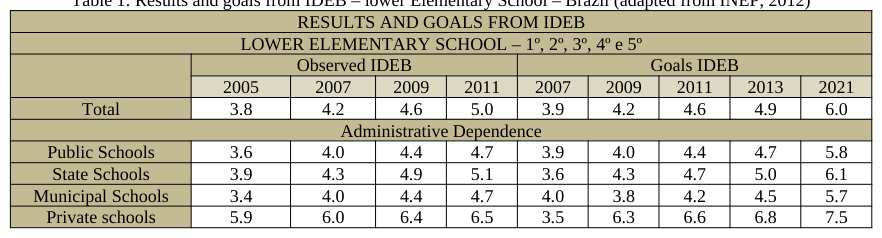
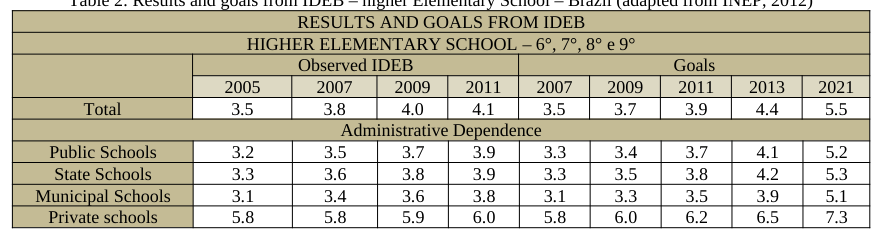
The evaluation of Brazilian students’ performance, conducted through standardized tests and presented through the educational rating Basic Education Development Rating – IDEB, displayed shocking results (INEP, 2012). In 2011, the lower Elementary School of Brazilian public schools obtained IDEB 4.7 (see Table 1). Still in the year 2011, the IDEB of higher Elementary School grades decreased to 3.9 (IINEP, 2012) (see Table 2). The highest punctuation that can be achieved is 10. In comparison to private schools, public schools showed lower scores. In lower Elementary School, the IDEB score of private schools was 18% higher than in public school. In the higher Elementary School grades, this difference grows up to 21%.
Table 1: Results and goals from IDEB – lower Elementary School – Brazil (adapted from INEP, 2012) RESULTS AND GOALS FROM IDEB LOWER ELEMENTARY SCHOOL – 1º, 2º, 3º, 4º e 5ºTable 2: Results and goals from IDEB – higher Elementary School – Brazil (adapted from INEP, 2012)
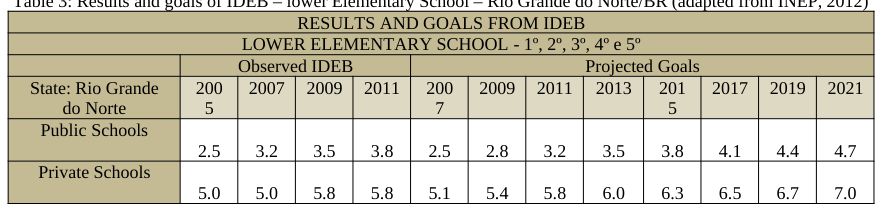
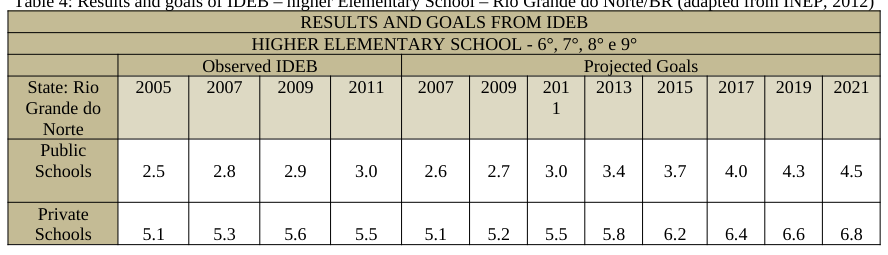
In the state of Rio Grande do Norte, numbers are even more worrying. Lower Elementary School grades got a 3.8 IDEB (see Table 3). The higher grades got a 3.0 IDEB (see Table 4). Although results show a growing tendency, and being higher than the goals projected by Ministry of Education –MEC, they are still low if compared to the highest possible results, which is 10. In Rio Grande do Norte, following the same pattern seen at the national level, students from private schools present a finer performance than students from public school. In 2011, private schools’ IDEB was 20% higher than the one from public school in lower Elementary schools and 25% in higher Elementary schools.
Table 3: Results and goals of IDEB – lower Elementary School – Rio Grande do Norte/BR (adapted from INEP, 2012) RESULTS AND GOALS FROM IDEB LOWER ELEMENTARY SCHOOL - 1º, 2º, 3º, 4º e 5º Observed IDEB Projected Goals State: Rio Grande do NorteTable 4: Results and goals of IDEB – higher Elementary School – Rio Grande do Norte/BR (adapted from INEP, 2012) RESULTS AND GOALS FROM IDEB HIGHER ELEMENTARY SCHOOL - 6°, 7°, 8° e 9° Observed IDEB Projected Goals State: Rio Grande do
In the capital city of Rio Grande do Norte, Natal, 3.9 was the IDEB reached by the lower Elementary schools (see Table 5), and 3.0 was the one in higher Elementary schools (see Table 6). The goals were achieved in every year the evaluation method was implemented, however results remain low.
Table 5: Results and goals of IDEB – lower Elementary School – Natal/RN (adapted from INEP, 2012) RESULTS AND GOALS FROM IDEB LOWER ELEMENTARY SCHOOL - 1º, 2º, 3º, 4º e 5º Observed IDEB Projected Goals City 2005 2007 2009 2011 2007 2009 2011 2013 2015 2017 2019 2021Table 6: Results and goals of IDEB – higher Elementary School – Natal/RN (adapted from INEP, 2012) RESULTS AND GOALS FROM IDEB HIGHER ELEMENTARY SCHOOL - 6°, 7°, 8° e 9° Observed IDEB Projected Goals City 2005 2007 2009 2011 2007 2009 2011 2013 2015 2017 2019 2021
Turnover Rate Turnover is another factor that may demonstrate the urgency for improvements in the teaching profession. According to Ministry of Labor and Employment, in 2007, among the teaching professionals the turnover rate – except for transferences, retirements, deceases and voluntary termination- was 17.5%, and in 2008 it came up to 19.2%, reaching 19% in 2009, quite an expressive number.
A study conducted in the United States showed that ‘teachers are more satisfied and plan to stay longer in schools that have a positive work context” (Johnson, Kraft & Papay, 2012, p. 2). Deplorable working conditions, resulting from a series of organizational issues, may be responsible for the high rates of turnover among teacher from the Brazilian public education system. Inadequate working conditions lead these professionals to seek for a job in other institutions, abandoning the teaching area.
According to Esteve (1999), undervalue of professional teachers, the constant demands on their work, the violence and students’ lack of discipline, among other factors, contribute so that the teachers lose interest in work. Facing the work conditions that are imposed to them, teachers develop ‘intense negative feelings such as anguish, alienation, anxiety and demotivation, besides emotional exhaustion, coolly confronting problems, insensibility and unhuman attitude’ (Souza & Leite, 2011, p. 1009).
Although they work in inadequate conditions, the demands upon their work are not lessened. Therefore, their work requires more effort due to the inappropriate conditions for its execution (Gasparini, Barreto & Assunção, 2005).
STRESS According to the stress theory from Hans Selye (1956) called General Adaption Syndrome – GAS, stress is a reaction from the body to a threatening situation. Being exposed to a threatening situation, the human body responds. External factors that threaten the subject are called stressors and the body’s response to these stressors is the stress.
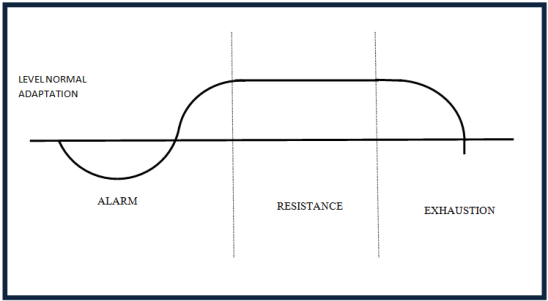
According to Selye’s theory (1956), stress is found in three stages: alarm, resistance and exhaustion (see Figure 3). Complementing the General Adaption Syndrome, Brazilian researcher Marilda Emanuel Novaes Lipp, after developing a variety of studies in Pontifícal Catholic University – PUC – Campinas/ São Paulo/ Brasil, identified a fourth phase of stress called by her as phase of ‘near exhaustion’ (Lipp, 2002, p. 110). The author then proposed a complementary model to the one shown by Selye, including the near exhaustion phase. This article contains the model of stress proposed by Selye and Lipp.
Figure 3: General Adaptation Syndrom’s stages according to Selye (adapted from Selye, 1956)
The alert stage is a positive phase. It consists in a body response to a stimulus, in contact with a ‘stressor’. The body prepares to fight against a situation that settles (Faria & Gallo-Penna, 2009; Goulart; Lipp 2008). In this phase, many changes happen in the human body.
There is the release of adrenaline, which permits more attention and focus on attitudes to reach a certain goal (Martins, 2007). It’s common to have difficulty to sleep, increase of muscular tension and breath frequency, irritability, among other symptoms (Faria & Gallo-Penna, 2009; Martins, 2007). The inner balance of the body is lost, which means, of the homeostasis. When the ‘stressor’ remains for a short time, the adrenalin is expelled and the homeostasis is reestablished. The well-being of the subject is preserved (Martins, 2007).
In this case, stress brings positive consequences due to the increase of attention and focus. Falzon and Sauvagnac (2007) point the importance of stress on the need to respond to challenging situations. However, if the stressor’s stimulus is intense it will cause serious damage to health (Meleiro, 2002).
The second stage, resistance, happens when the stressor remains a longer period of time or it has more intensity. In these cases, there’s an attempt of adaptation, of reestablish the homeostasis. This can cause exhaustion, since in the attempt to restore itself the body gives off a high quantity of energy (Meleiro, 2002; Martins, 2007; Faria & Gallo- Penna, 2009; Goulart & Lipp, 2008). According to Martin (2007), in this phase a lot of diseases may arise such as ‘blood pressure peaks, simple herpes and psoriasis and even diabetes if people are genetically predisposed to it’
(Martins, 2007, p. 112). Besides, it might affect the memory, cause headaches, the flu and viruses might become more frequent (Faria & Gallo-Penna, 2009).
According to Lipp (2002), between the phases resistance and exhaustion, we can identify the near exhaustion phase. In this phase, the sickening process begins and ‘the organs which have a higher genetic or acquired vulnerability start to show signs of deterioration’ (Lipp, 2002, p. 110). The physical and emotional aspects begin to suffer more significant changes, jeopardizing the body’s normal functioning (Martins, 2007), which may bring the subject to insomnia, fatigue and wear feelings, decrease of creativity and, in consequence of these factors, reduction of productivity (Faria & Gallo-Penna, 2009). According to Martin (2007), anxiety is characteristic in this phase and the diseases that arise in the resistance phase normally tend to worsen.
The following phase is exhaustion or wear. It is the most negative phase of stress; once it causes a very intense inner unbalance (Faria & Gallo-Penna, 2009; Martins, 2007). There is the possibility of physical and psychological exhaustion, which increases the chances of developing diseases. The sickening happens according to each person’s propensity (Goulart & Lipp, 2008; Meleiro, 2002), being quite common depression, ulcers, psoriasis, infarct, high blood pressure, diabetes, panic disorder, (LIPP, 2002; Faria & Gallo-Penna, 2009) skin, stomach and cardiovascular disorders, gingival retraction and, in some cases, it can even lead to death (Martins, 2007).
Occupational Stress in Teachers According to the World Health Organization – WHO (2013), occupational stress consists in the response of workers before the work’s demands and pressure, which are incompatible to their knowledge and skill and challenge their capacity (WHO, 2013). Occupational stress is directly linked to negative feelings towards work (Lipp, 2002), which, besides harming the employees’ health, reduces their performance and, consequently, the quality of their production (Milner & Khoza, 2008).
According to the American Institute of Stress – AIS (2013), stress at work is the mains kind of stress in adult Americans. According to a Health and Safety Executive – HSE (2013), statistics information from Great Britain referring to the period from 2011 to 2012, reveal that stress represents 40% of diseases related to work. In Brazil, according to the Ministry of Social Security (2012), Severe Reaction to Stress and Adaptation Disorders reached the twentieth position among the work accidents in 2012. In Great Britain, the economic sectors most toughly hit is health, social service, education, administration and public defense.
International Labour Organization – ILO (2007) states that in education, teachers are the most hit by stress. Studies developed by Martins (2007), Goulart Júnior and Lipp (2008), Silva, Damásio and Melo (2009) and Costa e Rocha (2013) with teachers from Brazilian Elementary public schools concluded that most of the researched professionals has a high level of stress, which may compromise their health and the quality of their work. Once the performance of the teacher is affected, the teaching quality decreases. Therefore, the teaching-learning process happens in an inefficient manner and students are harmed.
The studies of Martins (2007), Goulart Júnior and Lipp (2008), Damásio and Melo (2009) and Costa e Rocha (2013) identified that, respectively 67.1%, 56. 6%, 60.7% and 87.32% of the teachers researched with stress in damaging to health phases.
ERGONOMICS The International Ergonomics Association – IEA – definies ergonomics:
Ergonomics (or human factors) is the scientific discipline concerned with the understanding of interactions among humans and other elements of a system, and the profession that applies theory, principles, data and methods to design in order to optimize human well-being and overall system performance. (IEA, 2013).
To Wisner (9877, p. 12), Ergonomics consists of a ‘set of scientific knowledge related to men and necessary to the conception of tool and machinery and devices that can be used at their best comfort, security and effectiveness’. Following the same ideas as Wisner, Hendrick says that Ergonomics have the potencial ‘to improve people’s health, safety, and comfort and both human and system productivity” (Hendrick, 1996, p. 1). To Guérin, Laville, Daniellou, Duraffourg e Kerguelen (2001) the Ergonomics’ action is not simply the application of the method. It must, according the authors: Adjust its methods and application’s conditions to the context, to the questions and to what has been identified as being at stake. Subscribe possibilities for changes in work arising in this drafting process, which involved the different actors involved, their views and their own interest (Guérin et al, 2001, p. 6).
Thus, Ergonomics is presented as an approach that can be used to understand the real work of teachers and their context. It allows us to know the determining activities for teachers, which reflect in their performance and health and, therefore, understand the relation between teachers’ activities and stress. The comprehension of the work developed by teachers, searching for Ergonomics, enables the prevention and management of stress, once this comprehension might give the necessary tools to change positively the work situation (Vidal, 2008, p. 10).
METHODOLOGY
This article makes use of the qualitative and quantitative approach (Silveira & Córdova, 2009). The subjects of the research are teachers from lower Elementary level in schools from municipal public system of education from Natal/RN/BR. At first, a survey was conducted to know the amount of the schools that are part in the municipal education system of Natal/RN/BR and our sample was defined, being composed of five schools. The sample is simply random, so schools were chosen through a raffle. All teachers from the lower Elementary Schools selected accepted to participate in the survey, adding up to 52 teachers. The tools used when collecting the data were the Inventory of Stress Symptoms – ISSL (Lipp, 2000), to measure the level of stress of the teachers, and a questionnaire with direct and indirect questions, to get to know the socio-professional profile of the research subject, identify the present stressor factors in the teachers ‘work and their causes.
The item in the questionnaire referring to stressor at the work place had 30 options of stressors and allowed teachers to insert options. To fill this item, there was no minimum or maximum quantity of options to be chosen. This way, teacher could mention more than one organizational factor as being the stressor factor of their work activities.
RESULTS
Maping Stress in lower Elementary School Teachers in the Public Education System in Natal/RN/BR Socio-professional profile
The respondent group is composed by 52 teachers from 5 schools from the public educational system in Natal/RN/BR. From that number, 96.16% are female and 3.84% are male. 50% of teachers are married, 32.69% singles, 11.54% are divorced and 5.77% have another kind of relationship that has not been specified.
About their offspring, 1.92% of the teachers have more than three children. The teacher that have three children represent 3.85%. 36.53% have two children. Teachers that have only one child or no children represent 28,85%.
When it comes to age range, 19.23% of the respondents is between 36 and 40 years old. It is the same percentage shown for people between 41 and 45. 23.08% of teachers are between 46 and 50 years old, while 9.61% are between 51 and 55 years old. Teachers who are between 31 and 35 and 25 and 30 both represent 11.54% of these respondents. Teachers between the age of 20 and 24 and 56 and 60 years old represent respectively 1.92% and 3.85%.
On the educational background, most teachers researched, 48.08% are specialists. A small share of that population, 1.92% have not finished their high school. In the other hand, 36.54% are graduated. 5.77% of teachers are taking a specialization course and 7.69% have started but not completed a specialization course.
When asked about the amount of employment contracts that they had had working as teachers 67.30% reported having two bonds and 32.69% have only one. Besides working as teacher, 17.30% of the researched group states they have another job.
Analyzing the working hours of all of these employment contracts of the researched group, we come to an average of 39.75 hours of class per week per teacher. When it comes to respecting the wage level for teacher, 40.39% earn between 2 and 3 minimum wage, 34.61% between 3 to 5 minimum wages, 15.39% between 1 and 2 wages and 9.61 between 5 and 10 wages.
Apart from fulfilling the hours devoted to work, 78.84% of respondents were participating in training programs funded by the government. Teachers have also stated that continuing education is sought due to the need for constant updating and improvement in both theoretical aspects as for their professional practice.
Levels of Stress Through the application of the Inventory of Stress Symptoms - ISSL (Lipp, 2002) identified the stress level of the group studied (see Figure 4). The results show that 73.08% of teachers surveyed have stress and 26.92% do not.
26.92% Stressed Teachers
73.08%
Without Teachers Stressed
Figure 4: Number of stressed teachers
Figure available in the original PDF paper.
Among the teachers who have stress, just 2.63% are in alert phase, positive phase, which presents no health risk. 76.32% are in the resistance stage, when there is illness. 21.05% are in the exhaustion phase, a phase in which there is greater likelihood of illness and can be physical and psychological exhaustion (see Figure 5).
2.63%
21.05%
76.32%
Resistance Exhaustion Alert
Figure 5: Stages of Stress
Figure available in the original PDF paper.
Major Stressors
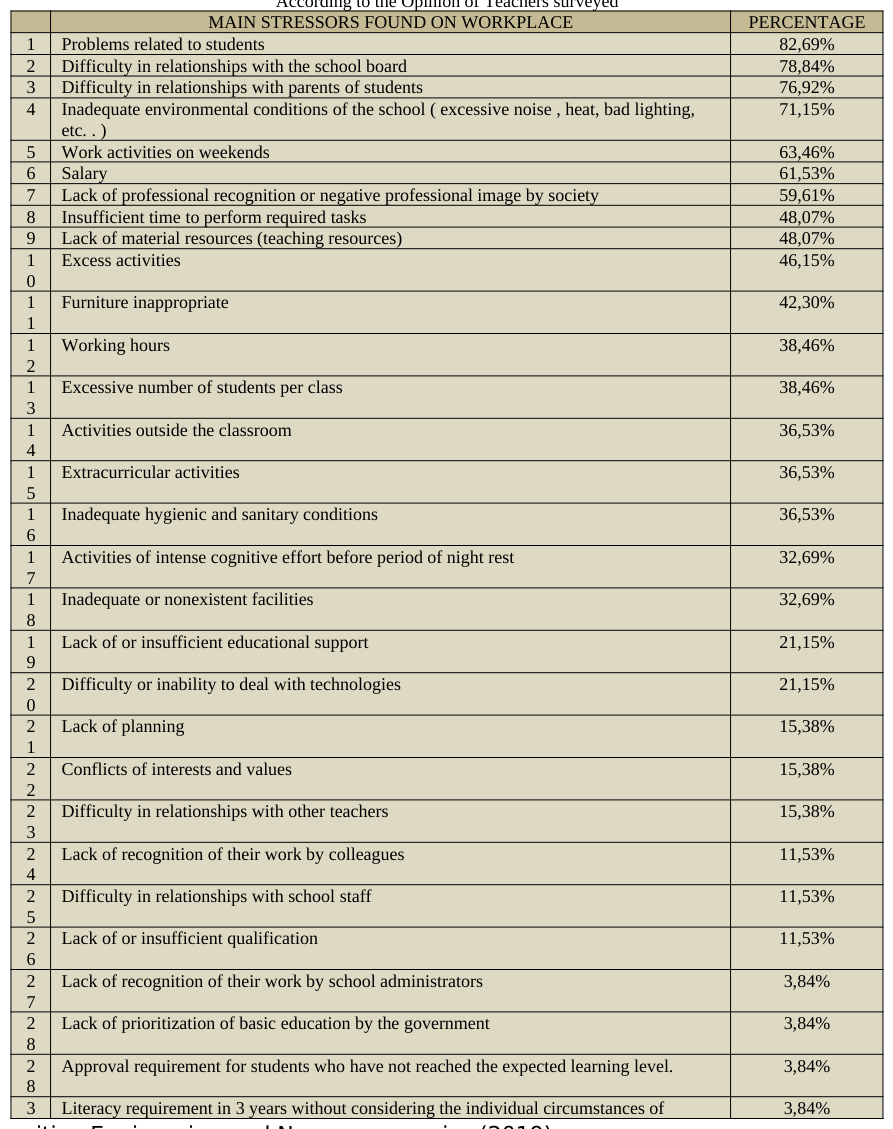
Table 7 presents a list of 37 stressors and the percentage of teachers who identified them in the schools where they work. The main stressors, 37 in total, relate to organizational factors.
Table 7: Major Stressors Factors at work for teachers in lower Elementary School of Municipal Public School in Natal / RN / BR
The problems related to the difficulty in the relationship with the school board are: excessive bureaucracy (50%), excessive accountability for results (28.57%), lack of support (14.28%) and authoritarian relation (7.15%).
Teachers stated the difficulties in relationships with parents of students were: lack of participation in school life (81.25%), overcharging the teacher (10.41%) and violence (3.34%).
From the respondents who mentioned the difficulty in relationships with other teachers, 40% cited the indifference of coworkers, 30% mentioned a lack of collaboration and 30% lack of communication.
Regarding the difficulty in relationships with school officials, 28.58% reported a lack of collaboration, 14.28% identified the lack of communication and 57.14% cited the lack of qualification of employees.
CONCLUSIONS
Stress is a syndrome that has become common in the workplace. In the educational sector the hardest hit are the teachers. This study found that 73.08 % of teachers surveyed had stress, from which 97.37 % were at very high levels. This existing framework of stress among teachers surveyed is consistent with the results reported by studies conducted with teachers in lower elementary school in other regions of Brazil : 67.1% (Martins , 2007) , 56.6 % (Goulart Junior and Lipp , 2008) , 60.7 % (Damasio and Melo , 2009) and 87.32 % (Costa and Rocha , 2013).
As we observed, the indicators of national education present results that demonstrate the inefficiency of the teaching- learning process. These aspects, along with the school management model and main factors stressors teachers pointed out - problems related to pupils , difficulty in relationships with the school board , difficulty in relationships with parents of students , inadequate environmental conditions of the school ( excessive noise , heat, poor lighting, etc.), activities on weekends , salary , lack of professional recognition or negative professional image by society - may be impacting on the health of teachers in terms of stress.
Besides exerting an excessive workload, teachers also devote part of their time to training. The continuing education courses conducted in Natal/RN/BR, and funded by the government, are provided on weekends, further reducing the time to rest, leisure and socialization of teachers. An important factor to consider is that the absolute majority of respondents were female, which may be an aggravating factor for occupational health and therefore for the involvement of stress, since in Brazil most women have the responsibilities with household chores and childcare. Because the job is underpaid, teachers feel the need to take other jobs to supplement wage income, overloading themselves with work and compromising their free time.
The educational scenario presented highlights the need to improve the working conditions of teachers of Brazilian public education. These improvements are needed to ensure even the existence of such professionals, since the turnover rate is high in this sector.
Ergonomics as a scientific approach, presents itself as an important theoretical and methodological framework, which can contribute to the understanding of teaching activity and its relationship with organizational determinants factors in schools, which are producers of stress, allowing thus deployments, changes in school organization, they are able to positively transform work situations (Vidal , 2008, p 10) of teachers.
The achievement of appropriate organizational changes, as part of a policy and program management occupational health teachers who also take account of stress management of these professionals, can contribute to the improvement of working conditions of teachers and the improvement of efficiency in the teaching- learning process, having repercussions sooner or later, in improving the quality of Brazilian education.
REFERENCES
Ministério da Previdência Social. (2013). Anuário Estatístico da Previdência Social – AEPS. Retrieved 04 July, 2013, from http//www.previdencia.gov.br/estatisticas/. Acesso em: 10 September, 2013. American Institute of Stress – AIS (2013). Workplace Stress. Retrieved 04 July, 2013, from http:// www.stress.org/workplace-stress . Caulfield, N.; Chang, D.; Dollard, M.F. & Elshaug, C. (2004). A review of occupational stress interventions in Australia . International Journal of Stress Management. 11(2), 149-166. Costa, R. C. P., & Rocha. R. (2013). Fatores estressores no contexto de trabalho docente. Ciências Humanas, 6 (1), 18-43.
Retrieved 04 July, 2013, from http://www.rchunitau.com.br/revista/index.p´hp/rch/article/view/51/44. Esteve, J. M. (1999). O Mau-Estar Docente: a sala de aula e a saúde do professor. Bauru: EDUSC. Falzon, P. & Sauvagnac, C. (2007) Carga de Trabalho e Estresse. In P. Falzon (editor). Ergonomia. (pp. 141 – 154) São Paulo: Blucher. Faria, D. C. P., & Gallo-Penna, E. C. (2009). Dimensões do Stress na Carreira Docente de Professores do Ensino Fundamental.
FAZU em Revista (6), 121-192. Retrieved 04 July, 2013, from http://www.fazu.br/ojs/index.php/fazuemrevista/article/view/30/24. Gasparini, S. M., Barreto, S. M., & Assunção, A. A. (2005). O professor, as condições de trabalho e os efeitos sobre sua saúde. Educação e Pesquisa, 31 (2), 189-199. Goulart, E. J., & Lipp, M. E. N. (2008). Stress entre Professoras do Ensino Fundamental de Escolas Públicas Estaduais.
Psicologia em Estudo, 13 (4), 847-857. Retrieved 04 January, 2014, from http://www.scielo.br/pdf/pe/v13n4/v13n4a23.pdf. Guérin, F., Laville, A., Daniellou, F., Duraffourg, J. & Kerguelen, A. (2001). Compreender o Trabalho para Transformá-lo: a prática da Ergonomia. São Paulo: Blücher: Fundação Vanzolini. Health and Safety Executive – HSE. (2013) Stress and Psychological Disorders in Great Britain 2013,
from//www.hse.gov.uk/statistics/causdis/stress/stress.pdf. Acesso em: 10 October 2013. Hendrick, H. W. (2001) Determining the Cost-Benefits of Ergonomic Interventions and Factors that Lead to Their Success.
Revista Ação Ergonômica, 1 (2), 7-12. Hendrick, H. W. (1996). Good Ergonomics Is Good Economics. In Proceedings of the Human Factors and Ergonomics Society Annual Meeting 40 (1), pp. 1-15. Instituto Brasileiro de Geografia e Estatística – IBGE (2012) Educação: Taxa de analfabetismo das pessoas de 10 a 14 anos de
idade, por sexo - Brasil - 2007/2011. Retrieved 04 January, 2014, from://http://brasilemsintese.ibge.gov.br/educação. Instituto Brasileiro de Geografia e Estatística – IBGE (2012) Educação: Taxa de analfabetismo das pessoas de 15 anos ou mais.
Retrieved 04 January, 2014, from://http://brasilemsintese.ibge.gov.br/educacao >. Instituto Nacional de Estudos e Pesquisas Educacionais Anísio Teixeira – INEP. (2012) Indice de Desenvolvimento da Educação Básica - Resultados e Metas. Retrieved 04 January, 2014, from://http://portal.mec.gov.br/index.php http://ideb.inep.gov.br. International Ergonomics Association – IEA. (2013). What is ergonomics? Retrieved 04 janeiro, 2014, from
http://www.iea.cc/01_what/What%20is%20Ergonomics.html. International Labour Organization – ILO. (2013). Violence and stress in education workplaces. Sectoral Activities. Programme,
2007. Retrieved 04 January, 2014, from http://www.ilo.org/wcmsp5/groups/public/---ed_dialogue/---sector/documents/ briefingnote/wcms_161994.pdf. Goulart Junior, E. & Lipp. M. E. N. (2008). Estresse entre Professoras do Ensino Fundamental de Escolas Públicas Estaduais.
Psicologia em Estudo, 13, (4), 847-857.
Johnson, S. M., Kraft, M. A., Papay, J. P. (2012). How Context Matters in High-Need Schools: The Effects of Teachers’ Working Conditions on Their Professional Satisfaction and Their Students’ Achievement. Teachers College Record, 114,1 – 39. Lipp, M. E. N. (2002) Soluções Criativas para o Stress. In M. E. N. Lipp. (Org.). O Stress do Professor. (pp. 109 – 126).
Campinas: Papirus. Martins, M. G. T. (2007). Sintomas de Stress em Professores das Primeiras Séries do Ensino Fundamental: Um estudo exploratório. Dissertação de Mestrado. Universidade Lusófona de Humanidades e Tecnologias, Lisboa, Portugal. McVicar, A.; Munn-Giddings, C.; & Seebohm, P. (2013). Workplace stress interventions using participatory action research
designs. International Journal of Workplace Health Management, 6 (1), 18-37. Meleiro, A. M. A. S. (2002). O Stress do Professor. In O Stress do Professor. In M. E. N. Lipp (Org.). (pp. 11 – 28). Campinas: Papirus. Milner, K., & Khoza, H. (2008). A comparison of teacher stress and school climate across schools with different matric success
rates. South African Journal of Education, 28(2), 155-174. Retrieved 04 May, 2013, from http://www.ajol.info/index.php/saje/article/view/25151/4350 Schelvis, R. M. C., Hengel, K. M. O., Wiezer, N. M., Blatter, B. M., Genabeek, J. A. G. M. van, Bohlmeijer, E. T. & Beek, A. J.
van der. (2013). Design of the Bottom-up Innovation Project: a participatory, primary preventive, organizational level intervention on work-related stress and well-being for workers in Dutch vocational education. BMC Public Health, 13, (760), 2 – 15. Selye, H. (1956). The Stress of live. New York: McGRAw – Hill Higher Education. Silva, Damásio & Melo, (2009). O sentido de vida e o stress do professorado: um estudo correlacional. Cadernos de Psicologia Social do Trabalho 12,( 1), 111- 122. Silveira, D. T. & Córdova, F. P. (2009) A pesquisa científica. In T. E. Gerhardt and D. T. SILVEIRA (Orgs.). Métodos de
pesquisa (pp. 31 - 42). Porto Alegre: UFRGS, 2009. Souza, N. A.; Leite, M. P. (2011). Condições de Trabalho e suas Repercussões na Saúde dos Professores da Educação Básica no Brasil. Educação & Sociedade, 32, (117), 1105-1121. Retrieved 04 January, 2014, from http://www.redalyc.org/articulo.oa?id=87321425011 Vidal, M. C. R. (2008). Guia para análise ergonômica do trabalho na empresa: uma metodologia realista, ordenada e
sistemática. Rio de Janeiro: Virtual Científica. Wisner, A. (1987). Por dentro do trabalho: ergonomia: método e técnica. São Paulo: FTD: Oboré. Wolrd Health Organization – WHO. (2013) Stress at the workplace. Retrieved 04 January, 2014, from http://www.who.int/occupational_health/topics/stressatwp/en/.
LISTED IN THE AHFE DIGITAL BOOKSTORE CATALOGUE
Explore the complete digital volume
Advances in Cognitive Engineering and Neuroergonomics
Read this individual research paper free through the original publisher, or explore the full digital proceedings book.
ISBN 978-1-4951-2101-2
Explore this ISBN in the AHFE Bookstore ↗Listed in the July 2026 bookstore catalogue; search by ISBN to confirm current availability · Digital book purchase optional