Fernando T. Soares, Paulo Simões abc, Ricardo Simoes ad (2019). Automotive Central Console Interface Design. In: Advances in Safety Management and Human Factors. AHFE Open Access, vol. 5. https://doi.org/10.54941/ahfe100152
This work was aimed at enhancing driving experience and safety by understanding the possibility of improving the central console physical interface experience, ergonomics and usability when dealing with in-vehicle tasks. An examination was carried out about some of the physical central console interfaces, measuring which one performed better concerning driver distraction and ease of use in double task situations. For that, a driving simulator was built, and a series of dual task tests were conducted to retrieve driving and performance data. The telemetry data about the driving line comparisons relative to a reference path, and the mean speed through the test sectors was compared to the eye tracking data, which was then compared and related to the modified self-perception subjective workload NASA Raw TLX test. It is expected that from this analysis some conclusions could be achieved that lead to an improvement opportunity to the central console interfaces. This could result from a combination of the systems, or could even give opportunity to develop an alternative new solution or a good practice guide for future design and developments.
The great demands of the actual quotidian life and the need for fast and efficient independent mobility makes the automobile the most preferred mean of transport in the whole world (EU Transport in Figures, 2000). As a matter of fact, most of the users spend a lot of time inside their car making necessary to bring inside new secondary functions that before were unthinkable of being applied out of their original environments. These new tasks created a change in the automobile paradigm as simple means of transportation, and making them each time more an extension of the other spaces where we live. Beyond simple comforts of acclimatization, radio, accessories for vices help and feeding, actually there are a lot of new technologies invading the automobile driver environment, even allowing it to access the internet and allowing the onboard car computer to be used the same way as any other personal computer.
These recent evolutions turned the driving task more multifaceted and not single centred in the simple driving task, but also directed to the accessory functions and tasks. The driving task became even more just an accessory function alike all the others. As a matter of fact, driving is a complex and extremely important and responsible task and everything that can cause driver distraction improves significantly the danger of accident occurrence.
Assuming this as a fact, there should be an effort to make the driving act more efficient, comfortable and ergonomically oriented. Product ergonomics focuses on the design of new products, invoking criteria of human functioning that allow an efficient, safe and comfortable use (Carvalhais and Simões, 2007).
This work will be about improving driving experience and driving safety at the same time, by studying the opportunities for improving the ergonomics and the interaction in the central console, diminishing the driver’s distraction from the road, making drivers more focused on the driving act, creating a more simple, safe and pleasant experience.
AUTOMOTIVE CENTRAL CONSOLE INTERFACE DESIGN Problem Definition
Driving cars is a task performed by a large amount of people all around the world, and because of the contemporary lifestyle, they spend very much time inside their cars, and they have accessory needs beyond driving. They need accessory functions like acclimatization, ashtrays, cup holders, radios, music players, satellite navigation, parking help, cell phone hands-free and accessories, seat adjustments, and onboard computers, internet access and more. Thus, light vehicle drivers are subjected to a lot of accessory solicitations, which may hamper the primary driving task.
When drivers perform tasks while driving, there´s a group of human resources that are taken away from the main task of driving, diminishing the human capabilities of doing it. This resource consumption is believed to be hazardous to the road safety, and that it can be one of the main causes of road accidents. Interfaces and their displays can be hazardous to the driving task, as suggested by Minin, Benedetto, Pedrotti, Re, and Tesauri (2012), during glances to the display, the visual input needed for lateral control is reduced or entirely inhibited: the driver is affected by a temporary lack of steering response, leading to a deteriorated lateral control that enhance the risks of frontal collision.
Understand central console interfaces, their means of function and their purpose is crucial. A better understanding of the relation between driver and console interfaces can help reducing these lateral control deviation effects, or avoid them, as well as understanding how the different interfaces work visually, physically and cognitively.
Driver Distraction Driver distraction is a term that defines de deviation of focus from the primary task of driving a vehicle, to a secondary task, consequently diminishing the performance of the primary one. The causes for this distraction can be of an immense range of possibilities, but they emerge from the effects of perturbation of certain human resources required for driving, so they can be arranged in a few types.
According to the NHTSA – National Highway traffic Safety Administration (NHTSA Department of Transportation, n.d.), there are three types of driver distraction that can affect drivers in different ways:
Visual distraction: Tasks requiring the driver to look away from the roadway to visually obtain information.
Manual distraction: Tasks requiring the driver to take a hand off the steering wheel to manipulate a device.
Cognitive distraction: Tasks requiring the driver to shift their mental attention away from the driving task.
The tasks performed by drivers can be of one, two, or all three of these distraction types at a time.
Torkkola, Gardner, Schreiner, Zhang, Leivian, Zhang, & Summers defined that in addition to interacting with onboard systems, drivers are also choosing to carry in mobile devices such as cell phones to increase productivity while driving (2008). They argued too, that because technology is increasingly available for allowing people to stay connected, informed, and entertained while in a vehicle many drivers feel compelled to use these devices and services in order to multitask while driving (Torkkola et al., 2008).
According to NHTSA the type and level of distraction, the frequency and duration of task performance, and the degree of demand associated with a task. Even if performing a task results in a low level of distraction, a driver who engages in it frequently, or for long durations, may increase the crash risk to a level comparable to that of a more difficult task performed less often (NHTSA Department of Transportation, n.d.). As seen, drivers often engage in various parallel activities inside the car while driving, exploring the world of multifunctional environment the cars provide nowadays. When using the central console interfaces to perform tasks, they give away very important part of their human driving resources.
STATE OF THE ART Inside the car there are a lot of considerations to take in account in order to develop a functional environment. Designing a vehicle involves the design, development and integration of a large number of systems and subsystems within a vehicle (Bhise & Pillai, 2006). This is a very complex process which involves multidisciplinary teams, working together in order to fit all the features within the existing limited space, nevertheless fulfilling the function for which they were designed, providing the vehicle the ideal combination of all the needed attributes such as appearance, performance, safety, ride and comfort (Bhise & Pillai, 2006).
One of the most complex assemblies within an automobile is the central consoles. They are function populated areas where there are instruments and information systems, HVAC ducting and all interaction driver-vehicle features, all of them struggling for space and driver attention. A vehicle consists of many systems that are not specifically for driving, but are, instead, for supplementary functions such as air conditioning, radio/multimedia, and more (Jonghyun Ryu, Jaemin Chun, Gunhyuk Park, Seungmoon Choi, & Han, 2010). Functions as satellite navigation, parking help, cell phone hands-free and accessories, seat adjustments, ride adjustments, engine and mechanical adjustments, and onboard computers are other examples of functions actually available in the automobiles.
As technology evolves, an increasing number of supplementary functions are added. Inevitably, the complexity of the function controls also increases. A recent solution for the problem has been the Driver Information System (DIS): a multifunctional system that provides a unified interface to control the vehicle electronics (Simões, 2011).
All these systems inside cars need physical interfaces in order for being manipulated by the driver during various driving conditions. Ryu et al. (2010) also refers that these kinds of systems require the driver´s visual attention for selecting the desired functions, which can increase the probability of having an accident.
Fai, Delbresine and Rauterberg (2007) also refers that the most important concept in automotive industry is safety, and Simoes (2011) refers that for that each component designed must be able to reduce injury to the occupants during a collision.
Murata and Moriwaka (2005) also argue that the use of additional in-vehicle information systems to promote safer driving should avoid distracting the driver from their main sources of visual information outside the vehicle. As suggested by Burns, Harbluk, Foley and Angell (2010) is glances away from the road scene prior to critical events that predominate in real-world crashes and near-misses.
This has been a great challenge for car manufacturers around the world, as they try to create the perfect solutions combining great interactivity and ease of use of the systems without compromising the driving safety. But until today there hasn’t been a consensus about the perfect solutions, and some solutions that seem ideal in some situations, became hardest or dangerous in other cases as suggested by Rydström, Broström, and Bengtsson, (2011) arguing that in terms of task completion time and the number of glances made to the display, there is not one input device that is always the best choice, since certain interaction devices are more suitable for certain kinds of tasks.
So in this search for the balance for the perfect system, the car manufacturers developed their own ideal interaction interfaces.
Physical interfaces Back in the days where computerized systems haven´t yet been present in automobile interiors, all central console interfaces were purely physical, directly connected with mechanical links to the operated function module or system. This has been the main concept throughout the years in the evolution of the central console interfaces: Physical interaction with the driver.
Nowadays, almost every system inside the car is computerized or works through any electrically controlled way, but the majority of the interaction performed by the driver remains as it was in the past: purely physical. As the car still works majorly with the driver’s actions, those still need to be operated through some kind of physical interface, exception to the actions who are automatic, and that they work based on sensors action and information.
The physical interfaces are still present in every central console, and there´s a certain amount of factors that affect their performance: Drivers ability (whether or not the driver knows how to operate the interface, or has skills and knowledge of its functions), Driving environment or situation (Meteorological conditions, and the details about the moment while performing the task), Driving position (If the body is well adjusted to the ideal driving position, and ideal distances of reach and operation of the interfaces), interface mechanical concept (If the interface is well designed, if its function is perfectly accomplishable, if the interface is not too small or if the buttons are not in groups of equal ones), visual perception of the interface (If it´s function and position is understandable and unmistakable just with simple glances), quality of manufacturing (if the surfaces wear fast, or suffer from disassembly or vibration problems), position in the central console (if the interface is ergonomically reachable without requiring the driver to perform exigent movements and allocate too much physical resources to operate it), feedback of function (if the function is giving feedback of its functions and status, and if it´s easily understandable) , Correspondence of its concept to the function type (as some interfaces work better with certain functions, and there is no 100% perfect solution, is always a compromise situation if the interface is well designed for the desired function).
The design of the interfaces visual information can be of various types, colours, symbols, abbreviation, numbers, painting, finishing’s, etc. and thus those aspects of the interfaces will only depend and be considered exactly as the real systems came from manufacture and that would be mounted in the simulator console.
The most common physical interfaces present in automotive central consoles are: -Limited rotary knobs with raised grip, graphics, and mechanical feedback: These are interfaces commonly used for acclimatisation systems or radios, and its functions are usually defined by graphic representations with numbers, symbols or colour gradients, and by mechanical feedback, that limits its range of movements, and combined with the visual clues gives outputs to the user about the positions of the rotary knobs. These are usually built with a raised grip which helps the user grabbing it and keeping the knob in good control while driving, and at the same time, the mechanical feedback gives the driver clues to make it feel the function, reducing the need for adjustment glances.
-Free Rotary knob with mechanical feedback: This system is usually given for functions which don´t need a limited physical range such as radio volume control or IVIS (in vehicle information systems) menus, and is usually combined with a mechanical feedback that gives some clicks at each action done. In terms of materials used, these systems have a great variation according to the manufacturer’s preferences, and it may include rubber coating for better handgrip. Visual feedback is not commonly used in these interfaces, but in the major cases it comes as onscreen temporary information.
-Linear sliders with and without feedback: These are systems usually used for acclimatisation or for HVAC systems. This kind of interface is becoming obsolete and it´s being dropped of the central consoles by most of the manufacturers. It is believed that functional reasons, space requirements, and aesthetics are the main reasons for that. This system works mechanically linked to the function modules, and it works by operating levers through different zones of its path. Some of these systems provide mechanical feedback along the path: just as air speed and air direction, and others don’t: air temperature and in some cases air direction too.
-Alphanumeric keyboard: This kind of interface is commonly used in vehicles with integrated communication systems as hands free cell phones, radios, and walkie-talkies. It is usually built as a group of simple push buttons, which can be arranged in a quadratic way (usually 3x4), or in a linear layout. They are built with a logical group of numbers letters and figures, which gives the user power to write almost everything as it would do in a computer keyboard. Even using visual and physical clues (as small raised dots) to help the users, this interface requires a great amount of driver’s attention, making it one of the most difficult to operate safely. Beyond the physical requirements of its operation, this system is usually controlling some digital device inside the car, and as it is a writing instrument, is of common sense that there´s always a big cognitive load associated to its use.
-Basic on/on/off two level rocker switches: These are the simplest on/off switches like the ones found in most of the homes walls, but with two clicks to power On functions, and one to power Off all functions. As the sliders, these ones are becoming obsolete too, and they´re being abandoned by manufacturers. These don’t require a great visual attention, neither great physical resources from the driver in their operation, and are usually dedicated for single functions like interior/exterior lighting, or windscreen anti-fog systems.
-Horizontal or vertical Rotary knobs: Rotary knobs like this are usually enclosed with a small part exposed. Usually they are for functions that work within ranges, to perform their respective adjustment. They can be found in ventilation exits in the central console, and in functions such as interior light intensity regulation, or light levelling. These only require visual attention in its immediate search, and can be operated without any physical feedback beyond its route, being the light feedback, or the air feedback the only clues that the driver gets about its functioning.
-Touch activated surfaces: These are interfaces that work by the simple contact between the human skin and the surface of a determined area. These are state-of-the art technologies that allowed the car manufacturers to create innovative interfaces which give to the central console a futuristic appeal, and a whole new freedom of design and function placement. These interfaces usually require a great visual and physical attention as the drivers need to look directly at the zone where the contact area for a determined function is, and to perform it, they must get to touch correctly but briefly the zone of the function, making it more likely to occur human errors in its operation.
-Simple push buttons: These are simple but efficient buttons that usually work by being pressed. They are mainly operated in two times, 1st time ON, and 2nd time OFF, or in a single use way, like ejecting a CD. Commonly they have a light visual feedback that gives drivers the clues about its status. These interfaces functions are very perceptible and is believed that the visual attention or physical resources are highly task dependant in its operation.
Some of the interfaces can be under the influence of market tendencies, and their future is a matter of market acceptability or trend lifecycles. There are a lot of efforts done by automotive manufacturers to improve the automotive central console design, but there´s still a long way to go, in order to improve them as close to usability perfection as possible, allowing a better driving experience and improving road safety. All these issues about the central consoles in the automotive industry still have a great evolutionary margin, and there´s always a long way free for new developments in the central consoles in the next future, and there could be developed a lot of short term simple implementations that could lead to a better and safer driving experience.
RESEARCH PLAN In this study it will be carried out an examination about some of the physical console interfaces, measuring which one is better concerning driver distraction and ease of use. For that, a driving simulator will be built, in order to allow the research to be done in a valid and safe way without expensive costs. Using a simulator instead of a real road test, allows the driving data to be easily retrieved from the telemetry in the simulation software’s, not needing sensor implementation on real vehicles nor road closing or safety issues, thus reducing the general costs of the study, and giving the possibility of centralising the whole data from driving and eye tracking in the same computer, making it perfectly synchronized. The telemetry data about the driving line and speed through the test sectors will be compared to the eye tracking data, which then will be compared and related to the self perception subjective workload test.
There is a special need for understanding about the driving negative influence of each interface and system, and to acquire accurate, valid and quantifiable data about it.
Research methodology There are some indicators that need to be measured to quantify valuable data. The main objective is to understand how defective the central console tasks are to the driving situation. By understanding what interfaces causes more drivers distraction, we hope to get clues where the central consoles are getting badly designed.
As suggested by Minin (2012) An indicator reflects driving performance when it detects the behavioural changes caused by the impact of a secondary task.
As North Atlantic Treaty Organization (NATO) Geddie, Boer, Edwards, Enderwick, Graff, Pfender, Ruisseau and Van Loon (2001) supposed, two systems with the same level of overall performance may impose quite different levels of workload on operators. This suggests why is important to measure not only the driving performance, but also the workload users experience during the double task operations. As pointed by NATO, the workload data is evaluated by analytical techniques, which can be used already in the design phase of a system (Geddie et al., 2001).
As suggested by Young, Regan and Hammer (2003) using a range of distraction measurement techniques, rather than a single technique, would be appropriate in evaluating HMI design concepts and prototypes in vehicles.
In order to gather important information about this interaction between the driver and the central consoles, a relation between three very important indicators will be analysed: The driving line, the driver’s visual attention, and the perceived workload of the driver.
As pointed by Minin et al. (2012) the primary effects on lateral position variations are drivers actions on the steering wheel, so the driving line is the major indicator to indentify driving disturbance.
Eye tracking, as indicated by Torkkola et al (2008) is the prevailing method for detecting driver inattention, using the camera to track the driver´s head or eyes. Curry, R., Greenberg, J., & Blanco, M., (2002) and Haigney, D., & Westerman, S. J., (2001) argued that eyes-off-the-road time is a widely accepted and valid measure of the visual demand associated with the performance of a secondary task and is highly correlated with the number of lane excursions committed during secondary task performance.
Hart and Staveland (1988) suggested that in comparison with other workload assessment methods, subjective ratings (As NASA TLX) may come closest to tapping the essence of mental workload and provide the most generally valid and sensitive indicator.
To achieve this information without any life integrity risks, a driving simulator will be developed, where all the central console interactions can be replicated, and where the interfaces would be tested in virtual environment. The simulator software allows a good data recording and processing, registering a lot of telemetry data that will give the main clues to understand drivers distraction caused by a certain interface.
Researching in driving simulators, as suggested by Young et al. (2003) is often used, as they allow for a number of driving performance measures to be examined in a relatively realistic and safe driving environment. So driving simulators are safer and could be less expensive than real world tests, as too for a certain number of uncontrollable situations in real life that can be controlled in a simulator, like the weather and some road events. One of the main advantages using a simulator is the fact of lot of the driver distracting variables can be under total control, and be totally eliminated.
As pointed by Young et al. (2003) an important aspect to consider when measuring driving distraction is the selection of the appropriate baseline measure against which to compare driving performance when interacting with various devices.
Thus, for this study, is assumed that the distraction provoked by a certain task involving the central console, is defined by measuring the amount of trajectory deviation registered during that task, and correlating it with the “eyes-off-the-road” mean time. Thus, this result is correlated with a workload measuring RAW NASA TLX method (RTLX), that gives us a result about the driver self perception of workload, and makes possible to relate if the recorded data, is compliant with the drivers feelings when exposed to double task danger situations.
The trajectory deviation when performing tasks will be compared to the centre of the driving lane, for each individual in each of the two laps, resulting in two comparisons: The theoretical driving line average and maximum deviation on the lap without tasks, and the theoretical driving line average and maximum deviation on the lap performing tasks. Thus, there will be comparison between these indicators for each individual, achieving the differences between the average and maximum deviation from the centre of the driving lane. This data will indicate how much the drivers were affected by the double tasks situations, and whether or not the driver will interfere with the opposite traffic or the roadside entering in an imminent risk situation, indicating a possible higher risk in vehicle interface task.
For eye tracking and % eyes-off-the-road time will be positioned an infrared camera on top of the central console, and the eyes-on-the-road position will be the easily identifiable. When drivers look to the console, they look to the camera too, and so the eyes-off-the-road time is easily identifiable, and measurable. The percent of the eyes-off-the- road time is achieved by dividing the total glances time by the total time the driver took to travel that task sector.
For the NASA RTLX procedure, the drivers will perform an enquiry about each task indicating the values of the self percept workload. The task workload measure will be indicated by the mean resultant from the percept workload values indicated.
The most effective way to implement optimizations on minimising the interface based distraction is to design the Human-Machine Interface (HMI) in an ergonomically ideal way. Using this methods combination is expected to obtain reliable data about the effectiveness and safety of the in vehicle interfaces on the automotive central console, and then to identify strengths and weaknesses in order to identify a guideline of good practices in automotive central console interfaces design and development.
THE DRIVING SIMULATOR This simulator was built in collaboration with EPATV (Escola Profissional Amar Terra Verde, Portugal) using an already developed simulator frame and adjustable car seat, which with some major adjustments became the ideal simulator for this research. The wheel and pedals were adjusted to allow a better driving position, and a real sized car wheel was mounted instead of the plastic little one of the simulator. There were only two pedals, and the drivers used only their right foot, exactly as when driving in an automatic gearbox car.
The screen implemented was with a video projector mounted above the driver head, and a cardboard panel beyond the steering wheel, where the image was projected and adjusted in a way, that the image size and point of view seen by the driver, was as much similar as possible with the in scale with the virtual wheel size and car interior. In 1982 Blaauw proposed two aspects for simulator validity:
Physical correspondence: between the two systems and its response characteristics correspondence with the real vehicle (Blaauw, 1982). The closer the simulator approximates the real world driving experience in ambience, control layout, field-of-view and driving characteristics, the grater fidelity is considered to have.
Behavioural correspondence: between the simulator test, and the real situation (Blaauw, 1982). This needed a real situation comparison, that would not be possible due to logistic and safety questions. Thus there are very few tests that could be used to compare some of the aspects of this study, and the comparison would not be reliable. In order to evaluate this type of validity, an inquiry was launched to some of the test subjects where they evaluate the simulator, and whether or not they relate it to their road driving experience and their everyday driving.
The computer used to run every function in the simulator was a portable computer with a Core i3 330M Intel processor, 4 GB of ram, a 120 GB 5200 rpm hard disk, and a GeForce G105M with 512 MB graphics memory. The low resources needed for the software’s selected and modified, and the connections available on this hardware, made it the ideal computer to this simulator study. The computer took care of every task related to the study: Running the simulator with outputting the telemetry data, and recording video for eye tracking, all at the same time. In terms of software, the rfactor simulator was selected amongst some other prestigious ones, because it provides a very realistic environment, and the modifying possibilities allowed by it were wider and easier to perform, keeping it very low on computer resource consumption.
Fig. 1: Driving simulator
The central console In order to test a wide range of central console interfaces, the simulator has a representation of a central console in which were mounted all the interfaces to be used during the tests. This central console had reunited all the major systems used in console interaction, and it was positioned in the simulator, with an ergonomically adjustable range of positions which combined with the seat adjustments, were the ideal conditions to match the subject’s anthropometric requirements.
The console was built in plywood, and real car central console systems were attached to it, in an imitation of its possible positions in a real car. The systems were mechanically functional, but electrically they weren’t working. Due to this, there was no visual feedback provided by light indications, nor functional feedback inside the car, due to impossibility in creating the entire car functional environment in the simulator. As we only wanted to test the negative effects of the interfaces and they were mechanically functional, this was not considered as a problem.
In order to match some of the extra functions inside a car, and the extra validation tasks using mobile phones, a cup holder was created for the drinking liquids task, and a mobile phone placement was created to the phone tasks to assure the same conditions to every driver. These tasks were added, to understand how much drivers are distracted by eating or drinking, and by talking on mobile phones.
The track A normal everyday winding road was needed in order to achieve the most realistic results correspondent to real situations simulation.
Visual information processing (as the one required for dealing with console interfaces) leads to a decrease of driving performance especially on curvy roads (Vollrath & Totzke, n.d.). As in the straight roads, the drivers could simply lock their arm on the wheel making the results very hard to measure, this fact is expected to give greater evidence to the results retrieved from the simulator tests, as it keeps the test closer to real life driving, increasing its validity.
To reduce distracting factors coming from the exterior environment, the majority of the trackside non natural objects were removed, keeping the same level of out-of-towns environment perception along the entire course.
The testing protocol After the adjustment of the driving position, was given them a cup of water always positioned in the same place in the console, and then was given the instruction of putting their mobile phone on the left top of the console where they could easily reach it.
Suggested by Knappe et al. (n.d.) a five minute familiarization drive is sufficient for driving simulator novices when the test track is fairly easy and no complicated manoeuvres like braking at a traffic lights is required. As our test was more complicated the habituation period was tested with five drivers prior to the main study, an ideal period of 10 minutes was tested and it was revealed enough. For the final study, a 15 minute period was decided, to give the drivers an even better familiarization with the simulator driving environment.
Previously to the beginning of the test itself, there was this driving simulator habituation period for about 15 minutes, where subjects were allowed to drive in an arbitrary way, limitless, and were encouraged to force up to the limits of the car, to push hard on the brakes, on the corners, to perceive the sensitivity of the simulator and the kind of road they would be travelling, and were too encouraged to crash the car on purpose, just to have a stronger contact with the simulator and a better habituation to the car and track, and to try to get the habitude of being in an actual everyday car even closer. Following this, each individual did two valid test laps to the previously established and programmed course. In both laps the drivers were encouraged to practice their habitual everyday driving, keeping a minimum speed limit of 40Km/h and a maximum speed limit of 90KM/h, which is the actual maximum speed limit regulations out of residential areas, for lightweight vehicles on Portugal.
Each one of the laps was runned in different situations: In the first complete lap each driver must do the course in their respective driving lane without tasks, applying their everyday driving in a safe way, in order to avoid first lap accidents and to avoid entering the opposite traffic lane. In this first lap the habitual trajectories without performing tasks of each driver were recorded, to get the without task “real reference driving line” to which the driving line performing tasks will be subsequently compared.
In the second lap, the drivers were previously advised that they would be performing tasks while driving, and that they should perform them after the instructor descriptions transmitted immediately before entering a task sector. These actions would be repeated for 17 sectors long, corresponding to 16 different tasks in different situations, and a 17th with a mixture of them all simulating a crisis of simultaneous attention required in the central console using a bit of each of the 16 previous tasks.
Between sectors there were zones of intermission, where drivers could calm down, and get back together their attention and reactivity to usual levels comparable to relaxed and normal driving, until they reached the new following task zone. This was needed to ensure that every test in every sector would be performed with comparable levels of driving attention and expectedness.
In the end of the test, users filled up the rest of the questionnaire data about their experience with the simulated driving, and performed a NASA RTLX test for each of the previously performed tasks, giving useful data for the results about self perception of workload.
In some of the tests were randomly given an extra questionnaire sheet that asked about simulator specific questions, which gathered important data about the validation of the driving experience they were having, if they considered it to be realistic, and how the simulator drive was representative of their everyday driving behaviour.
RESULTS
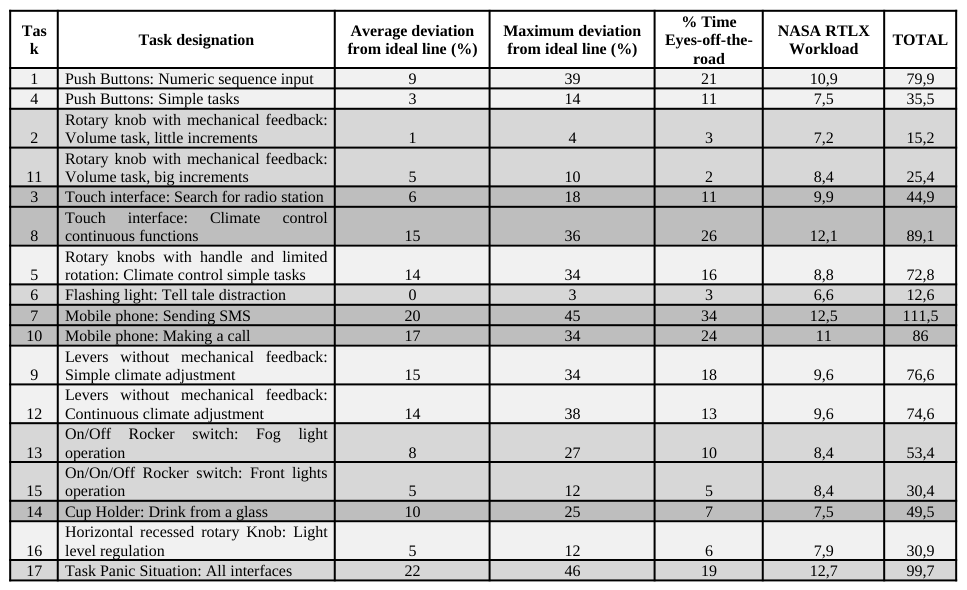
To achieve a clear point on the task performance classification of the interfaces, a table of comparison has been built in order to directly relate all the indicators, and get a result on the amount of negative influence the interfaces had on the driving performance.
Table 1: General interface classification
According to the results presented in the table, the interface classification (the less the points, the better) stands as following:
Fig. 2: Interface Classification.
From this classification some interesting conclusions can be achieved. The worst situations inside the car seem to be the ones concerning the mobile phone usage on writing an SMS, and, even if unlikely to happen, the panic situations where lots of simultaneous tasks may need to be performed. After that, we have the touch interfaces, which gathered high values of eyes-off-the-road time and workload, and in a continuous use are the most threatening to the primary driving task. These results suggest that they are more dangerous than the act of performing a mobile phone call, or inputting a sequence of numbers in a push buttons keypad on the central console. On the other side, the results show us that the touch interface can be used with less prejudice when dealing with simpler tasks, but even here, these interfaces lack the feedback characteristics from the mechanical interfaces, which makes them not the ideal interfaces to apply to an automotive central console, or in alternative, they need to be fulfilled with visual and haptic auxiliary characteristics, who must decrease the need for higher glances off the road, and to lead to a better feel of the desired button to press without the actual levels of workload.
The numeric sequence input on the central console is still a complicated operation on keypads with same size buttons that can´t be distinguished with the users haptic senses, so it requires a great amount of workload and glances off the road. Making the buttons in a good arrangement with great haptic feedback that allows them to be recognized without glances, is a possible way to help improve their function.
On the other end we have two interfaces which achieved very low values of driving task threatening, because of their obvious shapes and good mechanical feedback, they can be easily located and operated, almost without requiring eyes-off-the-road time, and taking almost no resources away from the driving task. These interfaces are the most safe to operate in a driving environment, and their qualities can be explored in ways that they could be applied to a wide variety of tasks.
CONCLUSIONS
After the statistical treatment of all the obtained data and after analysing the classification of each interface, there is some critical data about the efficiency of the different interfaces and data about the specific weaknesses of each one across various population fields is now available.
The Central console interaction while driving is performed by about 87% of the drivers, with a general optimistic opinion about their driving abilities, with 91% considering themselves as good drivers. In the genre distinction, the females tend to be less optimistic about their driving ability with 79% considering themselves as good drivers against 97% of the male genre. The results show that despite a very similar without tasks driving, and very similar levels of eyes-off-the-road time and workload levels, the female individuals had a slightly higher trajectory deviation result.
The general results shown that in average, driving while performing tasks is 10% more risky than normal driving, but the values can reach up to 25% riskier depending on the double task momentary conditions. There was appreciable a direct connection between the self-perceived workload, and the eyes-off-the road time with the trajectory deviations, which showed a great correlation between these two factors and the performance of the driving task. Concerning the speed data, the general results shown that all drivers tend to decrease their driving speed while performing tasks, but female individuals or experienced drivers tend to decrease more than the generality of male individuals or the more inexperienced drivers, who were the ones that shown less speed reduction while performing tasks assuming a less cautious approach. The experienced segmented results shown that more experienced drivers perform less trajectory deviations and are more cautious when dealing with tasks, showing a very little increment on the workload results, which defines a stronger effort to perform well on the double task situation, which translated into minor average deviations showing that experienced drivers between 17 and 33 years of experience are safer for longer periods of time.
The indicators analysis provided a very important data about the comparison of non automotive console interface tasks such as mobile phone tasks, cup holders and tell tales, and the rest of the central console physical interface interactions. As the results show, operating a mobile phone to write an SMS while driving has the biggest amount of driving deviation, a gigantic amount of visual attention, and has almost the same amount of human workload that a group of simultaneous tasks performed on critical time in the central console. The central console interfaces classification manifests a predominance of the cell phone related tasks and the continuous touch sensitive interface tasks as the worst interaction systems to perform while driving a car, but concerning the central console interfaces interaction, the continuous operation of touch sensitive interfaces shown similar results as the mobile phone usage for SMS sending, and generally worse results than performing a call on a mobile phone. The usage of touch interfaces achieved better results on dealing with simpler tasks, but not with values that consider recommendation, courtesy of the values achieved by the more mechanical interfaces with better visual conspicuity and better haptic feedbacks to the user. The numeric keypads built with simple push buttons were the following interfaces with not as good results, because of the difficulty in distinguishing between buttons, high visual exigencies and workload resources taken away from the primary driving task.
The interfaces that have shown good results for double task situations were the rotary knobs, the recessed rotary knobs, push buttons for simple tasks, and in some of the cases the On/Off rocker switches, all of them with a simple way of operation with visual (except for the push buttons) and mechanical feedback.
From the data acquired, the interfaces present with mechanical or haptic feedback registered the better scoring, being the kind of system which required the less human resources away from the driving task. The feeling transmitted by the interaction system through haptic or mechanical feedback about the amount of usage, or the simple and single (using different shapes or locations) shape of the interface that allows it to be allocated through the peripheral view, are major improvements which may lead to safer interaction systems. A major important factor is the volumes and reliefs of the interfaces, combined with improved conspicuity, or its ability to be found without the need of a glance. When these three factors are combined, the results are a very efficient interface, with a very safe usability that has very low interference with the major resources of the driving task.
It must be referred that all these results and suggestions are all software independent and are directed to the simple physical interfaces only and may vary according to the system that they are integrated with, but the improvement guidelines can be implemented in almost every system which depends on a physical interface.
The solutions that must be developed in order to bring under control the problems of each interface are left open, to give freedom to the designers and engineers functions. So the solutions emerging from the interpretation of this data are left open to lead to new interfaces design opportunities and solutions, but concerning ways and giving information about what factors that developing of a new interface for a central console should be taken in account. One of the more important points is to understand the positive points of the interfaces and transfer the characteristics to the other interfaces, and not to adapt the same interface to different functions.
From this we conclude that it will be possible to develop new interaction designs and technological development to improve ergonomics and usability, with the help of top automotive interaction developments. After these results, now there is a simple guideline of the ideal points in creating a central console interaction system meeting the needs of users, which should help fulfil the weaknesses of the existing systems, and should maintain the strong points of them too.
ACKNOWLEDGMENTS
Foundation for Science and Technology (FCT), Lisbon, Portugal, through Project PEst-C/CTM/LA0025/2013. Escola Profissional Amar Terra Verde, Portugal, for the support in building the driving simulator.
REFERENCES
Bhise, V., & Pillai, A. (2006). A parametric model for automotive packaging and ergonomics design. University of Michigan- Dearborn, USA. Blaauw, G. J. (1982). Driving Experience and Task Demands in Simulator and Instrumented Car: A Validation Study. Human
Factors: The Journal of the Human Factors and Ergonomics Society, 24(4), 473–486. doi:10.1177/001872088202400408 Burns, P., Harbluk, J., Foley, J. P., & Angell, L. (2010). The importance of task duration and related measures in assessing the distraction potential of in-vehicle tasks. In Proceedings of the 2nd International Conference on Automotive User Interfaces and Interactive Vehicular Applications (pp. 12–19). New York, NY, USA: ACM. doi:10.1145/1969773.1969776 Carvalhais, J. D., & Simões, A. (2007). Factores humanos e segurança nos transportes. Segurança E Higiene Ocupacionais 2007,
10. Curry, R., Greenberg, J., & Blanco, M. (2002). An alternate method to measure driver distraction. Intelligent Transportation Society of America’s Twelfth Annual Meeting and Exposition, USA. EU Transport in Figures, A statistical pocket book. (2000). European comission - Directorate-general for energy and transport in
co-operation with EUROSTAT. Fai, T.C., Delbresine, F., & Rauterberg, M. (2007). Vehicle seat design: state of the art and recent development. Proceedings World Engineering Congress 2007 (pp. 51-61), Penang, Malaysia. Geddie, J. C., Boer, l. C., Edwards, R. J., Enderwick, T. P., Graff, N., Pfendler, C., … Van Loon, P. A. (2001). NATO
Guidelines on Human Engineering Testing and Evaluation. North Atlantic Treaty Organization - Research and Technology Organization, (RTO-TR-021). Haigney, D., & Westerman, S. J. (2001). Mobile phone use and driving: a critical review of research methodology. Ergonomics, 44, 132-143. Hart, S. G. & Staveland, L. E. (1988). Development of NASA-TLX (Task Load Index): Results of empirical and theoretical
research. In P. A. Hancock and N. Meshkati (Eds.) Human Mental Workload. North Holland Press. Jonghyun Ryu, Jaemin Chun, Gunhyuk Park, Seungmoon Choi, & Han, S. H. (2010). Vibrotactile Feedback for Information Delivery in the Vehicle. IEEE Transactions on Haptics, 3(2), 138–149. doi:10.1109/TOH.2010.1 Knappe, G., Keinath, A., Bengler, K., & Meinecke, C. Driving simulator as an evaluation tool -assessment of the influence of
field of view and secondary tasks on lane keeping and steering performance. National Highway Traffic Safety Administration. Minin, L., Benedetto, S., Pedrotti, M., Re, A., & Tesauri, F. (2012). Measuring the effects of visual demand on lateral deviation: A comparison among driver’s performance indicators. Applied Ergonomics, 43(3), 486–492. doi:10.1016/j.apergo.2011.08.001 Murata, A., & Moriwaka, M. (2005). Ergonomics of steering wheel mounted switch–how number and arrangement of steering
wheel mounted switches interactively affects performance. International Journal of Industrial Ergonomics, 35(11), 1011–1020. doi:10.1016/j.ergon.2005.04.004 NHTSA Department of Transportation. (n.d.). Visual-Manual NHTSA Driver Distraction Guidelines For In-Vehicle Electronic Devices. National Highway Traffic Safety Administration. Rydström, A., Broström, R., & Bengtsson, P. (2011). A comparison of two contemporary types of in-car multifunctional
interfaces. Applied Ergonomics, ePub(ePub), ePub. doi:10.1016/j.apergo.2011.08.004 Simões, P. (2011). Car Driving Integrated Auxiliary Equipment Design-Thesis Plan For Doctoral program. Torkkola, K., Gardner, M., Schreiner, C., Zhang, K., Leivian, B., Zhang, H., & Summers, J. (2008). Understanding Driving Activity Using Ensemble Methods. In D. Prokhorov (Ed.), Computational Intelligence in Automotive Applications (pp. 39–58). Springer Berlin Heidelberg. Retrieved from http://link.springer.com/chapter/10.1007/978-3-540-79257-4_3 Vollrath, M., & Totzke, I. (n.d.). In-Vehicle Communication and Driving: An Attempt to Overcome their Interference. National
Highway Traffic Safety Administration. Young, K., Regan, M., & Hammer, M. (2003). Driver Distraction: A Review of the Literature. MONASH UNIVERSITY
ACCIDENT RESEARCH CENTRE, (206), 29.
LISTED IN THE AHFE DIGITAL BOOKSTORE CATALOGUE
Explore the complete digital volume
Advances in Safety Management and Human Factors
Read this individual research paper free through the original publisher, or explore the full digital proceedings book.
ISBN 978-1-4951-2100-5
Explore this ISBN in the AHFE Bookstore ↗Listed in the July 2026 bookstore catalogue; search by ISBN to confirm current availability · Digital book purchase optional