Katarzyna Lis (2019). The Levels of Safety Culture. In: Advances in Safety Management and Human Factors. AHFE Open Access, vol. 5. https://doi.org/10.54941/ahfe100163
This article aims to analyse theoretical models of safety culture levels and a proposal for a new model. In relation to these issues the paper is divided into four parts. In the introduction the concept of safety culture is characterized. The second part of the article is devoted to the presentation of the models of safety culture levels. The third chapter proposes a new model of safety culture levels. The conclusions regarding the contemplated subject are presented in the last part of the paper.
Corporate safety culture is nowadays considered to be part (element) of its organisational culture. In the relevant literature many attempts have been taken to define the term “safety culture “. One of the definitions was proposed in 1996 by Geller, who presented corporate safety culture as an element of shaping through engaging all employees, group work and sense of belonging to the company, and appropriate education. In his opinion, particular attention should be paid to three elements: – physical work environment (tools, machines, organisation of work stations), – employees’ behaviour (observing OHS regulations, communicating and cooperation, demonstrating concern for safety that goes beyond their scope of duties), – employees’ personal traits (knowledge, skills, motivation).
In 1997, the Health & Safety Executive (HSE), an English institute dealing with the problems of occupational safety, provided a definition of safety culture as “individual and group values, attitudes, skills and norms of behaviour, which affect the style, quality and effectiveness of OHS management in a firm.“ One year later (1998) Kennedy and Kirwan presented safety culture as a sub-element of a general organisational culture, which is a result of combining individual and group thought processes, feelings and behaviours, which in turn result in perceiving various issues in the organisation in a specific manner (Kennedy, Kirwan, 1998). In his definition of the term, Hale refers to “the attitude, beliefs and views shared by the group as the natural norms and values, which specify the courses of actions and reactions with regard to risk and risk control“ (Hale, 2000). Another attempt to define the notion was taken by Glendon and Stanton who proposed a compilation of attitudes, norms and values and personal responsibility, as well as human resources such as training and development (Glendon, Stanton, 2000) thus following the direction of HRM. Within the trend of combining safety culture with organisational culture, Guldenmund pointed out that safety culture is those aspects of organisational culture, which will affect attitudes and behaviours connected with increasing or decreasing the risk (Guldenmund, 2000).
According to Cooper, safety culture is “a product of multiple focusing the interactions between persons (psychic), work (behaviours) and organisation (situational)“. He thinks that „safety culture in a visible way affects all the members of the organisation focusing their attention and actions on everyday safety improvement“ (Cooper, 2000). A similar convention of defining safety culture was adopted by Mohamed who claims that it is a sub-aspect of organisational culture and it influences employees’ attitudes and behaviours in relation to the organisation and the current results in the area of safety (Mohamed, 2003). This direction was continued by Richter and Koch who state that safety culture is aimed at reminding employees of the actions to be applied with regard to accident risk and prevention (Richter, Koch, 2004).
An explicit combination of safety culture and norms is brought forward by Fang who attaches a set of applicable indicators resulting from legal regulations to the company’s beliefs and values regarding safety (Fang et all, 2006). This aspect of safety culture is exceptionally important due to the continuous and rapid technological process which not only increases work comfort, but also may create new, so far unknown risks. “Apart from technical risks, more and more significant are also social risks, i.e. those connected with fierce competition on the labour market, fear of losing one’s job or relations with one’s superiors. New risks are additional sources of stress experienced by employees, and that leads to, inter alia, accidents resulting from errors, weakened concentration or haste“ (www.stres.edu.pl).
The above review of the relevant literature regarding definitions of safety culture suggests that it may be referred to a society, a firm and an individual. Social culture of safety in some aspects may be similar to the national culture described by Hofstede. However, it includes such elements as: social attitude to risk, the value ascribed to life and health, accepting the norms of behaviour in risk situations, and the manner of risk evaluation. According to Sudenski, corporate safety culture refers to awareness of the risks, norms of behaviour in risk situations as well as technical and organisational methods to account for protection of employees’ safety, life and health. An individual’s safety culture, in turn, is expressed by individual beliefs and values regarding life and health, with a degree to which they must be protected (Studenski, 2000). In my belief, corporate safety culture is conditioned by the social culture and an individual’s safety culture. This assumption was also applied by Zohar who back in 1980 developed a questionnaire surveying the safety climate, i.e. a questionnaire regarding the perception of corporate safety aspects by employees (Zohar, 1980). Currently, safety climate is often applied in research and treated as a manifestation of safety culture (Flin, Mearns, O'Connor, Bryden, 2000), (Gordon, Kirwan, Perrin, 2007) (Hsu, Lee, Wu, Takano, 2008).
Researching corporate safety culture develops very dynamically within the framework of organisational culture research, applying, inter alia, methods used in that area. Evaluation of a corporate safety culture has become one of many tools to identify the areas requiring improvement within the company.
OCCUPATIONAL SAFETY CULTURE LEVELS Researchers often identify impact of various elements of labour organisation or labour conditions on the occupational safety culture level. Occupational safety culture level is assumed to fall within the scope ranging from the hardly specified low and high levels, like in the case of “safety - danger“ notions (see Figure 1).
DANGER SAFETY
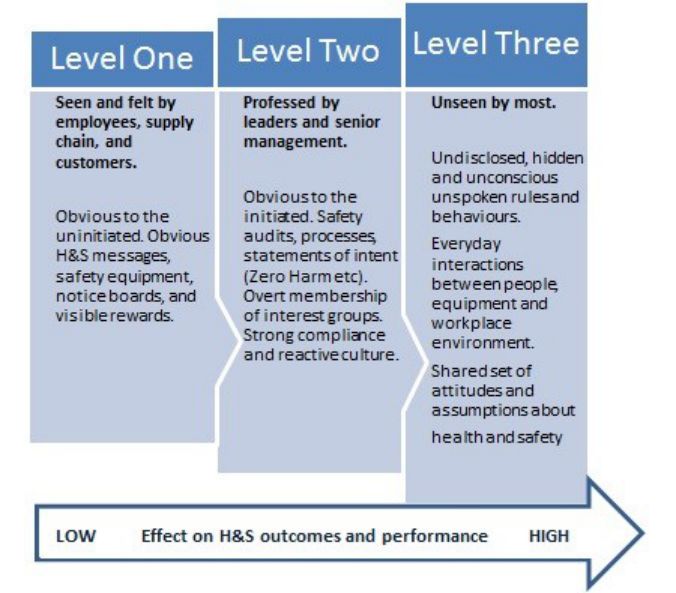
Figure 1. Course of variability of interpenetration of safety and danger (Wieczorek, 2008) An example of separating actual safety levels is the three-level approach (Brown, 2013), where Levels One and Two are easy to see, easy to measure with tick-the-box audits, and relatively easy to change. It’s Level Three that requires Safety Management (2019)
Figure available in the original PDF paper.
deep understanding and expertise (see Figure 2).
Figure 2. The three levels of safety culture. (Brown, 2013)
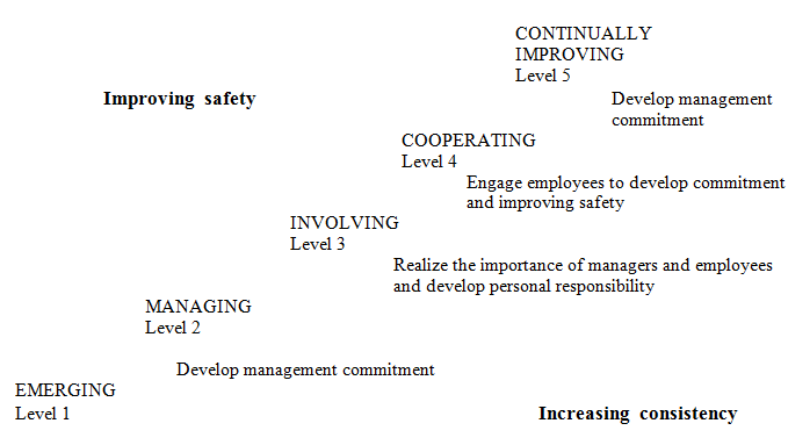
Another approach to the issue of safety culture level was presented by R. Lardner, M. Fleming and P. Joyner (2002) in the corporate occupational safety culture maturity model. The model shows a five-level representation of the increasing consequence in actions connected with engaging the organisation’s members in occupational safety issues. Advancement from one level to another enriches the occupational safety culture in a given organisation (Ejdys, 2010).
An organisation located at Level I initiates activities connected with occupational safety, e.g. establishes OHS norms and principles. If an organisation wishes to reach Level II, it must develop activities connected with increasing the commitment of the lower and higher level managerial staff to the idea of employee life and health safety.
The goal set at Level III is convincing employees to adopt the established vision of safe labour and creating conditions for personal engagement of each of them. Cooperation and consultation between employees and managerial staff help achieve the subsequent level of occupational safety culture – Level IV.
The top level of occupational safety culture, i.e. Level V, can be reached by continuous perfection of developed methods aimed at increasing occupational safety.
Figure 3. The safety culture maturity model (Fleming, 2000)
The above described model does not detail any procedures or key areas applied in order to achieve the individual levels, as each organisation has to develop them individually along with establishing or applying appropriate actions, measures and analyses as well as verification methods. The safety culture maturity model is applied in firms which have implemented an occupational safety management system.
MODEL OF OCCUPATIONAL SAFETY CULTURE LEVELS If we adopt an initial assumption that occupational safety culture is a subsystem of organisational culture, pursuant to the assumption there is no organisation without an organisation culture. The definition of organisational culture specifies it as social norms and value systems that stimulate employees and management style, shared meanings and symbols, cognitive patterns, behaviour requirements (Nogajski, 1998). Considering also the definition proposed by Sikorski, the most important element in specifying an organisation’s culture is the system of thinking and doing patterns. The patterns are established in the organisation’s social environment and are significant for implementation of its formal objectives (Sikorski, 2002). According to the aforementioned definitions, an organisation’s culture reflects the dominating views, specifies the employees’ sense of identity, provides them with principles and enhances social systems durability.
Assuming that organisational culture is shaped by external environment, organisation type, as well as organisation’s and employees’ characteristics, it is reasonable to assume that safety culture being its subsystem will also be shaped by the aforementioned factors.
Based on the above mentioned assumptions we can point out that the presented safety culture maturity model does not comprise organisations that only respect legal norms without specific establishment of goals connected with safety of employees’ life and health, or even do not fulfil OHS legal requirements, intentionally or involuntarily. The organisations may be characterised by partially visible or invisible occupational safety culture. This results from the organisation culture awareness criterion proposed by E. Schein who specified three levels of organisational culture (Kostera, 1996):
Level I - invisible, usually nonconscious,
Level II - partially visible and conscious,
Level III - visible and conscious. This can serve as a basis for adopting a new model of occupational safety culture levels, comprising the following levels:
Risky,
Initial,
Defined,
Managed,
Optimising.
BEHAVIOUR
INCREASED CONSISTENT
OCCUPATIONAL SAFETY
CULTURE
LEVEL V Optimising
LEVEL IV Managed
LEVEL III
Defined
LEVEL I Risky
Partial or total observance of OHS legal norms
Figure 4. Model of occupational safety culture levels
Figure available in the original PDF paper.
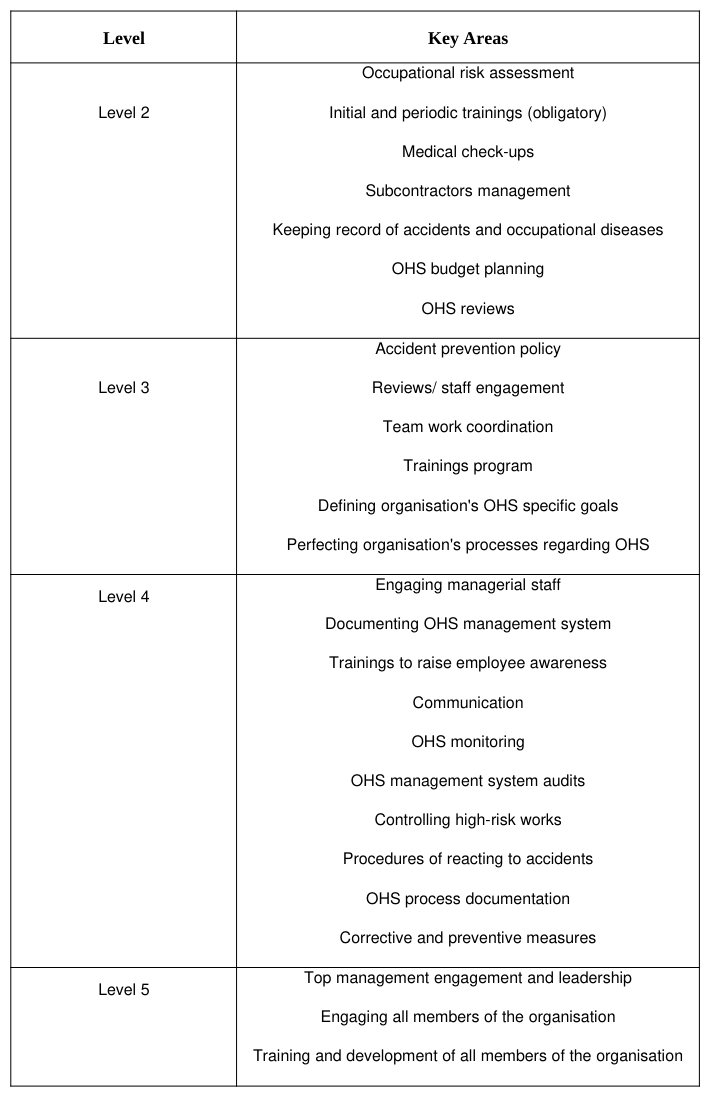
The model is to characterise a given level of occupational safety culture depending on measures taken by organisations in connection with occupational safety. The measures have been specified as Key Areas, except for the first level, as there may be a situation in which no measures are taken on that level. The key areas are characterised in detail by means of appropriate sets of actions (cf. Table 1). Each key area should be assigned a specific goal, obligations, practices, activities, measurements and analyses as well as verification methods.
One of the defined goals of the model is action planning and documenting. That means that each level has to be assigned an action plan as well as persons responsible for allotting and implementing appropriate tasks. The plan should include a schedule of actions, technical and organisational requirements, costs, time, etc. The measurements and analyses applied in the model are the number of potentially dangerous situations and the number of accidents, located on a time axis and in a concrete budget. They are verified via occupational safety reviews.
Table 1: Sets of key areas at different levels Level Key Areas
The first level of occupational safety culture may be named “risky“, as the safety culture is nonconscious and partially invisible. This level may be described as chaotic, since not all of OHS legal norms are met, team cooperation is poor, accident and occupational diseases analysis is neglected, and OHS in general is in a bad shape. Lack of workplace accidents may only be due to a high level of occupational safety climate, i.e. high awareness and experience regarding OHS which is shown by employees, but not the organisation itself.
The second level of the model, called “initial“, provides for respecting OHS legal norms. The norms are the minimum conditions and principles that the workplaces and employees are obliged to obey in order to protect themselves from technical devices, technological processes, tools, toxic substances, temperatures, sound levels, vibrations, lighting, disasters, etc. At this level an OHS reactive strategy is most often implemented, which focuses on post-accident investigations, rescue plans in case of emergency and their results mitigation measures. The key areas at this level include: occupational risk assessment, planning and implementing the initial and periodic trainings, medical check-ups, subcontractors management, keeping record of accidents and occupational diseases, planning the occupational safety budget and performing occupational safety reviews.
The third level of occupational safety culture pertains to the first stage of defining an organisation's goals with regard to OHS. At this level, the reactive strategy is replaced by a proactive (preventive) one. The major goal at this level concentrates on an individual – an employee, thus it may be called humanocentric, i.e. focused on human safety, work station safety and work process safety. The key areas at this level are: measures pertaining to accident prevention policy, reviews/staff engagement, team work coordination, a training program to increase employees’ skills, defining organisation's OHS specific goals, and perfecting organisation’s processes regarding OHS. The main objective of this level is ensuring that the applicable standards and rules are adhered to, and also the possibility of maintaining and developing safety culture in the future.
The fourth level of the occupational safety culture model is called the “managed“ level. Its determinants are: defining, documenting and collecting measurements, i.e. quantitative OHS control. Generally, the level consists in implementing and maintaining the occupational health and safety system. At this level, the following key areas are defined: engaging managerial staff, documenting OHS management system, trainings to raise employee awareness, communication, OHS monitoring, OHS management system audit, controlling high-risk works, procedures of reacting to accidents, OHS process documentation, and corrective and preventive measures.
The fifth, “optimising“ level effectively improves OHS procedures, using the data gathered on the fourth level. The key areas at this level include: top management engagement and leadership, engaging all members of the organisation, training and development of all members of the organisation, wide application of quality management techniques and tools, continuous perfection of all processes, examining occupational safety climate, preventive measures, business ethics and corporate social responsibility. Preventive measures at this level help eliminate accidents and occupational diseases, and also maximise the occupational safety climate. Preventive measures include: employee trainings, purchases of modern tools and technologically advanced personal protective equipment, regular meetings of team workers during which OHS issues are discussed and solved.
Table 2: Juxtaposition of organisational culture levels and occupational safety culture levels
Table available in the original PDF paper.
The presented model of occupational safety culture level may be applied in companies regardless of the number of employees or OHS management system implementation. Moreover, comparing the organisational culture levels with occupational safety culture levels it is possible to notice their congruity, which proves the original assumption that occupational safety culture is a subsystem of organisational culture.
CONCLUSIONS
Occupational safety culture to large extent depends on corporate strategy as well as employees’ social attitude and individual beliefs. Organisations which care for improving occupational safety culture and minimising the probability of workplace accidents and occupational diseases strive to implement appropriate measures in various areas of their activity. Minimising the occupational risk is becoming a strategic goal in many business sectors, since in view of today’s technologies an accident or a disaster may have even a global dimension. In accordance with the trend of work humanisation and increasing employees’ occupational safety, apart from respecting legal requirements regarding OHS, firms implement occupational safety management systems and they search for new methods to improve labour conditions in terms of safety. Monitoring and assessment of occupational safety culture is now becoming one of such methods. Perception of occupational safety by employees and employers is connected not only with the issue of endangering life or health, but also with their economic safety. Over the recent years, examination and evaluation of corporate safety culture has become one of many tools to identify the areas requiring improvement within the company. Thus it has become an element leading to a competitive advantage (Lis, 2010).
Examining corporate safety culture constitutes an element of organisational culture, which according to E. Schein may be found on three levels: the first (invisible and usually nonconscious culture), the second (partially visible and conscious culture) and the third (visible and conscious culture). Therefore, comparative studies of occupational safety culture should also include firms with very low organisational cultures, so as to identify the range of a given level of occupational safety culture. Thus it is possible to analyse not only enterprises operating within the same industry or having similar numbers of employees, but also to compare their levels in particular countries or culture areas.
REFERENCES
Brown, H. (2013), “Safety culture: A state of mind”: http://www.employmenttoday.co.nz/full_text/176_safety-culture.asp Cooper, M.D. (2000), “Towards a model of safety culture”, Safety Science, Volume 36. Ejdys, J. (2010), “Kształtowanie kultury bezpieczeństwa i higieny pracy w organizacji”. Oficyna Wydawnicza Politechniki Białostockiej, Białystok. Fang, D.P. Chen, Y. Louisa, W. (2006), “Safety climate in construction industry: a case study in Hong Kong”, Journal of
Construction Engineering and Management, Volume 132 No.6. Fleming, M. (2000), “Safety Culture Maturity Model; HSE Offshore Technology Report 2000/049: Sudbury, UK. Flin, R. Mearns, K. O'Connor, P. Bryden, R. (2000), “Measuring safety climate: identifying the common features”, Safety Science, Volume 34. Geller, E.S. (1996), “The Psychology of Safety: How to improve behaviors and attitudes on the job”, Boca Raton, FL: CRC
Press. Glendon, A.I. Stanton, N.A. (2000), “Perspectives on safety culture”, Safety Science, Volume 34. Gordon, R. Kirwan, B. Perrin, E. (2007), Measuring safety culture in a research and development centre: A comparison of two methods in the Air Traffic Management domain, Safety Science, Volume 45.
Guldenmund, F.W. (2000), “The nature of safety culture: a review of theory and research” Safety Science, Volume 34. Hale, A.R. (2000), “Editorial: culture’s confusions”, Safety Science, Volume 34. Hofstede, G. (1980), “Culture's Consequences: International Differences in Work Related Values”, Beverly Hills, CA, Sage Publications. Hofstede, G. (2000), “Kultury i Organizacje. Zaprogramowanie umysłu”, PWE, Warszawa. Hsu, S.H. Lee, Ch. Wu, M. Takano, K. (2008), “A cross-cultural study of organizatonl factor on safety Japanese”, Accident
Analysis and Prevention, Volume 40. Kennedy, R. Kirwan, B. (1998), “Development of a hazard and operability-based method for identifying safety management vulnerabilities in high risk systems”, Safety Science, Volume 30. Kostera, M. (1996), “Postmodernizm w zarządzaniu”, PWE, Warszawa. Lardner, R. Fleming, M. Joyner, P. (2002), “Towards a Mature Safety Culture”, Institution if Chemical Engineers Conference,
Symposium Series No. 148, Menchester. Lis, K. (2010), “Kultura bezpieczeństwa czynnikiem konkurencyjności przedsiębiorstw”, in: Niematerialne i społeczne uwarunkowania funkcjonowania i rozwoju przedsiębiorstw, red. A. Antonowicz. Wydział Zarządzania Uniwersytetu Gdańskiego Fundacja Rozwoju Uniwersytetu Gdańskiego (Ed.). pp. 209-217. Lis, K. (2013), “Kultura i klimat bezpieczeństwa pracy”, STUDIA OECONOMICA POSNANIENSIA, Volume 1, No. 7. Mohamed, S. (2003), “Scorecard approach to benchmarking organizational safety culture in construction”, Journal of
Construction Engineering and Management, Volume 129, No. 1. Nogalski, B. (1998), “Kultura organizacyjna. Duch organizacji”, Oficyna Wydawnicza Ośrodka Postępu Organizacyjnego, Bydgoszcz. Richter, A. Koch, C. (2004), “Integration, differentiation and ambiguity in safety cultures”, Safety Science, Volume 42. Schein, E.H. (1985-2005), “Organizational Culture and Leadership”, 3rd Ed., Jossey-Bass. Sikorski, Cz. (2002), “Kultura organizacyjna”, C. H. Beck, Warszawa. Studenski, R. (2000), “Kultura bezpieczeństwa pracy w przedsiębiorstwie”, Bezpieczeństwo pracy, Volume 9. Wieczorek, S. (2008), “Bezpieczeństwo człowieka w świecie zagrożenia ludzkiego”, in: Bezpieczeństwo i zagrożenia
współczesnego świata, Rzeszów, p. 247. Zohar, D. (1980), “Safety climate In industrial organizations: theoretical and applied implications”, Journal of Applied Psychology, Volume 65, No. 1. Zohar, D. (2008), “Safety climate and beyond: A multi-level multi-climate Framework”, Safety Science, Volume 46.
LISTED IN THE AHFE DIGITAL BOOKSTORE CATALOGUE
Explore the complete digital volume
Advances in Safety Management and Human Factors
Read this individual research paper free through the original publisher, or explore the full digital proceedings book.
ISBN 978-1-4951-2100-5
Explore this ISBN in the AHFE Bookstore ↗Listed in the July 2026 bookstore catalogue; search by ISBN to confirm current availability · Digital book purchase optional