Ann Mills, Toni Flint, Alice Monk (2022). An Evaluation of a National Rail Suicide Prevention Programme. In: Advances in Human Aspects of Transportation: Part III. AHFE Open Access, vol. 17. https://doi.org/10.54941/ahfe100750
This paper describes the rationale for the introduction of a GB national rail suicide prevention programme, which was introduced in 2010 with the aim of reducing the number of suicides on the rail network by 20%. The programme has three key streams of work; prevention activities (designed to reduce the level of suicide), post-vention activities (actions to reduce the impact of suicide) and activities to support partnership working between the key organisations involved in suicide prevention and each of these will be described in detail. This paper will describe the challenges of, and approaches to, the evaluation of such a complex (multiple activities and multiple agencies) and evolving programme. The paper will also present key findings from the evaluation in terms of the impact on the numbers rail suicides, the numbers of interventions, post incident management, improvements in partnership working, and staff attitudes to suicides.
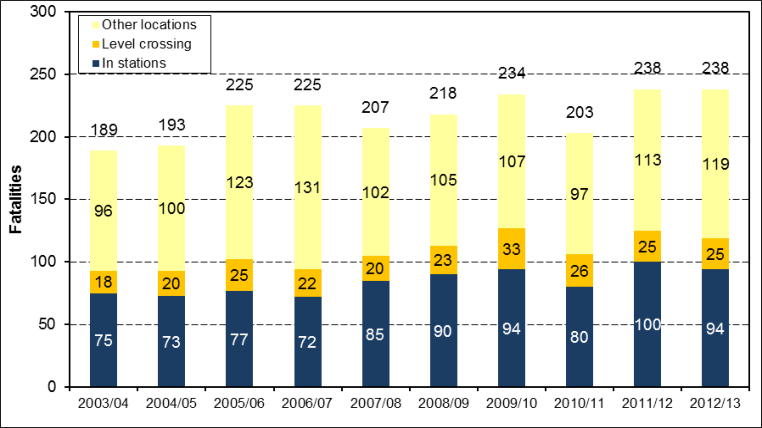
Over the past ten years, there has been an average of 217 suicides per year on the railway. As Figure 1 shows on average 39% take place at stations whilst 11% occur at level crossings. The category other locations mostly comprises suicides on the running line, but also includes a small proportion (less than 2%) occurring at other railway locations, eg bridges. Around 80% of recorded suicide attempts have a fatal outcome. Of those that do not, more than half result in major injuries, many of which will be severe and life-affecting.
Figure 1: Suicides and suspected suicides by location
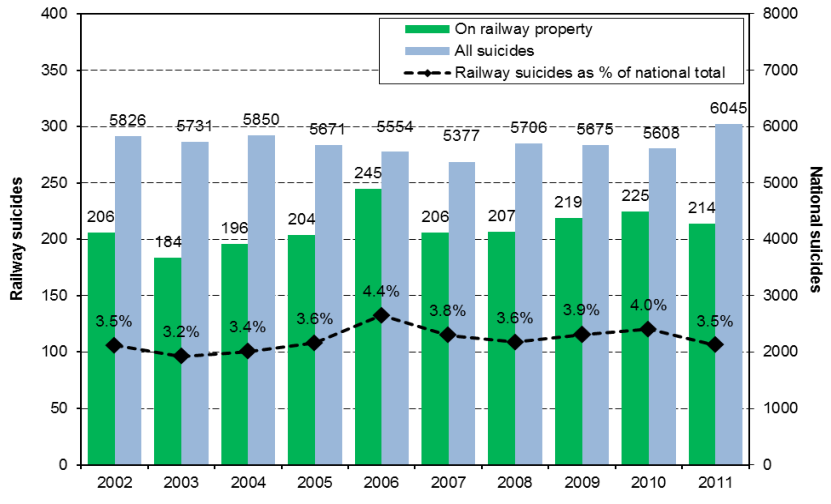
Suicides on the railway represent by far the largest proportion of railway-related fatalities, but they represent a relatively small percentage of suicides on a national level. National suicide figures are not available as recently as railway figures and are published on a calendar year basis. Figure 2 below shows the latest available calendar year comparisons.
Figure 2: Railway Suicide trends in the wider setting
The number of national suicides has been variable around a ten-year average of 5,704; the figure for 2011 is the highest recorded of the analysis, by a notable margin. The proportion of the national total occurring on railway property has been 3.7% over the presented period. Age and gender demographics of railway suicides vary somewhat from national suicides. Compared with the national profile, a greater proportion of railway suicides are male; this is particularly the case in the 15-44 years age group.
GB NATIONAL SUICIDE PREVENTION PROGRAMME In 2010, Network Rail entered into a £5 million, five year partnership with Samaritans to reduce suicide on the railways. Prior to the partnership there had been no national strategy in place to reduce railway suicide. The partnership involves the roll out of a programme of prevention and post incident support initiatives to reduce the impact of suicide. These include multi-agency partnership working at national and local level, bespoke training of railway industry staff, a national public awareness campaign (Figure 3), a volunteer call out service providing emotional support to people in distress at railway locations, post-incident support provided by local Samaritans branches and work to encourage responsible media reporting of suicides.
Figure 3: Posters from the public awareness campaign
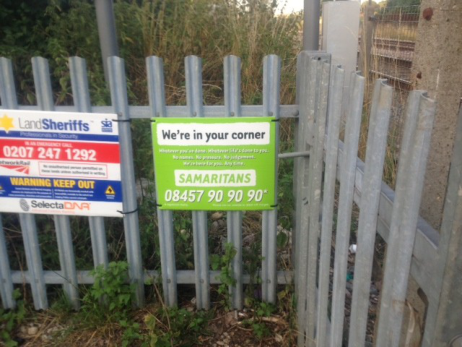
As mentioned earlier a number of suicides occur at level crossings and signage has been placed at these sites to encourage vulnerable members of the public to call Samaritans (see Figure 4).
Figure 4: Signage at a level crossing
The two targets established at the outset of the programme were for a reduction of rail suicide (by 20%) and for 10,000 rail staff to receive training (although the type of training or proportion of staff to be trained was not set). Targets have been now been set for the number of courses to be delivered annually, the number of participants and for the distribution of British Transport Police (BTP) witness cards and station awareness cards.
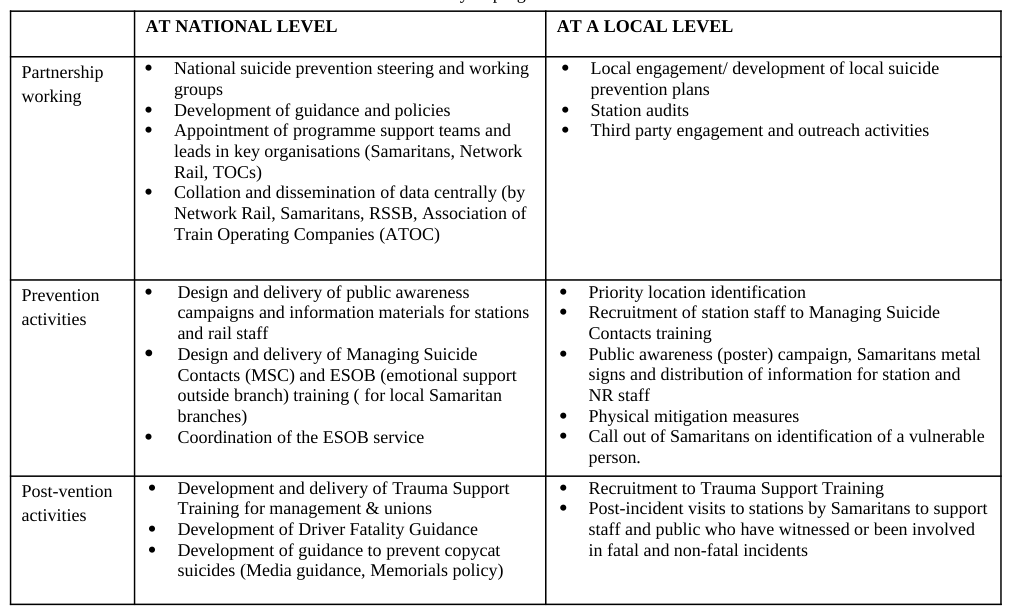
Table 1 below summarises the programme activities at the time of the evaluation and details the level at which they are being developed and delivered.
Table 1: Summary of programme activities AT NATIONAL LEVEL AT A LOCAL LEVEL
EVALUATION CHALLENGES Undertaking an evaluation of a programme of this nature is challenging for a number of reasons. As Table 1 shows the programme is very complex and operates at both national and local levels, includes a large number of different interventions that have multiple organisations involved in their delivery, is constantly evolving as more is learned, and partners are themselves changing their practice through their involvement.
Although a number of evaluation activities were undertaken during the first year of the programme, the detailed evaluation activity reported in this paper did not commence until the second year of the programme, meaning that it was too late to undertake any robust before and after measures, apart from in areas for which data is available from the years prior to the introduction of the programme (such as data on the number of suicides and delays caused by suicide).
An evaluation of this kind needs to consider ‘counterfactuals’. The programme is embedded within a wider environment within which a range of activities are taking place which may impact on the outcomes of the programme such as other activities to restrict access to the track or those by the British Transport Police (BTP) to speed up response to incidents. It is also important to consider the impact of the social context in which the programme exists, and the impact at macro and micro level of societal changes such as the recession.
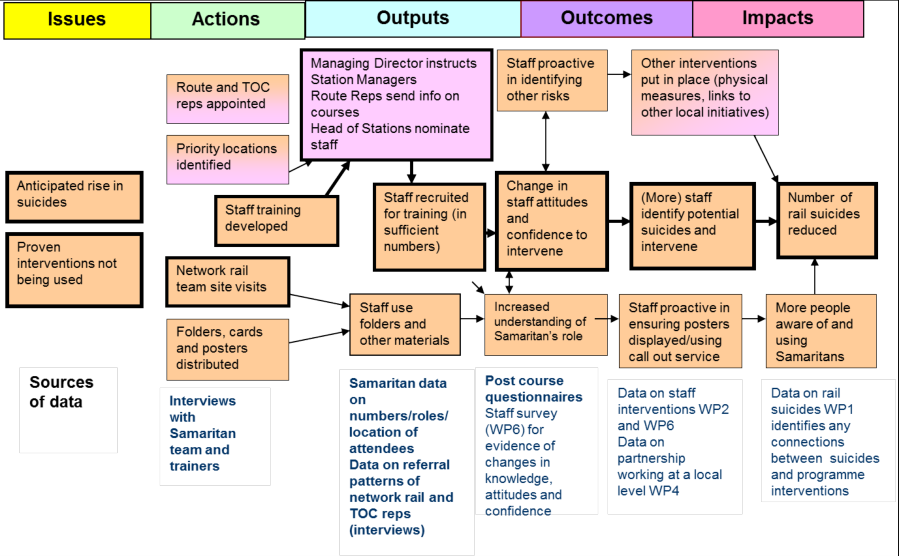
The evaluation of complex interventions is always challenging because it can be difficult to establish clear cause and effect relationships between the interventions and their outcomes/impacts (attribution). One approach that is increasingly being used in these circumstances is a ‘Theory of Change’ evaluation framework, which seeks to map the pathways between different elements of the programme and their intended outcomes. Figure 5 shows an example theory of change map from this study.
Figure 5: Example Theory of Change Map for Managing Suicide Contact Training The theory of change maps developed were used to both identify the different sources of data that can be used to establish ‘progress’ towards the intended outcomes and impacts, and as a framework for bringing the different sources of data together in the final analysis. Complex evaluations using theory of change maps involve the triangulation of different sources of data involving a mix of both qualitative and quantitative data.
The evaluation of the Network Rail/Samaritans programme is addressing the following overarching questions:
To what extent have programme activities, and activities enabled or supported by the programme, led to a reduction in loss of life from suicide on the railways?
What evidence is there that the programme has reduced disruption to services and distress, or lowered the cost resulting from suicides, to the railway industry?
Has the programme contributed to improved partnership and inter-agency collaboration in the prevention and mitigation of the impact of suicide, across the rail industry (nationally and locally)?
What is the evidence that individual elements of the programme have been effective in themselves, and contributed towards the overarching objectives of the programme?
To what extent has the programme supported the implementation and promotion of best practice in prevention and mitigation of the impact of suicide across the rail industry?
What has been learned that can support future strategy?
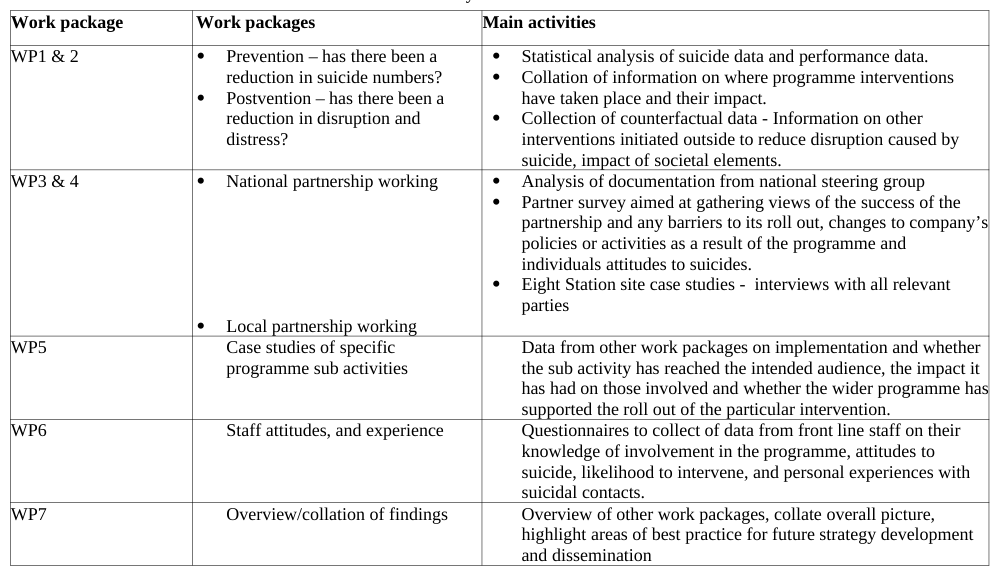
To support these overarching evaluation questions a number of work packages involving data collection and analysis are being undertaken. Table 2 below provides detail on the main data collection activities.
Table 2: Summary of evaluation activities Work package Work packages Main activities
RESULTS
The full results of this evaluation are reported in RSSB (2013a) The following sections provide a selection of the key findings that answer the first overarching questions mentioned previously.
Programme Coverage The number of locations and individuals involved in the programme activities has grown year on year, although implementation has often been patchy, largely because of the size and complexity of the rail network and the number of organisations involved.
Preventing Rail Suicide The number of rail suicides (as shown in Figure 1) shows no sustained reduction since the programme commenced. An overall comparison of the three years prior and three years since the launch of the programme in 2010 shows there has been an average increase of 7 events per year. This increase does not however represent a statistically significant increase over this period. These figures need to be seen in the context of the fact that the programme has not yet been fully implemented across the country.
As Figure 2 shows there is some evidence that rail suicides account for a higher proportion of national suicides than a decade ago although there has been no significant change in recent years and over the period during which the programme has been implemented. National suicide figures have also been impacted by the fact coroners are now more frequently using narrative verdicts where there is uncertainty over the person’s intent which may account for variations recorded at a national level. As the Statistical Bulletin published by the Office of National Statistics (2013) reports, a guidance note was issued to coroners in 2011 to ensure they provide enough detail in narrative verdicts. This allowed coders at the Office of National Statistics (ONS) to have more information when coding which may potentially have increased events coded to intentional self-harm. For railway suicides however, in most cases there is enough evidence to support the coding of suicide; the Ovenstone criteria (RSSB, 2013a and Evans, 2013) is used to categorise cases for which there is no definitive coroner’s verdict. Further work to understand how rail suicides have been coded compared to ONS coded suicides is on going.
Further analysis looked at those stations considered a priority in 2012. Stations were designated as priority locations using a risk based approach, taking into account the suicide history, delay minutes and hazard rating based on station layout and through traffic at the station. These stations had substantially more programme activities directed at them than those not designated as priority locations.
Number of suicides
Figure 6: Railway suicides at priority locations in 2012
Figure available in the original PDF paper.
There has been no obvious downward trend in the delay and cancellation costs that arise from suicides. As none of the programme activities were specifically targeted at reducing delay this finding is directly related to the fact that there is currently no evidence of a reduction in suicides on the railway.
There is some evidence that response times to suicides are improving. This requires BTP, Network Rail and the train operators to work together to resume the train service as quickly as possible. Response times between 2009 and 2012 show that the average time for the train service to resume following a suicide has reduced from 2hours 44 minutes to 1 hour 59 minutes.
The main area in which the programme may influence the disruption caused by suicide (in addition to reducing suicide) is in the activities designed to reduce staff trauma. The Training aimed at managers and supervisors of staff who may be exposed to vulnerable individuals trying to take their lives has not yet been established long enough for the changes to be fully assessed. It is interesting to note that some prevention activities, such as the MSC training and Samaritans information distributed at priority locations, were seen as being as helpful in reducing the distress caused by suicide as they were in reducing the level of suicide itself.
There is evidence however that the MSC training is preventing suicides and therefore providing cost savings. On the whole, programme activities have been welcomed by rail staff, particularly those which help them to manage and handle the aftermath of dealing with an actual or potential suicide. When asking respondents about the actions they would take on encountering a potentially suicidal person, those respondents who had received the MSC training were statistically more likely to say they would exhibit more appropriate actions (approaching the person and introducing themselves, asking the individuals name, how they were, encouraging them to talk about their problems, listening, showing empathy, encourage further discussion in a safe place, provision of Samaritans details. offering to organise for Samaritans to contact the individual and requesting an ESOB) than those who had not received the training. The same group was also statistically less likely to exhibit inappropriate behaviours than those who had not received the training.
Many qualitative examples of interventions were given by survey respondents which suggests that staff are making interventions on a regular basis which are often going unreported.
The role of partnership working in suicide prevention Establishment of the National Suicide Prevention Steering Group (NSPSG) and Working Group (NSPWG) has provided the opportunity for different organisations to meet, discuss and work collaboratively to deliver the programme together.
A survey was distributed to those individuals involved directly in implementing the programme at a national level (NSPSG and NSPWG), those with a supporting function (BTP) and those that facilitate implementation by virtue of their role, such as Train Operating Company (TOC) managing directors. 87% of respondents felt that the programme had improved partnership working and 77% and 72% felt that programme activities had reduced staff distress and service disruption following a suicide respectively.
Responses to the partnership survey suggested that respondents felt that relevant organisations are working well together to prevent suicides and reduce service disruption following an incident. However, only 37% of respondents felt that identified good practice was being effectively implemented on a national basis suggesting that communication between the steering group, working group and other partners at a local level could be improved to ensure industry strategy and activities are effectively rolled out. Qualitative responses suggested that there was a need for a coherent communications strategy to support strategy identified at the national level and delivery of the programme at the local level. On a positive note those respondents working at the local level felt that local groups were an effective means of achieving partnership working and that priority location identification was a useful way of targeting programme activities.
Respondents were also asked about which organisations they felt could have the most influence on suicide reduction and the perceived efforts of different organisations in this aim. Over 75% felt that Network Rail, Samaritans and BTP can influence the occurrence of suicides significantly, and 67% felt that the National Health Service had a key part to play. All of the representatives from (TOCs) recognised their role in influencing the occurrence of suicides, however over 40% felt that their potential influence was less than the previously mentioned organisations. When asked about the current efforts in suicide prevention the majority of respondents felt that the level of effort made by Samaritans and BTP were about right however that the Train Operators, Network Rail, Trades Unions and the National Health service needed to do more.
Attitudes to suicides Respondents were asked to rate the extent to which they agreed or disagreed with the validated Attituse to Suicides (ATTS) question set (Renberg and Jacobsson, 2003). This scale was developed to measure attitudes towards suicide in the general population and was adapted to make it suitable for front line rail staff. The scale did not have a consistent factor structure. Therefore a factor analysis was conducted to identify the key themes in the question set and these are shown in Table 3 (for more details refer to RSSB 2013b). A mean average was calculated for each factor identified in the factor analysis (See Table 3). Averages close to 5 represent strong agreement and averages close to 1 represent strong disagreement.
Table 3 Overview of ATTS factor ratings
Obligation to prevent, preventability and acceptance of suicide factors which are all positive attitudes that should result in motivation to try and prevent suicide and sympathy toward suicidal people. Staff are generally quite strong on these attitudes, indicating a good foundation for the programme.
Analysis of the ATTS scale identified a number of influencing factors on attitudes towards suicide such as religion, gender, ethnicity, marital status, previous experience of suicide, job role and organisation. It found that people who had experienced a suicide attempt at work, or in their personal life (by a friend, family member, or acquaintance) generally had ratings indicating a higher acceptance and openness about the issue of suicide. These respondents also had a high rating on the factor related to having a strong obligation to prevent suicide.
Respondents who had not experienced a suicide at work had higher ratings on the factor indicating that they were more likely to agree that suicide is a subject that should not be talked about.
The survey results show that the majority of front line staff are generally willing to take part in or use the programme activities. Respondents' willingness to engage in programme activities was positively linked to having a strong 'obligation to prevent suicide'. However, a reluctance to engage in programme activities was associated with the attitude that suicide is a long-lasting issue (hard to address) and a difficult subject to talk about. These results were significant but the correlation coefficients were weak, indicating that these were not strong relationships.
There was also evidence that people who feel more obligated to prevent suicide, and feel more strongly that it is preventable, may be more likely to take positive actions following a suicide while people who feel that suicide cannot be overcome may be less likely to take positive actions.
As the surveys only represented a 'snap shot' of attitudes to suicide at a single point of time, it is not possible to directly compare attitudes before and after people have taken part in programme activities. However, a comparison of attitudes indicated that people who have participated in programme activities generally reported holding more positive attitudes towards suicide and its prevention than those who had not participated. Overall, the MSC training has not had a dramatic impact on staff attitudes. As already reported attitudes varied depending on many factors including religion, ethnicity, previous experience of suicide etc. It is likely that the impact of these other factors outweighed the influence of a 1-day training course.
CONCLUSION
Evaluation of a programme of this nature is challenging. Reliance on simple indices such as the change in number of suicides – particularly when they are so low in number - isn’t sufficient and a more sophisticated approach that seeks to identify the relationship between the interventions and the full range of expected outcomes/impacts is required.
Early analysis of the programmes coverage has shown that there are wide variations in the level of implementation across the country. This variation in delivery of programme activities is likely to have had an influence on the overall effectiveness of the programme to date, but is currently being addressed through establishing a stronger leadership team within Network Rail and more full time 'route representatives' to support the implementation of activities on the ground.
At this stage, there is no evidence that the overall level of rail suicide, either in absolute terms, or proportional to overall national suicide levels, has been reduced since the programme was set up. Nor is there currently evidence of impacts in terms of delay and disruption caused by suicide, although the time taken to respond to suicide, and resume normal services has been reduced as a result of changes in British Transport Police practice. Providing evidence of change as a result of programme activities is challenging on account of the high level of fluctuation in the number of suicides. A small number of incidents can result in considerable levels of disruption and delay when taking place at a peak travel time. It has also been difficult, because of the dispersed nature of the network and programme activities, to gain accurate data on where the programme has, and has not, been fully implemented.
The programme will continue to run until at least March 2015, allowing further opportunities for evaluation and research, particularly as activities become more fully embedded into day to day practice across the network.
The promotion of partnership and more 'joined up' response to rail suicides at both a national and local level is a key underlying principle of the programme. There is considerable qualitative evidence to suggest that the programme has promoted closer collaboration between different organisations seeking to address rail suicide. However the evaluation identified the need to communicate the programmes strategy in a more consistent fashion; an industry handbook has been developed and will be distributed in the early part of 2014. The industry partner survey also identified the need to engage and work more closely with the health authorities and this outreach activity is now underway.
Staff are generally strong on attitudes relating to the obligation to prevent suicides, preventability and acceptance of suicides which are all positive attitudes that should result in motivation to try and prevent suicides and sympathy toward suicidal people. Those staff who have participated in programme activities generally reported holding more positive attitudes towards suicide and its prevention and there is also strong evidence that the MSC training has led to attendees to better understand how to approach vulnerable individuals they have identified and indeed encouraged staff to intervene to prevent suicides on a number of occasions. Given the large costs associated with suicides, the prevention of a small number of suicides per year would be sufficient for the scheme to be cost beneficial.
REFERENCES
Evans, A. (2013), “The economics of Railway Safety”, Research in Transport Ergonomics, 43 (1) 137-147, Elsevier.
Office for National Statistics, (2013), “Statistical Bulletin - Suicides in the United Kingdom 2011”, Retrieved March 3, 2014, from http://www.ons.gov.uk/ons/dcp171778_295718.pdf Renberg, E. & Jacobsson, L. (2003), “Development of a Questionnaire on Attitudes Towards Suicide (ATTS) and Its Application
in a Swedish Population” Suicide and Life-Threatening Behavior 33(1), The American Association of Suicidology RSSB, (2013a), “Annual Safety Performance report 2012/13 – a reference guide to safety trends on GB railways” Retrieved March 3, 2014, from http://www.rssb.co.uk
RSSB (2013b), “Improving suicide prevention methods on the rail network in GB 2013 - Annual Report”. Retrieved March 3, 2014, from http://www.rssb.co.uk
LISTED IN THE AHFE DIGITAL BOOKSTORE CATALOGUE
Explore the complete digital volume
Advances in Human Aspects of Transportation: Part III
Read this individual research paper free through the original publisher, or explore the full digital proceedings book.
ISBN 978-1-4951-2099-2
Explore this ISBN in the AHFE Bookstore ↗Listed in the July 2026 bookstore catalogue; search by ISBN to confirm current availability · Digital book purchase optional