Gregoire S. Larue, Andry Rakotonirainy (2022). Driver’s Over-Trust on Advanced Driver Assistance Systems on Passively Protected Railway Crossings. In: Advances in Human Aspects of Transportation: Part III. AHFE Open Access, vol. 17. https://doi.org/10.54941/ahfe100747
Passively protected railway crossings are a major rail safety issue in Australia. Such crossings cannot be upgraded as such crossings are too numerous and the cost involved is prohibitive. Advanced Driver Assistance Systems (ADAS) have been shown to improve road safety and are widely used. These systems could be a solution to improve safety of passively protected crossings at a lower cost. Such complementary ADAS could result in driver’s over-trust due to the absence of Humane Machine Interface reflecting the quality of the information or the state of the ADAS (failure status). This paper demonstrates that driver’s exposure to crossing exhibiting fail-safe and non-fail safe properties could result in improperly allocating trust between technologies. We conducted a driving simulator study where participants (N=58) were exposed to three types of level crossing warning system on passive and active crossings. The results show that a significant proportion of participants over-trust the ADAS. Such drivers exhibit the same driving performance with the ADAS as when exposed to infrastructure based active crossing protection. They do not take the necessary safety precautions as they have a faster speed approach, reduced number of gaze toward the rail tracks and fail to stop at the crossing.
Australian context Collisions occurring at level crossings represent more than 40% of all rail-related fatalities in Australia each year (Cairney, 2003). While such collisions only represent 2% of the road toll in Australia (State of Victoria, 2009), they undoubtedly have the potential for catastrophic consequences with substantial human and social costs. Analysing data collected between 2001 and June 2009, the Australian Transport Safety Bureau report (ATSB; 2009) recorded a total of 355 rail-related fatalities in Australia in this period, at a rate of 41.8 per year (range 33-56). This includes fatalities involving train occupants (in the event of a derailment), pedestrians and pedal cyclists and is not restricted to incidents occurring at level crossings. Based on the estimate provided by Cairney (2003) that 40% of rail-related fatalities occur at level crossings, it is approximated that 142 of the rail-related deaths during this period occurred at railway level crossings, at a rate of 16.7 per year.
Overall, the literature suggests that of all driver-related factors, unintentional errors are far more commonplace than deliberate violations (Abraham, Datta, & Datta, 1998; Australian Transport Safety Bureau, 2002). Indeed, an Australian study revealed that unintended errors contributed to 46% of all fatal collisions, while intentional errors such as substance impairment (9%), excessive speed (7%), fatigue (3%) and risk-taking (3%) contributed to fewer collisions (Australian Transport Safety Bureau, 2002). Over the 2001-2009 period, a total of 1,585 driver errors were recorded at level crossings, at a rate of 186.5 per year(Australian Transport Safety Bureau, 2009). However, this is not to suggest that deliberate violations occurring at crossings do not pose a significant safety risk. Indeed, studies in the United States have revealed that between 14% and 60% of drivers report that they would ignore lowered gates and flashing lights and circumvent warning infrastructure, even when the oncoming train is clearly visible (Cooper & Ragland, 2008; Witte & Donohue, 2000). Moreover, 10% reported experiencing a thrill when attempting to ‘beat’ a train across the crossing (Witte & Donohue, 2000).
Not surprisingly, there are enormous economic and social costs associated with collisions at level crossings. In Australia, crashes at level crossings cost an estimated $32 million each year, excluding costs associated with infrastructure losses (Bureau of Transport and Regional Economics, 2003). Specifically, $10 million of these costs are associated with crashes involving road vehicles. The majority of these costs represent human costs such as impacts on workplace and household productivity and quality of life, emergency services and medical and rehabilitation costs. The costs associated with collisions between road vehicles and trains have been estimated at $180,000 and $430,000 at urban and rural level crossings, respectively, which excludes costs associated with track and train repair (ARRB Transport Research, 2002).
There are a number of factors that reduce the feasibility of installing active protection at all railway level crossings in Australia. Australia’s rail network has approximately 9,400 railway level crossings (RLX) of which 64% are passively protected with a stop or give-way sign. Railway level crossing collisions occur at a relatively low frequency, are random in the location and characteristics of their occurrence, and a roughly comparable number of fatal incidents occur at both actively and passively controlled crossings (State of Victoria, 2009). Moreover, the costs associated with railway level crossing crashes must be balanced with costs associated with the implementation of various approaches to protection (active protection, grade separation). While it might seem intuitive to install active protection at all passively protected railway level crossings, this approach is expensive and does not eliminate completely the incidence of collisions between road vehicles and trains. Indeed, active protection has been estimated as costing upwards of $300,000 per site and costs associated with upgrading all level crossings in Australia with active protection have been estimated to be as much as $1.8 billion (Cairney, 2003). In addition, there are substantial costs associated with maintenance, particularly in regards to the many rural railway level crossings.
In an investigation of video recordings of Australian railway crossings, more than half (59%) of the drivers did not fully stop at passive crossings (Tey & Ferreira, 2010). Nevertheless, close to the majority (41%) of these non- compliant drivers slowed down before crossing the tracks. Active crossings are associated with comparatively fewer violations and collisions than passively protected crossings. While this may appear counterintuitive in light of the evidence suggesting that a greater proportion of all collisions occur at actively controlled crossings, this discrepancy can largely be accounted for in terms of exposure and increased traffic flow (of both road vehicles and trains) at actively protected crossings. Thus, a common recommendation is that the maximum number of crossings should be actively protected, within the limits of economic feasibility and sustainability (Edquist, Stephan, & Wigglesworth, 2009). Developments in emerging technologies, which are considered a form of active protection, present an innovative approach to increasing the proportion of actively controlled crossings. Advanced Driver Assistance Systems (ADAS) have been shown to improve road safety and are widely used. As a consequence, the potential for the development of ADAS for railway level crossing safety has been recently discussed; as such systems can target human errors and can be implemented at a fraction of the cost of traditional approaches. Such approaches typically involve vehicle-to-vehicle or vehicle-to-infrastructure communication devices such as transmitters, receivers, antennas or radio frequencies in conjunction with technology such as Global Positioning Satellites (GPS) or traditional track detection systems. The use of emerging technologies for railway level crossing safety is particularly pertinent for crossings in rural and remote areas given that many are currently only protected passively and the implementation of other forms of active protection is not feasible due to their expensive nature (Carroll, 1999).
Over-trust in the technology Australia mandates the road-based actively protected RLX warning systems to have the highest Safety Integrity Level rating (SIL 4) and to adhere to the fail-safe principle. New ADAS warnings to improve safety at RLX are proliferating and are designed to complement existing passive RLXs. Unlike standard active signage, ADAS systems considered for implementation at railway crossings in Australia do not provide the same level of reliability and integrity, lacking a fail-to-safe mode of operation. Such systems should only be considered as assistive systems, the traditional signage remaining the primary control at the crossing. Such ADAS could result in inadvertent effects such as driver’s over-trust in the provided information due to the absence of a HMI reflecting the quality of the information or the state of the ADAS (failure status). Driver distraction and technology acceptance have dominated ADAS human factor related research and have eclipsed the equally important issue related to over-trust on technology. For instance, it has been shown that users of adaptive cruise control systems did not understand the limitations of the system adequately (Larsson, 2012). Such issues could be relevant to ADAS for railway crossings, as the differences between traditional signage and ADAS are not apparent to drivers until the system fails.
Over-trust has been one of important issues in human factors and it seems that over-trust is closely related issues of risk compensation, complacency and expectation that the system would work outside the specified situations for which the system is designed (Itoh, 2012). This is of concern for passive railway crossings, as there is consistent evidence to suggest that collisions are more prevalent at crossings with which the driver is familiar (Caird, Creaser, Edwards, & Dewar, 2002; Pickett & Grayson, 1996; Wallace, 2008; Wigglesworth, 2001; Yeh & Multer, 2008). Drivers become complacent at crossings they regularly use and may take fewer safety precautions when crossing. Furthermore, speed profiles while arriving at passive crossings tend to show that drivers are more cautious at passive crossings (18% arriving too fast) than at active ones (23% to 30% arriving too fast) (Tey & Ferreira, 2010). This suggests that using ADAS at passive crossings could result in riskier driving behaviours with these systems in case drivers behave as they would at active crossings, particularly since such systems do not provide the fail-safe mode of operation, and would result in potentially catastrophic right side failures.
Lee and Moray (1994) have defined four dimension of trust and asserted that over-trust occurs when at least one of the following dimensions is evaluated inappropriately high: A. Foundation: representing the fundamental assumption of natural and social order
B. Performance: resting on the expectation of consistent, stable and desirable performance or behaviour C. Process: depending on understanding of the underlying qualities or characteristics that govern the behaviour
D. Purpose: underlying motives and intent Active fail-safe protection systems such as boom gates often work (A), they have consistent and stable performance (B) in protecting drivers (D). However ADAS do not have such proprieties, as they do not adhere to SIL 4 and are not fail-safe. ADAS do not have the desirable safeguards against faults that warrant the ability of the system to continue to perform, fully or partially, (B) and ultimately preserve the safety of the driver (D).
The aim of this paper is to demonstrate that driver’s exposure to fail-safe and non-fail safe protective systems could result in improperly allocating trust between technologies and can have serious consequence on safety. We conducted a driving simulator study where participants (N=58) were exposed to three types of ADAS warning system on passive and active crossing protection system.
METHOD
Experimental Design ADAS interventions can complement traditional signage at passively protected RLXs. The assumption of such intervention is that the current signage remains the primary control at the crossing, and that the ADAS provides further information to help the driver assess the situation at the crossing, and improve safety by reducing the number of errors while approaching crossings.. Three different HMIs of ADASADAS interventions were investigated in this study. These interventions were selected through a literature review process which highlighted the technologies most likely to provide safety benefits at competitive costs with conventional protections. Different HMIs were considered to provide a warning to drivers, and the choice of which HMIs to trial was formed by both the literature review and consultation with focus groups of Queensland drivers. The effects on safety of these interventions are compared to a baseline which presents only traditional warnings at crossings (both active and passive crossings, no ADAS intervention). Only passive crossings are considered in this study for measuring the effects of the ADAS intervention.
In this experiment, three groups of participants (one for each ADAS intervention) are required to drive three different scenarios. In each scenario, the participants are asked to drive and follow road rules for approximately 20 minutes in an urban environment. Each participant is tested on one baseline first. Afterwards, participants drive one baseline and one ADAS scenario, the order of these scenarios being counterbalanced between participants, resulting in a within-subject analysis of the effects of the ADAS intervention on the driver behaviour as they approach passive crossings.
Simulation Scenario Driving consists of following an itinerary at 60 kilometres per hour (except in the CBD, where the speed limit is 40 kilometres per hour and some portions of road which are limited at 80 kilometres per hour). Participants are asked to follow road rules and drive as they normally would. The itinerary goes through various intersections, traffic lights and RLXs. No manual gear changes are required, and traffic conditions are set to represent realistic traffic around RLXs.
The same road map is used for all trial, but the itineraries are different. The road map used includes the Brisbane CBD (no RLXs), as well as a practice road network around it which presents an important number of RLXs. On each trial, participants drive through four different passive railway crossings; two of them have a straight approach, and two of them follow a curve, which reduces visibility at the crossing, while still complying with Australian Standard. Manual of uniform traffic control devices. Part 7: Railway crossings (Standards Australia, 2007). In each trial, two trains were approaching passive crossings as the participant was arriving at the crossing (one for each of the two types of crossing). The approach of the train was adapted to each driver, so that the crossing would be activated 6 seconds (with some variability) before the driver arrives at the crossing, assuming the crossing was active. This gives time for the driver to process the information, take a decision and stop without braking as in an emergency.
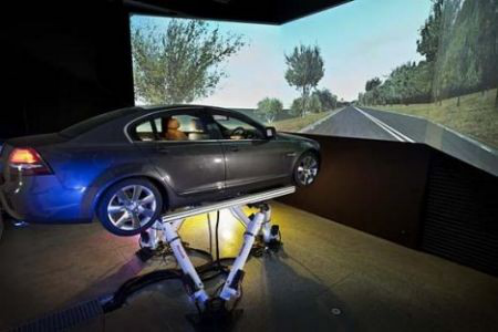
Driving Simulator The CARRS-Q advanced driving simulator consists of a complete Holden VE Calais vehicle body, with working vehicle controls and instruments, to provide a realistic control cabin and the ability to include up to 5 vehicle occupants (maximum 300kg total weight) during a simulation (see Figure 1). The vehicle body is mounted on a Bosch Rexroth E-Motion-1500 Electric Motion System, providing motion with 6 degrees of freedom (surge +716,- 602mm, sway +/-603mm, heave +407,-422mm, roll +/-27º, pitch +27,-24º, yaw +/-39º) and capable of supporting a combined load of up to 1500kg.
The driving simulator software is OKTAL’s SCANeRTM Studio v1.2 simulation software, which provides simulator control and data acquisition. The simulator is operated by six HP Z900 workstations, each with an XFX GeForce GTX285 1Gb graphics card, running components of the SCANeRTM simulation software in a distributed fashion. The forward images a provided by three Projection Design F22 sx+ 2100 Lumens projectors, projecting onto three flat 4m x 3m screens at 1400x1050 resolution to give a forward field of view of approximately 180° horizontal and 45° vertical. Three 8 inch LCD screens replace the side and central mirrors, each displaying a simulated rear view at an 800x600 resolution. Simulated vehicle and external sounds are provided by using the vehicle’s existing stereo speaker system and an additional subwoofer.
Figure 1. CARRSQ Advanced Driving Simulator.
ADAS interventions Three different ADAS interventions were trialled in this study. Two were in-vehicle interventions (one visual, one audio); one was an on-road intervention.
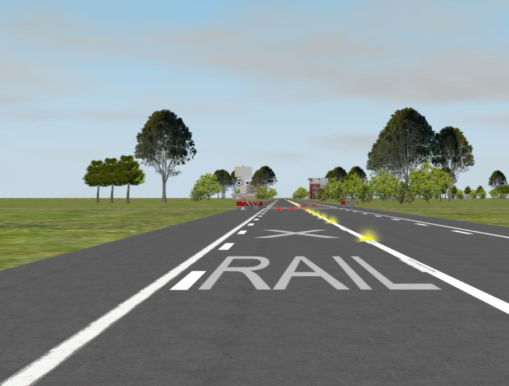
The road-based ADAS uses flashing warning beacons on the road which are activated when a train is approaching the crossing. These beacons highlight, in a similar way as illuminated airplane runways, the location where the driver is expected to stop their vehicle. This system improves drivers’ awareness of the crossing status earlier and more conspicuously, even in the case of reduced visibility independent of the time of the day. This system should primarily provide benefits when the approach to the crossing is curved or inclines, and in foggy or sun glare conditions. Such an intervention is similar to the SafeZone system (valet) from Inventis Technology. Flashing markers on the road are activated at the same time as the flashing lights of an active crossing and are positioned up to 150 metres from the crossing. In the case of passive crossings, the lights are activated 20 seconds prior to the arrival of the train, which provides a similar time to the driver to react to the warning. Three in-road red lights are used to emphasise the stop line at the crossing. Five in-road yellow lights are positioned in the middle of the road every 6 metres, and a further ten in-road yellow lights are positioned every 12 metres (see Figure 2). This ADAS is fully implemented with the simulator.
The visual in-vehicle ADAS is implemented with a smartphone (see Figure 2). This smartphone is positioned within the driving cabin at the usual location of a GPS (right side of the windscreen). As a train is approaching the crossing, the smartphone displays a warning flashing picture of the signage observed at actively protected crossings. The warning is displayed at an equivalent time as active crossings would be activated. In this situation (train approaching), the warning provides two messages at the same time in one symbolic representation: the fact that a train is approaching the crossing and that the driver is expected to stop. The pictures used are presented in Figure 2Error: Reference source not found. Both pictures are displayed alternatively to make the lights flash as traditional signals do at active crossings. They are designed as a combination of the assemblies RX-2 and RX-5 in order to present both explanation and action messages to the driver.
The audio in-vehicle ADAS uses the speakers of the simulator positioned inside the car (under the seat) to provide warning messages to the driver. As a train is approaching the crossing, the speakers provide a verbal warning as the flashing lights of active crossings would be activated. In this situation (train approaching), two messages are given to the driver as in the visual ADAS presented before:
“Train approaching the crossing ahead”
“Stop at the crossing”.
Figure 2. On-road intervention and visual in-vehicle ADAS.
Research Participants Potential participants were approached using an invitation letter on the Queensland University of Technology classified advertising website as well as the centre’s database of persons interested in participating in road safety research. Interested participants contacted the research team and were given an Information Sheet that outlined the purpose of the study, what the participant was requested to do, and the confidentiality and voluntary nature of the participation. In total, 76 participants were recruited to participate in this study; 18 participants were not able to complete the three drives and were not considered during the analysis. This study has therefore a sample size N=58, composed of 39 males and 19 females. The average age is 28.2 years, with a standard deviation of 7.63. Ages ranged from 19 to 59. Participants were divided into three groups, each group trialling one particular ADAS intervention. The first group trialled the visual in vehicle ADAS and was composed of 20 participants. The second group trialled the audio in vehicle ADAS and was composed of 19 participants. The last group trialled the on-road valet system and was composed of 19 participants. Participants were required to have an open driving licence to take part, and all participants reported having no disability that would influence the driving task. They were paid $50 for their participation. Participants were not informed of the expected results or hypotheses. The Queensland University of Technology Human Research Ethics Committee approved the study, and written informed consent was obtained from all participants prior to data collection.
Experimental Procedures Participants are tested individually in a dedicated simulator room in one session lasting approximately 2 hours. Each participant drives three scenarios (randomly assigned) in the simulator. Testing times are scheduled at 9am, 11am, 1pm and 3pm. Each participant chooses a testing time which is convenient.
Upon arrival, participants are asked to answer individual and anonymous questionnaires. A short practice drive is performed to familiarise participants with the driving task in the simulator. This is a familiarisation with the simulator, where participants get accustomed to accelerating, stopping, driving though intersections, RLXs and curves.
Then participants drive each scenario for approximately 20 minutes with 5 to 10 minutes breaks out of the simulator between scenarios. Prior to the scenario with ADAS, the system is presented to them on paper with pictures (screen captures from the simulator, photos of the device). In the case of the audio ADAS, the messages are played to the participant. They are then given a second familiarisation drive. This second familiarisation is a familiarisation for the ADAS. Once they feel confident with using the ADAS, they drive the scenario, at the end of which they answer questionnaires about the ADAS. Half of the participants have to drive the second baseline after their ADAS drive. Therefore, the fact that their last drive is without any ADAS was reinforced to participants and any devices were removed from the simulator.
Data analysis This study focuses on the effects of the ADAS intervention on the driver performance as they approach passive crossing. Behaviour with the system is compared to the behaviour without the system at active and passive crossings. As only small differences were observed with the three different HMI trialled, all interventions are combined and analysed as one intervention. Performance is assessed as the level of stopping compliance, the compliance in terms of gaze patterns towards the rail tracks and the approach speed twenty meters from the crossing. Such measures can provide information as to the changes in behaviour with the technology, and whether the system is used by participants as a complementary system or as a primary control at the crossing (in case the behaviour becomes similar to their behaviour at active crossings).
The stopping compliance of drivers was defined as the complete adherence to the road rules for railway crossings in Australia. Field studies have shown that three different behaviours can be observed at passive crossings equipped with stop signs (Tey & Ferreira, 2010). Such behaviours are then classified into compliant and non-compliant categories:
the driver stops the vehicle (comply)
the driver slows down but does not stop (non-comply)
the driver drives through, neither slowing down nor stopping (non-comply).
At passive crossings, drivers are expected to look for trains, and to stop and let the train cross if they see a train. Two operators recorded the gaze patterns of participants as they were approaching crossings. Compliance for matching records was inferred and used to evaluate the effects of the intervention on gaze compliance.
Approach speed was also of interest, as ADAS interventions are likely to result in risk compensation, where the driver compensates for the risk reduction from the ADAS. Higher speeds increase the distance required to stop the vehicle and could also increase driver errors at railway crossings. Speed profiles show that speed starts decreasing 50 meters to the crossing independently of the situation at the crossing, and that speed varies from 20 meters to the crossing depending on the situation at the crossing. Therefore analysis of speed 20 meters to the crossing was done in this study.
Data management for extracting data from SCANeR output was undertaken using Matlab version 7.10.0.499. All data analysis was conducted with R version 2.11 software1 using Generalised Linear Mixed Modelling in order to take into account the repeated measures design of this study. Speed was modelled with a normal distribution, while stopping and gaze compliance were modelled as binomial distributions with logit link function.
RESULTS
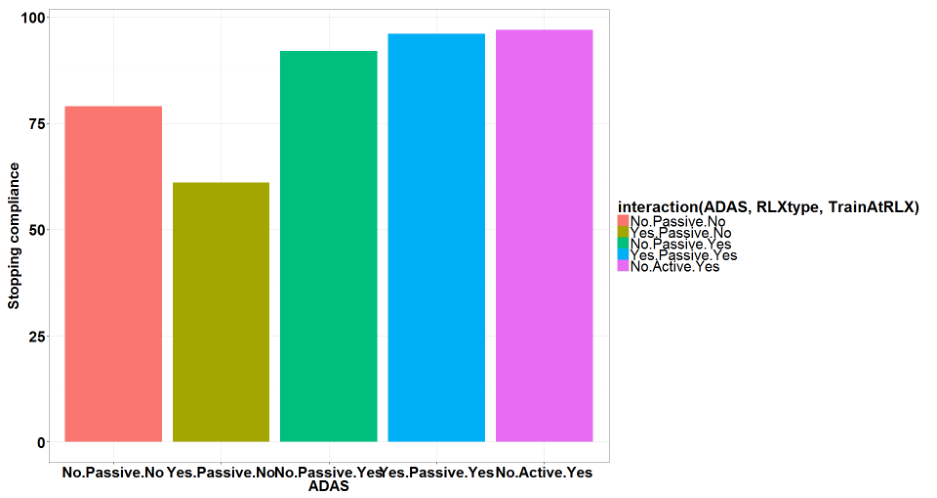
Baseline conditions show that the majority of participants (79%) stopped at passive crossings when no train was approaching (see Figure 3). Stopping compliance increases to 92% when a train is approaching (t(277)=2.947, p=.004) and reaches 97% for active crossings with a train approaching (t(277)=2.497, p=.013). Adding the ADAS, participants’ compliance decreased to 61% when no train was approaching (t(277)=-2.417, p=.016), and increased to 96% in case a train was approaching (t(277)=2.828, p=.005). This shows that the ADAS intervention increases stopping compliance when a train is approaching to a level similar to active crossings, but reduced compliance when no train is approaching by 17%.
Figure 3. Stopping compliance.
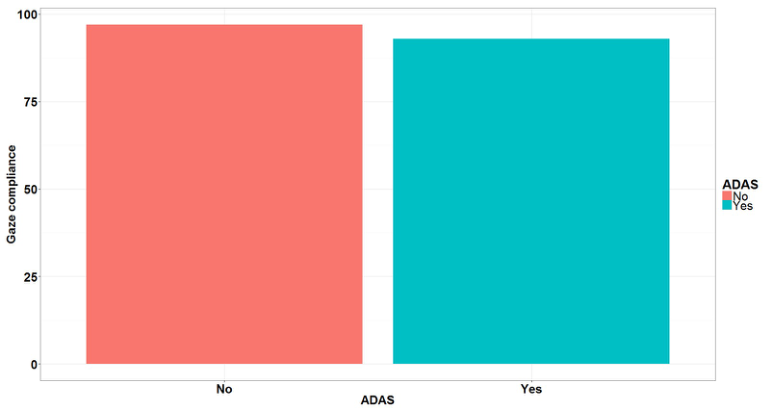
Analysis showed that gaze compliance at passive crossings was high, reaching 97%, independently of the approach of a train at the crossing or not (see Figure 4). Complementing the driving task with the ADAS resulted in a reduction of gaze compliance to 93% (t(164)=-2.900, p=.004). Drivers’ likelihood of not checking the rail tracks increases by 4% with the introduction of the ADAS system.
Figure 4. Histogram of gaze compliance at passive crossings.
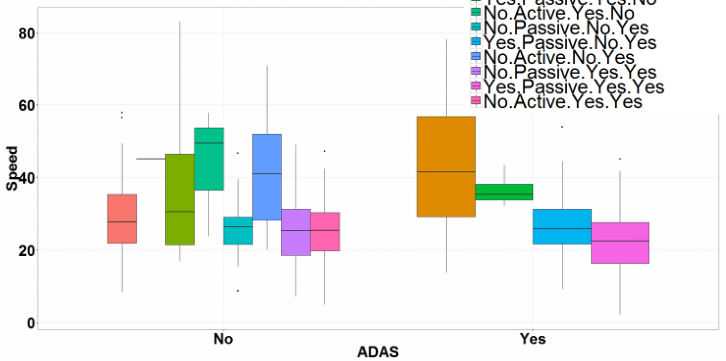
Speed 20 meters to the crossing (see Figure 5) is shown to depend on the stopping compliance of the driver and the presence of the train when information is provided to the driver (from the signals at active crossings or the ADAS at passive crossings). When the driver stops at the crossing, their speed 20 meters to passive crossing is 25.7 kph, but when they do not comply, their speed reaches 33.3 kph (t(385)=3.304, p=.001). For active crossings, participants were driving 15.3 kph faster than for passive crossings when a train was not approaching, reaching 41 kph (t(385)=11.097, p<.001). With the introduction of the ADAS for passive crossings, speed increases by 1.9 kph when Human Aspects of Transportation III (2022) no train approaches the crossing for complying participants (t(385)=2.850, p=.005). For non-complying participants, this value increases by 8.3 kph (t(385)=2.012, p=.045). When the ADAS indicates that a train is in the vicinity of the crossing, speed decreases by 5.4 kph (t(385)=-3.164, p=.002). This means that speed reduces to 22.3 kph for complying participants when a train was approaching, but increases to 27.8 kph when no train was approaching. Such increments in speed are even higher for non-complying participants, with values reaching 36.2 kph with a train approaching the crossing, and 41.6 when no train was in the vicinity of the crossing. The introduction of the ADAS resulted in a decrement in speed for complying participants when the ADAS was activated, but resulted in higher speeds when the system was not activated, and giving the information that no train was approaching the crossing to the participant.
Figure 5. Boxplot of approach speed 20 meters to the crossing.
DISCUSSION
Baseline conditions show that drivers do not always respect the stopping compliance at passive crossings, which have been observed on real crossings. When no train is approaching the crossing, compliance is rather low, reaching only 79%. When a train is approaching the crossing, stopping compliance is higher but still lower than the one observed for active crossings. As the train was approaching the crossing with a similar pattern for both active and passive crossings, the 5% difference observed between active and passive crossings with train approaching can be explained by the fact that some drivers do not know the rules at railway crossing in details or do not follow them, and consider it is acceptable to go through the crossing even though a train is approaching far in the distance. When the ADAS intervention is implemented within the driving simulator, stopping compliance with a train approaching increases to a level close to the one observed for active crossings. This intervention helps participants in analysing the situation at crossings with a train approaching, and makes participants realise that under such conditions crossing would be considered as unsafe if the crossing was active (it would be activated). Such behaviour change was expected from such an intervention, as the aim of this ADAS is to help drivers in assessing the situation at the level crossing. However, when the ADAS suggests that no train is approaching, the proportion of participants not stopping at the crossing increases by 17%, reaching 39%. This proportion of participants tends to use the ADAS system as the primary control at the crossing and fail to respect road rules. This behaviour is consistent with the behaviour for active crossings with no trains, where the driver is not expected to stop or visually check the rail tracks. This is further supported by the fact that the approach speed at passive crossings with the ADAS in the vehicle becomes very similar to the approach speed observed for active crossings without trains (27.7 kph versus 26 kph, and 41.6 kph versus 41 kph for non-complying participants). To a lesser extent, drivers also tend to check less the rail tracks when the ADAS is implemented, suggesting that they do not have a same level of confidence in the system as for the traditional signals. Nevertheless, in 5% of the cases, participants did not check at all for a train when the ADAS was suggesting that no train was approaching. We showed that while the majority of drivers comply with on-road and ADAS warning systems, a significant proportion of drivers using ADAS exhibit the same Human Aspects of Transportation III (2022) driving performance as when exposed to active crossing protection. They do not take the necessary safety precautions as they have a faster speed approach, a reduced number of gaze toward the rail tracks and fail to stop at the crossing. As the intent of ADAS for RLX and road based RLX are the same, that is to say to protect the driver (D), drivers mistakenly allocate the same level of trust to the two very different technology despite the fact that the reliability and the integrity of the technology are fundamentally different. One contributing factor to an inappropriate attribution of trust is driver’s similar understanding of the underlying qualities that govern the two HMI behaviour (C).
This study demonstrated that the assumption that the stop sign at the passive crossing remains the primary control, and hence counterbalances the potential failures of the ADAS, does not hold. While such behaviour would be safe if the ADAS technology was as reliable as traditional signage at railway crossings, such systems cannot provide such reliability and do not have a failsafe mode of operation. This has crucial safety implications. Furthermore, the HMI trialled in this study cannot be satisfactory. Indeed, no message is provided to drivers when they approach a crossing without a train. This design was used in order to let drivers follow the road signage under such conditions. This study shows that such assumption doesn’t hold either, and drivers learn from their experience with the system working that no message means no train is approaching. This is an issue with ADAS systems, as they do not have a fail to safe mode of operation, and the system failing would result in a message similar to the one for no train approaching. This is a right side failure and is the most dangerous one. As a consequence, the design of ADAS for passive crossing should exhibit radically different HMI to prevent drivers from considering the system as an equivalent to an active crossing protection, and further investigations should be done with new HMIs in order to ensure that the drivers do not use the ADAS system as the primary control at passive crossings.
CONCLUSIONS
This driving simulator study showed that driver behaviour is likely to be changed with the ADAS intervention at passive crossings. When a train is approaching, stopping compliance increases, but without a train approaching, compliance greatly decreases. Further, participants were slightly less likely to look at the rail tracks when approaching the crossing, and approach speed increases when the A DAS suggests no train is in the vicinity of the crossing. This suggests that a significant proportion of drivers behave as if the crossing became active with the technology. Such results suggest that ADAS cannot be implemented in-vehicles under the assumption that they would be used as a complementary system to help the driver assess the situation at the crossing, while still following the signage at the crossing. A significant proportion of drivers used the ADAS as the primary control as they approached passive crossings. Unlike traditional signage, these systems are not as reliable and do not provide any indication about failure. This study shows that such complementary ADAS can then result in driver’s over-trust due to the absence of such Humane Machine Interface reflecting the quality of the information or the state of the ADAS. Indeed, driver’s exposure to systems providing partly similar information could result in improperly allocating trust between technologies. This has crucial safety implications. As a consequence, the design of ADAS for passive crossing should exhibit radically different HMI to prevent drivers from considering the system as an equivalent to an active crossing protection, and further investigations should be done with new HMIs in order to ensure that the drivers do not use the ADAS system as the primary control at passive crossings.
REFERENCES
Abraham, J., Datta, T. K., & Datta, S. (1998). Driver Behaviour at Rail-Highway Crossings. Transportation Research Record, 1648, 28-34. ARRB Transport Research. (2002). Updating Practice at Passive Railway Level Crossings in Australia. Draft Report
RC 2016-2. Australian Transport Safety Bureau. (2002). Level Crossing Accidents - Fatal crashes at level crossings. Canberra: Australian Transport Safety Bureau. Australian Transport Safety Bureau. (2009). Australian Rail Safety Occurrence Data 1 January 2001 to 30 June
2009. ATSB Transport Ssafety Report Rail Statistics - RR-2009-007(1) Final. Canberra: Australian Transport Safety Bureau. Bureau of Transport and Regional Economics. (2003). Rail Accident Costs in Australia, Report 108. Canberra: Bureau of Transport and Regional Economics.
Caird, J. K., Creaser, J. I., Edwards, C. J., & Dewar, R. E. (2002). A Human Factors Analysis of Highway-Railway Grade Crossing Accidents in Canada (pp. 112). Alberta: University of Calgary. Cairney, P. (2003). Prospects for Improving the Conspicuity of Trains at Passive Railway Crossings Road Safety
Research Report (Vol. CR 217). Vermont South: Australian Transport Safety Board. Carroll, A. A. (1999). ITS Technology at Highway-Rail Intersections: “Putting It To The Test”. Proceedings From the ITS Joint Program Office Highway-Rail Intersection Evaluation Workshop. Cooper, D. L., & Ragland, D. R. (2008). Addressing Inappropriate Driver Behaviour at Rail-Highway Crossings.
Retrieved 23 January 2010, from UC Berkeley Traffic Safety Center, Institute of Transportation Studies Edquist, J., Stephan, K., & Wigglesworth, L. M. (2009). A literature review of human factors safety issues at Australian level crossings. Melbourne: Monash University Accident Research Centre. Itoh, M. (2012). Toward overtrust-free advanced driver assistance systems. Cognition, technology & work, 14(2),
51-60. Larsson, A. F. L. (2012). Driver usage and understanding of adaptive cruise control. Applied Ergonomics, 43(3), 501-506. Lee, J. D., & Moray, N. (1994). Trust, self-confidence, and operators' adaptation to automation. International
Journal of Human-Computer Studies, 40(1), 153-184. doi: http://dx.doi.org/10.1006/ijhc.1994.1007 Pickett, M. W., & Grayson, G. B. (1996). Vehicle Driver Behaviour at Level Crossings. HSE Contract Research Report No. 98/1996. Sheffield: Health and Safety Executive. Standards Australia. (2007). Australian Standard 1742.7-2007 Manual of uniform traffic control devices – Railway
crossings. Standards Australia. State of Victoria. (2009). Towards Zero: A Strategy for Improved Level Crossing Safety in Victoria. Melbourne: State of Victoria. Tey, L.-S., & Ferreira, L. (2010). Driver compliance at railway level crossings. Paper presented at the Australasian
Transport Research Forum 2010, 29 September-1 October 2010, Canberra, ACT, Australia. Wallace, A. (2008). Motorist Behaviour at Railway Level Crossings: The Present Context in Australia. Queensland University of Technology, Brisbane. Wigglesworth, E. C. (2001). A human factors commentary on innovations at railroad-highway grade crossings in
Australia. Journal of Safety Research, 32(3), 309-321. Witte, K., & Donohue, W. A. (2000). Preventing vehicle crashes with trains at grade crossings: the risk-seeker challenge. Accident Analysis and Prevention, 32(1), 127-139. Yeh, M., & Multer, J. (2008). Driver Behavior at Highway-Railroad Grade Crossings: A Literature Review from
1990-2006. Washington, D.C.: U.S. Department of Transportation, Federal Railroad Administration.
LISTED IN THE AHFE DIGITAL BOOKSTORE CATALOGUE
Explore the complete digital volume
Advances in Human Aspects of Transportation: Part III
Read this individual research paper free through the original publisher, or explore the full digital proceedings book.
ISBN 978-1-4951-2099-2
Explore this ISBN in the AHFE Bookstore ↗Listed in the July 2026 bookstore catalogue; search by ISBN to confirm current availability · Digital book purchase optional