Michele Meloni, Claudia Pinna, Luigi Lecca, Gianfranco Fancello (2022). Driving Ability Index (DAI) for Assessing Elderly People’s Performance. In: Advances in Human Aspects of Transportation: Part III. AHFE Open Access, vol. 17. https://doi.org/10.54941/ahfe100739
Aging results in a physiological decline in physical, cognitive and sensory abilities, which are required for executing complex tasks such as driving (Metzner et al, 1993). Accident rates are higher for older drivers and increase exponentially for over 75 year olds (Guerrier, et al. 1999). Moreover accidents in which elderly persons are involved are characterized by more severe injuries, due to the decline in their physical condition, owing to comorbidities and skeletal fragility. It is important to stress that not all older drivers are dangerous (Langford, et al., 2006): on the contrary they drive cautiously and their experience can outweigh the physical disadvantages. In addition, they are aware of their limitations at the wheel and thus behave prudently and rarely commit traffic offences. One major problem of general interest is associated with the fact that elderly persons are the fastest growing segment within the population and the ability to drive is one way of maintaining their autonomy and independence as well as social participation (Fonda et al., 2001). For this reason, there is an increasing need to evaluate objectively the physical and mental fitness of older drivers. The aim of this study is to identify an index for measuring and monitoring the driving ability of elderly persons. The tool proposed was developed by adapting the Work Ability Index (Ilmarinen J., 1999), widely used in occupational medicine to evaluate the ability to work, to evaluate the ability todrive. Like the Work Ability Index (WAI), the Driving Ability Index (DAI) is calculated on the basis of appropriately processed responses to a series of questions contained in a questionnaire. Based on the responses, the index value is calculated, which can vary from 7 to 49. In this way it is possible to identify the level of ability of elderly persons at the wheel. The survey involved 54 older drivers over the age of 65. The objective of the study was to develop an easy-to-manage tool for measuring and monitoring the driving ability of elderly persons, that can also be used for driving licence renewal. The utility of such a tool for a population of vulnerable road users lies in its ability to detect early signs of a decline in driving skills and devise actions to strengthen their positive abilities and reduce risks while driving.
The human lifespan has lengthened substantially over the last fifty years as one of the most important social targets. The extension of life expectancy has been accompanied by an increase in the number of people enjoying a good quality of life with good functional capacity. People now enjoy a healthier old age than ever before. Not only are people living longer, but those extra years are, by and large, healthy ones. The onset of chronic diseases and disability occurs at an ever-later age, so that healthy life expectancy appears to be increasing at least as fast as life expectancy itself.
This calls for a redefinition of ‘old’. If ‘old’ is taken to mean a certain degree of healthiness or disability, then the age at which people become ‘old’ is moving further and further forward. Similarly, if ‘old’ is taken to mean ‘not capable of working’, the age at which people need finally to retire is rising. To the extent that in 1950 it might have been appropriate to consider a 65-year-old as ‘old’, today that term would apply only to a person who has reached nearly 80.
With current trends and economic conditions, the changing age structure of populations poses several challenges. It is often difficult to get a safe lifestyle, attitudes and behaviors for executing complex tasks such as driving while sensory, cognitive and physical abilities are deteriorating.
Accident rates are higher for older drivers and increase exponentially for over 75 year-olds. Moreover accidents in which elderly persons are involved are characterized by more severe injuries, due to the deterioration of their physical condition, owing to comorbidities and skeletal fragility.
It is important to stress that not all older drivers are dangerous: on the contrary they drive cautiously and their experience can outweigh the physical disadvantages. In addition, they are aware of their limitations at the wheel and thus behave prudently and rarely commit traffic offences.
One major problem of general interest is associated with the fact that elderly persons are the fastest growing segment within the population and the ability to drive is one way of maintaining their autonomy and independence as well as social participation. For this reason, there is an increasing need to objectively evaluate older people's physical and mental fitness to drive.
The aim of this study is to identify an index for measuring and monitoring the driving ability of elderly persons. The tool proposed was developed by adapting the Work Ability Index (Ilmarinen J., 1999) widely used in occupational medicine to evaluate the ability to work, to evaluate the ability to drive. Like the Work Ability Index (WAI), the Driving Ability Index (DAI) is calculated on the basis of appropriately processed responses to a series of questions contained in a questionnaire.
METHODS
Based on the answers to different items of the Driving Ability Index, a final score is calculated, which can range from 7 to 49.
The questionnaire consisted of 7 core items:
1. current ability to drive compared to that of the best period of life (0-10 points).
2. self-assessment of ability to drive in relation to the demands of the task (2-10 points).
3. number of current disorders/diseases diagnosed by a doctor (1-7 points).
4. reduced ability to drive due to disease evaluated by the driver (1-5 points).
5. temporary stops in driving due to illness in the last 12 months (1-5).
6. prediction of driving ability for the next two years (1, 4 or 7 points).
7. driving behaviour and activities (1-5).
In this way it was possible to identify the level of ability of older persons at the wheel, classifying the sample into four groups (Tuomi at al. 2006):
1. Poor (7 – 27 points).
2. Moderate (28 – 36 points).
3. Good (37 – 43 points).
4. Excellent (44 – 49 points).
The questionnaire was administered by trained interviewers, able to standardize all the answers.
The most significant item in terms of self-assessment of driving ability is item 1; item 3 is devoted to health conditions, for identifying different disorders/diseases which can affect the elderly's fitness to drive, especially when combined. In this item a new question has been added regarding obstructive sleep apnea syndrome.
Item 7 is the innovative element in the questionnaire and describes driving behaviour and habits which may indicate difficulties at the wheel for elderly drivers. Item 7 is shown in Figure 1.
Figure 1. Item 7: different questions about driving activities (part of the questionnaire).
Figure available in the original PDF paper.
RESULTS
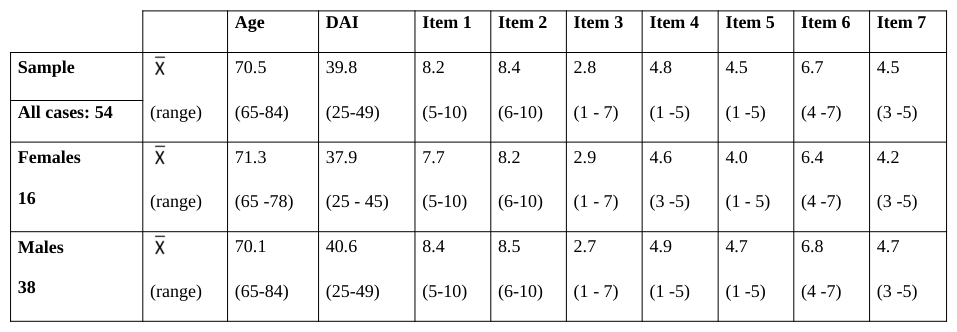
The survey involved 54 older drivers aged between 65 and 84: 16 women and 38 men.
Mean age of the sample was 70.5 years, ranging from 65 to 84 years. Mean age of the females tested was 71.3 (range 65-78 years), of the males 70.1 (range 65-84 years).
The mean DAI score for the whole sample is 39.8, near the middle of the “Good” group, the males attaining a higher score (40.6) than the females (37.9). This difference can likely be attributed to the slightly higher mean age of the women.
Analyzing different items in the two subsamples grouped by gender, show that men score higher in Items 2 and 6; these indicate a self-assessment of better degree of capability at the present time and in the near future (next 2 years).
At the same time Item 7 showed the older men to have better driving skills and abilities than the women.
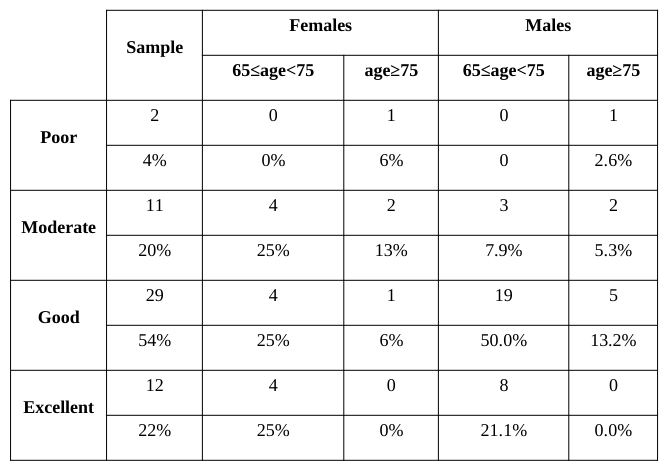
The “excellent” group with the highest scores includes 12 drivers (22% of the sample): 4 women and 8 men aged between 65 and 75. None of the over 75 year-old drivers ranked in this group.
The “good” group contains 29 drivers, by far the largest percentage (54%), 24 men and 5 women. 21% of the group classified as “good” were over 75 years of age.
20% of the drivers tested obtained a “moderate” score, corresponding to reduced fitness to drive, prevalent in the women. The “poor” group, accounting in this study for 4% of the sample, comprised drivers older than 75, suggesting they should not be considered fit to drive.
To evaluate the different effect of age on the DAI score for men and women two models were estimated using linear regression techniques. In both models only the “age” parameter was included, showing for the females alone a statistically significant negative correlation of more than 99%, as shown in Table 4 (t = - 4.436).
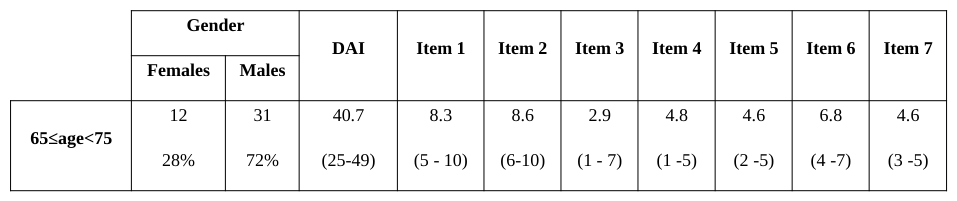
Table 1: Mean age, mean DAI scores, gender and mean values of different items.Table 2: Mean DAI scores and mean values for different items by gender and age.
Table 3: DAI score groups and percentage distribution by gender and age Females Males
Table 4- Description models.
Figure 2 – DAI score and age for males.
Figure 3 – DAI score and age for females.
CONCLUSIONS
The need to promote coping strategies by a self-evaluation of driving ability, on scoring the number of diseases and driving objective behaviors have become essential to lengthen driving abilities in older drivers and to determine which factors are connected with driving ability understanding their meaning to support inadequate drivers. The objective of the study was to develop an easy-to-manage tool for measuring and monitoring the driving ability of older persons, that can also be used for screening in driving licence renewal.
The utility of such a tool for a population of vulnerable road users lies in its ability to detect early signs of a deterioration in driving skills and thus devise actions to strengthen positive abilities and reduce risks while driving. In active elderly people several factors can significantly influence the DAI, some of which can be detected, prevented and controlled. Effective interventions could be useful in improving driving skills through periodic training and in-vehicle devices (driver assistance systems).
Age, diseases or medical disorders diagnosed by doctors are not sufficient criteria for assessing fitness to drive. In our study it clearly emerged that the number of diseases and driving behavior and habits, combined with self- assessment of current and future driving ability are the most important factors influencing the final score.
Further studies are needed to develop a method for increasing older drivers' knowledge and self-awareness. The driving ability index proposed here is a useful tool for improving driving performance in the active elderly and for supporting those drivers with “moderate” and “ poor” DAI scores.
REFERENCES
Fonda, S. J., Wallace, R. B. & Herzog, A. R. (2001), Changes in driving patterns and worsening depressive symptoms among older adults. Journal of Gerontology: Social Sciences, 56, 343–351. Guerrier, J.H., Manivannan, P., (1999) Nair, S., “The role of working memory, field dependence, visual search, and reaction
time in the left turn performance of older female drivers”. Applied Ergonomics, 30, 109–119. Illmarinen J. (1999), “Ageing workers in the European Union – Status and promotion of work ability, employability and employment”. Finnish Institute of Occupational Health, Ministry of Social Affairs and Health, Ministry of Labour, Helsinki. Langford J, Methorst R, Hakamies-Blomqvist L., (2006),“Older drivers do not have a high crash risk--a replication of low
mileage bias” Metzner, J.L., Dentino, A.N., Godarrd, S.L., Hay, L.H., Linnoila, M., (1993) “Impairment of driving and psychiatric illness”.
Journal of Neuropsychiatry, 5, pp 211-220. Tuomi K, Ilmarinen J, Jahkola M, Katajarinne L, Tulkki A. (2006). “Work ability Index. First reprint of the 2 nd revised edition.
Finnish Insitute of Occupational Health, Helsinki”. Tuomi K, Ilmarinen J, Martikainen R, Aalto L, Klockars M (1997). “Aging, work, lifestyle and work ability among Finnish municipal workers in 1981-1992. Scand J Work Environ Health 23 (sup 1): 58-65.
LISTED IN THE AHFE DIGITAL BOOKSTORE CATALOGUE
Explore the complete digital volume
Advances in Human Aspects of Transportation: Part III
Read this individual research paper free through the original publisher, or explore the full digital proceedings book.
ISBN 978-1-4951-2099-2
Explore this ISBN in the AHFE Bookstore ↗Listed in the July 2026 bookstore catalogue; search by ISBN to confirm current availability · Digital book purchase optional