Stas Krupeniaa, Anna Selmarkera, Johan Fagerlönnb (2021). The 'Methods for Designing Future Autonomous Systems' (MODAS) Project: Developing the Cab for a Highly Autonomous Truck. In: Advances in Human Aspects of Transportation: Part II. AHFE Open Access, vol. 16. https://doi.org/10.54941/ahfe100670
Modern technologies have the potential to create a paradigm shift in the vehicle-driver relationship with advanced automation changing the driver role from “driving” to “supervising”. To design new driver environments that caters for these emerging technologies, traditional approaches identify current human and technical constraints to system efficiency and create solutions accordingly. However, there are two reasons why such approaches are limited within the technologically-evolving automotive domain. First, despite significant progress in the development of socio-technical systems theory and methods, the application of these methods is largely constrained to the existence of a current system. Second, there are few structured approaches for using the analysis results to support design. In MODAS, an attempt is made to overcome these challenges by developing and implementing a method for analyzing and designing a non-existent sociotechnical system—a highly autonomous truck. The starting point for MODAS is the Goals, Method, Observability, Controllability (GMOC) model (Sandblad, Andersson, Kauppi & Wikström, 2007). In MODAS we also consider safety in human-automation system interaction and identify suitable assessment methods via a systematic analyze of estimated situations, goals, actions and behaviors that are of high importance from a safety perspective. A summary of the project is provided.
There are four goals of the MODAS project. First, to create a method for future (non-existent) systems design. Second, to apply the method to develop a driver environment that facilitates the safe, efficient, and pleasurable supervi- sion and control of a highly autonomous commercial heavy vehicle. Third, to develop a method for assessing the user acceptance of the Auditory Display components of this multimodal driver environment. Forth, to develop a method for assessing secondary task performance in highly automated commercial trucks. These four goals are ad- dressed within some broadly defined ‘future world’ constraints that are described below, starting with the question of why develop autonomous vehicles.
Why Develop Autonomous Vehicles?
Before addressing this overarching question, it is first necessary to clarify terms. Consistent with Wood, Chang, Healy, & Wood (2012), in the current manuscript we have chosen to refer to “autonomous” vehicles, instead of “au- tomated” vehicles, primarily because the former term is used more widely. In the current manuscript we seek to avoid a discussion on the meaning of automation, automatic, autonomous, and so on. Instead, consider the practical case of developing a driver environment for the supervision and control of commercial truck vehicle that can, as a minimum, take operational and tactical driving decisions and actions in the absence of any human control.
There are several immediate responses that come to mind when considering why invest in the development of auton- omous vehicles, most notably, safety, fuel efficiency, emission reduction, and supporting the mobility of persons with disabilities Indeed, it is possible to consider autonomous vehicles as reducing much of the ‘marginal social costs’ associated with travel (user costs, infrastructure provider costs, infrastructure user costs, society in general costs [air pollution, noise pollution…]; Jansson, 1997). Regardless of the issue of cost, a relatively agreeable per- spective is that autonomous vehicles is one way to increase safety, pleasure, and efficiency of transport in an in- creasingly complex transport system. Consider too that the increasingly complexity of modern transport systems is inevitable. Transport Systems are regularly considered as a typical example of a Complex System. A Complex Sys- tem is an entity composed of multiple interacting parts where the interaction of these parts (or agents) lead to large scale behaviors that cannot be predicted on the basis of any specific agent (Mitchell & Newman, 2002). Some of the key characteristics of Complex Systems are that they are Adaptive, include Emergent behaviors (novel behaviors cannot be predicted on the basis of the systems’ fundamental properties), Self-organizing, include Attractors (i.e. in- volves a recognizable dynamic state that may appear continuously), Non-linear (i.e. small changes in one part of the system can have disproportionate effects in other parts of the system), and includes Phase transitions (the system’s behavior may change radically once a certain threshold or phase has been passed) (adapted from OECD, 2009). Ac- cording to Arthur (Arthur, 1993), a complex system will increase in complexity as functions and modifications are added to that system to break through current limitations or to handle exceptional circumstances, and in general to adapt to a more complex world. Recent national, regional, and global initiatives, for example, aimed at reducing pollution (Euro 6 emission standards) or personal injury (zero fatalities in road transport by 2050; European Com- mission, 2011) are some of the modifications (c.f. Arthur, 1993) that will lead to increased complexity within the Transport domain. Although it is possible to put forward a strong theoretical argument for why transport systems complexity will increase, in the current manuscript we are more interested in the implications of this growing com- plexity on commercial truck drivers. To this end, it is possible to take a more practical examination of transport and technology trends and make conclusions about the effect of this evolving complexity on drivers. To understand the developing complexity from the driver perspective, three factors are introduced; (1) Increasing traffic growth, (2) Novel Intelligent Transport Systems (ITS) solutions, and (3) Developing vehicle technologies.
First, consider the expected increase in road transport. Within the EU 25, the number of passenger kms by car is ex- pected to increase by 20% from 2005 to 2020 and by 34% from 2005 to 2030. Even greater increases are expected within freight transport—truck ton-kms will increases by 27% from 2005 to 2020 and by 40% from 2005 to 2030 (Hansen, 2009; estimates based on a baseline model of growth). A key challenge for the transport industry as a whole, is how to cater for this increased traffic density and at the same time maintain reasonable levels of through- put. With new road highway construction costing about 10M€ per kilometer (Bentzrød, & Hultgren, 2009), national governments have a vested interest in avoiding the construction of new roads and instead need to find alternative means of catering for this expected increase in traffic density. Solutions to this challenge are being addressed within the transport sector, that is, via intelligent transport systems. Second, consider specifically the developments within Intelligent Transport Systems. Intelligent Transport Systems (ITS) are the advanced applications and integration of telecommunications, electronics, and information technologies together with transport engineering which aim to provide innovative services relating to different modes and transport and traffic management. These applications should support the better informed, safer, more coordinated, and more intelligent use of transport networks (Euro- pean Parliament, 2010). ITS solutions of various levels of sophistication (or complexity) can be found within trans- port systems, or under investigation. Some relatively simple ITS solutions that are found in most larger cities include dynamic highway speed control—where the maximum highway speed varies to support better traffic throughput. A slightly more complex solution is dynamic lane control (e.g. three lanes into the city in the morning, and one lane out which reverses to three lanes out and one in during the afternoon). More complex again is the notion of dynamic routing, here, it is not just lanes that may or may not be available during certain times, but whole roads (Taniguchi & Shimamoto, 2004). The potential for ITS solutions will continue to grow as the technology and methods for interact- ing with ‘big data’ develop. Third, consider the technological development occurring within vehicles (a factor some- times included within the broader view of ITS). For example, current sensors coupled with automatic emergency braking supports safer driving at reduced vehicle separation (both laterally and longitudinally). Indeed, a recent Eu- ropean Regulation (EC Regulation No. 661/2009; European Parliament, 2009) dictates that from the 1st November, 2013 all new vehicles in the EU must be fitted with Advanced Emergency Braking Systems—systems that can “au- tomatically detect and emergency situation and activate the vehicle braking system to decelerate the vehicle with the purpose of avoiding or mitigating a collision” (EC Regulation No. 661/2009, p. 8). As sensor sophistication in- creases, coupled with the capabilities afforded by vehicle to vehicle/infrastructure communication (and vice versa) it is likely (or inevitable?) that lateral and longitudinal separation can be further decreased.
Taken together, the implication of the three factors described above on transport complexity from a driver perspec- tive is that ‘future’ truck drivers will find themselves working in an environment with significantly more traffic than is currently the case. Additionally, on the basis of ITS solutions, from day to day a driver may not know which roads would be available for use, nor which speeds to travel at, nor which lanes to use. As a result of vehicle technology developments, drivers will encounter reduced lateral and longitudinal separation between vehicles while maintaining current (or potentially higher) speed limits. In this kind of environment, it is possible to envisage that full manual driving is extremely difficult, or impossible. Furthermore, full manual vehicle control may be not allowed. Thus we take the point of view that automation is a survival tool, without which driving may not be possible or allowed.
The role of the driver Given this future context, we must next consider the (expected) role of the driver. On this topic, we can use some existing theory on vehicle control and couple this with emerging technology trends to make predictions about the role of the driver. First, consider Michon’s (1985) theory on level of vehicle control (more recently developed fur- ther by, amongst others, Lee & Strayer, 2004). According to Michon’s model, there are three levels of vehicle con- trol; operational, tactical, and strategic. The operational level of control includes actions such as braking and acceler- ation, behaviors occurring between 0.5 and 5 seconds. On the tactical level, we have things such as changing lanes, negotiating traffic solutions, taking turns, etc. The tactical level includes behaviors occurring between 5 and 60 sec- onds. Finally, on the Strategic level, we have all the planning activities—these actions occur over minutes or days. A review of current technological trends suggests that technology development is currently very much towards autono- mous control at the operational and tactical level. Furthermore, despite very significant advances in cognitive com- puting over the last several years, developing autonomous planning tools will require some very significant develop- ments on data fusion using information from very diverse areas (e.g. weather, traffic, organizational, and other data- bases).
Thus, as illustrated in the Figure 1, within the MODAS project, we take the perspective that the role of the driver in the future environment becomes one primarily of strategic control. However, given the future environment described above, coupled with the inevitability of the driver remaining the final litigious controller of the vehicle (at least in the medium term), we expect that the driver will remain an actively involved in supervising their autonomous sys- tems, the environment, and taking supervisory actions. Thus an additional role of the Driver will be to Monitor and Supervise their systems and the environment (and take corrective actions as required). Finally, in addition to Plan- ning, Monitoring, and Supervising, we expect a third role of the driver—Resilience (c.f. Hollnagel, Woods, & Leve- son, 2006). Following (an inevitable) but wholly unexpected event, it becomes the drivers’ responsibility to bring their system back to some kind of normal state. This is particularly important when considering the future world as described (increased traffic density travelling faster) where the potential for loss of life following an accident is ar- guably greater than is currently the case.
Figure 1. Adaptation of Michon (1985) showing levels of control (Operational, Tactical, Strategic) with Operational and Tactical actions under Autonomous (Vehicle) Control.
Figure available in the original PDF paper.
In summary, we envisage three key roles of the driver in a future scenario, Strategic Planning, Monitoring and Su- pervision, and supporting system Resilience. The implication of this is significant. If we consider these three compo- nents as the key parts of ‘driving’ in the future, then it is clear that a system that affords this kind of control can be significantly different to current vehicles. As will be elaborated upon further in the manuscript, we suggest that a system that affords this kind of control does not currently exist and consequently, current methods for iterative sys- tems development are invalid. The fact that no system exists that could be said to afford the kind of control required in a future context is a main reason why we argue that a new method of systems development is required.
The nature of the future system The next question to be addressed is how do we start developing a system that caters for the future traffic context as well as the wholly novel (expected) role of the driver. Here we make two arguments. First, we argue that that in moving forward with systems designs for highly autonomous vehicles we need to take a holistic approach that con- siders the changing nature of the driver-vehicle relationship (as explained above) as well as the driver and the vehi- cle as two parts of a joint team. Without making any reference to any specific theory regarding human-machine in- teraction (especially with respect to ‘joint’ socio-technical systems), we merely want to make the point that in the fu- ture system, where the vehicle itself posses a relatively high degree of ‘intelligence’ it is important to consider that both the driver and the vehicle must work together as a team to achieve the system goals. Finally, in the same way that large aircraft manufacturers are known to have clearly defined philosophies regarding the role of automation in their systems (Young, Stanton, & Harris, 2007), a clearly defined philosophy is needed to ensure a consistent appli- cation of autonomous technology (thus reducing driver confusion). In the text that follows we describe in detail three key theoretical parts of the MODAS project; the design method, the multimodal driver environment, and the challenges associated with assessing autonomous driving. Following this is a brief description of how the MODAS project is being implement. We conclude we a summary of the current state of the project.
SYSTEMS DEVELOPMENT Current methods for complex system design, typically consider the user needs in the context of the current system. A standard user-centred approach to designing a new iteration of the current system normally involves some form of (user-oriented) system analysis, either descriptive (how users perform the task) or normative (how users should complete the task). These approaches involve interacting with end users to understand the current constraints to system efficiency and on the basis of the qualitative and /or quantitative data gathered, revisions to the system are proposed and implemented. Thus the new system improves system efficiency by removing the problems observed in the (now) old system. The automotive industry is currently experiencing a significant growth in the implementation of advanced automated driving technologies. When creating the control (driver) environment for interacting with these technologies, standard design methods are used. This means that the methods for interacting (accessing information and manipulating system states) with the novel technologies are fitted into the legacy (existing) system.
There are two problems with this approach. First, predicting system wide effects when modifying some aspects of the system can be notoriously difficult (Parasuraman, & Riley, 1997). Furthermore, and as mentioned previously, when introducing automated technologies—which have the potential to significantly change the driver-vehicle relationship—these difficulties are exacerbated. Second, and given the point above, it is possible to consider system design of the future system, as wholly unique (thus removing the dependence on the legacy system). However, developing a new system in the absence of an existing system becomes more difficult (as descriptive analysis are impossible, and normative analyses questionable; Loukopoulos, Dismukes, & Barshi, 2001). What is needed is a structured method for designing future systems that removes dependence on the current system, and can take into account the unknown behaviours (human and technology) that can arise from the future system.
Currently, the preferred method for systems analysis in the absence of an existing system are formative analyses. As opposed to explaining how the system currently works (descriptive) or should work (normative), a formative approach describes how the system could work. Although some formative systems analysis approaches (e.g. Cognitive Work Analysis; Rasmussen, 1986; Vicente, 1999) do exist, the application of such approaches for wholly novel systems is difficult to validate. Furthermore, when the formative systems analysis is complete, there are few, if any, reliable and valid approaches for using the system analysis results for system design (Read, Salmon, & Lenné, 2012). Clearly, in the absence of an existing system, as can be the case when future technologies are considered, not only is the system analysis impossible, but system design becomes more of an art than a science.
One developing approach for future systems design is the Goal, Model, Observability, Controllability approach (GMOC; Sandblad, Andersson, Kauppi & Wikström, 2007; Jansson, Stensson, Bodin, Axelsson & Tschirner, 2014). The GMOC model defines the human control aspects associated with controlling dynamic systems. GMOC is used to describe and analyze the control tasks, design new control principles, design the user interface and decision sup- port systems, and to support work organization and work place design. The new control strategy developed as part of the GMOC approach, "control-by-awareness", has shown to significantly improve the operational traffic planning and control processes. A key feature of GMOC as compared to other forms of system analysis is that the approach has an additional emphasis on system design. To support system design, GMOC, includes the following:
Vision seminars, where the goal of the organization and promises from new technology are driving forces;
Analyses of current work contexts and on-the-edge technology in driver environments, in order to separate current technology from intrinsic work constraints;
Workshops around current and future automation as well as future interaction technologies;
Design suggestions in terms of design principles and design concepts representing hypotheses about the relationship between the artefacts and human cognition and collaboration;
Evaluation of prototypes in order to subject the design concepts to empirical testing and revision as long as the mutual shaping goes on between the artefacts and the actors in a specific field of practice.
In the current project we acknowledge that designing for the evolving supervisory control modes change the required interaction principles. However, it is a mistake to believe that higher levels of automation can be introduced as a simple substitution of machines for people (Dekker & Woods, 2002). Supervisory control of a future vehicle means the driving task changes from being a primarily operational to a tactical and even a strategic task. In MODAS we acknowledge that designing for cognitive control introduces new challenges that are not present to the same degree in the existing driver environment. One way to approach and understand the evolving driver task is to study and interpret it as a Dynamic Decision-Making task (DDM; Brehmer, 1992). GMOC can be seen as the applied version of the DDM-approach since it is based on the same requirements for control as those defined by DDM. It thus makes sense to investigate the drivers’ actions using the following general problem formulation:
How can the drivers’ mental model development and goal formulation processes be supported by enhanced observability and augmented control functions?
One consequence of this general problem statement is that it is necessary to study, not only what drivers do when they perform judgments and make decisions, but also how they do it. This means identifying the drivers’ strategies in different situations and contexts, and supporting the development of mental models in relation to these different strategies. One way to conduct such strategy analyses via the method developed by Hassall and Sanderson (2012).
MULTIMODAL DISPLAY DEVELOPMENT A key goal of the future driver environment to be developed within MODAS is that the interface supports the driver acquire an accurate understanding of the state of their vehicle and of the external environment. It is presumed that in order to safely operate the vehicle some understand how the vehicle works is necessary. At a very superficial level it is necessary to understand that the accelerator is used to control acceleration, that the gear subsystem is used to con - trol direction (forward/backward) , and the braking subsystem reduces motion. During operation, drivers receive in- formation about the various subsystems (via the speed display, the gear display, the sound of the engine...) and use this to obtain an overall understanding of the vehicle. Thus in order to drive a vehicle, it is necessary to have some understanding of how the vehicle works as well as the current state of the vehicle, thus a “mental model” of the ve- hicle is required. More formally, a mental model can be defined as a representation of the system (or task) that is formed by the user, that is based on both previous experiences and current observations, which provides most (or all) of their subsequent system understanding and consequently dictates the overall level of task performance (Wil- son & Rutherford, 1989). In contrast to private drivers, for professional heavy vehicle drivers, where overall vehicle efficiency is a key task requirement and the negative effects of safety mishaps are exaggerated, a more complete ve- hicle mental model is required.
A more concrete example from the driving is: based on a driver’s previous experiences (the last time engine temper- ature increased, the cause was a split hose from the radiator) and current observations (my engine temperature is in- creasing now) an understanding is formed about the system (the cooling system has been comprised, probably due to a split hose) which dictates task performance (it is best to stop and attempt to fix the damaged hose). In this exam- ple, the driver has a formed a mental model of the vehicle mechanical subsystems (the coolant sub-system) that is formed by former and current observations. In this example, however, if the driver had received additional informa- tion, such as coolant pressure (which may have been normal), the driver would have formed an alternative mental model of the system state and implemented a different solution. Thus for safe and efficient control of (current) vehi- cles, drivers need an accurate mental model of the (mechanical) vehicular subsystems (e.g. engine subsystem, cool- ing subsystem, braking subsystem...). With comparatively simple mechanical subsystems the options for presenting this information are somewhat limited. However, with increasingly complex systems, the options for information presentation grow. Indeed, the key departure from traditional systems technology and display formats, to future ve- hicle systems is that with older vehicles, information was presented about the vehicle’s mechanical subsystems, however, with future systems, drivers will require an accurate mental model of the vehicle ‘cognitive’ subsystems. It is one thing to understand, from a mechanical perspective, why the vehicle is behaving in a certain way, but it is vastly different to understand why the vehicle automation is behaving in a certain way.
From a theoretical perspective, there is much work describing how to identify the information requirements for sup- porting operator mental models, as well as accompanying models and theories of display design. As Moray et al. (1993) stated, “Even experts can only exercise their skills and expertise optimally if the pattern in which information is displayed matches their models of the dynamics of the problem”. Whereas Moray’s comments were directed pri- marily towards a design approach, we consider the statement from a more applied perspective. To accompany the overall design methods development, in the current research we will investigate the affordances of multimodal tech- nologies to support the driver acquire an accurate mental model of the vehicle ‘cognition’. Two complimentary lines of work will be completed; how to use sound and visual information to assist the driver acquire an accurate mental model of the vehicle cognitive subsystems. In other words, whereas the mental models requirements will be defined under the scope of systems development and user needs, the iterative development of design solutions will be inves- tigated within the scope of multimodal display development.
Although supporting driver understanding of vehicle automation is essential to the present work, there are additional challenges for display design that will be considered as means of supporting efficient, safe, and pleasurable driver performance. As the vehicle will have operational and tactical control in many driving situations, its interface should be designed to assist drivers in making appropriate strategic decisions, and should enable them to override automa- tion when necessary. Drivers must be informed not only about the state and relevant intentions of the vehicle, but also about events and conditions in the environment that are relevant for making decisions. For instance, displaying road conditions or weather on available routes to a destination may assist drivers in selecting the most appropriate route. Thus, work will be conducted to investigate how to design displays that support drivers in making strategic decisions. In addition, the project will focus on how to design a multimodal interface that assists drivers to easily asses and prioritize information, and presents the information in an appealing (high user acceptance) fashion.
Furthermore, while the present work focuses primarily on fully automated driving, autonomous commercial vehicles will likely require manual driving in some situations. In demanding contexts, such as extreme driving environments (e.g., forests and mountain roads) and circumstances (e.g., snowstorms), reliable fully autonomous driving support may simply not be available. Thus, technological solutions should not only support fully autonomous driving, but also safe and efficient manual (less automated) driving when necessary. By considering situations in which the driver has operational and tactical control (longitudinal and/or lateral) of the vehicle, solutions will be developed that support the drivers’ decision-making process at these control levels. The vehicle may then provide perceptual, analytical and even decision support. For instance, during poor visibility conditions, the interface might display dis- tances to other road users and obstacles, and indicate when safety margins are optimal from a fuel-efficiency per- spective or too low from a safety perspective. In the present work, we will examine how display technology and so- lutions for highly autonomous vehicles can be utilized to support manual driving when necessary.
ASSESSING AUTONOMOUS DRIVING As mentioned previously, new automation technologies will change the role of the driver resulting in new driver be- haviors and errors. As Sarter, Woods, and Billings (1997) pointed out, automation can surprise operators via unex- pected problems and consequences. Earlier examples from aviation and industry, highlight the difficulties in predict- ing the effects of large technology shifts. However, even an inaccurate prediction is at least one step towards build- ing knowledge. In this project we aim to build a model for assessing automated driving.
Today, driving could be primarily described at a manual task, at least for most drivers. Still, much automation exists and assists the driver. Some automation systems are so common that we forget to view them as automated. One ex- ample is the fuel meter. Here, the vehicle automatically assists the driver in measuring the fuel and provides a warn- ing (e.g. a red light) when fuel level is low. Applying Parasuraman, Sheridan and Wickens’ (2000) description of au- tomation types and levels, consider the task of travelling from point A to B with sufficient fuel. For most current ve- hicles, we could say that this task has the following automation support; a medium level of information acquisition (the car provides automatic measuring but the driver reads the display), a medium level of information analysis (the driver analyzes the situation but the car informs the driver when fuel level is critical), and finally a low level of deci- sion selection and action implementation (the driver decides when and where to re-fuel and does this manually). Hence, driving could already be viewed as a semi-automated task. Using the levels of automation described by Sheridan (2011), current driving could be viewed as various actions where the car either offers no assistance (level 1) or executes a suggestion if the human approves to (i.e., cruise control, level 5). At the upper end of the scale, level 10, the car takes all decisions “ignoring the human”. At a high automation level (e.g. 10) there is no need to assess driver behavior because the drivers’ role reduces to being a passenger. On the contrary, if there is any risk of auto- mation failure that requires a co-driver ready to take over the driver behavior becomes of high importance—possibly of even greater importance than is currently the case. Today the driver is active (or at least should be) and should have a level of situation awareness, alertness and attendance that supports (at least) operational control on the sub- second level. If new automation systems reduce the alertness of driver, reaction times will increase, comprising safety. Our suggestion is that, as long as vehicles are equipped with a steering wheel and a brake, and that driver ‘driving’ is needed, standard measures of driving behavior remain relevant. According to our view, the issue is not which assessment measures must be removed, but rather which must be added.
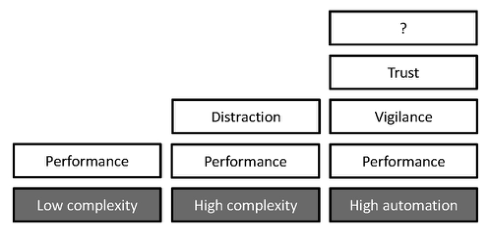
In an attempt to identify the future driver behaviors that must be assessed, we will make a systematic analysis of es- timated future situations, driver goals, and driver actions that build a foundation for predicting driver behavior (Fig- ure 2). A description of a specific situation makes it possible to predict driver goals linked to that specific situation. The driver goals then acquire driver actions to be fulfilled. When the driver actions are defined, then acceptable be- havior can be specified where acceptable behavior is defined as performance measures (e.g. time on task and error rate) as well as measures such as situation awareness, fatigue and mental workload. There are likely unexpected driver behaviors for which effective assessment methods are currently unknown. The need for new assessment methods has followed the development of new complex sub-systems in vehicles and could be expected to grow even more with automation (Figure 3). As complexity grows, the assessment methods must grow. New automation tech- nologies might reduce distraction but pose new problems. These problems may be avoided with smart systems giv- ing the right information to the driver at the right time. Automation comes with an expectation of reducing accidents and environmental influence. However, if the systems are not well designed there is a risk that the errors will be re- duced in numbers but increase in severe outcomes. Therefore, this new area of assessing automation in vehicles will need extensive research. The model built in this project is believed to become an important starting point but will not give the whole picture.
Figure 2. The planned method for predicting (future) desirable driver behavior.
Figure available in the original PDF paper.
Figure 3. The scope of assessment measures grows with increasing system complexity.
ASSESSING AUTONOMOUS DRIVING WITH DRIVING SIMULATOR Currently, the Lane Change Test (LCT) is the ISO standard for assessing the influence of secondary tasks on driving performance (Mattes, 2003). The LCT has the advantage of being relatively inexpensive and easy to use and has a high level of control. This makes the method suitable in early product development stages and in research when new areas are studied. The LCT is used to measure driving performance in terms of deviation from a normative driving route during the completion of other in-vehicle tasks (DaimlerChrysler AG, 2004). However, the value of the LCT for assessing future technologies is limited when automated driving features become more prevalent. For example, the LCT is useless for assessing secondary task performance during instances of autonomous lane changing. How- ever, in a shift from automated to manual, control lane deviation measures become highly important. Driver distrac- tion may affect driving in several ways, such as delayed reaction time (Alm & Nilsson, 1995; Treffner & Barrett, 2004) or decreased hazard detection (Strayer & Johnston, 2001; Reyes & Lee, 2008). These effects might increase when drivers are in supervisory rather than active control and suddenly need to take over the (manual) driving task. New technology solutions may also add effects that the current LCT method fails to capture (Engström & Markkula, 2007). Additional metrics measuring specific behaviors, and not only a general driving deviation, seems necessary (Rognin, Alidra, Val, & Lescaut, 2007), especially when the driver role changes due to automation. Previous re- search has been conducted that investigated what are the additional performance metrics can be obtained from the LCT with minimal methodological changes. Some performance measures identified include being the missed signs and erroneous lane changes (Bruyas et al., 2008; Young, Lenné, & Williamsson, 2011). However, given that the LCT was developed specifically to assess deviations in driving performance, the inclusion of these additional met- rics must be tested. Indeed, recent work has been completed that attempted to specifically develop and test addi- tional LCT metrics (Grane, 2012; Grane & Bengtsson, 2013). Whereas the development work on the LCT described by Grane (2012) moves towards validating some additional LCT performance measures that may be useful for as- sessing the impact of future technologies on ‘driving’ performance, the author noted that the measures investigated
may reflect experimental design, rather than task demand. From a safety perspective, careful adjustments and further tests are required.
In the current project, we move forward from Grane (2012; Grane & Bengtsson, 2013) and aim to define a more generally useful set of performance measures that can be extracted from the LCT to assess the impact of future tech- nologies on ‘driving’ performance. This work is necessary for assessing the impact of the to-be-developed system. Outcomes of this research will include recommendations for revisions of the LCT to remain valid for future tech- nologies. This evolving methodology will be used to assess the driver environment underdevelopment in an iterative way with results used to revise both the driver environment and the assessment method.
PROJECT IMPLIMENTATION Work will be completed within six key research and development workpackages The six key workpackages (two to seven) are described below and the relationship between workpackages is summarized in the PERT chart below.
Management (WP1) Auditory Visual
Design Method
User Needs (WP3)
Dissemination and Exploitation (WP9) Demonstration (WP8)
Figure 4. PERT chart showing relationship between Workpackages.
Figure available in the original PDF paper.
First, within the Design Method Workpackage (WP2), the overall design method will be developed. In WP2, a method for developing future systems is defined. The design method, a variant of the GMOC model will be adapted and refined for MODAS on the basis of the User Needs identified in the next workpackage. The key activity of the Design Methods workpackage will be to define the process of systems development that will be adhered to through- out the project. A challenge in developing this design method will be to identify a design process that considers fu- ture (currently unavailable) technologies. A good example of how a similar challenge was completed previously is Olsson and Jansson (2005) who successfully integrated future technologies into working practice. The methods of Olsson and Jansson (2005) will be extended in the current project.
Second, the Driver Needs workpackage (WP3) will occur closely with the Design Method Workpackage and aims to introduce the driver perspective to development. Whereas the Design Method Workpackage defines a general method for systems development, the adaptation and implementation of this methodology within the commercial truck domain occurs within the Driver Needs workpackage. This workpackage is thus dedicated to understanding (future and emerging) driver needs. The methods by which the driver needs are probed will be identified in Design Methods, but implementation (data collection and analysis) occurs within Driver Needs. Thus within this workpack- age the information required to assist the driver develop an accurate mental model of the system state will be identi- fied.
Third, in the Multimodal Affordances workpackage (WP4), the theoretical knowledge required for prototype design, integration and testing will be developed. The work here is divided into three main areas. First, we will investigate various possible technological solutions for a multimodal display. The work in this area will focus on the affor- dances of technologies and will occur within two modality directions: auditory and visual. The results will be used to support the process of decision-making on technological investments for the multimodal display. Secondly, litera- ture studies will be conducted to support the multimodal display design work. The research will focus specifically on the vehicle and environment information identified in the Design Methods workpackage and the Driver Needs workpackage. The outcomes will be used to assess which driving-related information could be best expressed au- rally or visually, as well as determine the most promising approaches for doing so. Finally, we will examine avail- able assessment technologies, which will support decisions regarding investments in simulator test equipment.
Fourth, in the Driver Environment Development workpackage (WP5), the driver environment will be constructed using the methodology developed in the Design Methods work package, on the basis of the Driver Needs, and using the theoretical knowledge from WP4. The information display will be developed in parallel with the visual displays. Included within this WP will be the initial design, building and evaluating of the auditory and visual information dis- plays. During the design process, both display types will be evaluated and refined in an iterative way. An iterative approach is necessary given that the theoretical knowledge identified in WP4 is more general, and may not have been confirmed within a relevant user context and with appropriate end users. Carelessly implemented audio and vi- suals displays are known to cause annoyance, which can significantly impact the acceptance of the entire interface. The iterative process will contribute to a more context-specific and precise understanding of how the sounds and graphics should be designed and presented within the multimodal environment, in order to work effectively and be accepted by the users. Furthermore, as part of the iterative testing process, a new tool for audio display evaluations will be developed. Established methods for display evaluations already exist within the visual domain. However, while auditory cues are common components in various types of driver assistance systems, methods are lacking for how to evaluate the sounds in order to improve their design. Developing and applying a useful evaluation method for the auditory information display is crucial for efficient testing within the iterative design process.
Fifth, in the Integration workpackage (WP7) the auditory and visual displays developed in the Driver Environment Development workpackage will be integrated into Scania’s high fidelity truck driving simulator. This workpackage includes two components, first, the visual and auditory displays will be integrated into a single driving environment, and second, the environment will be integrated into Scania’s truck driving simulator. Key to this work is the devel- opment of a Multimodal Display Engine. Additionally, within this work package, the simulator scenarios necessary for implementing the Design Method will be developed, as well as those needed for Test Methods (WP6).
Sixth, in the Test and Test Methods workpackage (WP6) we systematically investigate the estimated situations, goals, actions and behaviors that might be of importance for future autonomous vehicles and safety. The results will give input to how the current ISO standard for assessing in-vehicle technologies (the LCT) could be extended to re- main relevant for future technologies. In this WP we develop the test methodology for assessing the impact of the to-be-developed system. Outcomes here will include recommendations for revisions of the LCT to remain valid for future technologies. This evolving methodology will be used to assess the driver environment under development in an iterative way with the results influencing both system design and test method. A key difference between the work in this WP and that within WP2 is that developing the test method is conducted primarily with the involvement of domain experts (whereas system development is conducted with the primary involvement of potential system users).
It is important to note that within each WP, where relevant, an internal iterative process is applied. For example, within WP5, multiple iterations of display design occur with ongoing user assessment. In addition to regular deliv- erables from each Workpackage, three key Milestones have been defined. Milestone 1 is the 1 st User Testing – where initial, conceptual auditory and visual (not integrated with each other or the simulator) displays can be pre- sented to the user population. Essentially, these displays are to be developed on the basis of the first iteration of the Design Method. Milestone 2 is the 2nd User Testing, where the integrated Auditory and Visual displays are tested in the driving simulator and finally, Milestone 3 is the Final User Testing.
CURRENT STATE OF MODAS The MODAS project has recently passed Milestone 1 (1st User Testing using non-integrated Auditory and Visual Displays). A brief summary of the work completed up to Milestone 1 is described. An initial proposal regarding the
GMOC method was provided (by WP2) that including a first plan on how to implement the GMOC method within MODAS. Data collection with professional truck drivers (interviews and observations) and expert engineers (inter- views) were then conducted (within WP3) to complete a Work Domain Analysis and a Control Task Analysis (Vi- cente, 1999). These analysis were used to identify the various levels (abstractions) of system constraints as well as critical situations for which further technology development was needed. A series of Hierarchical Task Analyses were conducted (also within WP3) for around fifty common driving activities. These activities were selected on the basis of the Control Task Analysis which identified these activities as being important to the overall goal. A series of GMOC interviews (a joint WP2/WP3 activity) with professional drivers was conducted using synthesized observa- tion data to probe for the driver mental models. Follow up interviews were conducted to better understand what in- formation is used (and where it is obtained) to build these mental models. Next, a series of interviews were con- ducted to identify driver preferences regarding automation and how it can be used to reach the high level system goals (identified from the WDA). In addition to identifying driver automation preferences, a literature review was conducted to identify the expected advantages of automation from a theoretical perspective (WP4). During this data collection, a series of literature and state-of-the-art reviews (WP4) were conducted to identify software and hard- ware requirements for building a prototype system of the type being investigated, as well as the requirements for as- sessing autonomous ‘driving’ performance. All this data was used as input for creating a set of visual and auditory displays (within WP5) that were then used for a comprehensive week of user testing. The key topics investigated during this week of user testing were to what extent the visual displays can (1) support operational, tactical, and strategic vehicular control, (2) support the development of the driver mental models, (3) support current, manual driving, and (4) are liked/accepted by the drivers. Regarding the auditory displays, drivers reviewed the semantic connection between the auditory displays and the intended object of representation. Current activities include the it- erative development of the auditory and visual displays via more detailed user involvement, as well as a Strategies Analysis. Additionally, the planned method for identifying future driver behaviors (Figure 2) is being implemented.
CONCLUSIONS
The MODAS project has positioned itself at the cusp of the burgeoning field of autonomous vehicles. Several novel approaches to the problem of ‘human-automation interaction within future vehicles’ are taken within the project. First, the project takes a comprehensive approach to systems development, investigating work constraints, technol- ogy and environmental trends, and a systematic approach for predicting future driver behaviors. Second, the project has significant user involvement throughout, from concept generation to final testing. Third, the project includes multiple rounds of iterative development, with user participation tailored for each stage of iterative testing. The key challenges associated with the project are eloquently summarized in Woods (1998) where he discusses the interplay between experimenter-as-designer and designer-as-experimenter—at what point does the project investigate new de- signs, compared to new artifacts that influence cognition and collaboration? Indeed, the MODAS project, to some extent, is an embodied attempt to solve the four questions considered by Woods (1998) to be pertinent to the ‘de- signer-as-experimenter; (1) how to close the analysis-design gap, (2) how to use knowledge from other [application] domains, (3) what is the role of innovation, and (4) balancing short term [project] deadlines, with long term [product development] advantages. To date, the project has generated a number of novel visual and auditory displays for sup- porting safety, efficiency, and pleasure when controlling a highly autonomous vehicle. The final prototype is due for completion at the end of 2014 and the project is on track to meet all stated objectives.
REFERENCES
Arthur, W.B. (1993). Why do things become more complex? Scientific American, May, 1993. Alm, H., & Nilsson, L. (1995). The Effects of a Mobile Telephone Task on Driver Behavior in a Car Following Situation. Accidental Analysis and Prevention, 27(5), 707-715. Bentzrød, S.B., & Hultgren, J. (2009, Mar 19). Så mye motorvei får vi. Retrieved June 1st from http://www.aftenposten.no/ny-
heter/iriks/article2970807.ece#.UvtuBfldV8G Brehmer, B. (1992). Dynamic decision making: Human control of complex systems. Acta Psychologica, 81(3), 211-241. Bruyas, M.-P., Brusque, C., Tattegrain, H., Auriault, A., Aillerie, I., & Duraz, M. (2008). Consistency and sensitivity of lane change test according to driving simulator characteristics. IET Intelligent Transport Systems, 2, 306-314. DaimlerChrystler AG, Research and Technology. (2004). Lane Change Test – User Guide 1.2. Retrieved October 12, 2012, from:
http://people.usd.edu/~schieber/pdf/LCT-UserGuide.pdf Dekker, S.W.A., Woods, D.D. (2002). MABA-MABA or abracadabra? Progress on human automation co-ordination. Cognition,
Technology & Work, 4, 240–244. European Commission. (2011). Roadmap to a single European transport area – Towards a competitive and resource efficient transport system [White Paper, COM(2011) 144 final]. European Commission, Brussels. European Parliament. (2009). Regulation (EC) No 661/2009 of the European Parliament and of The Council Concerning type-ap-
proval requirements for the general safety of motor vehicles, their trailers and systems, components and separate technical units intended therefore. European Parliament (2010). Directive 2012/40/EU of the European Parliament and of The Council. On the Framework for deployment of Intelligent Transport Systems in the field of road transport and for interfaces with other modes of transport. Grane, C. (2012). Methodological considerations when adding new measures to the Lane Change Test. In Proceedings of the
44th Annual International Conference of the Nordic Ergonomics Society (NES2012), Stockholm, Sweden. Grane, C., & Bengtsson, P. (2013). Driving performance during visual and haptic menu selection with in-vehicle rotary device.
Transportation Research Part F, 18,123-135. Hansen, C.O. (2009): Report on Scenario, Traffic Forecast and Analysis of Traffic on the TEN-T, taking into Consideration the External Dimension of the Union – TRANS-TOOLS model version 2: Calibration and forecasts 2020 and 2030, Funded by DG TREN, Copenhagen, Denmark.
Hassall, M.E., & Sanderson, P.E. (2012). A formative approach to the strategies analysis phase of cognitive work analysis. Theoretical Issues in Ergonomics Science, x, 1-47. Hollnagel, E., Woods, D.D., & Leveson, N. (Eds.). (2006). Resilience Engineering: Concepts and Precepts. Aldershot, UK: Ash-
gate. Jansson, J.O., (1997). Theory and practice of transport infrastructure and public transport pricing. In de Rus, G. & Nash, C., (Eds.). Recent Developments in Transport Economics, Ashgate, Aldershot, UK. Jansson, A., Stensson, P., Bodin, I., Axelsson, A. & Tschirner, S. Authority and level of automation: Lessons to be learned in
design of in-vehicle assistance systems. In Proceedings from HCI International Conference, Special session on In Vehicle Assistance Systems: Standalone to Social, Heraklion, Crete, Greece, June 22nd-27th, 2014. Lee, J.D., & Strayer, D.L. (2004). Preface to the special section on Driver Distraction. Human Factors, 46(4), 583-586. Loukopoulos, L.D., Dismukes, R.K., & Barshi, I. (2001). Cockpit interruptions and distractions: A line observation study. In Proceedings of the 11th Symposium on Aviation Psychology, Columbus, OH, March. Mattes, S. (2003). The Lane-Change-Task as a tool for driver distraction evaluation. In H. Strasser, K. Kluth, H. Rausch & H.
Bubb (Eds.), Quality of Work and Products in Enterprises of the Future (pp. 57-60). Stuttgart, Germany: Ergonomia Ver- lag. Michon, J. A. (1985). A critical view of driver behavior models: What do we know, what should we do? In L. Evans & R. C.
Schwing (Eds.), Human behavior and traffic safety (pp.485–520). New York: Plenum. Mitchell, M., & Newman, M. (2002). Complex Systems Theory and Evolution. In M. Pagel (ed.). Encyclopedia of Evolution, New York: Oxford University Press. Moray, N., Jones, B.J., Rasmussen, J., Lee, J.D., Vicente, K.J., Brock, R.. et al. (1993). A performance indicator of the effective-
ness of human–machine interfaces for nuclear power plants (NUREG/CR-5977). Urbana, IL, USA: University of Illinois, Urbana-Champaign, Department of Mechanical and Industrial Engineering; 1993. OECD. (2009). Applications of Complexity Science for Public Policy: New Tools for Finding Unanticipated Consequences and Unrealized Opportunities. Paris OECD. Olsson, E., & Jansson, A. (2006). Work on the bridge – studies of officers on high-speed ferries. Behavior & Information Tech-
nology, 25(1), 37-64. Parasuraman, R., & Riley, V. (1997). Humans and Automation: Use, Misuse, Disuse, Abuse. Human Factors, 39(2), 230-253. Parasuraman, R., Sheridan, T. B., & Wickens, C. D. (2000). A model for types and levels of human interaction with automation.
IEEE Transactions on Systems, Man, and Cybernetics – Part A: Systems and Humans, 30(3), 286-297. Rasmussen, J. (1986). Information Processing and Human-Machine Interaction. Amsterdam: North Holland. Read, G.J.M., Salmon, P.M., & Lenné, M.G. (2012). From work analysis to work design: A review of Cognitive Work Analysis design applications. In Proceedings of the Human Factors and Ergonomics Society Annual Meeting, 56(1), 368-372, Bos- ton, MA, USA, Reyes, M. L., & Lee, J. D. (2008). Effects of cognitive load presence and duration on driver eye movements and event detection
performance. Transportation Research Part F, 11, 391-402. Rognin, L., Alidra, S., Val, C., & Lescaut, A. (2007). Occurrence of secondary tasks and quality of lane changes. In D. Harris (Ed.). Engineering Psychology and Cognitive Ergonomics, HCII 2007, LNAI 4562, 397-406. Berlin Heidelberg: Springer- Verlag. Sandblad, B., Andersson, A.W., Kauppi, A. & Wikström, J. (2007). Implementation of a Test System for Evaluation of New
Concepts in Rail Traffic Planning and Control. In J. Wilson., B. Norris., T. Clarke., & A. Mills. (Eds). People and Rail Sys- tems. Human Factors at the Heart of the Railways. Hampshire, UK: Ashgate Publishing. Sarter, N. B., Woods, D. D., & Billings, C. E. (1997). Automation Surprises. In G. Salvendy (Ed.), Handbook of Human Factors & Ergonomics, second edition (pp. 1-25). Wiley. Sheridan, T. B. (2011). Adaptive automation, level of automation, allocation authority, supervisory control, and adaptive control:
Distinctions and modes of adaptation. IEEE Transactions on Systems, Man, an Cybernetics – Part A: Systems and Humans, 41(4), 662-667. Strayer, D. L., & Johnston, W. A. (2001). Driven to distraction: Dual-task studies of simulated driving and conversing on a cellular phone. Psychological Science, 12, 462-466. Taniguchi, E., & Shimamoto, H. (2004). Intelligent transportation system based dynamic vehicle routing and scheduling with variable travel times. Transportation Research Part C: Emerging Technologies, 12(3-4), 235-250. Treffner, P.J., & Barrett, R. (2004). Hands-free mobile phone speech while driving degrades coordination and control. Transportation Research Part F: Traffic Psychology and Behaviour, 7, 229-246. Vicente, K. J. (1999). Cognitive Work Analysis: Towards Safe, Productive, and Healthy Computer-based Work, Mahwah, NJ:
Erlbaum. Wilson, J.R., & Rutherford, A. (1989). Mental Models: Theory and application in Human Factors. Human Factors, 31(6), 617-
634. Woods, D.D. (1998). Commentary Designs are hypotheses about how artifacts shape cognition and collaboration. Ergonomics, 41(2), 168-173. Wood, S.P., Chang, J., Healy, T. & Wood, J. (2012). The potential regulatory challenges of increasingly autonomous motor vehi-
cles. 52nd Santa Clara Law Review, 4(9), 1423–1502. Young, K.L., Lenné, M. G., & Williamsson, A.R. (2011). Sensitivity of the lane change test as a measure of in-vehicle system demand. Applied Ergonomics, 42, 611-618. Young, M. S., Stanton, N.A., & Harris, D. (2007). Driving automation: learning from aviation about design philosophies. Inter-
national Journal of Vehicle Design, 45(3), 323-338.
LISTED IN THE AHFE DIGITAL BOOKSTORE CATALOGUE
Explore the complete digital volume
Advances in Human Aspects of Transportation: Part II
Read this individual research paper free through the original publisher, or explore the full digital proceedings book.
ISBN 978-1-4951-2098-5
Explore this ISBN in the AHFE Bookstore ↗Listed in the July 2026 bookstore catalogue; search by ISBN to confirm current availability · Digital book purchase optional