Maria Nilsson ab (2021). Does Range Anxiety Exists? Experiences from the ELVIRE Project. In: Advances in Human Aspects of Transportation: Part II. AHFE Open Access, vol. 16. https://doi.org/10.54941/ahfe100693
This paper reports on the results from the EU-project ELVIRE regarding the phenomenon of range anxiety, the fear of not reaching the destination in an electrical vehicle (EV). Presented is the initial analysis of a questionnaire study with 42 Swedish EV drivers targeting their experience of range from a behavioural perspective (e.g., driving habits), as well as from a psychological perspective (e.g., experience of unease while driving). The following questions are addressed: (a) How is range anxiety portrayed by EV drivers? and (b) What is the role of experience of EVs for range anxiety? Regarding (a), findings show that the drivers’ posses a behaviour indicating that they suffer from range anxiety, although, they explicitly state that they have a low level of range anxiety; highlighting the unconscious nature of range anxiety. Regarding (b), statistical analysis show that there is a significant difference in level of experienced range anxiety and understandings of vehicle information but no significant difference in driving style between drivers who has more than 6-months experience compared to those with less than 6-month experience; indicating that driving style are manifested early on and stays stable over time.
Electric vehicles (EVs) have the potential to truly transform the automotive industry. The environmental benefits of the success for the technology are widely emphasised. Range anxiety (the fear of getting stranded in an EV due to low battery) is typically mentioned as the main factor affecting the penetration of EVs on to the global market together with long charging times and a high purchase price (Hidrue et al., 2011). It is repeatedly maintained that range anxiety is the one obstacle that may hinder the success of EVs (Hidrue., et al. 2011; Wynn & Lafleaur, 2009; Wellings et al. 2011; Botsford & Szczepanek, 2009).
Range anxiety is, in many ways, an intuitive term, defined herein as the perceptions or the experience of drivers regarding the fear of not reaching destination while driving an EV. Both qualitative and quantitative studies present research findings on the topic and numerous blogs have debated its existence and importance. A report by Wellings et al., (2011), for instance, suggests that range anxiety is reduced as the drivers become accustomed (familiarized) to the EVs. Indeed, Taylor (2009) reports that range anxiety, in fact, decreases within just a few weeks of actual use of an EV. The positive effect of experience on range anxiety is also noted by Franke et al., (2012b). However, some other drivers have reported that their range anxiety increases as they experience that they cannot trust the feedback they receive from the EV (Wellings, et al., 2011). This is also consistent with findings reported by Morton (2011) showing that pre/post trials have revealed that drivers are over-cautions when planning journeys and that range anxiety can, indeed, increase. Pichelmann et al (2013) concludes, amongst other, that the average EV driver needs three months to be able to reach his or her “maximum” driving range. Indeed, appraoches that has the potential to decrease the amount of time needed to reach the “maximum driving range” has also been suggested by e.g,
Lundtröm (2012), Nilsson & Habibovic. A. (2013). Franke & Krems (2013) highlights the fact that other variables than experience affects range anxiety such as systems competence and personality traits. Interestingly, EV drivers are satisfied with the level of range and limited range incidents rarely occurred. It should be noted that previous studies typically only cover one single brand of EV. Considering the definitions of range anxiety (cf. Nilsson, 2011a), some definitions refer to the problem of recharging the EVs, that is, range anxiety may relate to the occurrence of the particular situation. Others mention the available actions needing to be performed when in a situation in which the destination can no longer be reached.
To further our knowledge on the effect of time and experience on range anxiety, a questionnaire study is presented in this paper. It compares the behavioural aspects (e.g. driving habits) and the psychological aspects (e.g., the experience of unease) of range anxiety of drivers with different levels of experience. The questionnaire study only targets experienced EV drivers in Sweden. This study thus excludes the opinions of prospective costumers, which does not have access to an EV. That is, the focus is on the experience rather than the perception of range anxiety. Also to be noted, the survey is not excluded to one particular EV brand.
About The ELVIRE project The ELVIRE project (www.elevire.eu) had the goal to minimise the EV driver’s "range anxiety” by developing an effective communication and service platform to help drivers to managing the charge of their EV and enable efficient use of energy. In details, ELVIRE approached range anxiety from a holistic viewpoint (cf. Nilsson 2011a). ELVIRE not only provided strategies to prevent a limited range incident to occur (i.e., re-route navigation based on energy demand), but also informed about the current status (i.e., range estimation visualisations). In addition, ELVIRE limited the risk for the occurrence of a limited range incident (i.e., provided services to find available charging infrastructure), provided solutions to solve the (emergency) limited range incident (i.e., provide service for charging spot reservations), as well as strategies to eliminate the consequences of a limited range situation (e.g., battery swop). Several studies regarding range anxiety have been performed within project: (1) defined the phenomenon by analysing the definitions of range anxiety (Nilsson, 2011a) and (2) characterised the phenomenon by analysing reported limited range incidents in interviews (Nilsson 2011b; Luettringhaus & Nilsson, 2012). As a complement to the previous investigations, a questionnaire study was performed and presented herein.
METHODOLOGY
Survey Design The questionnaire investigated the drivers’ experience of range from a behavioural perspective (e.g., driving habits), as well as from a psychological perspective (experience of unease while driving). A closed-ended questionnaire that included 21 statements to be judged on a 5-point Likert scale was used.
Descriptive statistics as well as statistical analyses (paired T-tests) were performed to identify differences and similarities among the data. The descriptive statistics was further explored by studying the comments made by the respondents in the free text field.
Participants The questionnaire was answered by 42 Swedish EV drivers, with no restriction on EV brand. 8 women (19%) and 34 men (81%)) participated. 21 of the respondents had more than 6 months experience of driving an electric vehicle, while 16 of them had 1-6 months experience. 5 respondents had less than 2 weeks of experience. Most of the respondents had access to the electric vehicle via their work (20 respondents), 10 of them had participated in a research project, 8 had access via a car pool and one of them owned the vehicle himself. They had all had experience from different EV brands. Some respondents in the survey had experience from more than one brand. 18 had used a Volvo (43%), 9 had experience of Fiat (21%), 22 had experience of Mitchibishi (52%), 1 used a Peugeot (2%), 10 had experience of other brands not explicitly stated in the questionnaire (24%).
Material The questionnaire is based on the previous research performed within the ELVIRE project on range anxiety, cf. Nilsson, 2011a and Nilsson 2011b. The questionnaire used a closed-ended format in which categorical, multi- response and rating (Likert) scales were used. The rating questions used a five-step rather than a seven-step scale due to people’s tendency not to mark the edge numbers. For each question, it was possible for the respondents to add comments to explain their choice. The comments were later used to triangulate the findings to increase the reliability and validity of the results from the questionnaire. In the case of multiple-choice questions, the available options were defined based on the previous research. Also, the questionnaire was limited in size and published online to increase the response rate.
After an introductory text (outlining the purpose of study, the treatment of results etc.), the questionnaire had five main sections (A-F). The purpose of Section A was to collect the respondents’ background/previous experience. The data collected were age, EV brand, experience, access to an EV, and their usage of information sources in the EV. The questions were of categorical and multiple choice type. Section B investigated weather the respondents had experienced any situation without battery power. The respondents were asked to respond to a set of statements and judge how well they fitted their experience on a 5-point Likert scale. The purpose of Section C was to investigate how respondents deal with various limited range situations. Similar to the previous section, the respondents were asked weather or not they have experienced the stated situation. Section D, focused on the psychological experience of driving an EV and the existence of range anxiety. As in previous sections, the participants used a 5-point Likert scale to indicate to what degree they agreed with the statements. Section E further investigated the problematic issues and the effect of range anxiety and limited range situations on drivers. Section F, in contrast, had the purpose of ensuring the correctness and validation of the answers provided in the previous sections. That is, the respondents were asked to judge their own understanding of and ability to answer the questions. That is, the respondents were asked to judge their own understanding of and ability to answer the questions.
Procedure To be geographically independent, an online questionnaire was used to collect data. Lindholmen Science Park (Test Site Sweden) enabled the participation of respondents from several different Swedish national on-going projects (e.g., The Electrical Vehicle Initative, ELVIIS, Green Highway, E-mobility Malmö). The contact person at each project was provided with an introductory e-mail containing details of the study and a link to the electronic questionnaire to be sent out to the respondents. The respondents had 2 weeks from receiving the e-mail to answer the questionnaire.
RESULTS AND ANALYSIS To investigate the effect of the experience on perceived range anxiety, the respondents were divided into two groups dependent on their level of experience: Group 1 = < 6 month experience; Group 2= > 6 months experience. That is, the effect of age, gender or EV brand on perceived range anxiety were not investigated; rather the population was treated as single group of participants represents the general EV community.
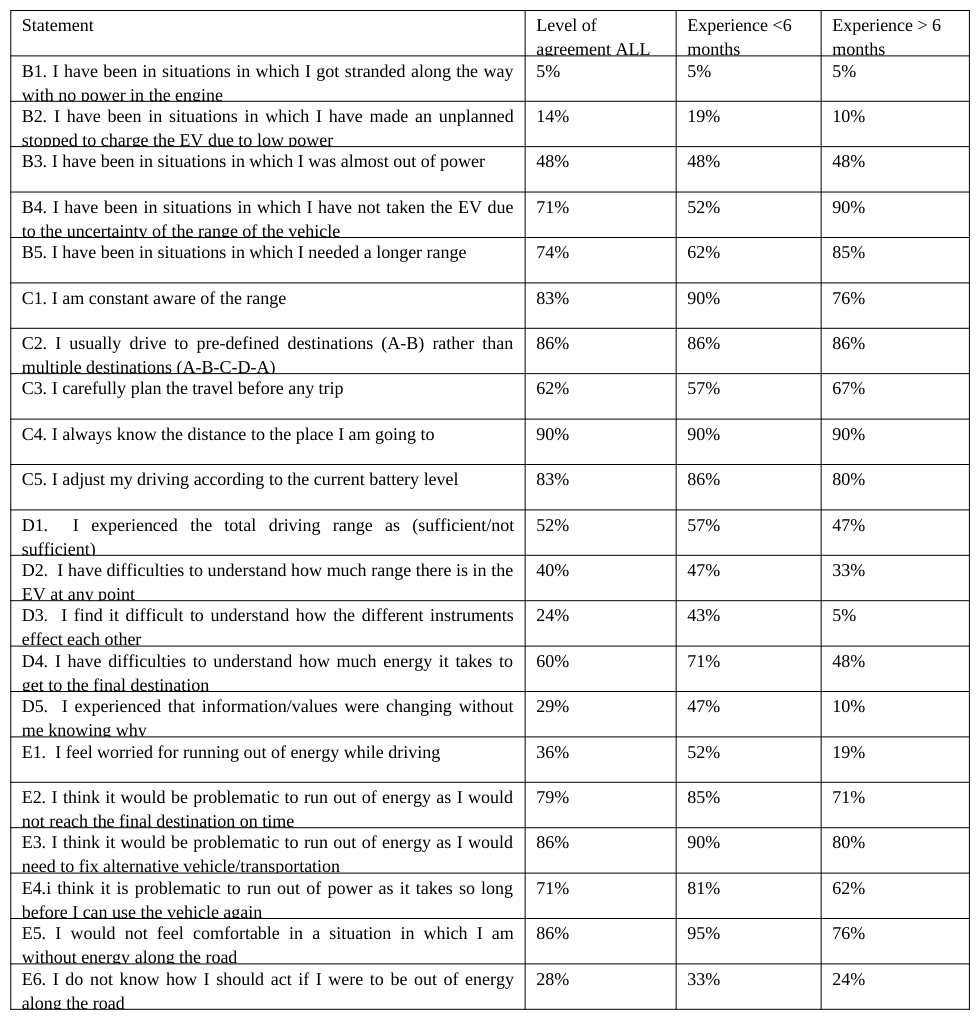
First of all, to investigate the factors influencing range anxiety the “level of agreement” has been calculated, and contrasted between the two groups. Table 3 list the different statements from the questionnaire and the level of agreement (i.e., respondents indicating 3 or higher on the likert scale). What can be seen in table 3 is that 13 of the 21 statements were indicated 3 or higher. This gives indication on what factors affect range anxiety. In particular, in Table 1 one can see that statements regarding driving style have a high agreement while statements of their psychological state have, generally a less high agreement level. The low agreement can be due to the fact that they did not experience range anxiety to a great extent.
Table 1. Statements and their level of agreement (percentage of respondents indicating 3 or higher on the Likert scale).
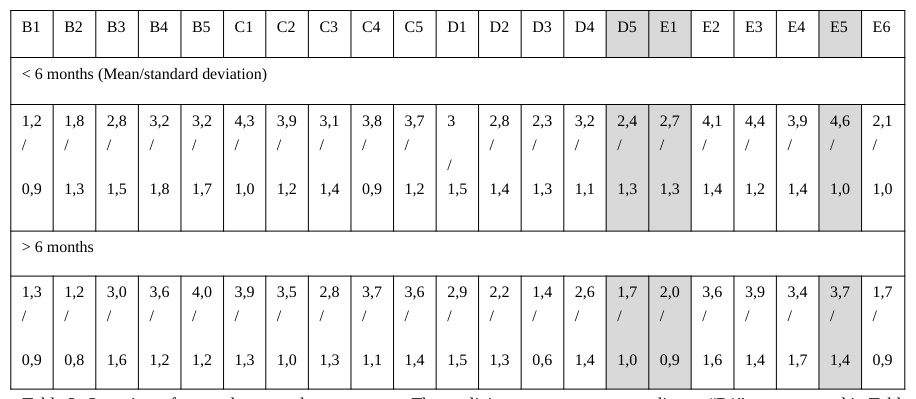
In the statistical analysis, the mean value from each question was compared between the two groups. As it can be seen in Table 2, statistical t-test reveals that three statements showed significant differences between the groups, with a probability of P=<0,05: D5. I experienced that the information changed without me knowing why [2,4 vs. 1,7] ; E1. I feel worried for being out of energy while driving [2,7 vs. 2,0]; E5. I would not feel comfortable in a situation without energy [4,6 vs. 3,7]. That is, significant differences in D5 show that participants that had less than 6 month experience thought that information changed to a higher degree without them knowing why, while those with more than 6 month experience knew why and how the information changed. This implies that there is a learning effect, dependent on level of experience. However, it should be noted that the mean value is on the lower end of the scale [2,4 vs. 1,7], indicating that they do not fully agree with the statement “I experienced that the information changed without me knowing why”. In addition, significant difference in E1 indicates that there is a difference in level of the range anxiety between the two groups. This imply that participants become more secure and confortable while driving EV. However, as similar to D5, the mean is on the lower range of the scale [2,7 vs. 2,0], indicating that the actual presence of range anxiety is low. Moreover, the significant differences in E5 shows that the participants experience that they would not feel confortable in a situation in which they are out of energy. The significant differences between the two groups show that the level of comfort changed along with the experience. Interestingly, there are no significant differences in statements regarding driving style or EV usage. This show that the driving style is, somewhat, stable and unaffected by experience.
Table 2. Overview of means between the two groups. The explicit statements corresponding to “B1” etc. are noted in Table 1.
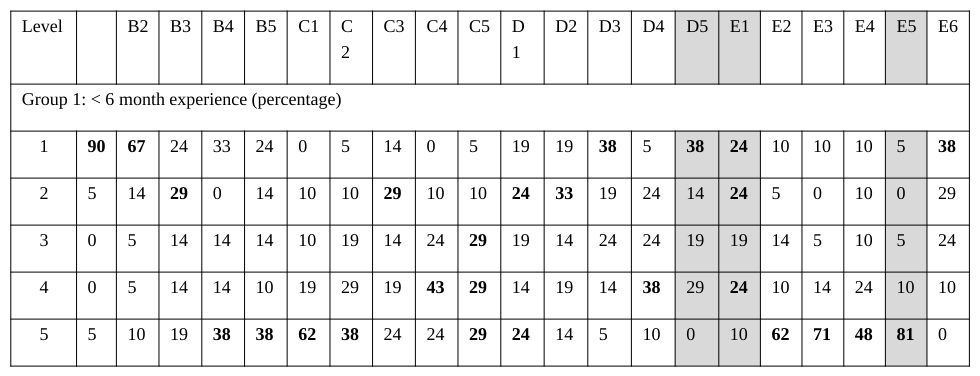
When considering the standard deviation (cf. Table 2), some of the results highlight large differences within the groups. Therefore, to provide a better understanding of the data, Table 3 presents the results in more detail by providing descriptive statistics in the form of the percentage of users for each level of the Likert scale for each group.
Table 3. Overview of data as divided between the two groups. Noted is the percentage of drivers indicating each of the levels 1 to 5.
CONCLUSIONS
Presented is the initial analysis of a questionnaire study investigating the effect of time and experience on range anxiety. The findings indicate that even though participants explicitly responded that they did not experience range anxiety, their responses to the driving style questions indicate that range anxiety, implicitly and unconsciously, exists and shapes their EV usage. Furthermore, there are indications that the respondents do not put themselves in a situation in which they may be out of power. The majority of the drivers had been in situations in which they chose not to take the EV due to its limited range. Likewise, a majority of the drivers had not been stranded or had had the need to make an unplanned stop because of limited energy. This is may explain why that the majority of the drivers did not experience range anxiety while driving, and further strengthen the fact that range anxiety is to some extent, unconscious. Indeed, statements regarding the explicit worry of range anxiety (e.g., “I feel concern of running out of energy while driving”) received a mean below three while statements regarding their driving style (e.g., “ I constant aware of range while driving; I typically driving to one destination) received a mean over three. This contradiction highlights the importance of investigation into the effect of range anxiety and the study of range anxiety as an unconscious phenomenon. The statistical analysis (T-test) shows that there was no significant difference in driving style (e.g., driving habits) between drivers who had more than 6-months experience and those who had less than 6-month experience. Indicating that experience does not affect driving style. However, one can assume, based on the results of the questionnaire, that there is a learning effect (experience effect) that affects (1) level of experienced range anxiety, (2) the level of comfort for situations with energy breakdown (i.e., getting stranded along the way due to limited energy), and (3) ability to understand changes in the EV’s instrumentations. Moreover, even though the majority of the respondents agreed that they would not feel comfortable in a situation in which they were out of energy, yet they felt certain of how to act in such situations.
To conclude, the results from the presented questionnaire study show that range anxiety is a complex phenomenon that may implicitly and unconsciously shape drivers EV usage. Also the results indicate that driving style does not change with level of experience.
ACKNOWLEDGEMENTS
This work was performed by Lindholmen Science Park, Sweden, within the ELVIRE project, supported by EU FP7 PROJECT ID: ICT-2009.6.1
REFERENCES
Botsford, C. & Szczepanek, A. (2009) “Fast Charging vs. Slow Charging: Pros and cons for the New Age of Electric Vehicles”.
EVS24 International Battery, Hybrid and Fuel Cell Electric Vehicle Symposium. Stavanger, Norway, May 13-16 Hidrue, M. K. Parsons, G., Kemton, W., Gardner, M. P (2011) Willingess to pay for electrical vehicles and their attributes” Resources and Energy Economics 33, pp. 686-705 Franke, T., Bühler, F., Cocron, P., Neumann, I., Krems, J. F. (2012a). “Enhancing sustainability of electric vehicles: A field study
approach to understanding user acceptance and behaviour”. In: Sullman, M., Dorn, L. (Eds.), Advances in Traffic Psychology. Ashgate, Farnham, UK, pp. 295-306. Franke, T., Cocron, P., Bühler, F., Neumann, I., Krems, J.F. (2012b). “Adapting to the range of an electric vehicle- the relation of experience to subjectively available mobility resources”. In: Valero Mora, P., Pace, J.F., Mendoza, L. (Eds.), Proceedings of the European Conference on Human Centred Design for Intelligent Transport Systems, Valencia, Spain, June 14-15 2012. Humanist Publications, Lyon, France, pp. 95-103. Franke, T., Krems, J.F. (2013). “Interacting with limited mobility resources: Psychological range levels in electric vehicle use”.
Transportation research part A: Policy and Practice 48, pp. 109-122. Lundström, A., (2012) “COPE1 – Incorporating Coping Strategies into the Electric Vehicle Information System”. 4th International Conference on Automotive User Interfaces and Interactive Vehicular Applications (AutomotiveUI '12), October 17–19, 2012, Portsmouth, NH, USA Luettringhaus, H., Nilsson, M. (2012) ”Elvire appraoches to mitigate EV driver´s range anxiety: technical paper by elvire-
european research project on ICT for electric vehicles”. In Proceedings of 19th ITS World Congress, Vienna, Austria, 22- 26 Oct, Paper Number: EU-00086 Morton, Schuitema and Anable (2011) “Electric vehicles: Will Consumers get Charged Up?” Technical document, Open University, Milton Keynes. In proceeding of: Universities' Transport Study Group Annual Meeting, At Milton Keynes. Available at: http://design.open.ac.uk/documents/Morton2011.pdf Nilsson, M (2011a) “Electric vehicles: the phenomenon of range anxiety”. Public deliverable Task (1300) the ELVIRE project.
Available at: http://www.elvire.eu/IMG/pdf/The_phenomenon_of_range_anxiety_ELVIRE.pdf [2014-01-25] Nilsson, M. (2011b) “Electric vehicles: An interview study investigating the phenomenon of range anxiety". Public deliverable Task (5000) ELVIRE project. Available at: http://www.elvire.eu/IMG/pdf/An_interview_studyinvestigating_the_phenomenon_of_range_anxiety_ELVIRE-2.pdf [2014-01-25] Nilsson, M., Habibovic. A. (2013) “Identifying EV driversʼ needs for information communication technology to ease the EV”. In
adjunct proceedings of 5th International Conference on Automotive User Interfaces and Interactive Vehicular Applications (Automotive UI´13), Eindhoven, the Netherlands, Oct 27-30. Pichelmann, S., Franke, T., Krems, J., F (2013). “The Timeframe of Adaptation to Electric Vehicle Range”. In M. Kurosu (Ed.), Human-Computer Interaction. Applications and Services, LNCS 8005 (pp. 612-620). Berlin, Germany: Springer. Taylor, D. (2009). The Differences and Similaritities between Plug-in Hybrid EVs and Battery EVs. 24th International Batteries,
Hybrid and Fuel Cell Electric Vehicle Symposium (EVS24), Stavanger Morton Wellings, T., Binnersley, J., Robertson, D., Khan, T (2011) “Human machine interfaces in low carbon vehicles: Market trends and user issues”. Dokument No. HMI 2.1. Low carbon vehicle technology project: workstream 13. Available at: http://www2.warwick.ac.uk/fac/sci/wmg/research/low_carbon/automotive/lcvtpevents/ ws13_hmi_in_lcvs_market_analysis_and_user_issues_v2_1.pdf [2014-01-25] Wynn, T & Leafeur, S. (2009) “A free market perspective on electrical vehicles”1. Technical Report, CascadePolicy Institute.
Available at: http://cascadepolicy.org/pdf/env/FMPonElecVehicles_100109a.pdf [2014-01-25]
LISTED IN THE AHFE DIGITAL BOOKSTORE CATALOGUE
Explore the complete digital volume
Advances in Human Aspects of Transportation: Part II
Read this individual research paper free through the original publisher, or explore the full digital proceedings book.
ISBN 978-1-4951-2098-5
Explore this ISBN in the AHFE Bookstore ↗Listed in the July 2026 bookstore catalogue; search by ISBN to confirm current availability · Digital book purchase optional