Gemma J. M. Reada, Paul M. Salmonb, Michael G. Lennéc, Elizabeth M. Greyd (2021). Evaluating Design Hypotheses for Rail Level Crossings: An Observational Study of Pedestrian and Cyclist Behavior. In: Advances in Human Aspects of Transportation: Part I. AHFE Open Access, vol. 15. https://doi.org/10.54941/ahfe100654
1 Human Factors Group, Accident Research Centre, Monash Injury Research Institute, Monash University, Victoria, Australia ↗
2 University of the Sunshine Coast Accident Research, University of the Sunshine Coast, Maroochydore, Queensland, Australia ↗
3 Human Factors Group, Accident Research Centre, Monash Injury Research Institute, Monash University, Victoria, Australia d Human Factors Team, Transport Safety Victoria, Melbourne, Victoria, Australia ↗
4 Human Factors Team, Transport Safety Victoria Melbourne, Victoria, Australia ↗
Accidents involving pedestrians at rail level crossings are a significant public safety concern in Australia and internationally. The current design of rail crossings incorporates assumptions and hypotheses about how people will interact with the infrastructure at the crossing. The hypotheses associated with the design of pedestrian rail crossings in metropolitan Melbourne were evaluated through the findings of naturalistic observations of users. Comparison of actual behavior as recorded in the observations was compared to the design hypotheses relating to the features at the crossing. While for some the majority of behavior was in line with the hypothesis, it was found that a number of the hypotheses were not always supported. The evaluation uncovered unexpected interactions between users and the infrastructure, as well as implications for rail crossing design. The findings support the need for a systems approach to the analysis and design of rail crossings from a pedestrian and cyclist safety perspective to assist understanding of the system and to inform its re-design.
Accidents at rail level crossings, including those involving pedestrians, are a significant public safety concern in Australia and internationally. In a 10 year period between 2002 and 2012, 92 pedestrians were struck by trains at rail level crossings in Australia . In Victoria, such collisions resulted in 18 fatalities and 5 serious injuries between 2008 and 2012 .
Rail crossings are complex sociotechnical systems. That is, they involve the interaction of social and technical components such as road users, vehicles (road and rail), equipment and infrastructure. The interactions can be diverse and random, particularly due to the openness of the system with no barriers to system entry in place for many road users including pedestrians and cyclists. There is no licensing, training or significant supervision of these users.
To understand and improve the performance of complex systems, the application of systems analysis and design methods is required. Cognitive work analysis (CWA) is a framework of methods that can be used to understand Human Aspects of Transportation I (2021) https://openaccess.cms-conferences.org/#/publications/book/978-1-4951-2097-8 complex systems . In contrast to most other tools for understanding human behavior which specify how behavior should be (normative approaches) or how behavior is (descriptive approaches), CWA takes a formative approach by specifying the constraints of the system within which behavior can occur.
In metropolitan Melbourne, equipment and infrastructure at rail level crossings are designed in one of three ways. The first type of design provides an alert to the user that a rail crossing is present and the user needs to make a decision whether or not to cross (known as passive warnings). The second type provides an alert that a train is approaching (through active warnings such as flashing lights or bells), while the third type provides a physical barrier intended to prevent road users accessing the crossing while a train is approaching and traversing the crossing (active warnings such as pedestrian gates and boom barriers, and road boom barriers). The latter types of risk controls are generally considered to be the most effective in minimizing collisions, at least for road vehicles . However, even with the widespread use of physical barriers, collisions still occur.
Woods explains that designs represent designers’ hypotheses about the relationship between technology and human cognition. It is suggested that the current design of rail crossings from a pedestrian safety perspective has taken a normative approach. That is, the current designs are based upon a series of pre-defined tasks required for pedestrians to cross safely. For example, at active crossings pedestrians are expected to search for and detect warnings, to stop in a particular place when warnings are detected, to wait until warnings are deactivated, and then to complete crossing). It is further suggested that the hypotheses associated with behavior at rail crossings can be evaluated through naturalistic observations of users at pedestrian rail crossings.
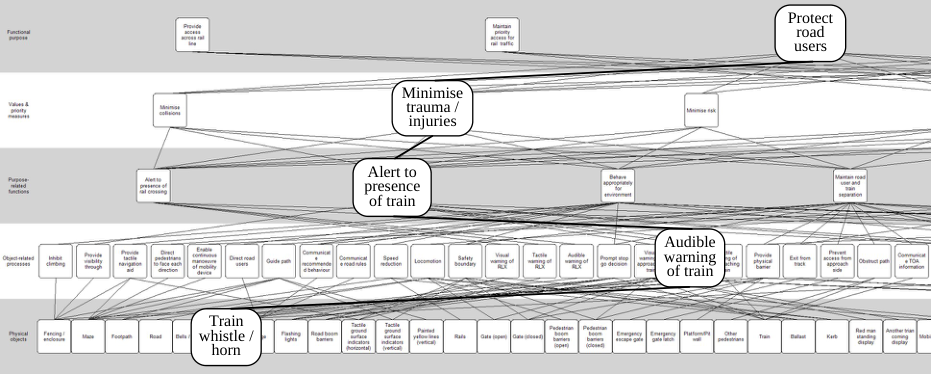
RAIL LEVEL CROSSINGS - DOMAIN DESCRIPTION To better understand the rail level crossing system, an abstraction hierarchy from the work domain analysis phase of CWA was developed (Figure 1). An abstraction hierarchy provides a functional view of a sociotechnical system, encompassing five levels of abstraction, with means-ends links between nodes at adjacent levels. It describes the constraints of the work domain within which behavior is possible. The representation identifies the physical resources available within the system (e.g. flashing lights), the processes afforded by those resources (e.g. provide visual warning of approaching train), the functions supported by the processes (e.g. alert road user to presence of train), the values and priorities that are measured and monitored within the system (e.g. minimize collisions), and finally, the overall purposes of the goal-directed work domain (e.g. protect road and rail users).
The abstraction hierarchy presented in Figure 1 considers rail crossings from perspective of improving pedestrian safety. However, the analysis also includes aspects of the system that may be designed for other road users (i.e. motorists) such as boom barriers, which can also provide cues for pedestrians, even if not intended. Further, cyclists are able to use a pedestrian crossing and therefore their behavior needs to be considered.
Figure 1 displays one chain of means-ends links showing relationships within the abstraction hierarchy. Starting from the bottom level of the hierarchy, the physical object highlighted is the train whistle / horn. This object provides an audible warning of an approaching train, which supports the system function of alert to presence of train. The ability of the system to achieve the function of alert to presence of train can be measured through its success in minimizing trauma and injuries, which relates to one of the functional purposes of the system: to protect road users.
Human Aspects of Transportation I (2021) https://openaccess.cms-conferences.org/#/publications/book/978-1-4951-2097-8
Protect road users
Minimise trauma / injuries
Alert to presence of train
Audible warning of train
Train whistle / horn
Figure 1: Extract from work domain analysis The relationships in the abstraction hierarchy were identified through documentation review (i.e. statements found in engineering standards and legislation relating to pedestrian rail crossings) as well as input from subject matter experts. Thus the relationships documented are those intended by system designers.
The means-ends links between the bottom two levels of the abstraction hierarchy, the physical objects and object- related processes, are of particular interest to the study discussed in this paper. The object-related processes identify the affordances of the physical objects.
The notion of affordances was originally proposed by Gibson , who defined them as properties of the environment that provide opportunities or possibilities for action. The notion comes from the field of ecological psychology. This field suggests that analysis should begin by understanding the environment for behavior, rather than cognitive processes associated with the detection and processing of stimuli.
Affordances are actor-dependent meaning that what can be done to some extent depends on the actor’s (i.e. pedestrian’s or cyclist’s) capabilities such as their height or strength. What an object affords for an adult may be different to what it affords for a child. Similarly, what an object affords for a pedestrian may be different to what it affords for a cyclist. However, an affordance is a stable property of the object, and doesn’t need to be realized by an actor to exist. An affordance exists independently of the actor and their motivation at that point in time. It is also important to note that affordances do not cause behavior; they just provide a means for it to occur .
DESIGN HYPOTHESES Designers are comparable to experimenters. During the design process, they develop hypotheses (explicitly or implicitly) about what the impact of the designed object will be on human behaviour and the system. These hypotheses are tested during the design process. Once implemented, however, the objects become part of the system and consequently affect the system which itself is dynamic and evolves over time in response to various pressures. Accordingly, it is valuable to periodically re-evaluate the extent to which the hypothesized effect remains valid over time, particularly in complex systems such as rail level crossings.
The hypotheses underlying the design of infrastructure and warnings intending to influence pedestrian behavior at rail crossings were identified based on the affordances defined in the abstraction hierarchy as well as a further review of the road rules and design standards and documentation. The standards reviewed included the Australian Standard for Traffic Control Devices at Railway Level Crossings (AS1742.7) and the Victorian Rail Industry Group Criteria for Infrastructure at Railway Level Crossings (VRIOGS 003-2-2006). The legislation outlining the offences applicable to behavior at rail crossings included the Road Safety Road Rules 2009 (VIC) and the Transport (Conduct) Regulations 2005 (VIC).
Design hypotheses for each physical object were determined. For example, for the automatic gate (when closed) the design hypothesis was determined to be that: Pedestrians will stop at the gate when it is closing, closed or opening.
Human Aspects of Transportation I (2021) https://openaccess.cms-conferences.org/#/publications/book/978-1-4951-2097-8
This reflects both the physical barrier affordance that a gate provides (stopping pedestrians when it is closed) as well as the legislated rules for crossing which make it an offence for a pedestrian to cross at a rail crossing if ‘a gate, boom or barrier at the crossing is closed or is opening or closing’ (Road Safety Road Rules 2009 (VIC) s 235(2) (b)). Additional design hypotheses identified are presented later in this paper.
The hypotheses represent the normative behavior expected by the designers of the technology and the wider system (e.g. the legislature). The affordances incorporated within the abstraction hierarchy are related to these hypotheses, as it is proposed that users will perceive and act upon the intended affordances of the design.
The aim of this paper is to evaluate the design hypotheses against observations of actual behavior at rail crossings in metropolitan Melbourne. In addition to evaluating the hypotheses, the paper identifies additional, unintended affordances of technology at rail crossings and discusses implications for the abstraction hierarchy and for rail crossing design generally.
METHODOLOGY FOR OBSERVATIONAL STUDY Site selection
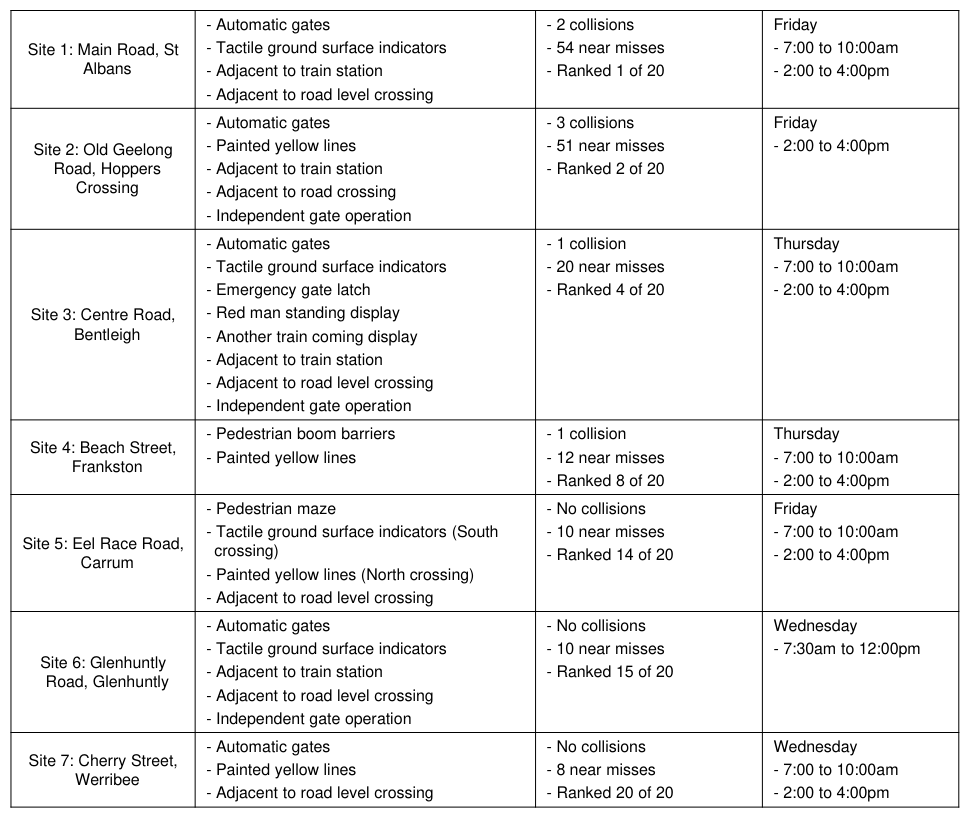
Seven rail level crossing sites located in metropolitan Melbourne were selected for the conduct of covert observations of user behavior. The sites were selected based on the features of the crossing (e.g. infrastructure, equipment, warnings present) as well as incident history. The features of each site are described in Table 1. The site selection process ensured that a range of crossing features were represented across the sites including automatic gates, automatic gates with locked emergency gates, pedestrian boom barriers, pedestrian mazes, crossings adjacent to stations and crossings adjacent to road level crossings (exposing pedestrians to features such as flashing lights and road boom barriers, etc.). Some crossings incorporated tactile ground surface indicators to define the edges of the pedestrian path (areas of raised studs or bars used to provide a tactile cue to pedestrians with visual impairments). Other crossings had painted yellow lines to define the edges of the path.
Where the site is documented in Table 1 as incorporating the feature of independent gate operation this means that the crossing has been designed to have two independently operating sets of gates on each side of an adjacent train station with an island or center platform. These crossings are all adjacent to a single road rail crossing. The gate design enables users to access the island platform when a train is approaching from the far track (i.e. a track that they need not cross to reach the train station). Users who wish to traverse the whole crossing will be able to cross the first track/s, but will then wait in the center of the tracks at a closed gate until the train on the far side has departed. At these crossing the gate remaining open for users to traverse the crossing is the only indication that the train is not approaching on that track (i.e. bells, flashing lights, road boom barriers, etc. will operate for the adjacent road crossing).
The crossing at Site 3 has additional countermeasures implemented including a latch on the emergency gate to stop pedestrians being able to open the gate from the approach side of the crossing, a red man standing display (similar to a road pedestrian signal however instead of showing green it extinguishes when no train is approaching), and an another train coming display (to inform waiting pedestrians that the gates remain closed because another train is approaching). Previous investigations have indicated that the another train coming display and red man standing display may not provide additional benefits in influencing behaviour where a locked emergency gate is provided .
As well as identifying the features of each site, Table 1 also displays the recent incident history for each site (taken from chart titled Top 20 Crossings by Pedestrian-only Incidents 2005 to 2013, provided by G. Sheppard, personal communication, May 10, 2013). All sites were within the top 20 list which are ranked according to the total number of incidents (collisions and near misses).
Observations were held on weekdays and were planned to occur in the mornings and early afternoon. At some locations the planned observations were unable to be undertaken due to operational requirements restricting access to some rail signal boxes and other unforeseen events. The actual observation times are provided in Table 1.
Table 1: Observation sites and times
Observation protocol Approval for the research was obtained from the Monash University Human Research Ethics Committee. The observations were conducted in a covert manner to avoid influencing the behavior of crossing users. Observations were undertaken from signal boxes with windows overlooking crossings, or from a vehicle parked close to the crossing. Users to be observed were selected using a convenience sampling method. Due to the unpredictable flow of users through the crossing it was thought to be overly restrictive to limit the observations by using a random process of, for example, selecting one in five users that approached the crossing.
The protocol required that the user should be selected when approaching the crossing, but not yet on the crossing. The person was then observed while they crossed and until they exited the crossing and moved away from the area. Where a group of people were approaching the crossing, one person in the group was selected to observe, with the effect of other pedestrians on their behavior documented. In addition to pedestrians, cyclists who chose to use designated pedestrian crossing were observed.
A structured form was developed for recording behavior. A paper-based form was completed for each user observed at the crossing. The form required recording of the following items:
Date and time of the observation.
The system state encountered by the user (e.g. check box for: warnings not activated, warnings activated as Human Aspects of Transportation I (2021) https://openaccess.cms-conferences.org/#/publications/book/978-1-4951-2097-8 the user approached, warnings activated as traversing crossing, etc.).
The behavior of the user in relation to each physical object present (e.g. for Fencing / enclosure – check box if the user: looked through, jumped over, leaned on, walked within, walked around, other [with free text to specify the behavior]).
A description of the path taken by the user and their behavior, including information about the person if it affected their behavior, such as a mobility impairment (free text description).
A representation of the user’s path through the rail level crossing, including the starting point and destination, overlaid on an aerial view of the crossing.
An independent rater received training on the observation protocol and data collection form. The independent rater was a highly experienced Human Factors professional, whose qualifications included a Masters in Applied Psychology. The training involved review of the observation protocol document and data collection form. The training also encompassed the use of photographs of pedestrians using different types of crossings to prompt discussion of how the behavior would be coded using the coding form. Any disagreements between raters were resolved prior to the observations being undertaken.
RESULTS
Inter-rater reliability The independent rater concurrently documented the behavior of users during three hours (approx. 10% of total observation time) at the first observation site. Ratings of 28 rail pedestrian crossing users were gathered during that period. Inter-rater reliability calculations were performed on two aspects of the observations for each of the 28 users observed: the classification of the system state and the classification of behavior in relation to each physical object present. Between the raters there were 1264 agreements (e.g. both raters recorded that the user walked within the fencing / enclosure or both raters did not check the box that the user walked within the fencing / enclosure) and 93 disagreements (e.g. one rater recorded that the user walked within the fencing / enclosure however the other rater did not check this box). The calculations took into account where the physical object was not present during the observation providing no opportunity for behavior in relation to the object. Where an object was not present it was excluded from the analysis (i.e. was not counted as an agreement nor disagreement). The percentage agreement score was 93.15. Once this satisfactory level of inter-rater agreement was obtained, the remaining observations were conducted by a single rater alone.
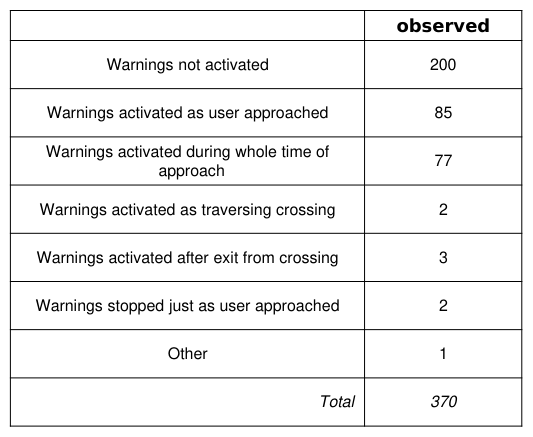
System state during observations In total, 370 crossing users (333 pedestrians and 37 cyclists) were observed over approximately 30 hours of observations at the seven sites. The majority of observations occurred while warnings were not activated (see Table 2). A number of observations involved the warnings becoming activated as the user approached, or situations where the warnings were activated during the whole time of the user’s approach (i.e. the warnings were activated at the time the observer first detected the user). The term ‘warnings’ included any technology at the crossing designed to inform users of the presence of a train and included bells, gates, flashing lights and boom barriers (even where these were only present at an adjacent road crossing).
System state No of users Human Aspects of Transportation I (2021) https://openaccess.cms-conferences.org/#/publications/book/978-1-4951-2097-8 observed
Table 2: System states during observations
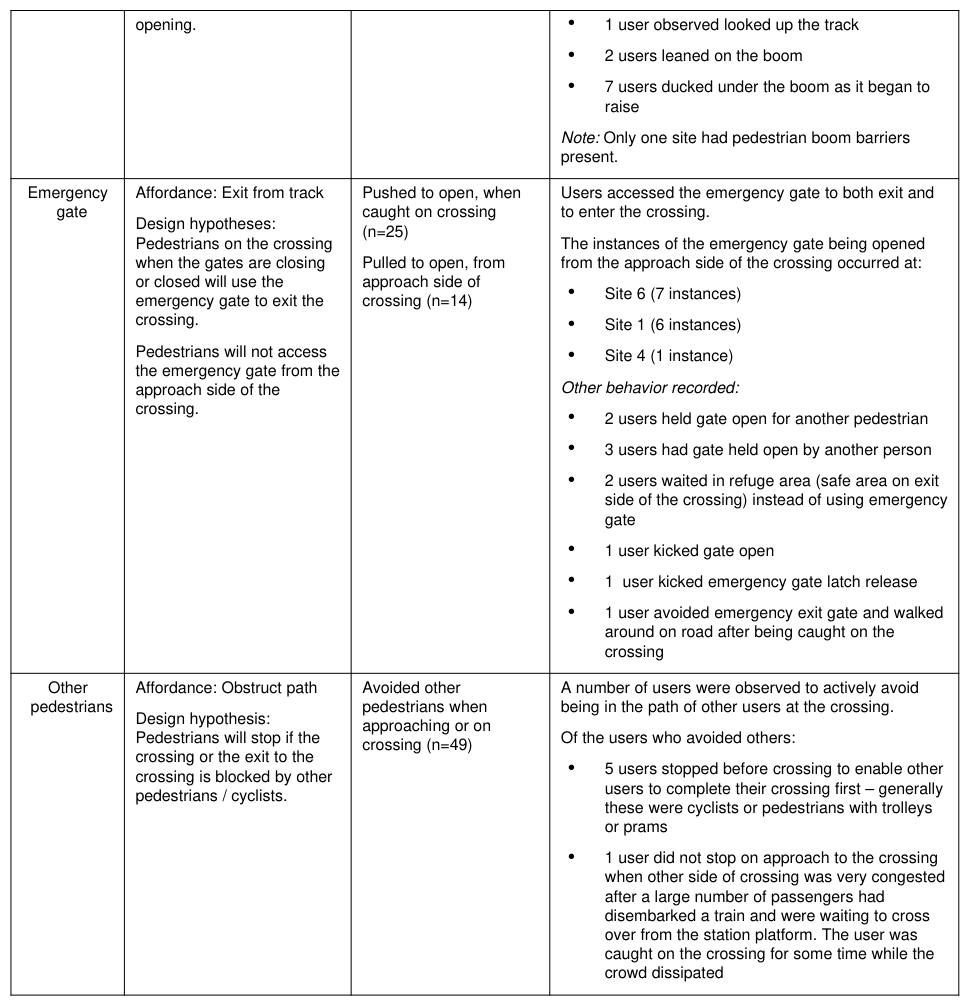
Evaluation of design hypotheses Due to space restrictions only the key design hypothesis for selected physical objects are displayed in Table 3. Those selected include those with the most interesting findings and where the hypothesis related to behavior was conducive to observation. For example, road boom barriers and flashing lights may have influenced behavior however the observer was generally unable to determine whether the user looked at or noticed these warnings.
The observed behavior documented in Table 3 was recorded where the user did this for at least part of the crossing. That is, a user may have walked within the fencing on approaching and entering the crossing and would be counted under walked within fencing for this behavior. However, if they then diverted their path while on the crossing and walked around the fencing onto the road then the same user would also be counted under walked around fencing.
Table 3 further provides some commentary evaluating the design hypothesis, as well as documenting other behavior recorded and any notes to assist interpretation.
Human Aspects of Transportation I (2021) https://openaccess.cms-conferences.org/#/publications/book/978-1-4951-2097-8
Table 3: Evaluation of the design hypotheses for selected physical objects, based upon observed behavior
Comparison of actual behavior as recorded in the observations was compared to the design hypotheses relating to the technology or infrastructure at the crossing. While for some the majority of behavior was in line with the hypothesis, it was found that a number of the hypotheses were not always supported and a range of other alternative behaviors were supported. For example, while most users traversed the crossing within the enclosure and fences provided, and walked within the path outlined by tactile ground surface indicators and painted lines, a number were observed to move outside of this defined path. Further, some pedestrians avoided the pedestrian crossing facilities altogether and crossed at the road instead.
In relation to the bells intended to provide an auditory warning of the approach of a train, it was interesting that a considerable number of users increased their speed when the bells began to sound. This outcome is the opposite of the design hypothesis that the user will stop when the auditory warning is present. The bells are the first warning and there are a number of seconds between their onset and the closing of the pedestrian gates. Pedestrians may determine Human Aspects of Transportation I (2021) https://openaccess.cms-conferences.org/#/publications/book/978-1-4951-2097-8 that if they increase their speed they will be able to cross before the gates close. Further, at train stations, the onset of the bells may suggest to user that their train is approaching, motivating them to increase their speed and reach the station before the train.
The cyclist dismount sign was another physical object that appeared to fail to achieve its design intention. While the sign was present at all locations, 37 cyclists did not dismount and only four were observed to dismount. The sign does not reflect a legal requirement and there is no explicit offence prohibiting cyclists from riding through a pedestrian rail crossing. However, it is an offence in Victoria for a person aged over 12 years to ride a bicycle on a footpath unless they are accompanying a person 12 years or younger. Cyclists appeared to use the pedestrian facilities more often where the site incorporated a busy road with no separate cycling facilities on the road. The number of cyclists using the pedestrian facilities was an unexpected finding that has implications for pedestrian and cyclist safety at rail crossings.
While most users stopped at closed gates or pedestrian boom barriers, there were users who went around them either to cross at the road or to access the crossing through an emergency gate. The gates and barriers are intended to provide a safety boundary or safety zone for users and using the emergency gate or road to access the crossing would be considered the most undesirable behavior from the perspective of the designers of the technology. The gate latch added to the emergency gate at Site 3 is intended to prevent access to the crossing from the approach side of the emergency gate. No users were observed using the emergency gate to access the crossing at that location. However, three pedestrians were observed to avoid the pedestrian facilities and cross at the road crossing with the warnings beginning to activate while they were on the road.
In addition to identifying behavior relating to the design hypotheses, behaviors relating to unintended or unexpected affordances were recorded. For example, it was noted that fences, gates and pedestrian boom barriers afforded leaning on. In many cases this involved pedestrians resting their arms on the gate or boom barrier while watching the train approach and pass. There is no obvious negative impact of the use of this affordance, however it may indicate that users have a need or preference for comfort while they are waiting. The waiting period can be quite lengthy at some crossings when multiple trains cross and waiting facilities are an aspect of design that appears to have been overlooked.
Other affordances were related to attempts to engage with and physically control the barriers. For example, pedestrians were observed to push gates and lift pedestrian booms while they were opening and closing. Many pedestrians who had waited at a boom barrier ducked under the boom as it was rising in order to begin crossing as soon as possible. In some cases there was obvious time pressure involved such as where the pedestrian subsequently ran across the track and to the station to catch an approaching train. However, this was not the case for all users. The use of these affordances may suggest the need for a sense of agency, a feeling of control over one’s own actions. Humans prefer to be in control of their actions and their surroundings and may be frustrated by a design that restricts their path and is then slow to open the path again when it is then safe to continue. The need for agency may also explain why some users choose to cross by accessing the emergency gate or road, rather than waiting for a barrier to open. Further, a considerable number of pedestrians looked up and down the track when they heard the bells sound or when approaching the crossing with no warnings activated. This reinforces that rail crossing users are not passive beings waiting for a warning or barrier to intervene to keep them safe. They are motivated to understand their surroundings and to make decisions about the appropriate way to respond to the situation. An implication for design might be to increase agency, or at the least a sense of agency, at rail crossings.
Two of the unexpected affordances had positive effects in terms of safety. Firstly, a person using a wheelchair was observed to veer to one side of the path while crossing the tracks (believed to be due to the cross-fall of the path at that location) but the wheels of the wheelchair stopped when they reached the raised tactile ground surface indicators at the edge of the path. This object stopped the wheelchair from moving off the path and onto the ballast and rails which would have placed the user in a dangerous situation if a train began to approach. The second example was the observation at the crossing incorporating a pedestrian maze that of the three cyclists who approached the crossing, one dismounted just before reaching the maze, one dismounted after having difficulty attempting the second turn within the maze, and one rode very slowly through the maze. It is suggested that the design of the maze may be difficult for cyclists to negotiate, requiring a slow speed which affects the ability to keep the bicycle upright. Thus, assuming there are safety benefits to separating pedestrians and cyclists at pedestrian rail crossings, the use of mazes more widely may be useful for discouraging cyclists riding through the crossing.
A final group of affordances uncovered by the observations related to other users at the crossing. The affordances Human Aspects of Transportation I (2021) https://openaccess.cms-conferences.org/#/publications/book/978-1-4951-2097-8 can be divided into three types :
Competition - e.g. users overtaking others to improve their chances of crossing before gates closed, users pushing through crowds approaching in the opposite direction, etc.
Communication - e.g. users speaking to one another while crossing, stopping on crossing to greet other users, pointing at approaching trains to show another user the train is approaching, using body language and movement to determine others’ intentions, etc.
Cooperation - e.g. pedestrians holding gates open for one another, pulling others back from stepping out, giving way to others, assisting others to work steadily, etc.
Interestingly, the role of other users at the crossing is something that has not received much attention in the design of rail crossings to date. However, as a socio-technical system, the social aspects involving are very important for the success of the system in meeting its purposes. An interesting future line of inquiry regards whether or not the three affordances above have positive or negative effects on safety and performance. For example, does competition reduce pedestrians’ awareness of the approaching train and the risk of being hit? Similarly, does communication have a positive or negative safety effect in that it can both prevent and encourage pedestrians from engaging in actions that put them at risk?
CONCLUSIONS
The aim of this study was to consider the intended or designed-for affordances of rail level crossings from the perspective of pedestrians and cyclists using the crossing and the related hypotheses held by designers of crossings, as inferred by reference to design standards. Evaluating the hypotheses using data gathered from actual behavior at rail crossings has shown that they are not always supported in practice and that other affordances, both positive and negative with respect to safety, are created. While this finding was not unexpected, the process of observation and evaluation has uncovered unexpected affordances as well as implications for rail crossing design.
The findings also have implications for the abstraction hierarchy presented in the introduction. While they provide evidence for the affordances between the physical objects and object-related processes in the abstraction hierarchy, they also suggest additional affordances uncovered by this analysis. The abstraction hierarchy will be revised in light of this evidence.
It should be noted that while the observations were based on a convenience sample and observation times were not equal across all sites, the intention of the research was to record the range of behavior, rather than to compare sites or compare the behavior of individuals. The numbers provided in Table 3 are only intended to provide an indication of the extent of the behavior within the sample.
The design philosophy behind the current rail crossing system is normative and does not acknowledge the normal performance variability occurring within the system. It is assumed that users will use the affordances intended by designers and to follow the rules set by the legislature. The philosophy appears to be that if people would just comply with the rules then there would be no accidents. However, the observations show that there is significant variability in human behavior, regardless of constraints and rules. Modern safety science has moved away from rule- based systems and now acknowledges the need to recognize emergence and performance variability and to support flexibility in the means for attaining goals. In line with Wilson , this study has identified emergent properties of the rail crossing system that are dysfunctional (i.e. the use of emergency gates to access the crossing), that are functional (i.e. the tactile indicators preventing wheeled objects from exiting the path) and that represent positive new system uses (i.e. the use of the fences, gates and barriers for leaning on). The findings suggest that safety at rail level crossings will be better achieved through recognizing that humans are the glue that hold complex sociotechnical systems together. Accordingly, rail level crossing designs should recognize the adaptive capacity of humans and strive to support appropriate performance variability and emergence.
Accidents at rail level crossings have shown themselves to be ‘wicked problems’. Such problems cannot be solved through the application of existing approaches . The observations described in this paper are an early step towards gathering data, within a larger research program, that aims to inform design changes to promote pedestrian safety at rail crossings, taking into account the complexities of the system. The systems approach is relatively new to the road Human Aspects of Transportation I (2021) https://openaccess.cms-conferences.org/#/publications/book/978-1-4951-2097-8 and rail domains and research methods to more fully understand the complex rail level crossing system are only now beginning to be applied. Accordingly, designers and policy makers have not had access to findings from systems- based research to inform their practice. It is hoped that the use of systems-based methodologies can assist designers to create innovation designs that minimize accidents while still supporting the other purposes of the system.
ACKNOWLEDGEMENTS
Gemma Read’s contribution to this article was funded through an Australian Postgraduate Award (Industry) provided by an Australian Research Council Linkage Grant (ARC, LP100200387) to Monash University in partnership with the University of Sunshine Coast and the University of Southampton, and the following partner organizations: the Victorian Rail Track Corporation, Transport Safety Victoria, Public Transport Victoria, Transport Accident Commission, Roads Corporation (VicRoads) and V/Line Passenger Pty Ltd. Dr Paul Salmon’s contribution to this article was funded through an Australian National Health and Medical Research Council post doctoral training fellowship.
REFERENCES
Australian Transport Safety Bureau. (2012). Australian rail safety occurrence data: 1 July 2002 to 30 June 2012. Canberra: Australian Transport Safety Bureau. Gibson, J. J. (1979). The ecological approach to visual perception. Hillsdale, NJ: Erlbaum. Rittel, H. W. J., & Webber, M. M. (1973). Dilemmas in a general theory of planning. Policy Sciences, 4, 155-169. Transport Safety Victoria. (2013). 2012 Annual incident statistics - Heavy rail. Melbourne, Victoria: Transport Safety Victoria. Vicente, K. J. (1999). Cognitive Work Analysis: Toward Safe, Productive, and Healthy Computer-Based Work. Mahwah, NJ:
Lawrence Erlbaum Associates. Warwick, J. (2009). Active pedestrian crossings controls and technology. Paper presented at the IRSE Technical Convention, Melbourne. Wigglesworth, E. C., & Uber, C. B. (1991). An evaluation of the railway level crossing boom barrier program in Victoria,
Australia. Journal of Safety Research, 22(3), 133-140. Wilson, J. R. (2014). Fundamentals of systems ergonomics/human factors. Applied Ergonomics, 45, 5-13. Withagen, R., de Poel, H. J., Araújo, D., & Pepping, G.-J. (2012). Affordances can invite behavior: Reconsidering the relationship between affordances and agency. New Ideas in Psychology, 30(2), 250-258. Woods, D. D. (1998). Designs are hypotheses about how artifacts shape cognition and collaboration. Ergonomics, 41, 168-173.
Human Aspects of Transportation I (2021) https://openaccess.cms-conferences.org/#/publications/book/978-1-4951-2097-8
LISTED IN THE AHFE DIGITAL BOOKSTORE CATALOGUE
Explore the complete digital volume
Advances in Human Aspects of Transportation: Part I
Read this individual research paper free through the original publisher, or explore the full digital proceedings book.
ISBN 978-1-4951-2097-8
Explore this ISBN in the AHFE Bookstore ↗Listed in the July 2026 bookstore catalogue; search by ISBN to confirm current availability · Digital book purchase optional