Sue Hignett, Elaine Goodwin, Laurie Wolf (2021). Integrated Patient Risk Assessment: Moving & Handling, Falls, Pressure Ulcers, Continence, Dementia. In: Advances in Human Aspects of Healthcare. AHFE Open Access, vol. 13. https://doi.org/10.54941/ahfe100478
This paper reports the development stages of an integrated patient risk assessment summary. The aim was to simplify the recording of assessment data and support communication of bedside information within the multi-disciplinary team. It is part of a larger study using human factors/ergonomics to manage the risk and associated injuries of in-patient falls. The previous documentation required staff to complete the appropriate sections of a 20 page adult admission risk assessment which was both complex and included duplication; thematic analysis identified that mobility and range of movement were recorded 17 times. Two workshops were held with subject matter experts (mobility, tissue viability, medication, falls) and medical ward staff. An iterative review process was used to identify, augment, reject and categorize themes and finally prioritize 7 topics for medical condition, confusion, mobility, fall history, skin condition, assistance needed to swallow/eat/drink and continence. There was also an alert box with information on allergies, infection control and communication (hearing and vision).
Slips, trips and falls continue to be one of the most frequent adverse incidents for acute hospital inpatients. Risk assessment and pre/post fall communication are established steps in falls risk management (Hignett, 2010). In the UK national guidance (NICE, 2013) has advised that hospitals should ‘not use fall risk prediction tools to predict inpatients’ risk of falling in hospital’; and should regard all patients aged 65 years and older to be at risk of falling. As part of a human factors/ergonomics (HFE) approach to understand and reduce the risk factors for falls, an HFE systems model has been developed to include patients as voluntary, transient members (Hignett et al, 2013a). A series of audits have been carried out to explore the patient contributing factors by looking at the location of falls (Hignett et al, 2010), bedrail use (Hignett et al, 2013b) and patient engagement in falls risk management (Hignett et al, 2013c).
Although not a primary objective during the audits, it was observed and reported that the nursing risk assessment documentation was lengthy (20 pages), complex, and included multiple duplication (e.g. collecting mobility data in several sections). The complexity of nursing documentation has been commented on by a number of authors (for example, Cheevakasemsook et al, 2006) who described the (sometimes) competing requirements for documentation as a communication tool for care (continuity and quality) and a legal record of the process and outcomes of care, often with multiple repetitions for recording data. Pronovost et al (2012) also identified the lack of harmonization of risk management interventions within care; ‘each harm type has its own checklist that includes multiple recommended care practices, and some practices occur multiple times a day, adding scores of interventions. However, these checklists have not been collated and integrated into a care plan or daily workflow to reliably ensure delivery of the practices’.
For falls risks the scope of assessment factors has included cognitive impairment, continence problems, falls history (including injury and fear of falling), missing or unsuitable footwear, environmental and equipment/furniture design, health problems that may increase the risk of falling, medication, postural instability, mobility and/or balance problems, syncope syndrome and visual impairment (NICE, 2013). Many of these factors are also included in assessment tools for moving and handling (Fray and Hignett, 2013), tissue viability / pressure ulcers (Balzer et al, 2013), and continence (Flanagan et al, 2013).
This paper reports the outputs of 2 workshops to develop an integrated adult admission risk assessment summary to reduce complexity and encourage multi-disciplinary communication.
METHOD
The first stage reviewed the adult admission risk assessment documentation in NVivo10 to thematically explore and quantify duplication. These data were then presented to staff at 2 workshops as the ‘Current State’ review (Fig. 1). The data from the workshops were recorded by field notes and photographs and imported into NVivo10 for thematic analysis.
Figure 1 Review stages
Participants The first workshop invited clinical participants who were key stakeholders (subject matter experts, SME) in developing the current adult admission risk assessment documentation. 10 participant specialists attended with expertise in Back Care (safer moving and handling), Falls, Clinical Governance, Mobility assessment (Physiotherapy), Tissue Viability, Medication (Pharmacy) and Discharge (Intermediate Care / Community). They represented a cumulative work experience at this hospital of 211 years (average 21.1 years, range 7 years – 40 years).
The second workshop invited nursing staff from medical wards as adult admission risk assessment documentation users. 8 participants attended from Medical Admissions, General Medicine, Short Stay, Stroke Rehabilitation, Care of the Elderly, Respiratory, Renal, Acute Stroke. They were all registered nurses with a cumulative work experience at this hospital of 95 years (average. 13.6 years, range 3.5 years to 23 years).
RESULTS
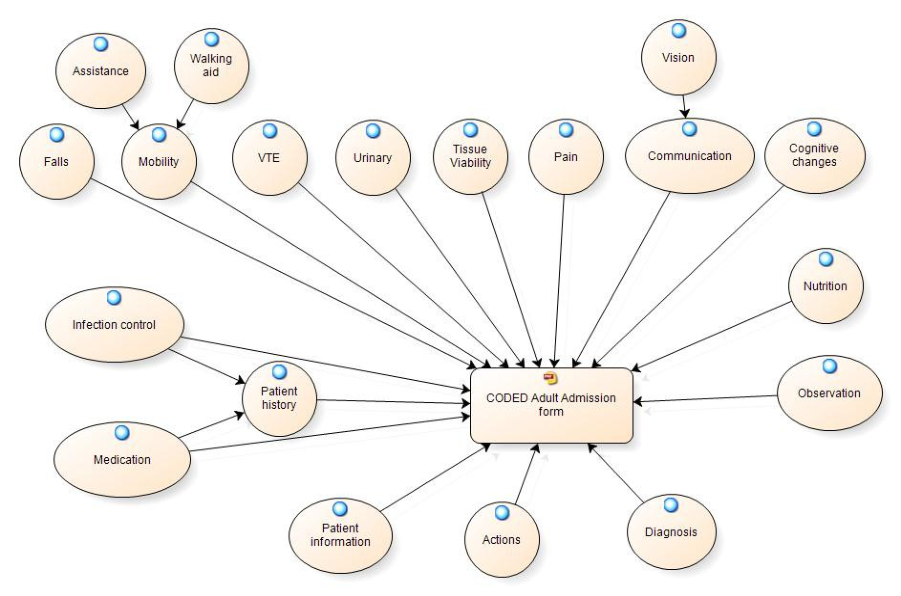
Thematic analysis of assessment documentation The assessment documents were scanned into NVivo10 and thematically coded (figure 2) for the type and frequency of duplication. The most repeated assessments were for mobility and range of movement (n=17), continence (n=8) and ability to self-care (n=8). These were followed by repeated assessment question about cognitive changes (n=6), falls (n=6), medication information (n=5) and pain (n=4).
Workshop 1 The 10 participants suggested 35 questions (topics) that they would like to ask patients in an [risk] assessment. These were then reviewed, discussed and prioritized using iterative voting.
10 or more votes: history of falls (16 votes); normal mobility state (13 votes); do you need assistance to move (11 votes); dependent / independent / self-care or supplemented (9 votes).
5 votes: fear of falling; patient perception of cause of falls; expectations; pain; normal continence state (toilet / pads); previous falls service input.
4 votes: foot wear; skin condition.
3 votes: previous history of pressure ulcers.
2 votes: past medical history (PMH); medical conditions; nutrition; diet; vision (bifocals, varifocals); hearing impairment; equipment at home; body mass index (BMI); are they confused (new or old).
1 vote: sensation; home status; continence at night.
No votes: recent change in medication; do you think you are at risk of falls; can you get yourself food, drink, shopping; who is involved in you being (staying) at home (family, carers, other agencies); are you less able at night; allergy status; how do you manage your risk of falls; how many medications / type of medications; long term conditions, but managing them; what is your main concern that I can help you with.
The ‘Current State’ adult admission risk assessment documentation was discussed in the context of the duplication review with participants reporting that when contributing to the design of the documentation they tended ‘to add to national guidance rather than simplify’ with ‘reassessment [duplication] driven by national standards for reasons rather than thinking’. They felt that this had resulted in complex (‘wordy’, ‘messy’) assessments that were ‘not read in full, skim key words (pattern completion)’ and could give a ‘blinkered perspective of specific issues with each specialty having unique forms whereas the patient has a ‘world view’ of their problems/condition’. They concluded that the documentation needed to change to be ‘meaningful to whole team’.
When asked to describe how a ‘Future State’ document might look they wanted achieve the goal of supporting ‘patient safety and quality of care’ with ‘efficient evaluations’. For the content it would be ‘less’ (‘clinical judgment balanced with documentation (tick box)’), and would ‘auto-populate some categories, linked into assessment already completed’ [but problems were identified with current access to computers], to give ‘information that nurses/MDT need on the ward’ so they don’t ‘have to start from scratch each time with patient’ and is ‘easy to share info’ (‘transferable information’, agency-to-agency’). They also identified quality requirements for the documentation to make it ‘easier to meet national, local and professional standards´ and be ‘measureable, meaningful, accurate and effective’, with ‘one place to find important information’. They felt that the major design challenge for the future state documentation was to meet the ‘need [for] assessment to match [patient] throughput / speed and [be] much more MDT in practice’.
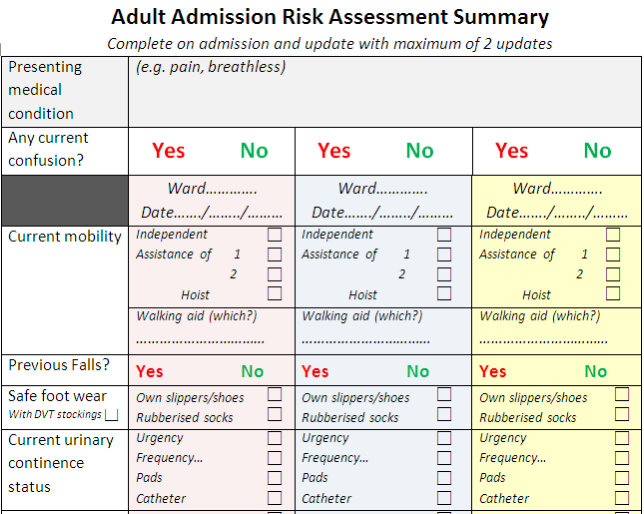
Workshop 2 The outputs from workshop 1 were reviewed and the participants added that they felt the ‘Current State’ documentation was a ‘form filling [exercise], subjective with variation between nurses and between disciplines’. They wanted ‘Future State’ documentation to be ‘faster’, ‘auto-populate’, with ‘functionality to match activity (e.g. can cope with interruptions)’ and ‘linked assessments e.g. VTE’. The 35 assessment questions were reviewed, accepted/rejected and augmented resulting in 38 questions. These were categorized into 4 higher level groups (pressure care area risk assessment, discharge planning, medical status and falls) and then prioritized by layout and format (Fig. 3). This resulted in 7 topics for medical condition (including pain and sensation), confusion (recent or history of confusion), normal and current mobility status (e.g. walking aids) and any assistance currently needed, history of a recent fall (risk of future fall), skin condition (pressure ulcer risk), assistance needed to swallow, eat, drink (including fluid restriction), and normal and current continence state (catheter, pads, urgency, frequency). There was also a requirement for an Alert Box with information on allergies, infection control issues and communication (hearing and vision). At this point the group discussed how the assessment could be divided between risk assessment and care assessment (and treatment planning) booklets. The care booklet could include information about past medical history, patient expectations and discharge planning. It was decided that the risk assessment booklet should have a minimum generic dataset completed on the assessment (admission) unit and be designed to communicate linked assessment information across the Multi-Disciplinary Team.
Figure 3. Prioritization of risk assessment questions (draft extract)
DISCUSSION AND CONCLUSION Pronovost (2013) discusses the variance within clinical practice for following published guidelines. He suggests 5 recommendations for guideline developers to address barriers for implementation of guidelines at the bedside (Fig. 4). This paper has used recommendation (3) as a guiding principle to integrate guidelines (risk management) for regularly assessed topics.
1. Unambiguous checklist with interventions (supported by ranked evidence) linked in time and space, e.g. on admission or at discharge. 2. Guidance to help clinicians address and mitigate barriers to use and implementation guideline. For example lack of awareness of guidelines requires education, disagreement requires conversation, ambiguity requires revision of the checklist, lack of ability requires system changes along with audit and feedback, and inertia requires influencing skills to motivate change. 3. Collaboration by guideline developers to integrate guidelines for conditions that commonly coexist. 4. Use reliance on systems, rather than the actions of individual clinicians, to ensure patients receive recommended interventions. 5. Create trans-disciplinary teams and pool expertise from clinical epidemiology (evidence synthesis), implementation science, and systems engineering to develop scholarly guidelines with practice strategies.
Figure 4. Pronovost’s (2013) recommendations to improve guideline implementation The proposed new adult admission risk assessment summary documentation will be reviewed using HFE usability design features for nursing documentation with respect to layout, orientation, quantity of information, use of colour and formatting. (Preece et al, 2013). As part of the HFE approach for falls risk assessment and management process both documentation and interventions will be further reviewed with the aim of improving safety, efficiency and communication in both the patient experience and staff work activities through design and systems interfaces.
Figure available in the original PDF paper.
Acknowledgments
The authors would like to acknowledge and thank the participants in the workshops.
REFERENCES
Balzer, K., Kremer, L., Junghans, A., Halfens, R.J.G., Dassen,T., Kottner, J. (2013) “What patient characteristics do guide nurses’ clinical judgement on pressure ulcer risk? A mixed methods study”, International Journal of Nursing Studies http://dx.doi.org/10.1016/j.ijnurstu.2013.09.005 Cheevakasemsook A, Chapman Y, Francis K, Davies C. (2006) “The study of nursing documentation complexities International
Journal of Nursing Practice 12: 366–374 Dochterman, J., Titler, M., Wang, J., Reed, D., Pettit, D., Mathew-Wilson, M., Budreau, G., Bulechek, G., Kraus, V., Kanak, M.
(2005) “Describing Use of Nursing Interventions for Three Groups of Patients”. Journal of Nursing Scholarship, 37:1, 57-6 Flanagan L, Roe B., Jack B., Shaw C., Williams K.S., Chung A., Barrett J . (2013) “Factors with the management of incontinence and promotion of continence in older people in care homes”. Journal of Advanced Nursing. doi: 10.1111/jan.12220 (accessed June 2013) Fray, M., Hignett, S., (2013). “TROPHI: Development of a tool to measure complex, multi-factorial patient handling
interventions”. Ergonomics 56, 8, 1280-1294 Hignett, S. (2010). “Technology and Building Design initiatives in interventions to reduce the incidence and injuries of Elderly In-Patient Falls”. Healthcare Environments Research and Design Journal 3, 4, 62-84 Hignett, S., Sands, G., Youde, J., Griffiths, P. (2010) “Targeting Environmental Factors to reduce Elderly In-Patient Falls”,
Proceedings of the 1st International Conference on Human Factors and Ergonomics in Healthcare / 3 rd International Conference on Applied Human Factors and Ergonomics, 17-20 July, 2010, Miami Hignett, S., Griffiths, P., Sands G., Wolf, L., Costantinou, E. (2013a) “Patient Falls: Focusing on Human Factors rather than Clinical Conditions”. Proceedings of the HFES 2013 International Symposium on Human Factors and Ergonomics in Health Care. Baltimore USA. 11-13 March 2013. Hignett, S., Sands, G., Fray, M., Xanthopoulou, D., Healey, F., Griffiths, P. (2013b). “Which bed designs and patient
characteristics increase bed rail use?” Age & Ageing. 42, 531-535 Hignett, S., Goodwin, E., O’Hagan, B., Youde, J. (2013c) “Audit of falls interventions using a Human Factors/ Ergonomics (HFE) approach”. Proceedings of British Geriatrics Society 14th International Falls & Postural Stability Conference Sept. Bristol NICE (2013). “Falls: Assessment and prevention of falls in older people”. Clinical Guidance 161. National Institute for Health
and Care Excellence. http://guidance.nice.org.uk/CG161 (accessed 25 October 2013) Preece, MHW, Hill, A., Horswill MS, Karamatic, R, Hewett, DG, Watson MO (2013) “Applying heuristic evaluation to observation chart design to improve the detection of patient deterioration”. Applied Ergonomics. 44, 544-556 Pronovost PJ, Bo-Linn GW. (2012) “Preventing patient harms through systems of car”. JAMA. 308(8):769-770. Pronovost, PJ. (2013) “Enhancing Physicans’ use of Clinical Guidelines”. JAMA doi:10.1001/jama.2013.281334 (accessed 6
December 2013)
LISTED IN THE AHFE DIGITAL BOOKSTORE CATALOGUE
Explore the complete digital volume
Advances in Human Aspects of Healthcare
Read this individual research paper free through the original publisher, or explore the full digital proceedings book.
ISBN 978-1-4951-2093-0
Explore this ISBN in the AHFE Bookstore ↗Listed in the July 2026 bookstore catalogue; search by ISBN to confirm current availability · Digital book purchase optional