Alexandra Fernandes, Kine Reegård, Asgeir Drøivoldsmo, John E. Simensen, Grete Rindahl (2021). Development of Telemedicine in Oil & Gas through the Capabilities Approach. In: Advances in Human Aspects of Healthcare. AHFE Open Access, vol. 13. https://doi.org/10.54941/ahfe100515
The oil & gas companies operating in the Norwegian Continental Shelf have commonly used the capabilities approach within the context of Integrated Operations. This approach focuses on understanding organisations as dynamic systems and provides concepts and a language for developing resources. Recent efforts are focusing on extending Integrated Operations and the capabilities approach to medical services offshore, specifically on the use of telemedicine. Telemedicine in this context involves the connection between offshore and onshore medical staff through the use of communication systems, as well the distribution of medical data obtained offshore (for instance HD images or vital signs readings). In this work we describe the elaboration of a new tool: the Capability Development Resource Matrix, based on the People - Capability Maturity Model (P-CMM) proposed by Curtis, Hefley, and Miller in 2009. This tool is designed to guide organisational development and is generated directly from the work with industry partners, being continuously tested and improved. We discuss the tool’s value for planning, development, and implementation of telemedicine in Oil & Gas and other contexts. We wrap-up with considerations about future steps in the methodology conception and evaluation.
Integrated Operations in Oil & Gas In 2004, the Norwegian Oil Industry Association initiated a program to improve value creation through implementing the concept of Integrated Operations (IO) across the petroleum industry (OLF 2006). On the Norwegian Continental Shelf (NCS) IO is now the domineering operational concept for offshore oil and gas exploration and production. IO introduces new ways of accessing information and working together across discipline and location, enabled by employment of both emerging and proven technologies (Skjerve et al., 2013).
Key aspects of IO in the petroleum industry are the implementation of IT solutions that support remote, real-time management of drilling operations, reservoirs and production facilities, maintenance, and logistics; and the improvement of decision and work processes through implementation of IO and transfer of operations to virtual operation centres onshore.
Cross-disciplinary groups will on a regular basis discuss, among others, production optimization, maintenance and modification plans, and make recommendations or decisions. This makes it possible to challenge plans and proposed decisions from several viewpoints and competencies simultaneously, avoiding long decision chains. IO collaboration also makes it possible to use the same experts for several similar problems across installations resulting in more experience for each expert and better use of a company´s internal and external expert base.
In the early stages of implementing IO, most companies had a strong technology focus, and it was expected that active collaboration between locations would be established mainly through acquiring high-end collaboration technology (Larsen, 2008). This often did not happen (ibid): Human Aspects of Healthcare (2021)
The technology had a higher user threshold than expected.
The established work practice did not require such tools.
Equipment was not available for the right people at the right time.
Even though IO has been valued as central tool for increasing recovery and minimizing operational cost, project focus in the industry has been and still is the challenges introduced by increased complexity in the production facilities. The project culture is therefore highly technology dominated and organisational factors and optimisation in operation are often given lower priority in the early project phases (Edwards, 2013). However, this technology- skewed development focus cannot be blamed on the technology. A main obstacle has also been the lack of efficient tools for operationalization of IO philosophies in the early project phases and that supports the development and implementation of IO as interplay through the whole project process.
In recent years, the Oil & Gas industry on the NCS have extended the philosophy of IO to medical services offshore, seeing potentials for improving their use of telemedicine. Offshore telemedicine involves the need for collaboration between roles holding different expertise located at a distance from one another and that belong to different organisations that may have particular ways of working, and the need to share objective data between roles regardless of their organisations, locations, or even time of the day. From our current experiences with telemedicine in the Oil & Gas industry, we see that the challenges described for telemedicine in this context seem similar to the challenges found in IO projects in general.
Telemedicine in Oil & Gas Telemedicine has a long history (e.g. Thrall & Boland, 1998), being mainly characterized by the use of the telephone in the initial stages (e.g. Michaels, 1989). References to its use in offshore installations are present at least since the 1970’s (e.g. Evensen & Fjærtoft, 2008; Norman et al., 1988). Nowadays, with technological advances allowing a continuous connection between onshore and offshore locations, telemedicine in offshore installations is a generalized practice, providing connection between offshore medical staff and onshore doctors and experts that can be contacted when required (e.g. Anscombe, 2010). The use of telemedicine offshore has been reported to reduce illness-related departures (e.g. Boultinghouse & Fitts, 2009), and allow shorter response times (Anscombe, 2010).
More recently the need to move from an accident-focused perspective to an illness-focused perspective in offshore healthcare has also been noticed (e.g. Lexow, 2000), alerting the decrease of accidents/incidents when compared to the growing number of illness occurrences in offshore installations. For instance, in the UK sector of the North Sea, in 1992, 65% of evacuations were due to illness, revealing the change in the pattern from the 1970’s and 1980’s (Ponsoby, Mika, & Irons, 2009). While the use of telemedicine seems to be rather generalised in the offshore Oil & Gas industry, there is still a need to improve efficiency, namely regarding data availability between offshore and onshore staff, improving the promptness of onshore medical staff, and increasing the availability of medical experts in situations that require it.
In the context we are working with, telemedicine practices involve real time collaboration between onshore and offshore medical personnel. Onshore medical personnel can be nurses, company doctors or medical experts (e.g. cardiologists). The offshore NCS medical personnel are nurses, usually with extra training relevant for offshore operations (Reegård et al. 2014). The oil platform sickbay is connected to the company's onshore support service (e.g. company doctor and/or a third party medical service provider) and can be connected to one or more public hospitals (e.g. Evensen & Fjærtoft, 2008). In such cases, equivalent video communication equipment is usually installed at the hospitals as well. The telemedicine solutions are designed for both emergency and non-emergency medical situations. In addition, the telemedicine solutions on the NCS are also used for non-medical communications between onshore and offshore such as meetings, training, and planning.
More recently in the NCS there is a trend to broaden the concept of IO to telemedicine (e.g. Evensen & Fjærtoft, 2008) and some companies have initiatives to create integrated solutions where video and current and historical patient and equipment information are available (e.g. Thorvik et al. 2014). As noted earlier, when introducing new technology it is important to be aware that other aspects of the practice will change as well. Jennett and collaborators (2003), have referred the concept of “organisational readiness for telemedicine”, highlighting that aspects such as motivation, willingness to invest, preparation, strategy and needs assessment, among others, are crucial for successful implementation. By focusing the development of telemedicine on the technological changes alone, the Human Aspects of Healthcare (2021) chances for successful implementation and continuation are highly reduced.
Although telemedicine practices in the offshore industry are frequent, in other contexts it is not yet conventional. In fact, even though there are numerous attempts of implementation of telemedicine across areas (e.g. access to rural areas, patients’ homes, etc.) and across countries from the 1960’s until today, telemedicine is not yet a generalized practice in healthcare and frequently the implementation projects reach stagnation, much due to legal and/or medical issues (e.g. Zanaboni & Wootton, 2012), but also in relation with organisational aspects and participant’s motivation (Jennet et al., 2003). There are however, interesting lessons to learn from these projects, exploring identified barriers and success factors and carrying them to our current work. Simultaneously, the current experiences in offshore telemedicine can provide relevant input into other contexts.
From the data present in the literature regarding telemedicine, we observed that previous attempts of implementation of telemedicine, regardless of the contexts, have revealed difficulties similar to the ones detected in our on-going work with IO projects in the oil & gas industry. In the next topic we will explore the background for our previous work in IO and then we will describe how we have been applying it to the particular context of telemedicine in Oil & Gas.
THEORECTICAL BACKGROUND As previously noted from the work with IO in the Oil & Gas industry, the initial implementation efforts suffered from a too heavy technology focus. Since then, organisational change (including people and process changes) and governance has been recognized as important factors in delivery of IO implementations (Edwards, Mydland & Henriquez, 2010). Part of the problem has been a lack of tools that efficiently guide IO projects throughout the project phases that addresses all the aspects and implied changes to the way of working that is introduced by the IO philosophy. The tool we present in this paper is meant to serve this purpose and is being explored in the context of telemedicine use in offshore installations. In the following topics we describe the two central theoretical approaches on which this tool is based, and that have guided our current work with telemedicine in Oil & Gas.
The capabilities approach The theoretical concept of (organisational) dynamic capabilities has been used to understand how organisations may attain and sustain competitive advantage (Teece, 2007; Ambrosini & Bowman, 2009). The concept of dynamic capabilities focuses on how the organisation adapts, integrates and reconfigures its resources toward changing environments (Teece, Pisano & Shuen, 1997).
Based on the line of thinking that the dynamic capabilities offer, Henderson, Hepsø, and Mydland (2013) initiated the capability approach to Integrated Operations. Within this approach, a capability is defined as the “synthesis of the interdependent resources involving people, process, technology, and governance that directly creates added value” (ibid). This definition highlights that the combination of the resources is essential for value creation, and that no single dimension is more important than the other, thus dealing with the technology bias that has been noted to affect some of the previous work on IO (Hepsø, 2006; Edwards et al., 2010). The capability approach to integrated operations uses the organisation’s operational context as a starting point for understanding which capabilities it is necessary to develop for successful operations in accordance with the IO philosophy which, in the case of the oil and gas industry on the NCS, is the overarching business goal. As such, it uses a high-level top-down perspective.
The potential value of using the capability approach for IO projects seem to lie in its identification of key capabilities in accordance with the operational context, both operational capabilities that allow for production as well as dynamic capabilities that ensure sustainability and/ or enhanced value of this way of working. The fit between the organisation’s capabilities and the external environment has been noted to be important for successful value creation (Helfat et al., 2007). Further, through its definition, the capability approach to IO contributes to ensure an understanding of how all four categories of resources constitute a capability and highlight the interdependencies between them, thereby avoiding the pitfall of focusing narrowly on certain resources.
Human Aspects of Healthcare (2021)
The People – Capability Maturity Model The People Capability Maturity Model (P-CMM) was developed, similarly to other capability maturity models, as a guiding model for development of targeted capabilities, specifically the workforce capabilities (Curtis et al., 2009). The overall focus of the model (and other similar capability maturity models) is on systematically removing any impediments to continuous improvement that is deemed important due to rapid evolvements in the organisation’s surroundings. This is believed to be achievable through a staged process that addresses the whole organisation (ibid).
P-CMM describes five maturity levels through which the organisation may manage and develop their workforce practices towards enabling continuous improvements. The staged process of development implies that the organisation needs to steadily develop its workforce level by level. In the first level, the organisation is marked by inconsistency in the practices performed in its units due to several factors such as lack of defining work practices and evaluating their effectiveness, lack of training of employees in performing the practices and poor management skills. Since only repeatable practices may be subject for improvement, the focus of the organisation at this level should be on removing any obstacles in each unit that keep them from repeating practices that prove to be successful. Therefore, the focus of the organisation at the second level is to establish control of commitments and baselines in order to enable the people in the organisation to repeat the successful practices. In level three, these practices are then standardized throughout the organisation, contributing to the establishment of an organisation- wide infrastructure that ties the capabilities of the workforce to the business objectives. In the fourth level, the organisation uses this infrastructure of workforce capabilities to quantitatively manage its performance. It is now possible to quantify the workforce capabilities and the processes used in performing activities so that the organisation is able to predict its future performance. Finally, in the fifth level, the organisation uses its quantitative knowledge to identify the processes that would benefit the most from improvement actions. The objective of continuous improvements is reached by empowering the workforce to attempt such improvement actions where they see potentials, referring to standardization of improvement processes throughout the organisation.
The value of using the P-CMM model seems to lie in its holistic view of how the organisation can develop workforce capabilities that are deemed necessary to achieve business goals through a number of organisational changes that are sequentially connected to each other. Further, the model takes into account that both the organisation and its environment is constantly changing, making the ability to continuously adjust and improve internal processes in response to changing external factors (e.g. new technological developments) necessary in order to achieve and maintain value from the business activities.
DEVELOPMENT AND USE OF THE MATRIX TOOL New developments on the model
Successful capability development is about being able to transfer the opportunities identified into practical and sustainable solutions. To make this happen in an inherently complex area as IO, it is critical that the capabilities developed are refined to fit the needs across all involved systems and parties of the organisation.
Developing the model, we encounter a combination of top-down and bottom-up perspectives. The capabilities approach is described as a top-down approach – focusing on strategical planning and long-term perspective of the organisation, keeping an overview or “big picture” analysis. On the other hand, the P-CMM outlook is much more centred in specific requirements for the (available or obtainable) resources in each level of maturity, focusing the work on practical and even shorter-term needs to fulfil the final objective of optimal goal achievement.
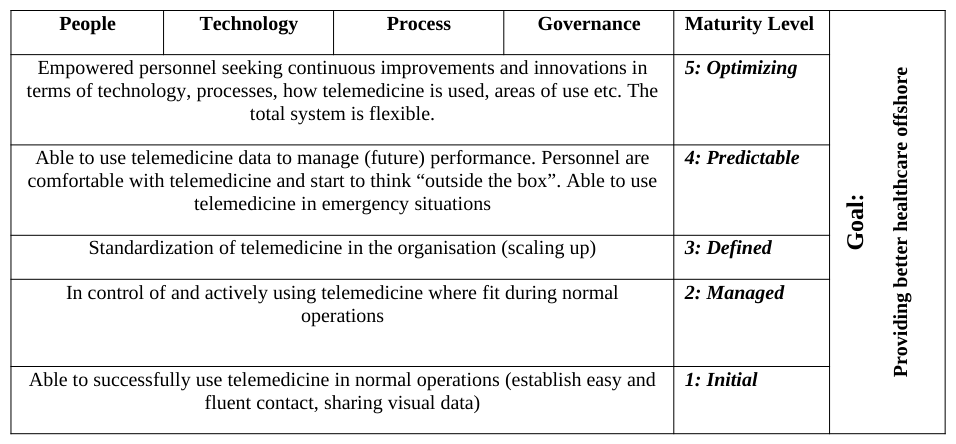
The main challenge regarding the adaptation of the P-CMM model to the capabilities framework lies on the expansion of the perspective of an one-dimensional model, considering only people issues, to a multidimensional model considering three more areas: technology, process and governance. Adding to the complexity, people, technology, process, and governance need to be aligned to allow organisational development. The direct implication is that an organisation will only be able to achieve a determined level of maturity if all the resources achieve that Human Aspects of Healthcare (2021) same level of maturity.
Table 1 shows our attempt of combining the two approaches into a development matrix that includes the four main resources identified in the capabilities approach. The preliminary description of each level shows a generic aim for each maturity level for the specific case of telemedicine. For instance, to be able to achieve level 1 in the people resource, staff would have to have minimum qualifications and training to provide health care and use the medical equipment and communication tools necessary for telemedicine; simultaneously, all equipment has to be available, installed, be easily accessible and user-friendly; the work processes should be adapted for a telemedicine practice including indications of when and how to use it; on the governance aspects, basic connections with other organisations (e.g. hospitals) must be in place to make sure that the adequate support from onshore is available.
Table 1. Generic description of the levels in the capability resource matrix for telemedicine (adapted from Curtis et al., 2009)
The capability resource matrix for telemedicine is being created attending to the collection of previous experiences with telemedicine in Oil & Gas and other contexts, serving as a “lessons learned summary” for each indicated level. As such, it can be empirically used as a reference for best practices in each level, pointing to the areas that require more or less initial investment attending to the long-term goals.
At this stage, we envision the use of the matrix as essentially a tool for long-term planning. Using the matrix as a guide from early stages in projects, namely the concept stage will allow the definition of a comprehensive plan, comprising both a task-level to strategy-level (bottom-up) and a long-term goals to present processes (top-down) perspective, and building a path that will be company-specific to achieve each defined goal.
Using the matrix as a tool In the current work we have defined generic goals that simultaneously contribute to long-term planning and define the dynamic stages of assessment, planning and implementation. Assuming the concrete definition of the maturity levels for each resource (people, technology, process, and governance), the work with the companies must rely on the “how-to’s” or on the definition of practical steps to implement new practices or improve existing ones. The work must focus on defining company-specific strategies to achieve the requirements established for each maturity level, enabling the company to grow and develop.
Through the steps described bellow we expect to gather data from different sources involved in the system and create an understanding of the needs and demands of each role, integrating it with the boundaries of contextual and Human Aspects of Healthcare (2021) legal aspects and incorporating them together with technology aspects in a robust work process for telemedicine, as well as supporting processes for telemedicine usage: a) Describe today’s practice: mapping today’s processes and exploring current challenges and good practices will provide the setting for the implementation of a new/improved telemedicine practice. This initial stage can also contribute to involve all roles in the process from an early stage, taking their opinions into account and minimizing resistance to change (e.g. Lin, Lin, & Roan, 2012).
b) Determine strategies to achieve minimum requirements/improve practice: this stage relates to the definition of actions to achieve the requirements or short-term goals for implementation – what needs to be in place in order to assume we are doing things differently/better than today, and how can we reach that? It relates to the “needs assessment analysis” referred in the telemedicine literature as a success factor for implementation (e.g. Jennet et al., 2003).
c) Implementation: one of the difficulties in implementing telemedicine in healthcare has been the lack of convincing evidence for its effectiveness (e.g. Zanaboni & Wootton, 2012). As such, we suggest an initial controlled and small-scale implementation phase that can provide evidence of potentialities and advantages. After this pilot experience is evaluated and discussed, the organisation can start broadening the areas of implementation, by extending it to other departments or places (e.g. start implementing telemedicine in one offshore installation and then applying it in other offshore installations) or to a wider set of practices (for instance start using it for normal situations only and then implement it for emergency situations as well). This internal first-hand experience will contribute to the improvement of processes, tasks definition, role responsibilities and others. It will also allow the integration of suggestions, opinions and ideas from people in relevant roles, enhancing the involvement of participants (e.g. Jennet et al., 2003) and providing internal formal/informal training with staff members that have experience with the new processes (e.g. Yellowlees, 2005). Future steps include the ability to adjust the generalized practices to new needs, new requirements, and new professionals and is a first step for creating a self-sufficient system aligned to specific goal achievement. In this stage the organisation should be able to evaluate their practices.
To be able to properly describe today’s practices, our strategy in the data gatherings include individual interviews with people in relevant roles, observations, meetings with people internally in the O&G organisations and external organisations involved in telemedicine usage (e.g. onshore doctors), document consultation, and workshops targeting both the organisations we have been directly working with and relevant external organisations (for instance other Oil & Gas companies). Our strategy is to collect information relevant for each dimension within the capabilities approach: people, technology, process, and governance. As such, the scripts for our interviews, observations, meetings and workshops included the four themes. Naturally, depending on the informant, we are able to collect more information regarding certain dimensions rather than others. For instance, interviews with management showed a tendency to be more informative regarding governance issues, while interviews with medical staff are more focused on process aspects.
After a comprehensive description of the current practices (comprising people, technology, process and governance), we should be capable of situating the organisation’s reality for each dimension in the matrix maturity levels. This corresponds to a diagnostic phase and will help us determine which areas should be prioritized for implementation. For instance, in our experience in the current telemedicine case, we were able to detect that people and process issues were not perceived as a challenge by the involved parties, but technology and governance barriers, related with the difficulties of sharing medical objective data (e.g. ECG) were determinant for their activities.
CONCLUSIONS
The presented tool is based on previous experiences in the Oil & Gas industry (e.g. Skjerve et al., 2013); combines concepts from the capability approach (e.g. Henderson et al., 2013) and maturity matrix perspectives (e.g. Curtis et al., 2009) and addresses issues pointed out in the literature on telemedicine implementation (e.g. Jennett, 2003). In our current experience with telemedicine development in offshore installations, we were able to identify three main areas where this tool might contribute as a facilitator for planning of implementation, possibly influencing the success of telemedicine implementation: Human Aspects of Healthcare (2021)
1) Assessing context and needs: A crucial step for defining a strategy for telemedicine implementation is accessing the specificities of the context of operation for each specific organisation (e.g. Henderson et al., 2012; Jennett et al., 2003). Likewise, assessing the current and future requirements for operations is crucial for planning.
2) Anticipating cross – organisational work: In complex dynamic systems, the internal change in one company has to be planned taking into account also the possible changes it might imply in its relationships with other companies, contractors, vendors or suppliers. In the presented case of telemedicine, if the Oil & Gas company wants/needs to have a direct contact with a medical expert, it has to be assured that the hospital responsible for that service is effectively capable of providing it (Reegård et al., 2014).
3) Technological potentialities and implementation: Technology is often a main driver for change; however, previous research has shown that investing in technology by itself will not guarantee a successful implementation (e.g. Larsen, 2008). Thinking of organisations as dynamic systems, we can anticipate that people, process and governance aspects will change with the introduction of new technology and these aspects should also be considered during planning.
There are also some challenges of using this method that we could anticipate from our current experience:
1) Mapping the system: The initial assessment/planning phase requires a relatively high amount of effort, both for collecting the required information and to organize it in a useful way for refining planning. Currently we are doing interviews with at least one representative of each role involved in the telemedicine system, we benefited from observations like visiting installations offshore, and we were able to conduct workshops with people in target roles. The time required to access all this roles can be a potential difficulty. However, we argue that the time spend in the beginning of the project accessing real needs, involving participants, discussing relevant issues, trying to reach agreements and defining a common goal will contribute to a more robust, quick, and efficient implementation phase.
2) Achieve agreement on long-term roles amongst roles/organisations: Another main assumption in the method we propose is the achievement of an explicit agreement on the long-term strategy between the main roles and organisations. This relates directly with the need to involve people from early stages, creating a joint perception of ownership of both the project and the ideas that are being discussed. This aim is dependent on the availability of the roles to discuss the process their willingness to compromise.
One of the main advantages we foresee in this tool is its relevance for resource alignment from an early stage of planning. One of the main challenges when starting a new project is to know where to start. This tool addresses this issue since its early stages of assessment/planning target the diagnostic of the organisation’s resources (people, technology, process, and governance) in relation to the contextual opportunities and constraints. This mapping entails the definition of priorities by highlighting the most and least established resources.
Next steps will involve the first configuration of a organisation-specific long-term plan jointly with the O&G companies that we collaborate with at the moment; an attempt to improve data collection instruments that allow us to perform the initial mapping of the system in a quicker and more efficient way; the analysis of the results obtained with the planning stage; and the creation of guidelines for the first implementation stage – implement the new practice in a controlled setting.
ACKNOWLEGEMENT The authors wish to thank the Center for Integrated Operations in the Petroleum Industry (www.iocenter.no) who has financed this work, and the partners involved in this study.
REFERENCES
Ambrosini, V. & Bowman, C. (2009). What are dynamic capabilities and are they a useful construct in strategic management?
International Journal of Management Reviews, 11, 29-49. Anscombe, D. L. (2010). Health Care delivery for Oil Rig Workers: Telemedicine Plays a Vital Role. TELEMEDICINE and e- Human Aspects of Healthcare (2021)
HEALTH, 16. Boultingshouse, O. W. and Fitts, T. G. Jr. (2009). Telemedicine technologies enhance offshore healthcare, reduce illness-related departures. Drilling Contractor. Retrieved from http://www.drillingcontractor.org/telemedicine-technologies-enhance- offshore-healthcare-reduce-illness-related-departures-1853 Curtis, B., Hefley, B., Miller, S. (2009). People Capability Maturity Model (P-CMM) Version 2.0, Second Edition. Technical
Report CMU/SEI-2009-TR-003, ESC-TR-2009-003. Carnegie Mellon, Software Engineering Process Management Edwards, T. (2013). Integrated Operations enabling new operational and project concepts. Presentation in the 9th International Conference on Integrated Operations in the Petroleum Industry. Trondheim, Norway, 24-25 September 2013 Edwards, T., Mydland, Ø. & Henriquez, A. (2010). The Art of Intelligent Energy (iE) – Insights and Lessons Learned From the
Application of iE. 2010 SPE Intelligent Energy Conference and Exhibition held in Utrecht, The Netherlands, 23-25 March 2010. Evensen, A., & Fjærtoft, I. (2008). The use of Integrated Operations in order to improve quality of health care and medical evacuations from offshore installations. 2008 SPE Intelligent Energy Conference and Exhibition held in Amsterdam, The Netherlands, 25–27 February 2008. Helfat, C. E., Finkelstein, S., Mitchell, W., Peteraf, M. A., Singh, H., Teece, D. J. and Winter, S. G. (2007). Dynamic
Capabilities: Understanding Strategic Change in Organizations. Blackwell Publishing Ltd. Henderson, J., Hepsø, V. & Mydland, Ø. (2013). What is a Capability Platform Approach to Integrated Operations? An Introduction to Key Concepts. In T. Rosendahl & V. Hepsø (Eds). Integrated Operations in the Oil and Gas Industry: Sustainability and Capability Development (Ch. 1, 1-19). Hershey, PA: IGI Global. Hepsø, V. (2006). When Are We Going To Address Organizational Robustness and Collaboration as Something Else Than a
Residual Factor? 2006 SPE Intelligent Energy Conference and Exhibition held in Amsterdam, the Netherlands, 11-13 April, 2006. Jennett, P., Yeo, M., Pauls, M., & Graham, J. (2003). Organizational readiness for telemedicine: implications for success and failure. Journal of Telemedicine and Telecare, 9 (suppl 2), 27–30. Kotter, J.P. (1995). Leading Change: Why transformation efforts fail. Harvard Business Review, 73(2), 59-67. Larsen, S. (2008). Keys to high performance virtual teams. Integrated Operations, IO Center Report No. P4.2.-004, 2008. Lexow, K. (2000). Challenges in Emergency Preparedness: Time for Changing Focus? SPE International Conference on Health,
Safety and Environment in Oil and Gas Exploration and Production, 26-28 June, Stavanger, Norway. http://dx.doi.org/10.2118/61360-MS Lin, C., Lin, I.-C., & Roan, J. (2011). Barriers to Physicians’ Adoption of Healthcare Information Technology: An Empirical Study on Multiple Hospitals. Journal of Medical Systems, 36(3), 1965–1977. doi:10.1007/s10916-011-9656-7 Michaels, E. (1989). Telemedicine: the best is yet to come, experts say. Canadian Medical Association Journal, 141(6), 612–614. Norman, J. N., Ballantine, B. N., Brebner, J. A., Brown, B., Gauld, S. J., Mawdsley, J., et al. (1988). Medical Evacuations From
Offshore Structures. British Journal of Industrial Medicine, 45(9), 619–623. OLF (2006). The value potential for integrated operations on the NCS, April 2006, retrieved at http://www.olf.no Ponsonby, W., Mika, F., & Irons, G. (2009). Offshore industry: medical emergency response in the offshore oil and gas industry.
Occupational Medicine, 59(5), 298–303. doi:10.1093/occmed/kqp075 Reegård, K., Nystad, E., Fernandes, A. & Rindahl, G. (2014). Anticipated challenges for cross-organisational distributed collaboration in reactive telemedicine. In O. Broberg, N. Fallentin, P. Hasle, A. Kabel, M.E.Larsen, & T. Weller (Editors). 11th Human Factors in Organizational Design and Management & 46th Nordic Ergonomics Society Annual Conference held in Copenhagen, Denmark, 17-10 August 2014. Skjerve, A.B., Nystad, E., Rindahl, G. and Sarshar, S. (2013). Assessing the Quality of Collaboration in an Integrated Operations Organization. 22nd European Safety and Reliability Conference, Amsterdam, The Netherlands, 29th September to 2nd
October, 2013. Teece, D.J. (2007). Explicating dynamic capabilities: The nature and microfoundations of (sustainable) enterprise performance.
Strategic Management Journal, 28, 1319-1350. Teece, D.J. & Pisano, G. & Shuen, A. (1997). Dynamic capabilities and strategic change. Strategic Management Journal, 18(7), 509-533. Thorvik, K., Nystad, A., Skogås, J.G., Fernandes, A., Reegård, K., Simensen, J.E., Rindahl, G., Silva, E., Bergsland, T.,
Klingsheim, O., & Evjemo, T.E. (2014). The future of telemedicine in O&G. 2014 SPE Intelligent Energy Conference and Exhibition held in Utrecht, The Netherlands, 1-3 April, 2014. Thrall, J. H., & Boland, G. (1998). Telemedicine in practice, 28(2), 145–157. Yellowlees, P. M. (2005). Successfully developing a telemedicine system. Journal of Telemedicine and Telecare, 11(7), 331–
335. Zanaboni, P., & Wootton, R. (2012). Adoption of telemedicine: from pilot stage to routine delivery. BMC Medical Informatics and Decision Making, 12(1), 1–9. doi:10.1186/1472-6947-12-1
Human Aspects of Healthcare (2021)
LISTED IN THE AHFE DIGITAL BOOKSTORE CATALOGUE
Explore the complete digital volume
Advances in Human Aspects of Healthcare
Read this individual research paper free through the original publisher, or explore the full digital proceedings book.
ISBN 978-1-4951-2093-0
Explore this ISBN in the AHFE Bookstore ↗Listed in the July 2026 bookstore catalogue; search by ISBN to confirm current availability · Digital book purchase optional