Achim Elferinga, Cornelia Rollia, Urs Müllerb, Özgür Tamcanb, Anne F. Mannionc (2021). Maladaptive Back Beliefs and Low Back Pain in Nurses: A Longitudinal Study. In: Advances in Human Aspects of Healthcare. AHFE Open Access, vol. 13. https://doi.org/10.54941/ahfe100514
This population-based longitudinal questionnaire study examined whether back beliefs predicted increased low back pain (LBP) one year after baseline, comparing the phenomenon in nurses versus other participants. A random sample of 2’860 individuals participated. At one-year follow-up 1’445 questionnaires were returned. At baseline and follow-up, back beliefs were assessed with the Back Beliefs Questionnaire (BBQ) and LBP was assessed using a standardized pain intensity item and pain manikin. Cross-lagged structural equation modeling was used to estimate the prospective risk path from BBQ at baseline to LBP at follow-up. A model comparison test evaluated whether paths differed between 59 nurses and 1’383 other respondents. The cross-lagged path model fitted the empirical data well (CFI = 0.91; RMSEA = 0.04). In nurses, the longitudinal path from BBQ to LBP at follow-up (β=0.30, p=.013) and the cross-sectional association between BBQ and LBP at follow-up (β = 0.42, p = .031) were more positive than in others (longitudinal path: β = 0.05, p = .023; cross-sectional path: β = 0.06, p = .062). The biopsychosocial model of LBP and maladaptive back beliefs should be addressed in educational occupational health interventions for nurses.
According to a report of the Bureau of Labour Statistics (Cherney, 2013), nurses, , labourers, delivery truck drivers and freight handlers are all at high risk of developing musculoskeletal problems. In the study of Daraiseh et al. (2003), 24% of the nurses interviewed suffered from low back pain (LBP) and nearly one third were absent from work during the last 12 months due to LBP. Occupational health interventions include work redesign and ergonomic adaptations. In recent years, the use of interventions to increase and maintain nurses’ resilience to LBP has attracted increasing attention. For instance, worksite training with stochastic vibration exercises was shown to increase musculoskeletal well-being, especially in nurses who reported only moderate general health (Elfering et al., this volume). Improved musculoskeletal function and strength can also increase resilience to LBP, as can improvements in “negative” beliefs towards LBP (Rolli-Salathé & Elfering, 2013). In this study, we explore the relationship between negative back beliefs and LBP, comparing the association in nurses with that in a representative sample of individuals with other occupations.
INADEQUATE BACK BELIEFS How negative back beliefs affect LBP
The biopsychosocial model of pain postulates that the appearance of illness results from the interaction of diverse causal factors – biological, social and psychological factors– and that psychological variables are crucial with respect to the susceptibility, severity, and course of illness (Borrell-Carrió, Suchman, & Epstein, 2004, Engel, 1977; Rolli et al, 2013; Rolli & Elfering, 2013). Among the psychological factors, cognitions related to LBP play a key role. Cognitions include subjective appraisals, unhelpful beliefs and expectations about pain, or negative expectations of recovery. These adverse cognitive appraisals can enhance the fear of movement, the avoidance of activity due to expectations of pain and possible re-injury, as well as feelings of being helpless, worried and distressed. Cognitive factors such as individual attitudes and beliefs towards one’s own LBP have been described as predictors of an unfavourable course of LBP (Elfering & Mannion, 2008). Hence, modifying individuals’ beliefs about their back pain has become an important component of many back pain disability prevention strategies (Buchbinder & Jolley, 2005; Woby et al., 2004). In 1996, Symonds, Burton, and Tillotson developed the Back Beliefs Questionnaire (BBQ), which measures an individual’s beliefs regarding the inevitability of the future as a consequence of experiencing low back pain. There is increasing evidence that beliefs about back pain, as measured by the BBQ, are involved in the maintenance (Elfering Mannion, Jacobshagen, Tamcan, & Müller, 2009) and aggravation of back pain, as well as in back pain-related absenteeism and presenteeism (Mannion et al. 2009) and back-pain related use of the healthcare system (Mannion, Wieser, & Elfering, 2013).
BBQ and LBP in health care To date, the predominant reason for studying the BBQ scores of healthcare providers has concerned the influence of their beliefs on the treatment of patients with LBP (Bishop, Thomas, & Foster, 2007; Coudeyre et al., 2006; Linton, Vlaeyen, & Ostelo, 2002; Vlaeyen, & Linton, 2006). A recent systematic review concluded that there is strong evidence for an association between the LBP-beliefs of healthcare providers and the beliefs of their patients (Darlow et al., 2012). Moreover, healthcare providers who subscribe to a more biomedical model of LBP seem to have higher BBQ scores (more “negative” or maladaptive beliefs) than do proponents of the biopsychosocial approach to LBP (Darlow et al., 2012). Given that the biomedical approach to disease is still dominant in the education of physicians and nurses, one might expect to see not only higher BBQ scores in these professions but also a higher prevalence of LBP – possibly, in part, as a consequence of their higher BBQ scores. There is preliminary evidence that LBP is higher in the healthcare professions compared with other professions. Jensen and coworker (2009) reported on 5 studies in which the 12-month LBP prevalence was between 45% and 63% among healthcare workers compared with 40-50% in other employees in the general population. With respect to the potential association between biomedical-focused education, beliefs and LBP, a report of the Danish Institute for Health Technology (1999) showed that when healthcare students (healthcare helpers and assistants) begin their studies they do not have a higher prevalence of LBP than that of the same age-range in the general Danish population; however, differences in LBP prevalence start to appear later in their training. More direct evidence stems from a recent study that compared an excessively biomedical style of physical therapy undergraduate training with training that focused on the biopsychosocial model (Domenech, Sánchez-Zuriaga, Segura-Ortí, Espejo-Tort, & Lisón, 2011): two modules of biomedical training resulted in a worsening of maladaptive beliefs about LBP, while the same amount of biopsychosocial-focused training was associated with a reduction in maladaptive beliefs (Domenech et al., 2011). Thus, the strictly biomedical education that has been standard practice in nursing for many years may have served to promote maladaptive beliefs in nurses. We hypothesised that, in a representative population sample, nurses would show more negative back beliefs and a greater prevalence of LBP compared with other study participants, and the association between BBQ scores and LBP would be closer in nurses compared with others.
METHODS
Sample The participants were a sub-group of individuals who had previously taken part in a large-scale, population-based cross-sectional survey of musculoskeletal health in Switzerland (N=16’674) and comprised the “cases” in a further case-control study of individuals with and without LBP (Figure 1). Briefly, individuals were selected for participation in the present study after their pre-stratification for the presence/absence of LBP “in the last month” indicated both in the original survey and in a short telephone interview prior to the current study. From the pre- stratified groups, 2’860 individuals were randomly selected. During the telephone interview, 94% consented to participate and 2’507 (88%) individuals actually went on to return a baseline questionnaire (Figure 1). Of the 2’507 individuals returning a baseline questionnaire, 1’833 responded to a follow-up questionnaire sent one year after the baseline assessment. Participant characteristics are shown in Table 1. The final longitudinal sample included 1’442 participants, of which 59 were nurses. The research was carried out following the ethical guidelines of the local Research Ethics Committee.
Equations and mathematical formulas are available in the original paper PDF.
4046 report LBP
2700 (94%) consented to study
Baseline: 2507 (88%) returned q’aire
+ 1 yr later Follow-up: 1833 (73%)
1689 reported their profession
Longitudinal Sample: 1442
Figure 1. Flow of study participants
Figure available in the original PDF paper.
Questionnaires The Back Beliefs Questionnaire (BBQ) is a questionnaire containing nine single-construct items. Respondents are asked to indicate on a 7-point scale (completely disagree = 1, completely agree = 7) whether they agree or disagree with each of the nine statements regarding the inevitability of the future as a consequence of having back pain. Eight out of the nine items loaded most heavily on the one common factor proposed in the original model of Symonds et al (Symonds et al., 1996). The first question of the BBQ did not load on this common factor, confirming the findings of the recent population study of Bostick and colleagues (Bostick, Schopflocher & Gross, 2013). Therefore, we included only questions 2 to 8 and the total score ranged from 8 to 56. The item scores were not reversed as in the original study; instead, in the present study, a higher score indicated more negative beliefs about back pain. LBP was assessed using an item taken from the Pain Standard Evaluation Questionnaire (SEQ Pain, Müller et al., 2008). The SEQ was found to be a reliable and valid instrument for the assessment of pain in population-based observational studies (Müller et al., 2008). The question in the SEQ enquired about the intensity of musculoskeletal LBP: “In the last four weeks, how much pain did you experience in the lower back?” The response option in each case ranged from 0 (no pain) to 6 (unbearable pain). Additionally, volunteers completed a pain-drawing, also part of the SEQ Pain (Müller et al., 2008), by marking their painful body regions on an illustration of the human body (front and back). Specifically, they were asked, “If you experienced pain in the last four weeks, please indicate the painful regions by marking them on the figure below”). This additional measure was used to derive information about the precise localization of pain in the lower back. The pain drawing was evaluated by assessing whether each marked spot (multiple marks were allowed) belonged to the lumbar region Müller et al., 2008). The questionnaire also included an open question about profession. All entries including the term “nurse”, such as “registered nurse”, ”surgical nurse”, “geriatric nurse”, etc. were coded 1 for the variable “profession, nurse” while others were coded 0.
Analyses Analyses of covariance (ANCOVA) were used to examine whether nurses had higher scores than others on the BBQ and the LBP scale. In the ANCOVAs, age and BMI were included as control variables. The hypotheses regarding associations between BBQ and LBP were tested in a cross-lagged panel using structural equation modeling with AMOS 18.0. In cross-lagged panel models, BBQ and LBP were cross-sectionally correlated. The longitudinal directional path involving the latent variable of BBQ at baseline predicting the latent variable LBP at follow-up, whilst controlling for LBP at baseline, was entitled the “prospective risk path”. The prospective risk path examines BBQ scores as antecedents of increased musculoskeletal pain at follow-up. Similarly, the directional path from musculoskeletal pain at baseline to BBQ scores at follow-up (controlling for BBQ scores at baseline) examines pain as an antecedent of increased pessimistic beliefs from baseline to follow-up.
The moderation hypotheses – which examined whether the association between BBQ and LBP was stronger in nurses than in others - was tested by running the cross-lagged panel model separately for nurses and others. The cross-sectional association at follow-up and the prospective risk path were examined for differences between groups by constraining the paths to be the same for both groups. When the path coefficients in the group of nurses were higher than in the group of other professions, and the constrained model was significantly worse in fit than the model that allowed the paths to vary across groups, the test of differences in strength of association between BBQ and LBP in nurses versus others was significant.
RESULTS
The four-week prevalence of LBP as derived from the the marks made on the manikin at baseline and follow-up are shown in Table 1. At both time-points, approximately half of the participants had experienced LBP in the preceding four weeks. LBP prevalence did not differ between nurses and others when age and BMI were controlled for. The intensity of LBP in the last four weeks was higher in the group of nurses compared with the others, both at baseline and follow-up. The mean scores for the BBQ at baseline and follow-up did not differ between nurses and others (Table 1).
Table 1. Basic Statistics in Study Variables for Nurses and other Participants Baseline Follow- Up
Table available in the original PDF paper.
Nurses Others p Nurses Others p Sample size (n) 59 1383 59 1383
.17 2a Notes. BMI = Body Mass Index; BBQ = Negative Back Belief Questionnaire; LBP = Low Back Pain; Manikin = LBP indicated on pain drawing (0 = no, 1 = yes). ***p < .001, **p < .01, *p < .05, two-tailed. acontrolled for age and BMI.
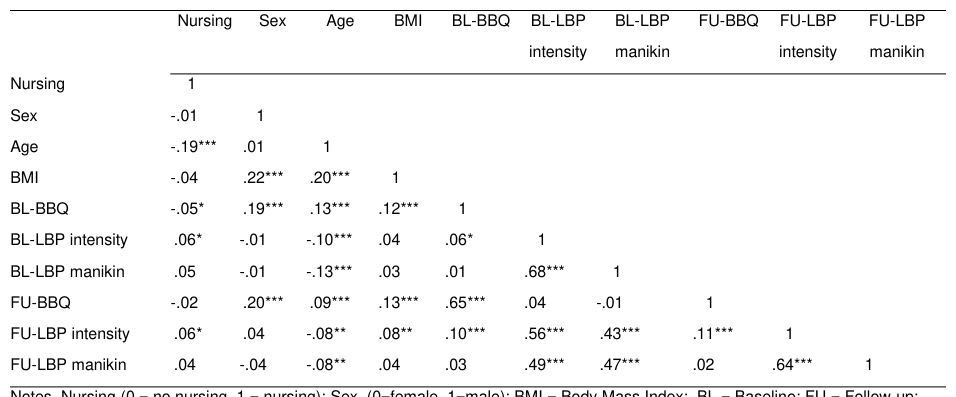
Table 2 shows the Pearson correlation coefficients for the relationships between study variables. Many correlations were < .10 i.e. small in terms of effect size. Age and BMI were positively correlated with BBQ scores. BBQ scores were higher in men compared with women. Nursing was positively associated with LBP intensity. Correlations between BBQ scores and LBP-intensity were significant while associations between BBQ scores and LBP prevalence measured with the manikin were not. Associations between the two indicators of LBP were strong (.68 at baseline, .64 at FU). The stability of BBQ scores over one year was high (r = .65); the stability of LBP was somewhat lower (.56 for LBP intensity and .47 for LBP manikin).
Table 2: Correlations Among Study Variables Nursing Sex Age BMI BL-BBQ BL-LBP BL-LBP
Notes. Nursing (0 = no nursing, 1 = nursing); Sex (0=female, 1=male); BMI = Body Mass Index; BL = Baseline; FU = Follow-up; BBQ = Negative Back Belief Questionnaire; LBP = Low Back Pain; Manikin = LBP mark in pain figure (0 = no, 1 = yes). ***p < .001, **p < .01, *p < .05, two-tailed.
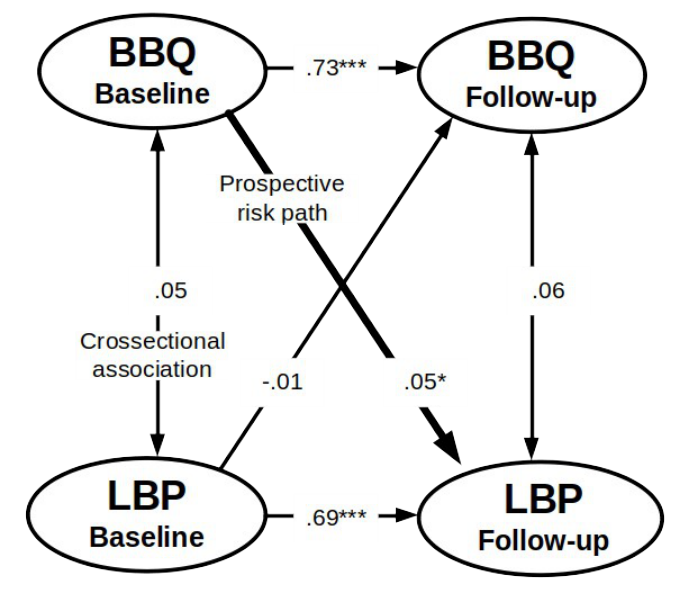
Before testing the study hypotheses in cross-lagged panel models, a measurement model was constructed. In the measurement model the individual items of the BBQ and the LBP questions are considered indicators of latent variables representing BBQ and LBP, respectively. As such, each indicator was restrained to have the same loading on the latent variable representing BBQ and LBP at baseline and follow-up, to guarantee measurement equivalence. The fit of the measurement model was good (Table 3). The fit of the cross-lagged panel model was also good (Table 3). Figure 2 shows the cross-lagged panel model with estimated path coefficients for the group of nurses and the group of others. In nurses, the longitudinal prospective risk-path from BBQ to LBP at follow-up (β = 0.30, p =.013) and the cross-sectional association between BBQ and LBP at follow-up (β = 0.42, p =.031) were both more positive compared with the corresponding values for the group of others (longitudinal path: β = 0.05, p =.023; cross-sectional path at follow-up: β = 0.06, p =.062). The reverse longitudinal path, from LBP to BBQ at follow-up, was not significant.
Table 3: Structural Equation Models’ fit to Empirical Data Model χ2 df χ2/df p RMSEA CFI AIC
The prospective risk path coefficient and the cross-sectional association at follow-up was higher in nurses than in others and the fit of a constrained model that forced both paths to be the same was significantly worse in fit (χ2diff(2) = 6.15 , p = .046).
Figure 3. Cross-lagged panel structural equation model of association between BBQ and LBP in nurses and others
DISCUSSION
To the best of the authors’ knowledge this is the first prospective, large-scale study that compares the strength of association between BBQ scores and LBP in nurses and others. Nurses did not report more pessimistic beliefs about LBP than others but, compared with others, their beliefs were more closely related with future LBP. In addition, LBP intensity was higher in nurses than in others. In the group of nurses, BBQ scores were a prospective risk factor for an increase in LBP after 1 year, with a moderate effect size; in the group of others, the effect size was only small. Nursing includes many risk factors other than maladaptive beliefs, including time pressure and lack of time control (Elfering, Grebner, Semmer, & Gerber, 2002) and ergonomic risks factors such as awkward postures and lifting (Elfering et al., 2002). However, the strength of the associations between BBQ scores and LBP found in nurses was comparable to or even higher than that between LBP and many other risk factors described in the literature to date, even for operating room nurses who have a particularly high exposure to various risk factors (Choobineh, Mohaved, Tabatabaie, & Kumashiro, 2010; Meijsen & Knibbe, 2007; Moscato et al., 2010). Assuming that most LBP is non- specific and of multifactorial etiology (Elfering & Mannion, 2008), then the results indicate that beliefs may be especially relevant in nursing. BBQ scores were not significantly higher in nurses than in others, but they may nevertheless be influenced by education and work experience: regarding the working hypothesis of the role of biomedical training in triggering negative beliefs about LBP (Domenech et al., 2011), the biomedical education may not have increased maladaptive beliefs in nurses but may have made them more entrenched. Future studies should evaluate this possible mechanism experimentally. The relatively high participation rates, in both the baseline and follow-up surveys, are a strength of the study. However, the study also has some limitations. The sample was not wholly representative of the population of Switzerland because of the pre-stratification (into pain and non-pain groups prior to random selection of participants) and because sampling was restricted to the German-speaking part of the country and (within that region) to those who were fluent in German. Individuals were asked if they were willing to participate in a survey on LBP; possibly, those who had more LBP or were more “LBP-aware” were more inclined to volunteer for participation than others, making the data less representative of the general population.
CONCLUSIONS
In a population sample, nurses did not report more negative back beliefs or reported higher LBP prevalence than other participants. LBP was of a higher intensity in nurses compared with other study participants and the association between BBQ with LBP was stronger in nurses than in others. In nurses, the prospective risk path over the one-year follow-up was 0.30 and significant; this represented a moderate effect size, while the effect size in others was only small. The strong associations in nurses suggests that their educational training should better embrace the biopsychosocial model of disease, in an attempt to reduce the extent of occupational LBP in healthcare workers. This might serve to complement initiatives related to the increase of time control (Elfering et al., 2002) and work participation (Elfering et al., 2010; Wilson, 2001) as well as worksite training of back muscle function and body balance (Elfering et al., this issue).
ACKNOWLEDGEMENT
The research reported in this article was supported by a grant from the Swiss National Science Foundation, National Research Program NRP53 “Musculoskeletal Health – Chronic Pain” entitled “Defining norm values on the natural history of acute and chronic low back pain in the Swiss population and prognostic indicators for chronic low back pain” (Project 405340-104826/1) and project “From norm values and predictive items in low back pain to operational tools for health care professionals” (405340-104826/2).
CONFLICT OF INTEREST The authors declare no conflict of interest.
REFERENCES
Bishop, A., Thomas, E. & Foster, N. E. (2007). Health care practitioners' attitudes and beliefs about low back pain: a systematic search and critical review of available measurement tools. Pain 132, 91-101. Borrell-Carrió, F., Suchman, A. L., & Epstein, R. M. (2004). The biopsychosocial model 25 years later: principles, practice, and
scientific inquiry. Annals of Family Medicine, 2, 576-582. Bostick, G. P., Schopflocher, D., & Gross, D. P. (2013). Validity evidence for the back beliefs questionnaire in the general population. European Journal of Pain, 17, 1074-1081. Buchbinder, R., & Jolley, D. (2005). Effects of a media campaign on back beliefs is sustained 3 years after its cessation. Spine,
30, 1323-1330. Cherney, K. (2013). Musculoskeletal disorders. Retrieved August, 15, 2013, from http://www.healthline.com/health/musculoskeletal-disorders. Choobineh, A., Mohaved, M., Tabatabaie, S. H., & Kumashiro, M. (2010). Perceived demands and musculoskeletal disorders in operating room nurses of shiraz city hospitals. Industrial Health, 48, 74-84. Coudeyre, E., Rannou, F., Tubach, F., Baron, G., Coriat, F., Brin, S., Revel, M., & Poiraudeau S. (2006). General practitioners'
fear-avoidance beliefs influence their management of patients with low back pain. Pain, 124, 330-337. Daraiseh, N., Genaidy, A. M., Karwowski, W., Davis, L. S., Stambough, J., & Huston, R. L. (2003). Musculoskeletal outcomes in multiple body regions and work effects among nurses: The effects of stressful and stimulating working conditions. Ergonomics, 46, 1178-1199. Darlow, B., Fullen, B. M., Dean, S., Hurley, D. A., Baxter, G. D., & Dowell, A. (2012). The association between health care
professional attitudes and beliefs and the attitudes and beliefs, clinical management, and outcomes of patients with low back pain: a systematic review. European Journal of Pain, 16, 3-17. Domenech, J., Sánchez-Zuriaga, D., Segura-Ortí, E., Espejo-Tort, B., & Lisón, J. F. (2011). "Impact of biomedical and biopsychosocial training sessions on the attitudes, beliefs, and recommendations of health care providers about low back pain: A randomised clinical trial." Pain, 152, 2557-2563.
Elfering, A., & Mannion, A. F. (2008). Epidemiology and risk factors of spinal disorders. In N. Boos & M. Aebi (Eds.), Spinal disorders – Fundamentals of diagnosis and treatment (pp. 153-173). Berlin: Springer. Elfering, A., Dubi, M., & Semmer, N. K. (2010). Participation during major technological change and back pain. Industrial
Health, 48, 370-375. Elfering, A., Grebner, S., Semmer, N. K., & Gerber, H. (2002). Time control, catecholamines, and back pain among young nurses. Scandinavian Journal of Work, Environment & Health, 28, 386-393. Elfering, A., Mannion, A. F., Jacobshagen, N., Tamcan, O., & Müller, U. (2009). Beliefs about back pain predict the recovery
rate over 52 consecutive weeks. Scandinavian Journal of Work, Environment and Health, 35, 437-445. Elfering, A., Schade, V. Burger, C., Stöcklin, L., Baur, S., & Radlinger, L. Stochastic resonance training at work reduces musculoskeletal pain in nurses. In T. Ahram, W. Karwowski and T. Marek (Eds.) Proceedings of the 5th International Conference on Applied Human Factors and Ergonomics AHFE 2014, Kraków, Poland 19-23 July 2014. UK: Taylor & Francis. Engel, G. L. (1977). The need for a new medical model: a challenge for biomedicine. Science, 196, 129-136. Jensen, J., Albertsen, K., Borg, V., & Nabe-Nielsen, K. (2009). The predictive effect of fear-avoidance beliefs on low back pain
among newly qualified health care workers with and without previous low back pain: a prospective cohort study. BMC musculoskeletal disorders 10, 117. Linton, S. J., Vlaeyen, J., & Ostelo, R. (2002). The back pain beliefs of health care providers: are we fear-avoidant? Journal of Occupational Rehabilitation 12, 223-232. Mannion, A. F., Horisberger, B., Eisenring, C., Tamcan, O., Elfering, A., & Müller, U. (2009). The association between beliefs
about low back pain and work presenteeism. Journal of Occupational and Environmental Medicine, 51, 1256-1266. Mannion, A. F., Wieser, S., & Elfering, A. (2013). Association between beliefs and care-seeking behavior for low back pain.
Spine. 38,1016–1025. Meijsen, P., & Knibbe, H. J. J. (2007). Work-related musculoskeletal disorders of perioperative personnel in the Netherlands.
AORN Journal, 86, 193-208. Moscato, U., Trinca, D., Rega, M. L., Mannocci, A., Chiaradia, G., Grieco, G., Ricciardi, W., & La Torre, G. (2010).
Musculoskeletal injuries among operating room nurses: Results from a multicenter survey in Rome, Italy. Journal of Public Health, 18, 453-459. Muller, U., Tänzler, K., Bürger, A., Staub, L., Tamcan, O., Roeder, C., Jüni, P., & Trelle S. (2008). A pain assessment scale for population-based studies: development and validation of the pain module of the Standard Evaluation Questionnaire. Pain, 136, 62-74. Rolli Salathé, C., & Elfering, A. (2013). A health-and resource-oriented perspective on nonspecific lower back pain in working
individuals. ISRN Pain, 2013, 1-19. Rolli Salathé, C., Kälin, W., Semmer, N. K., Roth, M., Müller, U., Melloh, M., Elfering, A. (2013). Comparison of a pain - resilient group of working individuals to population – based Case Controls with and without acute Low Back Pain. European Pain Journal, 7, 1411–1421. Symonds, T. L., Burton, A. K., Tillotson, K. M., & Main, C. J. (1996). Do attitudes and beliefs influence work loss due to low
back trouble? Occupational Medicine, 46, 25–32. Vlaeyen, J. W., & Linton, S. J. (2006). Are we "fear-avoidant"?, Pain,124, 240-241. Wieser, S., Horisberger, B., Schmidhauser, S., Eisenring, C., Brügger, U., Ruckstuhl, A., Dietrich, J., Mannion, A., Elfering, A., Tamcan, Ö., & Müller, U. (2011). Cost of Low Back Pain in Switzerland in 2005. European Journal of Health Economics, 12, 455-467. Wilson, J. R. (2001). Ergonomics and participation. In J. R. Wilson & E. N. Corlett (Eds.), Evaluation of human work: a
practical ergonomics methodology, (pp. 1071–1096). Bristol, UK: Taylor & Francis. Woby, S. R., Watson, P. J., Roach, N. K., & Urmston, M. (2004). Are changes in fear-avoidance beliefs, catastrophizing, and appraisals of control, predictive of changes in chronic low back pain and disability? European Journal of Pain, 8, 201-210. Working Group for the Danish Institute for Technology Assessment (1999). Low-Back Pain. Copenhagen, Danish Institute for
Health Technology.
LISTED IN THE AHFE DIGITAL BOOKSTORE CATALOGUE
Explore the complete digital volume
Advances in Human Aspects of Healthcare
Read this individual research paper free through the original publisher, or explore the full digital proceedings book.
ISBN 978-1-4951-2093-0
Explore this ISBN in the AHFE Bookstore ↗Listed in the July 2026 bookstore catalogue; search by ISBN to confirm current availability · Digital book purchase optional