Angela Caridà, Monia Melia, Maria Colurcio (2019). Interactive Technologies to Enhance Collaborative Practice for Innovation. In: Advances in The Human Side of Service Engineering. AHFE Open Access, vol. 8. https://doi.org/10.54941/ahfe100265
This study aims to provide a practice based view of collaborative innovation in order to contribute to the theoretical debate on collaborative innovation and to define a managerial practice to source and manage innovation. The context of investigation is the internet environment. It is recognized as powerful environment for enhancing collaborative innovation with customers, as well as, with the entire firm’s network. The paper, adds value to the existing literature on innovation by framing the elements of the collaborative practice for innovation and their role in the resource integration process and in the value creation. The study fosters a shared understanding of what the collaborative innovation practice is in order to keep it workable and meaningful. It calls for a new, more holistic and strategic role of the collaborative practice and provides new insights to replace episodic and improvised activities to innovate with a structured, codified and recursive practice to enhance the ideas co-generation process and to create value for all the actors engaged.
It is widely agreed that innovation has a key role in sustaining firms’ competitiveness (Mumford, 2000; Kanter, 1988; Schumpeter, 1939), as it is the life blood of corporate survival and growth (Zahra and Covin, 1984, p. 183). Innovation is a multi-dimensional and context-specific phenomenon. Indeed, as Adams et al. (2006, p. 22) state: “the term innovation is notoriously ambiguous and lacks either a single definition or measure”. The terminological ambiguity reflects the variety of research traditions and perspectives - marketing, quality management, operations management, technology management, organizational behavior, product development, strategic management and economics - that address various aspects of innovation (Hauser, Tellis and Griffin, 2006).
Over the last two decades, there has been a radical change in the innovation landscape that affected both the way in which academics consider innovation (Russo Spena and Colurcio 2010) and firms develop innovatory activities (Zeng, Xie and Tam, 2010). “Innovation in information technology, institutions, and strategic reorientation of technological change has opened opportunity, and competition has put strong imperatives in play for collaborative innovation” (Weaver, 2008). As Coombs and Miles (2000) state, innovation relates changes in market relationships that are embedded within a technological dimensions instead of the mere artifacts and the technological innovation.
Thereby a shifting from a closed view toward an open view of innovation emerged (Chesbrough, H. W., 2006). The open view frames innovation as the outcome of an interactive process between the firm and its environment (Perks, Gruber, and Edvardsson, 2012; Mention, 2011), that requires the development of strong relationships among different parties (Trott and Hartmann, 2009; Chesbrough, 2006). This approach is based on the collective construction of value (Vargo, 2008; Vargo and Lusch, 2008) and on the topic of “collaborative innovation” that is considered as the dominant perspective in the innovation literature in the last decades. Collaborative innovation focuses on the access to the resources of the crowd to enhance innovation efforts of companies. As stressed above, the recent and renovate interest for the relational approach to innovation is due to new possibilities for interaction and openness provided by the web based technologies. Indeed, internet can serve as a powerful environment for collaborative innovation with customers (Schau, Muñiz and Arnould, 2009; Sawhney, Verona and Prandelli, 2005; McAlexander, Schouten and Koenig, 2002), as well as, with the entire firm’s network (e.g. experts, suppliers, etc.). Innovation doesn’t depend on the discovery or creation of new resources or systems but it consists of the recombination of existing resources and ongoing efforts to maintain and develop new relationships, as well as new ways of creating value (Akaka and Vargo, 2013; Corradi, Gherardi and Verzelloni, 2010; Arthur 2009). Social interactions in a digital environment enable new combinations of previously disconnected and unrelated data and information (Kristensson, Gustafsson and Archer, 2004) that companies can lead and develop (Hargadon and Bechky, 2006) to foster innovation. Interactive technologies allow for a broad and continuous application of techniques to foster creativity and enrich the users’ imagination (Piller and Walcher, 2006), by stimulating the continuous generation of new and valuable idea that are selected, developed and launched through the collaboration with the entire firm’s network.
Despite of the prosperous and well-established debate on collaborative innovation and on the role of interactive technologies in fostering it, few studies investigated this topic as a practical phenomenon (Russo Spena and Mele, 2012; Schau, Muñiz and Arnould, 2009) as well as dynamics through which such practice emerges remain ambiguous. More generally, this is confirmed by the lack of contributions, within the practice literature, on the relevant topic of how to organize practice for strategic aims (Dougherty, 2004), such as innovation. Therefore, the strategic connection of the practice theory to the issues of innovation is still underdeveloped.
The route we choose to bridge this gap is to deepen the topic of collaborative innovation from a practice lens by stressing the role of interactive technologies in enhancing the innovation process.
The paper, adds value to the existing literature on innovation by articulating, through empirical examination, the elements of the collaborative practice for innovation and their role in the resource integration process and thus in the value creation.
The remainder of this paper is organized as follows. We review the literature discussing previous contributions on collaborative innovation and practice based theory. Then we present the research design and discuss the results. Finally, we draw the theoretical and managerial implications.
THEORETICAL FRAMEWORK The theoretical framework we referred to concerns two theoretical streams of research: studies on collaborative innovation and studies on practice theory.
Collaborative innovation In the last decades the debate on the collaborative innovation has received a considerable attention within the academic literature and beyond. This topic is characterized by many approaches and terminologies which stress many different and various aspects of collaborative innovation.
More recently, the innovation literature has emphasized the key role of interaction describing innovation as an information-creation process that arises out of social interaction (Trott and Hartmann, 2009). It is an iterative, cumulative and cooperative phenomenon, driven by processes of interactive learning (Lundvall,1992). According to this perspective, innovation is viewed as the product of networks of firms and other organizations (Freel and de Jong, 2009).
As Trott and Hartmann (2009) stated the topic of collaborative innovation is not new within the innovation management literature. It can be defined as a general concept that is rooted in the previous contributions on the network model of innovation (Rothwell and Zegveld,1985; etc), on open innovation (Chesbrough, 2003, 2006; Gassmann, 2006) and on open innovation user that includes firms users or individual users (von Hippel 1985, 2013).
The collaborative innovation approach calls for an open innovation paradigm that advocates the importance of external agents for innovation (Chesborough, 2003; Laursen and Salter, 2006) and emphasizes the fundamental role of both external and internal networks of information and collaboration in fostering innovation (Hakansson, 1982; Freeman, 1991). It goes beyond the development of an inter-firm cooperation (Sivadas and Dwyer, 2000; Wuyts et al., 2004) by providing a network perspective. The network perspective encompasses from the firms perspective to a global perspective which integrates the views of the diverse network participants (Rampersad et al., 2010).
According to previous studies (Chesbrough, 2003; Chesbrough and Crowther, 2006) the collaborative, relational and interactive approach to innovation is critical to support the growth and the firm’s competitiveness. It can be seen as a necessary organizational adaptation to the changes in the external environment (e.g. the increasing availability and mobility of knowledge workers, the widespread availability of internet and venture capital markets, the reduction of the product’s life cycle, etc.).
Successful innovation requires sources of complementary competence that lie outside of the innovating firm (Freel and de Jong, 2009). The establishment of network relations can provide an avenue to address this problem allowing firms to ride out the limits and the barriers to innovation (Colurcio and Russo Spena, 2013). External partnerships provide firms with the stimulus and capacity to innovate (Zeng, Xie and Tam, 2010), by fostering the access to resources, complementary skills, capabilities and knowledge that are not internally available (Døving and Gooderham 2008). Furthermore, they can contribute to reduce time-to-market and enhancethe firm’s ability to better utilize internal creativity as well as to better collect and channel external creativity (Colurcio et al., 2012).
Collaborative networks affect positively the innovative performance of firms, by impacting on the introduction of innovation, on the degree of innovation novelty (Nieto and Santamaría, 2010, Colurcio, 2009) – e.g. inter-firms cooperation pursues radical and incremental innovations (Sammarra and Biggiero, 2008) – and on both the product and process innovation (Whitley, 2002). Specifically, the innovative performance of firms is affected by the strength of the relationships ties (Freel and de Jong, 2009; Hansen, 1999). Strong ties, that depend on durable relations and involve a trust and emotional closeness, enable the transfer of complex knowledge; on the other hand, weak ties, are generally temporary and involve little emotional investment. They are a source of inspiration as provide new perspectives, novel information and opportunities. According to Freel and de Jong, 2009 both ties can generate value, by allowing firms to leverage on the novelty as well as on the trust necessary to innovate.
The main challenge for firms is to ensure the technological, strategic and relational alignment with the partners (Emden, Calantone and Droge 2006). The interaction between partners is the premise of resource integration and thus a precondition for creating a synergistic value: “through their interactions, partners transfer knowledge and other resources in developing organisational learning; […] knowledge, skills and other resources are integrated to put together a network of firms possessing a set of competencies capable of offering a value innovation that is an innovative value proposition which enable higher value co-creation” (Mele et al., 2010).
Collaborative innovation from a practice lens The practice concept has a long tradition in philosophy and in sociology; it is an umbrella concept which covers a broad set of labels and interpretations (Corradi, Gherardi and Verzelloni, 2010).
In this study we referred to the label practice lens or practice-oriented approach (Corradi, Gherardi and Verzelloni, 2010) as we are interested in framing the macro and the micro dimension of a phenomena (Schultze and Orlikowski, 2004), such as collaborative innovation, by analyzing what people do, how people do and the consequences of their doing (Schultze and Boland, 2000).
The practice-oriented approach draws on a view that social reality consists of nexuses of practices (Schatzki et al. 2001) that make action and order possible (Bourdieu, 1977). By focusing on how something happens and which are the consequences (Fuglsang and Eide, 2013), practice has been a central approach in studies of various phenomena (Kowalkowski et al. 2012). Although studies on innovation from a practice oriented approach are still in an infancy stage (Russo Spena and Mele 2012), the practice lens is becoming a central notion for understanding innovation (Korkman et al. 2010).
According to Korkman et al. (2010), the practice-based view frames innovation as a set of innovative practice (actions) which depends on the interaction/integration of resources of customers and providers with different contextual elements (Reckwitz, 2002). Activities and actor, are focal issues in strategy-as-practice (Wikner, 2010). Actors interact through practical activities, such as actions or micro-processes for a strategic goal and expect an intended outcome. Over time, actors develop patterns of actions and routines that can be identified as strategic practices. The concept of practice is not synonymous with action. It expands the unit of analysis to the system that fosters action (Dourish, 2001), involving the subject, the action, the tools and the context in which the integration of many resources occurs (Reckwitz, 2002).
Hence, investigating innovation through the practice lens implies the joint analysis of these elements, as well as, the idea that innovation emerges from an interactive process performed by many actors.
According to this, we address the topic of collaboration as a key theme for the development of innovation practice. Paraphrasing the notion of market practice (Kjellberg et al, 2012) and combining it with the topic of collaborative innovation (Trott and Hartmann, 2009; Chesbrough, 2006) we stated that collaborative innovation practices are enacted through – routine, micro-level inter-actions between multiple actors who integrate their resources seeking to create value for themselves and other by developing something new and better.
RESEARCH DESIGN Aim
This paper aims to contribute to the theoretical debate on collaborative innovation from a practice based view (Korkman et al. 2010; Røpke, 2009; Korkman, 2006; Schatzki et al., 2001). Specifically, it aims to improve the understanding on how collaborative practice through online platforms can be set up by companies to source and manage innovation. In order to fulfill the purpose we first try to clarify what collaborative innovation practice is and what are its core elements, second we frame role of interactive technologies in fostering collaborative innovation practice.
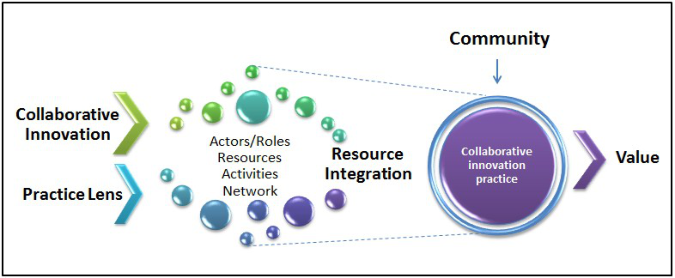
Research construct In order to analyzed and interpret data we draw conceptual research construct (figure, 1). The research construct draws from previous practice research (Russo Spena and Mele, 2012; Korkman et al., 2010; Kjellberg and Helgesson, 2007) and from studies on collaborative innovation (Von Hippel, 2013, Trott and Hartmann, 2009; Døving and Gooderham 2008; Chesbrough, 2006). It identifies key elements to set collaborative practice to foster innovation: actors, roles, resources, activities and network.
Specifically, we define actors as generic entities, who have the capability to integrate resources (Vargo and Lusch, 2008). They are engaged in exchange relationship and act as resource integrators to carry out new practice (Reckwitz, 2002). Resources we focus on are mainly operant whichinclude knowledge, skills, effort, technology etc. (Akaka and Vargo, 2013; Vargo and Lusch, 2008). They act upon other resources to foster new way of creating value. Activities are the active doing that individuals carry out by integrating resources from multiple sources as the the focal firm and or other public and private sources (McColl-Kennedy, 2012.). Network relates to the dynamic relational system where all elements are embedded in.
As stressed above, the research construct identifies the resource integration process as the main condition to set the collaborative innovation practice and to create value for all the actors. Value is the potential outcome that actors can extract from the interaction. As Vargo and Lusch (2011, p.184) stated: “the usefulness of any particular potential resource from one source is moderated by the availability of other potential resources from the other sources, the removal of resistances to resource utilization, and the beneficiary's ability to integrate them”. Accordingly, value is an abstract concept with specific meanings that vary according to context (Sweeney, 1994).
Figure 1: The theoretical construct (Our elaboration)
Methodology
We used a Social Network Analysis (SNA) based approach (Wasserman and Faust, 1994) as it is a suitable methodology for understanding complex patterns of interaction (Streeter and Gillespie, 1992) and allows to analyse different actors who are interlinked in the relationship of the network. As Otte and Rousseau (2002) observed, SNA is a broad and flexible strategy for investigating social structure where the focal priority to understand phenomena is given to the relationship between actors. Specifically, SNA “conceptualises social structure as a network with ties connecting, members and channelling resources focuses on the characteristics of ties rather than on the characteristics of the individual members and views communities as networks of individual relations that people foster, maintain, and use in the course of their daily lives” (Wetherell et al.,1994 p. 645). The study focuses on Formabilio.com, a network of designers, business partners (Partners) and supporters built up by an Italian furnishing startup who uses interactive technologies to source and give shape to designers’ ideas by emphasizing the style, quality and tradition of the made in Italy Data collection
Research activity has been carried out between September 2013 and February 2014. Data has been collected in two phases. The first phase concerned the non-participant observation of the Formibilio community. The aim of this research stage has been the better understanding of the dynamics of interaction (analyses of posts, forum discussions, blog, etc). The second phase has been based both on primary and secondary data. Secondary data related articles and documents available through the web and other sources. Primary data were gathered through direct interaction with all actors of the network: designers, supporters, Partners, Formabilio. Information have been collected through an online questionnaire submitted to community members and trough direct interviews to Partners and Formabilio Managers. The interviews were tape-recorded and transcribed verbatim.
Data and information were selected according the SNA principle that relational data are the focus of the investigation and are fundamental for the understanding of social phenomena in order to explore and learn as much as possible about the set-up of the collaborative innovation practice within a digital context. Data analysis and interpretation have been based on the research construct we explained above.
Formabilio network Formabilio is an Italian start up that produces furniture, lighting and home accessories designed by creative minds from all over the world in a participatory and eco-friendly way. It is a community of talented designers who propose innovative solutions with style, comfort and according to sustainability standards. Formabilio “is a contest provider” as the co-founder says, “it organizes call for ideas to gather through digital platform the most original and innovative ideas from the creative crowd of community”. Ideas are chosen by a community of design enthusiasts, manufactured by small enterprises of the made in Italy and sold online on the web-platform Formabilio.com.
The architecture of the digital platform allows Formabilio to fit the users’ needs with the designers’ ideas and the know-how of Partners. Designers are the main actors engaged in the creation of a product as well as anyone who loves design; they are called to propose ideas and participate to idea contests. The entire community is called to evaluate, comment and vote ideas, while the Partners of Formabilio produce the winning ideas (see Figure 2).
Figure 2: The Formabilio community
Figure available in the original PDF paper.
Within the Formabilio platform, each designer can manage a personal page – “our designers” – where he/she can tell itself by introducing passions and experiences and the creative solution proposed to the community.
All submitted ideas are evaluated, commented and voted by peers and potential customers. The community judgment drawn from a formula that bond the number of votes, the average of the opinions (e.g. I don’t like it, do it better; good, I like it and great) and the reputation of voters. The best ideas in terms of innovation, sustainability and appeal are selected and submitted to the evaluation of a jury of experts, composed by the Formabilio’s staff, Partners, and experts.
The winning ideas are developed and transformed in products by the small craftsmanship companies partners of Formabilio in full compliance with the know-how and high quality of the made in Italy tradition. Formabilio is the hub of the network of excellent manufacturing companies who produce the selected ideas (Ivo Fontana Mobili, Euroline Furniture, Live In and Torremato). It uses the digital environment to favor the sharing of resources and the cooperation between all the companies of the network..
All products realized, are marketed online through the platform. Formabilio business model is based on online sales. It grants to the winning designers a fee of 7% on all sold products and to the community a 10% discount on the products purchased if they have voted and chosen a winning project. The company’s goal is to value the skills of all the players involved. The activity counter lists each actions carried out by the community members and grades their involvement in the project by building their reputation.
Four months from its launch, more than 40.000 people have registered and have joined the Formabilio’s community. Among them, 700 designers submitted more than 1.100 projects for the first four contests. Up to now, 87.300 users joined the platform and 2050 young designers have been involved in 25 ideas contests by submitting a total of 4.500 proposals. The community has voted 22.500 times and commented 42.000 times. More than 80 ideas to produce have been selected and 44 have been realised by the Partners involved in the project and are now available in the online shop.
FINDINGS In this section we report the results of the case study analysis we carried out according to the construct of research outlined above.
Actors and roles The main actors involved within the community are designers and Partnes. Both of them act as primary resource integrators, as they provide input for the design and the further realization of new products through new materials and new applications, as demonstrated by the following quotes.
“G: Very good! I like your idea. Probably you can use a part of it for the lamp backing. Anyway my vote is 5, the maximum. S: I think you’re right. I can regain more space. Thank you so much for your suggestion”. Giancarlo e Silvia, Formabilio designers.
“The knowledge exchange within the community allows for the optimization of products and solutions. I remember a conversation of a designer who provided suggestions to better fit an idea. The proposal has been changed according to the suggestions and has been evaluated successfully in the following contest” Denis, CEO Euroline –Partner.
As quotes reveal, Formabilio is the hub of the network. The company enhances the integration of resources among all players involved in the project. It plays as intermediary of the innovation process establishing connections and relationships among the actors of the community. Thanks to Formabilio actors are networked each other even on issues which are also beyond the specific context. Furthermore, it supports the learning process within the community by channeling and allowing the matching of the actors skills and knowledge to improve their effectiveness as resource integrators and to set up a new ways of creating value.
“Formabilio goes between us and designers to solve problems or to redefine some details of the product. …bridges the gap between the actors of the community as it interprets the need of both supplier and designers. Furthermore, it is possible interact personally with designers during the events organized by Formabilio” Denis, CEO Euroline –Partner.
Potential customer or made in Italy-furnishing lovers are a typology of actors; who differently from the previous ones, don’t have a decisive role in the creative process but their contribution is valuable as they provide comments , remarks and opinions on the product, materials, etc. Such community insights are taken in consideration to select the most interesting ideas and to test the product before its launch on the market.
“I like it, interesting project. I’ll vote it”. Andrea, Formabilio community member.
“Good job! Your projects are always originals and interesting, but please, could you replace the green color with another one? It is too common and used”. Davide, Formabilio community member.
“Formabilio gives us the opportunity of direct feedback from customers about products. Traditionally, suppliers of components, like my company who has mainly B2B relationship, have not any direct relationship with customers…now, due to the engagement in the community of Formabilio, we are more awareness and interested in the customers’ opinion. It marks our route and pushes us to interact more with designers and other suppliers - within the supply chain - to refine products according to the customers’ preference”. Denis, CEO Euroline –Partner.
Resources All actors are resources integrators. They integrate their own resources with ones made available from the community in different ways and intensity depending on the typology of role, skills, and of relationship they engaged. Specifically, they integrate human – knowledge, skills, time, effort – as well as non-human resources relating to the platform technical infrastructure to create new and sustainable solutions.
Data analysis and quotes highlighted that creativity, knowledge, technical and artistic competences, as well as, the culture of the made in Italy are the main resources that actors integrate within the community of Formabilio. May be such resources could be meant as a sort of shared values among them. Actors are continually encouraged to act upon, recombine and improve existing resources, as well as, to create new ones. This mechanism is well-recognised within the community as the suitable way to shift ideas into new and original products.
“Formabilio allow us to offer to the creativity of designers all our skills, competences and all our 60 years’ experience and tradition, to further their opportunities and ours.” Katia, Manager Ivo Fontana Mobili – Partner.
“The traditional mistrust within the supply chain has been replaced by the culture of collaboration. I have the opportunity to improve my work by learning working techniques that belong to interrelated business (supplier company) and that till a year ago I perceived as very far from my work”. Denis, CEO Euroline –Partner.
Technology (especially referred to the technical infrastructure of the digital platform) is a core factor for the process of resources integration and for the development of the collaborative innovation practice. As showed in the figure 2, Formabilio.com is an user-friendly interface designed to ensure access, transparency (e.g. idea contest rules, project evaluation rules etc.), visibility of the community members (e.g. recognition by both peers and companies), sharing of information and opinion, and to provide the opportunities to collaborate. It is fundamental for stimulating and driving participants activities. Social software – Twitter, Facebook, Vimeo, YouTube, etc. – complement the technical infrastructure provided by Formabilio, but, differently from the blog and the space within Formabilio.com, they are used mainly by company to communicate the launch of new contests, events and news instead of to share and comment ideas. Social networks are just communication tools for Formabilio.
“Our records reveal that community members prefer interact and exchange opinions and ideas within the digital platform Formabilio.com instead of on the Facebook fan page. This trend is confirmed by the request of the community for a forum to freely interact”. Maria Grazia - Formabilio Co-founder.
Activities Activities can be simple activities, such as, compliance with community (liking and voting), collating information (discussions observation), buying products, and/or complex activities, such as, suggesting new ideas, commenting ideas (provide suggestion to improve ideas), evaluating the technical feasibility of product solutions, producing wining products and co-learning. Members can be involved in one or more tasks according to their role within the community. Such activities foster and nourish the practice of innovation by enhancing the logic of collaboration and value co-creation for all actors involved in the project.
“Formabilio is a sharing community; it a creative lab that put ideas in the realm of practice.” Luca, Formabilio designer.
“Formabilio is a showcase for the GOOD DESIGN. It pays attention to the experimentation, encourages creativity and fosters the sharing and comparison among experts.” Chiara, Formabilio designer.
Value The company’s goal is to produce and share value with all player involved in the project. We identified different types of value: economical and financial, relational, reputational, cognitive and epistemic. For designers value relates first of all the opportunity to increase their professional competences as well as to obtain trust and reputation as a “professional designer” by peers, firms and potential customers (e.g. each Formabilio product is marked with the designer and manufacturer names). Moreover they extract also economic value from the collaboration as they gain monetary reward for each sold product they designed (a fee of 7% on all sold products) .
“I believe Formabilio is a good chance to keep in touch people wants share ideas and knowledge. It allows the stand out of young professional designer and their cooperation with potential customers and firms.” Maddalena, Formabilio designer.
“...my favorite Formabilio product is Nestore, when I saw it Formabilio, it made me smile. There is nothing more appropriate than a sofa to represent comfort, free time, a shelter against stress. Nestore combines together a relax area for humans and for pets. I find this idea really original. The petroleum green version is the one I like best, by the way.” Fabio Area Pavimenti – Partner.
The Partners are small-size, craftsmanship and high specialised Italian firms who are very sensitive to environmental, sustainability and made in Italy issues. For them the value depends firstly on business and network opportunities: Joining the Formabilio adventure allowed them to access wider network and to get in touch with other companies and partners. Such type of value leads to or is a precondition for economic and financial value. Moreover value is related to knowledge as it concerns with tackling new technological and market frontiers and coping with the challenge of competitiveness.
“Formabilio is the future. It gives us the opportunity to work with designer who have new ideas and, above all, the opportunity to enter in a global market.” Paolo, Live In – Partner.
“We have no doubt that the furniture industry is suffering the recession and that needs for change and revolution. A part of this change is shown in the very innovative development and sale system applied by Formabilio. We grew up in term of relationships with other suppliers and designers. We have information about materials and manpower costs that before were not easy accessible; furthermore, the reference system enacted by Formabilio allowed us to be engaged in other projects outside the community” Denis, CEO Euroline –Partner.
Value for members of community is cognitive, relational and ludic too as all enthusiastic people who contribute by commenting and participating increase their own knowledge (about products, processes, designers, firms, materials, events….) and also find entertainment as they are design lovers and innovation sensitive. The first type of value for customers depends surely on the collaborative nature of the process: they are partners in the process of selection of the idea: the feel very deeply this participation and it is a great self-esteem benefit and gratification. The value for the customers is complex and relates the awareness of a solution which matches design, price, quality and sustainability (work processes, materials, employees respect, innovative culture). Of course customers can wish different types of value depending on their own engagement, system of values, role and expectations.
DISCUSSION
Companies are increasingly seeking to foster collaborative innovation as it is a key factor for the organisational success, performance improvement and survival in the competitive arena (Trott and Hartmann, 2009; Chesbrough, 2003; Chesbrough and Crowther, 2006). Recently, manufacturing companies operating in mature and traditional industry are trying to enrich the potentialities of traditional and strengthened methods through the use of interactive technologies to source new ideas (e.g. ideas contest). This type of open behavior combines the competitive feature of the challenge with the opportunity of interaction and collaboration enhanced by the virtual platform (Hutter et al., 2011). Our study stressed both the role of interactive technologies and of network for boosting a revolutionary business model based on the practice of collaborative innovation. This practice effects on the working activities and process of all actors involved in the project. It extends their business boundaries and prioritize the interaction and the sharing of information, knowledge, competences, etc. with new actors in a changeable relationship system. Indeed, as quotes cited above highlighted, suppliers of component products – who traditionally focuses on a narrow business approach – cooperate with other actors (e.g. Formabilio, designers, other suppliers, furniture experts and customers) since the fuzzy front end phases and share passion and enthusiasm with them. The heterogeneity of the actors of Formabilio network contributes to make this community unique. Differently from previous cases (e.g. Nel Mulino che Vorrei, Nutella, Dell etc ) that are based mainly on dyadic relationships (e.g. company and consumers, company and experts, company and fans), Formabilio community encompasses the point of view of different participants who are actively engaged in developing innovation through the mechanism of idea contest. Formabilio (the company) ensures fundamental preconditions for the triggering and the developing resource integration: the matching of the actors’ skills and knowledge. Formabilio improves the members effectiveness as resource integrators and the members opportunity to extract value from the community itself. Otherwise to previous studies (Sawney and Prandelli, 2000) that identify the community as one of the main actors in the practice of innovation we identify the community as the collaborative practice for the innovation development, as it is a new ways of creating value that results from the recombination of existing resources (Akaka and Vargo, 2013; Corradi, Gherardi and Verzelloni, 2010; Arthur 2009). Therefore, innovation and value emerge in and through the community and are enabled by web technologies, through the active doing and the resources integration. As stressed above, interactive technologies are operant resource (Caridà et al., 2014; Akaka and Vargo, 2013) which enable the development and the set-up of collaborative practice and ensure its recursiveness. This feature distinguishes the concept of practice from action (one of its element) and makes possible the development of innovation through the constant adaptation of the practice to the changing circumstances and context (Corradi, Gherardi and Verzelloni, 2010). Hence, the practice we identified and argued in the present study is not a static concept; it can may vary over time (McColl-Kennedy et al. 2012), depending mainly on the nature and on the architecture of its elements and on the networking system that frame it. In other words, the practice depends on the context that, according to an iterative view, creates and is created by the practice (e.g. community).
MAIN IMPLICATION This study provides relevant implications for companies and managers who are challenged by the need to create the right context and condition to foster innovation. We framed collaborative innovation from the practice lens, by analyzing what people do, how people do and the consequences of their doing (Schultze and Boland, 2000). Drawing from previous practice research (Russo Spena and Mele, 2012; Korkman et al., 2010; Kjellberg and Helgesson, 2007) and from studies on collaborative innovation (Von Hippel, 2013, Trott and Hartmann, 2009; Døving and Gooderham 2008; Chesbrough, 2006), we identified key elements - actors, roles, activities and networking – and key process – the resource integration –to set collaborative innovation practice and to foster a shared understanding of what it is and to keep it doable and meaningful.
The analysis of Formabilio network reveals the importance to shift the concept of community from the implicit to the explicit dimension. It is codified and recognised as a part of the organization formal structure and hence as a modus operandi. It is more than an interactive tool or a collection of action or a community of people, it is the context where all these resources integrate themselves to foster innovation. It is a strategic practice that requires a formal organizational structures based on values, norms, and rules (Piller and Walcher, 2006; Prahalad and Ramaswamy, 2004).
Our study calls for a new, a more holistic and strategic role of the community and provides new insights to replace episodic and improvised activities for innovating with a structured, codified and recursive practice to enhance continuously the ideas co-generation process and to create value for all the actors engaged.
From the theoretical perspective, the study frames the concept of community under a new lens. As stressed above, community is not just the main actors in the practice of innovation, it synthesizes the practice elements by defining the locus where collaborative innovation occurs.
Finally, however the present paper involves both the concept of practice and community, the definition we proposed in the study is very far from the concept of community of practice. Indeed, while contributions on community of practice defined community as something that pre-exists to its activities (Corradi, Gherardi and Verzelloni; 2010; Gherardi, 2009), the structures and the elements that inform our idea of community and thus the collaborative practice are not fixed or given, but are constituted and reconstituted through the practice itself.
REFERENCES
Adams, R., Bessant, J., Phelps, R. (2006), “Innovation management measurement: A review”, International Journal of Management Reviews Volume 8 No. 1 pp. 21-47. Akaka, M.A., Vargo, S.L. (2013), “Technology as an operant resource in service (eco) systems”, Information Systems and e-
Business Management Volume 1 No. 18. Arthur, W.B. (2009), “The nature of technology: what it is and how it evolves”, Free Press, New York. Bourdieu, P. (1977), “Outline of a Theory of Practice”, Cambridge university press. Caridà, A., Colurcio, M., Melia M. (2014), “Interactive health technologies and value co-creation. The Mayo Clinic Experience”, In: Managing Consumer Services: Factory or Theater?, Baglieri, Karmarkar, Springer International Publishing (ed.). Chesbrough, H. W. (2003), “Open innovation: The new imperative for creating and profiting from technology”, Harvard
Business Press. Chesbrough, H.W. (2006), “The era of open innovation. Managing innovation and change”, Volume 127 No. 3, pp. 34-41. Chesbrough, H., Crowther, A.K. (2006), “Beyond high tech: early adopters of open innovation in other industries”, R&d Management Volume 36 No. 3, pp. 229-236. Colurcio, M. (2009), “Asymmetric business relationships and interaction capabilities: an exploratory study”, Sinergie, Vol. 4, pp.
109-28. Colurcio, M., Russo-Spena, T. (2013), “Collaborative Innovation. A Focus on Food SMES”, In: Food Industry, Mazzalupo, Intech (Ed.). Colurcio, M., Tregua, M., Melia, M., Caridà, A. (2012), “Social networks for outsourcing and developing a Firm’s creativity”. In:
Advances in the Human Side of Service Engineering, Spohrer, Freund (ed) pp. …. Corradi, G., Gherardi, S., Verzelloni, L. (2010), “Through the practice lens: where is the bandwagon of practice-based studies heading?”, Management learning Volume 41 No. 3, pp. 265-283. Dougherty D. (2004), “Organizing practices in services: capturing practice-based knowledge for innovation”. Strategic
Organization Volume 2 No 1, pp. 35-64. Dourish, P. (2001), “Seeking a foundation for context-aware computing”, Human–Computer Interaction Volume 16 No. 2-4, pp.
229-241.
Døving, E., Gooderham, P.N. (2008), “Dynamic capabilities as antecedents of the scope of related diversification: the case of small firm accountancy practices”, Strategic Management Journal Volume 29 No. 8, pp. 841-857. Emden, Z., Calantone, R.J., Droge, C. (2006), “Collaborating for new product development: selecting the partner with maximum
potential to create value”, Journal of product innovation management Volume 23 No. 4, pp. 330-341. Fuglsang, L., Eide, D. (2013), “The experience turn as ‘bandwagon’: Understanding network formation and innovation as practice”, European Urban and Regional Studies Vol. 20 No.4, pp. 417-434. Freel, M., De Jong, J.P. (2009), “Market novelty, competence-seeking and innovation networking”, Technovation Volume 29 No
12, pp. 873-884. Gassmann, O. (2006), “Opening up the innovation process: towards an agenda”, R&d Management Volume 36 No. 3, pp. 223-
228. Gherardi, S. (2009), “Knowing and learning in practice-based studies: an introduction”, Learning Organization Volume 16 No. 5, pp. 352-359. Hakansson, H. (1982), “International marketing and purchasing of industrial goods: An interaction approach”, Chichester and
New York: Wiley. Hansen, M. T. (1999), “The search-transfer problem: The role of weak ties in sharing knowledge across organization subunits”, Administrative Science Quarterly Volume 44, pp. 82-111. Hargadon, A.B., Bechky, B.A. (2006), “When collections of creatives become creative collectives. A field study of problem
solving at work”, Organization Science Volume 17, pp. 484-500. Hauser, J., Tellis, G.J., Griffin, A. (2006), “Research on innovation: A review and agenda for marketing science”, Marketing science Volume 25 No. 6, pp. 687-717. Hutter, K., Hautz, J., Füller, J., Mueller, J., Matzler, K. (2011), “Communitition: The Tension between Competition and
Collaboration in Community-Based Design Contests”, Creativity and Innovation Management Volume 20 No. 1, pp. 3-21. Kanter, R.M. (1988), “Three tiers for innovation research”, Communication Research Volume 15 No. 5, pp. 509-523. Kjellberg, H., Helgesson, C.F. (2007), “On the nature of markets and their practices”, Marketing Theory Volume 7 No. 2, pp.
137-162. Kjellberg, H., Storbacka, K., Akaka, M., Chandler, J., Finch, J., Lindeman, S., Nenonen, S. (2012), “Market futures/future markets: Research directions in the study of markets”, Marketing Theory Volume 12 No. 2, pp. 219-223. Korkman, O., (2006), “Customer Value Formation in Practice: A Practice Theoretical Approach”. Swedish School of Economics
and Business Administration, Helsinki. Korkman, O., Storbacka, K., Harald, B. (2010), “Practices as markets: Value co-creation in e-invoicing”, Australasian Marketing Journal Volume 18 No. 4, pp. 236-247. Kowalkowski, C., Persson Ridell, O., Röndell, J.G., Sörhammar, D. (2012), “The co-creative practice of forming a value
proposition”, Journal of Marketing Management Volume 28 No. 13-14, pp. 1553-1570 Kristensson, P., Gustafsson, A., Archer, T. (2004), “Hernessing the creative potential among users”, The Journal of Product Innovation Management Volume 21, pp. 4-14. Laursen, K., Salter, A. (2006), “Open for innovation: the role of openness in explaining innovation performance among UK
manufacturing firms”, Strategic management journal Volume 27 No. 2, pp. 131-150. Lundvall, B. A. (1992), “National systems of innovation: Towards a theory of innovation and interactive learning”, London : Pinter. McAlexander, J.H., Schouten, J.W., Koenig, H.F. (2002), “Building brand community”, Journal of Marketing Volume 66 No. 1,
pp. 38-54. McColl-Kennedy, J.R., Vargo, S.L., Dagger, T.S., Sweeney, J.C., van Kasteren, Y., (2012), “Health care customer value cocreation practice styles”, Journal of Service Research Volume 15 No. 4, pp.370-389. Mele, C., Russo Spena, T., Colurcio, M. (2010), “Co-creating value innovation through resource integration”, International
Journal of Quality and Service Sciences Volume 2 No. 1, pp. 60-78. Mention, A.L. (2011), “Co-operation and co-opetition as open innovation practices in the service sector: which influence on innovation novelty?”, Technovation Volume 31 No. 1, pp. 44-53. Mumford, M. (2000), “Managing creative people: strategies and tactics for innovation”, Human resource management review
Volume 10 No. 3, pp. 313-351. Nieto, M.J., Santamaría, L. (2010), “Technological Collaboration: Bridging the Innovation Gap between Small and Large Firms”, Journal of Small Business Management Volume 48 No. 1, pp. 44-69. Otte, E., Rousseau, R. (2002), “Social network analysis: a powerful strategy, also for the information sciences”, Journal of
information Science Volume 28 No. 6, pp. 441-453. Perks, H., Gruber, T., Edvardsson, B. (2012), “Co-creation in radical service innovation: a systematic analysis of microlevel processes”, Journal of Product Innovation Management Volume 29 No. 6, pp. 935-951. Piller, F.T., Walcher, D. (2006), “Toolkits for idea competitions: a novel method to integrate users in new product development”,
R&D management Volume 36 No. 3, pp. 307-318. Prahalad, C.K., Ramaswamy, V. (2004), “Co-creating unique value with customers”, Strategy & Leadership Volume 32 No. 3, pp. 4-9. Rampersad, G., Quester, P., Troshani, I. (2010), “Managing innovation networks: Exploratory evidence from ICT, biotechnology
and nanotechnology networks”, Industrial Marketing Management Volume 39 No. 5, pp. 793-805. Raghavan, P. (2001), “Social networks on the Web and in the enterprise”. In: Web Intelligence: Research & Development.
Lecture Notes in Artificial Intelligence 2198, Zhong, Yao, Liu, Ohsuga (ed). pp. 58-60. Reckwitz, A. (2002), “Toward a Theory of Social Practices A development in culturalist theorizing”, European journal of social theory Volume 5 No. 2, pp. 243-263. Røpke, I. (2009), “Theories of practice - New inspiration for ecological economic studies on consumption”, Ecological
Economics Volume 68, pp. 2490–2497. Russo Spena, T., Mele, C. (2012), “Five Co-s” in innovating: a practice-based view", Journal of Service Management Volume 23 No. 4, 527-553. Russo Spena, T., Colurcio, M. (2010), “A cognitive-relational view of innovation in the agri-food industry: the fresh-cut
business”, International Journal of Innovation Management Volume 14 No. 2, pp. 307-329. Sammarra, A., Biggiero, L. (2008), “Heterogeneity and specificity of Inter-Firm knowledge flows in innovation networks”, Journal of Management Studies Volume 45 No. 4, pp. 800-829. Sawhney, M., Prandelli, E. (2000), “Communities of Creation: Managing Distributed Innovation in Turbulent Markets”,
California management review Volume 42 No. 4. Sawhney, M., Verona, G., Prandelli, E. (2005), “Collaborating to create: The Internet as a platform for customer engagement in product innovation”, Journal of interactive marketing Volume 19 No. 4, pp. 4-17. Schau, H.J., Muñiz Jr, A.M., Arnould, E.J. (2009), “How brand community practices create value”, Journal of Marketing Volume
73 No. 5, pp. 30-51. Schumpeter, J.A. (1939), “Business cycles”, New York: McGraw-Hill. Schatzki, T.R., Knorr-Cetina, K., vonSavigny, E. (2001), “The Practice Turn in Contemporary Theory”, Routledge: London. Schultze, U., Orlikowski, W.J. (2004), “A practice perspective on technology-mediated network relations: The use of Internetbased self-serve technologies”, Information Systems Research Volume 15 No. 1, pp. 87-106. Schultze, U., Boland Jr, R.J. (2000), “Knowledge management technology and the reproduction of knowledge work practices”,
The Journal of Strategic Information Systems Volume 9 No. 2, pp. 193-212. Sivadas, E., Dwyer, F.R. (2000), “An examination of organizational factors influencing new product success in internal and alliance-based processes”, Journal of marketing Volume 64 No. 1, pp. 31-49. Streeter, C.L. Gillespie, D.F. (1992), “Social Network Analysis”, Journal of Social Service Research Volume 16 No. 1/2, pp.
201-222. Trott, P., Hartmann, D. (2009), “Why 'open innovation' is old wine in new bottles”, International Journal of Innovation Management Volume 13 No. 4, pp. 715-736. Vargo, S.L., Lusch, R.F. (2008), “Service-dominant logic: continuing the evolution”, Journal of the Academy of marketing
Science Volume 36 No.1, pp. 1-10. Vargo, S.L. (2008), “Customer integration and value creation Paradigmatic Traps and Perspectives”, Journal of service research Volume 11 No. 2, pp. 211-215. von Hippel E. (2013), “Open User Innovation”. In: The Encyclopedia of Human-Computer Interaction, 2nd Ed. Soegaard, Mads
and Dam, Rikke Friis (eds.).Aarhus, Denmark: The Interaction Design Foundation Von Hippel, E. (2005), “Democratizing innovation”, Cambridge, MA: MIT Press. Wasserman, S. (1994), “Social network analysis: Methods and applications”, Cambridge: Cambridge university press. Weaver, R.D. (2008), “Collaborative pull innovation: origins and adoption in the new economy” Agribusiness Volume 24 No. 3, pp. 388-402. Wetherell, C., Plakans, A., Wellman, B. (1994), “Social networks, kinship, and community in Eastern Europe”, Journal of
Interdisciplinary History Volume 24, pp. 639-663. Whitley, R. (2002), “Developing innovative competences: the role of institutional frameworks”. Industrial and Corporate Change Volume 11 No 3, pp. 497-528. Wuyts, S., Dutta, S., Stremersch, S. (2004), “Portfolios of interfirm agreements in technology-intensive markets: Consequences
for innovation and profitability”, Journal of Marketing Volume 68 No 2, pp. 88−100 Zahra, S.A., Covin, J.G. (1994), “The financial implications of fit between competitive strategy and innovation types and sources”, The Journal of High Technology Management Research, Volume. 5 No. 2, pp. 183-211 Zeng, S.X., Xie, X.M., Tam, C.M. (2010), “Relationship between cooperation networks and innovation performance of SMEs”,
Technovation Volume 30 No. 3, pp. 181-194.
LISTED IN THE AHFE DIGITAL BOOKSTORE CATALOGUE
Explore the complete digital volume
Advances in The Human Side of Service Engineering
Read this individual research paper free through the original publisher, or explore the full digital proceedings book.
ISBN 978-1-4951-2091-6
Explore this ISBN in the AHFE Bookstore ↗Listed in the July 2026 bookstore catalogue; search by ISBN to confirm current availability · Digital book purchase optional