Seyedeh Arezoo Baghaei Naeini, Adel Badri, François Gauthier (2026). The Changing Landscape of Occupational Health and Safety in Mining: Challenges Posed by Emerging Technologies. In: Human Interaction and Emerging Technologies (IHIET 2026). AHFE Open Access, vol. 236, pp. 577–586. https://doi.org/10.54941/ahfe1008133
The mining industry is experiencing a profound transformation, moving from Automated Mines (Mining 3.0) to Intelligent Mining (Mining 4.0) and the emerging Cyber-Physical-Social Systems of Mining 5.0. While these technologies promise higher productivity, they fundamentally reshape Occupational Health and Safety (OHS) paradigms. This study examines emerging risks, both new hazards and familiar risks appearing in novel contexts, associated with complex human–technology interactions.A dual-phase approach was used. First, a systematic literature review following the PRISMA Statement synthesized 32 high-impact studies from Scopus, IEEEXplore, and PubMed to explore OHS implications and global technological trends, including Internet of Things (IoT), Artificial Intelligence (AI), and autonomous vehicles. Second, an empirical study employed a targeted questionnaire for managers and executives at digitally transforming mining sites, assessing smart technology adoption (e.g., collaborative robotics, big data) and perceived impacts on risk management.Findings reveal that while digital strategies are established, critical gaps remain in addressing “soft” OHS factors such as mental health and organizational risks. Traditional physical hazards are mitigated through teleoperation and Proximity Warning Systems, yet new risks are emerging, including cognitive overload, stress from constant monitoring, and cybersecurity vulnerabilities. These results emphasize the need for human-centered OHS frameworks that address psychosocial and cognitive demands in Mining 4.0 and 5.0. By linking technological trends with practical managerial insights, this study offers guidance for achieving a safer, sustainable digital transformation in the mining sector.
The global mining industry is currently navigating its most significant evolution since the industrial revolution. We are witnessing a rapid transition from the era of Mining 3.0, characterized by isolated automation, toward Mining 4.0 (Intelligent Mining) and the nascent frameworks of Mining 5.0. This shift is driven by the integration of the Industrial Internet of Things (IIoT), Artificial Intelligence (AI), and Cyber-Physical-Social Systems, promising unprecedented gains in operational efficiency and resource recovery (Chen et al., 2023).
This new context, beneficial to both mining and occupational health and safety (OHS), offers several advantages: advanced technologies can enhance Received April 10, 2026; Revised June 18, 2026; Accepted July 13, 2026; Available online August 25, 2026
productivity, reduce costs, and improve profitability (Faz-Mendoza et al., 2020; Zhironkina and Zhironkin, 2023), while also strengthening risk management and overall safety through better hazard identification and proactive prevention (Zhou et al., 2018).
However, this technological transition has introduced new “invisible” risks, including organizational challenges, increased cognitive workload, and data management vulnerabilities. (Badri, Boudreau-Trudel and Souissi, 2018a; Min et al., 2019; Arana-Landín et al., 2023). A significant obstacle in managing risks in Industry 4.0 involves effectively identifying risk factors and ensuring consistent knowledge of OHS experts (Badri, Boudreau-Trudel and Souissi, 2018).
Effective hazard identification in the mining industry necessitates a synergistic approach that bridges the gap between theoretical frameworks and operational reality. While a systematic literature review provides a robust foundation by capturing global accident trends, emerging safety technologies, and longitudinal data, it often lacks site-specific granularity. To overcome this, integrating the empirical experience of on-site personnel is crucial; their tacit knowledge offers a better understanding of workplace hazards that standardized data might overlook (Kirsch, Hine and Maybury, 2015).
Despite the increasing attention to mining digitalization and occupational safety, a significant gap remains in understanding how emerging technologies reshape the nature of occupational risks in mining. Existing studies are often limited to either technological performance or conventional safety hazards, while the systemic impact of digital transformation on new and evolving risk patterns has not been sufficiently explored.
This paper aims to analyze how emerging technologies are reshaping the landscape of occupational health and safety in mining by combining a focused literature review with exploratory empirical insights from mining professionals.
METHODOLOGY
This study adopts a mixed exploratory approach combining a focused literature review with an empirical survey. The literature review was conducted to identify key thematic patterns related to occupational health and safety risks in technology-driven mining environments. Subsequently, a questionnaire-based survey was used to explore expert perceptions regarding emerging occupational risks associated with digital transformation in the mining industry.
Literature Review
The literature review was conducted using a systematic approach based on the PRISMA framework to ensure transparent and unbiased selection of relevant studies. The search strategy focused on three main thematic areas: occupational health and safety (OHS), mining industry, and emerging technologies.
Four scientific databases were selected, including PubMed, IEEE Xplore, ScienceDirect, and Scopus, to capture multidisciplinary perspectives. The initial search identified 236 articles, of which 32 were retained after screening.
The Changing Landscape of Occupational Health and Safety in Mining 579 Articles were included if they focused on mining-related technologies and occupational safety risks. Non-relevant publications, conference abstracts, book chapters, and studies outside the defined scope were excluded. Following full-text screening, 32 articles were retained for final analysis.
Exploratory Field Survey In order to provide empirical insight into the research problem, an exploratory field survey was conducted. The objective of the survey was to capture professional perspectives on how digital transformation influences occupational health and safety risk patterns in the mining industry. The study targeted mining professionals working in the Canadian mining sector, with a total sample size of 33 participants. The questionnaire was developed based on existing literature on occupational risk management in technology-intensive work environments and on commonly used classifications of occupational hazards. The survey instrument focused on evaluating three primary dimensions: level of digital transformation in mining operations, perception of occupational benefits and risks associated with new technologies, and the level of risk management as a mechanism supporting human–technology integration.
Overall, this approach supports an exploratory perspective for analyzing safety challenges associated with human–technology interactions in digitally transforming mining environments. This approach was intended to support a preliminary human systems integration perspective for analyzing safety challenges in technology-driven mining environments.
RESULT
Literature Review
Digital Transformation and Emerging Technologies in Mining Safety The literature review analysis indicates that Internet of Things (IoT) and cyber- physical systems represent the most frequently addressed technological category in mining safety research (Xie, Liu and Wang, 2022; Mekala et al., 2023).
Collaborative robotics and autonomous or guided vehicles constitute the second most emphasized category (Wang et al., 2022; Onifade et al., 2023). The findings reflect the growing importance of automation and human– machine interaction in hazardous mining environments (Ge et al., 2022; Burgess-Limerick et al., 2024).
Simulation technologies, including augmented reality and digital twin systems are primarily discussed in relation to safety training, risk modelling, and virtual hazard identification (Xie, Liu and Wang, 2022).
Big data and cloud computing tools are less dominant than IoT-related systems, these technologies are associated with predictive safety analytics, operational data management, and intelligent risk assessment processes (Zhou et al., 2018).
Artificial intelligence appears as the least frequently isolated category. However, AI is often embedded within other technological systems, such
as IoT platforms or autonomous equipment, which may explain its lower independent representation in the literature (Kamran et al., 2023).
Challenges and New Risk Patterns in Digital Mining Based on the risk classification framework proposed by Baghaei et al. (2024), the literature analysis in the mining sector shows that accident-related risks remain the most frequently discussed category, indicating that operational accidents continue to be a primary safety concern (Ruff and Holden, 2003). Ergonomic risks have also received growing attention, reflecting increased focus on human–machine interaction and work design in automated mining environments (Santos, Reis and Fernandes, 2023). Chemical, physical, psychosocial, and design-related risks are less frequently addressed, while legislative, management, and geographical risks appear only occasionally. Overall, these findings suggest that traditional accident-related risks dominate mining safety research, although emerging ergonomic and psychosocial considerations are gradually gaining recognition within digital safety studies.
Benefits of Emerging Technologies in Mining Safety: Evidence From the Literature The literature review identified four principal benefit themes associated with emerging technologies in mining safety. The most recur passing early warning systems, real-time hazard detection, and predictive maintenance capabilities (Zhou et al., 2018). Operational efficiency and human error reduction emerged as the second category, reflecting improvements in decision- making, emergency response, and process optimization (Wang et al., 2022; Onifade et al., 2023).
Physical hazard elimination represented the third most prominent theme, primarily through the removal of workers from dangerous operational zones via automation and remote operation (Cheng, Cheng and Chen, 2015). Ergonomic and health improvement, including reduction of biomechanical strain and vibration exposure, was less frequently reported, while training and human-machine interaction benefits, such as VR/AR-based safety training and enhanced operator coordination, appeared least frequently in the reviewed literature (Dempsey et al., 2018).
Survey Field The sample mainly consisted of mining professionals involved in occupational health and safety management, supervision, and technology-related operational functions. A total of 33 valid questionnaires were collected from mining sites in Canada.
Most participants held university degrees and had more than 10 years of experience in the mining industry. The majority of responses were obtained from large mining organizations with more than 250 employees. The sample
The Changing Landscape of Occupational Health and Safety in Mining 581 included open-pit, underground, and combined mining operations, providing a diverse representation of mining environments.
Technology Findings Around 70% of participants reported that a digital strategy has been defined and implemented, with technologies already in use or being introduced. Cyber- physical systems and IoT-based technologies are the most widely applied, followed by automation tools such as collaborative robotics and autonomous vehicles. Advanced technologies, including artificial intelligence, big data, cloud computing, and simulation tools, remain partially implemented, with roughly 50–60% of sites adopting them. Overall, these findings indicate a transitional pattern of digitalization, with strong adoption of monitoring and connectivity systems and gradual integration of more advanced technologies.
Risk Profile Findings The analysis of participant risk perception shows that data management risks are considered the most critical, followed by organizational and psychosocial risks, reflecting concerns about information reliability, governance, workforce adaptation, and cognitive demands in digital mining operations. Physical risks remain relevant, while ergonomic and chemical risks are perceived as less critical. Overall, these findings indicate a shifting risk profile in digitally transformed mining environments, where operational, data-related, and human–technology interaction risks are increasingly recognized as central safety concerns.
Perceived Benefits Index of Emerging Technologies The perceived benefits of emerging technologies indicate that big data and cloud computing are recognized as the most valuable for mining safety and operational management. Simulation technologies, artificial intelligence, IoT and cyber-physical systems, as well as collaborative robotics and autonomous vehicles, also demonstrated high perceived benefit levels. These results suggest that participants generally perceive emerging digital technologies as contributing positively to occupational safety performance and operational efficiency in mining environments.
DISCUSSION
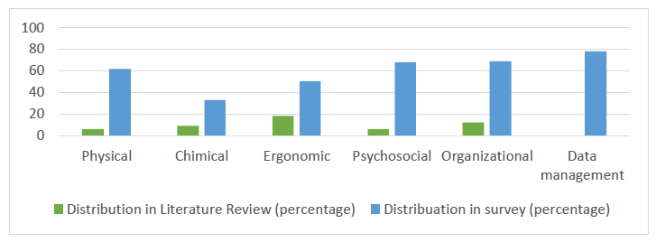
Risk Landscape Transformation The analysis of risk patterns shows that physical, psychosocial, organizational, and data management risks are more prominent in survey results than in the literature review. Physical risks, while less emphasized in the literature, are highly significant in practice, particularly regarding automation and collaborative robotics (Codoceo-Contreras, Rybak and Hassall, 2024).
Chemical risks also demonstrated a similar pattern, with moderate theoretical attention but higher practical reporting in the survey data.
Ergonomic and psychosocial risks also emerge more clearly in survey findings, reflecting growing awareness of human–technology interaction and mental workload in digitalized mining environments (Li, Xia and Bentley, 2026). Organizational and data management risks, largely absent or underrepresented in the literature, are strongly reported in practice, highlighting new operational challenges in system reliability and information handling (Lööw and Johansson, 2024).
Figure 1 compares the distribution of risk categories in the literature and survey, highlighting their relative emphasis.
Figure 1: Risk type distribution: Survey versus literature review.
Benefits–Risk Paradox The literature review and survey findings collectively point to four consistent benefit themes: physical hazard elimination through automation and remote operation; real-time monitoring and predictive risk identification; ergonomic improvement and reduction of physiological strain; and enhanced decision- making through intelligent data-driven systems. Across all four technology categories, benefit perception remained consistently high, indicating broad professional recognition of the safety value of digital transformation in mining.
However, these high benefit perceptions stand in direct tension with the risk findings. The technologies perceived as most beneficial are simultaneously associated with the most critically rated risk categories: big data and cloud systems are linked to the highest-rated risk dimension of data management; IoT systems, while enabling real-time safety monitoring, introduce systemic connectivity vulnerabilities (Mekala et al., 2023); as well as collaborative robotics, despite reducing physical exposure, are associated with elevated physical and cognitive loading risks in practice (Cherubini et al., 2016; Villani et al., 2018). This tension reflects the dual nature of Industry 4.0 technologies, which simultaneously promise safety improvements while introducing new and poorly understood risk configurations (Badri, Boudreau-Trudel and Souissi, 2018b; Veruscka Leso, Luca Fontana and Ivo Iavicoli, 2018).
The Changing Landscape of Occupational Health and Safety in Mining 583 Human–Technology Integration Perspective (HSI Framework)
The observed risk patterns reveal a fundamental shift in the nature of occupational hazards in digitalized mining environments, one that cannot be fully explained through conventional safety frameworks.
The results interpreted through a Human Systems Integration (HSI) lens, reveal that occupational risks in digitalized mining environments emerge from the complex interactions between workers, technologies, and organizational structures. The high perceived criticality of data management, organizational, and psychosocial risks in the survey findings reflects precisely the type of systemic vulnerabilities that HSI frameworks are designed to address, namely, the challenge that arise at the interfaces between human operators and increasingly autonomous, data-driven systems (Burgess- Limerick et al., 2024).
The reason HSI is particularly relevant in this context lies in the nature of the risks themselves. Data management risks signal that workers and organizations struggle to maintain control over information flows that are critical for safe data analysis and ensuring system security (Venkatraman and Venkatraman, 2019). Organizational risks reflect inadequate adaptation and integration of systems and processes, as well as poorly defined parameters governing workers’ interaction with the work environment (Bispo and Amaral, 2024). Psychosocial risks indicate that the cognitive and emotional demands imposed by digital systems are not yet adequately managed. (Arana- Landín et al., 2023b; Li, Xia and Bentley, 2026). These are not independent failures, they are interconnected symptoms of systems where the human element has not been sufficiently integrated into the design and deployment of technology.
Together, these findings suggest that ensuring safety in digitalized mining environments requires moving beyond technology-centered approaches toward frameworks that treat human capabilities, limitations, and organizational contexts as primary design parameters throughout the entire lifecycle of mining technology (Burgess-Limerick et al., 2024).
CONCLUSION
This study examined the evolving landscape of occupational health and safety in mining environments undergoing digital transformation, combining a systematic literature review with an exploratory field survey of Canadian mining professionals. The findings reveal a clear shift in the nature of occupational risks, from predominantly accident-related and physical hazards identified in the literature toward technology-driven risk dimensions, particularly data management, organizational, and psychosocial risks, as reported by practitioners in the field.
The results confirm that emerging technologies such as IoT and cyber- physical systems, collaborative robotics, and AI-driven platforms are widely recognized for their safety benefits, yet simultaneously introduce new and complex risk configurations that conventional OHS frameworks are not fully equipped to address. This dual dynamic underscores the relevance of a
Human Systems Integration perspective, which positions human capabilities, organizational structures, and technological design as interdependent components of safe mining operations.
This study contributes to a growing body of knowledge on the systemic implications of digitalization for occupational safety and offers a foundation for developing more comprehensive, human-centered OHS frameworks suited to the realities of intelligent mining environments. While it provides valuable exploratory insights, future research with larger survey samples and broader literature coverage would further strengthen and validate the observed patterns.
ACKNOWLEDGMENT
The autours thank the Université du Québec à Trois-Rivières (UQTR) and the Fonds de recherche du Québec – Société et culture (FRQSC) for their financial support. They also thank the mining sector professionals and experts who participated in the survey for their valuable contributions.
REFERENCES
Arana-Landín, G. et al. (2023a) “Assessing the influence of industry 4.0 technologies on occupational health and safety,” Heliyon, 9(3), p. e13720. Available at: https:// doi.org/10.1016/j.heliyon.2023.e13720. Arana-Landín, G. et al. (2023b) “Assessing the influence of industry 4.0 technologies
on occupational health and safety,” Heliyon, 9(3), p. e13720. Available at: https:// doi.org/10.1016/j.heliyon.2023.e13720. Badri, A., Boudreau-Trudel, B. and Souissi, A.S. (2018a) “Occupational health and safety in the industry 4.0 era: A cause for major concern?,” Safety Science, 109, pp. 403–411. Available at: https://doi.org/10.1016/j.ssci.2018.06.012. Badri, A., Boudreau-Trudel, B. and Souissi, A.S. (2018b) “Occupational health and
safety in the industry 4.0 era: A cause for major concern?,” Safety Science, 109, pp. 403–411. Available at: https://doi.org/10.1016/j.ssci.2018.06.012. Bispo, L.G.M. and Amaral, F.G. (2024) “The impact of Industry 4.0 on occupational health and safety: A systematic literature review,” Journal of Safety Research, 90, pp. 254–271. Available at: https://doi.org/10.1016/j.jsr.2024.04.009. Burgess-Limerick, R. et al. (2024) Human Systems Integration for Mining Automation.
Boca Raton: CRC Press. Available at: https://doi.org/10.1201/9781003380887. Chen, L. et al. (2023) “Mining 5.0: Concept and Framework for Intelligent Mining Systems in CPSS,” IEEE Transactions on Intelligent Vehicles, 8(6), pp. 3533–3536. Available at: https://doi.org/10.1109/TIV.2023.3285417. Cheng, B., Cheng, X. and Chen, J. (2015) “Lightweight monitoring and control
system for coal mine safety using REST style,” ISA Transactions, 54, pp. 229–239. Available at: https://doi.org/10.1016/j.isatra.2014.07.004. Cherubini, A. et al. (2016) “Collaborative manufacturing with physical human–robot interaction,” Robotics and Computer-Integrated Manufacturing, 40, pp. 1–13. Available at: https://doi.org/10.1016/j.rcim.2015.12.007. Codoceo-Contreras, L., Rybak, N. and Hassall, M. (2024) “Exploring the impacts
of automation in the mining industry: A systematic review using natural language processing,” Mining Technology: Transactions of the Institutions of Mining and Metallurgy, 133(3), pp. 191–213. Available at: https://doi. org/10.1177/25726668241270486.
The Changing Landscape of Occupational Health and Safety in Mining 585 Dempsey, P. et al. (2018) “Emerging Ergonomics Issues and Opportunities in
Mining,” International Journal of Environmental Research and Public Health, 15(11), p. 2449. Available at: https://doi.org/10.3390/ijerph15112449. Faz-Mendoza, A. et al. (2020) “Intelligent processes in the context of Mining 4.0: Trends, research challenges and opportunities,” 2020 International Conference on Decision Aid Sciences and Application (DASA). IEEE, pp. 480–484. Available at: https://doi.org/10.1109/DASA51403.2020.9317095. Ge, S. et al. (2022) “Making Standards for Smart Mining Operations: Intelligent Vehicles
for Autonomous Mining Transportation,” IEEE Transactions on Intelligent Vehicles, 7(3), pp. 413–416. Available at: https://doi.org/10.1109/TIV.2022.3197820. Kamran, M. et al. (2023) “Intelligent based decision-making strategy to predict fire intensity in subsurface engineering environments,” Process Safety and Environmental Protection, 171, pp. 374–384. Available at: https://doi.org/10.1016/j.psep.2022.12.096. Kirsch, P., Hine, A. and Maybury, T. (2015) “A model for the implementation of
industry-wide knowledge sharing to improve risk management practice,” Safety Science, 80, pp. 66–76. Available at: https://doi.org/10.1016/J.SSCI.2015.07.009. Li, K., Xia, M. (Rachel) and Bentley, T. (2026) “The paradoxical effects of emerging mining technologies on psychosocial work factors: An integrated framework and research agenda,” Technological Forecasting and Social Change, 222, p. 124391. Available at: https://doi.org/10.1016/j.techfore.2025.124391. Lööw, J. and Johansson, J. (2024) “Eight Conditions That Will Change Mining Work
in Mining 4.0,” Mining, 4(4), pp. 904–912. Available at: https://doi.org/10.3390/ mining4040050. Mekala, S.H. et al. (2023) “Cybersecurity for Industrial IoT (IIoT): Threats, countermeasures, challenges and future directions,” Computer Communications, 208, pp. 294–320. Available at: https://doi.org/10.1016/j.comcom.2023.06.020. Min, J. et al. (2019) “The Fourth Industrial Revolution and Its Impact on Occupational
Health and Safety, Worker’s Compensation and Labor Conditions.” Available at: https://doi.org/10.1016/j.shaw.2019.09.005. Onifade, M. et al. (2023) “Challenges and applications of digital technology in the mineral industry,” Resources Policy, 85, p. 103978. Available at: https://doi. org/10.1016/j.resourpol.2023.103978. Ruff, T.M. and Holden, T.P. (2003) “Preventing collisions involving surface mining
equipment: a GPS-based approach,” Journal of Safety Research, 34(2), pp. 175– 181. Available at: https://doi.org/10.1016/S0022-4375(02)00074-9. Santos, A.A., Reis, L.P. and Fernandes, J.M. (2023) “The applicability of advanced technologies from the traditional industry to mitigate ergonomic problems in maintenance activities in the mining industry,” Journal of Quality in Maintenance Engineering, 29(4), pp. 877–898. Available at: https://doi.org/10.1108/JQME-01- 2023-0008. Venkatraman, S. and Venkatraman, R. (2019) “Big data security challenges and
strategies,” AIMS Mathematics, 4(3), pp. 860–879. Available at: https://doi. org/10.3934/math.2019.3.860. Veruscka Leso, Luca Fontana and Ivo Iavicoli (2018) “The occupational health and safety dimension of Industry 4.0,” La Medicina del Lavoro, 110(5), pp. 327–338. Available at: https://doi.org/10.23749/mdl.v110i5.7282. Villani, V. et al. (2018) “Survey on human–robot collaboration in industrial settings:
Safety, intuitive interfaces and applications,” Mechatronics, 55, pp. 248–266. Available at: https://doi.org/10.1016/j.mechatronics.2018.02.009. Wang, X. et al. (2022) “Analysis of Factors Influencing Miners’ Unsafe Behaviors in Intelligent Mines using a Novel Hybrid MCDM Model,” International Journal of Environmental Research and Public Health, 19(12), p. 7368. Available at: https:// doi.org/10.3390/ijerph19127368.
Xie, J., Liu, S. and Wang, X. (2022) “Framework for a closed-loop cooperative human Cyber-Physical System for the mining industry driven by VR and AR: MHCPS,” Computers & Industrial Engineering, 168, p. 108050. Available at: https://doi.org/10.1016/j.cie.2022.108050. Zhironkina, O. and Zhironkin, S. (2023) “Technological and Intellectual Transition
to Mining 4.0: A Review,” Energies, 16(3), p. 1427. Available at: https://doi. org/10.3390/en16031427. Zhou, L. et al. (2018) “Research on Occupational Safety, Health Management and Risk Control Technology in Coal Mines,” International Journal of Environmental Research and Public Health, 15(5), p. 868. Available at: https://doi.org/10.3390/ ijerph15050868.
SEARCH THE AHFE DIGITAL BOOKSTORE BY ISBN
Explore the complete digital volume
Human Interaction and Emerging Technologies (IHIET 2026)
Read this individual research paper free through the original publisher, or explore the full digital proceedings book.