François Gauthier, Damien Burlet-Vienney, Chantal Gauvin, Aida Haghighi (2026). Prevention of Collisions Between Mobile Machinery and Pedestrian Workers: A Review of Proximity Detection Technologies. In: Human Interaction and Emerging Technologies (IHIET 2026). AHFE Open Access, vol. 236, pp. 454–461. https://doi.org/10.54941/ahfe1008120
The risk of collisions between mobile industrial equipment and pedestrian workers represents a major occupational health and safety concern, particularly on construction sites. The use of driver assistance systems, such as proximity detection devices designed to warn workers and equipment operators of potential collision hazards, is an increasingly explored and rapidly evolving prevention strategy. This article proposes a review of the various proximity detection technologies available for managing these collision risks on construction sites, and through consultation of suppliers, portrays the key market challenges, product characteristics, customer needs, installation-related issues, as well as the strengths and limitations of these different technologies. The results highlight the technical, human, and organizational complexity associated with the selection and implementation of proximity detection technologies. Successful deployment relies not only on technological performance, but also on user acceptance, adaptability to real work contexts, and the ability of these systems to support operators’ vigilance without overloading it.
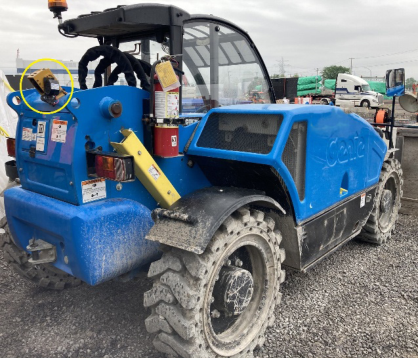
The risk of collisions between mobile machinery (MM) and pedestrian workers (PW) represents a major occupational health and safety concern, particularly on construction sites (e.g., during earth-moving operations) (Hinze & Teizer, 2011; Marsot et al., 2009; McCann, 2006; Kecojevic & Radomsky, 2004). In the province of Quebec, Canada, this type of accident counts for 8 % of all fatal accidents at work between 2013 and 2023 (CNESST, 2024). The use of driver assistance systems, such as proximity detection devices (PDDs, Figure 1) designed to warn workers and equipment operators of potential collision hazards, is an increasingly explored and rapidly evolving prevention strategy (Wharry, 2019; INRS 2015; Nnaji et al., 2020; Saidi, 2021; Kudlinski & Ryu, 2026).
Figure 1: PDDs (artificial intelligence enhanced camera) installed on the rear of a telehandler used on a construction site.
As part of a broader project on PDDs, this article focuses on the perspectives of suppliers of PDDs. The objective of this study was 1) to identify and review the various proximity detection technologies available for managing these collision risks on construction sites and 2) to identify, through consultations with 7 technology suppliers, key market challenges, product characteristics, customer needs, installation-related issues, as well as the strengths and limitations of the different technologies.
METHODS
A survey of existing PDDs on the market was conducted using multiple sources, including the work of Saidi (2021), exchanges with researchers from the Institut National de Recherche et de Sécurité (INRS) in France (INRS, 2015), a visit to Canada’s largest construction equipment show in 2024 and numerous internet searches. This survey made it possible to identify products available in the main Canadian markets in 2024. Various data on the devices were compiled using information from technical data sheets and on manufacturers’ and distributors’ websites.
Based on the information gathered from the PDDs survey, suppliers were selected using a purposeful sampling method (Statistique Canada, 2013; Palinkas et al., 2015). Selection was based on the following criteria: 1) Locally supplying a proximity detection device for the construction sector; 2) Having technical knowledge of the device sold; 3) Having experience with several clients regarding the targeted device. The objective was to obtain a representative sample of the number of suppliers locally present (i.e. provinces of Quebec and Ontario, Canada) and to document a diversity of products (Gillham, 2000).
Participation consisted of a semi-structured interview with the supplier (one or two company representatives), lasting approximately two hours. The topics addressed during the interviews included key market challenges, product characteristics, customer needs, installation-related issues, as well
as the strengths and limitations of the different technologies. This study received ethical approval from the Research Ethics Committee (REC) of the Institut de recherche Robert-Sauvé en santé et en sécurité du travail du Québec (IRSST #2023-0008).
RESULTS
The international market offers a wide range of proximity detection technologies including AI-enhanced camera systems, RFID (Radio Frequency Identification) systems, radar, ultrasonic sensors, infrared cameras and others. A total of 92 companies, including manufacturers, system integrators and suppliers, were identified in this sector in 2024. The available products are continuously evolving, with frequent innovations and technological improvements. The market survey and supplier interviews established that the products most relevant to the construction sector mainly rely on three types of technologies: AI-enhanced cameras, RFID systems and radar systems. The main characteristics of these three PDD technologies are described below.
AI-Enhanced Cameras Artificial Intelligence (AI) enhanced camera systems detect pedestrians within the camera’s field of view. The camera uses an AI algorithm to process images locally and recognize and detect human shapes. It transmits the filmed image and detections to a monitor that provides a visual warning on the screen (e.g., real scene view with a frame around detected pedestrians) and an audible warning (alarm), modulated according to the proximity of danger (e.g., different colored zones and alarm signals). Examples of AI camera systems available on the market in 2025 include Blaxtair Origin by Arcure, ADA 38 by Stonkam, OmniPro Vision AI by Matrix, Cat Detect by Caterpillar, LUIS Safe Edge by LUIS or Visionary AI-Assist by Sick. This list is not exhaustive, and many products are currently under development worldwide.
Cameras are installed to cover one or more blind spots of the MM. Installing two, three, or four cameras allows coverage of additional blind spots and machine movements (forward, reverse, turret rotation, etc.). The selection of camera height and angle is crucial to ensure optimal AI detection performance, particularly due to shape recognition and the way algorithm training has been conducted. A current trend involves installing four to six AI cameras to provide full 360° coverage around the vehicle through image fusion.
Technical specifications - particularly those relating to detection limits and algorithm training - are often missing or inconsistent. Yet, suppliers indicate that detection reliability strongly depends on algorithm accuracy: false negatives may occur (e.g., failure to detect a person lying on the ground), as well as false positives (e.g., fire hydrants or cones incorrectly detected as humans). Some suppliers believe certain AI systems perform better due to training based on images from industrial or construction environments rather than road traffic images. Although detection in some scenarios (e.g., upper- body detection or crouching pedestrians) may remain uncertain, algorithms continue to improve and cover an increasing range of situations.
Prevention of Collisions Between Mobile Machinery and Pedestrian Workers 457 Performance and reliability decrease if the camera’s field of view is obstructed or visibility conditions are degraded (e.g., low light at night, fog, heavy snowfall). This limitation can partly be compensated by adding other PDD technologies. A common approach is to install AI cameras supplemented by a thermal infrared camera or a radar system to compensate for limitations in detecting very close obstacles and in night conditions.
These cameras require regular and frequent cleaning of the lens or protective glass to maintain performance. Cleaning may be more laborious if cameras are installed at height, although suppliers report that most cameras remain accessible (less than 2 m high). Models with protective glass may provide slightly lower image quality than those without, although they often include a washer-jet option. Heated elements integrated into some designs can help prevent lens icing. However, the high cost of these options limits widespread use, and their real-world performance remains to be demonstrated.
Finally, AI camera startup time is not instantaneous when the vehicle is turned on. Some systems requiring up to 30 seconds to start. This issue can potentially compromise detection during quick start and movement of the MM.
Table 1 shows the main strengths and limitations of AI-enhanced camera systems as reported by suppliers.
Table 1: Strengths and limitations of AI Cameras systems.
Table available in the original PDF paper.
Strengths Limitations
Cognitive overload for the operator (additional monitor in the cabin).
More frequent false positives in certain situations.
Difficult performance comparison between products due to lack of standardized algorithm information.
Requires direct line of sight; reliability decreases if obstructed.
Requires regular lens cleaning.
Reduced performance in difficult environmental conditions (low light, fog, severe weather).
Targeted detection of pedestrians.
360° detection possible with four cameras.
Easy identification of detection source via screen visualization.
Continuous improvement in AI precision through field feedback and advances in image processing.
Easy installation and configuration.
Easy field use; minimal management once installed.
Various price ranges adapted to client financial capacity.
Durable (certified for harsh environments); few reported breakdowns; camera protected with a robust steel frame.
RFID Systems RFID systems allow MM equipped with an RFID detector to capture tags worn by nearby workers. This technology was implemented in workplaces before AI-enhanced cameras. Effectiveness depends primarily on proper tag use by workers. This can be challenging on open or less controlled construction sites. Detection can be based on active or passive systems. Passive RFID tags worn by workers have no internal power source and do not emit signals. They rely on energy emitted by the RFID detector installed
on the MM. Active RFID tags contain an internal power source (battery) and emit signals continuously, which are captured by the RFID detector on the MM. Compared to passive systems, active tags have greater detection range but are more expensive and have limited lifespan due to battery life. Active RFID systems allow bidirectional warning: when a worker enters the detection zone, the MM operator is alerted (audible and visual signals in the cabin), and the worker can also receive a warning (visual, vibratory, or audible) via the system worn.
Many products are available worldwide. Examples include passive systems such as SCAN~LINK Armour system by SCAN~LINK in Canada and active systems such as EGOPro Safe MOVE by AME, ZoneSafe RFID by Ayonwood and RealTrac collision awareness system by RealTrac.
Detection by RFID does not require direct line of sight and can function through obstacles (e.g., storage structures) or environmental factors (e.g., smoke, gas). However, interference from metallic objects or electromagnetic fields may disrupt operation. Also, the worksite must be free of other radiofrequency devices operating in the same frequency band to avoid interference. Some systems cannot detect through metal or large masses of solid water. Detection reliability also depends on tag orientation and worker movement (e.g., a single front-worn tag may not be detected if the worker lies face down).
Table 2 shows the main strengths and limitations of RFID systems as reported by suppliers.
Table 2: Strengths and limitations of RFID systems.
Table available in the original PDF paper.
Strengths Limitations
All workers must wear a tag.
Logistical challenges, especially on open or less controlled sites.
Regular charging required for active systems.
No visual display of detection zone unless paired with a camera.
Targeted detection of workers wearing tags.
Detection in harsh environmental conditions (snow, rain, ice, fog, dust, dirt) and inside containers or vehicles.
Longer detection range for active systems.
Reduced maintenance for passive systems (no battery management).
Robust and reliable tag detection (no false positives), even when worker is not visible.
Radar Systems Radar systems, a proven technology, detect all objects and persons within the detection zone indiscriminately. They emit electromagnetic waves and analyze wave reflections from obstacles. An audible or visual alarm is triggered when an obstacle or moving object enters the detection zone. Although capable of detecting objects and other MM, supplier discussions emphasized pedestrian detection. Examples of radar systems include TrackVision RadCam 3Z by TrackTech RadarEye by Stoneridge and Radar Backsense by Brigade.
Radar detection is not specific to pedestrians, potentially causing frequent unnecessary alarms. Thus, many radar systems are combined with a camera and cabin monitor to provide visual feedback. The combination of radar and
Prevention of Collisions Between Mobile Machinery and Pedestrian Workers 459 AI-enhanced cameras has recently become a realistic possibility. Radar is considered a less “technological” but robust solution. It performs better when obstacles are moving relative to the MM. These systems generally function well in difficult environmental conditions (darkness, smoke, fog, dust).
Table 3 shows the main strengths and limitations of RADAR systems as reported by suppliers.
Table 3: Strengths and limitations of RADAR systems.
Table available in the original PDF paper.
Strengths Limitations
Detects all obstacles indiscriminately; not pedestrian-specific.
Frequent alarms due to object detection.
Difficulty detecting slow-moving objects or persons.
Robust and simple detection solution.
Significant improvements with 77GHz systems in terms of range, resolution, and accuracy
Detection zone precision possible with multiple sensors.
PDDs Selection and Installation-Related Issues Suppliers emphasize that selecting the appropriate solution and ensuring successful implementation depend on a precise understanding of client needs and worker acceptance. A technology may be the most appropriate in one context (organizational, work activity), but not suitable in another context that at first glance appears similar. Involvement of all key stakeholders — particularly MM operators — is fundamental. Operator training is crucial and must be thorough and tailored to system use and benefits. Furthermore, price remains a major barrier to adoption, especially for small organizations.
To ensure proper operation, installation of PDDs systems is performed by suppliers (or trained specialized distributors), not clients. Positioning of detection hardware (cameras, antennas, radars) is critical due to variability in MM configurations. Field experience is essential to cover blind spots, maximize detection while minimizing excessive alarms, adapt to specific vehicle requirements, and avoid placing components in vulnerable areas.
Reducing false positives (warnings without real danger) and false negatives (no warning in dangerous situations) is a major challenge. Most suppliers recommend combining multiple technologies to leverage complementary strengths.
All suppliers reported that excessive cabin alarm frequency is the primary reason for clients to request post-implementation adjustments. Since MM operators perform cognitively demanding work over long periods, alarm frequency affects fatigue and operational efficiency. Improvement strategies include reducing false positives with for example conditional activation (e.g., in reverse gear only if the camera monitors the area behind), adjusting alarm modalities with a gradation (auditory/visual intensity, colors) and detection zone configuration. Detection zone configuration must be defined collaboratively with MM operators to promote system acceptance. All participants emphasized that proper configuration is critical: poorly configured zones lead to excessive unnecessary alarms, compromising system effectiveness and acceptance. The detection zones must still allow the operator time to react. ISO 21815-3 (ISO, 2023) addresses this aspect, but is not used in the field.
CONCLUSION
This study highlights the technical, human, and organizational complexity associated with the selection and implementation of proximity detection technologies. Successful deployment relies not only on technological performance, but also on user acceptance, adaptability to real work contexts, and the ability of these systems to support operators’ vigilance without overloading it. A major challenge concerns the division of attention between driving the MM and the warnings generated by the PDD, in a work environment that is often noisy, complex, and cognitively demanding. Furthermore, the use of AI in relation to occupational safety raises questions in terms of functional safety (proper functioning of safety-critical systems). Historically, safety has been based on deterministic and a comprehensive and detailed understanding of failure modes.
ACKNOWLEDGMENT
The authors wish to thank the Institut de recherche Robert-Sauvé en santé et en sécurité du travail (IRSST) for funding this research.
REFERENCES
Commission de la santé et de la sécurité du travail – CNESST (2024). Centre d’information scientifique et technique [Scientific and technical information centre]. CNESST. Montréal, Canada, 2024 Gillham, B. (2000). The research interview. Bloomsbury Academic, 104 pp. Hinze J. W., Teizer J. (2011) Visibility-related fatalities related to construction
equipment. Saf Sci.; 49: 709–718 INRS - Institut national de recherche et de sécurité (2015). Prévenir les collisions engins-piétons - La place des dispositifs de détection et d’aide visuelle (ED6083). INRS. Paris, France, 2015 International Organization for Standardization. (2023). Earth-moving machinery —
Collision warning and avoidance — Part 3: Risk area and risk level for forward/ reverse motion. ISO 21815-3 standard. Kecojevic V., Radomsky M. (2004) The causes and control of loader- and truckrelated fatalities in surface mining operations. Int J Inj Contr Saf Promot. 2024 11: 239–251. Kudlinski, D. et Ryu, J. (2026). Struck-by fatalities in construction: A systematic
review of regulatory roles, responsibilities, and research gaps. Journal of Safety Research, 96(2), 11–18. https://doi.org/10.1016/j.jsr.2025.11.010 Marsot J., Charpentier P., Tissot C. (2009) Collisions engins-piétons. Analyse des récits d’accidents de la base EPICEA (ND 2318). HST. 2009; 217: 23–32 McCann M. (2006). Heavy equipment and truck-related deaths on excavation work
sites. J Safety Res. 2006; 37: 511-517 Nnaji C., Gambatese J., Lee H. W., Zhang F. (2020) Improving construction work zone safety using technology: A systematic review of applicable technologies. J Traffic Transp Eng. 2020; 7: 61–75 Palinkas, L., Horwitz, S., Green, C., Wisdom, J., Duan, N. et Hoagwood, K. (2015).
Purposeful sampling for qualitative data collection and analysis in mixed method implementation research. Administration & Policy In Mental Health & Mental Health Services Research, 42(5), 533-544. https://doi.org/10.1007/s10488-013- 0528-y
Prevention of Collisions Between Mobile Machinery and Pedestrian Workers 461 Saidi, A. (2021). State-of-the-art review of person-detection technologies applicable
to construction sites (Report No. QR-1120). IRSST. Statistique Canada. (2013). Non-probability sampling. https://www.statcan.gc.ca/ edu/power-pouvoir/ch13/nonprob/5214898-fra.htm#a3 Wharry M. (2019) Collision Avoidance Systems and Collision Warning Systems.
Reducing Surface Mobile Equipment Accidents Through Technology. MSHA.
SEARCH THE AHFE DIGITAL BOOKSTORE BY ISBN
Explore the complete digital volume
Human Interaction and Emerging Technologies (IHIET 2026)
Read this individual research paper free through the original publisher, or explore the full digital proceedings book.