Tokuyasu Kakuta, Daichi Saito (2026). Legislative Support System to Assist in the Transfer of Skills for Municipal System Design and Ordinance Drafting. In: Human Interaction and Emerging Technologies (IHIET 2026). AHFE Open Access, vol. 236, pp. 503–511. https://doi.org/10.54941/ahfe1008125
This paper presents a legislative support system designed to facilitate the transfer of drafting skills. This system called "eLen Ordinance Database System", supports the works in ordinance drafting by providing access to a comprehensive database of approximately 1.4 million Japanese ordinances. Publicly available free since 2012, the system has been integrated into the daily routines of numerous municipal officials, who actively use the specific functions described in this paper. Beyond standard database queries, the system automatically generates ordinance comparison tables and templates for supporting legislative drafting. These features help the drafters adopt established drafting practices from existing ordinances and explore alternative administrative system designs. According our results of interviews with local government officials it is indicated that ordinance drafting prioritizes policy intent and strict adherence to conventional notation, typically building upon practices established by predecessor drafters. To address these practical needs, the system shown in the paper has used a supercomputer to evaluate similarities and dissimilarities across ordinances, thereby extracting typical patterns and unique characteristics. In practice, typicality of policies are identified within large clusters of similar ordinances, while a diverse range of policy options is uncovered by analyzing variations within those clusters.
This paper presents the legislative support functions of the eLen Ordinance Database System, which aggregates approximately 1.4 million ordinances- covering nearly 98% of all local ordinances in Japan. Specifically, we show how the system facilitates the transfer of ordinance drafting skills, a process that has traditionally relied on manual methods. In this paper, “eLen” denotes the eLen Ordinance Database System. Developed and launched by the author’s team in 2012 (Nakamura, 2014), the system has been adopted by about half of Japan’s municipalities and currently attracts an average of 180,000 monthly accesses, establishing it as a highly utilized public platform (Kakuta, 2025). The motivation behind the system stemmed from interviews with more than 150 officials across over 60 municipalities (Shima, 2020), with each interview averaging 2 hours. These interviews highlighted the top
504 Kakuta and Saito priority need for a digital tool that allow officials to draft ordinances by referencing existing similar ordinances.
Prior to the development and publishment of eLen in 2012, Japan lacked a unified, nationwide database for local ordinances. Because each municipality independently hosted its ordinances on individual websites, cross-municipal searches were impractical. Since an officer in municipalities, who tries to refer to the other municipalities’ ordinances, had to navigate more than 1,700 municipal web pages one by one, the process was exceptionally time- consuming. Discrepancies in data formats also placed a heavy burden on post-retrieval data compilation. To improve these inefficiencies, eLen was built as a centralized national database. It standardizes various styles of ordinance data into a uniform format compatible with both the Japanese government’s legal data specifications and Akoma Ntoso (Palmirani, 2011), while providing open public access to streamline the drafting process. Given that Japanese ordinance drafting skills have been traditionally passed down as a form of manual method through hands-on practice, eLen incorporates dedicated functions explicitly designed to support this skill transmission.
The primary purpose of this paper is to report on the implementation of these skill-transfer methods within eLen. The remainder of the paper is structured as follows. The next section details the traditional transmission of ordinance drafting skills that motivate our study, alongside the concept of text similarity underpinning the transfer mechanism. The subsequent sections describe eLen’s functions and technical architecture of eLen, followed by a comprehensive discussion of our current evaluation and future approaches.
TRANSMISSION OF ORDINANCE DRAFTING TECHNIQUES In the early stages of the eLen Project, we conducted detailed interviews over a two-year period beginning in 2010 with more than 60 local governments in Japan regarding their methods for drafting ordinances. These interviews revealed how the skills required for drafting ordinances have traditionally been passed down. Since most of these transmission processes relied on manual efforts, the need to utilize information technology to support them became clear. The findings from these interviews are summarized as follows:
(1) Ordinance drafting skills are manually transmitted. (2) In many local governments, there is a culture that places a strong emphasis on typicality. (3) Comparison tables are heavily utilized for drafting and benchmarking.
To address these insights, the eLen development project modeled user requirements around two core concepts which are sharing and options. This section outlines the specific insights obtained from the interviews, explains how eLen involves them, and demonstrates that the overall modeling relies on text similarity. Building upon this framework, this section also illustrates how each eLen function supports human-centric ordinance drafting.
Legislative Support System to Assist in the Transfer of Skills 505 Manual Transmission of Skills
Interviews with Japanese local governments revealed that while various documents compiled past examples and drafting patterns, and workshops for drafting, no systematic theory of ordinance drafting existed. The most prevalent method for transmitting these skills was manual, fundamentally relying on on-the-job training so far. Consequently, digital tools designed to directly support the skill transmission remain lacking. Although academic and technical frameworks exist for broader policymaking, this study focuses specifically on the techniques required for translating formulated policies into descriptions of ordinances.
As shown in the following section, the most efficient approach within the manual paradigm is to reference existing ordinances and draft standard ones to the greatest extent possible. Although this method depends on manual processes, it is widely accepted because it enables even non-experts to draft ordinances of acceptable quality, thereby reducing the costs associated with technical education and skill transmission.
However, non-experts may overlook critical exceptions, even when they can identify typicality based on shared external patterns. When drafting ordinances, an approach rooted in traditional experience remains deeply entrenched. This approach involves veteran officers identifying exceptions through meticulous manual checks. This reliance on manual verification is also evident in the benchmarking process, where creating and checking comparative tables of multiple ordinances is a widely accepted practice.
Nevertheless, these traditional methods remain entirely manual and have not yet been digitized. To address this situation, the first step in the development of eLen focused on building a central database that consolidates the ordinances of nearly all municipalities, thereby enabling cross-municipal searches. This functionality was universally requested by the interviewed officers. As mentioned in the Introduction, prior to 2011, local ordinances across Japan were published individually by each municipality, rendering cross-municipal searches impossible. Users were forced to search and download files from each municipal website separately. Compounding this issue, the data formats varied significantly, demanding substantial manual effort to integrate and standardize the file formats post-download. Reducing this administrative burden and eliminating inefficiencies were the primary driving forces behind the development of eLen.
Culture Emphasizing Typicality Almost all interviewed local government officers indicated that, when drafting ordinances, they rarely drafted original proposals from scratch. Instead, they relied heavily on existing ordinances for both content and wording. The referenced ordinances included not only those of the local government itself but also those of other local governments.
The officers emphasized that they referenced existing ordinances to achieve greater standardization. When asked why they preferred standardized ordinances, respondents cited a proven implementation track record, higher stability with fewer errors, and efficiency in terms of time and effort. These are critical factors given the limited manpower available to the officers. Furthermore, certain officers hinted at an underlying psychological
506 Kakuta and Saito motivation. That is a desire to distribute accountability not only within their own organization but also across other local governments and predecessor drafters. Overall, ordinance drafting reflects a culture of technical precision, characterized by an institutional preference for “standards.”
Crucially, these “standards” are not established through democratic deliberation. Actually, the practice of drafting ordinances that closely mirror existing ones has led to a high degree of commonality across local governments. As the overlap among these commonalities increases, a typical system or rule gradually emerges, eventually being treated as an established, objective standard.
Benchmarking A widely adopted approach among local government officers for both policy formulation and ordinance drafting is the use of comparative (or benchmark) tables. These tables, traditionally compiled through manual methods, serve to evaluate and examine policy options and specific statutory wordings, thereby distinguishing typical articles from exceptional ones. In local governance the basis of this methodology that commonly referred to as benchmarking has already advocated by Ammons (Ammons, 1995). Japanese local governments also have systematically integrated benchmarking into their early policy- formulation stages, a practice now codified in standard legal textbooks and introductory manuals dedicated to local governance methodologies.
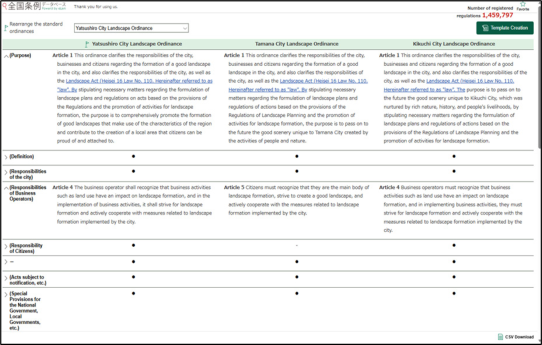
Although benchmarking provides various analytical techniques in policy formulation, the primary focus of this study is the construction of matrices designed to compare multiple ordinances simultaneously. Specifically, these comparative matrices organize disparate ordinances along the vertical axis while horizontally aligning articles that share identical functional labels.
This comparative format enables drafters to identify typical patterns within common legislative descriptions and uncover policy nuances that might otherwise be overlooked. More specifically, articles shared across multiple local governments can be viewed as transmitting established legislative norms, serving as a de facto standard. Conversely, divergence in wording highlights municipality-specific exceptions or tailored policy options. This approach essentially operationalizes a method of transmitting ordinance drafting expertise that aligns closely with human cognitive processes.
Nevertheless, compiling these tables manually is an exceptionally arduous task. It requires downloading potentially relevant ordinances from an extensive number of disparate municipal websites, manually organizing these texts, standardizing competing file formats, and composing matrix spreadsheets using software like Microsoft Excel. Furthermore, if the scope of the comparison changes or new legislative models are introduced during the policymaking process, these tables must be reconstructed again. The eLen system was developed specifically to eliminate this substantial manual burden by automating the benchmarking works.
SIMILARITY Ordinance drafters acquire and inherit drafting expertise by identifying commonalities and divergences within comparative benchmarking tables. The function of the automatic template generation provided by eLen explicitly visualizes and streamlines this cognitive process (Kakuta, 2025). These generated templates function not only as a structural blueprint of ordinances but also as a visual representation of comparative data that aligns precisely with the user’s workflow and cognitive progression during legislative works.
Generally, templates highlight foundational frameworks where attention naturally gravitates toward the predominant commonalities. However, the alternative choices and optional articles also play a vital role in prompting awareness and mitigating the risk of oversight. This mechanism mirrors biological homeostasis. That is, humans like various other organisms are considered as evolutionary primed to react strongly to anomalies against a stable backdrop. Consequently, visualization through benchmark tables and templates functions as a “nudge” that guides practitioners toward rigorous checking behaviors almost subconsciously.
This structural duality is considered almost the dual process theory popularized by Kahneman (Kahneman, 2011). According to this psychological theory, human cognition comprises two distinct systems. One is driven by fast, like subconscious and reflexive actions, and the other is governed by slow, like conscious and analytical processes. Our interface design also leverages this cognitive asymmetry. The users inherently bypass common elements once recognized as standard, allowing them to allocate their limited cognitive capacity to examining the differences, namely, the specific choices and policy options. This visualization directly mirrors the analytical processes described in cognitive theory.
Furthermore, the architectural approach of eLen offers distinct advantages over deep-learning models, such as transformer based generative AI, particularly regarding how commonalities and divergences are managed. Unlike neural-network driven machine learning, which operates as an opaque “black box,” eLen explicitly maps and structures legislative commonalities and differences. Especially, within the legal domain, since explainability is a strict requirement, the ability of eLen to directly demonstrate the rationale behind legislative options through concrete ordinances represent a compelling advantage.
OVERVIEW OF ORDINANCE DRAFTING SUPPORT FUNCTIONS AND IMPLEMENTATION METHOD eLen is an ordinance database equipped with keyword search functionalities targeting both ordinance titles and full texts, supplemented by filtering mechanisms based on municipal attributes. Beyond basic retrieval, the primary features designed to facilitate legislative drafting and decision- making encompass the following three core functions:
(1) Search result grouping (2) Automatic generation of benchmark tables (3) Automatic generation of ordinance templates
508 Kakuta and Saito This section details how these specific functionalities support the systematic transfer of ordinance drafting skills. The necessity of the search result grouping function (1) is driven by the massive scale of the ordinance data, which aggregates approximately 1.4 million ordinances across more than 1,700 local governments. Since there are so many similar ordinances, search queries often return more than 1,000 results. To facilitate manual handing of such output, eLen incorporates a clustering mechanism for the retrieved ordinances, enabling users to efficiently find typical legislative patterns while bypassing redundant documents with nearly identical content. Crucially, the degree of typicality is intuitively reflected by the population size of each generated group.
The basic implementation method of this function is to measure the similarity between articles using the Levenshtein distance (Levenshtein, 1966), a type of edit distance, and then group similar articles based on that information (Kakuta, 2025).
The automatic benchmark table generation function (2) constructs the web-based comparative matrices shown above, allowing users to view them directly or download the dataset in CSV style. A dynamic benchmark table can be generated and displayed immediately upon selecting any ordinance cluster identified in function (1). To maximize comparative flexibility, users can also arbitrarily select specific ordinances of interest to automatically generate a tailored comparison table. Previously, composing these matrices required intensive manual works. For instance, even a basic table comparing only three ordinances took one hour. Worse still, whenever the comparison targets changed, the manual operations had to be repeated for each new combination, imposing a severe operational burden on officers. With eLen, however, generating a benchmark table by selecting target ordinances requires less than a second. Figure 1 illustrates an example of the benchmark table interface displayed by eLen.
Figure 1: Display of benchmark table.
The foundational implementation of this function relies on formatting and storing all ordinance data to be compatible with the Japanese government’s standard XML specifications, which is also compatible with Akoma Ntoso
Legislative Support System to Assist in the Transfer of Skills 509 (Palmirani, 2011). Since the structured dataset explicitly retains information regarding individual article titles, eLen dynamically extracts and organizes the text of the corresponding articles from the selected ordinances, using these titles as anchors to generate each row of the benchmark table.
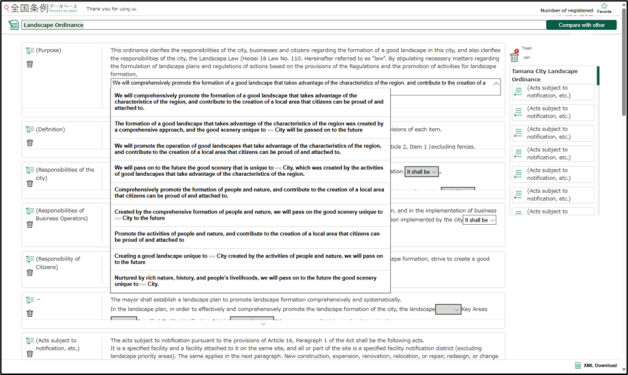
The function (3) is implemented to compose automatically an ordinance template from the ordinances selected within the benchmark table. In eLen’s implementation, the text segments universally shared across all compared ordinances constitute the mandatory body text of the template, while the divergent segments are automatically rendered as operational options within a pull-down menu. By selecting these menu items to match their specific legislative intent, users can effortlessly compose an ordinance tailored to their local requirements. The resulting template can be downloaded directly for immediate use as an official draft ordinance. Figure 2 illustrates an example of the ordinance template generated by eLen.
Figure 2: Display of ordinance template.
The template generation funcition is implemented by detecting text variations among the designated ordinances. Specifically, eLen displays identical segments as standard static text while sequentially organizing conflicting clauses into dynamic pull-down menus. Regarding the overall computational overhead of the primary eLen functionalities described in this section, the execution cost for functions (2) and (3) is negligible compared to the large-scale clustering required for function (1). To process the massive corpus internally, the execution of this clustering algorithms demands an average elapsed time of approximately three days, utilizing a 400-core supercomputer environment. However, the calculation takes almost no time when eLen is running, because it is pre-processed and indexed.
DISCUSSION
The primary objective of eLen was to empower local government officers by streamlining the transfer of ordinance drafting skill. It that has been successfully realized and validated through its widespread adoption. On
510 Kakuta and Saito the other hand, due to eLen being a publicly accessible platform, its user base has expanded. Currently, there is a substantial demand not only from legislators but also from private sector entities in highly regulated fields, such as architecture, medicine, and environmental science, for a targeted providing mechanism that alerts users exclusively to ordinances relevant to their specific domains. Previously, identifying such relevance has relied on the experience of the officers and experts. This requested feature providing a cognitive safeguard, actively bringing critical ordinances and specific statutory articles to light that human practitioners might otherwise overlook. To date, eLen has been continuously improved to satisfy this dependency of special domains demand. Previously, when a ordinance from a specific local government was regarded as relevant to a particular industry, eLen listed related ordinances by extending the document-level clustering mechanism. While this approach mitigated the problem to some degree, a significant limitation remained. The limitation is that if a particular ordinance contains only a very small number of articles that are strongly related to the user’s domain of expertise, this document level clustering method will overlook the ordinances that contain those articles. To overcome this granularity challenge, we recently developed and deployed an article level clustering mechanism. This function detects highly relevant ordinances even when a single, very small number of specific articles within a local ordinance relevant to a target domain, thereby drastically reducing missed opportunities and enhancing information retrieval precision.
CONCLUSION
This study has aimed to facilitate the transfer of human skills in local government ordinance drafting. The continuous and widespread utilization of the eLen system by numerous local government officers demonstrates that this primary objective has been successfully realized. Rather than merely offering static databases or templates, the systematized transfer mechanism of eLen leverages similarity-based clustering to provide a dynamic benchmarking environment. Ultimately, this visual contrast itself rather than the mere presence of the output ordinance texts as the primary catalyst for effective skill transmission, directly in accordance with the cognitive workflows of legislative practitioners.
Going forward, a key challenge for eLen will be addressing domain-specific dependencies, as mentioned above. This is expected to enable them to meet the needs of a wider range of people.
ACKNOWLEDGMENT
This study was supported by JSPS KAKENHI (grant number: JP24H00746).
REFERENCES
Ammons, D. N. (1995). Overcoming the inadequacies of performance measurement in local government: The case of libraries and leisure services. Public Administration Review, 37–47.
Legislative Support System to Assist in the Transfer of Skills 511 Kahneman, D. (2011). Fast and slow thinking. Allen Lane and Penguin Books, New
York. Kakuta, T. et al. (2025). Ordinance Template Composition System: Supporting legislative drafting in the eLen database system, in: Proc. of ICAIL2025. pp. 483–484. Levenshtein, V. I. (1966). Binary Codes Capable of Correcting Deletions, Insertions,
and Reversals, Soviet Physics-Doklady, 10(8). pp. 707–710. Nakamura, M., Kakuta, T. (2014). Development of the eLen Regulation Database to Support Legislation of Municipalities, in: Proc. of JURIX2014. pp. 185–186. Palmirani, M., Vitali, F. (2011). Akoma-Ntoso for Legal Documents, in: Legislative
XML for the Semantic Web, Springer. pp. 75–100. Shima, A., Kakuta, T. (2020). Qualitative Analysis of Interviews with Municipal Officers Toward the Human-Centered Improvement of the eLen Regulation Database System, in: Human-Centric Computing in a Data-Driven Society. HCC 2020. IFIP Advances in Information and Communication Technology, 590, Springer. pp. 86–99.
SEARCH THE AHFE DIGITAL BOOKSTORE BY ISBN
Explore the complete digital volume
Human Interaction and Emerging Technologies (IHIET 2026)
Read this individual research paper free through the original publisher, or explore the full digital proceedings book.