Margot Dumas, Eric Meyer, Sophie Sakka (2026). Development of the Rob’Tales methodology to teach emotional an social skills to autistic adolescents. In: Human Interaction and Emerging Technologies (IHIET 2026). AHFE Open Access, vol. 236, pp. 409–418. https://doi.org/10.54941/ahfe1008116
Autistic adolescents frequently experience difficulties with emotional and social skills. Robots are promising tools to promote the development of those abilities. This study aimed to develop a robot-assisted therapy named Rob’Tales, targeting social and emotional skills in autistic adolescents. Methods: Intervention development was based on three complementary sources of information: (1) a scoping review to identify didactic techniques used in evidence-based practices and potential intervention targets, (2) a feasibility study to refine the intervention structure, (3) autistic individuals opinions to define the curriculum. Results: Two interventions considered as EBP were identified: Social Skills Training and Cognitive Behaviroral/Instructational Strategies. Common modules taught in SST were listed. These results were used to create a first version of Rob’Tales, implemented in a feasibility study whose results inform about the strengths and shortcomings of this first version. Preference ratings showed that modules related to psychoeducation, emotion, and interpersonal problem solving should be prioritized. Conclusion: This paper presents the construction of Rob’Tales, built from three different sources of information. Its efficiency promoting emotional and social well-being of autistic adolescents should be tested.
Adolescence represents a critical developmental period during which individuals experience substantial social, emotional, and cognitive changes. They can encounter difficulties in emotional regulation, and are hypersensitive to emotional stimuli, to their peers influence, and to peer rejections (Andrews, Ahmed Blakemore, 2021). This is especially true for autistic adolescents. On average, autistic adolescents experience alexithymia more frequently (Milosavljevic et al., 2016), have a lower emotional self-awareness (Huggins et al., 2020), experience more difficulties in emotion regulation (Restoy et al., 2024), and suffer more often from loneliness (Kiliç Tülü, Özbek Girli, 2026). This can have an impact on their well-being. During adolescence, brain maturation processes are observed in regions involved in emotion processing Received June 13, 2026; Revised July 8, 2026; Accepted July 31, 2026; Available online August 25, 2026
and social skills (Andrews, Ahmed Blakemore, 2021). Hence, adolescence is considered as a sensitive period to promote their development.
Robots are promising tools to train emotional and social skills of autistic people (Zhong et al., 2025). They are predictable, non-judgmental, simplified interactive agents, and entertaining (Cabibihan et al., 2013; Dubois-Sage et al., 2024), which allow participants to work on social and emotional skills in a reassuring and non-overwhelming setting. Studies on Robotic-Assisted Therapies (RATs) focus mainly on children and not on adolescents (Santos et al., 2025). In addition, most of them propose short interventions with less than 5 sessions, and of less than 15 minutes duration (Santos et al., 2025). These limitations highlight the need to develop novel reproducible RATs.
The opinions of autistic people should be taken into account in the development of new interventions. Programs such as Social Skills Training (SST) are criticized because they may encourage the development of masking behaviors (i.e hiding of autistic traits to look neurotypical) (Graf-Kurtulus Gelo, 2025), that is associated with poor mental health (Hull et al., 2021). In addition, they may not always meet autistic individuals’ needs (Hull et al., 2025). This study aimed to present the development process of a new RAT, Rob’Tales, targeting the social and emotional skills of autistic adolescents. This methodology was designed based on a scoping review of evidence-based practices (EBP), findings from a feasibility study (Dumas et al., in press) and preferences expressed by autistic individuals regarding intervention content.
MATERIAL AND METHODS Study Design
The present study aimed to develop a RAT targeting social and emotional skills in autistic adolescents. The intervention was developed based on 3 sources of evidence: (1) a scoping review conducted to identify interventions considered as EBP (2) a feasibility study to adjust the intervention structure, and (3) autistic individuals opinions to choose the intervention curriculum. Findings from all stages were synthesized to create the Rob’Tales methodology. This study was approved by an institutional research ethics committee.
Stage 1: Search for Evidence Based Practices Steinbrenner et al. (2020) produced a report identifying 28 practices considered as EBP. To create the main structure of the program, we decided to focus on EBPs identified in this report as effective in improving social skills, mental health, and communication in adolescents aged 12 to 16 years.
To identify the module taught in current programs targeting social and emotional skills, we conducted a scoping review on the EBSCOhost database, by using the search terms TI (“autism” OR “ASD” OR “Asperger” OR “autistic”) AND TI (“social skills training” OR “social skills intervention” OR “social skill development” OR “social communication intervention”), and by looking at programs included in systematic reviews found in the process. We decided to focus more specifically on the curriculum of programs considered as SST, as it is one of the most common intervention proposed to autistic adolescents (Lord et al., 2018). Module were selected if they were
Development of the Rob’Tales Methodology to Teach Emotional and Social Skills 411 present in at least 5 SST programs. Then, they were merged into broader categories based on their common features.
Stage 2: Feasibility Assessment The first version of Rob’Tales was implemented in a feasibility study involving four autistic adolescents, enrolled in a medical educational setting. The goal of this stage was to identify the strengths and shortcomings of this intervention, and especially of its structure. A detailed description of this first version of Rob’Tales, and of the feasibility study results has been reported in (Dumas et al., in press). A list of strengths and shortcomings regarding the program structure was created, and adaptations were proposed.
Stage 3: Assessment of Content Preferences We designed a survey on LimeSurvey (Version 6.15.20+251021) to ask autistic people about their opinion and expectations on SST. This survey was only available in French. We shared it on social media (e.g. forums, Discord groups, Facebook group, and Reddit groups related to autism), and through emails to autism societies. The diffusion took place between April 2025 and June 2025. The inclusion criteria were that the participant should be diagnosed autistic, undergoing a diagnosis process, or self-diagnosed. Participants gave informed consent at the beginning of the survey. Table 1 presents the main characteristic of the participants included in this survey.
Table 1: Main characteristics of participants included in stage 3.
Table available in the original PDF paper.
n 32 Gender Woman: ≃59% ; Man: ≃31% ; Non-binary: ≃9% Age ≃34 years old (± 12 years)
Diagnosis status Diagnosed: ≃69% ; Undergoing: ≃22% ; Self-Diagnosed: ≃9% The survey was composed of three parts, asking questions about (1) participants identity (2) their expectations of SST, and (3) their opinions on current SST content. The third part was used to conceive Rob’Tales. Participants had to rate SST items, coming from the Stage 1 review, on a seven point Likert Scale (−3 = “very harmful”, −2 = “harmful”, −1 = “rather harmful”, 0 = “neither harmful nor beneficial”, 1 = “rather beneficial”, 2 = “beneficial” or 3 = “very beneficial”).
To analyze autistic people ratings of items depending on their categories, we conducted a one-factor repeated measured ANOVA, with a Greenhouse- Geisser correction to correct for sphericity violation, on Jamovi (version 2.6.26). The five preferred items, that is those rated the highest on average, were also reported.
Stage 4: Development of the Final Intervention The final intervention was developed through the integration of findings from all three stages. Stage (1) informed the general structure and content of the intervention, Stage (2) informed decisions regarding the intervention structure, and Stage (3) informed the selection of intervention content.
RESULTS
Stage 1: Search for Evidence Based Practices Two interventions were identified as effective to improve social skills, communication and mental health of autistic adolescents aged between 12 and 16 years old: Social Skills Training (SST) and Cognitive Behavioural/ Instructional, Strategies (CBIS) (Steinbrenner et al., 2020). They often use a lesson time, where a skill is taught thanks to explicit learning and direct strategies, and a practical time where the new skill is trained thanks to role- play, modelling, and feedback.
Regarding the intervention content 39 programs categorized as SST were found, and 57 items were identified. They could be categorized in the following categories: conversation (n = 14), interpersonal problem solving (n = 10), emotions (n = 8), using nonverbal communication (n = 7), collaboration (n = 6), understanding others (n = 5), relationships (5 items), and psychoeducation (n = 2).
Stage 2: Feasibility Assessment A first version of Rob’Tales was created from stage 1. It was composed of 11 weekly sessions of 1h15 each. Each session was divided in 5 different parts lasting 15 minutes each: (1) a review part, (2) a theory part where a lesson was taught (3) a break time, (4) a practical part where the NAO robot told stories to the participants who had to make choices and answer questions related to the trained skill; a tablet was used to share information and to collect participants’ answers, (5) a free time part. A description of the first version of Rob’Tales and the main findings of the feasibility study are described in (Dumas et al., in press). Table 2 presents the modifications applied to build the new version of Rob’Tales. Besides these modifications, a new time was added to the session: a play time with NAO. This time aimed to propose a space where they can play with NAO, to maintain their interest for the robot and their engagement in the program.
Table 2: List of modifications that should be made to Rob’Tales according to stage 2.
Table available in the original PDF paper.
Rob’Tales 1 Modifications Review Part Suppression of homework Transformed in reminders of the previous sessions
Theory Part Simplification of the lessons vocabulary Systematic addition of illustrations or mimes Break Time No modification
Practice Part Lessening of the number of content presented on the tablet Shortening of the time were NAO spoke without interruptions Using only simple stories with minimal to no plot Lessening of the number of written information Simplification of the vocabulary Free time part Suppression of the free time part
Material No modification Setting No modification: same number of referees, same room configuration
Number of session Increase in the number of sessions
Development of the Rob’Tales Methodology to Teach Emotional and Social Skills 413 Stage 3: Assessment of Content Preferences
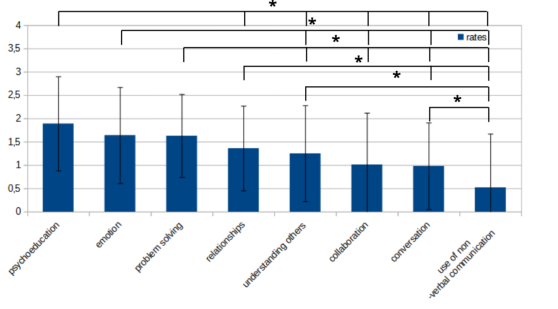
A one-factor repeated measures ANOVA with a Greenhouse-Geisser correction was conducted to examine the effect of item category on participants’ rating. There was a significant difference in rating of at least 2 categories (F(3.99, 31) = [43.9], p < 0.001, n²p = 0,428). Post hoc Turkey- adjusted tests showed that psychoeducation was rated significantly higher than conversation (t(31) = 6.388, p-Turkey < 0.001, Cohen’s d = 1.13), use of non-verbal communication (t(31) = 7.022, p-Turkey < 0.001, Cohen’s d = 1.24), relationships (t(31) = 4.162, p-Turkey = 0.005, Cohen’s d = 0.736), collaboration (t(31) = 5.696, p-Turkey < 0.001, Cohen’s d = 1.01) and understanding others (t(31) = 5.064, p-Turkey < 0.001, Cohen’s d = 0.895). Ratings for to the category emotions are significantly greater than those of use of non-verbal communication (t(31) = 6.788, p-Turkey < 0.001, Cohen’s d = 1.2), conversation (t(31) = 5.479, p-Turkey < 0.001, Cohen’s d = 0.969), collaboration (t(31) = 4.211, p-Turkey = 0.004, Cohen’s d = 0.744), and understanding others (t(31) = 3.492, p-Turkey = 0.028, Cohen’s d = 0.617). Interpersonal problem solving ratings are significantly greater than those for use of non-verbal communication (t(31) = 6.446, p-Turkey < 0.001, Cohen’s d = 1.14), conversation (t(31) = 6.336, p-Turkey < 0.001, Cohen’s d = 1.12), collaboration (t(31) = 4.493, p-Turkey = 0.002, Cohen’s d = 0.794) and understanding others (t(31) = 3.360, p-Turkey = 0.038, Cohen’s d = 0.594) ratings. Use of non-verbal communication ratings are significantly lower than all others categories ratings except collaboration (conversation: t(31) = –3.532, p-Turkey = 0.025, Cohen’s d = −0.624; relationships: t(31) = –5.554, Cohen’s d = –0.982, p-Turkey < 0.001; understanding others: t(31) = –6.193, p-Turkey < 0.001, Cohen’s d = –1.09). Finally, the conversation category was rated lower than the relationships category (t(31) = –3.446, p-Turkey = 0.031, Cohen’s d = –0.609). Figure 1 shows these results, and Table 3 presents the five best-rated modules.
Figure 1: Mean module ratings by category among autistic individuals. * = p-Turkey < 0.05.Table 3: List of the five best rated modules.
Table available in the original PDF paper.
Module Mean Rates (SD) Saying no, refusing, setting boundaries 2.28 (± 0.95) 2.06 (± 1.16)
Learning about autism, knowing one’s strengths, abilities, and difficulties Handling teasing and bullying 1.96 (± 1.37) Expressing one’s need and wishes 1.93 (± 1.1)
Stage 4: Development of the Final Intervention The results of stages (1), (2), and (3) were taken into account to design the new version of the Rob’Tales program. This program is composed of 14 sessions of 1h30 each. The new structure of this program is (1) Review part (15 minutes), (2) Play time with NAO (15 minutes), (3) Recreation (20 minutes), (4) Lesson, where a new skill was presented thanks to explicit learning strategies (15 minutes), (5) Exercises where the NAO robot tells short stories to the participant, and asks questions in relation to the skill trained during the lesson (25 minutes). Regarding the curriculum, the new Rob’Tales program focus on psychoeducation, emotion, and interpersonal problem solving. A description of each session structure and content is presented in Table 4.
DISCUSSION
This study aimed to develop Rob’Tales, a RAT targeting social and emotional skills in autistic adolescents By combining didactic techniques from EBP identified in the literature, results from a feasibility study, and preferences expressed by autistic individuals, the study aimed to develop a methodology based on pre-existing evidence, compatible with real-world constraints, and aligned with stakeholders’ expectations.
Difficulties related to emotional and social skills have been associated with educational, social, and mental health outcomes (Durlak et al., 2011; Žic Ralić, Bubalo Vrankić Pavon, 2025). Developing interventions targeting these skills may therefore contribute to supporting the mental health and well-being of autistic adolescents. The use of RAT may further support engagement. Previous studies have suggested that robots may facilitate participation and increase autistic people motivation (Dubois-Sage et al., 2024).
Several limitations should nevertheless be acknowledged. First, the different stages of intervention development involved relatively small samples, which may limit the generalization of the findings. Second, the present study focused on intervention development rather than effectiveness. No conclusions can be drawn regarding the impact of the intervention on social-emotional outcomes. Thirdly, the results from the feasibility study rely on feedback from two members of the research team: those results are subjective, and could be biased. Finally, Rob’Tales was designed for adolescents, but mostly adults answered in the Stage 3 of the study. Adults’ perspective is still an interesting
Development of the Rob’Tales Methodology to Teach Emotional and Social Skills 415 feedback, as they may have tested SST, and toffer retrospective insight into their experience. Future research should evaluate the effectiveness of the final intervention protocol using larger samples and psychological testing related to well-being and social-emotional skills. In addition, autistic people opinions were collected only on the third stage of the study: the final program should be presented to stakeholders, to assure that it actually fits their needs and expectations. Finally, although the intervention was developed specifically for autistic adolescents, difficulties regarding emotional awareness, emotion regulation, and more broadly social skills are not unique to autism. Future studies may therefore investigate whether Rob’Tales could be proposed to adolescents presenting social-emotional difficulties in general, with or without a diagnosis.
This study describes the development of a RAT targeting social-emotional skills in autistic adolescents through integrating techniques from EBP, findings from a feasibility study, and stakeholder perspectives. The resulting intervention, Rob’Tales, should be tested in educational and medical settings.
Table 4: Description of the new version of the Rob’Tales methodology.
Table available in the original PDF paper.
Exercise With NAO
Reminders Game With NAO Theme of the Lesson
1 Presentation of the program
Participants make NAO say something one at a time
Knowing one’s strengths and difficulties
Participants have to guess what NAO likes, dislikes, finds easy, and find difficult within a restricted list of activities by asking yes-no questions.
2 Review of the previous week
Defining emotions and their goals
One at a time, participant make NAO mime an sport movement from a list, others have to guess the sport.
NAO tells the story of someone feeling different emotion. Participants have to guess the emotion, and determine if they find it pleasurable or not.
3 Review of the previous week
Link between emotions and situations
Participants make NAO say something one at a time, and demonstration of a danse on the robot.
Participants choose an emotion, and are asked to construct on object that can induce this emotion. They show their production to NAO which react by miming the expected emotion.
4 Review of the previous week
Link between body sensations and needs
One at a time, participant make NAO mime an animal movement from a list, others have to guess the animal.
NAO mimes some yoga posture, and participants should imitate it. Participants are encouraged to be mindful of their body sensations.
(Continued)
Table 4: Continued.
Table available in the original PDF paper.
Exercise With NAO
Reminders Game With NAO Theme of the Lesson
5 Review of the previous week
Link between body sensations and emotions.
Exquisite corpse game: participant chose one at a time a word, and secretly program it on NAO. NAO say the final sentence.
NAO describes some sensations, and participants should determine which emotion is the most likely associated with those sensations.
6 Review of the previous week
Link between thoughts and emotions
Rebus game: each participant secretly look at an image, and program NAO to say the word seen. We listen to the result: if they are correct, it forms a word.
Each participant draw an emotion, and a situation. Then they find a thought that would link them. NAO is programmed to say their sentences, and other participants are asked to guess the emotion.
7 Reminders the 6 first sessions
Participants have to complete 4 trials in which (1) NAO mime some emotions, (2) NAO describe some situations (3) NAO says a situations and a through (4) NAO describe some body sensation. For each trial, they have to guess which emotion is the most likely represented. After each trial, a part of a robot made out of paper is given to them, and they can build it.
Follow up of the previous session
Exercise of the flower and the candle with NAO.
8 Review of the previous week
Introduction to emotion regulation concept
9 Review of the previous week
Participants make NAO say something one at a time
Adaptative and maladapta- -tive emotion regulation strategies
NAO tell some stories about someone living some emotions, and using different emotional strategies to handle them. Participants have to identify which strategy is used, and if it is an adaptative strategy or not.
10 Review of the previous week
Use of emotional regulation strategies
NAO tells the story of someone living emotions, and the participant have to guide them step by step to regulate their emotions.
One at a time, participant make NAO mime an animal movement from a list, others have to guess the animal.
11 Review of the previous week
Rebus game Expressing one’s needs, wants, and feelings
NAO tells the story of someone having trouble expressing its wants, needs, and feelings. Participants have to identify how they could express it.
(Continued)
Table 4: Continued.
Table available in the original PDF paper.
Exercise With NAO
Reminders Game With NAO Theme of the Lesson
12 Review of the previous week
Saying no, refusing, setting boundaries
Participants control NAO one at a time to play a “Simon says” game with a set of pre-programmed movements options.
NAO tells the story of someone encountering situations of boundaries settings, and boundaries violation. Participants should identify those situations, and find ways to expression their boundaries.
NAO tells the story of people disagreeing, making mistakes, and misunderstanding each other. Participants should identify those situations.
Handling joking, teasing, bullying
14 Review of the previous week
Participants control NAO one at a time to play a “Simon says” game with a set of pre-programmed movements options.
NAO tells the story of someone encountering situations of friendly joking, teasing, and bullying. The goal is not to tell the participant how they should act in those situations, but how to handle it emotionally, and how to enforce their limits.
15 Review of what was seen since
Final celebration : participants are awarded by a diploma.
session 10
ACKNOWLEDGMENT
Margot Dumas is funded by ERM Automatismes, a NAO robot distributor.
REFERENCES
Andrews, J.L., Ahmed, S.P. Blakemore, S.-J. (2021) “Navigating the Social Environment in Adolescence: The Role of Social Brain Development”, Biological Psychiatry, 89(2), pp. 109–118. Available on: https://doi.org/10.1016/j. biopsych.2020.09.012. Cabibihan, J.-J. et al. (2013) “Why Robots? A Survey on the Roles and Benefits of
Social Robots in the Therapy of Children with Autism”, International Journal of Social Robotics, 5(4), pp. 593–618. Available on: https://doi.org/10.1007/s12369- 013-0202-2. Dubois-Sage, M. et al. (2024) “People with Autism Spectrum Disorder Could Interact More Easily with a Robot than with a Human: Reasons and Limits”, Behavioral Sciences, 14(2), p. 131. Available on: https://doi.org/10.3390/bs14020131.
Dumas, M., Meyer, E. and Sakka, S. (in press) “Development of the Rob’Tales methodology to teach emotional skills to autistic adolescents enrolled in medical and educational establishments: Theoretical development and feasibility study”. Proceedings of the IEEE International Conference on Development and Learning (ICDL). Durlak, J.A. et al. (2011) “The Impact of Enhancing Students’ Social and Emotional
Learning: A Meta-Analysis of School-Based Universal Interventions”, Child Development, 82(1), pp. 405–432. Available on: https://doi.org/10.1111/j.1467- 8624.2010.01564.x. Graf-Kurtulus, S. Gelo, O.C.G. (2025) “Rethinking psychological interventions in autism: Toward a neurodiversity-affirming approach”, Counselling and Psychotherapy Research, 25(1), p. e12874. Available on: https://doi.org/10.1002/ capr.12874. Huggins, C.F. et al. (2020) “Emotional self-awareness in autism: A meta-analysis of
group differences and developmental effects”, Autism [Preprint]. Available on: https://doi.org/10.1177/1362361320964306. Hull, L. et al. (2021) “Is social camouflaging associated with anxiety and depression in autistic adults?”, Molecular Autism, 12(1), p. 13. Available on: https://doi. org/10.1186/s13229-021-00421-1. Hull, L. et al. (2025) “Just Ask What Support We Need”: Autistic Adults’ Feedback
on Social Skills Training, Autism in Adulthood, 7(3), pp. 283–292. Available on: https://doi.org/10.1089/aut.2023.0136. Kiliç Tülü, B., Özbek, A.B. Girli, A. (2026) “A Comparative Study of Self-Efficacy, Loneliness, and Well-Being in Adolescents Diagnosed With Autism Spectrum Disorder and Specific Learning Disorder”, Journal of Autism and Developmental Disorders [Preprint]. Available on: https://doi.org/10.1007/s10803-026-07247-x. Lord, C. et al. (2018) “Autism spectrum disorder”, Lancet (London, England),
392(10146), pp. 508–520. Available on: https://doi.org/10.1016/S0140- 6736(18)31129-2. Milosavljevic, B. et al. (2016) “Alexithymia in Adolescents with Autism Spectrum Disorder: Its Relationship to Internalising Difficulties, Sensory Modulation and Social Cognition”, Journal of Autism and Developmental Disorders, 46(4), pp. 1354–1367. Available on: https://doi.org/10.1007/s10803-015-2670-8. Restoy, D. et al. (2024) “Emotion regulation and emotion dysregulation in children
and adolescents with Autism Spectrum Disorder: A meta-analysis of evaluation and intervention studies”, Clinical Psychology Review, 109, p. 102410. Available on: https://doi.org/10.1016/j.cpr.2024.102410. Santos, L. et al. (2025) “Applications of Robotics for Autism Spectrum Disorder: A Scoping Review”, Review Journal of Autism and Developmental Disorders, 12(3), pp. 455–476. Available on: https://doi.org/10.1007/s40489-023-00402-5. Steinbrenner, J.R. et al. (2020) Evidence-Based Practices for Children, Youth, and
Young Adults with Autism. FPG Child Development Institute. Disponible sur: https://eric.ed.gov/?id = ED609029 (Consulté le: 19 novembre 2024). Zhong, W. et al. (2025) “The Role of Social Robot in Enhancing Social–Emotional Skill Development in Children With Autism: A Three-Level Meta-Analysis”, Journal of Computer Assisted Learning, 41(6), p. e70154. Available on: https:// doi.org/10.1111/jcal.70154. Žic Ralić, A., Bubalo, S. Vrankić Pavon, M. (2025) “Social and Emotional
Competencies of Children with Autism Spectrum Disorder and/or Intellectual Disability”, Journal of Autism and Developmental Disorders [Preprint]. Available on: https://doi.org/10.1007/s10803-025-06864-2.
SEARCH THE AHFE DIGITAL BOOKSTORE BY ISBN
Explore the complete digital volume
Human Interaction and Emerging Technologies (IHIET 2026)
Read this individual research paper free through the original publisher, or explore the full digital proceedings book.